HackerNews AI - 2026-06-12
1. What People Are Talking About
June 12 was still an agent-heavy Hacker News AI day, but it felt less like a model-trust referendum and more like an operator day. The feed carried 88 AI stories, and the top three combined for 230 points and 82 comments. Compared with June 11's anger about hidden model behavior, June 12 centered on how to run agents locally, how to wrap them with explicit control layers, and how to turn AI work into durable apps or analytics instead of ephemeral chat.
1.1 Local and private coding-agent setups became practical enough to attract mainstream HN attention (🡕)
The biggest story by far was a practical one: how to run a usable coding agent locally on consumer Apple hardware. That pulled in adjacent threads about workstation sizing, OS-level isolation, and lower-cost local alternatives. The common thread was not anti-cloud ideology. It was a desire for control over speed, secrets, and spend.
kkm posted How to setup a local coding agent on macOS (165 points, 55 comments). The linked guide documented a full local stack of llama.cpp with Metal, Gemma 4 26B-A4B GGUF, a Q8 MTP draft model, and Pi as the harness, with the author reporting 72.2 tokens per second on an M1 Max plus screenshot support through mmproj. In the thread, Aurornis (score 0) argued that the benchmark was too short to prove the MTP gain cleanly, c-hendricks (score 0) pointed out that llama.cpp can download the models directly with -hf, and mark_l_watson (score 0) said they were already doing real local work with a Pi wrapper despite the latency.
pjungwir posted My Claude Code Setup (10 points, 0 comments). The linked post described a different local-control pattern: keep permissive agent mode, but run Claude under a separate Unix account with its own SSH key, database users, and no access to the human user's secrets. That is not a benchmark story. It is a sign that users are operationalizing coding agents the way they would onboard a semi-trusted coworker.
willsmith72 posted Ask HN: What computer are you using for AI coding tools? (1 point, 4 comments) after saying that 5-10 Claude Code sessions, each with 1-3 subagents plus Chrome and Playwright, were overwhelming an 18 GB M3 Pro. The replies made the hardware tradeoffs explicit: inventor7777 (score 0) recommended a 48 GB M4 Max Mac Studio, while dlcarrier (score 0) described using an Intel A770 mainly to secure 16 GB of VRAM cheaply for local AI work.
Discussion insight: The interesting nuance was that commenters were benchmarking the harness, not just the model. They cared about download flows, token throughput, image support, OS isolation, and how many simultaneous sessions a machine could sustain.
Comparison to prior day: June 11's local-private signal was mostly about air-gapped Claude Code and privacy tradeoffs. June 12 broadened that into mainstream setup guides, hardware-sizing questions, and lower-cost local-first alternatives such as MandoCode (2 points, 0 comments) and 3code (2 points, 1 comment).
1.2 Harness engineering became the day's main answer to agent risk (🡕)
The second cluster treated the agent as something that must be fenced, reviewed, and budgeted like any other executable system. Low-score builder posts still converged on the same need: local scanners, command-review plugins, deterministic permission rules, and better models of what the agent is actually doing. That made this theme more important than its raw scores suggest.
Prajwal_Hage posted Guardian Runtime – Local firewall for AI coding agents and runaway costs (6 points, 0 comments). The linked PyPI page and README position it as a local-first proxy and SDK that intercepts prompts and responses before they reach the provider, scans for secrets and PII, enforces spend budgets, and adds a terse mode to cut token usage. A same-day duplicate post for the repo, Guardian Runtime – Track AI agents token usage and enforce API budgets (5 points, 0 comments), reinforced that users see cost control and leak prevention as part of the same product surface.
vinzenzu posted Auto mode for pi.dev. An LLM reviews your coding agent's commands (1 point, 2 comments). The linked README divides commands into auto-permitted, auto-blocked, and reviewer-LLM tiers, and blocks the review-required tier by default in non-interactive mode. In the HN thread, vinzenzu (score 0) said the plugin existed specifically because pi.dev and OpenCode lacked the auto-review surface users already expected from Codex and Claude Code.
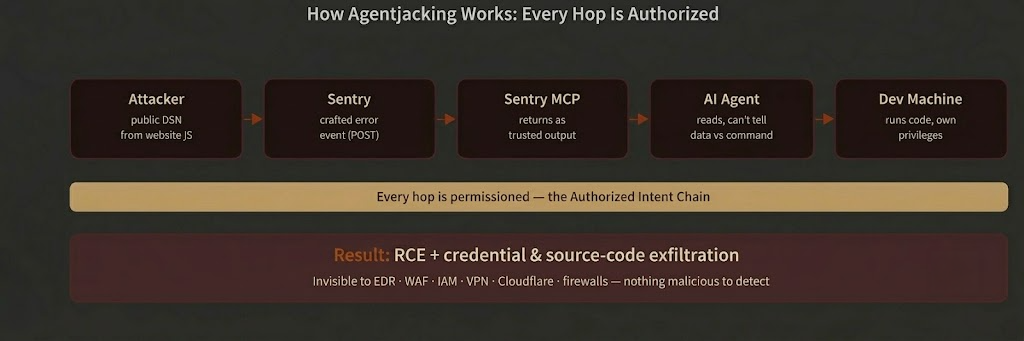
patrickdavey posted A Fake Bug Report Hijacks Your AI Coding Agent – and Nothing Catches It (3 points, 0 comments). The linked Tenet Security report argued that a forged Sentry event can pass through Sentry MCP as trusted output and steer an agent into running attacker-controlled code, and said the team found 2,388 organizations with injectable DSNs and saw 100+ agents act on the injected errors in controlled testing. gdss posted The 98% Problem: A Survey of Harness Engineering for AI Agents (4 points, 0 comments), whose linked survey argued that the quality and safety of production agents live mostly in the harness: context, permissions, tools, sandboxing, observability, and recovery.
Discussion insight: What changed from earlier safety debates is where people want the fix. The appetite here was not for gentler prompting. It was for deterministic gates, local interception, append-only traces, and reviewer loops outside the model.
Comparison to prior day: June 11 focused on hidden vendor guardrails and silent intervention. June 12 showed users building their own visible guardrails around the agent runtime itself.
1.3 AI-native workspaces kept moving from chat toward durable outputs and shared context (🡕)
The third cluster was about getting AI work out of the chat box. Builders kept shipping products where the output is a dashboard, an app, a persistent context layer, or a queryable catalogue that both humans and agents can reuse. The repeated complaint was that current AI work disappears too easily and is too hard to share or verify.
datafreak_ posted Show HN: StackScope – I crawled over 40k indie launches to see what they ship (36 points, 12 comments). The selftext said StackScope watches Product Hunt, Show HN, and PeerPush launches, then crawls the public sites to infer hosting, frameworks, analytics, DNS, security headers, legal pages, and AI-builder signals using .NET, Playwright, and a first-party fingerprint catalogue. The feedback was practical rather than dismissive: jrhizor (score 0) asked for trend views like vibe score over time, while pixel_popping (score 0) said the live site had broken assets in Firefox and Chromium.
arcb posted Launch HN: BitBoard (YC P25) – Analytics Workspace for Agents (29 points, 15 comments). The selftext said AI analysis is still ephemeral and hard to collaborate around, so BitBoard adds shared dashboards, canonical metrics, provenance, repeatable answers, and traces for long-running agent work on top of DuckDB and Apache Arrow. In the thread, rancar2 (score 0) said the pivot matched what they were already doing across multiple healthcare companies, while mritchie712 (score 0) said the same problem had pushed their team from a semantic layer toward a fuller ontology of company terms and metrics.
grouchy posted Show HN: Deploy personal apps with your agent via Buildy (4 points, 0 comments). The selftext and Buildy guide pitch a live URL as the cheapest mockup: an agent can ship a workerd-plus-KV app over HTTP or MCP first, then iterate. jthorare posted Show HN: Setup your Company Brain in minutes (1 point, 2 comments), proposing a centralized vector database for cross-app company context, but hillj23 (score 0) said the idea lives or dies on self-hosting because security-conscious teams will not centralize their full internal context in a third-party SaaS.
Discussion insight: The demand was for durable context and reusable artifacts, not just smarter chat replies. The biggest objection was not product usefulness but data custody: if the agent needs everyone's context, who stores it and who can inspect it?
Comparison to prior day: June 11's builders focused on sharing agent outputs and monitoring agent sessions. June 12 extended the same instinct into analytics workspaces, launch intelligence, and personal software deployment.
2. What Frustrates People
Useful local agent setups still require too much manual tuning and hardware headroom
How to setup a local coding agent on macOS (165 points, 55 comments) shows how high the bar still is even for an enthusiast success story: compile llama.cpp, download multiple model artifacts, tune speculative decoding, wire multimodal support, expose an OpenAI-compatible endpoint, and then configure the harness. The HN comments sharpened the frustration rather than dismissing it. Aurornis (score 0) said the benchmark was too short to prove the speedup properly, and c-hendricks (score 0) pointed out easier model-download paths the guide omitted. My Claude Code Setup (10 points, 0 comments) adds a different kind of cost: a separate Unix user, separate credentials, and extra local ops just to feel safe enough using permissive mode. Ask HN: What computer are you using for AI coding tools? (1 point, 4 comments) showed the hardware consequence, with heavy users jumping toward 48 GB Macs or dedicated VRAM cards. Severity: High. People cope by writing wrappers, accepting slower local models, or buying more RAM and GPU headroom. Worth building for: yes, directly.
Default trust boundaries around agents are still too weak
A Fake Bug Report Hijacks Your AI Coding Agent – and Nothing Catches It (3 points, 0 comments) makes the failure mode explicit. The linked Tenet report says a forged Sentry event can be returned through MCP as trusted output and steer an agent into running attacker-controlled code. Guardian Runtime – Local firewall for AI coding agents and runaway costs (6 points, 0 comments) and Auto mode for pi.dev. An LLM reviews your coding agent's commands (1 point, 2 comments) exist because users do not trust default agent behavior to distinguish safe from unsafe prompts or commands. The 98% Problem: A Survey of Harness Engineering for AI Agents (4 points, 0 comments) adds the meta-frustration: permissions, tool design, and sandboxing are safety surfaces, but most teams are still assembling them ad hoc. Severity: High. People cope by proxying traffic locally, adding deterministic allow and block lists, or isolating the agent under a separate OS account. Worth building for: yes, directly.
AI analysis and memory products still make people choose between durability and data custody
Launch HN: BitBoard (YC P25) – Analytics Workspace for Agents (29 points, 15 comments) argued that current AI analysis is too ephemeral to report on or collaborate around, and its comments described how much effort still goes into stitching together ETL, warehouses, semantic layers, and business context. Show HN: Setup your Company Brain in minutes (1 point, 2 comments) showed the other side of the tradeoff: hillj23 (score 0) said third-party context layers are hard to adopt because security-conscious teams would rather build in-house than centralize sensitive company state elsewhere. Show HN: StackScope – I crawled over 40k indie launches to see what they ship (36 points, 12 comments) surfaced a smaller operational version of the same problem, with users immediately asking for trend views and broader categorization while also reporting live-site asset failures. Severity: Medium. People cope by building internal ontologies, narrower local-state tools, or manual dashboards. Worth building for: yes, competitively.
Solo AI-product builders still hit legal ambiguity they cannot cheaply resolve
Ask HN: I Need Help for a Product (7 points, 3 comments) is the clearest example. The founder had a polished AI dramatization pipeline but could not tell whether user-supplied copyrighted content, cached outputs, and moderation liability were legally workable. The strongest reply from dieselgate (score 0) said plainly that LLMs are not lawyers and that the right answer is to pay for real counsel. Severity: Medium. People cope by paying a lawyer, consulting informal communities, or not launching. Worth building for: yes, but the credibility requirements are high.
3. What People Wish Existed
A local or private coding agent that works out of the box
How to setup a local coding agent on macOS, Ask HN: What computer are you using for AI coding tools?, Show HN: MandoCode – local-first AI coding agent (.NET and Ollama), and 3code, the Economical Coding Agent all point at the same need: people want privacy, flat-cost operation, and agent ergonomics without a multi-step local-systems project. The need is practical and urgent because users are already trading off speed, RAM, VRAM, isolation, and provider choice just to keep working. Partial substitutes exist in cloud agents, Ollama-based tools, and DIY harnesses, but the unmet need is a stack that is fast, local, interoperable, and boring to operate. Opportunity: direct.
A first-class approval, budget, and provenance layer for agent actions
Guardian Runtime – Local firewall for AI coding agents and runaway costs, Auto mode for pi.dev. An LLM reviews your coding agent's commands, A Fake Bug Report Hijacks Your AI Coding Agent – and Nothing Catches It, and The 98% Problem: A Survey of Harness Engineering for AI Agents read like requests for the same missing layer. People do not only want better outputs. They want an agent runtime that can explain why it acted, what it sent, what it cost, and why a risky command was allowed. The need is highly practical and already urgent because the security and spend failure modes are immediate. Opportunity: direct.
AI analytics surfaces that preserve context and collaboration instead of resetting each chat
Launch HN: BitBoard (YC P25) – Analytics Workspace for Agents and Show HN: StackScope – I crawled over 40k indie launches to see what they ship both came from teams that found today's AI interfaces too transient. BitBoard wants dashboards, provenance, and repeatable answers. StackScope wants a persistent catalogue of what people actually ship, plus trends over time. The need is practical, and there are partial substitutes in BI tools and artifact surfaces, but the repeated complaint was that neither is designed around agents sharing durable analytical state with humans. Opportunity: direct.
Self-hostable company memory with grounded cross-app retrieval
Show HN: Setup your Company Brain in minutes was effectively asking for a shared context plane that agents can trust across meetings, tickets, repositories, and app data. The comments made the missing requirement just as clear as the product pitch: security-conscious teams want self-hosting, citations, and strong data-custody guarantees before they centralize company context anywhere. The need is practical and increasingly urgent for teams using many agents, but it is already competitive because sophisticated adopters are building internal versions first. Opportunity: competitive.
Affordable expert guidance for AI copyright and product compliance
Ask HN: I Need Help for a Product showed a founder who had already built the product and operations stack, but was stalled by uncertainty over copyright, caching, moderation, and liability. The replies were telling: the community did not have a lightweight product answer, only "get a lawyer." The need is practical and acute for solo builders, but anything that addresses it credibly has to earn trust well beyond ordinary prompt engineering. Opportunity: aspirational.
4. Tools and Methods in Use
| Tool | Category | Sentiment | Strengths | Limitations |
|---|---|---|---|---|
| Claude Code | Coding agent | (+/-) | Big daily-use reference point with a hook and statusline ecosystem, and enough capability that users run many parallel sessions | Users still isolate it with separate OS accounts, extra hardware, and third-party safety and cost tooling |
| Pi / pi.dev | Coding agent harness | (+/-) | Works with local OpenAI-compatible servers and supports extensions like auto-review | Needs add-ons to reach safer command-review behavior, and local-model speed and quality still vary |
| Local Gemma 4 + llama.cpp + MTP | Local model stack | (+) | Reported 72.2 tok/s on an M1 Max, multimodal support, an OpenAI-compatible endpoint, and no cloud dependence | Requires manual model and runtime tuning, and the gains are hardware-specific |
| Guardian Runtime | Security / FinOps | (+) | Local secret and PII scanning, budget caps, terse mode, and proxy or SDK integration | Adds another routing layer and still has light community signal |
| 3code | Economical coding agent | (+) | Lean binary, aggressive token caching, loop guard, and support for free or open-weight providers | Early ecosystem and limited proof of adoption compared with Claude Code or Codex |
| MandoCode | Local-first coding agent | (+) | No API keys, Ollama or local models, MCP and Skills support, and a .NET-friendly stack | Early-stage and still inherits local-model latency and quality tradeoffs |
| BitBoard | Analytics workspace | (+/-) | Provenance, repeatable answers, shared dashboards, and traces for humans plus agents | Early product competing with artifact and chat surfaces as well as existing BI stacks |
| Harness engineering | Method | (+) | Gives concrete patterns for context, permissions, sandboxing, evaluations, and observability | Adds substantial engineering overhead and is still less benchmarked than the models themselves |
Overall sentiment was most positive when a tool reduced cost or exposed control surfaces, and most skeptical when an agent assumed unsafe defaults or hid its resource use. The common workaround was layering: a primary coding agent plus a separate OS user, local proxy, reviewer subagent, or lightweight analytics surface.
The migration pattern was lateral rather than winner-take-all. Claude Code remained the reference point, but users paired it with Pi, local Gemma stacks, MandoCode, or 3code depending on whether privacy, price, or extensibility mattered most.
Competitive dynamics are moving outward from the model itself toward the harness. Budget enforcement, context management, permissions, and durable shareable outputs now look more differentiating than a small raw model gain.
5. What People Are Building
| Project | Who built it | What it does | Problem it solves | Stack | Stage | Links |
|---|---|---|---|---|---|---|
| StackScope | datafreak_ | Crawls public launches and infers the stack behind them | Shows what indie builders actually ship instead of broad web averages | .NET, Playwright, fingerprint catalogue | Shipped | post, site |
| BitBoard | arcb | Shared analytics workspace where humans and agents co-author dashboards and data assets | Makes AI analysis durable, collaborative, and verifiable | DuckDB, Apache Arrow, agent containers, traces | Beta | post, site |
| Guardian Runtime | ashp15205 | Local firewall, proxy, and SDK for prompt security and token budgets | Blocks secrets, PII, and runaway spend before data leaves the machine | Python, local scanners, proxy/SDK, policy engine | Shipped | post, repo, PyPI |
| Claudinho | arturogarrido | Puts live football scores into the terminal, Claude Code statusline, and MCP clients | Shows how quickly agents can be extended with useful personal utilities | Node.js CLI, MCP server, local cache | Shipped | post, repo |
| Buildy | grouchy | Lets agents deploy persistent personal web apps and expose them over HTTP/MCP | Removes repeated auth, database, and API scaffolding for personal software | workerd isolates, persistent KV, HTTP, MCP | Shipped | post, site |
| MandoCode | devmando | Local-first CLI coding agent for Ollama models | Gives .NET users an open-source local agent with no API keys | .NET, Ollama, MCP, Skills | Alpha | post, repo |
| pi-auto-reviewer | vinzenzu | Reviews suspicious pi.dev bash commands with a subagent before execution | Adds an approval layer where the base agent lacks auto-review | TypeScript extension, reviewer LLM, rule tiers | Alpha | post, repo |
| 3code | rainmaking | Cost-focused coding agent tuned for free or cheap providers | Keeps coding-agent workflows usable after paid quotas run out | Nim, token caching, loop guard, session logs | Beta | post, site |
BitBoard and StackScope both treat AI as an interface over durable business or product state rather than as a chatbot. BitBoard is deeper on collaboration and verifiability, while StackScope is narrower but already useful as launch telemetry and stack intelligence.
Buildy, Claudinho, MandoCode, and 3code show a complementary pattern: shrinking the distance between idea and working personal tool or local agent, often without requiring API keys or a hosted backend. The underlying bet is that agents become more valuable when they can leave behind something reusable - a URL, a CLI, an MCP surface, or a persistent session log.
Guardian Runtime and pi-auto-reviewer represent the governance side of the same ecosystem. Their existence, plus the same-day duplicate Guardian Runtime submissions, suggests that review, policy enforcement, and spend control are turning into standalone products rather than optional add-ons.
6. New and Notable
Agentjacking turned MCP-connected observability tools into an explicit security story
A Fake Bug Report Hijacks Your AI Coding Agent – and Nothing Catches It (3 points, 0 comments) mattered because it translated a fuzzy agent-security fear into a specific path: public DSN, injected Sentry event, trusted MCP output, then code execution on the developer's machine. Even with light HN engagement, the linked Tenet report was a concrete reminder that the agent, not just the model or the package ecosystem, is now an attack surface.
Local and open-weight coding stacks crossed from tinkering into reproducible playbooks
How to setup a local coding agent on macOS (165 points, 55 comments), My Claude Code Setup (10 points, 0 comments), Show HN: MandoCode – local-first AI coding agent (.NET and Ollama) (2 points, 0 comments), and 3code, the Economical Coding Agent (2 points, 1 comment) all treated local or lower-cost agent operation as something people can set up today, not a future aspiration. That is notable because it shifts the conversation from "someday local models will matter" to practical questions about throughput, RAM, isolation, and user experience.
AI-native analytics became a clearer product category
Launch HN: BitBoard (YC P25) – Analytics Workspace for Agents (29 points, 15 comments) and Show HN: StackScope – I crawled over 40k indie launches to see what they ship (36 points, 12 comments) are different products, but they share the same premise: AI work should end in durable analytical surfaces that people can inspect and reuse. That matters because it points beyond chat toward a real software category.
Personal software deployment via agents is getting productized
Show HN: Deploy personal apps with your agent via Buildy (4 points, 0 comments) and Show HN: A Claude Code statusline that shows live World Cup scores (6 points, 0 comments) show the same idea at different scales: let agents ship something a human can immediately use, share, or remix. The notable shift is that the agent is no longer just a code generator; it is becoming part of the runtime and distribution story.
7. Where the Opportunities Are
[+++] Local-first agent operations — How to setup a local coding agent on macOS, My Claude Code Setup, Ask HN: What computer are you using for AI coding tools?, MandoCode, and 3code all point at the same cluster of pain: setup complexity, hardware sizing, privacy, and cost. This is strong because the need is broad, concrete, and already generating multiple independent products.
[+++] Runtime security and approval layers for agent tools — A Fake Bug Report Hijacks Your AI Coding Agent – and Nothing Catches It, Guardian Runtime, pi-auto-reviewer, and The 98% Problem all say the same thing in different forms: the agent needs explicit gates around what it can read, send, and execute. This is strong because the failure modes are severe and the market still looks highly fragmented.
[++] Durable analytics and reporting surfaces for agent work — BitBoard and StackScope show demand for analytical outputs that persist beyond a single chat. The opportunity is moderate because the need is real, but incumbents in BI plus native artifact surfaces from model vendors will compete hard.
[++] Self-hostable company context planes — Setup your Company Brain in minutes and the BitBoard discussion both point to the same gap: agents need cross-app business context, but many teams do not want that context centralized in a third-party service. The opportunity is moderate because the pain is obvious, but the most sophisticated buyers may default to building internally.
[+] AI-product legal and compliance triage — Ask HN: I Need Help for a Product shows that some builders are blocked less by engineering than by uncertainty over copyright, moderation, caching, and liability. The signal is emerging because the pain is acute but productizing trustworthy help here is much harder than shipping another agent wrapper.
8. Takeaways
- June 12 was about operating agents, not admiring them. The highest-signal stories were install guides, hardware sizing, control layers, and durable analytical surfaces rather than frontier-model theater. (source) (165 points, 55 comments)
- Local and private coding-agent demand is now a mainstream workflow problem. Users are willing to accept setup overhead, OS isolation, and slower local models if they gain control over secrets, cost, and availability. (source) (10 points, 0 comments)
- The harness is emerging as the real product surface. Runtime review layers, secret scanning, budgets, and defenses against trusted-tool output mattered more than small model deltas on this date. (source) (4 points, 0 comments)
- AI analytics looks increasingly like its own category. BitBoard and StackScope both assume that the output of AI work should be inspectable, shareable, and persistent rather than stranded inside a chat session. (source) (29 points, 15 comments)
- Agents are starting to ship end-user-facing software, not just code edits. Buildy and adjacent personal-tool launches show growing interest in agents that can publish URLs, hooks, and MCP surfaces humans can use directly. (source) (4 points, 0 comments)
- Legal ambiguity is still a real launch blocker for AI products. At least one founder on HN had the product ready but did not feel safe launching without expert counsel on copyright, moderation, and liability. (source) (7 points, 3 comments)