HackerNews AI - 2026-09-18
1. What People Are Talking About
September 18's HackerNews AI feed got smaller but more concentrated. Story count fell to 87 from 106 on September 17, yet total points rose from 768 to 1,169 and comments only slipped from 450 to 432. Bend 2 and the Vibe-Coding Trap (303 points, 227 comments) and ZCode, the GLM coding agent, silently uploads your Git history (257 points, 13 comments) alone captured 47.9% of the day's points and 55.6% of its comments. The day still contained 23 Show HN posts and 46 stories that explicitly mentioned agents, but the strongest evidence clustered around hidden harness behavior, a more mature critique of vibe-coding, safety as boundary design, and builders turning missing context and control into inspectable artifacts.
1.1 Hidden harness behavior and open conventions became the main trust test (🡕)
Five of the strongest items were really about the same question: what exactly does an agent harness do around the model, and how much of that behavior is visible to the user? HN was less interested in claims of raw capability than in whether the surrounding runtime exposed its boundaries honestly.
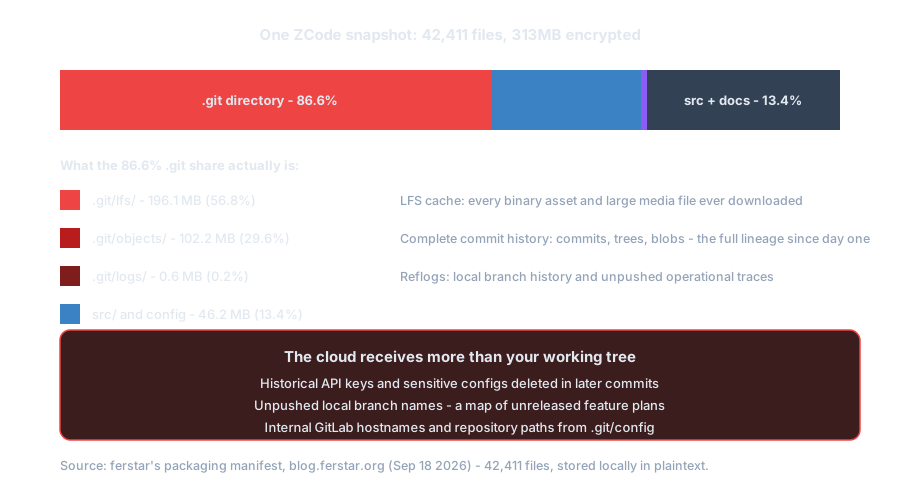
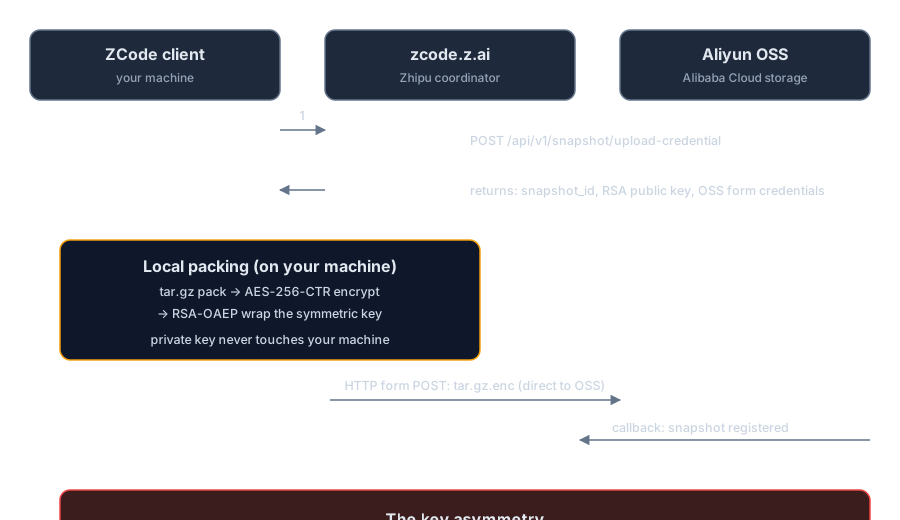
cdnsteve posted ZCode, the GLM coding agent, silently uploads your Git history (257 points, 13 comments). The linked write-up summarizes ferstar's reverse engineering of ZCode's snapshot system: while logged in, the app packages the workspace plus .git history, reflogs, and configs, encrypts the archive with a server-provided public key, and uploads it to Aliyun OSS. The article says .git made up 86.6% of one 313 MB snapshot and that local toggles for experience optimization or snapshot indexing did not stop capture. HN replies mainly argued over terminology rather than over whether a silent full-repo snapshot existed; Aldipower (score 0) objected that the article blurred "git history" and the full repository, but that distinction still left the core complaint intact.
datadrivenangel posted Claude Code now reads AGENTS.md if there is no Claude.md (159 points, 68 comments), and the linked Anthropic changelog confirmed that Claude Code 2.1.277 now reads AGENTS.md when no CLAUDE.md exists, though not yet on Bedrock, Vertex, or Foundry. The HN reaction was supportive but impatient: askonomm (score 0) called it finally standards-compliant, while TomGarden (score 0) called it "the absolute bare minimum" and clutter55561 (score 0) immediately pointed out that .agents/skills still does not get discovered. A second submission, Anthropic finally adds AGENTS.md support to Claude Code (40 points, 7 comments), pushed the same frustration harder: water-drummer (score 0) said filename lock-in itself was crazy.
The trust question extended beyond naming conventions to survivability. HoldOnAMinute posted Ask HN: What happens when Claude Code goes away? (2 points, 15 comments), describing a workflow that now feels like "missing a body part" without Claude Code. Replies split between low switching-cost optimism and strong vendor-dependency anxiety: gtadesktop1 (score 0) argued that building around a closed cloud API means staking a career on someone else's rules, while mattm (score 0) said moving to Codex felt easy. Low-ranked builder responses such as Show HN: Forcefield: A fast, lightweight local-first AI agent harness (3 points, 0 comments) made the alternative explicit: the linked README promises a single-binary runtime with no account, no cloud service, no remote data processing, and no telemetry.
Discussion insight: HN increasingly treats the harness as part of the security model and the portability surface, not as a neutral shell around the model. Silent host-side behavior, hidden upload paths, and proprietary instruction conventions all now read as first-order trust defects.
Comparison to prior day: September 17 focused on portable control planes such as Skillsync, Aclif, and GuardRail. September 18 pulled the same concern closer to first-party behavior: the arguments were not just about moving between agents, but about whether the harness itself is honest about what it reads, uploads, and expects.
1.2 Vibe-coding criticism got more domain-grounded and measurable (🡕)
Two of the day's three biggest stories advanced the same idea from opposite directions: if you want better coding agents, model strength alone is not enough. What matters is whether the builder understands the problem domain and whether the harness gets measured component by component.
LiamPowell posted Bend 2 and the Vibe-Coding Trap (303 points, 227 comments). In the linked essay, he argues that Bend 2's "humans write laws, AI writes implementations and proofs" pitch recreates work formal-verification tooling already handles more directly: the Bend demo needs 58 lines of laws and 442 lines of proof, while his SPARK/GNATprove comparison proves the same property automatically. HN complicated rather than rejected the thesis. z7 (score 0) noted the Bend author has written publicly about formal verification, but thomasahle (score 0) still found the SPARK comparison persuasive because it showed how much manual proof work the Bend path created.
wek posted An empirical study of harness design for coding agents (194 points, 56 comments). The linked paper abstract says the authors fixed the execution loop and varied planning, action space, and context management across 176 matched settings on SWE-Bench Verified and Terminal-Bench 2.1. The main result was not "add more machinery everywhere." Context management mattered most when context windows were tight, staged rule-based elision beat heavier summarization schemes on efficiency, planning shifted from an accuracy scaffold for weaker models to a cost saver for stronger ones, and bash-capable models often did fine with a bash-only interface. HN commenters read this as a useful correction to model-centric narratives: gps372 (score 0) compared harness choices to tires or gearboxes rather than engines, while lieret (score 0) said more complicated harnesses do not consistently beat very small agents.
Discussion insight: The critique of AI coding is becoming more operational. HN is less interested in saying that model-written code merely "looks sloppier" and more interested in whether builders skipped existing research, confused model quality with harness quality, or added complexity that never pays for itself.
Comparison to prior day: September 17 argued that the harness matters almost as much as the model. September 18 pushed that claim farther by pairing a controlled ablation study with a vivid case study of what happens when an AI-assisted build outruns domain understanding.
1.3 Safety arguments narrowed to containment, provenance, and human authority (🡒)
Safety never fully left the HN AI feed, but on September 18 it showed up less as a legitimacy fight and more as a boundary-design question. The strongest items were about what the model should be allowed to touch, how output transformations change behavior, and where human sign-off belongs.
tknaup posted AI containment is a systems engineering problem (5 points, 0 comments). In the linked essay, Tobi Knaup argues that documented incidents look like classic failures of permissions, segmentation, sandboxes, and kill switches—not evidence that models have developed independent intent. The piece keeps returning to ordinary safety tooling such as least privilege, hardware interlocks, and out-of-band controls. That same "boundary, not psychology" frame showed up in The Provenance Tax: How LLM Watermarking Changes AI Agent Behavior (8 points, 1 comment), where the linked Lasso study says SynthID-style watermarking can change tool-call correctness and refusal behavior, especially under prompt injection. A compliance-oriented feature turns out to be part of the operational behavior of the agent.
Lower-ranked safety and policy items reinforced the same shift toward explicit authority boundaries. Gov. Newsom signs executive order targeting AI safety 'before it's too late' (5 points, 5 comments) drew mostly cynical replies about committee theater, suggesting little trust that broad safety branding means much by itself. In contrast, healthworker posted Show HN: Prohibition of Nuclear Launch Automation (3 points, 0 comments) and quoted the FY2025 NDAA language that requires positive human actions in decisions about nuclear employment. That was one of the day's clearest examples of "human in the loop" being expressed as a concrete system boundary instead of a slogan.
Discussion insight: Even when engagement was modest, the most credible safety arguments were the ones that specified a boundary—who holds the key, whether a watermark changes tool calls, whether a launch decision still requires a human action—not the ones that leaned on abstract warnings.
Comparison to prior day: September 17's safety attention centered on legitimacy, culture, and accountability. September 18 was less about who gets to define safety and more about which technical and legal guardrails actually exist.
1.4 Builders kept shipping context-capture and local-control layers instead of fully autonomous agents (🡒)
The Show HN set was smaller than on September 17, but the builder pattern stayed consistent: people kept externalizing context and control into artifacts the user can inspect. Rather than promising a magical general agent, the more credible launches targeted the seams where current agents still lose context or hide too much state.
maddy30445r posted I got tired of taking screenshots and explaining everything to AI agents (4 points, 2 comments). The post describes a Swift app that records cursor motion, sketches, narration, and screenshots, then turns those events into a context bundle that can be dropped into Claude Code, Cursor, or Codex. The live Deiko site compresses the pitch to "Point at it. Say it. Hand it to your agent," and emphasizes local storage plus an on-device workflow after a small free tier. In a more domain-specific direction, aidog posted GrassLobster: AI Agentic Generation of Parametric Geometry Workflows (27 points, 5 comments). The linked project page describes a prototype that connects Rhino and Grasshopper with an external AI agent so the user can describe a structure, answer questions about dimensions and materials, and keep editing the resulting parametric workflow. dllu (score 0) added why the niche works: Rhino already exposes command-line and headless surfaces that make agentic generation tractable.
Other projects attacked the same outer loop from different angles. Show HN: Forcefield: A fast, lightweight local-first AI agent harness (3 points, 0 comments) focused on a no-telemetry local runtime. Show HN: OnPanda – Steer LLMs and agents at the token level (2 points, 0 comments) paired an interactive README with a live app for editing tokens, reasoning, and tool calls directly while comparing harness prompts, skills, and memory. Show HN: An open Add/Search evaluation framework for agent memory (2 points, 0 comments) linked to Agent Memory Leaderboard, which formalizes auth schemes, retry behavior, token budgets, and "no silent truncation" rules for memory systems. Even Show HN: Concat: the open-source CapCut replacement. (4 points, 3 comments) fit the same local-control logic: the linked README promises that video-editing AI features stay on-device instead of behind a closed paywall.
Discussion insight: The most persuasive builder move was to turn fuzzy missing context into something explicit: a screen-and-voice event file, a Grasshopper graph, a local runtime, a token-level editing surface, or a benchmark contract. That is a different ambition from "replace the user"; it is closer to making the user-agent boundary legible.
Comparison to prior day: September 17 centered on persistent workspaces and transcript portability. September 18 widened the same control-plane instinct into GUI capture, CAD workflows, local creator tools, and direct inspection of tokens, prompts, and memory APIs.
2. What Frustrates People
Closed harnesses still hide too much of what they collect and where it goes
ZCode, the GLM coding agent, silently uploads your Git history (257 points, 13 comments) concentrated the sharpest trust complaint of the day: users increasingly assume the runtime around the model may be doing more than the chat interface admits. The linked write-up says ZCode packaged the workspace plus .git history, reflogs, and configs, encrypted the archive with a server-held key path, and kept retrying uploads even after local cleanup attempts. The smaller but thematically related Ask HN: What happens when Claude Code goes away? (2 points, 15 comments) shows the same pain from the dependency side: even without a scandal, people worry that a closed harness can change pricing, policies, or access rules out from under a workflow they now rely on. The coping pattern today was to look for open conventions such as AGENTS.md, local-first runtimes such as Forcefield (3 points, 0 comments), and explicit self-hosted fallbacks. Severity: High. Worth building for: yes, directly.
AI-assisted builds still outrun domain research and harness measurement
Bend 2 and the Vibe-Coding Trap (303 points, 227 comments) turned a broad anti-slop mood into a precise complaint: LLMs make it easy to ship a substantial design before learning that an older, better-articulated field already solved much of the problem. The linked essay's contrast between Bend's proof burden and SPARK/GNATprove was powerful because it showed wasted complexity, not just bad vibes. An empirical study of harness design for coding agents (194 points, 56 comments) attacked the same issue from the research side, showing that context-management schemes, planning, and action-space choices affect outcomes in model- and budget-specific ways. People are coping by reaching for formal methods, smaller agents, or more explicit evals, but the frustration remains that many AI builds are still under-researched and under-measured relative to how confident their launches sound. Severity: High. Worth building for: yes, directly.
Getting enough context into an agent is still manual and repetitive in GUI-heavy work
I got tired of taking screenshots and explaining everything to AI agents (4 points, 2 comments) described a common current-state annoyance plainly: for UI work or multi-window debugging, people keep re-sending screenshots and manually narrating relationships that the agent cannot see. The author's Deiko prototype tries to solve that with cursor traces, narrated overlays, and reusable event bundles. GrassLobster: AI Agentic Generation of Parametric Geometry Workflows (27 points, 5 comments) exposes a different version of the same gap in CAD work, where the hard part is not only generating geometry but preserving editable design intent. Show HN: Forcefield: A fast, lightweight local-first AI agent harness (3 points, 0 comments) adds setup friction from the local-model side: the author built it specifically because existing harnesses made local model usage too frustrating. Severity: High. Worth building for: yes, directly.
Safety language is cheap when it is not attached to a real authority boundary
The safety stories today were most frustrating when they sounded broad and least frustrating when they described an actual limit. Gov. Newsom signs executive order targeting AI safety 'before it's too late' (5 points, 5 comments) drew dismissive comments about committees and auto-complete politics, which is evidence that generic safety branding no longer buys much trust. By contrast, AI containment is a systems engineering problem (5 points, 0 comments) and The Provenance Tax: How LLM Watermarking Changes AI Agent Behavior (8 points, 1 comment) both focused on concrete mechanics—permissions, network reach, kill switches, and the fact that provenance watermarking can alter tool calls or refusals. The one item that felt concrete from the start was Show HN: Prohibition of Nuclear Launch Automation (3 points, 0 comments), because it cited statutory language requiring positive human action. Severity: Medium. Worth building for: yes, but mostly through boundary tooling, auditability, and approval design rather than new slogans.
3. What People Wish Existed
A portable, local fallback for coding-agent workflows
The clearest practical need was not another model, but a way to keep the workflow if one harness disappears or changes terms. Ask HN: What happens when Claude Code goes away? (2 points, 15 comments) made the dependence explicit, while Claude Code now reads AGENTS.md if there is no Claude.md (159 points, 68 comments) showed how much value users place on even a partial portability standard. Show HN: Forcefield: A fast, lightweight local-first AI agent harness (3 points, 0 comments) partially addresses the need with a no-account, no-telemetry runtime, but the HN discussion suggests people still want the whole package: compatible instruction files, portable sessions, and a credible local fallback when a cloud vendor changes course. This is a practical, immediate need. Opportunity: direct.
Reusable multimodal context packages for work outside a text editor
I got tired of taking screenshots and explaining everything to AI agents (4 points, 2 comments) and GrassLobster: AI Agentic Generation of Parametric Geometry Workflows (27 points, 5 comments) point to the same gap from different directions: current agents still struggle when the real context lives in windows, pointer gestures, CAD graphs, or spoken explanation instead of plain source files. Deiko partially addresses this by turning cursor movements, screenshots, and narration into a drop-in brief; GrassLobster does it for Rhino and Grasshopper by keeping the parametric workflow editable after generation. The need is urgent for specific professions, but surfaces will vary by domain and incumbents may still own key interfaces. Opportunity: competitive.
Evals that isolate harness, memory, and provenance effects instead of grading the whole stack as one blob
An empirical study of harness design for coding agents (194 points, 56 comments) is strong evidence that planning, action-space, and context-management choices need to be tested independently. Show HN: An open Add/Search evaluation framework for agent memory (2 points, 0 comments) extends that impulse into memory APIs, while The Provenance Tax: How LLM Watermarking Changes AI Agent Behavior (8 points, 1 comment) shows that even provenance features can change tool-call and refusal behavior. There are partial answers today—benchmark papers, narrow leaderboards, and security studies—but they do not yet add up to one shared evaluation layer for real agent stacks. This is a practical need with technical buyers already visible. Opportunity: direct.
Safety controls that are enforced by the runtime, not just promised in policy copy
ZCode, the GLM coding agent, silently uploads your Git history (257 points, 13 comments) is the strongest evidence that users want hard technical boundaries, not decorative settings. AI containment is a systems engineering problem (5 points, 0 comments) argues for least privilege, segmentation, and kill switches, and Show HN: Prohibition of Nuclear Launch Automation (3 points, 0 comments) demonstrates what a real high-stakes boundary looks like in policy language. Some emerging tools address fragments of this problem—local runtimes, instruction-file standards, token-level editing, or privilege-focused products such as Show HN: Keydris, Sudo for AI Agents (3 points, 0 comments)—but the common unmet need is a runtime that makes hidden authority escalation hard by default. Opportunity: direct.
4. Tools and Methods in Use
| Tool | Category | Sentiment | Strengths | Limitations |
|---|---|---|---|---|
| Claude Code | Coding harness | (+/-) | High day-to-day productivity; large enough installed base to make portability work worth doing | Dependence on one vendor; prior filename lock-in; partial AGENTS.md rollout; no .agents/skills discovery yet |
| AGENTS.md | Instruction-file convention | (+) | Cross-agent portability; plain Markdown; reduces symlink and duplicate-file hacks | Support is still uneven across products and cloud variants |
| ZCode | Coding harness | (-) | Tight first-party GLM positioning; checkpoint and rewind workflow | Silent workspace snapshot uploads; opaque host-side capture path; settings that do not actually stop upload |
| SPARK / GNATprove | Formal verification | (+) | Proves properties without writing large hand-built proof scaffolding; mature field knowledge | Requires specialized understanding; far outside most default AI coding workflows |
| Forcefield | Local-first harness | (+) | Single binary; local or remote providers; no account, cloud service, or telemetry | Early product with evolving interfaces and a smaller ecosystem |
| Deiko | Context-capture layer | (+/-) | Converts cursor motion, narration, and screenshots into reusable agent context | Early product and niche to GUI-heavy work; adoption evidence is still thin |
| onPanda | Model inspection / steering | (+) | Token-level editing of output, reasoning, and tool calls; compares harness prompts, skills, and memory | Power-user oriented and still early; broad production fit is unproven |
| Agent Memory Leaderboard | Memory evaluation | (+/-) | Makes auth, retries, truncation, and token budgets explicit; pushes apples-to-apples memory comparisons | Narrow Add/Search scope; early coverage rather than a full agent benchmark |
| SynthID-style watermarking | Provenance / compliance method | (-) | Machine-readable output provenance and regulatory relevance | Can change tool-calling and refusal behavior, especially under prompt injection |
Satisfaction was highest when the tool or method made the agent boundary more inspectable: open instruction files, local runtimes, explicit benchmark contracts, or direct token-level editing. Satisfaction was lowest when the surrounding runtime claimed convenience while hiding the real authority surface, as in the ZCode upload story.
The most common workaround pattern was to externalize what the model should not be trusted to invent alone: project instructions in AGENTS.md, local execution in Forcefield, formal proofs in SPARK/GNATprove, GUI context in Deiko event bundles, or benchmark rules in memory and harness evals. Migration pressure is running away from opaque first-party harnesses and toward stacks where context, permissions, and comparisons can be inspected independently of the base model.
5. What People Are Building
| Project | Who built it | What it does | Problem it solves | Stack | Stage | Links |
|---|---|---|---|---|---|---|
| Deiko | maddy30445r | Captures cursor motion, sketches, narration, and screenshots, then turns them into an agent-ready brief | GUI-heavy work still requires repetitive screenshots and manual explanation for agents | Swift macOS app, Whisper-timed narration, local event files, BYO agent handoff | Alpha | post, site |
| GrassLobster | aidog | Connects Rhino and Grasshopper to an external AI agent that generates editable parametric workflows | Architects and computational designers need a way to move from design intent to reusable parametric graphs | Rhino, Grasshopper, external AI agent, headless and command-line-friendly CAD workflow | Alpha | post, site |
| Forcefield | jehoshuam | Provides a local-first CLI runtime for agents with tools, skills, sessions, memory, and shell execution | Existing coding harnesses make local models, privacy, and low-overhead execution awkward | Go, single-binary CLI, local and remote providers, permissions, sessions | Beta | post, repo |
| Concat | calanus | Rebuilds CapCut-style editing as a free local app with on-device AI features | Users resent paywalls, watermarks, and cloud dependence in creator tools | Native Rust engine, local auto-captions, local TTS, MCP support, cross-platform app | Beta | post, repo |
| onPanda | diyer22 | Lets users edit tokens, reasoning, and tool calls directly while comparing agent harness behavior | Developers and researchers lack a fine-grained way to inspect or correct model behavior mid-trajectory | Web app, MCP integrations, multimodal I/O, browser agent, self-hostable Node stack | Shipped | post, site, repo |
| Agent Memory Leaderboard | IreneAI | Benchmarks Add/Search memory APIs under a shared answer model and explicit contract rules | Agent memory systems are hard to compare when each team chooses its own evaluator and response policy | Web benchmark, auth contract, retry rules, token-budgeted answer window | Shipped | post, site |
Deiko and GrassLobster stood out because both preserve a richer intermediate than plain chat. One records GUI evidence as cursor-linked event files; the other keeps the result in a parametric graph that stays editable after the agent's first pass. That is a strong sign that builders no longer expect the raw prompt to be the only working surface.
Forcefield and onPanda approached the same "don't trust the black box" problem from different directions. Forcefield moves the runtime local and strips out cloud dependency and telemetry by design, while onPanda moves visibility deeper into the trajectory by letting users edit tokens, branches, prompts, and tool calls directly.
Concat and Agent Memory Leaderboard show how wide the pattern has become. Concat applies the local-first reaction to consumer editing software, not just coding agents, while Agent Memory Leaderboard turns previously fuzzy memory claims into explicit API and retry contracts. Across the table, the repeated trigger is the same: users want to keep more of the workflow, context, and control outside a closed vendor surface.
6. New and Notable
Instruction-file standardization finally crossed into a major first-party harness
Claude Code now reads AGENTS.md if there is no Claude.md (159 points, 68 comments) was notable not because the feature was technically large, but because it confirmed that community pressure around AGENTS.md has become impossible for a major harness vendor to ignore. The linked changelog makes the concession explicit, even if the HN reaction shows users immediately moved on to the remaining gaps.
Hidden repo capture is becoming a trust killer for "local" coding tools
ZCode, the GLM coding agent, silently uploads your Git history (257 points, 13 comments) was notable because it collapsed the distinction between "local model" branding and a trustworthy local runtime. The linked write-up does not describe a few prompt snippets leaving the machine; it describes host-side snapshotting of the repository plus its history, with an upload flow and key path the user does not control. That is the kind of story that changes how people evaluate the whole harness category.
Watermarking is no longer a neutral compliance detail
The Provenance Tax: How LLM Watermarking Changes AI Agent Behavior (8 points, 1 comment) was notable because it attacked a popular policy assumption. If watermarking changes tool-call correctness and refusal behavior under prompt injection, as the linked Lasso study argues, then provenance features need agent evals and red-team coverage of their own.
Human-in-the-loop safety got one unusually concrete example
Show HN: Prohibition of Nuclear Launch Automation (3 points, 0 comments) mattered because it replaced vague calls for "responsible AI" with quoted statutory language requiring positive human action in nuclear-employment decisions. Even at low engagement, that made it a clearer safety artifact than many higher-profile slogans or executive statements.
7. Where the Opportunities Are
[+++] Transparent local-first control planes for coding agents - ZCode, the GLM coding agent, silently uploads your Git history, Claude Code now reads AGENTS.md if there is no Claude.md, Ask HN: What happens when Claude Code goes away?, and Show HN: Forcefield: A fast, lightweight local-first AI agent harness all point to the same demand: users want visible boundaries, portable instructions, and a fallback they can actually run themselves.
[+++] Harness-evaluation layers for context, memory, and provenance effects - An empirical study of harness design for coding agents, Show HN: An open Add/Search evaluation framework for agent memory, The Provenance Tax: How LLM Watermarking Changes AI Agent Behavior, and Show HN: OnPanda – Steer LLMs and agents at the token level all support a growing need for systems that measure not just the model, but the surrounding runtime, memory layer, and output transformations.
[++] Multimodal context packaging for GUI, desktop, and CAD workflows - I got tired of taking screenshots and explaining everything to AI agents and GrassLobster: AI Agentic Generation of Parametric Geometry Workflows show direct user pain around non-text context. The opportunity looks moderate rather than overwhelming because the right artifact varies by domain, but the need is concrete wherever users work through windows, canvases, or parametric editors instead of plain files.
[++] Runtime-enforced least-privilege and approval surfaces - AI containment is a systems engineering problem, Show HN: Prohibition of Nuclear Launch Automation, Show HN: Keydris, Sudo for AI Agents, and the ZCode upload story all converge on a practical gap: teams need runtimes where dangerous capabilities are segmented, escalated deliberately, and easy to audit. The evidence is weaker in raw HN engagement than for portability or evals, but the need is structurally important.
[+] Research-aware AI coding workflows that surface existing formal methods before overbuilding - Bend 2 and the Vibe-Coding Trap and An empirical study of harness design for coding agents suggest an emerging opportunity for tools that do more than generate code: they could point builders toward relevant mature techniques, benchmarks, or proof tools before an AI-assisted implementation locks in a worse design. The signal is still early, but the day showed clear appetite for that kind of guardrail.
8. Takeaways
- Attention reconcentrated around two stories about harness trust and methodology. Bend 2 and the Vibe-Coding Trap and ZCode, the GLM coding agent, silently uploads your Git history together captured 47.9% of the day's points and 55.6% of its comments. (source, source)
- Hidden runtime behavior is now a first-order product risk for coding agents. The ZCode upload story, the AGENTS.md support threads, and the Claude Code dependency discussion all show users looking past model quality to inspect what the harness reads, stores, uploads, and locks in. (source, source, source)
- HN wants better harness science, not just stronger models. The Bend critique and the harness-design paper both landed because they separated domain knowledge and runtime choices from raw model capability. (source, source)
- The most credible builders were packaging context and control, not promising full replacement of the operator. Deiko, GrassLobster, Forcefield, onPanda, and Agent Memory Leaderboard all made some part of the user-agent boundary more explicit and inspectable. (source, source, source, source, source)
- Safety talk kept moving toward system boundaries and human authority instead of abstract doom alone. The strongest safety items were about permissions, segmentation, watermark-induced behavior drift, and quoted human-in-the-loop policy language. (source, source, source)
- The local-first reaction is spreading beyond coding. Forcefield framed it as a private agent runtime, while Concat applied the same values—no account, no cloud dependence, and local AI execution—to consumer editing software. (source, source)