Reddit AI Agent - 2026-07-06
1. What People Are Talking About
1.1 Cost discipline and outcome pricing moved to the center (🡕)
The loudest shift was economic, not architectural. At least four strong threads treated token spend, quota burn, and task-level ROI as first-order product questions rather than an implementation detail.
u/Fearless_Vanilla_690 anchored that shift in Palantir CEO says AI companies should be pricing outcomes instead of tokens (94 points, 73 comments). The Reddit thread argued that enterprises want value-based pricing and more control over their stack; the underlying CNBC interview quoted Alex Karp calling token pricing "completely wrong" and saying customers want control over compute, models, and data (CNBC). u/Conscious-Shoe-157 (score 6) added an important correction: the move is not away from proprietary models altogether, but toward selective open-source use where it improves control or price.
u/Competitive_Stand_20 made the retail version of that same complaint in Claude is WAY TOO EXPENSIVE (22 points, 45 comments). The OP said a single Claude Code session for SDK design burned 20% of a five-hour usage window before any code was written. u/PositiveUse (score 17) called Sonnet 5 a token hog, while u/Strict_Blacksmith462 (score 3) said Claude remains strong for hard design and review work but is a poor value if used for routine iterative coding.
A lower-score but very concrete n8n thread supplied the visual proof. In How do you handle token cost? (2 points, 5 comments), u/Internal_Weight8363 showed execution logs from a practice appointment-setter workflow where a Groq chat step used 3,436 tokens and another step used 8,513 tokens within seconds, enough to hit RPM limits once the design shifted to multiple agents.
Discussion insight: The community was not saying premium models are useless. It was saying they now need explicit routing rules: use expensive models where reasoning quality clearly pays back, and keep bulk or repetitive work on cheaper paths.
Comparison to prior day: Compared with 2026-07-05, which centered more on reliability and workflow control, 2026-07-06 made pricing discipline itself part of the architecture discussion.
1.2 Control planes, permissions, and side-effect gates are becoming the real agent layer (🡕)
The next dense cluster said the important missing layer is not another agent framework. It is the operational layer around agents: scoped identity, approval, replay, audit, and tool-boundary enforcement. At least five strong items supported that view.
u/Bladerunner_7_ opened the theme in I think we're repeating the early microservices mistake with AI agents (27 points, 21 comments). The OP argued that building one agent is easy compared with managing 5 to 20 that share context, recover from failure, and remain debuggable. u/germanheller (score 8) said most teams would be better off with one capable agent plus sharp tools, and u/Rosie_grac (score 2) added that a four-agent CrewAI setup had produced coordination chatter that cost roughly three times as much as the actual task.
u/Bladerunner_7_ then made the category explicit in Agent frameworks solved one problem. What solves the next one? (9 points, 3 comments). The attached diagram did not pitch one new model or harness. It mapped the post-framework stack: deployment, lifecycle/versioning, identity and access, observability, evaluation, governance, memory/context, tools and integrations, cost controls, orchestration, audit, alerts, and policy.

u/Fit_Fortune953 shipped a more concrete version in I built a control plane for AI support agents instead of another chatbot (4 points, 10 comments). The post described a brokered support-agent prototype where the model proposes, the broker decides, the tool boundary enforces scope, high-risk actions require approval, and replay plus audit trails remain first-class. The linked RelayOps repo documents exactly that stack - signed auth, rate limits, approval queue, replay verification, operator metrics, and explicit limits that keep the demo on synthetic data only.
The same logic appeared in smaller operational threads. In How are you catching bad tool calls before your agent acts on them in prod? (3 points, 19 comments), u/MasterJoePhillips (score 1) and u/Hot-Leadership-6431 (score 1) both argued for decide/execute separation, typed validators, per-run allowlists, spend caps, and human confirmation on irreversible actions. In Don't hand your AI agent your personal email. Give it a mailbox of its own. (27 points, 10 comments), u/mqasimca argued for dedicated inboxes with pre-model rules, and u/EmailNo8428 (score 1) said inbound email must be treated as untrusted input while outbound mail still needs recipient allowlists and approval logic.
Discussion insight: The consensus was not "prompt better." It was "move trust outside the model": broker layers, scoped credentials, separate mailboxes, explicit approvals, and replayable audit records.
Comparison to prior day: 2026-07-05 already emphasized traces and narrow scope. 2026-07-06 made that operational layer much more concrete by naming its components.
1.3 Workflow-first builders kept shipping, but with budgets, state, and narrow scopes (🡕)
Builder energy stayed high, but the most credible projects were not free-running autonomous employees. They were vertical systems with explicit state, cost boundaries, and review surfaces. At least five concrete builds fit that pattern.
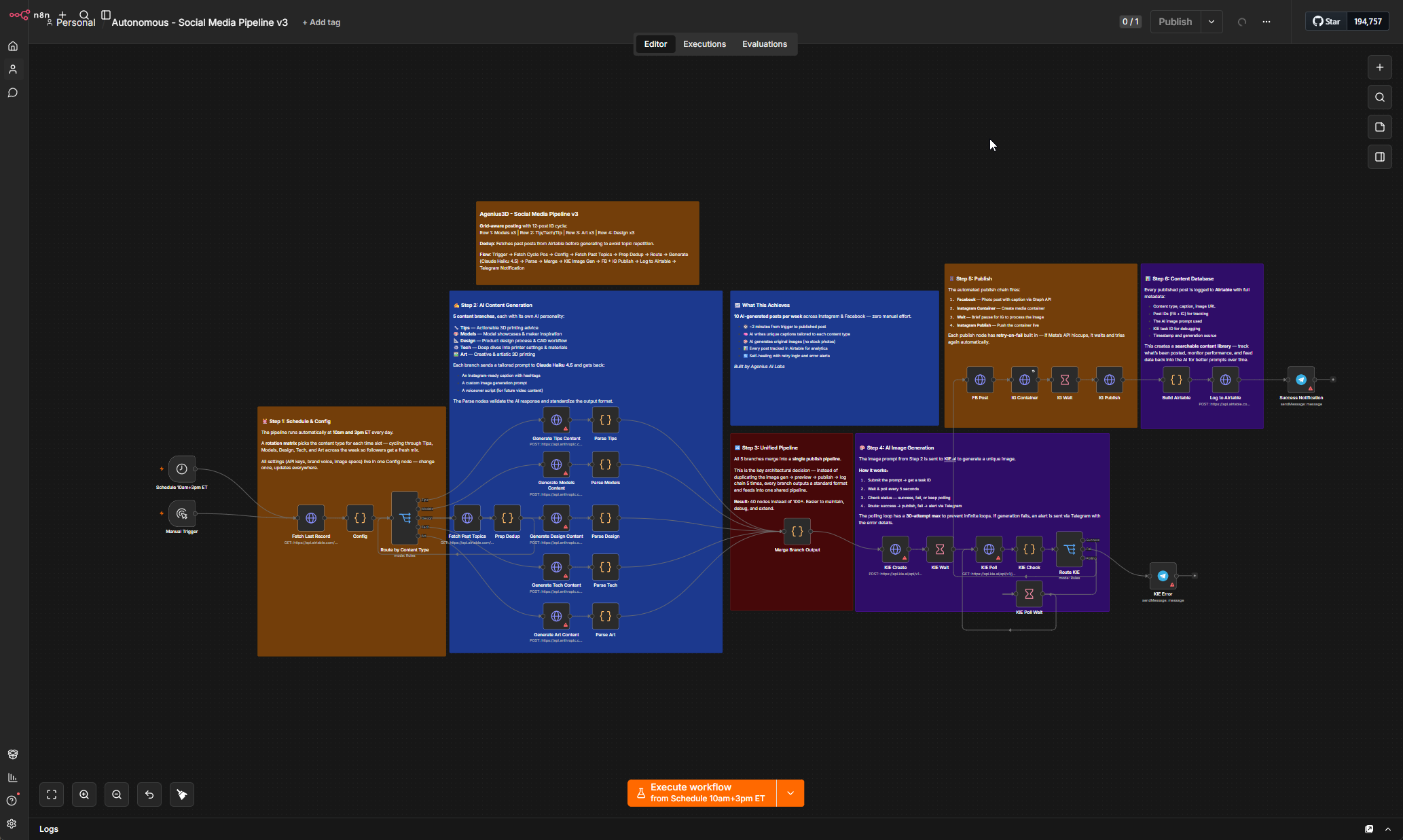
u/ageniusai shared Built an n8n workflow that runs a social account end to end (62 points, 7 comments). The post described a schedule-driven pipeline that chooses a topic, writes captions, generates an image, publishes to Facebook and Instagram, and remembers what it already posted. The linked repo confirms the stack - n8n, Claude Haiku, KIE.ai, Airtable, Meta Graph API, and notifications - while the attached README makes the logic fully config-driven around a 12-slot cycle. The most useful evidence was the blunt result: after 149 posts the account had only 6 followers, so the builder shut off the static-image version and planned a video-based rewrite.
u/EngJosephYossry posted Built an n8n workflow that turns trash git commits into clean CHANGELOG.md files and auto-commits them back (3 points, 5 comments). The linked Git Log Humanizer repo keeps the model inside one bounded translation stage: GitHub push webhook in, structured Llama 3.1 parsing, changelog update, notifications, and an audit table out. That pattern - AI as one constrained step inside a deterministic delivery system - kept recurring across the day's strongest build posts.
u/Ambitious-Scholar501 raised the ceiling in I built an open-source team of AI agents that finds the jobs that actually fit you (19 points, 19 comments). The post described a job-search team built around Claude Code, Codex, or Kimi CLI sessions sharing state through SQLite, with a web dashboard and desktop shell on top. The linked Job Hunter Team repo and results page grounded the more ambitious claims: one documented month-long run found 658 positions, scored 520, and marked 307 as strong matches while pacing weekly subscription budgets across the whole cycle.
Smaller vertical builders showed the same instinct. u/Temporary_Ad7810 described a gym growth assistant with qualification, scoring, deduplication, history, and a staged roadmap in Building an AI Gym Growth Assistant in Public – Week 1 (8 points, 9 comments). u/TinoMicheal showed a self-hosted outreach system with n8n, Ollama, Qdrant, Google Sheets, and Telegram in Self-Hosted AI Automation: How I Scaled My Outreach Without Buying Expensive Tools (4 points, 2 comments).
Discussion insight: The recurring build pattern was workflow first, agent second. Builders were explicit about memory stores, audits, budget pacing, or post history because those were the parts that made the system usable.
Comparison to prior day: This stayed aligned with 2026-07-05's workflow-first builder trend, but 2026-07-06 supplied more evidence about cost controls, vertical packaging, and honest postmortems when automation underperformed.
1.4 The business layer remained fragile: distribution, implementation, and buyer trust matter more than demos (🡕)
The commercial side of the topic stayed pragmatic. The strongest threads were about bans, margins, retainers, and buyer hesitation - not about which model felt smartest.
u/Meris-Dabhi described the channel-risk version in Six months of hard work disappeared overnight (68 points, 31 comments). The OP said AI-agent and automation work had grown from $10 Fiverr orders to $300-$1,200 projects before a permanent ban wiped out the account. u/Dull_Flatworm777 (score 85) compressed the day's clearest lesson into one line: never make your business depend on a single platform.
u/EmbarrassedEgg1268 showed the implementation-gap version in I built an AI support agent platform, turns out the agencies reselling it are making better margins than I am (20 points, 11 comments). The post argued that SMBs do not buy a graph builder or a model call. They buy setup, prompt design, flow logic, multichannel integrations, and someone accountable when the workflow breaks. The concrete figures mattered: setup work worth roughly $1,500 to $5,000 as a service, plus $300 to $800 monthly retainers for ongoing AI receptionist management.
The buyer-trust side appeared in voice AI threads. u/BreadfruitChoice3071 asked for help in Completely lost trying to understand voice ai for a flower shop (20 points, 13 comments), and the best replies were cautious rather than promotional: u/FaultofDan (score 3) said human-service businesses can lose trust fast if callers hit an AI unexpectedly, while u/SomebodyFromThe90s (score 1) recommended overflow-only scope plus quick handoff for custom orders. At the same time, Looking for someone who could built me an voice ai receptionist (10 points, 20 comments) showed direct demand for a low-cost Hindi-speaking receptionist, so the willingness to buy is clearly present even if trust and implementation remain hard.
Discussion insight: The money is not flowing to the nicest canvas or the smartest prompt alone. It is flowing to owned channels, vertical specialization, implementation labor, and maintenance contracts.
Comparison to prior day: 2026-07-05 already showed anti-fragility instincts around service automation. 2026-07-06 pushed that further into distribution risk, reseller economics, and explicit maintenance packaging.
2. What Frustrates People
Cost and quota behavior is still too unpredictable for agent-heavy workflows
High severity. In Claude is WAY TOO EXPENSIVE (22 points, 45 comments), u/Competitive_Stand_20 said one Claude Code task consumed 20% of a five-hour quota before any code was generated, and u/Strict_Blacksmith462 (score 3) said that behavior is normal because the quota includes file reads, planning, and tool calls, not just final output. In How do you handle token cost? (2 points, 5 comments), u/Internal_Weight8363 posted screenshots showing 3,436-token and 8,513-token steps inside a beginner multi-agent appointment setter, enough to hit RPM limits despite using free Groq, Gemini, and OpenRouter models.


The coping strategy was explicit routing, not blind loyalty to one model. u/Aspectdude09 (score 4) said Codex is cheaper, and u/PositiveUse (score 17) said Sonnet 5 is the mistake if the task is routine. This looks worth building for because people are already improvising manual model-routing heuristics, which usually signals a product gap around predictable cost envelopes and task-aware model selection.
Silent wrongness and maintenance drift remain worse than obvious failures
High severity. In Found a bug in my production workflow that never once threw an error — because it wasn't failing, it was just wrong (11 points, 11 comments), u/Top_Conflict_7240 said a lead-capture pipeline kept reporting success while writing the segment field into the phone column for weeks. u/SomebodyFromThe90s (score 1) said the useful fix was not just error alerts, but shape checks on business-critical fields, while u/0xGich (score 1) said builders need outcome checks that ask whether the business result is drifting, not just whether the node executed.
The same operational brittleness showed up in Issues with the newest update? (3 points, 3 comments), where u/gizmo884 showed community nodes being flagged for removal immediately after an update. The tooltip literally told the user to uninstall and reinstall the package.

The workaround pattern was consistent across threads: dual writes, sanity checks on critical fields, exported JSON backups, and explicit care plans for drift after delivery. This looks worth building for because the pain is operational, recurring, and invisible until money, data quality, or delivery accuracy degrades.
Multi-agent control surfaces are still too easy to overbuild and too hard to audit
High severity. In I think we're repeating the early microservices mistake with AI agents (27 points, 21 comments), u/germanheller (score 8) said most teams would be better off with a modular monolith than a swarm of agents, because the orchestration and observability burden arrives before the business need does. u/Rosie_grac (score 2) said a four-agent CrewAI research task had coordination chatter that cost about three times the actual work.
That same frustration surfaced at the side-effect boundary. In How are you catching bad tool calls before your agent acts on them in prod? (3 points, 19 comments), u/MasterJoePhillips (score 1) said the model cannot reliably police its own side effects, and u/anp2_protocol (score 2) said even gate layers rot unless teams run scheduled canary bad actions to prove the validator still fires. In agent safety probably starts with boring permission design (2 points, 11 comments), u/CODE_HEIST (score 1) summarized the safer posture as read-only by default, narrow write scopes, previews before external actions, and logs a normal operator can understand.
The current coping strategy is to collapse scope: fewer agents, narrower tools, deterministic validators outside the model, and human approval for high-blast-radius actions. That is worth building for because the community is already describing the missing product layer in detail.
Customer-facing AI workflows still fail on trust, onboarding, and channel ownership
High severity. In Six months of hard work disappeared overnight (68 points, 31 comments), u/Meris-Dabhi said a Fiverr account that had grown into a real AI-agent service business was permanently banned, and u/Dull_Flatworm777 (score 85) said the core mistake was letting one platform own the whole business. In Completely lost trying to understand voice ai for a flower shop (20 points, 13 comments), u/FaultofDan (score 3) said a florist caller often wants a human specifically, and u/SomebodyFromThe90s (score 1) said voice AI should start as overflow-only support, not full order intake.
The commercialization threads sharpened the same pain from the seller side. In Those of you selling automations to small businesses — what are you actually charging and what happens after delivery? (7 points, 11 comments), u/GodmodeEntrepreneur (score 11) and u/Calm-Dimension3422 (score 2) said many small shops lose money because they do not separate discovery, build, and care-plan pricing. The workaround today is narrow scope, explicit acceptance windows, and monthly maintenance sold up front. That looks worth building for because both buyers and builders want AI help, but neither side wants ambiguous responsibility once something breaks.
3. What People Wish Existed
A real control plane for fleets of agents
This was the clearest practical need. In Agent frameworks solved one problem. What solves the next one? (9 points, 3 comments), u/Bladerunner_7_ explicitly asked what comes after building agents once organizations start running dozens of them. In I built a control plane for AI support agents instead of another chatbot (4 points, 10 comments), u/Fit_Fortune953 proposed one answer - broker, approval queue, replay, audit export - and u/LaceLustBopp (score 3) said the missing piece before a pilot is a visible failure-mode table with owners and expected state transitions.
This is a direct need, not an aspirational one. People already know the rough shape of the missing product. What they do not have is a dominant, trusted implementation.
Safer agent identities and bounded authority by default
A second practical need was clear separation between identity, access, and authority. In Don't hand your AI agent your personal email. Give it a mailbox of its own. (27 points, 10 comments), u/mqasimca argued for dedicated inboxes plus pre-model rules, while u/EmailNo8428 (score 1) said inbound mail must be treated as untrusted input and outbound mail still needs allowlists, send caps, and approval for new recipients. In agent safety probably starts with boring permission design (2 points, 11 comments), u/germanheller (score 1) described a desktop-control tool that stays physically off until a human deliberately arms it.
This is a direct need with active partial solutions - separate mailboxes, scoped credentials, read-only defaults - but the community still talks about it as custom policy work rather than a solved base layer.
Voice agents that can start narrow, stay trustworthy, and support multilingual demand
The voice-AI threads made this need explicit from both sides of the market. In Completely lost trying to understand voice ai for a flower shop (20 points, 13 comments), u/BreadfruitChoice3071 wanted something that catches missed calls without sounding robotic or promising the wrong thing. u/SomebodyFromThe90s (score 1) said the right scope is overflow calls only: hours, delivery area, basic availability, and fast handoff on custom orders. In Looking for someone who could built me an voice ai receptionist (10 points, 20 comments), the requested product was even narrower and more practical - a cheap Hindi-speaking receptionist for inbound calls.
This is a direct need with obvious willingness to pay, but also heavy competitive pressure. The opening is not generic voice AI. It is field-safe, multilingual, handoff-friendly workflow design.
Payment rails that can hold money until an agent actually finishes the job
This was a thinner but still notable infrastructure need. In Why does every agent payment protocol (x402, MPP) only do one-shot transactions? No escrow anywhere? (4 points, 11 comments), u/Dry_Steak30 asked why agent payments stop at pay-per-call instead of supporting escrow for multi-step outcomes. u/Strict_Blacksmith462 (score 1) said the gap is real because outcome-based payment needs task specs, verification, disputes, and reputation, while u/Complete_Road999 (score 1) described a GPU-rental pattern that combines a 402 handshake with on-chain escrow.
This is more emerging than urgent, but it is practical rather than speculative. The thread was already talking about verifiers, milestones, refunds, and contract layers - not just theory.
4. Tools and Methods in Use
| Tool | Category | Sentiment | Strengths | Limitations |
|---|---|---|---|---|
| n8n | Workflow automation | (+/-) | Flexible visual orchestration, self-hosting, code nodes, webhooks, and reusable vertical workflows | Update churn, silent mapping bugs, pagination awkwardness, and ongoing maintenance burden |
| Make | Workflow automation | (+/-) | Good visual branching for mid-complexity SaaS workflows and cheaper scaling than Zapier in comparison threads | No self-hosting and less control than code-heavy or n8n-style setups |
| Zapier | Workflow automation | (+/-) | Fastest way to wire up simple SaaS automations | Task-based costs climb quickly and complex branching/custom logic gets clumsy |
| Claude Code / Sonnet | Coding agent | (+/-) | Strong for hard design, review, and coding work; still the quality reference point in many threads | Quota burn is front-loaded by repo/context reads, making routine iteration feel expensive |
| Gemini CLI / Google AI Pro | Coding agent | (+/-) | Budget-friendly access and repo-native CLI workflows for modular codebases | Some users still prefer Claude for quality, and chat-panel workflows create avoidable paste-limit friction |
| Codex | Coding agent | (+) | Perceived as cheaper for repeated coding work; proven in Job Hunter Team's long-running subscription-paced setup | Still subscription-dependent and CLI-first for serious use |
| Airtable / Google Sheets / SQLite | State store | (+) | Easy shared state for posting history, lead logs, budget pacing, and light workflow memory | Not enough on their own to catch semantic drift or silent wrong writes |
| KIE.ai | Media generation API | (+/-) | Simple image-generation step inside n8n social workflows | Dominates per-post cost and does not solve channel-fit problems like static images underperforming on social |
| AgentTeam Email / dedicated agent mailboxes | Email infrastructure | (+) | Scoped inboxes, safe review of untrusted mail, self-hosting, and clearer separation between mailbox identity and authority | Requires domain/routing setup and still needs outbound approval policy for higher-risk sends |
| CGA | Context retrieval | (+) | Local-first graph retrieval, MCP-compatible query surface, and documented 90.44% average token reduction in the linked benchmark | Graph-first retrieval still needs fallback to raw source when context is stale or too narrow |
| RelayOps | Control plane | (+) | Broker, approval queue, replay verification, audit export, and explicit prototype-vs-production boundaries | Synthetic-data prototype only, with no real production traffic or vendor execution |
Overall satisfaction was highest when the tool had a narrow, legible job and a visible state layer. Builders repeatedly used premium models for high-value reasoning, but routed bulk or repetitive work toward cheaper alternatives, subscriptions, or deterministic automation. That tradeoff was explicit in Claude is WAY TOO EXPENSIVE (22 points, 45 comments), in the lower-cost advice thread Looking for an alternative to Antigravity IDE for modular code (~$20) (4 points, 16 comments), and in Job Hunter Team (19 points, 19 comments), whose public results page documents subscription-budget pacing across month-long runs.
Migration patterns were concrete. In N8N vs Zapier vs Make. Who wins ? (7 points, 15 comments), u/Dilanpol (score 2) said n8n wins when teams need control, custom logic, APIs, and self-hosting, while the linked Sinqra comparison framed Zapier as the fastest start but the worst scaling cost. On the coding side, u/germanheller (score 1) argued in Looking for an alternative to Antigravity IDE for modular code (~$20) (4 points, 16 comments) that the real shift is from IDE chat panes toward repo-native CLIs that can read files directly instead of forcing users to paste modules into a prompt.
Competitive dynamics were therefore less about a universal winner and more about where each tool breaks. Zapier breaks on volume and branching, Make breaks on self-hosting and deeper control, n8n breaks on maintenance and correctness drift, Claude breaks on quota economics, and graph/control-plane layers are still early enough that builders are evaluating them as category-defining infrastructure rather than settled defaults.
5. What People Are Building
| Project | Who built it | What it does | Problem it solves | Stack | Stage | Links |
|---|---|---|---|---|---|---|
| Autonomous Social Media Pipeline | u/ageniusai | Runs topic selection, caption writing, image generation, publishing, and post-memory for FB/IG accounts | Repetitive social posting and repeat-topic drift | n8n, Claude Haiku, KIE.ai, Airtable, Meta Graph API, Telegram/webhooks | Shipped | repo, post |
| Job Hunter Team | u/Ambitious-Scholar501 | Runs a team of agents to find roles, score fit, and draft tailored applications | Job-hunt volume, targeting, and document customization | Node.js/TypeScript, Python, CLI agents, tmux, SQLite, Next.js, Supabase, Electron, Docker | Beta | repo, site, post |
| Git Log Humanizer | u/EngJosephYossry | Converts weak commit messages into structured changelog entries and pushes documentation updates | Manual release-note cleanup and low-signal commit history | n8n, GitHub webhooks, GitHub API, Groq Llama 3.1, Gmail, Discord, audit table | Beta | repo, post |
| RelayOps | u/Fit_Fortune953 | A control plane for support agents with brokered decisions, approvals, replay, and audit export | Safe execution for customer-support agents in higher-risk workflows | Python, FastAPI, Streamlit, SQLite, policy broker, MCP-style tool boundary | Alpha | repo, demo, post |
| CGA (Context Graph Agent) | u/Remarkable-One9371 | Uses AST-backed repository graphs to feed coding agents tighter evidence before file reads | Token-heavy broad context retrieval in coding-agent workflows | Python, AST/LSP-style graph indexing, FalkorDB, MCP-compatible tools | Beta | repo, benchmark, post |
| AI Gym Growth Assistant | u/Temporary_Ad7810 | Builds a lead-qualification and lifecycle engine for gym customer acquisition and retention | Fragmented lead intake and manual follow-up for gym owners | n8n, OpenAI, Airtable | Alpha | repo, post |
| Self-hosted outreach lead system | u/TinoMicheal | Automates local-business lead discovery, enrichment, and operator notifications | Manual small-business prospecting and spreadsheet cleanup | n8n, Ollama, Qdrant, Google Sheets, Telegram | Alpha | post |
The strongest builder posts kept one recurring promise: automate a painful loop, but keep the state visible. Autonomous Social Media Pipeline (62 points, 7 comments) is notable because the repo makes the memory and scheduling logic explicit - Airtable-backed history, a 12-slot cycle, config-driven topic selection - and the OP was honest that static-image posting worked operationally while still failing to win distribution. Job Hunter Team (19 points, 19 comments) pushes the same pattern into a more ambitious domain: its public results page grounds the build in month-long subscription pacing, shared SQLite state, and role-specific agent sessions rather than generic "apply everywhere" hype.
Infrastructure-heavy projects were also prominent. RelayOps (4 points, 10 comments) is less about model capability than about safe execution boundaries: broker packets, approval queue, replay checks, and audit export. CGA (2 points, 10 comments) does the same for coding context: its linked benchmark says graph-scoped context cut prompt tokens by 90.44% on average across 102 real-code cases while still requiring fallback to raw source when the graph is too narrow.
Git Log Humanizer (3 points, 5 comments) was a compact example of the day's most repeatable architecture: one bounded LLM stage inside a deterministic workflow.

The smaller vertical systems mattered too because they showed where agent work is actually getting productized. AI Gym Growth Assistant (8 points, 9 comments) laid out a roadmap from lead intelligence to conversion, nurture, onboarding, retention, and referrals. Self-Hosted AI Automation: How I Scaled My Outreach Without Buying Expensive Tools (4 points, 2 comments) showed the same instinct in SMB prospecting: use self-hosted components, automate one boring but valuable loop, and preserve operator notifications instead of pretending the human disappears.

Repeated build patterns were easy to see. People are building around noisy inbound data, narrow side effects, explicit logs, and subscription-aware economics. When several builders independently choose state tables, approval points, or budget watchers, that usually signals the same missing abstraction above the model.
6. New and Notable
Governed agent mailboxes moved from best practice to product surface
In Don't hand your AI agent your personal email. Give it a mailbox of its own. (27 points, 10 comments), u/mqasimca argued that the real anti-pattern is letting a prompt-injected message act with a human inbox's full identity. What made the thread notable is that the comments already pointed to productized alternatives: u/gvkhna (score 1) linked AgentTeam Email, whose public docs describe self-hosted agent mailboxes, safe review of untrusted mail, and scoped mailbox operations. This is more concrete than generic "be careful" advice. The pattern is becoming a real tool category.
Context graphs are being framed as measurable token savings, not just smarter retrieval
I tested AST-backed context graphs for coding agents; here is what changed (2 points, 10 comments) was low-engagement but unusually specific. u/Remarkable-One9371 claimed graph-first context used about 90% fewer tokens than broad snippets, and the linked CGA benchmark reports a 90.44% average token reduction plus a 13.34% drop in Hallucination Pressure Score across 102 real-code cases. The important nuance is that the repo does not present graph retrieval as magic: one benchmark slice got worse, and the docs explicitly say agents still need to reopen raw source when evidence is weak.
Outcome-based agent payments still look structurally underbuilt
Low-confidence but notable. In Why does every agent payment protocol (x402, MPP) only do one-shot transactions? No escrow anywhere? (4 points, 11 comments), u/Dry_Steak30 asked why payment rails stop at pay-per-call instead of escrowed outcome contracts. u/Strict_Blacksmith462 (score 1) answered that verification, disputes, and reputation are the missing layer, while u/Complete_Road999 (score 1) described a GPU-rental flow that combines a 402 challenge with escrowed settlement. The discussion was small, but it exposed a specific infrastructure gap rather than vague future talk.
7. Where the Opportunities Are
[+++] Agent control planes and side-effect governance - Evidence came from section 1's control-plane threads, section 2's complaints about bad tool calls and overbuilt multi-agent systems, section 3's explicit demand for ops layers, and section 5's RelayOps prototype. The need is strong because the community already agrees on the primitives - broker, scoped tools, approval queue, replay, audit - but not on a dominant product.
[+++] Cost-aware context and model routing - Section 1's pricing threads, section 2's token screenshots, section 4's tooling tradeoffs, and section 6's context-graph benchmark all point to the same gap: people need systems that automatically choose the smallest useful context and the cheapest model that can still finish the task safely. This is strong because users are already hand-rolling these routing rules.
[++] Trust-preserving customer communication layers - The mailbox-governance thread, the flower-shop voice AI thread, and the multilingual receptionist demand all showed that businesses want AI help in customer channels only if authority, escalation, and field safety are explicit. This is a practical opening, but it is more competitive because many vendors already claim to solve it.
[++] Vertical implementation and maintenance systems for SMB automation - The support-agent reseller thread and the pricing-after-delivery thread both said the money is in setup, maintenance, and accountability rather than the workflow file itself. That suggests room for products that package care plans, acceptance windows, drift monitoring, and role-based handoff for agencies or internal ops teams.
[+] Outcome-based payment and escrow rails for agents - The x402/MPP escrow discussion was smaller than the other themes, but it exposed a real missing layer between pay-per-call APIs and multi-step agent work. This is emerging rather than proven, yet it could become important if agent marketplaces move beyond demos.
8. Takeaways
- Cost discipline is now part of agent architecture. Outcome-based pricing debate, Claude quota shock, and token-heavy multi-agent screenshots all pointed to the same shift: model choice now gets judged by cost per useful result, not just output quality. (Palantir CEO says AI companies should be pricing outcomes instead of tokens (94 points, 73 comments), Claude is WAY TOO EXPENSIVE (22 points, 45 comments), How do you handle token cost? (2 points, 5 comments))
- The community's preferred safety answer sits outside the model. The strongest threads agreed on brokers, validators, scoped tools, approvals, replay, and audit trails rather than trying to prompt the model into self-discipline. (I think we're repeating the early microservices mistake with AI agents (27 points, 21 comments), How are you catching bad tool calls before your agent acts on them in prod? (3 points, 19 comments), I built a control plane for AI support agents instead of another chatbot (4 points, 10 comments))
- The builders getting traction are shipping narrow loops with explicit state. The most credible projects were not selling unlimited autonomy; they were exposing memory, budget pacing, workflow state, and deterministic edges around one concrete job. (Built an n8n workflow that runs a social account end to end (62 points, 7 comments), I built an open-source team of AI agents that finds the jobs that actually fit you (19 points, 19 comments), Built an n8n workflow that turns trash git commits into clean CHANGELOG.md files and auto-commits them back (3 points, 5 comments))
- For SMB automation, implementation and maintenance are still the business. Threads about support agents, pricing, and reseller margins all said the same thing: buyers pay for setup, drift handling, and accountability far more readily than they pay for a raw workflow or model call. (I built an AI support agent platform, turns out the agencies reselling it are making better margins than I am (20 points, 11 comments), Those of you selling automations to small businesses — what are you actually charging and what happens after delivery? (7 points, 11 comments))
- Customer-facing channels remain the hardest place for agents to earn trust. Voice and email threads both converged on the same boundary: scoped identity, overflow-only starts, careful field capture, and fast human handoff matter more than sounding fluent. (Don't hand your AI agent your personal email. Give it a mailbox of its own. (27 points, 10 comments), Completely lost trying to understand voice ai for a flower shop (20 points, 13 comments), Looking for someone who could built me an voice ai receptionist (10 points, 20 comments))