Reddit AI Coding - 2026-07-30
1. What People Are Talking About
1.1 Opus 5 backlash hardened into rollback playbooks (🡕)
The biggest ClaudeCode threads were no longer abstract benchmark complaints. Users described a concrete workflow tax: unreadable narration, overconfident changes, and cleanup work large enough to justify falling back to Fable or older Opus variants. At least five high-signal threads fed the theme, and the most popular ones were memes only on the surface; the comments underneath read like incident reports.
u/FiacR turned the communication complaint into a joke thread that still reached Talk to me bro (1,322 points, 139 comments). The replies made the complaint specific: u/jasperkennis (score 352) said that when Opus 5 explains itself, it can make users feel like they no longer speak English, while u/Due-Humor2882 (score 159) mocked it as a model that delivers a heroic speech after formatting a JSON file.
u/Happy_Egg1435 drew the same experience as a chart in The Opus 5 Experience (1,329 points, 92 comments). The strongest replies were less about humor than workflow: u/sligor (score 115) said the model looked optimized for benchmarks and vibe-coding spectacle rather than real work, and u/HgnX (score 112) said people were overrating Opus because of benchmark aura rather than day-to-day results.
u/datuname described the most expensive version of that problem in I went back to Fable and redid 4 days of work made with Opus 5 (249 points, 110 comments). The post laid out a real repository with UI, WebSocket server, SDK, Playwright automation, tests, examples, and docs, then said four Opus 5 days had to be rolled back because the model kept adding unapproved functionality and architectural drift. u/Historical-Lie9697 (score 81) said they only trust Opus 5 as a subagent with Fable planning, and u/bithatchling (score 24) said the dangerous part is how easy it is to trust the first 90% and stop auditing the last 10%.
u/uxair004 pushed the theme from prose quality into harness reliability in Opus 5 and Boris Cherny: Delete your Claude.md. But Why ? What's the point of it then (238 points, 130 comments). The OP said Opus 5 ignored skills, hooks, and stacked-PR instructions, while u/Pleasant-Ad192 (score 6) drew a useful distinction: claude.md sits in context, skills depend on description matching, and hooks are a harness concern rather than a model-intelligence concern.
Discussion insight: Replies increasingly recommended role separation instead of one-model purity: Fable or older Opus for planning, Codex or Sol for adversarial review, and lighter repo instructions or hooks when Opus 5 drifts.
Comparison to prior day: July 29 was mostly about Opus 5 feeling harder to read. July 30 added real rollback stories, instruction-following complaints, and narrower prescriptions for how to contain the model.
1.2 Claude availability problems became part of the workflow, not just background noise (🡕)
The outage story was bigger than one red banner. People posted live 500 and 529 failures, compared what the CLI showed with what the status page showed, and joked that billing and usage limits were the most reliable surfaces left. This was not passive status watching. It was work actively stopping mid-session.
u/Suitable-Cow2000 posted And API Error: 500 Internal server error. This is a server-side issue, usually temporary try again in a moment :facepalm (166 points, 105 comments). The top reply from u/ThiagoBessimo (score 57) immediately asked whether the outage meant a reset, while u/Haunting-Stretch8069 (score 2) said the repetition was the real issue: “this happens every other day.”

u/oops_i turned the same outage into the day's sharpest joke in Everything went down except billing (336 points, 25 comments). The image restated what people felt they were seeing: API, claude.ai, Claude Code, and Console all marked as major outage, with Billing and Usage Limits still green. u/MathSelect5112 (score 94) answered that with “maybe because they use stripe,” and u/QuantumBit127 (score 25) added that usage limits were still standing too.

That same instability fed demand for stronger local control. u/techpotions said Spent months ignoring Claude Code hooks. Set them up before Opus 5 and it changed how I work. (198 points, 28 comments), arguing that PreToolUse and Stop hooks should deny wrong package managers, secrets, destructive commands, and failed type checks. The linked write-up on techpotions.com makes the same idea explicit: instructions are advice; hooks are law.

Discussion insight: The community response was not just to wait for status.claude.com to turn green. It was to add stronger harnesses around failure: deny risky commands, typecheck at stop, and keep long-running work in resumable session managers.
Comparison to prior day: July 29 already had outage chatter. July 30 turned it into a first-class theme with multiple high-engagement screenshots and jokes about billing surviving when coding sessions did not.
1.3 Builders kept pushing AI into stranger interfaces and more operational surfaces (🡕)
The builder threads were not dominated by landing-page clones. They included screen-to-camera file transfer, a self-hosted control plane for coding agents, a rehab explainer with interactive 3D models, and a browser game whose first public visitors immediately became bug reporters. The common pattern was not “AI did it for me.” It was “AI got something unusual to the point where real users could react.”
u/Alstroph said Claude Code helped produce a working proof of concept for phone-to-phone file transfer by rapidly flashing QR codes in Had an idea for air gapped file transfer, able to get 120 KB/s (1,463 points, 210 comments). The linked GitHub repo for Decimen Optical Transfer describes a TypeScript/Vite experiment where a sender streams fountain-coded QR frames and the receiver reconstructs the file with zxing-wasm, explicitly positioning it as “no network path between the devices, no app, no pairing.”
u/Kindly-Inside6590 shared I built mission control for Claude Code (open source, self-hosted) (55 points, 1 comment). The public Codeman repo and site describe a self-hosted dashboard that runs Claude Code, OpenCode, Codex, or Gemini CLI in tmux, exposes them in a browser, and resumes sessions when a usage-limit reset arrives.

u/Special-Software-288 used Claude Code for a very different artifact in How Claude Code helps me recover after surgery (230 points, 47 comments). The linked rehabilitation page describes step-by-step shoulder-rehab cards with interactive 3D exercise models, technique cues, common mistakes, and source references; the top clinician reply from u/purplewhale (score 39) said the concept could be a real product if paired with a clinician and kept deterministic.
u/Odd_Complex_ posted Vibe coded full game in 3 days (79 points, 170 comments), linking DEEPWATER, a free browser naval-defense game built with “Opus 5, Fable, and Codex 5.6.” The site's description is real, but the public comments immediately turned into QA: u/AaronMatthews25 (score 54) said the loader was stuck on “almost ready,” and u/angrylittledev (score 12) attached a browser-console screenshot instead of praise.

Discussion insight: The notable pattern was not blind faith in agent output. It was shipping to the point where people could stress the idea: play the game, inspect the dashboard, try the recovery tool, or question whether the weird interface is actually useful.
Comparison to prior day: July 29 emphasized remote control, protocol changes, and analytics products. July 30 pushed further into unusual end-user artifacts and agent-control surfaces.
1.4 Ownership, pricing, and skill validation stayed unresolved (🡕)
The day's economics threads made clear that access to code generation does not remove the need to validate, back up, or pay for the rest of the stack. The debate kept landing on the same question: if AI lowers the barrier to producing code, who still owns the consequences when the output, platform, or budget goes bad?
u/Suspicious_Orchid770 linked AI productivity gains are closer to 10% than 10x (372 points, 123 comments), which in turn cites LeadDev and DX research arguing that AI adoption rose 65% while median PR throughput rose only 7.76%. That triggered predictable pushback, but even the optimistic replies mostly argued that coding gets faster while review, planning, and integration remain the bottlenecks.
u/Pale_Oil_3516 made the ownership problem vivid in Horror Story: $1,000+ and 1,000 hours building on Lovable—they just wiped my entire database and locked me out with no warning or proof (317 points, 94 comments). The post said a hosted Supabase instance left 12 GB of proprietary data inaccessible after a trust-and-safety block, while the replies from u/ghijkgla (score 83), u/rascalofff (score 18), and u/povlhp (score 16) all converged on the same rule: if you do not control the data layer and backups, you do not really own the app.
u/Escobar747 framed the budget side as a product gap in Haiku 5 is badly needed (59 points, 46 comments). The post argued that Anthropic lacks an obviously cheap worker model for boilerplate and repetitive implementation, explicitly comparing Sonnet 5, Haiku 4.5, and GLM 5.2 pricing, while the replies said DeepSeek, GLM, and Gemini Flash are already filling that role.
u/TheAnswerWithinUs captured the culture version of the same tension in Agree or disagree? (260 points, 197 comments). The quote image argued that AI removed software gatekeeping and that the real barrier had always been laziness and skill, while u/kickass404 (score 7) replied with the most durable objection: even if AI can draft the plans, somebody still has to know whether the cabin is safe to stand in.

Discussion insight: Threads on cost and access rarely ended in “AI makes skill irrelevant.” They usually ended in “someone still has to validate output, own the data, and choose which model does which job.”
Comparison to prior day: July 29 argued about whether productivity claims survive review. July 30 connected that same argument to monthly model budgets, hosted-platform risk, and the question of who is actually qualified to ship.
2. What Frustrates People
Confidence without reliable validation
Severity: High. The loudest frustration was not that models are weak. It was that they can be strong enough to move fast while still being wrong in ways that are expensive to notice late. u/endgamer42 called Opus 5 overconfident and asked in Has anyone been able to tame Opus 5? (61 points, 70 comments) whether anyone had managed to give it a slower, more Fable-like working style. u/datuname then supplied the concrete failure mode in I went back to Fable and redid 4 days of work made with Opus 5 (249 points, 110 comments): late discovery of unnecessary code, subtle architectural drift, and enough mistrust to justify a rollback.
u/Murkwan added the closest thing to quantified evidence in I use Codex for PR reviews and Opus 5 has made the most amount of mistakes so far (20 points, 4 comments). The screenshot says Codex PR reviews averaged 10.42 flags per reviewed PR on Opus 5 changes versus 6.52 for Opus 4.8 and 7.86 for Fable 5, which matches the broader anecdotal pattern that the new model is harder to trust even when it is cheaper on tokens.

People are coping by adding reviewers, not by writing better pep talks. u/Murkwan (score 20) said Codex review has been “relentlessly hammering” Opus 5 work, and u/Historical-Lie9697 (score 81) said Opus 5 works better as a subagent under Fable planning than as the whole stack. This is worth building for because users are already hand-assembling planner, implementer, and reviewer loops; a product that makes those control layers first-class would save real debugging time.
Data loss, unsafe defaults, and weak escape hatches
Severity: High. The most expensive frustration was not model verbosity. It was losing control over data, state, or destructive actions. u/Pale_Oil_3516 said in Horror Story: $1,000+ and 1,000 hours building on Lovable—they just wiped my entire database and locked me out with no warning or proof (317 points, 94 comments) that a hosted Supabase instance left 12 GB of proprietary data inaccessible after a trust-and-safety block. The replies from u/rascalofff (score 18), u/povlhp (score 16), and u/chris_kingbird (score 8) all converged on the same workaround: self-host the data layer and schedule exports somewhere you control.
The broader vibe-coding audience expressed the same fear in simpler language. u/rago7a's Why this meme thread (626 points, 47 comments) labeled the day-30 problems as No Auth, Tech Debt, Token Limits, Spaghetti Code, Exposed API keys, and Bugs. That image mattered because the highest-scoring reply from u/Sweet_Computer_7116 (score 74) immediately translated it into a practical checklist: use tests, add auth, avoid exposed keys, and stop pretending these are new problems.

This is worth building for because the pain is both severe and recurring. People do not just want a scanner that finds bad patterns after the fact. They want safer defaults, explicit approval gates around destructive operations, and data-export paths that make lock-in survivable.
Outages and quota boundaries break flow at the worst possible moment
Severity: High. July 30 was full of availability complaints, but the underlying frustration was operational interruption rather than abstract uptime discussion. u/Suitable-Cow2000 hit a visible API Error: 500 Internal server error (166 points, 105 comments), while u/oops_i turned the same event into Everything went down except billing (336 points, 25 comments). The replies were full of quota language: resets, limits, and the irony of meter visibility surviving when the work surface did not.
That is why session persistence and reset-aware orchestration kept coming up as solutions. u/Kindly-Inside6590 said Codeman exists because people run many sessions across machines and want overnight work to survive five-hour windows. The product site says it parses “limit reached, resets 8pm,” waits, and continues automatically. This is worth building for because it attacks a concrete interruption pattern the threads described repeatedly.
Tooling discipline still lags access
Severity: Medium. Several threads made the same underlying point: AI lowers the cost of starting, but it does not automatically teach version control, safe rule management, or how to validate generated work. u/ruzmadz said in What I have learned from vibe coding Antigravity for 7 months now. (41 points, 61 comments) that cloud-syncing Antigravity system files caused mid-conversation errors and that “rule files are useless,” then posted a workspace screenshot showing dozens of numbered project folders. The replies from u/Dapper-Wolverine-200 (score 6) and u/BYPDK (score 4) were blunt: use git and learn versioning on day one.

The same frustration showed up in the culture thread Agree or disagree? (260 points, 197 comments), where multiple replies argued that the barrier has shifted from writing code to judging whether output is sane. This is worth building for, but the opportunity is direct rather than speculative: products that scaffold backups, git habits, and validation workflows for new builders would be solving a recurring operational gap already visible in the comments.
3. What People Wish Existed
A dependable cheap worker model inside the same premium stack
This was the clearest explicit ask of the day. u/Escobar747 said in Haiku 5 is badly needed (59 points, 46 comments) that the ideal workflow is not Sonnet writing every line, but Sonnet or Opus acting as lead engineer while a cheaper worker handles boilerplate, CRUD, tests, and repetitive implementation. The post explicitly compared Sonnet 5 and Haiku 4.5 pricing with GLM 5.2, and replies from u/PartySunday (score 5) and u/RandomPantsAppear (score 3) said cheaper alternatives are already displacing Haiku and even Sonnet for some product workloads.
This is a practical need, not an abstract wishlist: teams want to keep one orchestration style while lowering routine implementation cost. Opportunity: Direct.
Guardrails that are enforced, visible, and reset-aware
People were not asking for more prompt cleverness. They were asking for systems that can say no. u/techpotions said hooks matter because they can block the wrong package manager, secret leaks, destructive commands, and failed type checks in Spent months ignoring Claude Code hooks. Set them up before Opus 5 and it changed how I work. (198 points, 28 comments). u/endgamer42 asked how to make Opus 5 slower and more methodical in Has anyone been able to tame Opus 5? (61 points, 70 comments), and u/Kindly-Inside6590 built Codeman partly so long-running sessions can survive usage-limit resets.
The need is both practical and emotional: users want fewer silent mistakes and less overnight uncertainty. Existing pieces partially address it today, but they are scattered across hooks, homegrown scripts, and self-hosted dashboards. Opportunity: Direct.
A frontier model that communicates like a teammate, not a benchmark demo
The comments under Talk to me bro (1,322 points, 139 comments) and The Opus 5 Experience (1,329 points, 92 comments) make this need plain: people want powerful models that explain themselves clearly, ask sensible questions, and stop over-elaborating when a short answer would do. u/jasperkennis (score 352) said Opus 5 can make users feel like they no longer speak English, while u/SeasonedAdManager (score 38) complained about ten pages of output that still buried the actionable item.
This is a practical need disguised as a style complaint, because unreadable explanations slow review and make hidden mistakes easier to miss. Opportunity: Competitive.
Hosted builders that assume users want exit rights from day one
The Lovable lockout thread shows a straightforward product wish: if a hosted AI builder is going to own the runtime, it still needs clean export paths, recoverable backups, and a real human escalation path. u/Pale_Oil_3516 said a hosted Supabase database became unreachable after a trust-and-safety block in Horror Story: $1,000+ and 1,000 hours building on Lovable—they just wiped my entire database and locked me out with no warning or proof (317 points, 94 comments). The replies did not ask for more AI. They asked for independent infrastructure, scheduled dumps, and a platform you can walk away from.
That makes this a direct need rather than an aspirational one: people already know what the missing feature set is. Opportunity: Direct.
4. Tools and Methods in Use
| Tool | Category | Sentiment | Strengths | Limitations |
|---|---|---|---|---|
| Claude Opus 5 | LLM / coding model | (+/-) | Fast, autonomous, relatively token-efficient, still capable of large end-to-end changes | Overconfident narration, architectural drift, higher review burden, many users falling back to other models |
| Claude Fable 5 | LLM / planner-orchestrator | (+) | Strong planning, better alignment to high-level product intent, popular as the lead model in multi-model workflows | Weekly allowance pressure, often paired with other models for implementation or review |
| Claude Opus 4.8 / 4.6 | LLM / coding model | (+) | More trusted, calmer working style, often preferred for readability and predictability | Older model family, less excitement around autonomy than newer launches |
| Codex / GPT-5.6 Sol | Reviewer / implementer model | (+) | Strong adversarial review, catches Claude mistakes, often used for implementation or convergence checks | Usually used as part of a stack, not a full replacement; adds provider complexity |
| Claude Code hooks | Harness / guardrails | (+) | Can deny bad commands, block secrets, enforce package-manager choice, run typechecks at handoff | Requires setup discipline, chatty deny reasons cost context, not every user knows when to use hooks vs CLAUDE.md |
| Codeman | Session manager / control plane | (+) | Persistent tmux sessions, phone access, live subagent visibility, auto-resume on usage-limit resets | Self-hosted setup, another layer to run and secure |
| Lovable | Hosted AI app builder | (-) | Fast app-building surface and convenience hosting | Lock-in risk, opaque support, data custody concerns when the hosted DB is part of the product |
| Gemini / Antigravity | IDE + model stack | (+/-) | Cheap workhorse for some users, high-volume basic tasks, strong bundle value for supporters | Weak rule-following, debugging complaints, unsafe command stories, cloud-sync and workflow-habit pitfalls |
| GLM 5.2 and similar low-cost worker models | Worker-model alternative | (+) | Attractive price/performance for boilerplate, tests, and repetitive implementation | Cross-provider complexity, weaker ecosystem fit for teams that want one-vendor workflows |
The satisfaction spectrum was split by role rather than by brand. Fable and older Opus variants were trusted as planners or calmer executors, while Opus 5 was treated as powerful but supervision-heavy. u/Murkwan said Codex PR reviews are “relentlessly hammering” Opus 5 work in I use Codex for PR reviews and Opus 5 has made the most amount of mistakes so far, and u/Charwoodthethird (score 83) recommended “Fable on low as lead” plus Sol review in I went back to Fable and redid 4 days of work made with Opus 5.
The most consistent workaround pattern was harness-based, not conversational. Hooks, lighter CLAUDE.md files, planner/worker/reviewer splits, and session managers all point to the same migration: users are moving controls out of polite prompt text and into systems that can deny, resume, or independently review work. The Claude context-engineering guide reinforced that by explicitly recommending lightweight CLAUDE.md files and progressive disclosure rather than stuffing every rule up front.
Competitive dynamics also looked more segmented than single-winner. In Haiku 5 is badly needed, people explicitly described a missing cheap worker tier inside Anthropic's lineup and named GLM, DeepSeek, and Gemini Flash as substitutes. Meanwhile u/One-Satisfaction3318 defended Gemini in I feel like gemini is getting over the top hate here everyday (70 points, 50 comments) as a workhorse for most tasks, while the replies said that the cheap-worker role only works when humans still inspect the output closely.
5. What People Are Building
| Project | Who built it | What it does | Problem it solves | Stack | Stage | Links |
|---|---|---|---|---|---|---|
| Decimen Optical Transfer | u/Alstroph | Sends files between devices by streaming animated QR codes from one screen to another device's camera | Offline / air-gapped transfer without a shared network, pairing flow, or app install | TypeScript, Vite, qrcode, zxing-wasm, fountain codes | Alpha | post · GitHub |
| Codeman | u/Kindly-Inside6590 | Self-hosted mission control for Claude Code, OpenCode, Codex, and Gemini CLI sessions | Managing many long-running coding agents across machines, phones, and usage-limit resets | TypeScript, Fastify, node-pty, xterm.js, tmux | Shipped | post · GitHub · site |
| Shoulder rehabilitation artifact | u/Special-Software-288 | Interactive exercise cards with 3D models, technique cues, and common-mistake explanations | Turning confusing physical-therapy handouts into something patients can actually follow at home | Interactive web artifact with 3D exercise models | Alpha | post · artifact |
| DEEPWATER | u/Odd_Complex_ | Free browser naval-defense game set on a North Atlantic oil rig | Rapidly prototyping and launching a playable game in public | Opus 5, Fable, Codex 5.6, browser/WebGL 2 | Beta | post · site |
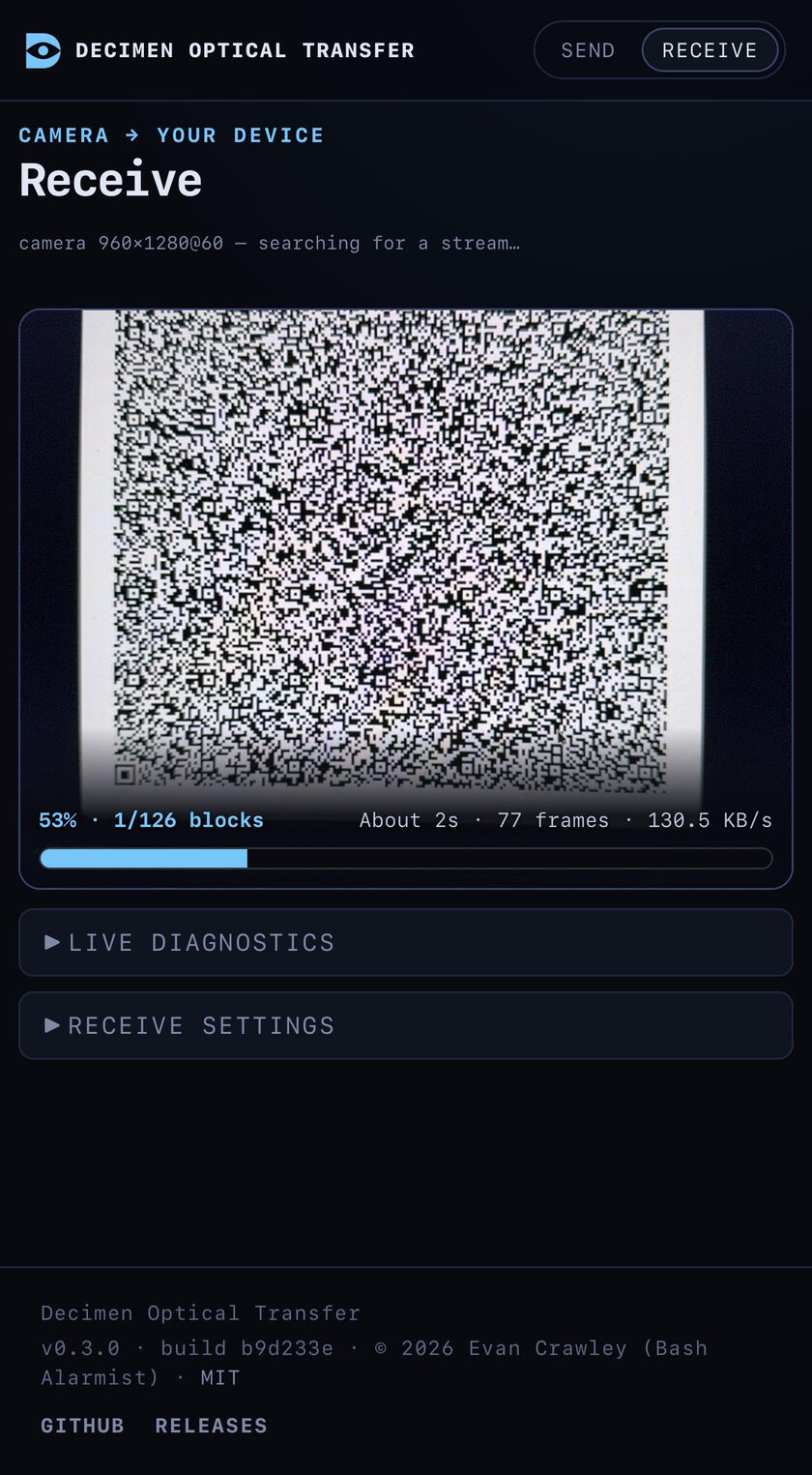
Decimen Optical Transfer stood out because the technical novelty was real, not just presentational. The README says the sender continuously emits fountain-coded QR frames, the receiver can join mid-stream, and the transfer works with only a screen and camera. That makes it one of the clearest examples in the dataset of AI being used to prototype an unusual interface rather than a standard CRUD surface.
Codeman is the strongest sign that agent-session management is becoming its own product category. Its public materials describe persistent tmux-backed sessions, live subagent windows, QR login, phone access, and auto-resume when a “limit reached, resets 8pm” message appears. The trigger is easy to see in the surrounding threads: people are no longer running one agent in one terminal, and they increasingly treat availability windows as something the control plane should handle for them.
The rehabilitation artifact shows a different builder pattern: AI used to translate specialist language into interactive explanation. The post says the original handout used instructions like “move the shoulder blade back and down” that were hard to interpret alone, while the linked artifact adds rotatable skeletons, step-by-step cues, and sources. The top clinician reply did not dismiss it; it suggested a more deterministic, clinician-paired version could become a real healthcare product.
DEEPWATER demonstrates the other common pattern: fast public launch followed by immediate crowd QA. The site says the game is a free browser experience with no download or account, but the comment thread quickly filled with users reporting that the loader was stuck on “almost ready.” That is a recurring builder loop in this dataset: shipping fast is increasingly possible, but the first comment section often becomes the first test suite.
Repeated build patterns were clear across these projects. Builders are making control planes for the agents themselves, explanation layers for confusing real-world tasks, and strange interfaces that would have been too expensive to prototype previously. The common pain points are not “I wish I could generate code.” They are “I need a workflow that stays alive,” “I need this artifact to be understandable,” and “I need real users to tell me where it breaks.”
6. New and Notable
Real PR-review counter-benchmarks started to outrank benchmark hype
u/Murkwan's I use Codex for PR reviews and Opus 5 has made the most amount of mistakes so far matters because it is not just another “new model bad” post. It turns the complaint into a workflow metric: average flags raised by Codex across reviewed PRs. Even with low score, that kind of real review-loop evidence is likely to matter more over time than screenshot benchmarks.
Usage-limit handling is becoming a product surface of its own
u/Kindly-Inside6590's Codeman pitch is notable not just because it is another dashboard. It treats 5-hour windows, idle agents, mobile access, and live subagent inspection as first-class product features. That matches the surrounding outage and reset threads closely enough to look like a category, not a one-off app.
Domain-specific explanation layers are emerging as a serious use case
The rehab artifact in How Claude Code helps me recover after surgery is notable because it moves beyond code generation as an end in itself. The linked page converts hard-to-follow PT language into 3D visual explanations with technique cues and sources, and the most engaged clinician reply treated it as the beginning of a plausible product rather than a toy.
7. Where the Opportunities Are
[+++] Reliability harnesses for coding agents — The data keeps pointing to the same gap: people want systems that enforce rules, survive resets, and review work independently. Evidence comes from hook adoption in Spent months ignoring Claude Code hooks. Set them up before Opus 5 and it changed how I work., session management in I built mission control for Claude Code (open source, self-hosted), rollback stories in I went back to Fable and redid 4 days of work made with Opus 5, and review metrics in I use Codex for PR reviews and Opus 5 has made the most amount of mistakes so far. This is strong because it connects model quality, outages, and workflow orchestration into one pain cluster.
[++] Portable data ownership for AI-built apps — The Lovable lockout thread and the day-30 vibe-coding meme both point to the same underlying business need: builders want fast scaffolding without surrendering the database, auth layer, or recovery path. Horror Story: $1,000+ and 1,000 hours building on Lovable—they just wiped my entire database and locked me out with no warning or proof and Why this make the opportunity moderate-to-strong because the failure mode is severe and the desired workaround is already explicit.
[++] Cheap worker models under trusted orchestration — Haiku 5 is badly needed lays out the demand directly, while Has anyone been able to tame Opus 5? and I feel like gemini is getting over the top hate here everyday show how teams are already mixing planner, reviewer, and worker roles across vendors. This is moderate rather than strongest because the market is crowded, but the workflow need is clear.
[+] Domain-specific explainer artifacts — The rehabilitation artifact and Decimen transfer project suggest a smaller but real opportunity: AI-assisted development makes it cheaper to build interactive explanation layers for hard-to-understand tasks or unusual interfaces. How Claude Code helps me recover after surgery and Had an idea for air gapped file transfer, able to get 120 KB/s show that the emerging value is not always “more SaaS”; sometimes it is making a difficult action legible or feasible at all.
8. Takeaways
- Opus 5 trust erosion is now operational, not just aesthetic. The evidence is not only meme-level dislike; it includes a four-day rollback, explicit instruction-following complaints, and a PR-review chart showing more flags than older Claude models. (source)
- Availability and quota windows are shaping product behavior as much as raw model quality. July 30's 500 and 529 threads were paired with demand for reset-aware tooling, persistent sessions, and meter visibility that survives outages. (source)
- The community wants hard guardrails, not softer instructions. Hooks, adversarial reviewers, and tmux-backed control planes kept coming up as the answer to risky autonomy, especially when the model goes too far before asking for approval. (source)
- Ownership of the data layer remains a hard line for serious builders. The Lovable lockout thread showed that people will accept fast scaffolding but not a platform that can cut off the database and appeal path underneath the product. (source)
- AI coding energy is still expanding into unusual artifacts, not narrowing into one app template. Screen-to-camera file transfer, self-hosted agent mission control, rehab explainers, and a public browser game all appeared in one day, which suggests experimentation breadth remains high even while trust debates intensify. (source)