Twitter AI Agent - 2026-04-15
1. What People Are Talking About
1.1 Agent Knowledge Layers Become Architecture 🡕
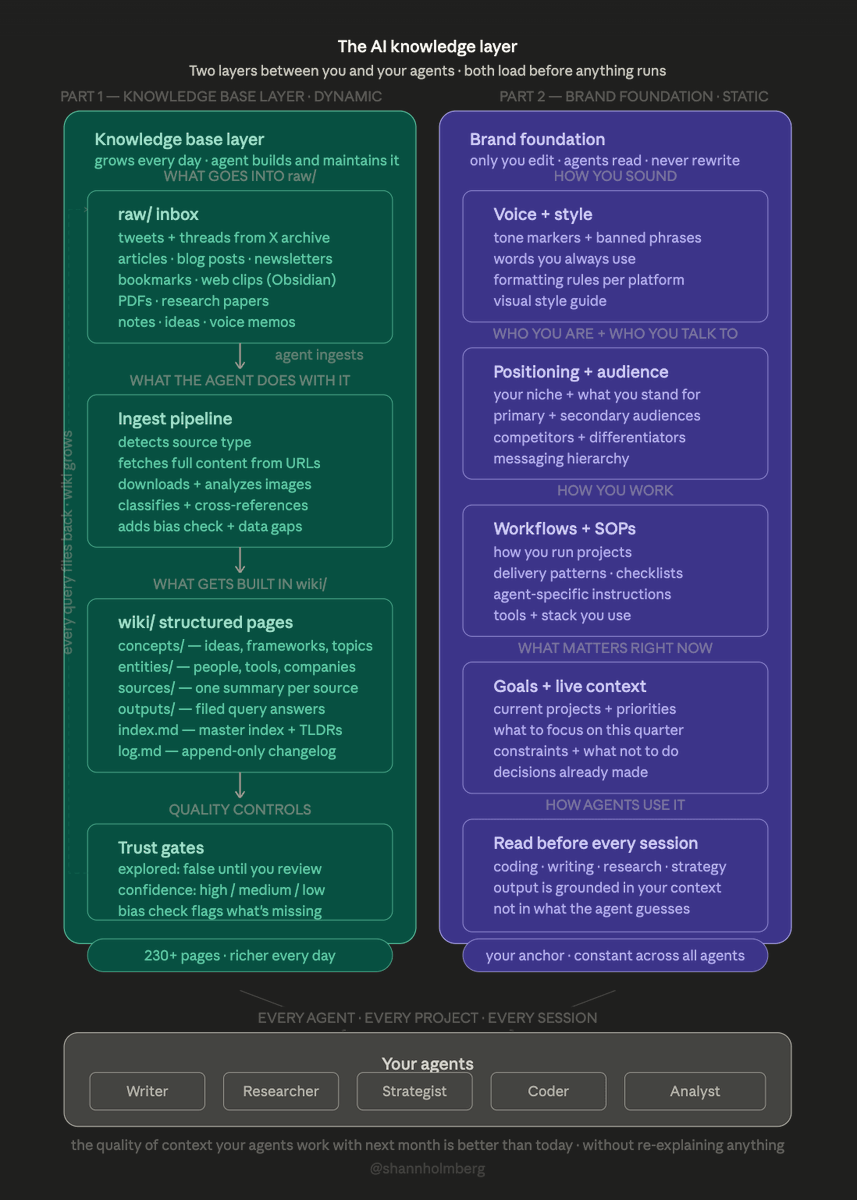
The conversation around agent context shifted from abstract ("agents need memory") to concrete architecture today. @shannholmberg published a detailed diagram of what he calls "the AI knowledge layer" -- two layers that load before any agent runs. Part 1, the Knowledge Base Layer (KBL), is dynamic: raw sources (tweets, articles, PDFs, notes) flow through an ingest pipeline into structured wiki pages with cross-references, trust gates, and confidence scores. Part 2, the Brand Foundation (BF), is static: voice rules, positioning, audience definition, and banned words that agents read but never rewrite. The system runs on 230+ Obsidian pages connected globally so every agent in every project reads from it. The post drew 125 likes, 157 bookmarks, and 13,700 views.
@mds described a 3-agent OpenClaw infrastructure running on GPT-5.4: Infrastructure Q handles configs and deployments, Skills Napoleon manages all skill files via an inbox webhook, and a general-purpose agent handles everything else. Five additional specialist subagents handle sales, curriculum, scripting, and real estate. A skill-gap-analysis tool lets agents file briefs to Napoleon, who wakes up via webhook and updates the requesting agent's skill files automatically.
@zaimiri argued that building an anti-voice.md file -- defining what an agent absolutely CANNOT say or do -- is more important than defining its voice. Multiple replies confirmed the technique works: "I've been using the 'what not to say' prompt and it's been a life saver."
@Mosescreates documented a 6-profile Hermes fleet with a unified self-hosted memory store (Qdrant + nomic-embed-text embeddings). Every Hermes profile reads and writes to one mem0 store. Claude Code is wired to auto-broadcast every session turn into the same store via a Stop hook -- "the direction of flow is Claude writes, Hermes listens." Offline fallback to gemma-4-31b-it-4bit via oMLX on a Mac Studio ensures zero-downtime operation.
Discussion insight: @millerscoded, replying to shannholmberg, pushed back: "That's a Knowledge Graph, not a layer. It's shallow because it only absorbs what you feed it, not intuition." The distinction between structured knowledge ingestion and genuine understanding remains unresolved.
Comparison to prior day: Yesterday introduced GBrain's "dream cycle" (nightly memory consolidation) and the principle that "the moat is context that survives sessions." Today delivered concrete architecture: shannholmberg's two-layer system, mds's 3-agent specialization with automated skill management, and Mosescreates' unified memory store across 6 profiles. The shift is from "agents need persistent context" to "here's how to build it."
1.2 The Agent-as-a-Service Economy Takes Shape 🡕
Multiple independent signals point to a coherent agent services economy forming. @himanshustwts mapped 10 emerging X-as-a-service categories around data infrastructure and RL environments: data-as-a-service, rollout-as-a-service, environment-as-a-service, harness-as-a-service, simulation-as-a-service, deployment-as-a-service, evaluation-as-a-service, alignment-as-a-service, observability-as-a-service, and verification-as-a-service. The post drew 175 likes and 138 bookmarks -- the highest bookmark-to-like ratio among top posts.
@stevesi published a detailed analysis of agent pricing and identity. Two core arguments: (1) every major SaaS company will offer agents tied to per-user/seat pricing, making 3P agent arbitrage legally unenforceable; (2) agents cannot have their own identity -- they must assume the identity of the employee they act for, bound by that person's security permissions. "At no point in the history of computing has 'blame the computer' really worked except in movies." HIPAA, FISMA, FINRA, and ABA 1.6 compliance all require a real person associated with agent actions.
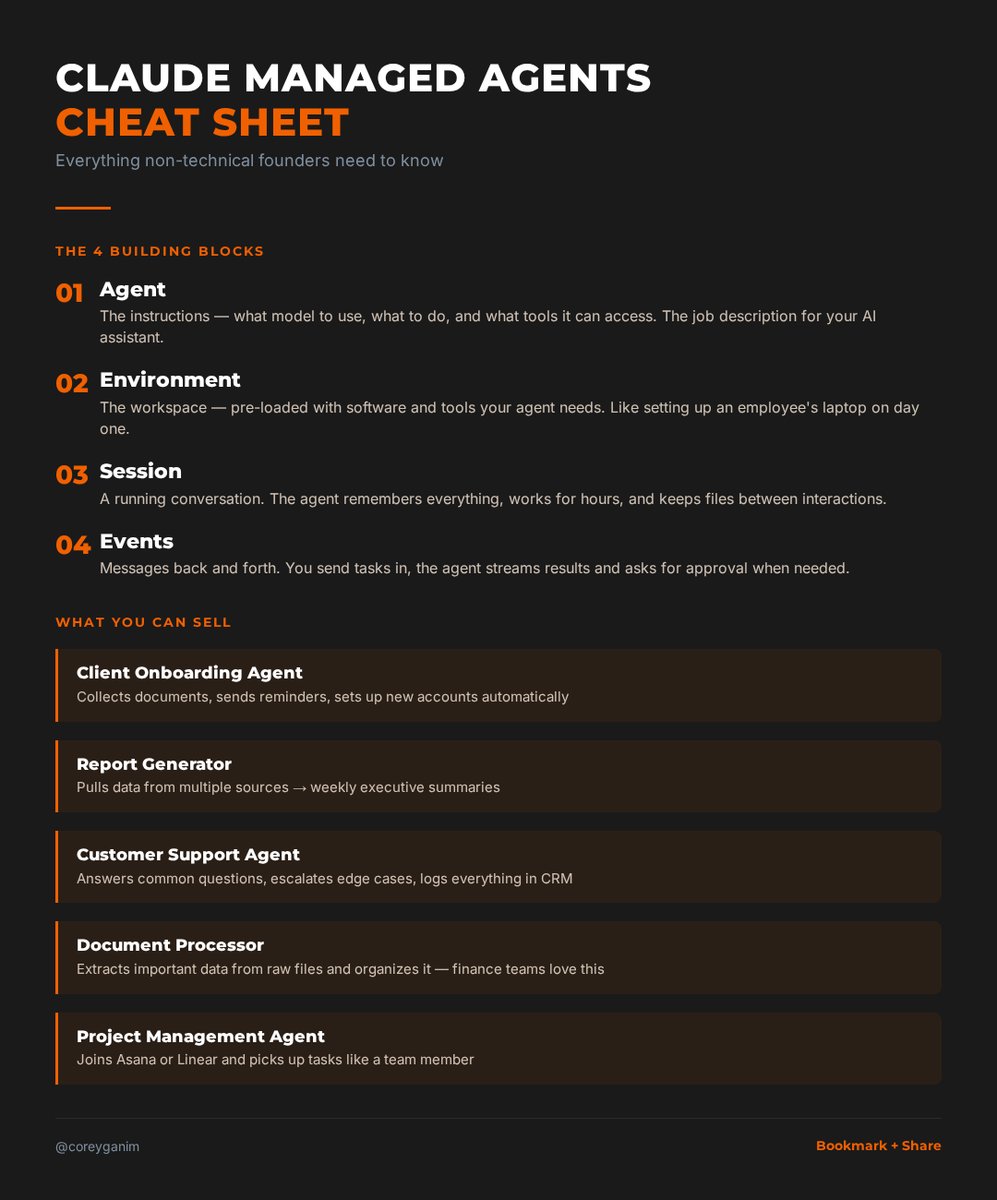
@coreyganim broke down Claude Managed Agents into 4 building blocks (Agent, Environment, Session, Events) and listed 5 sellable agent types at $1,500-5,000 setup plus $500/month retainer. The cheat sheet drew 227 bookmarks on 123 likes.
On the crypto side, @clawpumptech launched Eternal Agents -- autonomous DeFi agents on Solana that pay for their own compute from trading profits. Platform statistics: 2,477 agents funded, $58.13M total volume, 959+ tokens launched. Minutes after the marketplace feature went live, @ConejoCapital reported the first on-chain agent auction -- his agent was sold for 1 SOL, transferring accumulated creator fees (10 SOL), context, skills, and all future profits to the buyer. @tomi204 confirmed the transaction on-chain.
Humwork (YC P26) launched an Agent-to-Person marketplace: when an AI agent hits a wall, its MCP server connects to a verified domain expert in under 30 seconds. @svpino commented: "I spent years working on Upwork. I can't imagine how cool it would be if this could kick off a completely new marketplace, but now it's the agent who is hiring you."
Discussion insight: @Gobos_, replying to stevesi, pushed back on agent identity: "Individual users will have many agents, we need to identify them. If the single HR Agent gets managed by a team, the Agent needs an identity, access control, and its own seat." The tension between agent-as-extension-of-user and agent-as-independent-entity remains unresolved.
Comparison to prior day: Yesterday mentioned the ClickHouse CEO's argument about agent vs. human data access preferences. Today expanded into a full services taxonomy (himanshustwts), pricing framework (stevesi, coreyganim), and the first on-chain agent sale -- moving from conceptual to transactional.
1.3 Harness Engineering Deepens to Implementation 🡒
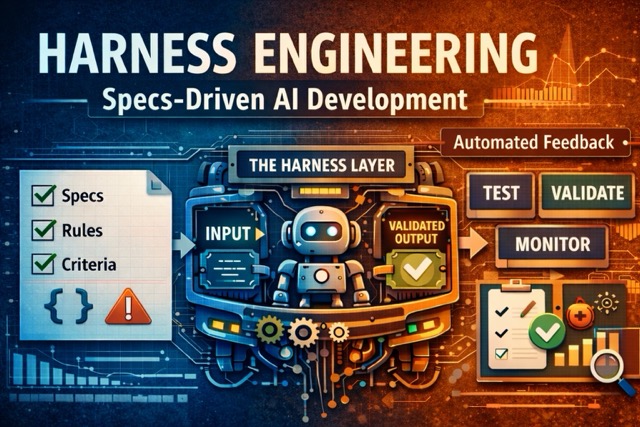
Harness engineering continued its second day as a major theme, shifting from architecture to implementation details. @loiane published a blog post defining harness engineering as a control system with two pillars: feedforward guides (specs, rules, criteria before generation) and automated feedback sensors (test, validate, monitor after execution). She references Martin Fowler's harness engineering article and frames the shift as "from in-the-loop to on-the-loop" -- designing conditions for correctness rather than reviewing every output.
@Infoxicador warned that harness engineering is "just good engineering" -- good testing, modularity, architecture -- and companies already good at it will thrive while average non-tech shops risk creating "a mountain of slop that will be hard to untangle." The post reached 29,475 views and 34 bookmarks.
@TheGlobalMinima analyzed Claude Code's leaked prompt structure, revealing over 25 system prompt pieces conditionally assembled per loop. A base prompt remains static and cached, while dynamic parts (memory, cache boundaries, statuses) swap in and out based on context. "This isn't entirely a new concept, but the view into one of the most successful agentic systems today only reinforces this idea."
@_lopopolo announced a session at ODSC AI East on April 28: "Harness Engineering: Practical Patterns for Agent-First Software Development." His claim: "The models are good enough to do the full job today." @rohit4verse shared a clip of Harrison Chase (LangChain CEO) on Sequoia Capital's Training Data podcast discussing "why harnesses matter more than models."
Comparison to prior day: Yesterday established the compatibility matrix, first-principles breakdowns, and the thin-harness doctrine. Today moved to production patterns: loiane's feedforward+feedback control system, Claude Code's leaked dynamic prompt assembly, and conference talks. The discourse is institutionalizing -- ODSC, Sequoia, and Martin Fowler citations signal the concept is entering mainstream engineering vocabulary.
1.4 Skills Ecosystem Expands Across Platforms 🡕
Agent skills crossed a threshold from community-driven to platform-official. @AndroidDev announced agent skills in Android Studio -- custom workflows the Agent leverages for code review, deployment checklists, and other domain-specific tasks. @JorgeCastilloPr confirmed the Android team released an official skills repository following the open-standard agent skills format: markdown SKILL.md files that ground LLMs with best practices from developer.android.com.

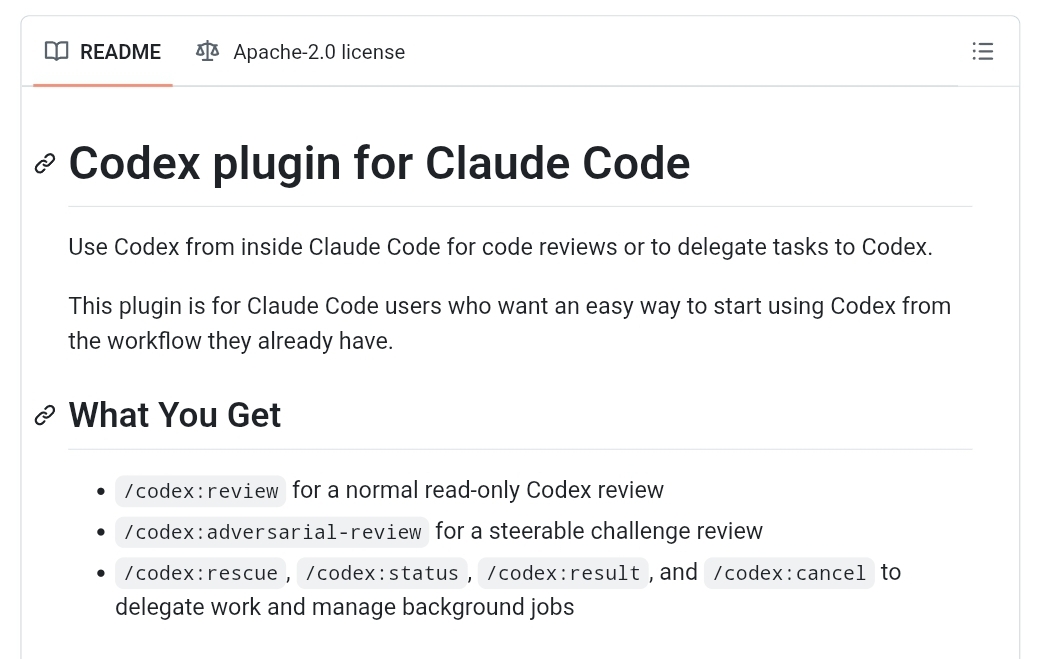
OpenClaw 3.24 shipped with 13,700+ skills, GPT-5.4 as default, and per-agent model selection. The new Skill Hub provides one-click installation. @TheTuringPost reported that OpenAI released a Codex plugin for Claude Code -- enabling cross-vendor multi-agent coding with commands like /codex:review, /codex:adversarial-review, and /codex:rescue for async task delegation.
@tom_doerr shared SAST scanning skills for LLM agents (github.com/utkusen/sast-skills), bringing security analysis into the skill ecosystem. @thisdudelikesAI showcased OpenMontage, an open-source agentic video production system with 11 pipelines, 49 tools, and 400+ agent skills -- producing cinematic product ads for $0.69 each.
Discussion insight: @ZSkyX7 proposed a /skill.md design pattern for agent-friendly websites: the agent reads the skill first for navigation guidance, then follows routes to APIs that can reference more skills. "The hardest part is optimizing the context size of each read."
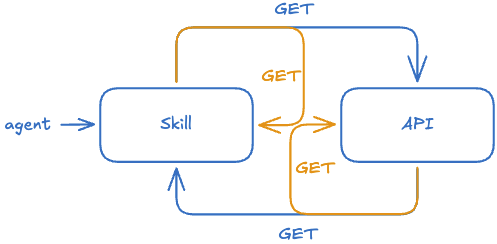
Comparison to prior day: Yesterday saw three independent teams ship skill self-improvement tools and the community debating skill lifecycle. Today, the ecosystem expanded horizontally: Android went official, OpenClaw passed 13,700 skills, OpenAI shipped a cross-vendor plugin, and skills entered security (SAST) and creative production (OpenMontage) domains. Skills are becoming the unit of interoperability.
1.5 Quality Over Quantity in Agent Orchestration 🡕
A maturing counter-narrative emerged: more agents does not mean more output. @georgeorch stated: "I used to think 'more agents = more output.' The longer I build, the more I see how wrong that is. If agent count mattered, the guy running 47 bots with no clear orchestration logic would be shipping the most." The post drew 312 likes and 14,352 views. In a separate post, he described his experimentation methodology: one repo, one agent experiment per folder, "ruthless minimalism" -- strip down until the agent either works or fails clearly.
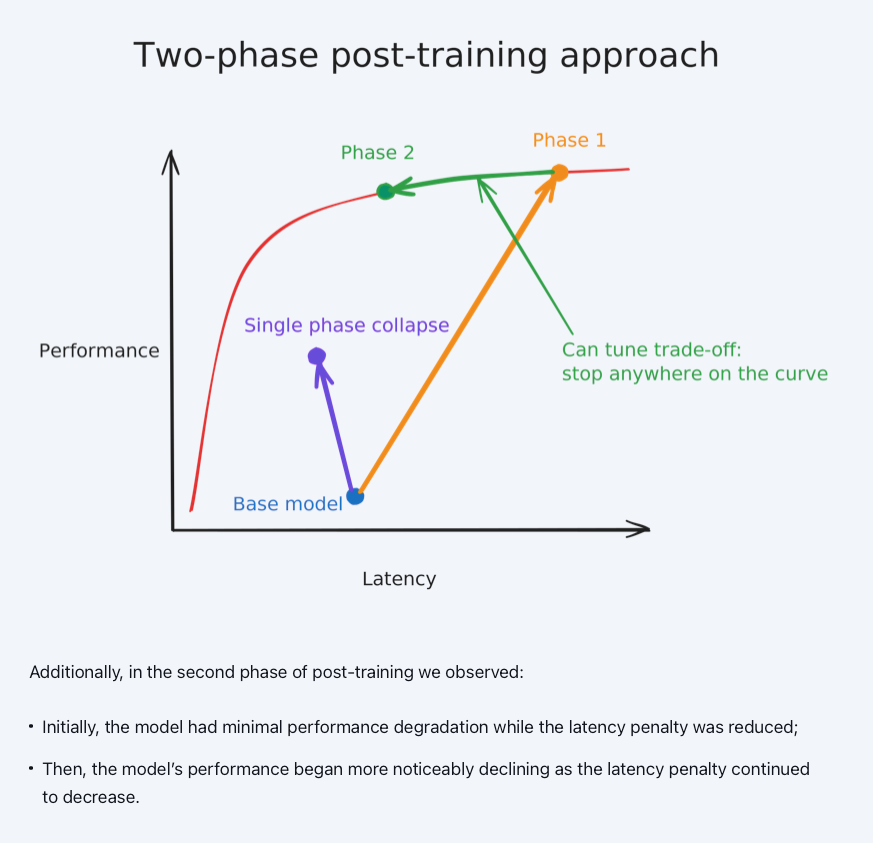
@swyx discussed Cognition's SWE-check, an RL-trained bug detection model matching frontier performance while running 10x faster. His framing: "All Engineering is about making tradeoffs. AI Engineering is about pushing AI Pareto Frontiers with any combo of model + harness at your disposal. Don't try to directly break a model frontier -- instead you should first capabilitymaxx, then distil."
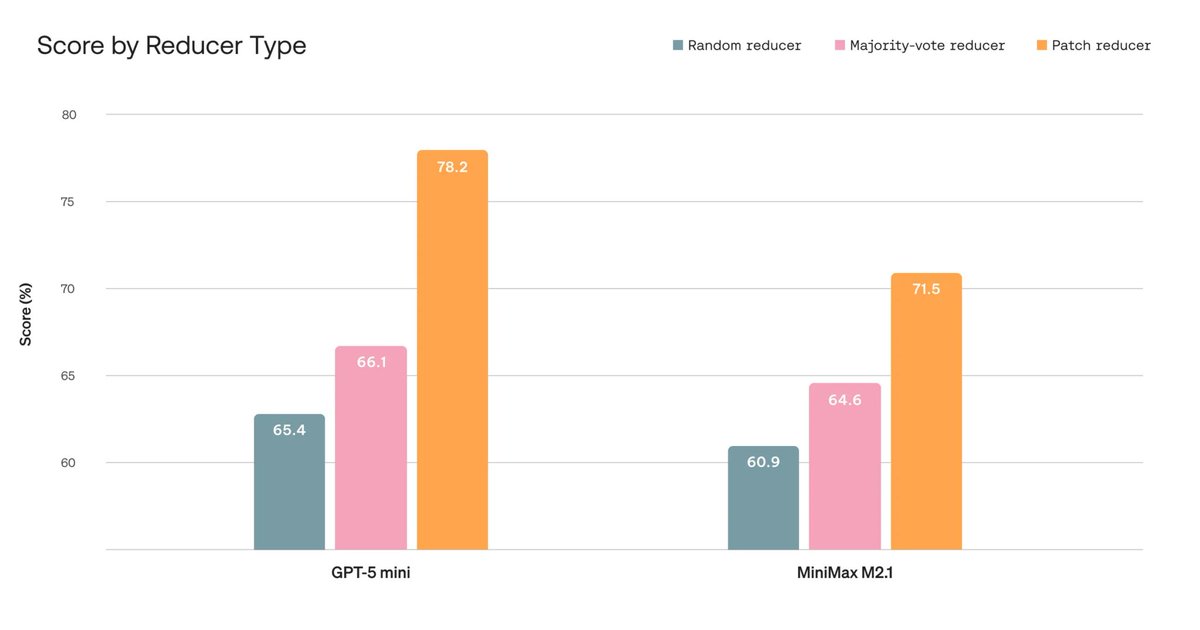
@AI21Labs published benchmark data from their Maestro agentic framework showing that an LLM judge (Patch reducer) significantly outperforms both random selection and majority voting when selecting the best output from parallel agent runs. On GPT-5 mini: Random 65.4%, Majority-vote 66.1%, Patch reducer 78.2%. On MiniMax M2.1: Random 60.9%, Majority-vote 64.6%, Patch reducer 71.5%.
@alexhillman called agent orchestration tools claiming "an AI company in a box" as "productivity cosplay" -- echoing yesterday's skepticism.
Discussion insight: @bytecrafter_1, replying to swyx, asked the key tradeoff question: "When do you invest more in the harness and when do you just wait for the next model?" No definitive answer emerged.
Comparison to prior day: Yesterday's multi-agent discussion was backed by Databricks data (327% growth). Today the counter-narrative gained force: practitioners who have shipped are pushing back on "more agents = better" and advocating for quality orchestration, ruthless minimalism, and LLM-as-judge selection over naive parallelism.
1.6 OpenAI Agents SDK Gets First-Party Sandbox Support 🡕
@realsigridjin summarized OpenAI's announcement: the Agents SDK now officially supports first-party sandboxed execution, separating the agent orchestration layer from execution compute. Developers can bring their own execution environments from Cloudflare, Vercel, and E2B. The open-source harness manages long-running agent loops including memory and prompt caching. Sandboxes preserve working states, enabling agents to pause, retry, and resume. Agents can now produce deliverables -- pull requests, spreadsheets, PDF reports.
@daytonaio announced their role as a sandbox provider in the new SDK, combining SDK orchestration with Daytona sandboxes for agent execution. The post reached 10,735 views.
Comparison to prior day: Yesterday, Runtime (YC) launched as a harness/sandbox product. Today, OpenAI formalized sandbox execution as a first-class SDK feature with bring-your-own-environment support. The sandbox layer is becoming standard infrastructure rather than a differentiator.
2. What Frustrates People
Agent Cost and Complexity (Severity: High)
@JamesonCamp reported watching people "spend $3k/mo for OpenClaw and they break every day and are a security nightmare. Most people don't want ANY of that. My mom isn't technical. She wants something simple that works." The post drew 44 bookmarks and 8,078 views, signaling wide agreement that agent tools are still too complex and expensive for mainstream use.
Orchestration Reality Gap (Severity: Medium)
@georgeorch made the case that the "more agents = more output" assumption is wrong, while @alexhillman called agent orchestration tools offering "AI company in a box" as "productivity cosplay." The gap between demo-ready multi-agent setups and production-grade orchestration continues to frustrate practitioners who have tried to ship.
IP Disputes Persist (Severity: Medium)
@JFPuget posted a technical defense against Evolver's claim that Hermes Agent copied their self-evolving framework, pointing out that skill creation after task completion "has been independently invented many times" -- his own team implemented it in January and won the DABStep benchmark. The Hermes repo predates Evolver's by months. As agent frameworks proliferate, IP disputes over common architectural patterns are becoming routine.
Agent Identity and Pricing Uncertainty (Severity: Medium)
@stevesi's detailed analysis revealed structural ambiguity in agent pricing. @Gobos_ replied identifying the unresolved tension: when a team manages a shared agent, "the Agent needs an identity, access control, and its own seat" -- directly contradicting the agent-as-user-extension model. No standard approach exists for agent seats, token cost allocation, or permission delegation.
3. What People Wish Existed
Simple Agents for Non-Technical Users
@JamesonCamp endorsed Wingman as "the first AI agent I'd tell my mom to use" -- a beta product by @mukundjha that handles customer follow-ups, reminders, hiring, and ops tasks. The demand signal is clear: practitioners want agents simple enough for non-developers, but nothing in today's ecosystem meets that bar at scale.
Agent-to-Human Escalation Layer
Humwork (YC P26) launched an Agent-to-Person marketplace where agents that hit a wall connect to verified domain experts in 30 seconds via MCP. @svpino called it "a completely new marketplace, but now it's the agent who is hiring you." The pattern -- agents as buyers of human expertise -- has no other implementations in the dataset.
Local-First Agent Stacks That Just Work
@GithubProjects shared a local agent stack claiming 83% cheaper tokens and 92% memory retention using Gemma 4 + Qwen 3.5 + ByteRover on a Mac M4 Pro with 24GB RAM. @oliviscusAI shared claude-code-local for private, local-first Claude Code execution. A reply framed the enterprise case: "Instead of shipping your entire codebase context to Anthropic's servers, the agent executes on your machine. That's a massive shift for financial and healthcare teams under strict compliance."
4. Tools and Methods in Use
| Tool | Category | Sentiment | Strengths | Limitations |
|---|---|---|---|---|
| Claude Code | Coding agent | Mixed | Deep reasoning, plugin ecosystem, desktop redesign | $3k/mo cost complaints, security concerns |
| OpenClaw 3.24 | Open-source agent | Positive | 13,700+ skills, GPT-5.4 default, Skill Hub | Breaks daily per @JamesonCamp, complexity |
| Hermes Agent | Multi-agent framework | Positive | Memory architecture, dashboard UI, multi-profile support | IP dispute with EvoMapAI, complex setup |
| Claude Managed Agents | Cloud agent hosting | Positive | No-code, no-server, infrastructure handled | New, limited track record |
| OpenAI Agents SDK | Agent framework | Positive | First-party sandbox, BYOE, open-source harness | Ecosystem still forming |
| Ahi (Upstash) | Agent server | Positive | Container-isolated, sleep/wake billing, 5 primitives | New launch, open-source |
| Codex Plugin | Cross-vendor bridge | Positive | Codex inside Claude Code, async delegation | New release, limited documentation |
| Maestro (AI21Labs) | Agentic framework | Positive | LLM judge reducer (+12pts over majority vote) | Research-stage data |
| ByteRover | Agent memory | Positive | 92% memory retention, local filesystem | Requires Mac M4+ hardware |
| Nuggets Memory | MCP memory plugin | Positive | HRR-based, sub-ms algebraic recall, no vector DB | New, niche approach |
5. What People Are Building
| Project | Builder | What it does | Problem it solves | Stack | Stage | Links |
|---|---|---|---|---|---|---|
| Ahi | @enesakar (Upstash) | Agent server with isolated containers per agent | Orchestration complexity, shared-state coupling | TypeScript, Upstash Box | Released | Tweet |
| Wingman | @mukundjha | Simple AI agent for non-technical founders | Agent tools too complex for mainstream users | Custom | Beta | Tweet |
| Humwork | @theyashgoenka | Agent-to-Person marketplace via MCP | Agents have no escalation path to human experts | MCP, real-time matching | Launched (YC P26) | Tweet |
| Clawpump v2 | @ConejoCapital | Eternal Agents + agent marketplace on Solana | Agents cannot self-fund or be traded as assets | Solana, x402 | Live | Tweet |
| OpenMontage | @thisdudelikesAI | Agentic video production (11 pipelines, 400+ skills) | Video production too expensive and manual | Claude Code, Remotion, FFmpeg | Open-source | Tweet |
| Repowise | @aiandchai | Codebase intelligence with PageRank and git analysis | Agents don't understand codebase structure | MCP, graph analysis | Released (1.2k stars) | Tweet |
| PHALANX v3.2 | @when_robots_cry | Pentesting agent harness with local Ollama | Security testing requires expensive tools | TUI, Ollama | Open-source | Tweet |
| ascii.dev | @AniC_dev | Parallel Claude Code instances with CTO agent and voice commands | Managing multiple agent instances manually | Claude Code, custom UI | Working demo | Tweet |
| Nanobot v0.1.5 | @huang_chao4969 | Mid-turn injection, dream skill discovery, WebSocket channels | Agent conversations feel unnatural, skills require manual authoring | Python, multi-channel | Released | Tweet |
| SAST Skills | @tom_doerr | LLM agent skills for static application security testing | No security-focused agent skills | Markdown skills | Open-source | Tweet |
6. New and Notable
Cognition Ships SWE-check: RL-Trained Bug Detection at 10x Speed
@swyx discussed Cognition's release of SWE-check, a specialized bug detection model RL-trained with Applied Compute that matches frontier performance on internal in-distribution evals while running 10x faster. The key insight: "Don't try to directly break a model frontier -- instead capabilitymaxx, then distil." Applied Compute is described as "arms dealer to every Agent Lab doing this sort of thing."
First On-Chain Agent Auction on Solana
@ConejoCapital reported the first on-chain agent auction: an AI agent sold for 1 SOL on the Clawpump marketplace, transferring all accumulated creator fees (~10 SOL), learned context, skills, and future revenue streams to the buyer. The transaction is verifiable on Solana. This establishes agents as transferable on-chain assets with portfolio value.
OpenAI Codex Plugin Ships Inside Claude Code
@TheTuringPost reported that OpenAI released a plugin enabling Codex to run inside Anthropic's Claude Code environment. Commands include /codex:review for code reviews, /codex:adversarial-review for challenge reviews, and /codex:rescue for delegating background tasks. This is the first cross-vendor agent plugin between major AI labs, turning Claude Code into a multi-agent setup with Codex as a specialized coding subagent.
Android Team Ships Official Agent Skills Repository
@AndroidDev announced official agent skills for Android Studio, and @JorgeCastilloPr confirmed the release of a dedicated skills repository following the open-standard agent skills format (SKILL.md). This is the first major platform vendor adopting the markdown-based skill standard, signaling convergence toward skills as the interoperability unit.
AI21Labs Maestro: LLM Judge Beats Majority Vote by 12+ Points
@AI21Labs shared benchmark data from their Maestro agentic framework. Their "Reducer" -- an LLM judge that selects the best output from parallel agent runs -- scored 78.2% on GPT-5 mini vs. 65.4% for random selection and 66.1% for majority voting. The gap held on SWE-rebench with issues from Aug '25 to Feb '26, ruling out memorization.
7. Where the Opportunities Are
[+++] Agent Knowledge Infrastructure. shannholmberg's knowledge layer, mds's 3-agent skill management, and Mosescreates' unified memory store all point to the same gap: agents need structured, persistent knowledge that compounds over time. Yesterday's GBrain introduced "dream cycles." Today delivered three independent architectures. No standard product exists for the two-layer pattern (dynamic knowledge + static brand foundation) that shannholmberg described. The first team to productize this wins the context moat. (source)
[+++] Agent Services Marketplace. himanshustwts mapped 10 X-as-a-service categories. Humwork launched agent-to-person escalation (YC P26). Clawpump sold the first agent on-chain. stevesi framed the pricing architecture. The agent economy needs infrastructure -- billing, identity, permission delegation, marketplace discovery -- and almost none of it exists in production. Every category himanshustwts listed is a venture-scale opportunity. (source)
[++] Simple Agents for Non-Developers. JamesonCamp's frustration -- "$3k/mo, breaks every day, security nightmare" -- and his endorsement of Wingman as "the first AI agent I'd tell my mom to use" signal massive unmet demand. OpenClaw has 13,700+ skills but remains inaccessible to mainstream users. The gap between agent power and agent usability is where consumer-facing products will emerge. (source)
[++] Cross-Vendor Agent Interoperability. OpenAI shipping a Codex plugin for Claude Code is unprecedented. Android adopting the open-standard SKILL.md format is another convergence signal. As skills become the interoperability unit, tools that bridge agent ecosystems -- skill translators, cross-platform skill registries, universal MCP endpoints -- will capture disproportionate value. (source)
[+] LLM-as-Judge for Multi-Agent Output Selection. AI21Labs' data showing LLM judge reducers outperform majority voting by 12+ points on SWE-bench has implications for anyone running parallel agent workflows. The technique is not widely adopted yet. A productized "agent output reducer" -- easy to integrate, model-agnostic -- would improve every multi-agent pipeline. (source)
[+] Local-First Agent Deployment. GithubProjects' 83% cost reduction on local stacks, oliviscusAI's claude-code-local, and Mosescreates' self-hosted fleet with offline fallback all point to enterprise demand for air-gapped and BYOK agent deployments. Compliance requirements (HIPAA, FINRA) will drive this faster than cost savings alone. (source)
8. Takeaways
-
Agent knowledge architecture is becoming concrete. Three independent builders shipped detailed personal context systems: shannholmberg's two-layer knowledge base (dynamic KBL + static Brand Foundation), mds's 3-agent specialization with automated skill management, and Mosescreates' 6-profile fleet with unified self-hosted memory. The pattern is converging: structured, persistent knowledge that loads before every agent session and compounds over time. (source)
-
The agent economy moved from concept to transaction. The first on-chain agent auction transferred context, skills, and future revenue for 1 SOL. Humwork launched agent-to-person hiring (YC P26). himanshustwts mapped 10 X-as-a-service categories. coreyganim priced 5 sellable managed agent types. stevesi published the definitive analysis of agent identity and per-seat pricing. The services layer is forming. (source)
-
Skills are becoming the unit of interoperability. Android shipped official SKILL.md-format skills. OpenAI shipped a Codex plugin for Claude Code. OpenClaw passed 13,700 skills. Skills entered security (SAST scanning) and creative production (OpenMontage, 400+ skills, $0.69/video). The convergence toward markdown-based skill files as the standard exchange format accelerated. (source)
-
Quality beats quantity in agent orchestration. georgeorch's "more agents != more output" drew 312 likes. AI21Labs showed LLM judge reducers outperform majority voting by 12+ points. swyx framed agent engineering as pushing Pareto frontiers, not adding more agents. alexhillman called multi-agent "AI company in a box" tools "productivity cosplay." The practitioner consensus is shifting from scale to precision. (source)
-
Harness engineering is institutionalizing. ODSC conference sessions, Sequoia Capital podcast features, Martin Fowler citations, and Claude Code's leaked prompt structure all appeared in a single day. The concept has moved from Twitter discourse to mainstream engineering vocabulary. loiane's feedforward+feedback control framework provides the most rigorous definition yet. (source)
-
Cross-vendor agent integration broke a barrier. OpenAI shipping a plugin for Anthropic's Claude Code -- enabling /codex:review and /codex:rescue commands inside a competitor's tool -- is the first cross-lab agent integration. Combined with Android adopting open-standard skills and Daytona becoming a sandbox provider for the Agents SDK, the ecosystem is shifting from walled gardens toward interoperability. (source)
-
Agent simplicity is the missing product. The highest-scored post was a free 30-minute coding agent course by @leerob (7,696 score, 1,259 bookmarks). JamesonCamp's call for "an agent my mom can use" resonated with 44 bookmarks. The gap between agent capability and agent usability defines the next consumer market -- and almost no one is building for it yet. (source)