Twitter AI Agent - 2026-04-22
1. What People Are Talking About
1.1 Enterprise Agent Platforms Converge: Microsoft Foundry, Google Gemini, Anthropic All Ship in One Day 🡕
Three hyperscalers announced enterprise agent platforms within the same 24-hour window. @satyanadella posted the day's highest-engagement announcement (1,191 likes, 597 bookmarks, 97.6K views): "Every agent will need its own computer. And with new Hosted agents in Foundry, every agent gets its own dedicated enterprise-grade sandbox, with durable state, built-in identity and governance, and support for any harness or framework." @jeffhollan detailed the technical preview (186 likes, 157 bookmarks, 31.5K views): persistent microVMs with scale-to-zero economics, 1,000+ built-in tools, observability, evaluations, guardrails, and private networking.

@georgeorch reacted to Google DeepMind's Gemini Enterprise Agent Platform (93 likes, 5.7K views): "The model wars are ending. The orchestration wars are just beginning." @googlecloud shipped an Agent Marketplace (49 likes, 3.2K views) inside Gemini Enterprise with partners including Atlassian, Elastic, Oracle, ServiceNow, and Workday. Separately, @rseroter announced (33 likes, 21 bookmarks) the first official Google Cloud agent skills repository covering 13 products, 3 Well Architected framework pillars, and 3 common journeys.
@aakashgupta continued his analysis (27 likes, 32 bookmarks, 6.9K views) of Anthropic's $0.08/hour agent runtime: "Thirty to fifty AI startups raised $10M to $100M over the past two years to be 'the infrastructure layer for AI agents.' Anthropic just priced that space at $0.08/hour." @bpizzacalla confirmed in reply: "Running 20+ agents on Claude right now. Infra cost is less than one SaaS tool they replaced."
Reply from @agora_alpha: "Is the dedicated sandbox really the breakthrough here? Most enterprise teams are already orchestrating this with standard containers and existing IAM." Reply from @gagansaluja08: "same convergence every hyperscaler hit this month. anthropic cloud fleet, google cloud run sandboxes, now foundry. infra is commodifying fast."
Comparison to prior day: April 21 introduced Anthropic's pricing pressure as a structural argument. April 22 adds Microsoft and Google shipping competing platforms simultaneously, turning the agent infrastructure market into a three-way hyperscaler race. The infrastructure pricing compression identified on April 21 is now confirmed across all three providers.
1.2 Harness Engineering Becomes the Dominant Design Conversation 🡕
The "harness engineering" concept from prior days reached peak discourse density. @TheAhmadOsman declared (172 likes, 20 bookmarks, 6.7K views): "Harness Engineering is the new Software Engineering." This sparked debate in replies -- @guigotgit said "I feel like we have yet to find a better name for it," while @rugbist_ pushed back: "harness engineering sounds like the same job but with more steps and probably lower pay."
@Vtrivedy10 appeared in three high-engagement threads. In a podcast recap with @himanshustwts (47 likes, 14 bookmarks), he outlined the practice: "working backwards from the model's capabilities/flaws and building systems (a harness) around them to accomplish Tasks." Traces are "our signal for continual learning and self-improving agents." He also noted (19 likes) that Google and frontier companies "are leaning hard into how/why harnesses make agents work better," citing @addyosmani's position: "A decent model with a great harness beats a great model with a bad harness."
@Marktechpost introduced "Coordination Engineering" (16 likes, 33.8K views) as the step beyond harness engineering, via JiuwenClaw's AgentTeam capability: hierarchical orchestration with a Leader Agent, unified team workspace, and event-driven fault recovery.

@SentientAGI published Arena Cohort 0 results (72 likes, 3.2K views) showing that open-source MiniMax M2.5 with the Goose harness achieved ~70% accuracy on OfficeQA at $1.74/run -- near-frontier performance at 1/30th the cost of Claude Opus 4.5 ($55/run). "Open-source models aren't just cheaper. With the right harness and prompting, they win significantly on accuracy-per-dollar."
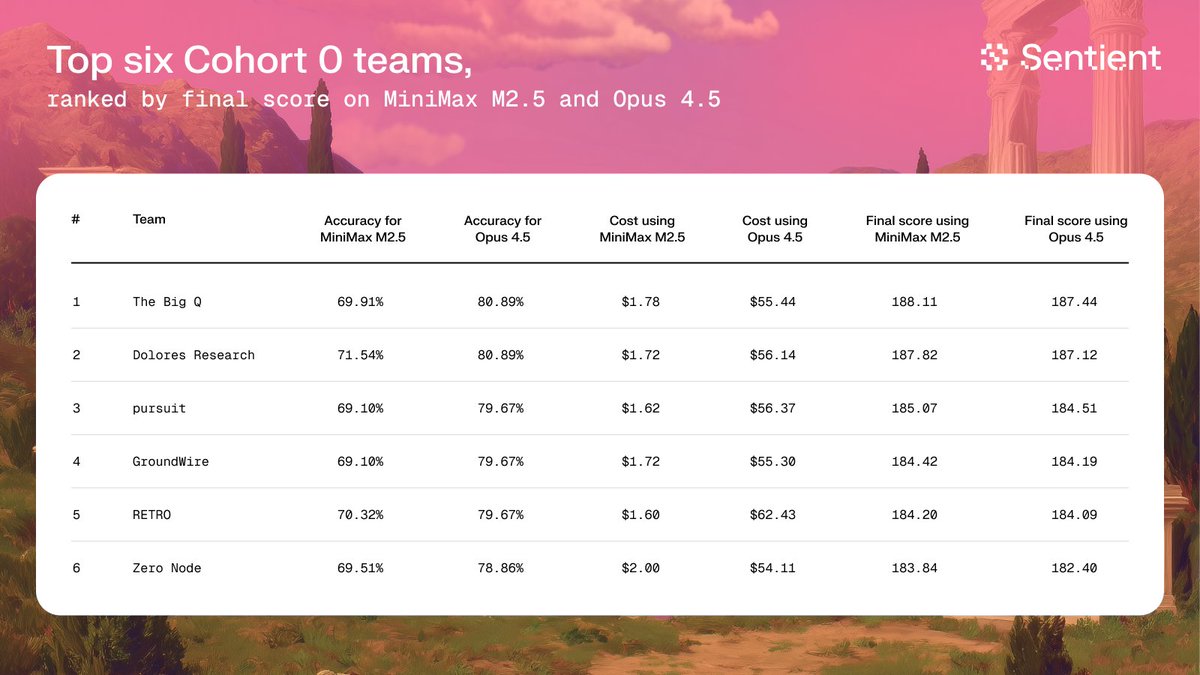
Comparison to prior day: April 21 introduced the harness/environment distinction and debated OpenClaw vs Hermes philosophies. April 22 consolidates around quantified evidence: Arena benchmarks proving harness quality matters more than model choice per dollar, and JiuwenClaw proposing "Coordination Engineering" as the next abstraction layer above harnesses.
1.3 CodeRabbit Agent for Slack Drives the Largest Single-Product Discourse Wave 🡕
@harjotsgill launched CodeRabbit Agent for Slack (81 likes, 43.5K views), and @IndianTechGuide amplified it to 2,104 likes, 343 bookmarks, and 226.8K views -- the day's second-highest-engagement post. The product addresses three pain points CodeRabbit observes across 15,000+ teams: context and decisions living outside the codebase, lack of a team-level durable knowledge base, and no trust layer for agentic workflows.
At least six independent quote-tweets echoed the same diagnosis. @darshal_ wrote (24 likes, 14 bookmarks): "Engineering teams don't usually struggle because of bad code. They struggle because context gets lost." @base10_ added (26 likes): "AI didn't just speed up engineering, it fragmented it. Every session resets. Every tool starts from zero. Your team becomes the memory layer." @JaynitMakwana noted (21 likes, 11 bookmarks): "context switching is the actual tax on engineering teams."
@carlvellotti surfaced specific Claude Code pain points in reply: "1. zero memory - every session starts from scratch 2. no team context - only knows what I tell it 3. decisions die in Slack threads no one can search."
Comparison to prior day: The context loss problem was discussed abstractly on April 21. April 22 produces a concrete product (CodeRabbit Agent) and six independent accounts describing the same failure mode, shifting the conversation from architectural theory to specific tooling.
1.4 Context Engineering Moves from Concept to Architecture Diagrams 🡕
@mdancho84 published (39 likes, 32 bookmarks) a three-stage evolution diagram distinguishing RAG, Agentic RAG, and "Agentic search in context engineering." The key difference: context engineering adds file search tools, skill loading tools, database tools, web search tools, memory tools, and shell tools to the retrieval pipeline, with Skills YAML frontmatter and memory files becoming first-class context window components.

@ihtesham2005 broke down Anthropic's engineering blog findings (4 likes, 4 bookmarks) on MCP context bloat: presenting MCP servers as filesystems reduced tool definition loading from 150,000 tokens to 2,000 tokens (98.7% reduction). Filtering data inside the code execution environment before it hits the model shrank a Playwright snapshot from 56KB to 299 bytes and a 500-request access log from 45KB to 155 bytes. "The agent isn't getting smarter. The architecture is getting cleaner."
@_avichawla continued gaining engagement (152 likes, 283 bookmarks, 38.4K views) for InsForge's quantified results: 10.4M tokens to 3.7M (2.8x reduction), 10 errors to zero, $9.21 to $2.81. Reply from @megacode_ai: "Context engineering is becoming its own stack layer."
Comparison to prior day: April 21 delivered the first quantified context engineering results (InsForge 2.8x, Claude Context 40%). April 22 adds architecture diagrams, Anthropic's own engineering data (98.7% reduction), and the filesystem-as-tool-registry pattern, moving context engineering from measured results to reproducible techniques.
1.5 Agent Memory Emerges as the Unsolved Core Problem 🡕
@eddiegreenwood_ posted (116 likes, 12 bookmarks, 111.5K views) the day's highest-view organic frustration: "been running AI agents for a few months. the hard problem isnt the model, its memory. built my own filing system so they dont lose yesterday. now i need a new agent to manage the filing system. agent on top of agent. starting to feel like im chasing the dragon." @0xGrebe replied: "every fix spawns another layer till you're basically running an ai bureaucracy in your laptop."
@WalrusProtocol quoted @GDanezis (29 likes): "Memory is not anymore just a casual trace of what the agent has done so far. It really is the soul of the agent. It is its personality, its professional qualifications."
@threepointone shared (28 likes, 16 bookmarks) a concrete design solution: subagents with "facets" on Cloudflare Durable Objects, where an existing Agent mounts as a child with shared memory and filesystems. "Shipping this week."

Comparison to prior day: April 21 discussed memory through the lens of Google's ReasoningBank framework and Hermes librarian profiles. April 22 shifts to practitioner frustration: memory is the bottleneck preventing real autonomous agent operation, and recursive agent management creates new complexity rather than solving it.
1.6 Multi-Agent Systems Get a Cautious Endorsement from Devin 🡒
@cognition posted (44 likes, 38 bookmarks, 7.2K views): "10 months ago, our CPO @walden_yan argued not to build multi-agent systems. Today, the landscape is different, and we've implemented a few specific flows for this in Devin." @walden_yan elaborated (14 likes, 5 bookmarks): "A year ago, I'd tell people to not build multi-agents and to focus on context engineering fundamentals. Today, many sexy ideas are still impractical, but we've found some setups that actually work."
This selective endorsement aligns with the day's broader pattern. @georgeorch noted (196 likes, 10.3K views): "I once believed multi-agent orchestration would replace most solo dev work, and that one-person AI teams shipping real products was still a decade away. I was wrong." @sharbel published (14 likes, 13 bookmarks) a 25-minute tutorial on deploying PaperClip, a multi-agent system with CEO and CTO agents, heartbeat intervals, and budget controls.
Comparison to prior day: April 21's discussion of single-agent superiority (from farhanhelmycode's production experience) is now nuanced by Devin's qualified reversal: multi-agent works for "specific flows," not as a general architecture pattern.
1.7 Agent Skills Ecosystems Mature with Official Repositories and Marketplaces 🡕
Official agent skills repositories shipped from multiple major platforms. @rseroter launched (33 likes, 21 bookmarks) Google Cloud's first official skills repository covering 13 products. @googlecloud also announced (19 likes) a Data Agent Kit integrating skills into VS Code, Claude Code, and Gemini CLI. @ElevenLabsDevs shipped (19 likes, 16 bookmarks) a Voice Isolator Skill installable via npx skills add elevenlabs/skills. @dotnet detailed (6 likes, 6 bookmarks) three ways to author .NET agent skills with human approval gates.
The crypto skills ecosystem expanded independently. @diegoxyz catalogued (10 likes, 5 bookmarks) the Crypto Skill Hub: 1,185 crypto skills, 97 MCP servers, 13 categories, 23 official projects from Coinbase, Binance, MetaMask, and Uniswap, compatible with OpenClaw, Claude Code, and Hermes Agent.
Comparison to prior day: April 21 discussed skills as a concept and the discovery problem. April 22 shows platform vendors (Google, ElevenLabs, .NET) shipping official skills packages, moving from ecosystem fragmentation toward vendor-curated skill repositories.
2. What Frustrates People
Agent Memory Requires Recursive Agent Management -- Severity: High
@eddiegreenwood_ described (116 likes, 111.5K views) building a filing system for agent memory, only to need another agent to manage it. "agent on top of agent. starting to feel like im chasing the dragon." @OmoKadupe05 identified the deeper issue: "At what point does adding agents to manage memory just recreate the same complexity you're trying to solve?" @_orcaman added (6 likes): "agent memory sucks... keeps mixing irrelevant background into fresh conversations."
Prevalence: High -- multiple independent accounts describe the same recursive management problem. No current framework provides memory curation that scales without human oversight.
Infrastructure Pricing Compression Threatens Agent Startups -- Severity: High
@aakashgupta continued (27 likes, 32 bookmarks) the structural argument from April 21: Anthropic at $0.08/hour, Microsoft Foundry with hypervisor-level isolation, and Google Gemini Enterprise Agent Platform all converged in the same week. "The companies in that kill zone have maybe 12-18 months of runway left." @gagansaluja08 confirmed: "infra is commodifying fast. real question is which platform pulls the developer surface."
Prevalence: Structural for the 30-50 agent infrastructure startups identified in the dataset. The three-way hyperscaler convergence makes this more acute than April 21.
Context Loss Across Engineering Tools Compounds with AI Agents -- Severity: Medium
Six independent accounts described the same failure pattern on April 22. @carlvellotti: "zero memory - every session starts from scratch... decisions die in Slack threads." @JaynitMakwana: "context switching is the actual tax on engineering teams. slack to terminal to github, back to slack." @base10_: "AI didn't just speed up engineering, it fragmented it."
Prevalence: High across engineering teams using AI coding agents. CodeRabbit Agent is the first shipped product explicitly targeting this gap.
Harness Engineering Lacks Professional Identity -- Severity: Low
@TheAhmadOsman declared "Harness Engineering is the new Software Engineering" but replies resisted the framing. @guigotgit: "we have yet to find a better name for it." @rugbist_: "same job but with more steps and probably lower pay." @ethankongee raised the evaluation gap: "most of the articles I've found are too abstract... Without solid benchmarks, it's hard to know if a harness is actually good."
Prevalence: Emerging -- the discipline exists but lacks consensus naming and standardized evaluation criteria.
3. What People Wish Existed
Agent Memory That Curates Itself Without Recursive Management
@eddiegreenwood_ (116 likes, 111.5K views) built his own filing system and still needed an agent to manage it. The core gap: no framework provides memory that automatically distinguishes what is worth remembering from noise, without requiring another agent layer. @eddiegreenwood_ concluded in replies: "memory is easy. curation is the job."
Opportunity: High -- a memory system with built-in relevance scoring and automatic pruning that operates within a single agent loop, not as a separate management layer.
Standardized Harness Engineering Benchmarks
@ethankongee described the gap: "I'm learning how to build agent harnesses, but most of the articles I've found are too abstract and don't really help me judge whether my harness is working. Without solid benchmarks, it's hard to know if a harness is actually good." The Arena Cohort 0 results from @SentientAGI begin to address this, but no public benchmark isolates harness quality from model quality.
Opportunity: High -- a benchmark that decomposes agent performance into model contribution versus harness contribution would reshape how teams evaluate and invest in agent infrastructure.
Voice Agent Interruption and State Management
@JamesClawn identified a specific failure mode: "Voice agents break trust when interruption stops the audio but not the pending tool call, because memory and turn state still need a hard revoke before the agent keeps acting." @somi_ai confirmed: "most voice stacks still cut users off mid-syllable when they try to barge in."
Opportunity: Medium -- voice agent frameworks that handle interruption at the tool-call level (not just audio level) would address a structural trust gap in production voice deployments.
4. Tools and Methods in Use
| Tool / Method | Category | Sentiment | Strengths | Limitations |
|---|---|---|---|---|
| Microsoft Foundry Agents | Enterprise agent platform | Positive | Persistent microVMs, 1000+ tools, Entra identity, scale-to-zero, any framework | Preview stage, pricing not yet detailed |
| Gemini Enterprise Agent Platform | Enterprise agent platform | Positive | Partners (Atlassian, Oracle, ServiceNow), agent marketplace, Google Cloud integration | New launch, limited production reports |
| CodeRabbit Agent for Slack | Agentic SDLC | Positive | 2M+ reviews/week across 15K teams, Slack-native, durable knowledge base | Slack-only, team size scaling unknown |
| Hermes Agent | Agent platform | Positive | 106K GitHub stars, self-improving skills, persistent memory, cross-platform | Name collision with OpenAI "Hermes", skill management complexity |
| InsForge | Context engineering | Positive | 2.8x token reduction, zero errors, open-source, MCP-based | New release, limited production data |
| Claude Code | Coding agent | Mixed | Strong with skills and context engineering | Session memory resets, closed source, limited team context |
| Spectrum (Photon) | Multi-platform agent messaging | Positive | iMessage, WhatsApp, Telegram, Slack, SMS/RCS, one API, open-source | Early adoption, limited scale data |
| OpenHarness | Open-source agent harness | Positive | 43+ tools, skills system, claude-code plugin compatible, MIT license, 114 passing tests | New, community size unknown |
| Cloudflare Agents SDK | Voice + edge agents | Positive | Streaming STT/TTS at the edge, Durable Objects for state, interruption handling | Workshop-stage, developer-focused |
| Hyperframes (HeyGen) | Agent video creation | Positive | HTML in, MP4 out, Apache 2.0, skills for Claude Code/Cursor/Gemini CLI/Codex | New open-source release |
| MiniMax M2.5 + Goose | Open model + harness | Positive | ~70% accuracy at $1.74/run (1/30th cost of Opus 4.5) | Lower absolute accuracy than frontier |
| Qwen3.6 27B | Open LLM | Positive | +42-77% on coding agent benchmarks vs Qwen3.5 27B, retains reasoning context | Self-reported benchmarks |
5. What People Are Building
| Project | Builder | What it does | Problem solved | Stack | Maturity | Links |
|---|---|---|---|---|---|---|
| Foundry Hosted Agents | @satyanadella, @jeffhollan | Enterprise-grade sandbox per agent with durable state and identity | Secure, governed agent compute for enterprises | Azure, hypervisor microVMs, Entra | Beta | post |
| CodeRabbit Agent for Slack | @harjotsgill | Slack-native engineering knowledge base from 2M+ weekly code reviews | Context loss and tribal knowledge scattered across tools | Slack, GitHub, Jira, AWS integrations | Shipped | post |
| Hyperframes | @sentient_agency | HTML-to-MP4 video rendering framework for AI agents | Video creation tools built for humans, not agents | Node.js, Puppeteer, FFmpeg, Apache 2.0 | Shipped | post |
| OpenHarness + ohmo | @Sumanth_077 | Open-source agent harness with 43+ tools, skills, permissions, multi-agent | Lightweight open alternative to closed agent frameworks | Python 3.10+, React+Ink TUI, MIT | Shipped | post |
| JiuwenClaw AgentTeam | @Marktechpost | Multi-agent collaboration with hierarchical orchestration and shared workspace | Moving from single-agent harnesses to coordinated agent teams | openJiuwen SDK, event-driven | Shipped | post |
| Google Cloud Agent Skills | @rseroter | Official skills repository for 13 Google Cloud products | Agents lacking authoritative cloud provider knowledge | Skills files, multiple agent tools | Shipped | post |
| Subagents with Facets | @threepointone | Mount existing agents as children with shared memory and filesystems | Multi-session agent state management | Cloudflare Durable Objects | Alpha | post |
| Autosana | @ycombinator | End-to-end validation harness for coding agents across iOS, Android, web | Closing the QA loop after agent-generated code changes | Cross-platform testing | Shipped | post |
| Higgsfield Marketing Studio | @higgsfield | AI UGC ad creation from product URLs using Hermes Agent | Distribution bottleneck for vibe-coded products | Hermes Agent, Seedance 2.0, Meta Ads | Shipped | post |
| Respan Agent + CLI + MCP | @RespanAI | AI engineering observability agent, CLI setup, and MCP integration | Manual evaluator building, prompt debugging, trace analysis | Claude Code, Cursor, MCP | Shipped | post |
| Voice Isolator Skill | @ElevenLabsDevs | Background noise removal as installable agent skill | Adding voice isolation to apps without custom audio engineering | npx skills add | Shipped | post |
Notable project details
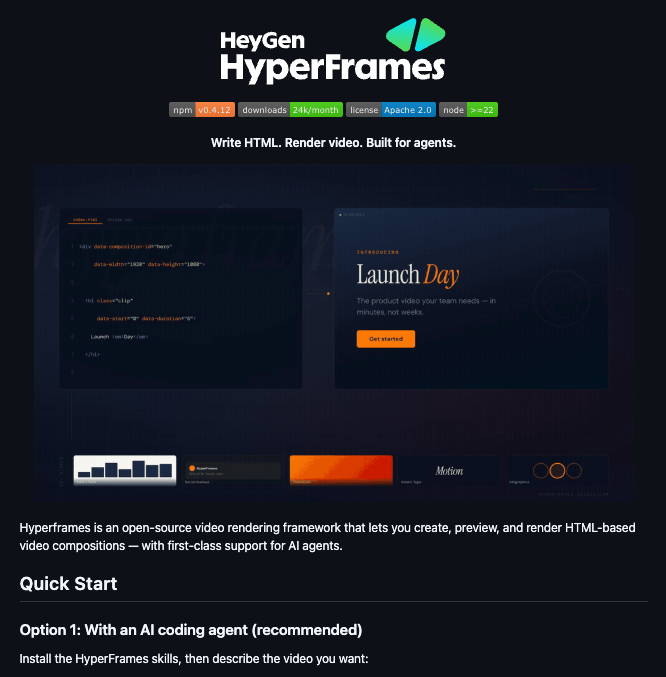
Hyperframes by HeyGen represents a category-creating release: the first video framework designed from day one for AI agents. Every prior video tool assumed a human with a mouse cursor. Hyperframes uses HTML as the composition format, with data attributes defining timing and elements defining layers. It ships agent skills for Claude Code, Cursor, Gemini CLI, and Codex that encode framework-specific patterns. Apache 2.0 license with 24K/month npm downloads at launch.
OpenHarness fills the gap between closed-source Claude Code and minimal custom harnesses. The architecture defines Harness = Tools + Knowledge + Observation + Action + Permissions. It includes 43+ tools, skills compatibility with Anthropic's format, plugin compatibility with claude-code plugins, multi-level permissions (default/auto/plan modes), and ships with ohmo -- a personal agent that works from Feishu, Slack, Telegram, or Discord on existing Claude Code or Codex subscriptions.

6. New and Notable
Devin Reverses Stance on Multi-Agent Systems
@cognition (the company behind Devin) announced (44 likes, 38 bookmarks, 7.2K views) it has implemented multi-agent flows, reversing its CPO's prior public position. @walden_yan qualified the change (14 likes): "many sexy ideas are still impractical, but we've found some setups that actually work." This selective endorsement -- multi-agent for specific flows, not as a general architecture -- marks a significant shift from the largest funded coding agent company.
Open Models Match Frontier Performance Per Dollar in Arena Competition
@SentientAGI published (72 likes, 3.2K views) the Arena Cohort 0 competition results. The top team achieved 69.91% accuracy with MiniMax M2.5 at $1.78/run, versus 80.89% with Claude Opus 4.5 at $55.44/run. The final composite scores were nearly identical (188.11 vs 187.44), demonstrating that harness engineering, prompt density, and skills compensate for model capability gaps at a fraction of the cost.
Qwen3.6 27B Posts Major Coding Agent Benchmark Gains
@leftcurvedev_ reported (16 likes) that Qwen3.6 27B posted substantial gains over Qwen3.5 27B across multiple agent benchmarks: Terminal-Bench 2.0 +42.55%, SkillsBench +77.21%, QwenWebBench +39.23%, NL2Repo +32.60%, and Claw-Eval +12.60%. The release also introduces retained reasoning context from historical messages, reducing overhead in iterative agentic workflows.
ERC-8226 Proposes Regulatory Framework for AI Agent Financial Operations
@Brickken introduced (35 likes) ERC-8226, a framework for compliant agent mandates allowing verified investors to delegate limited on-chain authority to AI agents while preserving KYC, AML, eligibility checks, and issuer control. This is the first concrete Ethereum standards proposal for regulated AI agent operations in financial markets.
MCP Context Bloat Gets a 98.7% Reduction Technique
@ihtesham2005 synthesized Anthropic engineering blog findings: presenting MCP servers as filesystems instead of loading all tool definitions upfront reduced context from 150,000 tokens to 2,000 tokens. Cloudflare independently confirmed the same pattern, calling it "Code Mode" -- letting agents write code to call tools instead of calling tools directly.
7. Where the Opportunities Are
[+++] Agent memory curation systems -- The recursive management problem is the day's highest-view frustration signal (111.5K views). Every agent framework provides memory storage, but none provides intelligent curation -- deciding what is worth remembering, when to forget, and how to prevent irrelevant context from contaminating fresh sessions. A memory system with built-in relevance scoring and automatic pruning that operates within a single agent loop would address the "chasing the dragon" pattern. Sources: @eddiegreenwood_, @_orcaman, @WalrusProtocol.
[+++] Context engineering tooling and services -- Three independent data points confirm massive context waste: InsForge's 2.8x token reduction, Anthropic's 98.7% tool-definition reduction, and Cloudflare's Code Mode pattern. Teams building context optimization layers -- semantic retrieval, filesystem-as-registry patterns, incremental indexing, context compression -- address both cost and reliability. The market is early and fragmented. Sources: @_avichawla, @ihtesham2005, @mdancho84.
[++] Harness benchmarking and evaluation -- The Arena Cohort 0 results show harness quality rivaling model choice in final performance scores, but no public benchmark isolates harness contribution from model contribution. A standardized harness evaluation framework would enable teams to make investment decisions about infrastructure versus model spending. @ethankongee explicitly requested "benchmarks for different tasks and industries." Sources: @SentientAGI, @ethankongee.
[++] Team context persistence for engineering workflows -- Six independent accounts described the same failure: AI coding sessions reset context, decisions die in Slack threads, teams re-explain the same context every sprint. CodeRabbit Agent for Slack is the first shipped product targeting this, but the problem extends beyond Slack to all collaboration surfaces. Sources: @harjotsgill, @carlvellotti, @base10_.
[+] Agent-native video and media creation -- HeyGen's Hyperframes is the first open-source framework designed for agents to create video. The broader pattern: every media creation tool was built for humans with mouse cursors, and agents need native interfaces. Audio (ElevenLabs skills), video (Hyperframes), and image tools designed as agent primitives have immediate demand from the growing UGC automation wave (Higgsfield, Hermes Agent). Sources: @sentient_agency, @ElevenLabsDevs.
[+] Voice agent state management at the tool-call level -- Current voice agent frameworks handle interruption at the audio level but not at the tool-call level, breaking trust when an interrupted agent continues executing pending actions. Cloudflare and LiveKit are investing in this space, but the gap remains open for production voice deployments in customer support and telephony. Sources: @JamesClawn, @Cloudflare, @livekit.
8. Takeaways
-
Three hyperscalers shipped enterprise agent platforms within the same 24-hour window. Microsoft Foundry Agents (persistent microVMs, Entra identity, 1,000+ tools), Google Gemini Enterprise Agent Platform (agent marketplace with Atlassian, Oracle, ServiceNow), and Anthropic's $0.08/hour runtime all target the same layer. The infrastructure pricing compression identified on April 21 is now a three-way race. Sources: @satyanadella, @georgeorch, @aakashgupta.
-
Harness engineering dominates the design conversation with quantified evidence. Arena Cohort 0 showed open-source MiniMax M2.5 with the right harness achieving near-frontier performance at 1/30th the cost of Claude Opus 4.5. JiuwenClaw proposes "Coordination Engineering" as the next abstraction layer. The emerging consensus: harness quality matters more than model selection per dollar. Sources: @SentientAGI, @Vtrivedy10, @Marktechpost.
-
CodeRabbit Agent for Slack produced the largest single-product discourse wave of the day (2,104 likes, 226.8K views on the amplified post). Six independent accounts described the same pain point: AI coding agents fragment engineering context across tools, and teams become the memory layer. Sources: @IndianTechGuide, @harjotsgill, @base10_.
-
Context engineering advanced from measured results to reproducible architecture patterns. Anthropic's own engineering data showed 98.7% context reduction by presenting MCP servers as filesystems. InsForge continued gaining engagement with 2.8x token reduction. The architectural diagram from @mdancho84 codifies the evolution from RAG to agentic context engineering as a three-stage pipeline. Sources: @ihtesham2005, @_avichawla, @mdancho84.
-
Agent memory emerged as the day's highest-frustration unsolved problem. The recursive management pattern -- building agents to manage agent memory -- was described by @eddiegreenwood_ with 111.5K views. No current framework provides memory curation that scales without adding management layers. Source: @eddiegreenwood_.
-
Devin reversed its public stance on multi-agent systems, implementing "specific flows" after 10 months of arguing against them. The qualification matters: multi-agent works for targeted use cases, not as general architecture. This aligns with the day's broader pattern of selective, evidence-based adoption. Sources: @cognition, @walden_yan.
-
Official agent skills repositories launched from Google Cloud (13 products), ElevenLabs (voice isolation), and .NET (three authoring modes). The Crypto Skill Hub catalogs 1,185 skills across 97 MCP servers. The skills ecosystem is moving from community-driven to vendor-curated, with
npx skills addbecoming the standard installation pattern. Sources: @rseroter, @ElevenLabsDevs, @diegoxyz. -
HeyGen open-sourced Hyperframes, the first video rendering framework built for AI agents. HTML in, MP4 out, with skills for Claude Code, Cursor, Gemini CLI, and Codex. Meanwhile, Higgsfield Marketing Studio (Hermes Agent-powered UGC creation) generated multiple high-engagement posts claiming to replace $500/video agency work at $100/month. Source: @sentient_agency.