Twitter AI Agent - 2026-04-26
1. What People Are Talking About
1.1 Anthropic's Four-Layer Production Agent Framework Dominates the Day 🡕
Anthropic's Agents team published a 30-minute talk presenting a four-layer architecture for production-grade multi-agent systems, and it became the day's most amplified topic across multiple high-engagement posts. @cyrilXBT declared (203 likes, 346 bookmarks, 13,155 views): "ANTHROPIC JUST KILLED THE DEMO AGENT ERA. Their Agents team showed exactly what production grade looks like. Not theory. Not a tutorial. A four layer framework for multi agent systems built to actually work in the real world." @RoundtableSpace posted three separate breakdowns totaling over 72K views. @zodchiii framed (41 likes, 58 bookmarks) the talk around an Anthropic team member who "broke his hand and was forced to code without a keyboard for 2 months. He could only talk to an AI agent that wrote and committed code for him."
The commentary was notably skeptical about the "production-grade" label. @orskyai pushed back: "Production grade's a bold claim when latency's still the biggest bottleneck for multi-agent loops. Does this actually solve the token cost spike?" @illmeta168736 replied to the thread: "The 4-layer blueprint is the slide. What these talks rarely show is the failure log -- which agents got pulled mid-production, why, and how long rollback took."
Discussion insight: The talk landed with high engagement (combined 2,700+ likes, 500+ bookmarks across posts) but drew pushback on whether architectural blueprints translate to production reliability. The gap between framework design and actual failure handling is the recurring critique.
Comparison to prior day: April 25's harness engineering theme focused on the discipline itself (quantified 15.7-point harness advantages, Seoul's omocon meetup). April 26 shifts to Anthropic claiming to define what production-grade multi-agent looks like, prompting the community to test whether the framework survives real-world failure modes.
1.2 Anthropic's Agent-to-Agent Commerce Experiment Draws Continued Scrutiny 🡒
Anthropic's Project Deal experiment continued generating discussion on day two. @Pirat_Nation summarized (373 likes, 29,920 views): "Anthropic tested a marketplace for agent-on-agent commerce, giving 69 employees $100 each and let AI agents do all the buying and selling. The agents closed 186 real deals totaling over $4,000. Stronger AI models got better prices and more deals. One agent even bought 19 ping-pong balls for its owner as a self-gift." @TechCrunch covered (28 likes, 11,275 views) the experiment, noting that Anthropic ran four separate marketplaces with different models and found that "when users are represented by more advanced models, they get objectively better outcomes" -- but users didn't notice the disparity.
The replies shifted toward practical concerns. @PointWake25 observed: "Service-biz version is smaller and arrives sooner. One agent books the HVAC tech, another confirms availability and pricing. Trust scales with constrained transactions, not open marketplaces." @micahrmiller13 flagged: "The money part is scary because the permission boundary is vague. Agents should start with constrained budgets and boring repeatable decisions, not open-ended shopping."
Discussion insight: The conversation matured from April 25's inequality framing to practical deployment constraints: budget limits, constrained transaction types, and service-business applications as the entry point rather than open marketplaces.
Comparison to prior day: April 25 surfaced the model-tier inequality angle ("if your landlord runs gpt7 and you run budget-mini"). April 26 adds the practical deployment path: constrained service transactions first, open commerce later.
1.3 Local Agentic Coding Reaches Cloud-Comparable Quality 🡕
Multiple posts demonstrated local coding agents achieving quality comparable to cloud offerings. @paraschopra shared (262 likes, 217 bookmarks, 14,290 views) a working setup: "Qwen 27bn (4bit quant) + Pi coding agent + CCO sandboxing for yolo mode. My Mac M3 has 36GB ram. It's surreal to see a local model read prompt, follow it flawlessly and then build a fully self-contained html/css page with zero errors. ~20 tokens/second, quality similar to Haiku." CCO (github.com/nikvdp/cco) provides OS-native sandboxing for autonomous agent mode without the permission-prompt overhead.
@JulianGoldieSEO outlined (10 likes) a zero-cost local setup: "PI Agent, Ollama, Gemma 4, and Parallel's free web search MCP. Free local coding agent. No monthly bills. Private file editing. Terminal based automation." @AlphaIntelMedia reported that "OpenClaw AI Agent Craze Triggers Mac Mini Shortages and $200+ Resale Premiums" as demand for always-on local agents pushes hardware purchases.
@willdepue connected the dots (50 likes, 9,914 views): "local full-access coding agent was always the right interface, but it's worth noting that the reason that took off so hard is how fucking unbelievably bad code interpreter was executed." @jercarin replied: "Anthropic does this significantly better -- Claude web has full network access through a proxy, whereas GPT can only access approved package managers."
Discussion insight: Local coding agents are crossing the usability threshold. The combination of quantized models (Qwen 27B 4-bit), sandboxing (CCO), and free model routing is enabling a zero-cost stack that competes with paid cloud agents for many tasks. Hardware shortages from always-on agent usage are a tangible demand signal.
Comparison to prior day: April 25 focused on OpenClaw's voice-to-agent handoff and DeepSeek V4 integration as platform advances. April 26 shows individual practitioners assembling local stacks that bypass the platform entirely, with hardware demand as evidence of real adoption.
1.4 Agent Skills Ecosystem Matures with Vertical Specialization 🡕
The agent skills ecosystem continued expanding, with notable movement toward domain-specific skill packs. @tom_doerr shared (60 likes, 69 bookmarks) finance-skills by himself65 -- a collection of agent skills for financial analysis and trading including DCF valuation, earnings analysis, options payoff, and SaaS valuation compression, installed via npx plugins add himself65/finance-skills.
@RhysSullivan packaged (125 likes, 156 bookmarks) his React Miami talk's "good code" section as an agent skill covering branded types, discriminated unions, end-to-end type flow, and OpenTelemetry. He noted candidly: "I don't think it'll actually make a difference when they're writing code since they ignore these things." @bedesqui replied with an observation about the cultural shift: "I like how agents make people share .md files that I read, save, and then read again. Before it took so much for people to publish conventions."
@sharbel profiled (24 likes, 44 bookmarks) the mattpocock/skills collection (22,800+ stars): "grill-me interrogates your plan until every decision is resolved. tdd builds in a red-green-refactor loop. to-prd synthesizes your conversation into a PRD and files it as a GitHub issue." The comparison to paid tools was pointed: "GitHub Copilot: $10/month. Cursor Pro: $20/month. skills: $0. Forever."
Discussion insight: Skills are splitting into two categories: coding-practice skills (TypeScript conventions, TDD workflows) and domain-vertical skills (finance, SEO). The former encode developer opinions; the latter encode domain expertise. Both are distributed as installable .md files, making agent knowledge literally open-source.
Comparison to prior day: April 25 saw skills expansion focused on platform integrations (MotherDuck, DFlow, PancakeSwap). April 26 shows vertical specialization (finance skills, quality-code skills) and the mattpocock/skills package reaching 22,800 stars as the de facto standard.
1.5 Coding Agent Over-Customization Gets Called Out 🡒
@thdxr triggered the day's most-liked post (735 likes, 15,416 views): "you used to spend a day messing with your neovim config, feel self conscious, then get back to work. now people are spending weeks on some hyper customized coding agent workflow that definitely is worse than vanilla but they can talk about it like they're ahead of the game." The post drew 64 replies and 9 quotes.
@iankitxai agreed: "Same energy as spending 3 hours customizing your terminal and calling it productivity. The tool tinkering trap just evolved and now has a much cooler name." @AJalomaki offered the counterpoint: "Only thing that I found is needed is fresh docs after the knowledge cutoff date."
@dosco echoed (17 likes) the sentiment more constructively: "building with LLMs is growing as an area of engineering all by itself. it's part vibes and part engineering. it's not always throwing the biggest model at the largest prompt. your prompt and harness should be inline with the expectations of the model."
Discussion insight: The 735-like count -- highest raw engagement in the dataset -- reveals deep resonance with the meta-frustration. The "tool tinkering trap" framing suggests a bubble in agent customization where the time investment exceeds the productivity gains. This tension between customization and shipping is the defining cultural split in the coding agent community.
Comparison to prior day: April 25 celebrated harness engineering as a serious discipline (meetups, quantified results). April 26's most-liked post calls out the opposite extreme: customization as procrastination.
1.6 Harness Engineering Research Produces Open-Source Tools 🡕
Stanford open-sourced the Meta-Harness framework, and new research quantified harness engineering advantages. @AlphaSignalAI reported (39 likes, 57 bookmarks): "Stanford just turned the Meta-Harness paper into open source code. It's a framework that automatically optimizes the scaffolding around a fixed base model. Think memory, retrieval, and context decisions. The proposer read a median of 82 files before each new attempt." The repo (stanford-iris-lab/meta-harness) ships with reference experiments for text classification and Terminal-Bench 2.0.
@daniel_mac8 cited (15 likes) the ClawEnvKit paper (arXiv:2604.18543): "Harness engineering is a serious engineering discipline. In ClawEnvKit, the best structured harness beat a bare ReAct loop by 15.7 points. The AI frontier is not just models. It is model + harness." The paper from UMD, UC Berkeley, UCLA, and MBZUAI introduces an automated pipeline for generating 1,040 evaluation environments across 24 categories.
@_vmlops shared (343 likes, 469 bookmarks, 15,906 views) an "AI Harness Engineering Interview Preparation Handbook" covering Runtime, Control Layer, Guardrails, MCP, Evals, and Observability. The 469-bookmark count -- highest in the dataset -- signals practitioners saving this for career preparation.
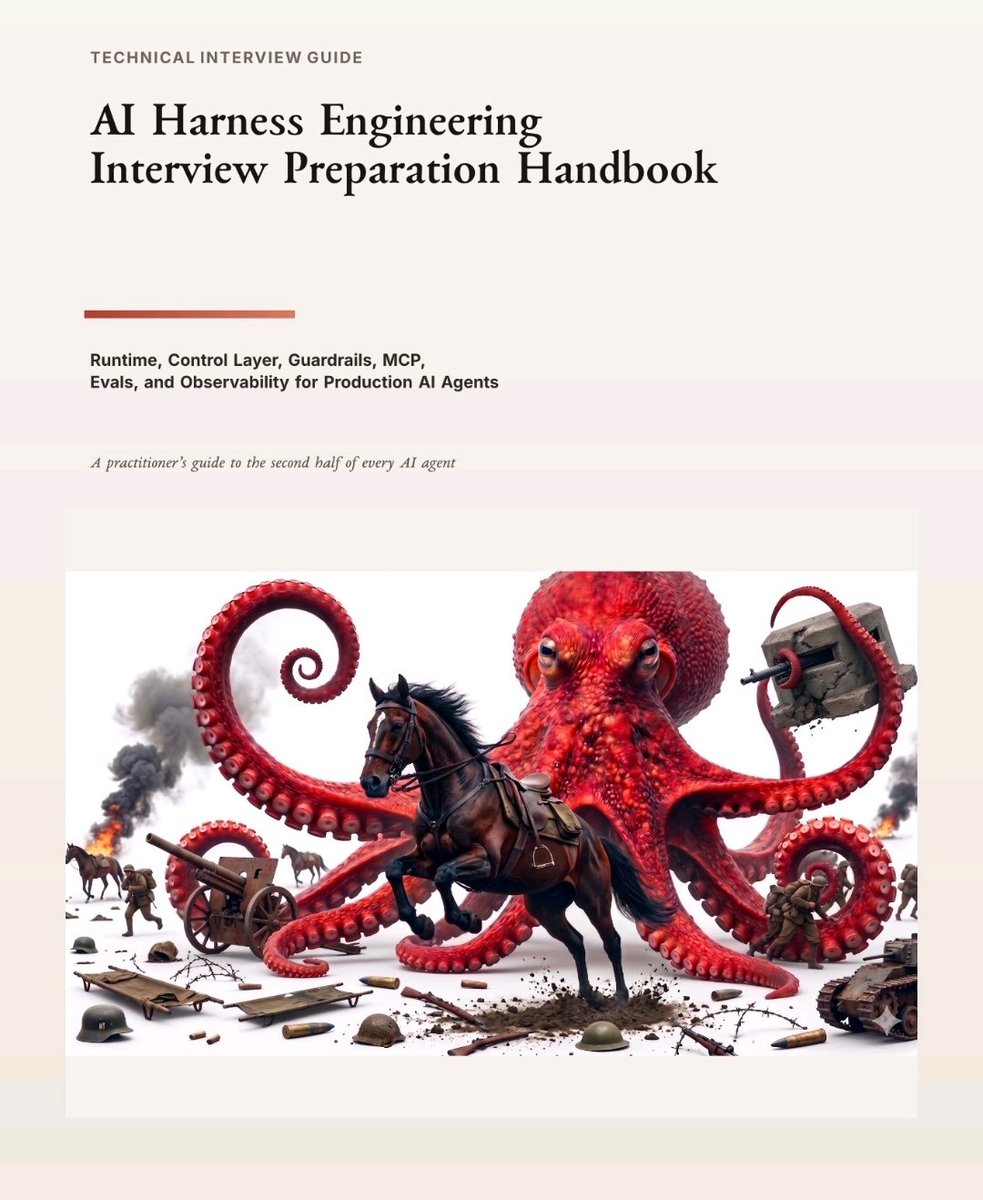
Discussion insight: Harness engineering is producing both research artifacts (Meta-Harness, ClawEnvKit) and career infrastructure (interview handbooks). The 469-bookmark interview guide and the 15.7-point quantified advantage together signal that this is moving from emerging practice to recognized engineering subdiscipline.
Comparison to prior day: April 25 saw harness engineering solidify with Seoul's omocon meetup and codified best practices. April 26 adds Stanford's open-source framework, a new benchmark paper, and an interview handbook -- the research and career infrastructure that formalize a discipline.
1.7 Context Engineering and Token Optimization Gain Traction 🡕
Context management emerged as a distinct concern. @mksglu announced (14 likes) context-mode v1.0.90 with 10K+ GitHub stars and 82K npm downloads: "Your AI coding agent spends most of its context window re-sending tool output it already processed. context-mode intercepts the output, indexes it into a local FTS5 database, gives the agent a 1KB summary instead." Real session results: 86.5% token reduction (29.6 MB to 4.0 MB), 6.7M tokens saved. The tool now supports 14 platforms including Qwen Code and JetBrains Copilot.
@PawelHuryn quoted (10 likes, 12 bookmarks) Anthropic's engineering blog: "building with LLMs is becoming less about finding the right words and phrases, more about what configuration of context and memory and tools you give the model." @HanchungLee shared slides on "context engineering and agentic memory for zoomers."
Discussion insight: The reframing from "prompt engineering" to "context engineering" is accelerating. context-mode's 82K downloads and 86.5% token reduction demonstrate that context management is a solved problem at the tool level -- the gap is in agent frameworks natively integrating these optimizations.
Comparison to prior day: April 25 discussed persistent agent memory as an unmet need (Obsidian second brain, markdown distillation). April 26 shows context-mode delivering measurable token savings at scale, shifting the conversation from memory persistence to context efficiency.
2. What Frustrates People
Agent Customization as Procrastination -- Severity: High
@thdxr captured (735 likes) the dominant frustration: developers spending weeks building "hyper customized coding agent workflow that definitely is worse than vanilla." The post resonated because it names a behavior everyone recognizes. The 64 replies and 9 quotes suggest this is a lived experience, not theoretical concern. The underlying tension: the skills and harness ecosystem encourages customization, but there is no way to measure whether a custom setup actually outperforms defaults.
Prevalence: Widespread -- this is the day's highest-engagement post and a cultural inflection point.
Code Interpreter Remains Broken While Local Agents Thrive -- Severity: Medium
@willdepue reported (50 likes): "tried today: cant download packages, dies and wipes itself, errors." @jercarin contrasted: "Anthropic does this significantly better. Claude web has full network access through a proxy, whereas GPT can only access approved package managers." The frustration is structural: OpenAI's sandboxed code interpreter lags behind both local agents and Anthropic's approach.
Prevalence: Recurring -- code interpreter complaints have persisted across multiple days.
No Personal Agent Checks All Boxes -- Severity: Medium
@petergyang listed (109 likes, 113 bookmarks) seven requirements for a personal agent (cross-app, proactive, memory, multimodal, multi-platform, messaging, personality) and found "none of them check all these boxes." Specific gaps: Claude Code requires /remote-control each time on mobile and doesn't notify when routines fail; Codex lacks mobile entirely; OpenClaw is unreliable and "power users have to get Codex/Claude Code to fix it on a semi-regular basis."
Prevalence: Active -- the personal agent gap is widening as individual capabilities improve but integration remains fragmented.
3. What People Wish Existed
Coding Agent Customization Benchmarks
The tension between @thdxr's "worse than vanilla" critique and the harness engineering community's quantified advantages (15.7 points over ReAct) reveals a gap: there is no standard way for individual developers to measure whether their custom agent setup actually outperforms defaults for their specific workflow. ClawEnvKit benchmarks exist for research but not for personal productivity measurement.
Urgency: High -- Opportunity: [++]
Unified Personal Agent Across Devices and Apps
@petergyang (113 bookmarks) defined the spec: email, calendar, Google Workspace, proactive cron jobs, persistent memory, text/voice/video switching, messaging app reachability, personality. No product delivers this. Claude Code is closest on routines but code-centric; OpenClaw is closest on integration breadth but unreliable. The high bookmark count signals developers saving this as a product requirement spec.
Urgency: High -- Opportunity: [+++]
Agent-Native Project Management
@tom_doerr shared Agent Kanban (github.com/saltbo/agent-kanban) -- a task board where agents are first-class team members with cryptographic identity, roles, and self-organization. This addresses the coordination gap: agents can write code but cannot collaboratively plan, assign, and review work with humans and other agents in a shared workspace.
Urgency: Medium -- Opportunity: [++]
Native Agent Framework Token Optimization
@mksglu's context-mode delivers 86.5% token reduction as an external MCP server, but no major agent framework natively integrates similar context interception. The tool's 82K npm downloads and 14-platform support demonstrate demand. Frameworks that build context compression into their core loop (rather than requiring an external plugin) would reduce costs by default.
Urgency: Medium -- Opportunity: [++]
4. Tools and Methods in Use
| Tool / Method | Category | Sentiment | Strengths | Limitations |
|---|---|---|---|---|
| Anthropic Multi-Agent Framework | Agent architecture | Positive | Four-layer production blueprint, state management, failure handling | No public repo yet; community skeptical about production readiness |
| mattpocock/skills | Agent skills | Positive | 22,800+ stars, MIT, grill-me/tdd/to-prd workflows, free | Author admits agents "ignore these things" in practice |
| context-mode | Context optimization | Positive | 86.5% token reduction, 10K stars, 82K npm downloads, 14 platforms | External plugin; not natively integrated into frameworks |
| CCO (cco) | Agent sandboxing | Positive | OS-native sandboxing for Claude Code/Codex, Docker fallback, minimal overhead | Limited to Unix-like systems for native sandbox |
| Meta-Harness (Stanford) | Harness optimization | Positive | Automated scaffold search, median 82 files read per attempt, MIT licensed | Research-stage; two reference experiments only |
| ClawEnvKit | Agent benchmarking | Positive | 1,040 environments, 24 categories, 15.7-point harness advantage quantified | Academic benchmark; not packaged for practitioner use |
| finance-skills | Vertical agent skills | Positive | DCF valuation, earnings, options payoff, SaaS compression | Educational disclaimer; not financial advice |
| Hermes Agent v0.11 | Agent framework | Positive | Ink-based TUI, unlimited sub-agent depth, AWS Bedrock, plugin system | Early adoption; ecosystem smaller than OpenClaw |
| OpenRouter create-headless-agent | Agent tooling | Positive | Headless CLI agent via Bun, multi-model support | Requires Bun runtime |
| Agent Kanban | Agent coordination | Positive | Cryptographic agent identity, self-organizing teams, task board UI | FSL license; early stage |
5. What People Are Building
| Project | Who built it | What it does | Problem it solves | Stack | Stage | Links |
|---|---|---|---|---|---|---|
| Meta-Harness | Stanford IRIS Lab | Automated optimization of model harnesses via coding agent proposer | Manual harness tuning doesn't scale | Python, Claude Code | Shipped | post |
| ClawEnvKit | UMD, UC Berkeley, UCLA, MBZUAI | Automatic environment generation for agent evaluation | Manual environment creation bottleneck | Python, 1,040 environments | Shipped | post |
| finance-skills | @himself65 | Agent skills for financial analysis: valuation, earnings, options | No standardized finance skills for coding agents | Agent Skills standard, yfinance | Shipped | post, repo |
| quality-code skill | @RhysSullivan | TypeScript best practices as installable agent skill | Agents ignore coding standards by default | Skills format, npx | Shipped | post, repo |
| Agent Kanban | @saltbo | Agent-first task board with cryptographic identity and self-organization | No shared workspace for agent-human collaboration | React, Ed25519 | Shipped | post, repo |
| Vibe-Trading | HKU DS Lab | Multi-agent crypto trading via natural language | Manual trading strategy execution | Python 3.11, FastAPI, React, 71 skills | Shipped | post, repo |
| Claude Code System Prompts | @aiandchai | Open-sourced reverse-engineered Claude Code prompts | Opaque agent behavior; no reference for custom implementations | MIT, Markdown | Shipped | post |
| context-mode v1.0.90 | @mksglu | MCP server intercepting tool output for 86.5% token reduction | Context window waste from re-sending processed output | FTS5, MCP, 14 adapters | Shipped | post |
| SEO Agent | @learnwithella | Full SEO loop: GSC gap analysis, competitor scraping, content writing, rank tracking | Manual SEO workflows and expensive subscriptions | Claude Code, GSC, Apify | Shipped | post |
| create-headless-agent | @OpenRouter | Skill for building headless multi-model CLI agents | Gap between demo UIs and production automation pipelines | Bun, OpenRouter Agent SDK | Shipped | post |
| GStack | @garrytan | Opinionated coding agent tools for Claude Code | Default agent behavior lacks structured workflow | Open source, Claude Code | Shipped | post |
Mind DeepResearch by HuggingPapers deserves special note: a three-agent architecture (Planning Agent, Search Agent Swarm, Report Agent) that rivals massive models with just 30B parameters using a four-stage training pipeline. @HuggingPapers reported (30 likes, 17 bookmarks) it achieves "leading results on deep research benchmarks while significantly reducing computational costs."

6. New and Notable
AI Harness Engineering Interview Handbook Signals Career Formalization
@_vmlops shared (343 likes, 469 bookmarks) an interview preparation handbook for AI harness engineering covering Runtime, Control Layer, Guardrails, MCP, Evals, and Observability. The 469-bookmark count -- highest in the entire dataset -- indicates practitioners are treating harness engineering as a career-defining skill worth studying for. When a discipline gets its own interview prep guide, it has crossed from emerging practice to recognized specialty.
Signal strength: [++]
Coding Agent Customization Backlash Hits 735 Likes
@thdxr (735 likes, 15,416 views) compared weeks spent on custom coding agent workflows to the old neovim config tinkering -- "definitely worse than vanilla but they can talk about it like they're ahead of the game." This is the highest raw like count in the day's dataset and represents a cultural correction within the agent community. The backlash may signal peak agent-customization hype.
Signal strength: [++]
Coding Agent to General Agent Trajectory Articulated by Vercel VP
@leerob (Lee Robinson, Vercel) observed (130 likes, 10,653 views): "It wasn't obvious to me one year ago that an excellent coding agent would also be the path to a general agent for all knowledge work. But now it makes a lot of sense." @CausalEngineer replied: "Coding is a domain, and it is also the most testable form of knowledge work. Once agents learn to plan, use tools, debug, and verify inside software, the same pattern naturally extends to other fields."
Signal strength: [+]
100-Repo Claude Code Ecosystem Compilation
@alphabatcher compiled (41 likes) 100 repositories for Claude Code, highlighting: superpowers by obra (TDD workflows), claude-context-mode (98% token reduction on massive codebases), claude-flow (enterprise multi-agent orchestration), and repomix (codebase packing). The gap between basic and power-user Claude Code setups is widening into what looks like a two-tier developer ecosystem.
Signal strength: [+]
Agentic Context Engineering Presented at ICLR 2026
@lihanc02 gave a talk (20 likes) on "Agentic Context Engineering (ACE)" at the Lifelong Learning Agent workshop at ICLR 2026. The academic community formalizing context engineering as a research area validates the practitioner movement from prompt engineering to context engineering.
Signal strength: [+]
7. Where the Opportunities Are
[+++] Unified personal agent platform -- @petergyang defined seven requirements (cross-app work, proactive behavior, persistent memory, multimodal input, multi-platform, messaging reachability, personality) and found no product delivers all of them. The 113-bookmark count suggests developers are treating this as a product spec. Claude Code, Codex, and OpenClaw each cover different subsets. Whoever integrates these into a coherent cross-device experience captures the personal agent market.
[++] Agent customization measurement -- The tension between @thdxr's 735-like "worse than vanilla" critique and ClawEnvKit's 15.7-point harness advantages reveals a gap: no standard benchmark lets individual developers measure whether their custom setup actually helps. A personal-productivity benchmark for coding agents (not just research benchmarks) would resolve the customization-vs-shipping debate with data. Sources: @thdxr, @daniel_mac8.
[++] Vertical agent skill packs -- finance-skills (himself65) demonstrates that domain expertise packaged as agent skills creates immediate value. Legal, healthcare, DevOps, and marketing verticals lack equivalent standardized skill packs. The Agent Skills open standard and npx skills add distribution pattern make creation and adoption low-friction. Sources: @tom_doerr, @RhysSullivan.
[++] Agent-to-agent commerce infrastructure -- Anthropic's Project Deal (186 deals, $4,000+) demonstrated agent commerce works. No standard protocol exists for agent negotiation, settlement, or dispute resolution. The practical entry point is constrained service transactions (booking, pricing confirmation) rather than open marketplaces. Sources: @Pirat_Nation, @TechCrunch.
[+] Native context optimization in agent frameworks -- context-mode's 82K npm downloads and 86.5% token reduction prove demand. No major agent framework natively integrates context interception and compression. The tool exists as an external MCP server across 14 platforms; the opportunity is building it into framework cores so developers get token savings by default. Sources: @mksglu.
8. Takeaways
-
Anthropic's four-layer production agent framework dominated April 26, generating 2,700+ combined likes and 500+ bookmarks across multiple posts, but drew pointed skepticism about whether architectural blueprints translate to production reliability. The community wants failure logs, not layer diagrams. (source, source)
-
The day's highest raw engagement (735 likes) went to a post calling out coding agent customization as the new neovim config tinkering -- "definitely worse than vanilla." This cultural backlash may signal peak customization hype, even as the harness engineering discipline formalizes with interview handbooks (469 bookmarks) and Stanford research. (source, source)
-
Local agentic coding reached cloud-comparable quality: Qwen 27B (4-bit) + Pi + CCO sandboxing achieves Haiku-level quality at 20 tokens/sec on a Mac M3, with Mac Mini shortages and $200+ resale premiums as tangible demand evidence. (source, source)
-
Agent skills split into two categories: coding-practice skills (TypeScript conventions at 22,800 stars) and domain-vertical skills (finance analysis via Agent Skills standard), both distributed as installable markdown files that make agent knowledge literally open-source. (source, source)
-
Anthropic's Project Deal discussion matured from inequality framing to practical deployment: constrained service transactions (HVAC booking, pricing confirmation) as the entry point for agent commerce, not open marketplaces. (source, source)
-
Stanford open-sourced Meta-Harness, a framework where a coding agent reads a median of 82 files per attempt to automatically optimize model scaffolding, while ClawEnvKit quantified that the best harness beats bare ReAct by 15.7 points across 1,040 generated environments. (source, source)
-
context-mode hit 10K GitHub stars and 82K npm downloads with 86.5% token reduction across 14 platforms, demonstrating that context optimization is a solved problem at the tool level -- but no major framework natively integrates it. (source)
-
No personal agent product checks all seven boxes defined by @petergyang (113 bookmarks): cross-app, proactive, memory, multimodal, multi-platform, messaging, personality. Claude Code, Codex, and OpenClaw each fail on different dimensions. The unified personal agent remains the largest unclaimed product opportunity. (source)