Twitter AI Agent - 2026-05-31
1. What People Are Talking About
1.1 Harness engineering became a product spec, not just a concept 🡕
The core AI-agent conversation on May 31 was about where capability actually lives. The answer repeated across posts was "the harness": prompts, skills, filesystem, orchestration, memory, hooks, and verification layers around the model. Four retained items supported this theme.
@byanujpatel shared (200 likes, 11,057 views, 261 bookmarks) LangChain's public harness engineering article. The post defines "Agent = Model + Harness" and treats prompts, tools, filesystem, orchestration logic, hooks, and sandboxing as the code that turns model intelligence into useful work.
@pallavishekhar_ mapped (79 likes, 4 replies, 4,712 views, 114 bookmarks) a progression from memory and ReAct loops all the way to observability and harness engineering. The most useful reply argued that harness engineering is not "step 16" after everything else; it is the box the other topics sit inside.
@RoundtableSpace claimed (150 likes, 17 replies, 55,244 views, 41 bookmarks) that Claude Code can detect complex tasks, write orchestration logic, and spin up an agent swarm automatically. The replies turned that demo into a checklist: visible plan, isolated workstreams, verification, failure evidence, and cost visibility.
Discussion insight: "Harness engineering" stopped being a label for experts and started functioning like a practical buying and design checklist.
Comparison to prior day: May 28 gave harness engineering a public canon. May 31 treated it as the default architecture vocabulary for serious agent work.
1.2 Default skill bloat and context spend became the main optimization fight 🡕
The loudest practical dispute was not whether agents need skills, but how many should be enabled by default and how much attention those skills consume every turn. Three retained items supported this theme.
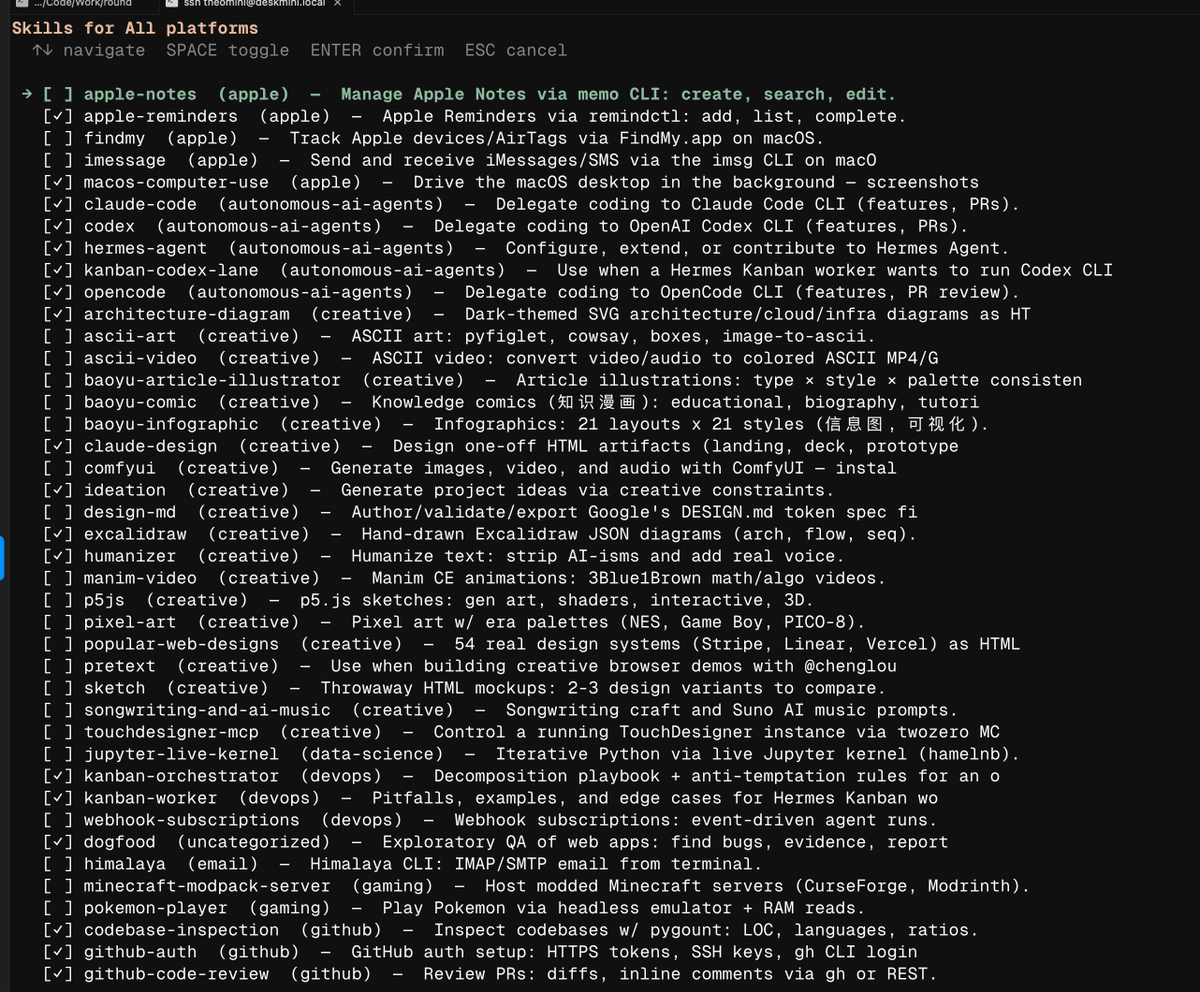
@theo complained (597 likes, 107 replies, 68,779 views, 204 bookmarks) that Hermes Agent shipped with more than 100 pre-enabled skills, including many unrelated to his work. His clarifying reply said the problem was not only menu clutter but that some skills had already fired where they should not have.
@steipete countered (139 likes, 23 replies, 18,939 views) that OpenClaw should stay modular and lean: only add what you need. The most informative replies said smaller tool lists are not only faster but more accurate because they cut wrong-tool picks, decision noise, and permission risk.
@RoundtableSpace argued (71 likes, 14 replies, 46,561 views, 37 bookmarks) that swapping in a different skills-and-CLI stack reduced Claude Code token use from 10.4 million to 3.7 million and errors from 10 to 0. The replies immediately demanded stronger evidence: same task, same acceptance tests, same reasoning load.
Discussion insight: The day's optimization target was not "make the agent more powerful." It was "make the default surface smaller, cheaper, and easier to inspect."
Comparison to prior day: May 28 still treated skill systems as expanding assets. May 31 sounded more like pruning, routing, and scope control.
1.3 Builders kept shipping orchestration stacks, but trust hinged on inspectability 🡕
New projects kept appearing, but they only felt persuasive when they paired orchestration with reviewability, trace ownership, or live supervision. Four retained items supported this theme.
@tom_doerr shared (123 likes, 5 replies, 6,101 views, 129 bookmarks) EpicStaff, a self-hosted orchestration platform for operations teams. The public repo says it is a Django-backed visual editor with MCP/Python integrations and persistent context through Redis/PostgreSQL, while the replies argued that self-hosting still needs per-action approval logs and good postmortem visibility.
@tom_doerr also shared (20 likes, 1,491 views, 25 bookmarks) Spring AI Alibaba's DeepResearch stack. The public repo describes multi-agent planning, online search, Hybrid RAG, reflection, HITL, secure sandboxing, and report generation.

@eliautobot posted (9 likes, 1,720 views, 15 bookmarks) a self-hosted "virtual office" for OpenClaw. The public repo turns agent activity into a retro pixel-art office with live status, activity logs, and API-usage views so people can see what their agents are doing instead of staring only at logs.
@ClementDelangue asked (51 likes, 10 replies, 4,817 views) for more public coding and agent traces to improve open models. The quoted Simon Willison complaint about Codex losing transcript export, plus replies about regulated production data, made the missing governance layer obvious: even when traces exist, operators may not control or be able to share them.
Discussion insight: Self-hosting and multi-agent orchestration are not enough on their own. The missing layer is inspectability: approval logs, trace export, visual oversight, and privacy-respecting datasets.
Comparison to prior day: May 28 emphasized shared state and continuity for persistent agents. May 31 added concrete products for operations teams and visual supervision, while exposing trace ownership as the unresolved bottleneck.
2. What Frustrates People
Default skill bundles create noise, wrong-tool picks, and permission risk
Severity: High. @theo showed (597 likes, 107 replies, 68,779 views, 204 bookmarks) a Hermes setup with more than 100 pre-enabled skills and said some had already fired where they should not have. @steipete answered (139 likes, 23 replies, 18,939 views) that lean, opt-in capability surfaces work better, and the replies explained why: pre-enabled skills add context the model has to read every turn, which increases decision noise and permission risk. People are coping by disabling skills, choosing more modular frameworks, or rebuilding their tool surface from scratch. This is worth building for because the pain is immediate and measurable in both mistakes and operator trust.
Token and error savings claims need stronger evidence than demo rhetoric
Severity: Medium-High. @RoundtableSpace claimed (71 likes, 14 replies, 46,561 views, 37 bookmarks) a 3x token reduction and error drop after changing context setup, but the top reply asked whether the comparison used the same task and acceptance tests. Another reply reported burning 400,000 tokens in a single error loop. The feed was not rejecting optimization claims; it was demanding reproducible ones. This is worth building for because teams increasingly treat context engineering as budget management, and they want evidence that survives reruns rather than screenshots alone.
Valuable agent traces are hard to export, own, or share
Severity: High. @ClementDelangue called (51 likes, 10 replies, 4,817 views) for more public traces, but the thread immediately hit two barriers: regulated production data cannot be shared freely, and transcript export can disappear from products without warning. The quoted Simon Willison complaint about Codex losing "Copy as Markdown" made the ownership issue concrete. People are coping with opt-in contributions, ad hoc exports, or whatever repositories they can share while they still control them. This is worth building for because trace data is simultaneously a model-improvement asset, an audit artifact, and a lock-in surface.
Self-hosting alone does not solve trust for operations teams
Severity: Medium-High. @tom_doerr promoted (123 likes, 5 replies, 6,101 views, 129 bookmarks) self-hosted orchestration for ops, but the replies immediately asked who can inspect the mess after a failure and whether every action can be reviewed. The visible workaround is manual approval, external logs, or choosing simpler systems with clearer evidence trails. This is worth building for because operations buyers care about what happened after something breaks, not only where the binary ran.
3. What People Wish Existed
Lean, opt-in skill surfaces
The strongest product ask was not "give me more skills." It was "start small and let me add only what maps to my work." Theo's Hermes complaint and Steipete's OpenClaw reply together made that desire explicit. Opportunity: direct. Users are already manually pruning surfaces to get the behavior they want.
Inspectable orchestration
Visible plans, isolated workstreams, failure evidence, per-action approval, and cost reporting appeared repeatedly in replies to Dynamic Workflows and EpicStaff. The demand is for agents that leave a clean paper trail, not just impressive output. Opportunity: direct. This is a practical requirement for production usage.
Privacy-preserving trace export and dataset contribution
The trace-sharing thread made clear that people want to contribute data without giving up customer privacy or product control. Existing Hugging Face trace collections are a start, but the feed showed no broadly adopted answer for regulated or vendor-locked contexts. Opportunity: competitive. The need is obvious, but the solution space is crowded with privacy, compliance, and platform questions.
4. Tools and Methods in Use
| Tool | Category | Sentiment | Strengths | Limitations |
|---|---|---|---|---|
| Hermes Agent | Agent framework | (+/-) | Comes ready with many capabilities and generated skills | Default surface is so broad that users reported wrong-tool fires and too much menu/context noise |
| OpenClaw | Agent framework | (+) | Modular, lean, and easy to tailor to the job | Requires more deliberate setup than "everything enabled" packages |
| Harness engineering patterns | Method | (+) | Provides a shared language for prompts, skills, filesystem, orchestration, hooks, and sandboxing | Can remain abstract unless tied to observable plans, logs, and failure evidence |
| EpicStaff | Orchestration platform | (+/-) | Self-hosted visual editor, Django backend, persistent context, MCP/Python integrations | Self-hosting does not itself answer per-action review and approval needs |
| DeepResearch | Research-agent stack | (+) | Multi-agent planning, search, Hybrid RAG, reflection, HITL, secure sandbox, report generation | Early public traction was lower than for higher-level discourse about harnesses |
| My Virtual Office | Observability layer | (+) | Turns invisible agent work into live status, activity, and API-usage views | Early-stage and niche, with low discussion volume so far |
Overall sentiment favored tools that reduce ambiguity around what the agent can do, what it actually did, and what it cost. Migration pressure ran from broad default bundles toward leaner, more inspectable setups. The biggest unsolved gap was not another framework feature but operator ownership of evidence trails and traces.
5. What People Are Building
| Project | Who built it | What it does | Problem it solves | Stack | Stage | Links |
|---|---|---|---|---|---|---|
| EpicStaff | EpicStaff | Self-hosted visual platform for AI flows owned by operations teams | Ops teams need reviewable agent workflows without handing everything to engineers or opaque SaaS | Django backend, Python logic, MCP integration, Redis/PostgreSQL persistence | Beta | repo |
| DeepResearch | Spring AI Alibaba | Multi-agent research system that plans, searches, reasons, and generates reports | Complex research/reporting tasks need orchestration, retrieval, reflection, and sandboxed analysis in one stack | Java 17, Spring Boot 3.4, Spring AI, Hybrid RAG, Docker sandbox, Tavily/Jina/Aliyun search | Beta | repo |
| My Virtual Office | eliautobot | Retro pixel-art browser workspace that visualizes OpenClaw agent activity in real time | Agent work is hard to supervise when it only appears as logs and terminal output | Self-hosted browser UI, OpenClaw integration, live status/activity/API views | Beta | repo |
EpicStaff stood out because it targets operations teams directly, not just AI engineers. The most important reaction was that self-hosting is table stakes once agents touch operations, but buyers still want per-action approval and inspect-after-breakage workflows.
DeepResearch stood out because it bundles many of the harness components the discourse keeps naming separately: search, memory, reflection, secure execution, and report output. The architecture image made the stack legible in a way the text alone would not.
My Virtual Office mattered as a smaller but revealing pattern: as agents spread, some builders are solving the observability problem with human-friendly metaphors instead of more dashboards and raw logs.
6. New and Notable
Trace export became a policy surface, not just a convenience feature
@ClementDelangue made (51 likes, 10 replies, 4,817 views) public trace sharing a model-quality issue, while the quoted Simon Willison complaint about disappearing transcript export turned it into a product-governance issue. That combination made trace ownership look like one of the next battlegrounds in agent tooling.
Visual supervision emerged as a legitimate agent UX
@eliautobot showed (9 likes, 1,720 views, 15 bookmarks) a retro office for OpenClaw agents, and the public repo's dashboard features made the concept more than a joke. The underlying message was serious: people want agent work to be easier to inspect than a stream of terminal logs.
7. Where the Opportunities Are
[+++] Inspectable orchestration and trace export — RoundtableSpace's Dynamic Workflows thread, EpicStaff's feedback thread, and Clement Delangue's trace-sharing post all converge on one missing layer: plans, actions, failures, and transcripts that operators can actually own and review.
[++] Lean capability management — Theo's Hermes complaint and Steipete's OpenClaw response show a direct need for task-scoped skill packs, clearer defaults, and better visibility into what is loaded and why.
[+] Visual supervision for agent teams — My Virtual Office's launch tweet suggests there is room for products that make agent behavior legible in real time without assuming users want to read raw logs all day.
8. Takeaways
- Harness engineering is now the shared systems language for serious agent work. The LangChain article, Pallavi Shekhar's map, and Dynamic Workflow discussion all treated prompts, tools, memory, orchestration, and hooks as one design surface. (source)
- The community is pushing back on bloated default skill surfaces. Theo's Hermes screenshot and Steipete's OpenClaw response turned "fewer tools" into a concrete reliability argument, not a stylistic preference. (source)
- New agent products only felt credible when they exposed how work can be reviewed. EpicStaff, DeepResearch, and My Virtual Office all drew attention because they promised some combination of visual flows, architecture clarity, or live supervision. (source)
- Trace ownership is becoming as important as model quality. The request for public traces collided immediately with privacy limits and disappearing export features, showing that data access is now a core product and governance issue. (source)