Twitter AI Agent - 2026-06-03
1. What People Are Talking About
1.1 Harness engineering stayed central, but the discussion got more prescriptive 🡒
The strongest conversation still treated the model as only one layer in a larger system. What changed from June 2 was tone: instead of introducing the context-memory-harness vocabulary, builders used it to tell people what to stop learning, what to study instead, and where complexity should actually live. Five retained items supported this theme.
@DataChaz argued (272 likes, 25 replies, 36,443 views, 415 bookmarks) that the pieces likely to compound are context engineering, tool design, orchestrator-subagent patterns, eval discipline, MCP, and a "harness > model" mindset. The replies made the bar more concrete: builders said eval discipline is the quiet separator, and that a harness needs crash recovery, session resume, and an audit trail before the rest of the stack matters.
@sairahul1 made the same case (155 likes, 18 replies, 37,968 views, 254 bookmarks) more aggressively, listing AutoGen, CrewAI, agent marketplaces, benchmark leaderboards, and horizontal "build any agent" platforms on the "dead list" while repeating that context engineering, tool design, eval discipline, MCP, and the harness mindset are what survive framework churn. The most useful reply said the fragile part is exactly the generic "build any agent" layer, while taste and evals outlast it.
@_avichawla reframed (34 likes, 6 replies, 2,749 views, 37 bookmarks) the same idea as an architecture problem: the model stays deliberately thin while the harness externalizes memory, skills, protocols, and mediators such as observability, approval loops, and evaluation. A reply pushed the implication even farther, saying prompt logs are not enough; teams need to replay the full composed runtime to debug failures.
@joaomdmoura summarized (21 likes, 1 reply, 2,611 views) the operational version of that argument: there is no simple agent system, only a choice of where the complexity lives. His advice was to keep orchestration simple and push complexity into tooling, observability, and testing where constant iteration hurts less.
@adxtyahq collected (152 likes, 4 replies, 3,785 views, 268 bookmarks) a learning path around RAG, agentic RAG, Anthropic's Building Effective Agents, LangGraph, MCP, memory systems, and evals, while explicitly telling readers to skip "build an AI agent in 10 minutes" videos. That resource list mattered because it turned the day's anti-hype mood into a concrete study canon.
Discussion insight: The replies were less interested in model choice than in what makes a harness inspectable: evals, replayable runtime state, recovery, and receipts.
Comparison to prior day: June 2 established context, memory, and harness as the shared vocabulary. June 3 treated that vocabulary as settled and shifted toward design rules, reading lists, and warnings about putting too much complexity into orchestration.
1.2 Skills stopped looking like static prompts and started looking like trainable, governed, and installable assets 🡕
The skills conversation moved past "write a reusable prompt" and toward three harder questions: can skills be optimized with evidence, can they be reviewed before they change future behavior, and can they be distributed through real product surfaces. Five retained items supported this theme.
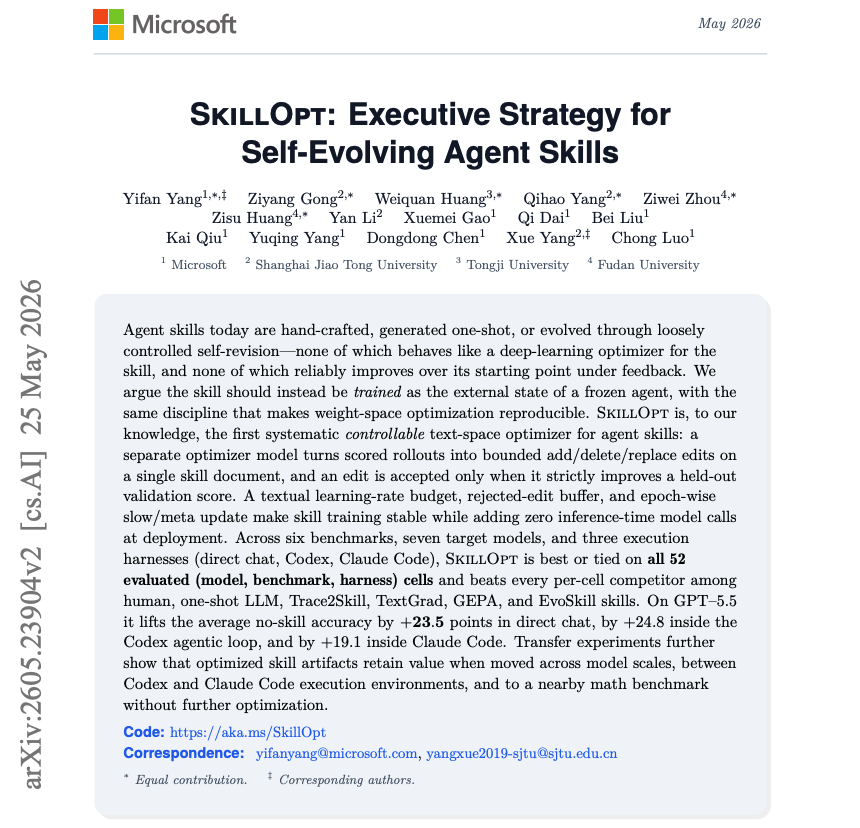
@omarsar0 reported (130 likes, 22 replies, 9,487 views, 223 bookmarks) that Microsoft's SkillOpt paper looked more credible after he integrated it into his own orchestrator and saw better results. The attached teaser and the public paper both made the novelty specific: treat the skill as external state for a frozen agent, use a separate optimizer model to propose bounded add/delete/replace edits, and accept changes only when held-out validation improves.
@openclaw introduced (60 likes, 9 replies, 5,051 views, 37 bookmarks) Skill Workshop as a way to turn repeated work into reviewable proposals instead of silently rewriting future runs. The linked blog post and docs showed a proposal-first workflow where generated skills remain PROPOSAL.md drafts until a human tweaks, applies, rejects, or quarantines them.
@grabbou showed (11 likes, 1 reply, 1,181 views, 8 bookmarks) that Codex can now add external marketplaces directly from GitHub repos, then load Callstack's React Native skills into the UI. The screenshots made the distribution surface explicit: one modal adds a marketplace from callstackincubator/agent-skills, and another shows browsable, runnable React Native review and QA skills inside the product.


@VaibhavSisinty highlighted (28 likes, 3 replies, 2,112 views, 38 bookmarks) Everything Claude Code as an installable stack with 38 specialized agents, 156 skills, 72 commands, and a security scanner with 1,282 tests. The screenshot mattered because it showed both selective install commands and the role split inside the bundle: planner, security reviewer, TypeScript reviewer, code reviewer, and debugger.
Discussion insight: The disagreement was not about whether skills help. It was about how much autonomous learning should be allowed before a human checkpoint, and whether skill quality can be measured rather than assumed.
Comparison to prior day: June 2 emphasized skill repos, install commands, and recursive skill improvement. June 3 added benchmarked optimization, proposal gating, repo-backed marketplaces, and selectively installable full stacks.
1.3 Agent runtimes moved from one terminal window toward persistent operator surfaces 🡕
A second cluster of posts treated agents less like chats and more like work surfaces that persist across interfaces, machines, and schedules. Four retained items supported this theme.
@akshay_pachaar described (58 likes, 9 replies, 8,291 views, 77 bookmarks) Hermes Desktop as the same core agent, sessions, memory, and skills as the CLI, but with streaming tool-call visibility, side-by-side previews, an artifacts panel, and remote gateway mode so heavy work can run on a VPS while the operator stays local. The key claim was not "now with GUI" but continuity: a task can start in terminal and finish in the app without resetting state.
@codyplof gave (38 likes, 11 replies, 3,072 views, 44 bookmarks) the most grounded practitioner report. He said Hermes felt worth the setup cost on a Mac Mini, worked well with Claude and Codex, was useful as a chief-of-staff style assistant in Slack, and was being expanded into a shared team agent with repo, workspace, and analytics access. The same thread also surfaced a real operator constraint: he moved off the Anthropic API because it was too expensive for his use case and switched to a Codex plan instead.
@Daniel_Farinax showed (44 likes, 5 replies, 1,509 views, 19 bookmarks) a voice layer orchestrating Grok Build on the desktop and handling "dozens of agents at once" with memory, scheduling, and notifications. A reply captured why that stood out: voice is starting to act as a router, not just an input mode.
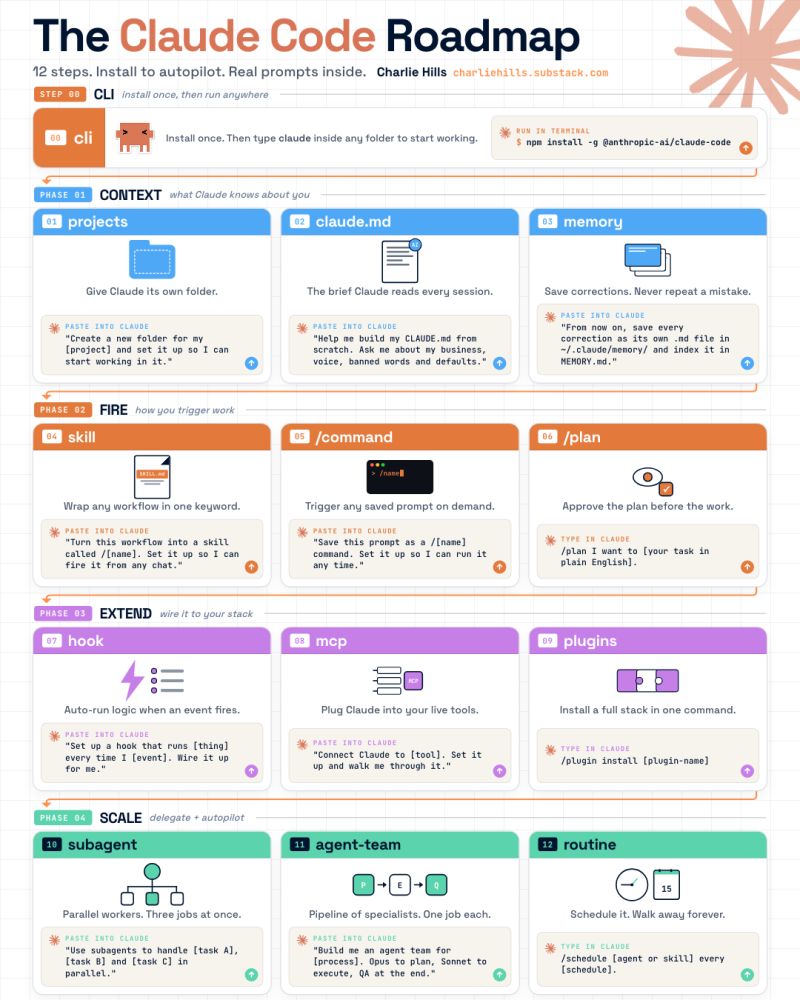
@Tanaypawar27 published (41 likes, 13 replies, 7 bookmarks) a Claude Code roadmap that flattened the stack into a 12-step path from CLI and projects to memory, skills, hooks, MCP, plugins, subagents, agent teams, and routines. The infographic mattered because it packaged "install to autopilot" as a standard progression rather than insider lore.
Discussion insight: The replies focused on the operational edges of these surfaces: remote-gateway setup, memory version control when subagents work in parallel, and whether voice should become the primary dispatcher.
Comparison to prior day: June 2 made desktop interoperability visible through ACP. June 3 pushed farther into persistent sessions, Slack channels, VPS control, artifacts, and voice-driven orchestration.
1.4 Context and memory became explicit runtime primitives instead of hidden prompt stuffing 🡕
When people asked for "better memory" on June 2, the request was mostly abstract. On June 3, posts started naming the primitives they actually want: pushed context, pinned external state, reactive rules, and tiered memory. Four retained items supported this theme.
@tylbar announced (29 likes, 9 replies, 5,848 views, 21 bookmarks) Agent Signals for Mastra, describing notification signals for external events, state signals that re-anchor the latest external state in context, and reactive signals that adjust behavior based on the agent's current loop. That made "context engineering" look less like prompt writing and more like a context operating system.
@josevalim argued (13 likes, 6 replies, 744 views) that MCP needs a way for servers to push prompt context to clients. His concrete example was Figma selection state: today he has to do a second manual action just to tell the agent what he selected. The replies broadened the problem to CI failures, exception pages, and changed-tool notifications, while insisting that pushed state should stay inspectable and permissioned.
@OpenCovenant claimed (26 likes, 11 replies) that identity, permissions, memory, audit, and settlement should sit below every framework and model as shared services on the machine. A later post from the same account visualized (30 likes, 15 replies) memory as three layers: working, episodic, and long-term.

Discussion insight: The thread-level consensus was not "give me more context." It was "give me evented context, visible state, and memory layers with clear retention rules."
Comparison to prior day: June 2 treated memory as a discipline and recurring pain point. June 3 made it more concrete by proposing state signals, pushed context, and explicit working/episodic/long-term splits.
2. What Frustrates People
Manual context plumbing and stale state still interrupt otherwise-capable agents
Severity: High. @josevalim said (13 likes, 6 replies, 744 views) that MCP still makes him perform a second action just to tell an agent what is selected in Figma. The replies described the current workaround stack plainly: state hooks that do not yet exist, changed-tool notifications, or screenshots pasted back into the prompt. @tylbar shipped (29 likes, 9 replies, 5,848 views, 21 bookmarks) Agent Signals precisely because teams need CI failures, incoming email, and changing external state to reach the agent without manual reprompting. Even under @codyplof describing (38 likes, 11 replies, 3,072 views, 44 bookmarks) a working Hermes setup, one of the first questions was how he avoids context bleed across long sessions. People are coping with screenshots, pinned state, Slack channels, Obsidian notes, and sidecar memory layers. This is worth building for because the friction appears before the agent even gets to do useful work.
Complexity explodes when teams put too much intelligence in orchestration
Severity: High. @joaomdmoura wrote (21 likes, 1 reply, 2,611 views) that elaborate multi-agent orchestration layers slow teams down because every change cascades through routing and handoff logic. @_avichawla argued (34 likes, 6 replies, 2,749 views, 37 bookmarks) that the right response is to externalize memory, skills, protocols, observability, approval loops, and evaluation instead of hiding everything inside one opaque loop; a reply added that prompt logs are not enough and teams need to replay the full composed runtime. Under @DataChaz arguing (272 likes, 25 replies, 36,443 views, 415 bookmarks) for a harness-first mindset, replies said crash recovery, session resume, and audit trails are what separate durable systems from tutorial-grade demos. The coping pattern is consistent: simpler orchestration, stronger tooling, explicit plans, and more runtime receipts. This is worth building for because it is where iteration speed dies.
Silent learning and insecure execution still make teams wary of autonomy
Severity: High. @openclaw said (60 likes, 9 replies, 5,051 views, 37 bookmarks) that agents should learn repeated work, but not by silently rewriting future runs. The linked Skill Workshop flow exists because generated skills need reviewable proposals, support-file scanning, and explicit apply or reject actions before they become live behavior. @Dagnum_PI positioned (65 likes, 5 replies, 1,244 views) Gate AI as a layer between the agent and the model that screens every request, catches prompt injection, and anchors a tamper-proof audit trail. Even a broadly positive Claude Code roadmap thread from @Tanaypawar27 surfaced (41 likes, 13 replies, 7 bookmarks) an immediate operational doubt in replies: how do you version-control memory files when multiple subagents run in parallel? People are coping with approval gates, security scanners, and human review loops. This is worth building for because the blocker is trust in execution, not lack of demand.
Frontier-model cost remains a visible tax
Severity: Medium-High. @codyplof said (38 likes, 11 replies, 3,072 views, 44 bookmarks) that he started on the Anthropic API but moved to a Codex plan because it got too expensive for his setup. @SeanZCai amplified (155 likes, 6 replies, 24,816 views, 137 bookmarks) Harvey's claim that a hybrid legal agent with GLM 5.1 as the main worker and Opus 4.7 as an advisor beat Opus on both quality and cost, while a post-trained Kimi 2.6 legal agent beat Opus at roughly 11x lower cost on the same 100-task slice. @CommandCodeAI marketed (93 likes, 3 replies, 111,603 views, 59 bookmarks) a $1 per month entry plan with ~15K requests and credits aimed at DeepSeek V4 Pro, Qwen 3.7 Max, and MiniMax M3, which is itself evidence that pricing pressure has become a product feature.

People are coping with hybrid routing, post-training, cheaper open models, and aggressive model-plan packaging. This is worth building for because economics decide whether agents stay experiments or become default tools.
3. What People Wish Existed
Evented context injection with user-visible permissions
The clearest request was not for a bigger context window. It was for the right state to arrive automatically when it changes. @josevalim described (13 likes, 6 replies, 744 views) the current gap with a simple Figma example: after selecting something, he still has to perform a second action just to tell the agent what changed. @tylbar offered (29 likes, 9 replies, 5,848 views, 21 bookmarks) a partial answer through notification, state, and reactive signals, while the replies under both threads insisted that pushed state must remain inspectable and permissioned. This is a practical need, not an aspirational one, because current workarounds are screenshots, pasted prompts, and manually refreshed state. Opportunity: direct.
Governed learning that improves skills without silently changing behavior
@openclaw argued (60 likes, 9 replies, 5,051 views, 37 bookmarks) that agents should turn repeated work into proposals that can be tweaked, applied, or rejected, not directly into live behavior. @omarsar0 pointed (130 likes, 22 replies, 9,487 views, 223 bookmarks) to SkillOpt as a more formal version of the same instinct: optimize skills with bounded edits and held-out validation instead of one-shot prompt rewrites. Together they show what people want: skill learning that is measurable, reversible, and exportable across agents and harnesses. Some pieces exist today, but they sit in separate products and research artifacts. Opportunity: direct and competitive.
Shared agent workspaces that preserve sessions across CLI, desktop, Slack, and voice
@akshay_pachaar said (58 likes, 9 replies, 8,291 views, 77 bookmarks) the important part of Hermes Desktop is that the same sessions, memory, and skills carry over from the CLI instead of resetting in a new interface. @codyplof showed (38 likes, 11 replies, 3,072 views, 44 bookmarks) why that matters in practice: he already uses Hermes in Slack, cron, and a Mac Mini setup, and is preparing a shared team agent with full organizational context. @Daniel_Farinax added (44 likes, 5 replies, 1,509 views, 19 bookmarks) voice as another control surface for scheduling and spawning agents. This need is urgent and practical because teams already want one persistent worker surface rather than separate chats, bots, and desktops that forget each other. Opportunity: direct and competitive.
Cheaper, safer harness layers for domain agents
The other clear ask is not for another general-purpose model release, but for a harness layer that makes vertical agents affordable and safe enough to keep around. @SeanZCai relayed (155 likes, 6 replies, 24,816 views, 137 bookmarks) Harvey's results that hybrid legal agents and post-trained open models can move the cost-quality frontier materially. @CommandCodeAI turned (93 likes, 3 replies, 111,603 views, 59 bookmarks) pricing pressure into a visible product pitch, while @Dagnum_PI framed (65 likes, 5 replies, 1,244 views) security and auditability as a separate middleware layer between the agent and the model. The need is practical and already partially addressed, but the solutions are still fragmented across pricing plans, routing tricks, and early-access security layers. Opportunity: direct and competitive.
4. Tools and Methods in Use
| Tool | Category | Sentiment | Strengths | Limitations |
|---|---|---|---|---|
| Harness engineering | Method | (+) | Separates memory, skills, protocols, evals, and observability from the base model | Easy to bury too much logic in orchestration unless the runtime is replayable |
| Building Effective Agents | Reference / workflow | (+) | Serious starting point for workflows, agents, tools, and MCP | Guidance only; teams still need their own runtime, evals, and policy layers |
| SkillOpt | Skill optimization | (+) | Bounded edits, held-out validation, and transfer across Codex and Claude Code | Research-stage integration work; depends on scored rollouts and validation setup |
| Skill Workshop | Skill governance | (+) | Proposal-first skill creation, revise/apply/reject flow, and support-file scanning | Adds human review friction and currently focuses on workspace-scoped skills |
| Agent Signals | Context / memory primitive | (+) | Notification, state, and reactive signals let agents see changing external state | Alpha and Mastra-specific so far |
| Hermes Desktop | Agent runtime / UI | (+) | Shared sessions, artifacts, remote gateway, voice, and visual tool-call visibility | Setup and remote-mode questions still show up immediately in replies |
| Claude Code workflow stack | Workflow / IDE | (+/-) | Projects, CLAUDE.md, memory, skills, commands, hooks, MCP, subagents, and routines form a legible operating model | Memory version control and concurrency semantics are still unclear |
| Codex external marketplaces | Skill marketplace | (+) | Imports repo-backed skills and exposes them in a product UI | Ecosystem-specific and only as good as the repo catalog |
| Hybrid open-model legal agents | Model routing / post-training | (+) | GLM/Kimi plus a frontier advisor improves the cost-quality frontier in a real vertical | Replies question whether the fine-tune or the workflow data becomes the moat |
| Command Code Go plan | Pricing / coding-agent service | (+/-) | Cheap entry tier and multi-model spend routing | Promotional claims exceed disclosed technical detail |
| Gate AI | Security middleware | (+/-) | Prompt-injection screening and tamper-proof audit trail | Early access and light public implementation detail |
| Covenant | Agent substrate / memory | (+/-) | Shared identity, permissions, memory, audit, settlement, and tiered memory | Signal is still mostly diagram-level in this dataset |
Overall sentiment favored tools that externalize capability into skills, signals, memory layers, and security middleware instead of hiding it in one prompt blob. The migration pattern ran from frontier-only setups toward hybrid routing, from ad hoc skill files toward reviewed and optimized skill artifacts, and from terminal-only usage toward shared surfaces across desktop, Slack, and voice. The competitive split was also clear: research projects are pushing measured skill improvement, product teams are packaging operator surfaces and marketplaces, and security or context vendors are trying to become mandatory middleware between agents and models.
5. What People Are Building
| Project | Who built it | What it does | Problem it solves | Stack | Stage | Links |
|---|---|---|---|---|---|---|
| Skill Workshop | OpenClaw | Turns repeated agent lessons into reviewable skill proposals before they become live behavior | Silent self-modifying skills are risky and hard to audit | PROPOSAL.md / SKILL.md workflow, Control UI, CLI, Gateway, support-file scanning |
Shipped | blog, docs |
| Agent Signals | @tylbar / Mastra | Adds notification, state, and reactive signals for agents | External state, alerts, and behavior guidance are still too manual | @mastra/core@1.39.0, Studio, Code, browser integrations, Working Memory |
Alpha | tweet (29 likes, 9 replies, 5,848 views) |
| Everything Claude Code | affaan-m | Selectively installable Claude Code superstack with 38 agents, 156 skills, 72 commands, and AgentShield tests | One generic coding agent is too blunt for planning, review, debugging, and security | Specialist agents, skill bundles, commands, security scanner, selective install profiles | Shipped | repo, tweet (28 likes, 3 replies, 2,112 views, 38 bookmarks) |
| React Native skills marketplace for Codex | Callstack | Imports repo-backed mobile-dev skills into Codex and exposes them in a browsable UI | Generic coding agents miss domain-specific mobile review, upgrade, and QA workflows | callstackincubator/agent-skills, GitHub marketplace import, Codex UI |
Shipped | repo, tweet (11 likes, 1 reply, 1,181 views, 8 bookmarks) |
| Hermes Desktop | Hermes team | Desktop surface for the same agent core, sessions, memory, skills, and artifacts as the CLI | Terminal-only agents hide state and are cumbersome to operate continuously | Shared agent core, remote gateway, artifact panel, cron, voice, drag-drop files | Beta | tweet (58 likes, 9 replies, 8,291 views, 77 bookmarks) |
| Grok Voice desktop orchestrator | @Daniel_Farinax | Custom voice layer that can spawn and manage many desktop agents | Desktop multitasking and orchestration are still too manual | Custom macOS app, 400+ tools, Grok Build, memory, scheduling, notifications | Alpha | tweet (44 likes, 5 replies, 1,509 views, 19 bookmarks) |
| Gate AI | @Dagnum_PI | Security layer between coding agents and model endpoints | Prompt injection and missing audit logs still block agent deployment | Request screening, prompt-injection detection, tamper-proof audit trail | Beta | tweet (65 likes, 5 replies, 1,244 views) |
| Command Code Go plan | @CommandCodeAI | Low-cost entry tier for coding-agent usage across multiple models | Frontier-model usage cost blocks broader day-to-day adoption | DeepSeek V4 Pro, Qwen 3.7 Max, MiniMax M3, usage routing, tool-call repair | Shipped | tweet (93 likes, 3 replies, 111,603 views, 59 bookmarks) |
| Harvey hybrid legal agents | Harvey + FireworksAI | Routes an open model to a frontier advisor and post-trains legal specialists | Frontier-only legal agents remain too expensive for repeated expert workflows | GLM 5.1 worker, Opus 4.7 advisor, Kimi 2.6 SFT, Legal Agent Benchmark | Beta | discussion tweet (155 likes, 6 replies, 24,816 views, 137 bookmarks) |
| Covenant | @OpenCovenant | Local substrate for identity, permissions, memory, audit, settlement, and tiered memory | Frameworks keep rebuilding the same shared agent services | Local shared services plus working, episodic, and long-term memory tiers | Alpha | foundation (26 likes, 11 replies), memory (30 likes, 15 replies) |
SkillOpt, Skill Workshop, Callstack's marketplace flow, and Everything Claude Code all point to the same build pattern: skills are no longer just prompts, but lifecycle-managed artifacts with optimization, review, distribution, and selective-install surfaces. The key difference is where each project intervenes: SkillOpt at training time, Skill Workshop at approval time, Callstack at distribution time, and ECC at bundle-composition time.

Hermes Desktop and the Grok Voice demo show a second pattern: the operator surface itself is turning into product scope. @codyplof added (38 likes, 11 replies, 3,072 views, 44 bookmarks) that he is already using Hermes on a Mac Mini, inside Slack, and as the seed of a shared team chief-of-staff agent, which suggests the interface question is no longer hypothetical.
Harvey, Gate AI, Command Code, and Covenant show where differentiation is moving next: routing, security, pricing, and shared infrastructure. @SeanZCai relayed (155 likes, 6 replies, 24,816 views, 137 bookmarks) the clearest vertical data point of the day by pointing to Harvey's lower-cost hybrid legal-agent results, while Gate AI and Covenant treated audit trails and shared memory or permission layers as products in their own right.
6. New and Notable
SkillOpt made the skills conversation measurable instead of purely philosophical
@omarsar0 surfaced (130 likes, 22 replies, 9,487 views, 223 bookmarks) one of the clearest hard-data artifacts in the dataset: a paper and public project page arguing that skills can be optimized with bounded text edits and held-out validation, then transferred across direct chat, Codex, and Claude Code. That was notable because most skills talk in this dataset was about packaging and distribution; SkillOpt added benchmark language, failure-driven iteration, and explicit validation gates.
Harvey gave the day its strongest vertical proof point for hybrid agent economics
@SeanZCai highlighted (155 likes, 6 replies, 24,816 views, 137 bookmarks) Harvey's claim that a hybrid legal agent with GLM 5.1 as worker and Opus 4.7 as advisor beat Opus on both quality and cost, while a post-trained Kimi 2.6 legal specialist also outperformed on cost. That was notable because it moved the "harness matters more than the model" thesis into a domain-specific benchmark rather than a general-purpose builder thread.
Everything Claude Code showed how fast full agent stacks are becoming productized bundles
@VaibhavSisinty highlighted (28 likes, 3 replies, 2,112 views, 38 bookmarks) a public Claude Code stack that bundles 38 agents, 156 skills, 72 commands, and a security scanner with 1,282 tests, while still telling users to install selectively. That was notable because it packaged planning, review, debugging, and security specialization into one installable surface instead of asking users to assemble the stack themselves.
7. Where the Opportunities Are
[+++] Evented context and durable memory orchestration — Jose Valim's MCP push-context request, Mastra's Agent Signals, codyplof's context-bleed discussion, and Covenant's tiered-memory framing all point to the same gap: agents still lack a standard, inspectable way to receive the right state at the right time.
[+++] Skill lifecycle tooling — SkillOpt, Skill Workshop, Callstack's Codex marketplace flow, and Everything Claude Code show that skills now need optimization, governance, packaging, and selective install paths, not just authoring. The market has pieces of the stack, but not yet a dominant end-to-end lifecycle.
[+++] Security and audit middleware for coding agents — Gate AI, Skill Workshop's approval flow, and the repeated thread-level demand for audit trails, replayable runtimes, and prompt-injection defenses suggest a clear product wedge between the agent and the model endpoint.
[++] Cross-interface operator surfaces — Hermes Desktop, Slack-based shared agents, and voice-driven desktop orchestration all suggest demand for one persistent worker surface that can span terminal, GUI, chat, remote servers, and schedules without resetting state.
[++] Hybrid routing and post-training for vertical agents — Harvey's legal-agent results, Command Code's pricing posture, and codyplof's cost-driven model switch all show room for products that beat frontier-only economics through routing, specialization, and tighter eval loops.
8. Takeaways
- The discourse is still converging on the harness, not the raw model, as the durable layer. @DataChaz argued (272 likes, 25 replies, 36,443 views, 415 bookmarks) that context engineering, tool design, evals, MCP, and the harness mindset are what compound, and the replies immediately turned that into concrete requirements like recovery and audit trails.
- Skills are becoming managed artifacts with optimization, review, and distribution steps. @omarsar0 surfaced (130 likes, 22 replies, 9,487 views, 223 bookmarks) benchmarked skill optimization, while @openclaw showed (60 likes, 9 replies, 5,051 views, 37 bookmarks) that teams also want proposal and approval gates before those skills go live.
- Agent operation is expanding beyond one terminal into shared, persistent surfaces. @akshay_pachaar described (58 likes, 9 replies, 8,291 views, 77 bookmarks) a desktop surface with shared state across CLI and VPS execution, and @codyplof added (38 likes, 11 replies, 3,072 views, 44 bookmarks) that teams are already using that pattern inside Slack and on shared Mac Mini setups.
- Context engineering is turning into runtime design, not just prompt craft. @josevalim argued (13 likes, 6 replies, 744 views) for push-based prompt context, while @tylbar shipped (29 likes, 9 replies, 5,848 views, 21 bookmarks) state, notification, and reactive signals as one concrete implementation path.
- Cost competition is moving into routing, post-training, and harness efficiency. @SeanZCai highlighted (155 likes, 6 replies, 24,816 views, 137 bookmarks) Harvey's hybrid legal-agent results, while @CommandCodeAI marketed (93 likes, 3 replies, 111,603 views, 59 bookmarks) cheap multi-model usage tiers as a core product feature.
- Security and approval layers are becoming first-class products around coding agents. @Dagnum_PI positioned (65 likes, 5 replies, 1,244 views) Gate AI as middleware for prompt-injection defense and audit trails, which matches the broader thread-level demand for visible receipts before autonomous systems get more authority.