Twitter AI Agent - 2026-06-19
1. What People Are Talking About
1.1 Coding-agent workspaces turned into operating systems for real work (🡕)
The strongest product thread was not about one new model. It was about coding-agent environments becoming full work surfaces with repo prep, dashboards, plugins, skills, and richer rendering inside the terminal. At least three strong items supported this theme: Grok Build's expansion into a multi-session workspace, Ramp's internal "inspect" stack, and Matt Pocock's public skills repo.
@XFreeze reported (1,657 likes, 276 replies, 456,309 views, 172 bookmarks) that Grok Build has expanded from a coding CLI into a terminal-native agent workspace with AGENTS.md-aware context, skills, hooks, plugins, MCP servers, parallel subagents, headless mode, and an Agent Dashboard for managing blocked, idle, and active sessions. The distinctive claim was not merely more tools, but a richer rendering layer inside the terminal itself: Mermaid, UML, ER diagrams, LaTeX, tables, and media outputs can now stay in-band with the work instead of getting copied into separate apps.
@rahulgs said (141 likes, 5 replies, 22,101 views, 194 bookmarks) that Ramp's internal agent, inspect, now produces more than 75% of the company's code. The thread matters because it spelled out what made that possible: preinstalled dependencies, token-efficient skills, sandbox snapshots, Terraform plans, parallel browser testing agents, faster mypy in sandboxes, human and AI review loops, and explicit cost optimization across models and reasoning levels. In a reply, he added that engineers rarely need to check out branches locally anymore because the cloud environment now covers what they would normally do by hand.
@mattpocockuk shipped (233 likes, 11 replies, 8,996 views, 164 bookmarks) v1 of mattpocock/skills, including /ask-matt, model-invoked versus user-invoked skills, and a public skill-writing guide. The public repo describes the package as "Skills for Real Engineers," centers it on alignment, TDD, domain modeling, and repo setup, and had 136,958 GitHub stars at capture time.
Discussion insight: The most useful nuance was operational rather than aspirational. Replies to Ramp focused on repo setup as the real differentiator, while a Grok Build reply said the product is now "one-shotting" tasks that older Grok dev surfaces missed, suggesting that environment quality is starting to matter as much as model quality.
Comparison to prior day: June 18 already showed multi-model routing and installable skills becoming routine. June 19 pushed further by treating the coding-agent workspace itself as the product, with session management, plugin systems, and repo-prepared cloud environments becoming the new baseline.
1.2 Loop and harness engineering became the language of serious autonomy (🡕)
A second theme was that the feed moved beyond prompt tips and into the outer loop around the model: human backstops, evals, context discipline, and explicit harness design. The strongest evidence came from one scheduling company that published its operating history, plus one practitioner thread about what harness builders actually optimize.
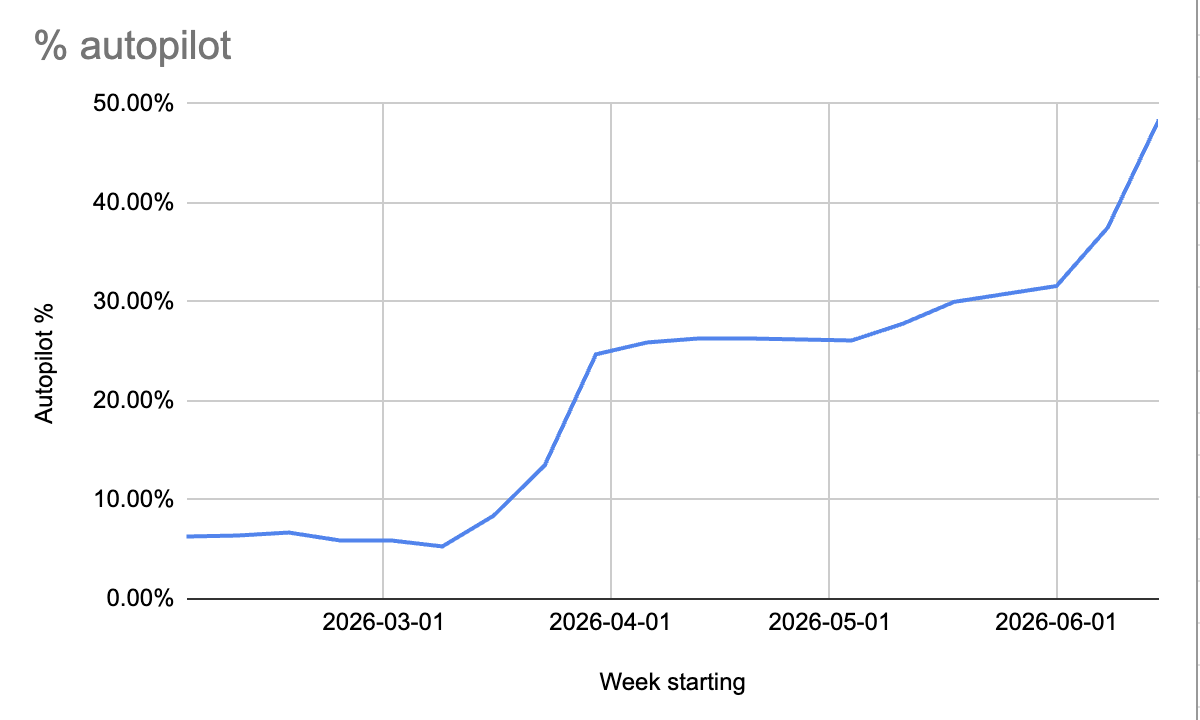
@awwstn reported (123 likes, 16 replies, 43,111 views, 103 bookmarks) that his email scheduling agent crossed 50% autopilot after years of handling a domain where one bad interaction can cost trust with prospects, investors, or candidates. The thread is unusually concrete: the company built a human-in-the-loop backstop, scaled that team to 75 people, created a synthetic gold dataset, iterated through fine-tuning, RL, ACE, DSPy, and sub-agents, and only then reached a point where 150 customers in a self-driving experiment used the product more despite reduced human steering.
@Vtrivedy10 argued (34 likes, 3 replies, 2,780 views, 55 bookmarks) that harness engineering is fundamentally about model-harness-task fit, evals and traces, and keeping a clean context window per sub-task. That thread added the clearest practitioner vocabulary of the day: harnesses are controllers and amplifiers of model behavior, models are not fungible inside the harness, and good harnesses are discovered through trace-driven iteration rather than designed correctly on the first try.
@traversymedia pushed back (41 likes, 14 replies, 3,344 views) on the whole "loop engineering" wave by saying the field had reached the part of the hype cycle where old concepts get renamed and rediscovered. That skepticism mattered because it kept the day's biggest meme from looking like universal consensus.
Discussion insight: The most credible caution came from production-minded replies, not from anti-AI posters. In the scheduling thread, the win condition was trust and lower churn, not novelty. In the harness thread and related loop discussions, people kept returning to evals, budget burn, and what happens when a loop cannot reliably tell that it has failed.
Comparison to prior day: June 18 treated memory, skills, and routing as installable infrastructure. June 19 moved one level outward, into the loops and harnesses that decide how those components are actually coordinated and supervised.
1.3 Private and local agents moved from preference to deployment pattern (🡕)
A third theme was that private and local execution was described less as ideology and more as an operating model. The evidence ranged from activist deployments to OpenAI-compatible private inference gateways.
@gladstein wrote (298 likes, 26 replies, 42,100 views, 174 bookmarks) that HRF and Finite have moved from an OpenClaw experiment into real activist use, with a "private" mode where the inference provider cannot read user data, a local cluster mode under the team's own control, and an uncensored model running on roughly $4,500 of equipment that can serve about a dozen people for research. The thread also tied that local/private push to specific deployment targets: TEE-backed frontier access, phone-native encrypted agent apps, and eventually organization-level "brains" built from internal records and meetings.
@ErikVoorhees showed (173 likes, 20 replies, 14,367 views, 53 bookmarks) Hermes Agent pointed at GLM 5.2 through Venice, framing privacy-focused coding-agent use as a practical setup instead of a research toy. Venice's public API docs describe an OpenAI-compatible API for private chat, image, audio, and video, and explicitly market coding-agent integrations for Claude Code, Cursor, and Codex CLI.
Discussion insight: The hardest unresolved question was still trust. A reply to Erik's thread asked whether a provider can fingerprint private code from the context even if the API is marketed as private. In Gladstein's thread, the same concern showed up in a different form: the whole strategic goal was to reduce dependence on KYC-gated or politically exposed frontier access.
Comparison to prior day: June 18 already showed people mixing cheaper and more private models into agent stacks. June 19 added first-hand deployment details, sensitive-user use cases, and clearer evidence that teams are budgeting for local control instead of just debating it.
1.4 Agent commerce and security shifted toward external authorization and proof (🡕)
The last major theme was that builders no longer trust prompts alone to keep agents safe around money, wallets, and code changes. They are moving approval, signing, and verification into separate control layers.
@SuiNetwork shared (78 likes, 9 replies, 3,024 views) a Seal MPC prototype for agent commerce that keeps authorization outside the agent. The thread and replies spelled out the mechanics: onchain spending rules and category checks, self-custodial wallets, one-shot witnesses from the MPC committee, and explicit stress tests against over-budget, wrong-merchant, and fake-category behavior.

@circle posted (64 likes, 7 replies, 2,508 views) a simpler but equally useful commerce example: one agent researches a prospect, prepares the call context, pays for a voice call, and drafts the follow-up for about $1.08 in USDC. The image matters because it turns "agentic economy" rhetoric into an itemized workflow with a visible dollar cost.

@OpenCovenant argued (34 likes, 14 replies, 107 views) that coding tasks need post-run proof, not just agent claims, and showed a verification card that links a completed task to the exact file changes and a cryptographic proof. @svpino added (43 likes, 13 replies, 3,591 views, 27 bookmarks) a hardware-signing variant where the agent can prepare Ethereum transactions through a Ledger Nano Gen5, but execution still requires a human approval on-device.
Discussion insight: The replies made the tradeoff explicit. Approval is safer, but it adds latency. That is why Sui emphasized caps and one-shot rules, while a reply to the Ledger thread said fast bots still need bounded policies instead of waiting for a human on every action.
Comparison to prior day: June 18's security conversation centered on governance frameworks and control theory. June 19 grounded that discussion in concrete wallet, payment, proof, and signing mechanisms that separate authorization from the model itself.
2. What Frustrates People
Real-world autonomous workflows still need expensive backstops and disciplined eval loops
Severity: High. @awwstn said (123 likes, 16 replies, 43,111 views, 103 bookmarks) that his scheduling company had to build a human-in-the-loop platform and scale that backstop to 75 people before the product could safely approach 50% autopilot. The same thread described negative gross margins, endless edge cases around timezones and calendar rules, and weeks where evals barely moved. @Vtrivedy10 argued (34 likes, 3 replies, 2,780 views, 55 bookmarks) that harnesses improve only through traces, evals, and repeated experimentation, not instinct. @neil_xbt warned (47 likes, 18 replies, 5,008 views) that production loops burn budget fast when they lack maker-checker splits, durable state, worktrees, connectors, and a verifier the operator actually trusts. Teams are coping by keeping humans in the loop longer than the marketing copy suggests and by treating evals as core infrastructure. This is worth building for because the pain is repeated by both builders and operators, not just commentators.
Invisible context and weak post-run inspection still make agent failures hard to explain
Severity: High. @DanKornas described (3 likes, 5 replies, 252 views) claude-tap as a response to a specific frustration: debugging coding agents is hard when the context is invisible. The public repo says it can inspect system prompts, conversation history, tool schemas, tool calls, streaming responses, token usage, and request diffs across Claude Code, Codex CLI, Cursor CLI, OpenCode, Kimi, Pi, and Hermes, with 1,872 GitHub stars at capture time. @OpenCovenant made (34 likes, 14 replies, 107 views) the same complaint from the verification side by saying users should not have to take the agent's word for what changed. People are coping by adding trace viewers, explicit proof layers, and more artifact linkage after the run. This is worth building for because the failure mode is structural: when context is invisible, neither trust nor debugging scales.
Safe agent commerce still trades autonomy for approval friction
Severity: High. @SuiNetwork showed (78 likes, 9 replies, 3,024 views) that current wallet patterns are a security risk for agents, then answered it with externalized authorization, spending caps, one-shot witnesses, and merchant/category checks. @svpino showed (43 likes, 13 replies, 3,591 views, 27 bookmarks) a Ledger-based flow where agents can prepare transactions but still cannot execute them without a human approval on-device, and a reply immediately called approval latency the blocker for faster trading-style agents. @circle added (64 likes, 7 replies, 2,508 views) that even a simple prospecting workflow already spans research, voice, payment, and follow-up services. The current workaround is to move more policy outside the agent while narrowing what the agent can do on its own. This looks worth building for because the demand is specific, but the current control surfaces still slow down the workflows they are meant to protect.
Privacy-safe and local stacks are improving, but they still ask users to own more complexity
Severity: Medium. @gladstein reported (298 likes, 26 replies, 42,100 views, 174 bookmarks) that HRF and Finite now run private and local variants for activists, including a local setup costing about $4,500 for a dozen users, which is progress but also a clear operational burden. @ErikVoorhees showed (173 likes, 20 replies, 14,367 views, 53 bookmarks) a private coding-agent path through Venice, but the replies immediately questioned whether private code can still be fingerprinted by the inference provider. Builders are coping by mixing local control, TEE-based deployment, and OpenAI-compatible private APIs instead of trusting a single stack. This looks moderately worth building for because the demand is real, but the setup and trust burden remain high.
3. What People Wish Existed
Trustworthy approval and verification layers around autonomous actions
The clearest practical need was not "smarter agents." It was safer ways to let agents spend, sign, or change code without trusting the model by itself. @SuiNetwork showed (78 likes, 9 replies, 3,024 views) externalized authorization with onchain spending rules and one-shot MPC witnesses, @svpino showed (43 likes, 13 replies, 3,591 views, 27 bookmarks) human approval kept inside a hardware signer, and @OpenCovenant argued (34 likes, 14 replies, 107 views) that users should be able to verify exact project changes instead of trusting post-run claims. This is a practical need with immediate buyer pain. Opportunity: direct.
Better observability for what the harness actually sent and saw
Several items implied the same missing tool: a way to inspect the real context, not just the final answer. @DanKornas surfaced (3 likes, 5 replies, 252 views) claude-tap, and the public repo says it captures system prompts, conversation history, tool calls, token usage, and request diffs. @alexjplaskett published (17 likes, 2 replies, 542 views, 7 bookmarks) a 50-page coding-agent security paper covering permission modes, sandboxing, dynamic workflows, and common failure classes. This is a practical need with active early solutions, but still a relatively open market. Opportunity: direct.
Default repo setup and reusable skills that make agents work on day one
The strongest adoption story of the day came from people reducing setup drag. @rahulgs said (141 likes, 5 replies, 22,101 views, 194 bookmarks) that Ramp got to 75%+ agent-written code by standardizing repo setup, tools, and feedback loops. @mattpocockuk shipped (233 likes, 11 replies, 8,996 views, 164 bookmarks) a public skills repo for alignment, TDD, and domain modeling, while @tom_doerr shared (8 likes, 2 replies, 876 views, 14 bookmarks) a YouTube skills repo whose README adds transcripts, search, channels, and playlists to OpenClaw, Hermes, Claude Code, Cursor, and others. This is a practical need, and the evidence shows builders already pay for it with time if not always with money. Opportunity: direct.
Private and sovereign agent stacks for sensitive users and organizations
The emotional and practical need overlapped here: users want capability without surrendering data, identity, or access. @gladstein framed (298 likes, 26 replies, 42,100 views, 174 bookmarks) private and local agents as a freedom and anti-KYC requirement for activists, while @ErikVoorhees used (173 likes, 20 replies, 14,367 views, 53 bookmarks) Venice as a private inference layer for Hermes. This is practical for a real subset of users, but the solution space is already competitive across local, private API, and TEE-flavored approaches. Opportunity: competitive.
4. Tools and Methods in Use
| Tool | Category | Sentiment | Strengths | Limitations |
|---|---|---|---|---|
| Grok Build | Coding agent workspace | (+) | AGENTS.md-aware context, plugins, MCP, dashboarding, diagram rendering, parallel subagents | Still framed through launch cadence and product reliability updates; strongest evidence is from changelog and user replies rather than deeper ops docs |
| inspect | Enterprise cloud coding agent | (+) | Repo setup, Terraform plans, browser testing agents, mypy in sandboxes, cost optimization, cloud parity with local workflows | Requires extensive internal prep work and environment standardization to reach its reported quality |
| mattpocock/skills | Skill library | (+) | Reusable engineering workflows for alignment, TDD, domain modeling, and setup; large public distribution | Adds another abstraction layer to curate and debug, especially when skills are model-invoked |
| Venice API + GLM 5.2 | Private inference gateway | (+/-) | OpenAI-compatible private API, coding-agent integrations, supports Hermes-style workflows | Privacy claims still face fingerprinting skepticism; API key and provider trust remain part of the cost |
| Seal MPC / Ledger Nano Gen5 | Authorization layer | (+) | Moves approval and key custody outside the agent; supports caps, budgets, human sign-off, and self-custody | Approval steps add latency; bounded policies are still needed for high-speed workflows |
| claude-tap | Observability / debugging | (+) | Local trace viewing, exact context inspection, token usage, request diffs across multiple coding agents | Solves inspection after the fact; teams still need discipline to act on what the traces reveal |
| Covenant | Verification layer | (+) | Links agent tasks to exact file changes and a cryptographic proof so users can verify outcomes | Early public signal only; broader production usage is not yet visible from today's evidence |
| youtube-skills / TranscriptAPI | Agent skill + external data access | (+) | Gives agents transcripts, video search, channel browsing, and playlists across OpenClaw, Hermes, Claude Code, and Cursor | Depends on third-party API setup and credits, and solves a narrower slice of research work than a general harness |
Overall, the mood was positive toward tools that added structure around the model rather than replacing the model outright. The clearest migration pattern was from prompt tweaks to environment prep: repo setup, skills, traces, evals, dashboards, and verification layers now show up as the real leverage. A second migration pattern ran from frontier-only execution toward mixed stacks that include open or private model gateways. The strongest competitive dynamic was not model-versus-model, but control surface versus control surface: who gives the operator the best visibility, safest approvals, and cheapest acceptable execution.
5. What People Are Building
| Project | Who built it | What it does | Problem it solves | Stack | Stage | Links |
|---|---|---|---|---|---|---|
| inspect | @rahulgs | Internal cloud coding coworker used across engineering and other knowledge-work tasks at Ramp | Teams want agents that "just work" across real repos instead of collapsing on missing deps, weak feedback, or slow environments | Cloud sandboxes, git + gh workflows, Terraform plans, browser testing agents, mypy, realtime voice inputs | Shipped | tweet |
| Howie | @awwstn | Email-based scheduling agent that now runs thousands of meetings a day and has crossed 50% autopilot | Scheduling is full of trust-sensitive edge cases that generic agents mishandle | Human-in-the-loop ops platform, synthetic gold data, fine-tuning, RL, ACE, DSPy, sub-agents | Beta | tweet |
| Finite / HRF private agent stack | @gladstein | Private, TEE-backed, and local variants of personal agents for activists and eventually organizations | Sensitive users need strong agent capability without KYC exposure or readable provider-side data | OpenClaw roots, customized Hermes surface, private inference mode, local cluster deployment, planned TEE harness hosting | Beta | tweet |
| mattpocock/skills | @mattpocockuk | Public skill pack for coding agents, centered on alignment, skill composition, and repeatable engineering practice | Builders want reusable workflows instead of re-explaining good practice every session | skills.sh installer, markdown skills, TDD, grilling, domain modeling | Shipped | tweet, repo |
| Covenant | @OpenCovenant | Verification layer that ties an agent's completed task to exact project changes and proof artifacts | Teams need auditable evidence of what an agent actually changed | File-change linkage, cryptographic proof, verification UI | Alpha | tweet |
| Seal MPC commerce prototype | @SuiNetwork | Prototype authorization layer for agentic commerce on Sui testnet | Wallet-based agents need safe spending without giving the agent raw key control | Seal MPC, onchain Move policies, one-shot witnesses, React dapp-kit | Alpha | tweet |
inspect and Howie were the strongest build signals because both looked past toy demos and into operating detail. Ramp's thread showed that environment prep, repo standardization, and extra feedback loops are what turn a cloud agent into a coworker, while Howie showed that trust-sensitive domains still need long periods of backstops, evals, and policy learning before autonomy feels safe.
Finite stood out because it applied agent design to a narrower but higher-stakes constituency than the rest of the feed. Instead of selling convenience first, Gladstein's thread sold privacy, sovereignty, and anti-KYC access, which suggests a builder pattern where deployment model is part of the product thesis, not a packaging detail.
The smaller public artifacts were still strategically important. mattpocock/skills, Covenant, and the Seal MPC prototype each package one layer that many teams will likely need: reusable workflow discipline, verifiable outcomes, and out-of-agent authorization. That pattern - shipping layers around the agent rather than one monolithic agent - was one of the clearest recurring build motifs in the day's data.
6. New and Notable
A public coding-agent security paper finally mapped the threat surface end to end
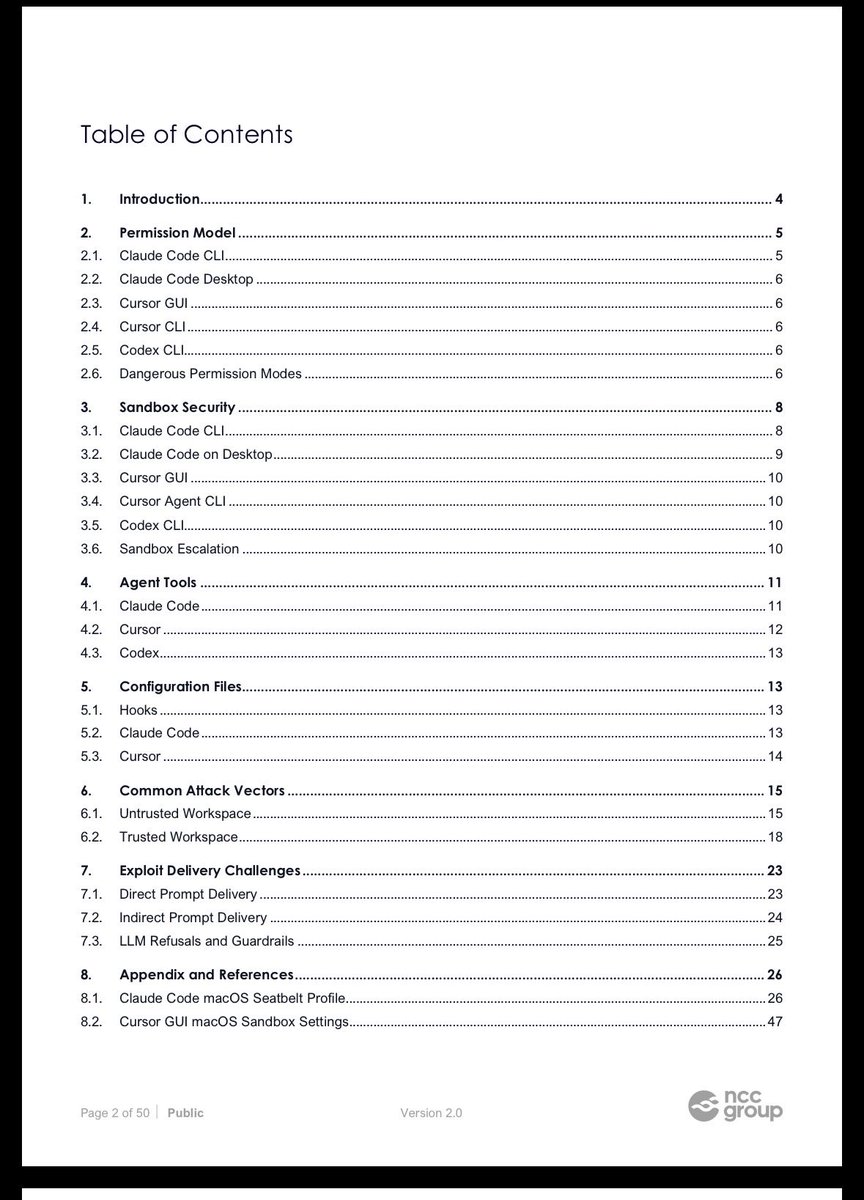
@alexjplaskett published (17 likes, 2 replies, 542 views, 7 bookmarks) a 50-page An Introduction to AI Coding Agent Security whitepaper. The paper's table of contents alone is informative because it lays out the concrete threat model operators are now expected to understand: permission modes, dangerous permission settings, sandbox security, agent tools, prompt injection, remote contexts, MCP, and agent communications. In the body, it states that coding-agent security is shaped mainly by permission models and sandboxing, and notes that Claude dynamic workflows do not currently execute inside an operating-system sandbox.
Specialized skills are becoming a real distribution channel, not just a local prompt hack
@tom_doerr shared (8 likes, 2 replies, 876 views, 14 bookmarks) a YouTube skills repo for search and transcription, and the public README says it gives agents transcripts, video search, channel browsing, and playlist extraction through TranscriptAPI. The repo also documents install paths for OpenClaw, Hermes Agent, Claude Code, Cursor, Cline, Codex, and others, which makes the item notable less for raw engagement than for how explicitly it treats agent capabilities as portable, installable packages.
7. Where the Opportunities Are
[+++] Agent authorization, verification, and spend control — Evidence came from multiple directions on the same day. Sui's Seal MPC prototype pushed authorization outside the agent, Ledger-based workflows kept keys off the machine while preserving human approval, Circle showed agents paying for multi-service work directly in USDC, and Covenant argued for cryptographic proof of code changes. The opportunity is strong because every one of these items starts from the same operator fear: the model is not the right place to store final authority.
[+++] Repo setup, traces, and feedback infrastructure for coding agents — Ramp's inspect thread, Vtrivedy's harness-engineering notes, Dan Kornas's claude-tap signal, and Matt Pocock's skills repo all point to the same unmet need: environments where agents arrive preloaded with the right tools, the right context, the right evals, and the right debugging surfaces. The opportunity is strong because teams are already building this internally, which usually means the external product category is real.
[++] Sovereign and privacy-preserving agent deployment — Gladstein's activist deployment thread and Erik Voorhees's Venice setup show real demand for local, TEE-backed, or provider-private agent stacks. The opportunity is moderate because the problem is urgent for a specific user class, but there are already several architectural routes competing to solve it.
[+] Installable specialist skills and data-access packs — Grok Build's plugin marketplace, Matt Pocock's public skills, and the YouTube skills repo all show that agent capability is being packaged into reusable modules. The opportunity is emerging because the packaging pattern is clear, but it is not yet obvious whether distribution settles around marketplaces, GitHub repos, or runtime-specific registries.
8. Takeaways
- The coding-agent market spent June 19 upgrading the workspace around the model. Grok Build's changelog, Ramp's inspect thread, and Matt Pocock's skills release all treated environment prep, session control, and reusable workflow layers as the real product surface. (source)
- Serious autonomy still looks like harness engineering plus patience, not just better prompting. Howie's 50%-autopilot milestone required a 75-person backstop, synthetic data, and long eval cycles, while harness builders kept insisting on traces and context discipline. (source)
- Private and local agent execution is now a deployment choice, not just a philosophical preference. HRF/Finite described activist use across private, local, and planned TEE-backed variants, and Venice documented a private OpenAI-compatible route for coding agents. (source)
- Agent commerce is forcing authorization to move outside the model. Sui's Seal MPC, Ledger-based approval flows, Circle's USDC workflow, and Covenant's proof layer all separate execution from final authority in different ways. (source)
- Security and observability are becoming standalone product layers around coding agents. The NCC Group whitepaper, claude-tap, and Covenant each addressed a different part of the same gap: users need to understand what the agent was allowed to do, what it actually saw, and what it really changed. (source)