Twitter AI Agent - 2026-06-29
1. What People Are Talking About
1.1 Loop engineering hardened from meme to operating discipline (🡕)
The clearest theme was that loop engineering stopped being treated as a catchy phrase and got discussed as an executable operating model. The strongest posts did not just praise autonomous loops; they broke them into concrete design primitives such as discovery, isolated worktrees, evaluator separation, persistence, and scheduling. At least three high-signal items supported this shift.
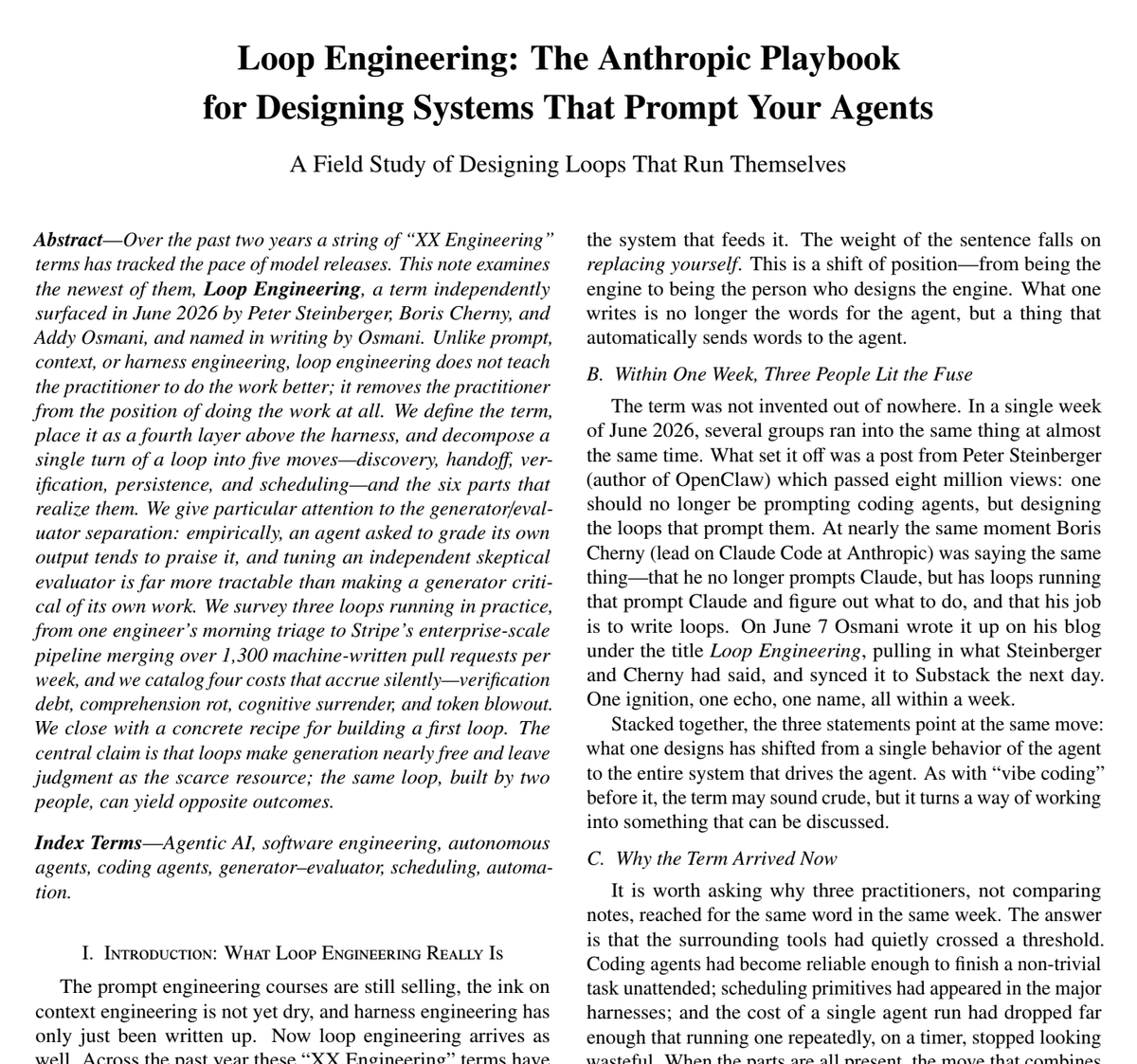
@milesdeutscher summarized (285 likes, 39 replies, 42,583 views, 570 bookmarks) a leaked Anthropic loop-engineering playbook around five moves — discovery, handoff, verification, persistence, and scheduling — plus a six-part stack of automations, worktrees, skills, connectors, sub-agents, and memory. The most specific practitioner reply came from @eriks_b, who said stale per-project wiki pages and one bad compile pass were enough to burn a token quota, adding a concrete warning that persistence needs its own retirement policy.
@PatrickToulme introduced (28 likes, 9 replies, 4,507 views, 17 bookmarks) HarnessGym as an evaluation harness that asks whether an agent can learn which harness was missing, build it, and make the next run stronger. In follow-up replies he said generated tooling is copied into a clean workspace and self-tested before counting as a harness win, pushing the conversation from loop design toward loop qualification.
@LangChain announced (30 likes, 6 replies, 5,787 views, 16 bookmarks) that Deep Agents now supports dynamic subagents where the main agent writes orchestration code instead of only calling subagents as tools. The most useful reply was skeptical: @JamesPelton18 argued that orchestration is only "the easy 20%" and that verification is still the real trust bottleneck.
Discussion insight: The discussion did not reject loops; it narrowed in on the missing control surfaces. Replies kept returning to verifier independence, stale memory cleanup, and whether orchestration improvements actually reduce long-horizon failure rates.
Comparison to prior day: June 26 established loop engineering as a named design discipline. June 29 shifted the center of gravity toward operational questions: how loops self-improve, how they verify artifacts, and how they avoid stale state.
1.2 Agentic engineering stacks are converging around evals, routing, and integrated workflows (🡕)
A second major theme was that agentic engineering is no longer being pitched as prompt quality alone; it is being packaged as a full workflow spanning scaffolding, evaluation, deployment, cost routing, and enterprise controls. The strongest items framed the harness as an opinionated stack rather than a single model choice.
@akshay_pachaar argued (230 likes, 20 replies, 28,420 views, 407 bookmarks) that Google's agents-cli finally gives Karpathy-style agentic engineering proper tooling: one setup command injects ADK-specific skills for scaffolding, eval generation, deployment, and Gemini Enterprise registration. His description was unusually concrete: Claude Code scaffolded an ADK RAG agent, generated 20 eval scenarios, surfaced an instruction loophole before deploy, then shipped to Agent Runtime and enterprise discovery.
@imjaredz made (203 likes, 9 replies, 46,143 views, 198 bookmarks) the enterprise cost case for Devin's comeback: independent model routing, cheap specialized coding models, robust spend controls, and an ROI-based sales motion matter more now that token spend is under scrutiny. The quoted thread from @brian_armstrong sharpened the mechanism: cheaper defaults, routing, caching, lean context, and model diversity in code review cut spend nearly in half while usage kept growing.
@pamelafox shared (26 likes, 8 replies, 1,272 views, 10 bookmarks) the public model-swap-workshop, a hands-on repo comparing GPT-5.4, Kimi-K2.6, Mistral-Large-3, DeepSeek-V4-FlashPro, and Sonnet 4.5 across function calling, multimodal input, RAG with citations, agent frameworks, LLM-as-judge evals, and prompt optimization with DSPy. That kept the day's stack conversation grounded in method comparison rather than single-model fandom.
Discussion insight: Replies under the agents-cli post emphasized that spec design and security oversight are still first-order concerns even when the workflow is unified. One reply proposed a missing fourth variable — failure budget — suggesting teams are starting to treat autonomous execution as an economics problem as much as a tooling one.
Comparison to prior day: June 26 argued that the harness is the moat. June 29 added more concrete stack assembly: public CLI workflows, model-routing economics, and workshop-style side-by-side evals.
1.3 Memory is being treated as infrastructure, not a context-window patch (🡕)
Memory remained a top topic, but the framing changed. Instead of asking for longer context or generic persistence, posts treated memory as a systems problem with architecture tradeoffs, ownership questions, and workflow-level consequences.
@gokulr summarized (52 likes, 5 replies, 4 quotes, 5,685 views, 71 bookmarks) Nikesh Arora's thesis that "memory is the moat": the winning systems will be the ones that accumulate enough context, edge-case handling, and workflow depth that users and enterprises do not want to switch away. The strongest reply pushed back on platform ownership, warning that a frontier lab remembering your last 90 days creates the lab's moat first, not necessarily the customer's.
@askalphaxiv highlighted (49 likes, 3 replies, 2,019 views, 31 bookmarks) the paper Are We Ready For An Agent-Native Memory System?, which argues memory should be decomposed into representation and storage, extraction, retrieval and routing, and maintenance, then benchmarked module by module. The linked MemoryData benchmark suite reinforces the paper's finding that no single memory architecture wins across all workloads.

@utk7arsh argued (15 likes, 5 replies, 760 views, 8 bookmarks) that Markdown plus YAML plus folders are starting to beat heavyweight agent frameworks as the practical substrate for coding harnesses. He linked the pattern to Google's public Open Knowledge Format, which uses Markdown files with YAML frontmatter as a vendor-neutral knowledge representation.
Discussion insight: The memory discussion was less about retrieval quality in isolation and more about inspectability, lifecycle, and who controls the accumulated context. That is a sharper enterprise conversation than the earlier local-first-memory excitement alone.
Comparison to prior day: June 26 centered on local-first memory products such as EverOS. June 29 broadened the topic into benchmarked memory architectures, file-based knowledge formats, and switching-cost strategy.
1.4 Governance moved from abstract risk to concrete approval and policy layers (🡕)
Governance was one of the clearest production themes of the day. Multiple posts no longer just warned that agents have too much authority; they described shipping control layers that can scope, approve, redact, audit, or halt actions at runtime.
@CopilotKit introduced (15 likes, 406 views, 18 bookmarks) OpenBox for CopilotKit, which can allow, redact, require human approval, block, or halt governed tool calls while streaming each verdict back into the UI. The docs make the design concrete: money movement routes to human approval, goal-drifting exports are blocked, and critical payment-control changes halt the session.
@MystiqueMide explained (12 likes, 5 replies, 542 views, 4 bookmarks) Rialo's Latch as a hardware-enforced proxy that gives each agent a scoped token while keeping the real API key inside a TEE-backed policy layer. The pitch is simple: agents should receive permissions, not your house keys.
The governance concern also surfaced in discussion around supposedly integrated stacks. Under the agents-cli thread, @SilverHamster asked whether an agent that can deploy and register enterprise resources from plain English can be permissioned tightly enough, underscoring that workflow unification raises the blast radius when controls are weak.
Discussion insight: The most interesting change was semantic precision. The day produced a real vocabulary for runtime decisions — approve, reject, redact, block, halt — instead of generic calls for "guardrails."
Comparison to prior day: June 26 named orchestration opacity and ambient authority as the risk. June 29 showed products trying to operationalize the fix.
1.5 Specialized agent infrastructure kept shipping at the edges: voice, OCR, and trace analytics (🡕)
Beyond the architecture debate, builders kept shipping concrete infrastructure for narrow but critical agent workloads. The highest-signal examples were voice-agent runtime tooling, OCR for document-heavy pipelines, and public trace analytics for coding-agent serving.
@adriablancafort announced (66 likes, 20 replies, 6,639 views, 50 bookmarks) PhoneFlow, an open-source voice-agent platform built around a canvas that compiles node graphs into runtime state machines, immutable agent snapshots, per-minute provider-aware billing, and real inbound and outbound calling. His post positioned it directly against a crowded but mostly closed voice-agent market.
@hasantoxr recommended (23 likes, 8 replies, 4,738 views, 27 bookmarks) olmOCR as the OCR tool "built for the LLM era," emphasizing Markdown output, equation and table handling, old scans, and natural reading order as the first-mile fix for broken document pipelines.

@UWSyFi released (8 likes, 2 replies, 3 quotes, 327 views) the TraceLab dataset and pipeline for coding-agent workloads. The companion dashboard revealed why these traces matter to infrastructure teams: coding agents averaged 8.8 steps and 10.8 tools per request, with 147K prefix tokens per step and long-tail tool latency dominating total execution time.

Discussion insight: These posts shared a common shape: the bottlenecks were unglamorous but unavoidable. Document parsing, telephony state, and workload traces are not model frontier topics, but they are exactly where agents stop being demos.
Comparison to prior day: June 26 focused more on conceptual stack layers. June 29 had more "show the repo or the dashboard" energy around operational infrastructure.
2. What Frustrates People
Verification still trails orchestration
Severity: High. The day produced repeated evidence that teams can now compose loops and subagents faster than they can trust them. @milesdeutscher stressed (285 likes, 39 replies, 42,583 views, 570 bookmarks) that generator and evaluator separation is the most important rule in loop engineering, while @PatrickToulme said (28 likes, 9 replies, 4,507 views, 17 bookmarks) HarnessGym only counts a harness win after the artifact survives a clean-workspace self-test. Even a pro-framework reply under @LangChain warned (30 likes, 6 replies, 5,787 views, 16 bookmarks) that verification remains the hard part of running a fleet. The workaround is always the same: add independent evaluators, self-tests, or explicit human review.
Token efficiency, routing, and long-tail latency remain practical blockers
Severity: High. Cost pressure was not abstract. @imjaredz argued (203 likes, 9 replies, 46,143 views, 198 bookmarks) that enterprise buyers now care deeply about spend controls, routing, and ROI alignment, and the quoted thread from @brian_armstrong explicitly tied savings to cheaper defaults, caching, and lean context. @UWSyFi added (8 likes, 327 views) trace evidence that coding-agent workloads are input-heavy and latency-skewed, with a small fraction of slow tool calls dominating total execution time. Teams cope with routing, cache-aware requests, context trimming, and cheaper execution models, but the pain point is still live.
Production governance is finally being specified because default agent permissions feel unsafe
Severity: High. @CopilotKit presented (15 likes, 406 views, 18 bookmarks) a runtime that can approve, block, redact, or halt tool calls, while @MystiqueMide described (12 likes, 5 replies, 542 views, 4 bookmarks) Latch as a way to keep raw API keys out of agent hands entirely. Under the agents-cli post, @SilverHamster asked whether plain-English deploy and registration powers can be permissioned safely. The frustration is straightforward: teams want action-taking agents, but they do not want to trust broad credentials or invisible policy decisions.
Memory is still fragmented across architectures, owners, and lifecycles
Severity: Medium. @askalphaxiv summarized (49 likes, 3 replies, 2,019 views, 31 bookmarks) research showing no single memory architecture dominates, and @gokulr pushed (52 likes, 5 replies, 4 quotes, 5,685 views, 71 bookmarks) the strategic claim that memory ownership becomes the moat. The sharpest reply questioned whether vendor-held memory benefits the user or the platform. People are coping with Markdown files, YAML metadata, and repo-based knowledge organization, but the field still lacks a settled standard for maintenance and portability.
3. What People Wish Existed
A default verifier layer that agents cannot bypass
What people want is not merely "better evals" but a standard external judge. The loop-engineering thread from @milesdeutscher and the harness-eval framing from @PatrickToulme both assume that self-grading is unacceptable. Opportunity: direct. The need is practical, urgent, and repeatedly tied to real deployment trust.
Portable, inspectable memory that survives tools and sessions
The strongest memory posts asked for something deeper than larger context windows: persistent state that humans can inspect, fix, and migrate. @utk7arsh pointed to file-based knowledge formats, while @askalphaxiv surfaced evidence that architecture choice should vary by workload. Opportunity: competitive. Many teams want this, but the field is already moving toward Markdown, YAML, and benchmarked memory stacks.
Runtime governance that turns approvals and audit trails into product defaults
The OpenBox and Latch posts both describe the same missing layer: production agents need an explicit approval, redaction, block, and audit model. @CopilotKit and @MystiqueMide show partial answers, but the repeated security questions under other workflow posts suggest the demand is broader than either product. Opportunity: direct.
Better workload instrumentation for agent serving and harness tuning
The TraceLab release from @UWSyFi and the model-swap workshop from @pamelafox show a need for public, reproducible ways to compare models, routes, tools, and latency behavior under agent workloads. Opportunity: direct. The field still lacks enough shared measurement artifacts.
4. Tools and Methods in Use
| Tool | Category | Sentiment | Strengths | Limitations |
|---|---|---|---|---|
| Loop engineering | Method | (+/-) | Gives teams a concrete design vocabulary for discovery, handoff, verification, persistence, and scheduling | Expensive without routing discipline; stale state and self-grading remain major failure modes |
| google/agents-cli | CLI / framework workflow | (+) | Unifies scaffold, eval, deploy, publish, and observability for ADK agents | Security scope and failure-budget decisions still sit with the team |
| Devin routing + spend controls | Harness / routing | (+/-) | Strong story around cheaper defaults, caching, dynamic routing, and enterprise cost controls | Public discussion still questions long-horizon reliability beyond price |
| Open Knowledge Format and repo-native memory | Memory format / method | (+/-) | Portable, inspectable, versionable Markdown+YAML knowledge that agents and humans can share | No evidence yet that file-based memory solves every workload; ownership and maintenance stay hard |
| OpenBox / Latch | Governance runtime | (+) | Makes approvals, redaction, scoped permissions, and audit trails explicit runtime primitives | Adds policy setup and more human gates to workflows that teams want to keep fast |
| LangChain Deep Agents dynamic subagents | Orchestration framework | (+/-) | Expands scale by letting the main agent write orchestration code for deterministic coverage | Verification and trust remain harder than orchestration itself |
| olmOCR | OCR / ingestion | (+) | Converts PDFs and images to Markdown with layout fidelity, table/equation support, and a benchmark suite | Still GPU-centric and only solves the ingestion layer, not retrieval or reasoning |
| TraceLab | Observability / eval | (+) | Publishes real coding-agent traces, replay tooling, and workload analytics for serving decisions | Current public release is centered on Claude/Codex traces, so coverage is still narrow |
| model-swap-workshop | Evaluation methodology | (+) | Side-by-side model comparison across RAG, tool use, multimodal input, evals, and prompt optimization | Workshop-style asset, not a turnkey production control plane |
Overall, the tool landscape looked more operational than aspirational. Teams are combining routing, governance, evaluation, and memory organization rather than arguing that one frontier model solves everything. The main migration pattern is away from prompt-only thinking toward explicit harness layers, with file-based memory and governed runtime controls emerging as the two most common support systems around the model.
5. What People Are Building
| Project | Who built it | What it does | Problem it solves | Stack | Stage | Links |
|---|---|---|---|---|---|---|
| Agents CLI | Google, highlighted by @akshay_pachaar | Unified agent-development workflow for scaffold, eval, deploy, and Gemini Enterprise registration | Too many context switches between coding, eval, deployment, and enterprise rollout | ADK, agents-cli skills, Agent Runtime, Gemini Enterprise | Shipped | tweet, repo |
| PhoneFlow | @adriablancafort | Open-source voice-agent platform with visual workflows, version snapshots, and real telephony execution | No established open-source alternative to commercial voice-agent builders | Node graph runtime, state-machine compilation, versioning, provider-aware minute billing | Alpha | tweet |
| TraceLab | SyFI / @UWSyFi | Sanitized coding-agent dataset, replay pipeline, and web analytics | Lack of real public workload data for coding-agent serving and harness analysis | Collector, sanitizer, DuckDB, replay client, web app | Shipped | tweet, repo |
| OpenBox for CopilotKit | @CopilotKit | Governance layer that approves, redacts, blocks, or halts agent tool calls | Agents need explicit runtime policy and human approval, not just post-hoc logging | CopilotKit, LangGraph, governance middleware, audit trail UI | Beta | tweet, docs |
| Latch | Rialo, described by @MystiqueMide | Hardware-enforced proxy for agent API access using scoped tokens and audit trails | Raw API keys and broad service permissions are unsafe to hand to agents | TEE-backed policy checks, scoped tokens, audit trail, policy engine | Beta | tweet, repo |
| HarnessGym | @PatrickToulme | Evaluation harness that scores whether agents can build missing harness/tooling and improve the next run | Task-only evals miss the quality of harness learning and artifact qualification | Clean workspaces, self-tests, run logs, harness qualification loop | Alpha | tweet |
The recurring builder pattern was "support system around the model," not another chatbot shell. One cluster focused on workflow integration and measurement — agents-cli, TraceLab, HarnessGym. Another focused on controlled execution — OpenBox and Latch. PhoneFlow showed the third pattern: domain-specific platforms where the hard part is not raw model output but state transitions, versioning, provider cost accounting, and connection to a real-world channel.
6. New and Notable
TraceLab published rare public workload facts for coding agents
@UWSyFi released (8 likes, 327 views) TraceLab, including a sanitized dataset and reproducible pipeline for Claude/Codex traces. The novelty was not just the repo; it was the workload profile made visible to the public: 357K LLM invocations, 8.8 steps per request, 10.8 tools per request, and long-tail tool latency dominating execution time.
OpenBox turned agent governance into a runtime UX, not a vague safety claim
@CopilotKit announced (15 likes, 406 views, 18 bookmarks) that governed actions can now return explicit allow, redact, approval-required, block, or halt states in CopilotKit's runtime. That is more specific than generic guardrail talk and makes the governance decision visible to both builders and users.
HarnessGym reframed evals around harness improvement, not just task completion
@PatrickToulme framed (28 likes, 9 replies, 4,507 views, 17 bookmarks) a new benchmark question: can the agent discover the missing harness, build it, prove it works, and start the next run stronger? That shift matches the day's broader move from one-shot prompting to system improvement loops.
7. Where the Opportunities Are
[+++] Governed action runtimes for production agents — Evidence came from OpenBox, Latch, security questions under agents-cli, and the broader shift from ambient-authority fear to explicit runtime controls. The need spans approvals, scoped tokens, audit trails, and halt states.
[++] Portable memory that teams can inspect, benchmark, and move — The memory paper, MemoryData, OKF, and the moat debate all point to the same opening: teams want memory that is durable and workload-aware without surrendering ownership to a single platform.
[++] Eval and observability stacks built for agent workloads, not chatbot workloads — TraceLab and HarnessGym both show that coding agents create distinct latency, tool-use, and artifact-validation problems. Public measurement remains sparse, so the field still has room for shared infra.
[+] Open-source voice-agent platforming — PhoneFlow's pitch suggests a live market gap: many funded voice-agent companies, but limited open-source infrastructure with versioning, billing intelligence, and runtime state control.
8. Takeaways
- Loop engineering is now being judged by its control surfaces, not its slogan. The strongest June 29 posts focused on verifier separation, harness qualification, and stale-state management rather than generic autonomy hype. (source)
- Agentic engineering stacks are converging on evals plus routing plus deployment, not on a single best model. Agents CLI, Devin routing talk, and the model-swap workshop all emphasized workflow composition and economics. (source)
- Memory has become a systems and ownership question. The conversation moved beyond longer context toward architecture tradeoffs, portable knowledge formats, and who benefits from accumulated history. (source)
- Governance is becoming a product category around agents. Approval-required, block, redact, halt, scoped-token, and audit-trail semantics all showed up as explicit product features rather than afterthoughts. (source)
- Operational edge tooling is where agents stop being demos. Trace datasets, OCR pipelines, and voice-agent runtimes drew serious interest because they solve the boring infrastructure layers real deployments cannot skip. (source)