Twitter AI Agent - 2026-07-02
1. What People Are Talking About
1.1 Loop engineering, skills, and local memory are becoming the default coding-agent playbook 🡕
The strongest theme on July 2 was that people were no longer treating coding agents as prompt wrappers. The highest-signal posts framed effective agent use as a system problem: model selection, reusable skills, persistent local memory, verification loops, and explicit stop conditions. This theme was supported by multiple high-engagement explainers, guides, and discussion threads rather than a single launch post.
@milesdeutscher packaged (431 likes, 29 replies, 104,921 views, 742 bookmarks) a Fable 5 guide around five operational ideas: long autonomous run time, 50+ parallel subagents, loop engineering, reusable skills, and a local context system. The attached guide image made the operating pattern unusually concrete by spelling out a barbell split of planning with Fable, execution with smaller subagents, and verification with Fable again. Replies pushed the conversation toward practitioner concerns: one said the loop-engineering section was the only part likely to matter in six months, and another said the context-memory section stood out because repeating the same background every run is exhausting.
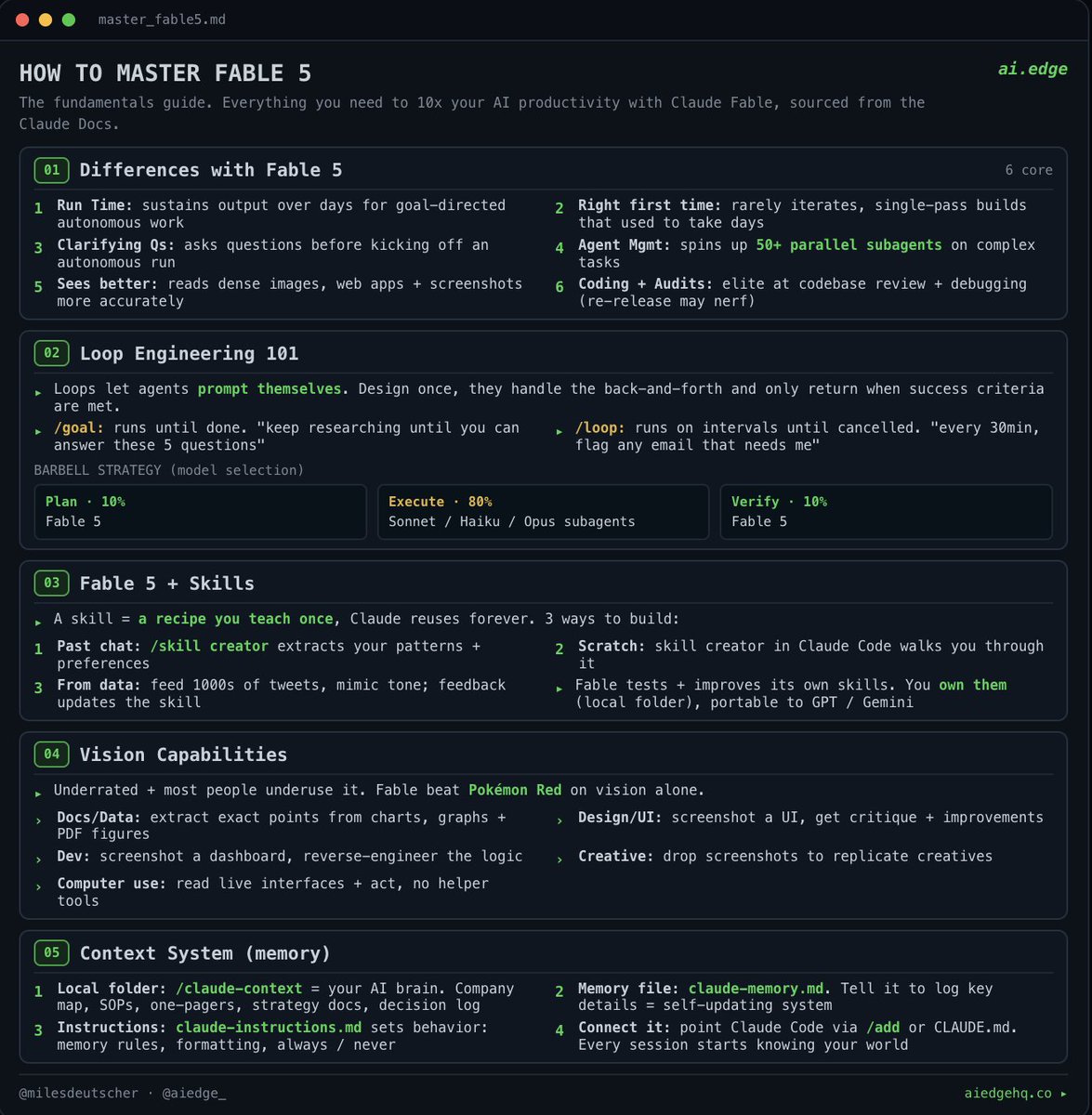
@milesdeutscher followed (125 likes, 22 replies, 27,875 views, 244 bookmarks) with a 20-minute video structured around loop engineering, Claude Skills, visual capabilities, and a local memory system. The replies again converged on memory and realism: one called local context “the missing piece for reliable automation,” while another asked for more real-world examples instead of creator- or trader-specific workflows.
@adxtyahq added (100 likes, 9 replies, 4,784 views, 67 bookmarks) an independent explainer arguing that “the hardest part of AI isn't the model anymore.” The replies treated it as study material, with one viewer saying the video clarified “memory” and “context builder” workers in the agent pipeline.
Discussion insight: The replies did not mainly debate whether Fable was good. They kept returning to what lasts beyond any one model release: loop design, local memory, human-in-the-loop verification, and whether the examples map to real work.
Comparison to prior day: On 2026-07-01, the conversation had already moved from prompting to harness and context engineering. On July 2, that shift became more operational and prescriptive: concrete memory-file setups, explicit plan/execute/verify splits, and teachable loop patterns dominated the strongest posts.
1.2 Software factories and agent control planes are getting specific enough to copy 🡕
A second theme was the jump from abstract “multi-agent” talk to reproducible operating recipes. The posts that traveled were not philosophical; they named the planner, the cloud orchestrator, the issue tracker, the verification bot, the worktree strategy, and the team communication layer.
@vinvan reported (88 likes, 8 replies, 6,693 views, 150 bookmarks) that Fable produced “60+ ready to merge PRs” for Mainframe overnight, then laid out the stack: dictate the full todo list, have Fable plan it into Linear as a dependency graph, use Devin as the long-running cloud middle manager, wire in Linear and Slack MCP servers, and gate everything with tests plus Cursor bug bot. The attached screenshot sharpened the claim by showing engineering-channel heartbeats, many PR-ready items, and a human bottleneck around bug-bot review rather than task generation.
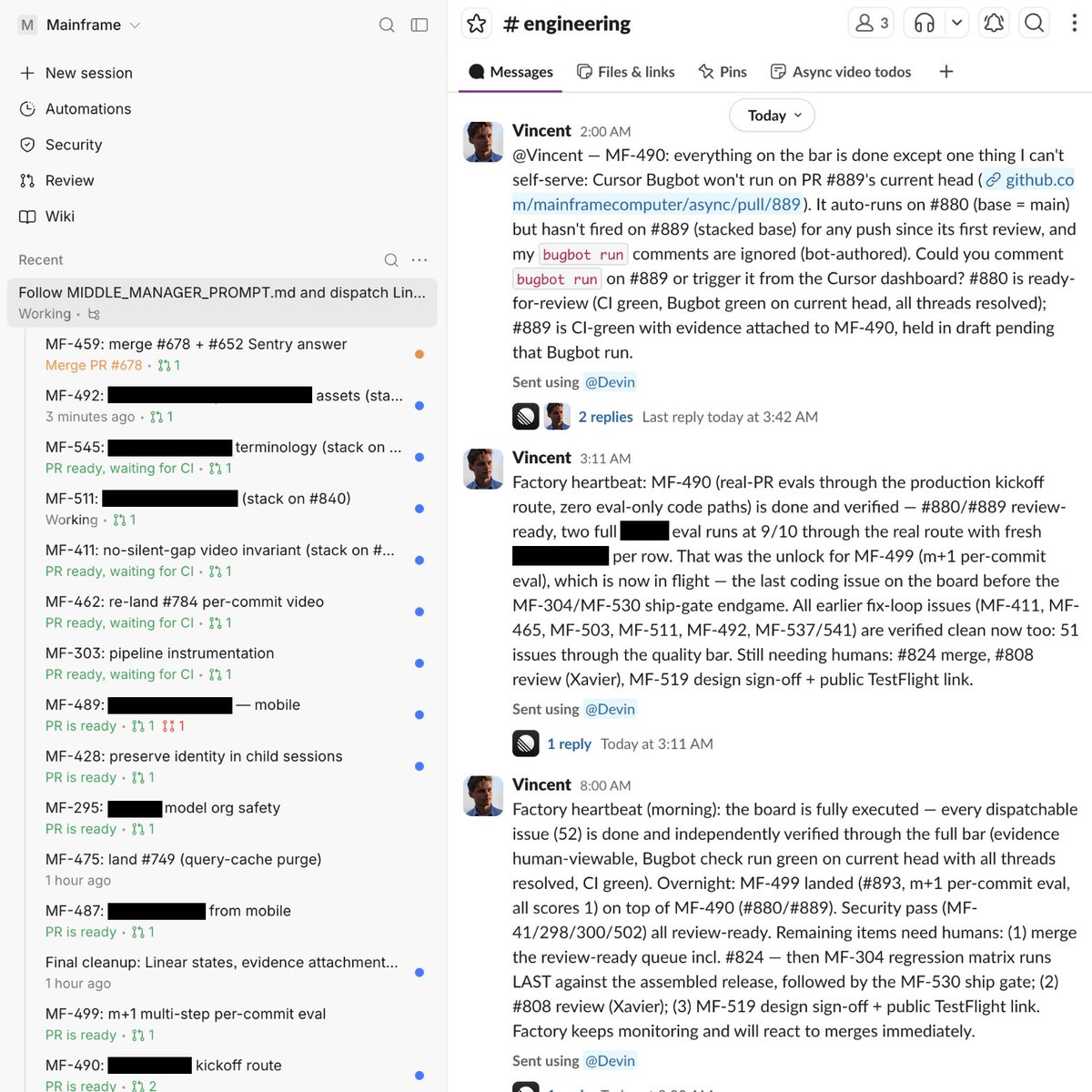
Replies filled in the missing operator detail. Vincent said each agent gets an isolated local stack, Limrun is used for iOS end-to-end testing, and the setup cost was “def > $1K” before optimization. The same thread also made the new limit explicit: once the system works, review throughput becomes the bottleneck.
@tom_doerr pointed to (13 likes, 3,297 views, 23 bookmarks) Aperant, an open-source framework for planning, building, and validating software. The repo README says Aperant 3.0 is under active development while 2.x remains usable today, and the repository had 14,404 stars at fetch time.

@loridotsh described (9 likes, 4,375 views) Lori as a control plane for the next problem after orchestration: too many terminals, duplicated MCP and skill configuration, and no shared view across agent CLIs. The live site showed a short coding-agent run completing a refresh-token rotation task in 18 seconds, which is thin evidence but enough to show the product is not just a mockup. @XFreeze added (120 likes, 19 replies, 8,494 views) a dense Grok Build release note centered on dashboards, subagents, worktree isolation, runtime MCP toggling, and IDE-terminal control.
Discussion insight: The useful disagreement was not about whether orchestration matters. It was about what breaks first once orchestration works: review queues, stacked-PR QA, shared configuration, or progress tracking for long objectives.
Comparison to prior day: July 1 emphasized frameworks and skills as reusable infrastructure. July 2 moved one level closer to execution, with copyable software-factory recipes and control-plane products for supervising many agents at once.
1.3 Long-horizon agent work is being benchmarked, formalized, and priced into infrastructure assumptions 🡕
Another major theme was the move from slogans about “autonomy” to artifacts that measure or model long-duration agent work. The evidence ranged from benchmarks to research papers to infrastructure theses, but the common thread was time: agents acting over hours, learning from environments, and creating second-order pressure on review and hardware.
@tikgiau introduced (66 likes, 7 replies, 6,802 views, 31 bookmarks) EdgeBench, a benchmark of 134 real-world tasks across six categories where agents run for 12 to 72 hours with environmental feedback. The project site and GitHub repo say 51 tasks and the full framework are public, and the repo reports a log-sigmoid scaling law from roughly 38,000 hours of interaction. Thread replies added a concrete example: on one gravitational-wave task, an agent improved from 42.8 to 67.0 across 247 scored attempts.
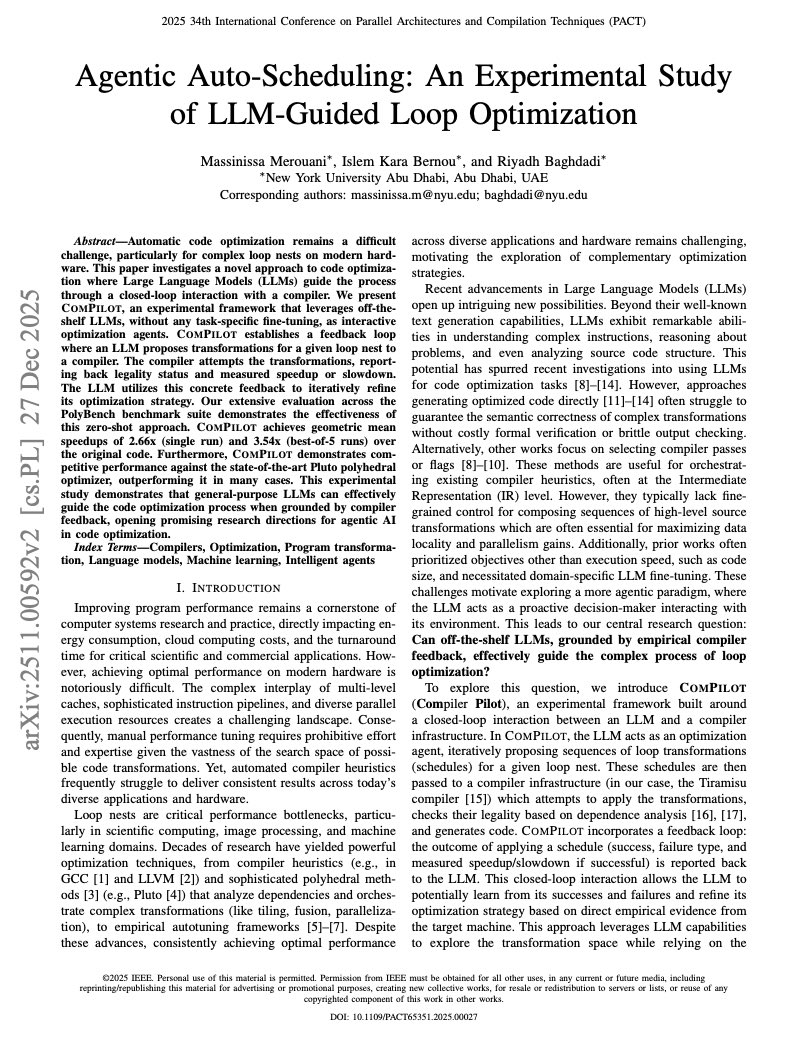
@AIHighlight summarized (72 likes, 11 replies, 10,899 views, 46 bookmarks) an 11-page PDF on loop engineering around five verbs: discover, isolate, verify, persist, and schedule. The attached image identified the underlying paper as Agentic Auto-Scheduling: An Experimental Study of LLM-Guided Loop Optimization, which ties the day’s loop language to a named research artifact rather than pure social shorthand.
@MarkosAAIG argued (91 likes, 7 replies, 25,006 views, 97 bookmarks) that long-context and agent workloads keep HBM demand tight even after KV compression and memory-tiering improvements. The attached HBM Tracker images were unusually specific: one listed assumptions such as 85% of KV-cache traffic staying on HBM and 40% token-traffic growth, another projected supply gaps of 25% in 2026, 16% in 2027, and 27% in 2028, and a third showed 5 of 6 supply constraints binding. The author also explicitly noted that the 5% incremental-efficiency estimate was an inference with wide error bars.
Discussion insight: Replies to the benchmark and paper posts focused on scheduling, second-agent verification, and how agents find work. The HBM thread was less conversational, but it showed that some of the community is already modeling long-horizon agents as infrastructure demand, not only software behavior.
Comparison to prior day: The previous report already showed reliability and safety being treated as deployment problems. July 2 extended that logic into measurement and capacity planning: benchmark the loop, formalize the scheduler, then ask what those loops cost in memory and compute.
1.4 Learning how to build agents is becoming its own product layer 🡕
A fourth theme was that people were not only shipping agents; they were packaging agent literacy itself. The strongest examples were study maps, explainers, and tutorial repositories that tried to turn scattered concepts into a sequence someone could actually learn.
@santtiagom_ shared (114 likes, 5 replies, 3,027 views, 102 bookmarks) a compact list of topics he had been studying: context engineering, tool calling, orchestration, planner/executor and maker/checker patterns, loop engineering, evals, guardrails, and spec-driven development. The replies were almost entirely requests for a curriculum: where to study spec-driven development, which books or courses to trust, and which communities or channels are worth following.
@pallavishekhar_ shared (20 likes, 252 views) a GitHub tutorial repo that walks from function calling through agent loops, ReAct, reflection, plan-and-execute, orchestration, and evaluation. The repo had 29 stars at fetch time and reads like a growing reference path rather than a one-off thread.
Discussion insight: The demand signal here was not hype. It was confusion management. People wanted an ordered path through agent concepts and repeatedly asked for sources grounded in current practice rather than older books.
Comparison to prior day: July 1 centered on frameworks and skills built by teams already deploying agents. July 2 added a parallel layer: content and repos that teach newcomers how to reason about those same workflows.
2. What Frustrates People
Review and verification become the bottleneck as soon as agents get productive
The clearest operational frustration was not that agents failed to write code. It was that once they did, teams still needed a credible proof loop around them. @vinvan reported (88 likes, 8 replies, 6,693 views, 150 bookmarks) that Mainframe ended up with 60+ merge-ready PRs and explicitly said the downside was being “review bottlenecked.” The screenshot-backed heartbeat updates showed stacked-PR review and bug-bot runs as the gating items. @AIHighlight summarized (72 likes, 11 replies, 10,899 views, 46 bookmarks) the same pressure in framework form: “Never let agents self-grade,” and one reply said second-agent verification is the one step they would not skip.
People are coping by adding isolated worktrees, second-agent review, explicit burden-of-proof rules, and bug-bot gates before human review. This looks worth building for at High severity because the failure mode appears exactly when usage starts working at scale.
Agents still forget too much context and splinter too many configurations
A second frustration was the amount of repeated setup still required to keep agents useful. In replies to @milesdeutscher posting (431 likes, 29 replies, 104,921 views, 742 bookmarks), one user said the context-memory section stood out because repeating the same background every time is tiring, and a reply to his follow-up video called local context “the missing piece for reliable automation.” @loridotsh framed (9 likes, 4,375 views) the adjacent pain point more bluntly: too many terminal tabs and separate MCP or skill configuration files for each CLI.
The coping behavior is to move state onto disk, share MCP and skill configuration centrally, and build dashboards or control planes around multiple agent sessions. This is High severity for teams using several agents at once, because the workaround is more tooling rather than less complexity.
People want practical curricula, not scattered inspiration
A third frustration was that many people feel behind on the agent stack and do not trust random learning paths. @santtiagom_ listed (114 likes, 5 replies, 3,027 views, 102 bookmarks) the concepts he had been studying, and the replies immediately asked for books, courses, and source lists. One reply said books are already lagging and that following practitioners from major labs is more useful. In replies to @milesdeutscher, another user asked for more real-world examples instead of optimized influencer-style workflows.
People are coping by treating Twitter threads, GitHub tutorial repos, and short videos as living curricula. This is Medium severity, but it is clearly worth building for because the audience is asking for ordering, examples, and trusted source selection rather than just more content.
3. What People Wish Existed
Durable local memory that improves reliability instead of just storing chat history
The most practical need in the dataset was for memory that survives sessions and actually changes how an agent works. @milesdeutscher centered (431 likes, 29 replies, 104,921 views, 742 bookmarks) his guide on a local context system, and replies said that memory was the part they cared about most. @sibyl_labs_ claimed (24 likes, 8 replies, 314 views) its Memory plugin is in open beta, while the attached roadmap image claimed 100% recall on 350 independent tester benchmarks and 95.2% on LongMemEval.
This is a direct need, not an aspirational one: partial answers exist, but the posts show users still treat reliable memory as missing infrastructure. Opportunity rating: [+++] direct.
A shared control plane for many agent CLIs, MCP servers, and skill bundles
Another practical need is coordination across agent tools. @loridotsh said (9 likes, 4,375 views) the current experience is “a nightmare” of terminal tabs and duplicated MCP and skill setup, then proposed Lori as a control plane. @XFreeze showed (120 likes, 19 replies, 8,494 views) that Grok Build is already competing on adjacent pieces such as dashboards, subagents, worktree isolation, runtime MCP toggles, and IDE-terminal control.
This looks like a competitive need rather than a greenfield one, because multiple products are already moving toward it. The gap is that none of the evidence today showed a clear winner across all CLIs and workflows. Opportunity rating: [++] competitive.
Real-world agent curricula with examples that look like actual work
The dataset also showed a clear demand for instruction that is current, ordered, and practical. @santtiagom_ drew (114 likes, 5 replies, 3,027 views, 102 bookmarks) immediate requests for books, courses, and source lists after posting his study map. @pallavishekhar_ linked (20 likes, 252 views) a GitHub tutorial path covering function calling, loops, orchestration, and evaluation, and replies to @milesdeutscher explicitly asked for more real-world examples.
This is direct but crowded. People want fewer disconnected explainers and more coherent paths grounded in real deployments. Opportunity rating: [++] direct.
Review automation that can keep pace with software factories
The strongest unmet need inside coding-agent workflows was post-generation review capacity. @vinvan said (88 likes, 8 replies, 6,693 views, 150 bookmarks) the system can now generate more ready-to-merge work than humans can comfortably review, and his screenshot showed bug-bot review itself becoming a queueing point. @AIHighlight repeated (72 likes, 11 replies, 10,899 views, 46 bookmarks) that second-agent review should be mandatory, which solves part of the problem but also creates more review work.
This feels like a direct need with real urgency, but the evidence today was stronger on pain than on proven solutions. Opportunity rating: [+++] direct.
4. Tools and Methods in Use
| Tool | Category | Sentiment | Strengths | Limitations |
|---|---|---|---|---|
| Fable 5 | Coding model / orchestrator | (+/-) | Strong interest around long autonomous runs, subagent orchestration, skills, and local context systems | Replies said the model-specific parts may age quickly and asked for more real-world examples |
| Devin | Cloud coding agent | (+) | Used as a long-running “middle manager” that can dispatch subagents and keep work moving for 12+ hours | Requires substantial setup and spend; Vincent said his version cost more than $1K before optimization |
| Linear MCP + Slack MCP | Coordination layer | (+) | Lets agents read planned work, keep DAGs current, and communicate with teammates in-channel | Needs careful upfront planning and issue decomposition before the automation pays off |
| Cursor bug bot | QA / review bot | (+/-) | Central verification gate in the Mainframe factory flow | The screenshot showed a stacked-PR bug-bot run becoming a blocking dependency |
| Limrun | Test automation | (+) | Gives agents iOS end-to-end test coverage instead of limiting them to repo-local checks | Evidence today came from one operator report rather than broader usage |
| x402 | Payment protocol | (+/-) | HTTP-native, accountless, pay-per-call flow for agents buying paid resources over standard web requests | Reply skepticism focused on who controls and funds the wallet, not on the protocol flow itself |
| Apify Actors | Data / API marketplace | (+) | Concrete example of a paid tool catalog an agent can discover, buy, and use autonomously | Its usefulness in the dataset depended on x402-style payment plumbing rather than standalone agent logic |
| EdgeBench | Benchmark / eval harness | (+) | Measures learning from real environments over 12 to 72 hours, with public tasks and published score tables | Only 51 of 134 tasks are public so far, and this is still early frontier-benchmark infrastructure |
| Grok Build | Coding-agent client | (+/-) | Dense release cadence around dashboards, subagents, runtime MCP control, worktrees, and IDE terminals | Evidence today was feature-heavy but still light on detailed operator outcomes |
| Aperant | Coding-agent framework | (+) | Open-source framework for planning, building, and validating software; strong GitHub traction at 14,404 stars | The repo says 3.0 is still being rebuilt, so the newest architecture is not fully public yet |
| Sibyl Memory | Memory infrastructure | (+/-) | Strong first-party positioning around graph-structured memory, auditability, and recall benchmarks | Most of today's evidence came from first-party claims and beta-stage materials |
| Lori | Agent control plane | (+/-) | Directly targets multi-CLI tab chaos, duplicated MCP config, and side-by-side supervision | Public site evidence was still very thin compared with the ambition described in the tweet |
The satisfaction spectrum ran from clear enthusiasm for orchestration features to cautious optimism around memory, benchmarking, and agent payments. The common workaround pattern was to add more structure rather than swap models: plan work explicitly, isolate changes in worktrees, verify with a second system, persist state to disk, and centralize MCP or skill configuration. The clearest migration was away from single-threaded “chat with a model” workflows and toward multi-agent systems with managers, dashboards, and QA gates. Competitive pressure is also visible: Fable, Grok Build, Aperant, and Lori are all trying to own overlapping pieces of the orchestration surface, while Sibyl and local-file approaches compete on what memory should look like in practice.
5. What People Are Building
| Project | Who built it | What it does | Problem it solves | Stack | Stage | Links |
|---|---|---|---|---|---|---|
| Mainframe software factory | @vinvan | Turns a narrated backlog into many parallel coding tasks and dispatches them through a cloud “middle manager” | Helps one team push a large dependency graph of software work overnight without manual babysitting | Fable, Codex subagents, Linear, Slack MCP, Devin, Cursor bug bot, Limrun, isolated local stacks | Alpha | tweet |
| x402 + Apify autonomous purchase flow | @svpino | Lets an agent discover a paid Apify Actor, authorize a spending ceiling, pay over HTTP 402, and use the result | Removes accounts, API keys, and manual checkout from agent access to paid services | x402, Base USDC wallet, Apify Actors, agent skill layer | Beta | x402 docs · tweet |
| Aperant | @tom_doerr | Open-source autonomous multi-agent coding framework that plans, builds, and validates software | Gives developers a packaged framework for parallel AI coding instead of assembling every loop themselves | TypeScript, Claude Code integration, git worktrees, memory layer | Beta | repo · tweet |
| Lori | @loridotsh | Control plane for running multiple agent CLIs side by side with shared model, skill, and MCP setup | Reduces tab sprawl and repeated per-CLI configuration | Multi-session matrix, unified LLM layer, skills marketplace, git telemetry | Alpha | site · tweet |
| Sibyl Memory / Sibyl Sovereign | @sibyl_labs_ | Memory plugin plus a trusted-autonomy framework organized around identity, purpose, and compliance | Tries to give agents persistent recall and bounded behavior in work environments | Graph-structured memory, schema-level invariants, append-only audit rows, cloud or self-hosted SDK | Beta | site · tweet |
| EdgeBench | @tikgiau | Long-horizon benchmark for agents learning from real environments over 12 to 72 hours | Gives researchers and builders a way to measure environmental learning instead of one-shot output | Python, SForge harness, project site, paper, Hugging Face dataset | Shipped | site · repo · tweet |
The Mainframe software factory stood out because it translated agent orchestration into an operating recipe rather than a product teaser. The important detail was not just “60+ PRs,” but the stack behind that outcome: explicit planning in Linear, long-running cloud management in Devin, and QA gates strong enough to keep stacked work moving.
The x402 and Apify example mattered because it showed agent commerce as a real request flow rather than a generic marketplace slogan. The official x402 docs describe the exact HTTP 402 → PAYMENT-SIGNATURE → settlement loop, so the tweet was anchored to a public protocol rather than pure narrative.
Aperant, Lori, and Sibyl all pointed at the same build pattern from different angles: one packages autonomous coding, one packages supervision across many agent CLIs, and one packages persistent memory with stronger trust boundaries. That clustering suggests the day’s builders were converging on the same underlying pain points even when the products looked different.

6. New and Notable
Loop engineering got a named research artifact, not just a slogan
@AIHighlight pointed to (72 likes, 11 replies, 10,899 views, 46 bookmarks) a paper titled Agentic Auto-Scheduling: An Experimental Study of LLM-Guided Loop Optimization, which framed loop optimization around discovering work, isolating changes, verifying with a second agent, persisting state to disk, and scheduling runs over time. The notable part was not just the paper’s existence, but how quickly replies translated it into operator language: finding work is messy, timer-driven loops change the tool category, and self-grading is not trusted.
HBM Tracker turned long-horizon agent demand into a hardware-capacity argument
@MarkosAAIG argued (91 likes, 7 replies, 25,006 views, 97 bookmarks) that longer-context and agent-style workloads keep HBM demand tight even after major efficiency gains such as KV compression, quantization, and sparse attention. The key images showed the exact assumptions behind the model, a projected shortage path of 25% in 2026, 16% in 2027, and 27% in 2028, and a “5 of 6 binding” supply-constraint dashboard. This is lower-confidence than a benchmark or vendor disclosure because the author explicitly said the 5% incremental-efficiency estimate is an inference with wide error bars, but it was one of the clearest attempts to quantify what long-horizon agent usage means for hardware.


Agent payments moved closer to a standard web flow
@svpino showed (97 likes, 20 replies, 13,416 views, 115 bookmarks) an agent discovering and paying for an Apify Actor without an account, API key, or credit card. The official Coinbase x402 docs say the protocol uses an HTTP 402 response with payment instructions, a resubmitted request carrying PAYMENT-SIGNATURE, and settlement handled directly or through a facilitator. That makes the thread notable because it attached agentic commerce to a concrete HTTP flow instead of only to onchain rhetoric.
7. Where the Opportunities Are
[+++] Review and reliability infrastructure for software factories — The strongest cross-section signal was that generation is scaling faster than proof. The evidence came from Vincent’s software-factory thread, where review bottlenecks appeared after 60+ PRs, and AIHighlight’s loop-engineering summary, where second-agent verification and scheduled loops were treated as mandatory. This is strong because it links the main builder story, the main frustration, and the most concrete unmet need.
[++] Memory and control-plane products for multi-agent teams — Local memory systems, shared MCP configuration, and side-by-side supervision all appeared as gaps people are actively trying to close. Evidence came from Miles Deutscher’s Fable guide, Lori’s control-plane pitch, Grok Build’s dashboard-heavy update, and Sibyl Labs’ roadmap post. This is moderate because there are already several competing approaches, but the need still looks unresolved.
[++] Applied agent education and operator playbooks — The learning demand was unusually explicit: people wanted ordered sources, examples grounded in real work, and explanations of loops, orchestration, evals, and guardrails. Evidence came from Santtiago’s study map, adxtyahq’s loop explainer, and the AI Agents Tutorial repo share. This is moderate because it is clearly needed, but the surface is already crowded with courses, repos, and explainers.
[+] Agent-native payments for paid tools and data — The x402 and Apify example showed a real path for agents to buy and use services on demand, and the official docs describe a standard HTTP flow rather than a custom integration. Evidence came from svpino’s autonomous-purchase demo plus the x402 public documentation. This is emerging rather than mature because the replies still questioned wallet control, funding, and who truly owns the agent’s spending authority.
8. Takeaways
- The conversation moved from “use a model” to “design the loop.” The most influential posts were about plan/execute/verify splits, reusable skills, and state persisted to disk rather than one-shot prompting. (source)
- Software factories are now real enough to create a review problem. Mainframe’s overnight flow produced more merge-ready work than humans could comfortably review, making QA and proof loops the next bottleneck. (source)
- Long-horizon agent evaluation is becoming a public research surface. EdgeBench framed agent performance as learning from environments over 12 to 72 hours and published an open subset plus score tables. (source)
- Memory and supervision are turning into standalone product categories. Lori, Sibyl, Grok Build, and the Fable local-context playbook all attacked different parts of the same problem: keeping many agents stateful, observable, and controllable. (source)
- Agent commerce got more concrete, but not fully trustless in practice. The x402 + Apify flow showed a standard HTTP payment path for agents, while replies immediately pushed on the question of who actually controls and funds the wallet. (source)