Twitter AI Agent - 2026-07-04
1. What People Are Talking About
1.1 Harnesses, not bigger models, stayed at the center of agent performance talk 🡕
The clearest July 4 theme was that builders kept treating agent quality as a systems problem around the model, not a model-selection problem on its own. The most useful posts talked about validation, routing, retry logic, evals, and production automations, and the best image-backed examples showed those layers explicitly. This theme was supported by high-engagement framing posts, an edge-device harness repo, and a concrete internal automation stack from a production engineering team.
@alxfazio argued (760 likes, 14 replies, 38,219 views, 827 bookmarks) that ARC AGI winning harnesses are where people should study what actually works from first principles, because too much current harness design is overfit to benchmark-maxing. @alex_prompter framed (166 likes, 7 replies, 18,610 views, 242 bookmarks) the same shift as four nested layers—prompt, context, harness, and loop—and one reply sharpened the operational point: for coding agents, reliability should be checked externally with a failing repro and diff scan, not just by trusting the model's own self-check.

@fatih described (172 likes, 7 replies, 12,798 views, 274 bookmarks) a real internal automation stack at PlanetScale: an e2e sweeper for flaky tests, a doc refresher that opens PRs every six hours, a kube-review skill, backup debugging with read-only production access, feature-flag cleanup, and rollout/recreate detection. The distinctive part was not just the list of automations, but the admission that these systems still need cleanup, tuning, and clearer prompts before they become dependable.
@OpenBMB shared (25 likes, 1 reply, 1,438 views, 19 bookmarks) EdgeHome Harness as a Rust wrapper around a 1B local model that keeps the model limited to candidate JSON while memory, policy, validation, execution, and trace/eval stay deterministic. The linked repo says the setup is aimed at 2GB to 4GB edge environments and enforces the rule that model output is never the command itself.

Discussion insight: The useful disagreement was not over whether harnesses matter. It was over where the trust boundary belongs: several replies argued that self-checking is too weak, and that external verification, reproducible failures, and explicit policy gates are what make agent output trustworthy.
Comparison to prior day: On 2026-07-03, harness and loop engineering were already the dominant explanation for agent quality. On July 4, the conversation moved one step closer to operations: internal automations, edge-device harnesses, and production-style verification boundaries replaced abstract benchmark talk.
1.2 Context persistence and orchestration portability kept moving from complaint to product surface 🡕
A second theme was that people were no longer talking about memory and context as vague future capabilities. They were talking about reset-safe skills, open metadata routes, worktree-based orchestration, and the permissions layer around context. The common idea was that useful context has to survive resets, stay attributable, and remain portable across tools.
@levie argued (183 likes, 51 replies, 24,637 views, 188 bookmarks) that the battle in AI is becoming a battle for context: the applied layer that organizes knowledge, tools, review, and model routing is where the moat forms. His replies added the more grounded caveat that context without permissions, ownership, and cost controls just gives an agent a bigger room to make a more expensive mess.
@kunchenguid introduced (69 likes, 8 replies, 2,289 views, 50 bookmarks) /stow, a context-preservation skill that persists decisions, learnings, and next steps to disk so people can safely clear a context window. The linked firstmate repo positions that skill inside a larger crew-style orchestration system built on visible session backends and isolated git worktrees, which makes the post more than a single reset hack.
@LLMJunky showed (116 likes, 8 replies, 8,687 views, 96 bookmarks) Fable planning seven independent product changes, dispatching GPT-5.5 implementers in separate worktrees, then reviewing and merging the results back together. The attached screenshot mattered because it exposed the type of work being delegated—server-side search, Stripe Connect transactions, pricing intelligence, compatibility checking, alerts, SEO, and schema cleanup—while the replies surfaced a real constraint: long-running orchestration can still get hit by cache expiry and context pressure.

@RhysSullivan explained (69 likes, 11 replies, 6,824 views, 52 bookmarks) how integrations.sh lets products publish agent-facing metadata through /.well-known/ routes for MCP, OpenAPI, agent cards, skills, and a custom integrations.json file. The live site says it already groups 5,758 publicly accessible integration specs across MCP, OpenAPI, GraphQL, and CLI, which turns “agent discoverability” into a concrete infrastructure surface rather than a slogan.
Discussion insight: The sharpest replies were about portability and trust, not storage alone. Builders wanted metadata and memory that stay with the product or repo, not one more opaque tool-specific cache.
Comparison to prior day: On 2026-07-03, memory and supervision were already moving into repos and products. On July 4, the emphasis narrowed to reset-safe persistence, open discovery routes, and orchestration patterns that can survive across tools and sessions.
1.3 Verification and accountability became explicit product requirements 🡕
Another strong theme was that many posts assumed raw generation is no longer enough: agents now need to produce evidence, survive audit, or stay behind human approval for risky actions. The most compelling examples were not abstract safety manifestos but concrete loops for deletion, e2e proof, and accountable action.
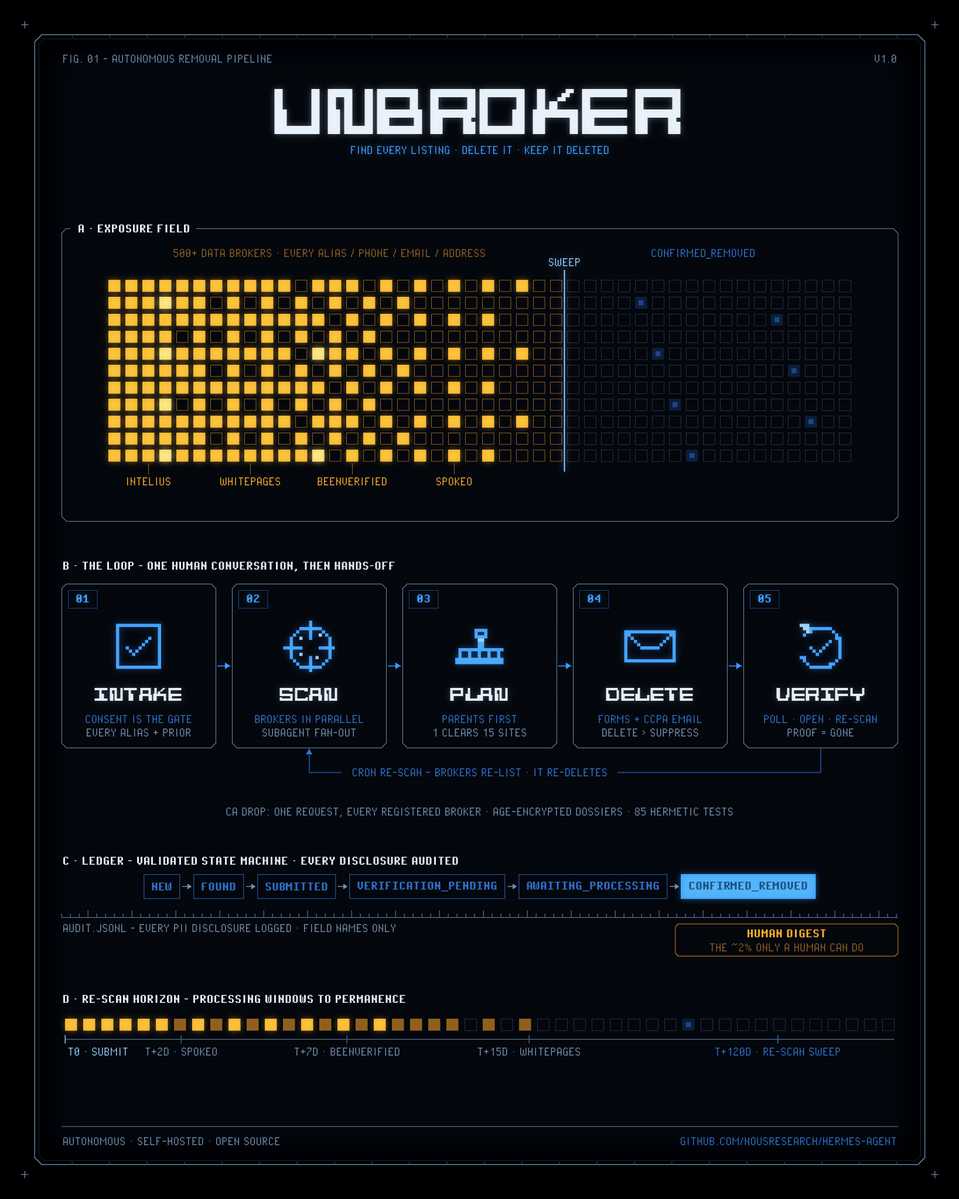
@SHL0MS open-sourced (1,050 likes, 72 replies, 187,129 views, 1,385 bookmarks) UNBROKER as a Hermes Agent skill that finds exposed personal-data listings, fans out broker-specific removal work, and keeps a ledger so the system can re-scan and re-delete later. The image added the real substance: a pipeline from intake to scan, plan, delete, and verify, plus an audited state machine and a re-scan horizon for relisted data.
@tonysimons_ argued (44 likes, 6 replies, 3,930 views, 31 bookmarks) that the real trust gap is the moment an agent says it finished a task and nothing is actually there; he positioned Hermes Agent v0.18.0 as infrastructure for verifying completion instead of assuming it. @RhysSullivan showed (93 likes, 5 replies, 7,239 views, 36 bookmarks) what that looks like in practice: an agent returned a PR with screenshots after reproducing and fixing a Mac menu-bar naming issue inside a Mac VM.
@captainjack125 argued (96 likes, 39 replies, 4,397 views, 16 bookmarks) that agents moving money or publishing on behalf of organizations need an accountability layer, not just reputation. The replies grounded that claim in operator behavior: one person said he never lets any of his parallel agents move money unwatched, and another reduced the requirement to custody, audit trails, and human sign-offs somewhere in the loop.
Discussion insight: The interesting split was between “verification” and “autonomy.” Builders were still willing to automate a lot, but only if the output came with reproducible proof or stayed behind explicit review gates when consequences got serious.
Comparison to prior day: On 2026-07-03, trust issues were attached to marketplaces, voice agents, and identity. On July 4, the conversation got more operational: deletion ledgers, screenshot-backed PRs, completion verification, and money-moving sign-off rules.
1.4 Skills, plugins, and agent “companies” widened the build surface beyond single assistants 🡕
A fourth theme was that the build surface around agents kept widening. Instead of one assistant with one prompt, people were sharing plugins, orchestration programs, team-of-agents frameworks, and explicit requests for extension points. The common thread was that builders want reusable seams where other people can add behavior without forking the core system.
@daniel_mac8 released (126 likes, 17 replies, 21,163 views, 227 bookmarks) fable-advisor, a Claude Code plugin that uses Fable 5 as the architect and routes implementation to cheaper Sonnet, Opus, or GPT-5.5 lanes. The linked README makes the product thesis explicit: keep expensive tokens for requirements and verification, and send most code volume to cheaper implementers.
@Teknium asked (140 likes, 12 replies, 4,601 views, 20 bookmarks) for ideas on expanding Hermes Agent’s plugin interface so developers can ship stable changes without long-lived forks. The most detailed reply did not ask for more tools first; it asked for gateway hooks, structured outbound messages, context injection, auth and approval middleware, tool-call hooks, and plugin-owned state.
@huang_chao4969 introduced (36 likes, 2 replies, 2,027 views, 49 bookmarks) OpenOPC as an “AI-native company” that can self-build roles, self-run work through structured handoffs, and self-grow organizational memory. The linked repo describes the same idea more concretely as a manager/dependency state machine across nine verticals, from AI development and software to finance, media, and education.
@realmcore_ introduced (47 likes, 6 replies, 16,517 views, 29 bookmarks) Slate programs as reusable orchestration components over Fable, GLMs Deep Research, and Kimi 2.7. That made the day’s orchestration discourse feel less like “let one agent run longer” and more like “compose agent systems from reusable parts.”
Discussion insight: The strongest requests were for seams, not vibes: plugin lifecycle hooks, state ownership, approval middleware, and publishable extensions that keep teams out of permanent fork maintenance.
Comparison to prior day: On 2026-07-03, orchestration products mostly focused on supervising many agents. On July 4, the discourse widened toward extension points, reusable orchestration components, and whole-team abstractions.
2. What Frustrates People
Agents still fail for ordinary harness reasons
High severity. @alxfazio said (760 likes, 14 replies, 38,219 views, 827 bookmarks) that the best harness lessons are hidden in ARC AGI winning systems, not in benchmark theater, and @alex_prompter summarized (166 likes, 7 replies, 18,610 views, 242 bookmarks) the same issue as a missing harness layer around prompts and context. The replies under that post were sharper than the original framing: one practitioner said the model should not be the final verifier of its own work, and another reduced the moat to the system around the model rather than the model itself.
The same frustration showed up in concrete products. @OpenBMB showed (25 likes, 1 reply, 1,438 views, 19 bookmarks) a 1B edge agent that only becomes safe once Rust owns validation and policy, and @tbrownio reported (40 likes, 4 replies, 2,865 views, 33 bookmarks) from the AI Engineer World's Fair that “autonomy without structure creates as much slop as leverage.” This looks worth building for because the complaint was not “models are dumb”; it was “wrappers are fragile.”
Context gets lost, fragmented, or trapped inside one tool
High severity. @levie argued (183 likes, 51 replies, 24,637 views, 188 bookmarks) that context is where agent effectiveness compounds, but his replies immediately pushed on the missing controls: permissions, ownership, and cost discipline. @kunchenguid introduced (69 likes, 8 replies, 2,289 views, 50 bookmarks) /stow precisely because people do not trust context resets to preserve what matters, and @LLMJunky showed (116 likes, 8 replies, 8,687 views, 96 bookmarks) that even productive multi-worktree orchestration can run into cache-expiry and resume-context pressure.
@RhysSullivan built (69 likes, 11 replies, 6,824 views, 52 bookmarks) integrations.sh to stop metadata from living in one private registry or one chat transcript, and @Teknium asked (140 likes, 12 replies, 4,601 views, 20 bookmarks) for better plugin interfaces because too much real customization still forces forks. People are coping by writing durable state to disk, publishing well-known routes, and moving orchestration into repos, but the recurring complaint still looks worth building for at High severity.
Human approval is still the backstop for risky actions
High severity for privacy, payments, and production operations. @SHL0MS showed (1,050 likes, 72 replies, 187,129 views, 1,385 bookmarks) an aggressive data-broker removal loop, but the replies still discussed brokers that may require certified-mail escalation and advised a human review gate around irreversible actions. @captainjack125 argued (96 likes, 39 replies, 4,397 views, 16 bookmarks) that agents moving money or speaking for organizations need accountability infrastructure, and one reply made the operating rule explicit: do not let parallel agents move funds unwatched.
The same pattern held in engineering. @fatih said (172 likes, 7 replies, 12,798 views, 274 bookmarks) his doc refresher still opens a PR for a human to read and merge, and @RhysSullivan showed (93 likes, 5 replies, 7,239 views, 36 bookmarks) an agent-backed fix whose evidence included screenshots from a Mac VM. The coping strategy today is not full trust; it is smaller blast radius, reviewable evidence, and a human sign-off step wherever the downside is real.
3. What People Wish Existed
Durable context that survives resets without becoming a private trap
This was the clearest practical need in the dataset. @kunchenguid introduced (69 likes, 8 replies, 2,289 views, 50 bookmarks) /stow so people can clear context without losing decisions and next steps, while @levie argued (183 likes, 51 replies, 24,637 views, 188 bookmarks) that the winning applied layer will be the one that captures and governs the best context. @huang_chao4969 introduced (36 likes, 2 replies, 2,027 views, 49 bookmarks) OpenOPC as a company-shaped system that accumulates organizational memory instead of restarting from scratch.
This is a direct need, not an aspirational one. Partial answers exist, but users still want context that is durable, attributable, and portable across tools. Opportunity rating: [+++] direct.
Open plugin and discovery standards across harnesses, APIs, and skills
Another strong need was interoperability. @RhysSullivan explained (69 likes, 11 replies, 6,824 views, 52 bookmarks) a public set of /.well-known/ routes for MCP, agent cards, skills, and integration metadata, and the integrations.sh site says it already indexes 5,758 public specs. @Teknium asked (140 likes, 12 replies, 4,601 views, 20 bookmarks) for plugin-interface expansion specifically so useful Hermes customizations can live as extensions instead of forks.
This need is practical and already competitive. Builders do not want another closed registry or another fork-heavy customization path. Opportunity rating: [++] competitive.
Verification rails that generate proof instead of confident claims
The strongest unmet need inside agent execution was trustworthy proof. @tonysimons_ argued (44 likes, 6 replies, 3,930 views, 31 bookmarks) that the real gap is when an agent says it finished and there is nothing there, @RhysSullivan showed (93 likes, 5 replies, 7,239 views, 36 bookmarks) screenshot-backed proof from a VM-based fix, and @SHL0MS built (1,050 likes, 72 replies, 187,129 views, 1,385 bookmarks) a deletion workflow with ledgering and re-scan verification.
This feels urgent and direct because the workaround today is still manual review, approval gates, and out-of-band checking. What people want is not more confidence from the model; it is evidence that the work happened in the real environment. Opportunity rating: [+++] direct.
4. Tools and Methods in Use
| Tool | Category | Sentiment | Strengths | Limitations |
|---|---|---|---|---|
| Harness engineering | Method | (+) | Focuses attention on validation, routing, retries, structured outputs, and reproducible execution | Needs explicit external checks; easy to overfit to demos or benchmarks |
| Loop engineering | Method | (+/-) | Turns goals into repeatable runs with stop conditions, verification, and retries | A bad prompt inside a loop can fail faster; still needs human outer-loop judgment |
| Context engineering | Method | (+) | Makes prompts more effective through system instructions, reference files, and conversation state | Context decays, bloats, or becomes unsafe without permissions and ownership controls |
| Cursor Automations | Coding-agent automation | (+/-) | Makes internal automations resumable and easy to inspect as agent runs | Initial cleanup, maintenance, and prompt tuning are still substantial |
| Hermes Agent | Agent harness | (+/-) | Growing skill ecosystem, verification focus, and plugin appetite | Builders still want more stable extension points and approval middleware |
| UNBROKER | Privacy agent skill | (+) | Local-first deletion workflow, broker fan-out, audited ledger, re-scan loop | Some edge cases still need human escalation and jurisdiction-specific handling |
| Fable Advisor | Claude Code plugin / orchestration | (+) | Mixed-model routing keeps expensive reasoning on Fable and pushes code volume to cheaper lanes | Depends on model availability, session limits, and more orchestration complexity |
| firstmate /stow | Multi-agent supervision + memory | (+) | Crew-style worktree orchestration plus reset-safe persistence of decisions and next steps | Setup is heavier than a single-agent workflow and early quality checks still matter |
| integrations.sh | Discovery / metadata infrastructure | (+) | Lets products self-publish MCP, API, CLI, and skills metadata through open routes | Needed a custom integrations.json layer because existing standards were not enough |
| OpenOPC | Multi-agent company framework | (+/-) | Packages org design, task handoffs, and organizational memory into one model | Public evidence is early and still repo/demo heavy |
| EdgeHome Harness | Edge safety harness | (+) | Makes a small local model usable by keeping command resolution deterministic | Narrow vertical scope and low public traction so far |
The overall satisfaction spectrum ran from strong conviction around harness, context, and verification layers to more cautious optimism around bigger orchestration frameworks. @fatih described (172 likes, 7 replies, 12,798 views, 274 bookmarks) a world where the automation itself is the unit of work, while @daniel_mac8 showed (126 likes, 17 replies, 21,163 views, 227 bookmarks) that model routing is becoming part of ordinary agent operations rather than an exotic optimization.
The common workaround pattern was to add structure instead of swapping models: persist state, publish metadata, isolate work in worktrees, require proof before merge, and keep a human approval step around anything costly or irreversible. The clearest competitive clusters formed around two surfaces: context and memory products such as /stow and OpenOPC, and supervision / discovery products such as firstmate, integrations.sh, Hermes plugins, and mixed-model orchestrators.
5. What People Are Building
| Project | Who built it | What it does | Problem it solves | Stack | Stage | Links |
|---|---|---|---|---|---|---|
| UNBROKER | SHL0MS / Hermes ecosystem | Finds personal-data broker listings, files removals, and re-checks for relisting | Makes privacy deletion work less manual and less dependent on subscription services | Hermes Agent skill, browser automation, local models, encrypted dossiers, email/webmail integration | Beta | post |
| EdgeHome Harness | OpenBMB community / Orlando Liu | Wraps a 1B local model in deterministic validation, policy, execution, and trace layers for smart-home control | Makes tiny edge models safe enough to act without handing execution authority to the model | Rust, MiniCPM5-1B, candidate JSON contract, policy gate, trace/eval | Alpha | repo |
| Fable Advisor | DannyMac180 | Uses Fable as architect and cheaper models as implementers inside Claude Code | Lowers orchestration cost while keeping requirements and verification on a stronger model | Claude Code plugin, Fable 5, Sonnet/Opus lanes, GPT-5.5 via Codex CLI | Beta | repo |
| firstmate /stow | kunchenguid | Supervises a crew of coding agents and persists durable state so resets are safer | Reduces terminal sprawl and lost context in multi-agent coding workflows | AGENTS.md orchestration, git worktrees, visible session backends, disk-backed state | Beta | repo |
| integrations.sh | Rhys Sullivan | Catalogs agent-facing metadata for products and lets them self-publish discovery routes | Makes APIs, MCP servers, CLIs, skills, and auth flows easier for agents to discover | /.well-known/ routes, OpenAPI, MCP, GraphQL, CLI metadata, integrations.json |
Shipped | site |
| OpenOPC | HKUDS | Spins up role-specific AI employees, orchestrates work items, and accumulates org memory | Turns open-ended business tasks into structured multi-agent company workflows | Python 3.10+, CLI, React + Phaser office UI, role/task memory | Alpha | repo |
| PlanetScale automation suite | Fatih / PlanetScale | Runs internal sweeps for docs, flakes, backups, rollout safety, and feature-flag cleanup | Keeps recurring engineering operations from depending on manual polling | Cursor Automations, bespoke skills, read-only production access, PR workflows | Shipped | post |
| Slate programs | realmcore | Packages reusable orchestration components over multiple research and coding models | Helps teams build repeatable agent systems instead of one-off agent sessions | Fable, GLMs Deep Research, Kimi 2.7, reusable orchestration components | Beta | post |
UNBROKER stood out because it connected a real consumer pain point to an unusually concrete agent loop. @SHL0MS showed (1,050 likes, 72 replies, 187,129 views, 1,385 bookmarks) a system that can fan out across brokers, tailor deletion requests by jurisdiction, and keep enough ledger state to re-run the process when data resurfaces. The replies made the build pattern even more useful: hard cases still need a human fallback, but most of the pain can be collapsed into one workflow.
EdgeHome Harness and Fable Advisor showed two ends of the same systems trend. @OpenBMB shared (25 likes, 1 reply, 1,438 views, 19 bookmarks) a narrow edge harness where Rust owns every safety-critical boundary, while @daniel_mac8 released (126 likes, 17 replies, 21,163 views, 227 bookmarks) a plugin whose whole job is choosing which model should think and which model should type. Both treat “the model” as one part of a larger runtime rather than the whole product.
firstmate, integrations.sh, OpenOPC, and Slate programs pointed to a second build cluster: agent operating systems. @kunchenguid introduced (69 likes, 8 replies, 2,289 views, 50 bookmarks) reset-safe context persistence inside a crew-oriented orchestration system, @RhysSullivan explained (69 likes, 11 replies, 6,824 views, 52 bookmarks) open discovery metadata for products, @huang_chao4969 introduced (36 likes, 2 replies, 2,027 views, 49 bookmarks) a whole AI-native company abstraction, and @realmcore_ introduced (47 likes, 6 replies, 16,517 views, 29 bookmarks) reusable orchestration programs. Together they suggest that agent infrastructure is splitting into coordination, discovery, memory, and proof layers rather than staying one monolithic assistant category.
6. New and Notable
Harness engineering is hardening into a named operating discipline
@suraj_sharma14 outlined (70 likes, 3 replies, 3,002 views, 96 bookmarks) a 12-stage path to becoming a Harness Engineer or AI Quality Engineer, covering testing, structured outputs, eval frameworks, safety engineering, tracing, CI/CD gates, red teaming, cost control, and drift detection. It mattered because it treated harness work as a real craft with its own curriculum, not just “prompting but more advanced.”
Open agent discovery infrastructure got a concrete public footprint
@RhysSullivan explained (69 likes, 11 replies, 6,824 views, 52 bookmarks) a product-side way to publish MCP, API, CLI, skills, and auth metadata through standard routes, and the live integrations.sh site says it already indexes 5,758 publicly accessible specs across MCP, OpenAPI, GraphQL, and CLI. That made “agent-readable software” feel less like a conceptual standard and more like a growing public dataset.
ICML-bound research kept turning agent hype into benchmarks and coordination papers
@SakanaAILabs shared (65 likes, 5 replies, 5,529 views, 7 bookmarks) a thread of 11 papers headed to ICML 2026, including CoffeeBench for 90-day multi-agent business performance, Sheaf-ADMM for coordination under partial local views, and context re-positioning work for relevance-aware long-context handling. It mattered because the thread connected three practical concerns from the day’s feed—coordination, long-horizon evaluation, and context management—to named research artifacts rather than generic promises.
7. Where the Opportunities Are
[+++] Verification and evidence loops for real agent work — Evidence came from multiple directions: Hermes completion verification, screenshot-backed PRs from VM-driven tests, UNBROKER’s audited deletion ledger, and repeated insistence on human sign-off around risky actions. Strong opportunity because it is supported by themes, frustrations, needs, and live builder activity.
[+++] Durable, portable context layers — /stow, firstmate, Levie’s context thesis, OpenOPC’s organizational memory, and the integrations.sh metadata surface all point to the same gap: people want context that survives resets and survives tool boundaries. Strong opportunity because the need is explicit and recurring, but no single approach has clearly won.
[++] Open plugin, discovery, and extension infrastructure — Hermes plugin requests, integrations.sh routes, OpenOPC, and Slate programs all respond to the same problem: teams do not want one more closed assistant or permanent fork. Moderate opportunity because demand is clear, but multiple builders are already moving into the space.
[++] Privacy-sensitive automation with human fallback — UNBROKER showed that agent loops can tackle messy real-world consumer workflows when they keep data local, keep logs auditable, and route the hard last mile back to a person. Moderate opportunity because the workflow value is concrete, but legal edge cases and trust requirements remain significant.
[+] Edge harness kits for small local models — EdgeHome Harness showed that a small model becomes more useful when the harness owns safety, validation, and replay. Emerging opportunity because the artifact is concrete, but the public evidence is still narrow and vertical-specific.
8. Takeaways
- Agent quality was framed as a runtime problem more than a model problem. The strongest posts on July 4 kept returning to validation, routing, retries, and external proof rather than raw model upgrades, as @alxfazio argued (760 likes, 14 replies, 38,219 views, 827 bookmarks) and @fatih described (172 likes, 7 replies, 12,798 views, 274 bookmarks) in production examples.
- Context is being treated as infrastructure, not a chat convenience. The day’s memory discourse centered on persistence, permissions, and portability, from @levie arguing (183 likes, 51 replies, 24,637 views, 188 bookmarks) that context is the battleground to @kunchenguid shipping (69 likes, 8 replies, 2,289 views, 50 bookmarks) a reset-safe persistence skill.
- Verification is becoming a first-class product surface. Screenshot-backed PRs, completion-verification infrastructure, and deletion ledgers all point to the same shift, as @tonysimons_ argued (44 likes, 6 replies, 3,930 views, 31 bookmarks) and @RhysSullivan showed (93 likes, 5 replies, 7,239 views, 36 bookmarks).
- Builders increasingly want reusable seams instead of one monolithic assistant. Fable Advisor, Hermes plugin requests, OpenOPC, and Slate programs all pushed toward pluggable lanes, hooks, and reusable orchestration components, not longer single-agent sessions. @daniel_mac8 released (126 likes, 17 replies, 21,163 views, 227 bookmarks) one concrete mixed-model version of that pattern.
- Public agent infrastructure is starting to look like an ecosystem, not isolated demos. integrations.sh’s published metadata routes, OpenOPC’s company abstraction, and Sakana’s benchmark thread all suggested that discovery, coordination, and evaluation are being externalized into shared artifacts rather than kept as private operator tricks. @RhysSullivan explained (69 likes, 11 replies, 6,824 views, 52 bookmarks) one infrastructure layer, and @SakanaAILabs shared (65 likes, 5 replies, 5,529 views, 7 bookmarks) the research layer behind it.