Twitter AI Agent - 2026-07-05
1. What People Are Talking About
1.1 Loop engineering became the default explanation for agent quality 🡕
The strongest July 5 theme was that people kept treating agent reliability as a systems problem above the prompt. The highest-signal posts did not just repeat “prompt engineering is dead”; they broke the stack into context, harness, verifier, retry, memory, and stop conditions, then argued that long-run performance depends on those layers. This theme was supported by a high-engagement explainer thread, multiple informative diagrams, and a practical Fable 5 loop guide.
@alex_prompter argued (339 likes, 10 replies, 30,174 views, 437 bookmarks) that prompt, context, harness, and loop engineering form nested layers, with the harness owning tool routing, verification, retry logic, and structured outputs. The distinctive value was in the replies: one practitioner said the model should not be the final verifier of its own work, and that coding agents need an external failing repro, a passing rerun, and a diff scan before anyone should trust the result.
@free_ai_guides mapped (30 likes, 5 replies, 1,625 views, 29 bookmarks) the same four layers more concretely, showing prompt composition, context curation, harness-time verifier and sub-agent calls, and loop-level completion checks. That image mattered because it made the claim operational: the loop is where budget, max-iteration limits, and “actually done or just confident” checks live.

@0x_kaize compiled (96 likes, 17 replies, 4,796 views, 69 bookmarks) a loop-engineering reading list and reduced the field to three questions: can the agent recover from a failed step, control spend, and know when to stop. @aiedge_ shared (16 likes, 1 reply, 2,906 views, 38 bookmarks) a Fable 5 guide whose image added the practical details missing from most slogan threads: verifier sub-agents, self-correction loops, and a five-step memory progression from failure note to reusable rule.
Discussion insight: The most useful replies were not debating whether loops matter. They were narrowing the trust boundary: a loop is only as good as its external verifier, kill switch, and retry discipline.
Comparison to prior day: On 2026-07-04, harness and loop engineering were already the center of the conversation. On July 5, the discourse became more prescriptive, with study lists, explicit verifier patterns, and concrete run-control tactics replacing broad framing alone.
1.2 Memory, skills, and reversible state became infrastructure surfaces 🡕
A second theme was that “memory” no longer meant stuffing more tokens into context. Builders were talking about reversible execution state, tiered skill loading, persistent decision history, and packaged skills that can survive across runs and teams. The conversation shifted from whether memory matters to how memory should be structured, audited, and replayed.
@_avichawla explained (75 likes, 5 replies, 7,054 views, 98 bookmarks) Shepherd as an “agent-native version of Git” that can fork from an exact earlier run state instead of restarting from step one. The Shepherd repo and paper say the runtime records durable execution traces, keeps retained outputs reviewable before selection, and improved CooperBench pair-coding pass rate from 28.8% to 54.7% with a live supervisor.
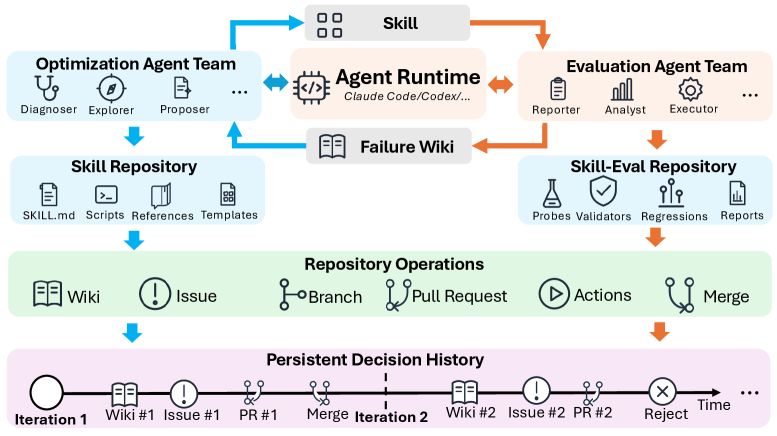
@HuggingPapers highlighted (11 likes, 1 reply, 817 views, 6 bookmarks) SkillHone as a system where agent skills remember why they changed instead of acting like static prompts. The image added the real substance: optimization agents, evaluation agents, a failure wiki, a skill repository, a skill-eval repository, and a persistent decision history that tracks each iteration through wiki updates, issues, PRs, merges, and rejects.
@dair_ai summarized (39 likes, 9 replies, 3,774 views, 25 bookmarks) HASTE as a hierarchical skill system for ML engineering agents, and the paper reports the strongest number in this cluster: with the same 159 skills across 8 competitions, tiered loading reached a 100% medal rate while flat loading reached 62.5%, matching the no-skills baseline and burning roughly twice the output tokens. @phosphenq framed (77 likes, 13 replies, 4,812 views, 65 bookmarks) Ruflo as a self-improving swarm around Claude Code and Codex, and the Ruflo repo describes 98 agents, 35 plugins, HNSW-backed AgentDB memory, federation across machines, and background workers that keep learning between tasks.
Discussion insight: The sharpest nuance was about memory quality, not memory quantity. Replies warned that unscoped memory can calcify false positives, and another thread asked outright for benchmarks that compare whole harness environments rather than just model outputs.
Comparison to prior day: On 2026-07-04, persistence centered on reset-safe context and repo-side metadata. On July 5, the evidence moved deeper into architecture: reversible traces, tiered skill hierarchies, decision-history systems, and public skill/runtime stacks.
1.3 Verification shifted from self-approval to user-reality checks 🡕
Another strong theme was that evaluation is moving away from “the agent said it finished” toward workflows that behave like a real user, inspect real files, and test the whole environment around the model. The day's posts treated browser dogfooding, parsing quality, and harness benchmarks as first-class product problems rather than QA polish.
@kieranklaassen described (38 likes, 2 replies, 3,677 views, 91 bookmarks) a verification loop built around the /ce-dogfood command, and the linked Thinkroom document lays out a six-phase flow: scope, build, serve, execute as a user, fix, and report. The important shift is that passing tests or review is not enough; the branch has to prove itself against a user-like scenario and record the evidence.
@jerryjliu0 argued (28 likes, 5,150 views, 28 bookmarks) that file attachments are exploding inside agent loops and that weak parsers such as pypdf or pdftotext create hallucinated context and bad retrieval. The LiteParse repo strengthened the claim: it positions local Rust/PDFium/Tesseract parsing, screenshots, markdown, JSON, and one-command skill installation as infrastructure for agents that need to reason over documents instead of just skim them.
@loraclexyz asked (63 likes, 4 replies, 4,992 views, 18 bookmarks) when the ecosystem will get real benchmarks for harnesses such as Hermes or OpenClaw, explicitly naming tools, scoping, document processing, memory organization, ontology building, and business-task execution as the things worth measuring. That was one of the clearest signs in the dataset that the benchmark surface is moving outward from the model itself.
Discussion insight: The emerging consensus was that verification now has at least three layers: external task checks, realistic user-path execution, and evidence that the agent understood the underlying files or environment correctly.
Comparison to prior day: On 2026-07-04, verification mostly meant proof-of-completion and human review gates. On July 5, the conversation moved closer to browser reality, file semantics, and full-environment evaluation.
1.4 Agents reached more public and risky surfaces, and trust questions followed 🡕
The fourth theme was a widening deployment surface. Coding agents were still central, but the most notable new examples pushed into offensive security, phone answering, and economic trust infrastructure. In each case, the product pitch came paired with a sharper trust or cost question than the day before.
@elder_plinius released (335 likes, 35 replies, 15,111 views, 300 bookmarks) T3MP3ST as a self-hosted offensive-security harness around existing coding agents. The repo says it supports a War Room UI, MCP and HTTP interfaces, 35 built-in tools by default and 83 with the opt-in full arsenal, reports 90.1% pass@1 on XBOW's 104-challenge XBEN suite via verify-claims, and keeps dangerous post-exploitation drivers behind a human-approval gate with explicit authorized-use language.

@testingcatalog showed (107 likes, 12 replies, 6,682 views, 18 bookmarks) xAI's Grok Voice Agent Builder screen promising that users will be able to deploy a phone-answering voice agent in minutes without code. The image mattered because it exposed the consumer product surface directly: real calls, a natural voice, configurable handling for questions or bookings, and a free number to start taking calls.

@ekinoks_26 argued (60 likes, 63 replies, 331 views) that Uber-style ROI doubts around agent deployments are really about hidden operating overhead such as monitoring, credential rotation, and oversight rather than token pricing alone. @mdmontasir674 used (29 likes, 26 replies, 102 views) NeoSoul's trust-layer diagram to argue that identity, intent, control, execution, verification, recourse, and evolution all have to be explicit before agents can participate in real economic activity.
Discussion insight: The replies concentrated on scope control, bugs, and governance. Security posts prompted questions about approval gates and misuse, while voice-agent replies jumped straight to turn-taking bugs, scam resistance, and whether people will know they are talking to a machine.
Comparison to prior day: On 2026-07-04, accountability and proof were already key product requirements. On July 5, those concerns extended into offensive-security tooling, consumer phone agents, and explicit trust-layer designs for agent economies.
2. What Frustrates People
Verification still breaks when agents grade themselves
High severity. @alex_prompter argued (339 likes, 10 replies, 30,174 views, 437 bookmarks) that the harness layer is what makes AI reliable, but the most technically useful reply under that post said the model should not be the final checker of its own work. @kieranklaassen described (38 likes, 2 replies, 3,677 views, 91 bookmarks) a verification loop that explicitly serves the app and exercises it like a user, and the linked Thinkroom guide says passing review can still leave the first user facing a broken form or wrong email path.
The same frustration appears in file handling. @jerryjliu0 argued (28 likes, 5,150 views, 28 bookmarks) that weak parsing inside agent loops produces hallucinated context and bad retrieval before the model even starts deeper reasoning. People are coping with verifier sub-agents, browser dogfooding, and specialized parsers such as LiteParse, but the fixes are still layered in manually. This looks worth building for because the failure mode is ordinary, recurring, and expensive once agents run longer than one step.
Memory and skill libraries still decay unless they are scoped and curated
High severity. @dair_ai summarized (39 likes, 9 replies, 3,774 views, 25 bookmarks) HASTE, and the paper reports the clearest warning in the dataset: flat loading with 159 skills performed no better than no skills at all, while tiered loading reached a 100% medal rate in the ablation. @phosphenq framed (77 likes, 13 replies, 4,812 views, 65 bookmarks) Ruflo as a self-improving swarm, but one reply warned that if memory only stores success summaries, the system starts training on its own false positives.
@DavidOndrej1 released (576 likes, 28 replies, 23,546 views, 813 bookmarks) a public skill pack after what he described as hundreds of hours of trial and error, which is its own signal that reusable agent workflows still take a lot of manual curation. @loraclexyz asked (63 likes, 4 replies, 4,992 views, 18 bookmarks) for harness benchmarks that include memory organization and ontology building, reinforcing that people do not yet trust current memory claims at face value. Teams are coping by hand-curating skills, preserving decision history, and narrowing what gets loaded, which makes this worth building for at High severity.
Operating and trust overhead is still the tax on real deployment
High severity. @ekinoks_26 argued (60 likes, 63 replies, 331 views) that the hidden cost in agent deployment is not inference alone but the operational overhead of monitoring, credential rotation, and human oversight. @elder_plinius released (335 likes, 35 replies, 15,111 views, 300 bookmarks) T3MP3ST with dangerous post-exploitation drivers kept behind human approval, and the repo is unusually explicit about what is stable, experimental, and authorized-use only.
The same pattern showed up on the consumer side. @testingcatalog showed (107 likes, 12 replies, 6,682 views, 18 bookmarks) Grok Voice Agent Builder, but one reply said a months-old turn-taking bug had been annoying enough to notice. @mdmontasir674 used (29 likes, 26 replies, 102 views) NeoSoul's trust-layer diagram to argue that verification and recourse have to sit alongside identity, intent, and execution. The coping strategy today is still approval gates, narrower scope, and more governance scaffolding, which makes this worth building for at High severity.
3. What People Wish Existed
Benchmarks for agent harnesses and operating environments
This was one of the clearest explicit asks in the dataset. @loraclexyz asked (63 likes, 4 replies, 4,992 views, 18 bookmarks) when the ecosystem will get benchmarks for harnesses such as Hermes or OpenClaw, and the replies argued that a useful benchmark has to include ontology mapping, document processing, web browsing, accounting, and noisy live environments rather than just a prompt/answer pair. The success of proof-heavy artifacts such as Shepherd, HASTE, and T3MP3ST suggests people will trust systems more when the harness itself is measured.
This is a practical need, not an abstract one. People are already improvising their own evaluation surfaces, but they want shared benchmarks for the whole runtime around the model. Opportunity rating: [++] direct.
Durable skills that preserve why they changed
Another strong need was memory with rationale, not just memory with recall. @HuggingPapers highlighted (11 likes, 1 reply, 817 views, 6 bookmarks) SkillHone as a system where skills keep a persistent decision history, @dair_ai summarized (39 likes, 9 replies, 3,774 views, 25 bookmarks) HASTE's tiered skill organization, and @DavidOndrej1 released (576 likes, 28 replies, 23,546 views, 813 bookmarks) a public skill pack after hundreds of hours of trial and error.
This is a direct need because the workarounds are still manual curation, hand-maintained skill folders, and narrow loading rules. What people seem to want is a memory layer that preserves failure context, successful patterns, and the reasons a skill changed without poisoning the next run. Opportunity rating: [+++] direct.
Verification loops that can prove behavior in user reality
The dataset kept returning to the same request in different forms: not more confidence from the model, but stronger proof from the system. @kieranklaassen described (38 likes, 2 replies, 3,677 views, 91 bookmarks) a dogfooding loop that serves and exercises the app like a user, @_avichawla explained (75 likes, 5 replies, 7,054 views, 98 bookmarks) Shepherd's replayable traces and supervisor model, and @jerryjliu0 argued (28 likes, 5,150 views, 28 bookmarks) that agents also need better file understanding before those checks mean anything.
This feels urgent and direct because the current fallback is still more manual review, more browser checking, and more parser glue. What people want is a repeatable path from “it says done” to “it is demonstrably done.” Opportunity rating: [+++] direct.
Plugin and governance layers for agents that act in public
The last unmet need was extension plus governance. @biscuitweb3 asked (60 likes, 55 replies, 2,778 views, 3 bookmarks) whether Hermes is entering its plugin era after @Teknium called for interface ideas that would let developers publish stable changes without long-lived forks. @mdmontasir674 used (29 likes, 26 replies, 102 views) NeoSoul's trust-layer diagram to argue that control, verification, and recourse are separate layers, and @testingcatalog showed (107 likes, 12 replies, 6,682 views, 18 bookmarks) how fast consumer-facing voice agents are getting to deployment.
This need is practical and already competitive. Builders do not want another permanent fork, but they also do not want public agents without explicit control and fallback layers. Opportunity rating: [++] competitive.
4. Tools and Methods in Use
| Tool | Category | Sentiment | Strengths | Limitations |
|---|---|---|---|---|
| Loop engineering | Method | (+) | Gives agents goals, retries, verification, stop conditions, and recovery paths for long runs | Still needs kill switches, budget control, and external success checks |
| Harness engineering | Method | (+) | Focuses on tool routing, verifiers, structured outputs, and reliability above the model | Hard to benchmark cleanly; easy to confuse self-checking with real verification |
| Fable 5 | Planning and orchestration model | (+/-) | Repeatedly cited for sub-agent planning, long-run autonomy, and strong architectural reasoning | Cost, session pressure, and handoff quality still matter |
| Fable Advisor | Claude Code plugin and router | (+) | Keeps expensive reasoning on Fable and delegates simpler implementation to cheaper lanes such as GPT-5.5 via Codex CLI | Adds orchestration complexity and depends on choosing the right tasks to hand off |
| Shepherd | Runtime and supervision substrate | (+) | Reversible execution traces, retained outputs, exact-state replay, and review before apply | Early alpha; external side effects still need separate gates |
| HASTE | Research system and skill-memory method | (+) | Tiered skill loading improved transfer efficiency and medal rate in benchmarked ML workflows | Evidence is strong but still research-scale and setup-heavy |
| Mission Control | Orchestration dashboard | (+) | Self-hosted control center with tasks, governance, skills, spend tracking, RBAC, and API surface | Alpha-stage and operationally broader than many teams may need |
| Ruflo | Meta-harness and swarm framework | (+/-) | Adds many specialized agents, AgentDB memory, federation, plugins, and background workers around Claude Code and Codex | Memory quality, trust boundaries, and real-world evaluation remain open questions |
| LiteParse | Document parsing | (+) | Local parsing with markdown, JSON, screenshots, OCR, and one-command skill packaging for agent loops | Complex documents can still need heavier parsing paths |
| T3MP3ST | Offensive-security harness | (+/-) | Concrete benchmark receipts, tool-backed recon and exploit pipeline, War Room UI, MCP and HTTP interfaces | Risky domain, explicit approval gates needed, coordinated swarm still partly experimental |
| Grok Voice Agent Builder | Voice agent builder | (+/-) | Very low-friction path to deploy a phone-answering agent with a natural voice | Trust, turn-taking quality, and public-facing failure modes remain unresolved |
The overall satisfaction spectrum ran from strong conviction around loops, harnesses, and verification infrastructure to more cautious optimism around large swarm frameworks and public-facing voice or security deployments. Mixed-model routing showed up as a practical optimization instead of a novelty, while document parsing and dogfooding loops were treated as core runtime components rather than polish.
The common workaround pattern was to add more structure around the model: separate verifiers, browser-like execution, narrower memory scopes, tiered skill loading, and explicit approval gates. The clearest migration was away from “pick the best model and prompt harder” toward “build the runtime around the model,” and the most visible competitive clusters formed around orchestration dashboards, swarm/meta-harnesses, file-understanding infrastructure, and evidence-generating verification loops.
5. What People Are Building
| Project | Who built it | What it does | Problem it solves | Stack | Stage | Links |
|---|---|---|---|---|---|---|
| T3MP3ST | @elder_plinius | Turns existing coding agents into an offensive-security workflow with recon, exploit, and reporting surfaces | Makes benchmarked red-team automation available without building a separate stack from scratch | Node.js app, War Room UI, MCP server, HTTP API, nmap, nuclei, semgrep, ffuf, configurable arsenal | Beta | repo · post |
| Shepherd | shepherd-agents | Records agent runs as reversible execution traces with reviewable retained outputs | Lets supervisors fork, replay, revert, and inspect long runs instead of restarting blind | Python, shepherd-ai, GitRepo permission model, OS-level sandbox enforcement, execution traces |
Alpha | repo · paper |
| LiteParse | run-llama | Parses PDFs, Office files, and images into markdown, JSON, and screenshots for agent use | Reduces hallucinated context and bad retrieval from weak file parsing inside agent loops | Rust, PDFium, Tesseract, OCR server hooks, TypeScript/Python/WASM bindings | Shipped | repo · post |
| Mission Control | @nyk_builderz / builderz-labs | Self-hosted dashboard for multi-agent tasks, skills, governance, logs, spend, and APIs | Centralizes orchestration and oversight instead of scattering work across tools and terminals | Next.js 16, TypeScript, SQLite, WebSocket/SSE, skills hub, RBAC, REST API | Alpha | repo · post |
| Ruflo | ruvnet | Adds swarms, memory, plugins, federation, and background workers around Claude Code and Codex | Turns single-agent coding sessions into a reusable multi-agent runtime | CLI, MCP server, AgentDB with HNSW, 98 agents, 35 plugins, federation layer | Beta | repo · post |
| Fable Advisor | @daniel_mac8 | Uses Fable for high-cost reasoning and cheaper models for implementation work | Lowers orchestration cost while preserving stronger planning on the front end | Claude plugin, Fable 5, Codex CLI, GPT-5.5, mixed-model routing | Beta | post |
Public .agents skill pack |
@DavidOndrej1 | Shares a categorized library of reusable agent skills across orchestration, ops, docs, and web work | Reduces repeated trial-and-error when setting up agent workflows | .agents skills, folderized playbooks, reusable prompts and procedures |
Shipped | post |
| SkillHone | WeChat AI | Evolves agent skills with a failure wiki, evaluation agents, and persistent decision history | Keeps skill changes attributable instead of losing why a prompt or skill was updated | Agent runtime, optimization agents, evaluation agents, skill and skill-eval repositories | Alpha | post |
| Grok Voice Agent Builder | xAI / Grok | Lets users configure a phone-answering voice agent with no-code setup | Lowers the barrier to shipping public-facing voice agents | SuperGrok mobile flow, natural voice, phone routing, free number onboarding | Beta | post |
T3MP3ST stood out because the product pitch was inseparable from its receipts. @elder_plinius released (335 likes, 35 replies, 15,111 views, 300 bookmarks) a system that treats benchmark reproducibility, tool scoping, approval gates, and “what ships today” status tables as core product surfaces, not side notes. That makes it one of the clearest examples in the dataset of an agent builder selling trust boundaries and measurement as part of the feature set.
Shepherd, LiteParse, and SkillHone formed a second build cluster around support infrastructure for agent runs. Shepherd makes long tasks reversible and inspectable, LiteParse makes attached files legible and structured, and SkillHone treats skill updates as an auditable lifecycle with failure history and evaluation passes instead of one more prompt rewrite. None of those projects are about a new model; all of them are about making the runtime around a model more cumulative and more reviewable.
Mission Control, Ruflo, Fable Advisor, and the public .agents skill pack pointed to the coordination layer as another active frontier. Some builders are centralizing work in a dashboard, some are turning one coding session into a swarm, some are routing tasks across cheaper and more expensive models, and some are open-sourcing their internal skill libraries so other operators do not have to start from zero. Grok Voice Agent Builder widened that build surface beyond coding: once deployment gets consumer-simple, trust and control move to the front of the product conversation.
6. New and Notable
Skill organization beat flat memory by a wide margin
@dair_ai summarized (39 likes, 9 replies, 3,774 views, 25 bookmarks) HASTE, and the paper reports one of the day's sharpest benchmark results: with the same 159 skills across 8 competitions, tiered loading hit a 100% medal rate while flat loading hit 62.5% and used roughly twice the output tokens. That mattered because it reframed memory as an organization problem rather than a pure accumulation problem.
Reversible execution traces became a concrete supervision substrate
@_avichawla explained (75 likes, 5 replies, 7,054 views, 98 bookmarks) Shepherd as a Git-like runtime for agent state, and the repo plus paper make the idea unusually concrete: retained outputs, exact-state replay, OS-level permission surfaces, and a jump from 28.8% to 54.7% on CooperBench with live supervision. That is notable because it turns “watch the agent more carefully” into a programmable runtime feature.
Phone-answering agents looked close to consumer launch
@testingcatalog showed (107 likes, 12 replies, 6,682 views, 18 bookmarks) a Grok Voice Agent Builder flow that promises call-answering agents with natural voice, configurable handling, and a free number in minutes. It mattered because the screenshot moved the idea from demo language to an actual deployment screen, while the replies immediately raised the questions that now follow consumer agent rollouts: bugs, edge cases, and whether people will know they are talking to a machine.
7. Where the Opportunities Are
[+++] Verification loops that produce user-reality evidence — Evidence came from multiple sections: the /ce-dogfood workflow, Shepherd's replayable supervision model, the push for external verifiers under the harness threads, and repeated complaints about agents that claim success without proof. This is strong because the need appears in themes, frustrations, tools, and builder activity at the same time.
[+++] Structured skill and memory systems that preserve rationale — HASTE, SkillHone, Ruflo, and public skill-pack sharing all point to the same gap: people do not just want recall, they want scoped loading, decision history, and reusable patterns that do not poison future runs. Strong opportunity because memory quality was both a positive builder pattern and a repeated frustration.
[++] Harness and environment benchmarks — The explicit request for harness benchmarks, plus the attention paid to T3MP3ST, HASTE, and Shepherd receipts, suggests a growing market for eval surfaces that measure the runtime around the model. Moderate opportunity because demand is real, but the product shape could land as a benchmark suite, hosted service, or framework feature.
[++] Control planes and mixed-model orchestration — Mission Control, Ruflo, Fable Advisor, and public skill bundles all respond to the same operating pain: too much manual coordination, too many terminals, and too little visibility into who should do what. Moderate opportunity because the field is active, but there is no obvious winner yet.
[++] Trust, approval, and governance layers for public-facing agents — T3MP3ST approval gates, NeoSoul's trust-layer framing, Grok Voice Agent Builder, and the Uber-overhead thread all show that deployment friction is falling faster than trust friction. Moderate opportunity because the downside risk is clear, but solutions will differ by domain.
[+] File-understanding infrastructure inside agent loops — LiteParse and related discussion point to a narrower but concrete opportunity: better parsers, screenshots, layout-aware markdown, and skill packaging for document-heavy tasks. Emerging opportunity because the pain is specific and practical, but the competitive surface is already forming.
8. Takeaways
- The main argument on July 5 was that agent quality lives above the prompt. The strongest posts treated loops, verifiers, retries, and stop conditions as the real engineering surface, not prompt wording alone. (source)
- Memory quality is being judged by structure and rationale, not raw accumulation. HASTE's tiered-vs-flat result and SkillHone's persistent decision-history design both pointed to the same lesson: the way skills are organized can matter more than how many are stored. (source)
- Verification is moving closer to user reality. The clearest workflows on this date served the app, exercised it like a user, and demanded better file understanding before declaring success. (source)
- Builders are increasingly wrapping existing agents instead of replacing them. T3MP3ST, Shepherd, Ruflo, Mission Control, LiteParse, and Fable Advisor all assume the model already exists and focus on orchestration, evidence, memory, or control around it. (source)
- Public deployment is widening faster than trust infrastructure is maturing. Voice agents, offensive-security harnesses, and agent-economy trust layers all appeared in the same day, but each one surfaced approval, bug, or governance concerns immediately. (source)