Twitter AI Agent - 2026-07-10
1. What People Are Talking About
1.1 The Codex launch aftermath turned model choice into a routing and UX problem 🡕
The loudest cluster on July 10 was the day-after reaction to OpenAI merging Codex into ChatGPT. The discussion was not just about whether GPT-5.6 Sol was good. It was about defaults, sliders, usage buckets, and whether users should have to know when to route to Sol, Terra, Luna, or another vendor. Four items supplied distinct evidence.
@danshipper argued (737 likes, 46 replies, 121,730 views, 464 bookmarks) that GPT-5.6 Sol is fast, cheap, and strong enough to run whole loops of knowledge work, but still scored 56/100 on his Senior Engineer benchmark versus 91/100 for Claude Fable 5. The distinctive angle was operational, not ideological: he recommended Sol as Fable's subagent, treated the merged ChatGPT Codex app as a workflow surface, and framed the real choice as what to delegate to Sol versus what to keep on a stronger but fussier model.
@thsottiaux said (1,672 likes, 356 replies, 32,372 views, 112 bookmarks) OpenAI made it too easy to trigger the highest-compute settings, buried familiar chats and projects in the desktop layout, and introduced regressions in some multi-agent workflows. He promised same-day usage resets, cheaper defaults in the model picker, fixes for plugin issues, and a more familiar sidebar plus clearer usage visibility the following week.
@btibor91 summarized (153 likes, 12 replies, 12,881 views, 89 bookmarks) the public Codex AMA: Sol Medium for most work, Terra for quick non-coding tasks, Luna for subagents, and no true "Auto" model yet. His thread also captured the team's advice for hard tasks: higher reasoning for ambiguous bugs and migrations, lower reasoning or CLI wrappers for MCP-heavy workflows, and bounded goals so Codex does not give up too early.
@nikesharora argued (132 likes, 29 replies, 11,058 views, 164 bookmarks) that enterprises will still get stuck on one model stack because harness tuning, evals, procedural memory, and cache pricing do not port cleanly across providers. His distinctive claim was that the real switching cost is not data migration but re-verification, which makes shallow routing layers useful for easy tasks but weak for long agent chains.
Discussion insight: Replies stayed practical: reset timing, Windows resource load, naming confusion, and whether routing should be learned automatically instead of pushed onto the operator.
Comparison to prior day: July 9 focused on harness economics. July 10 turned that same debate into a fight over defaults, model pickers, and how much routing work the product should absorb for the user.
1.2 Harness and loop engineering became a teachable operating model 🡕
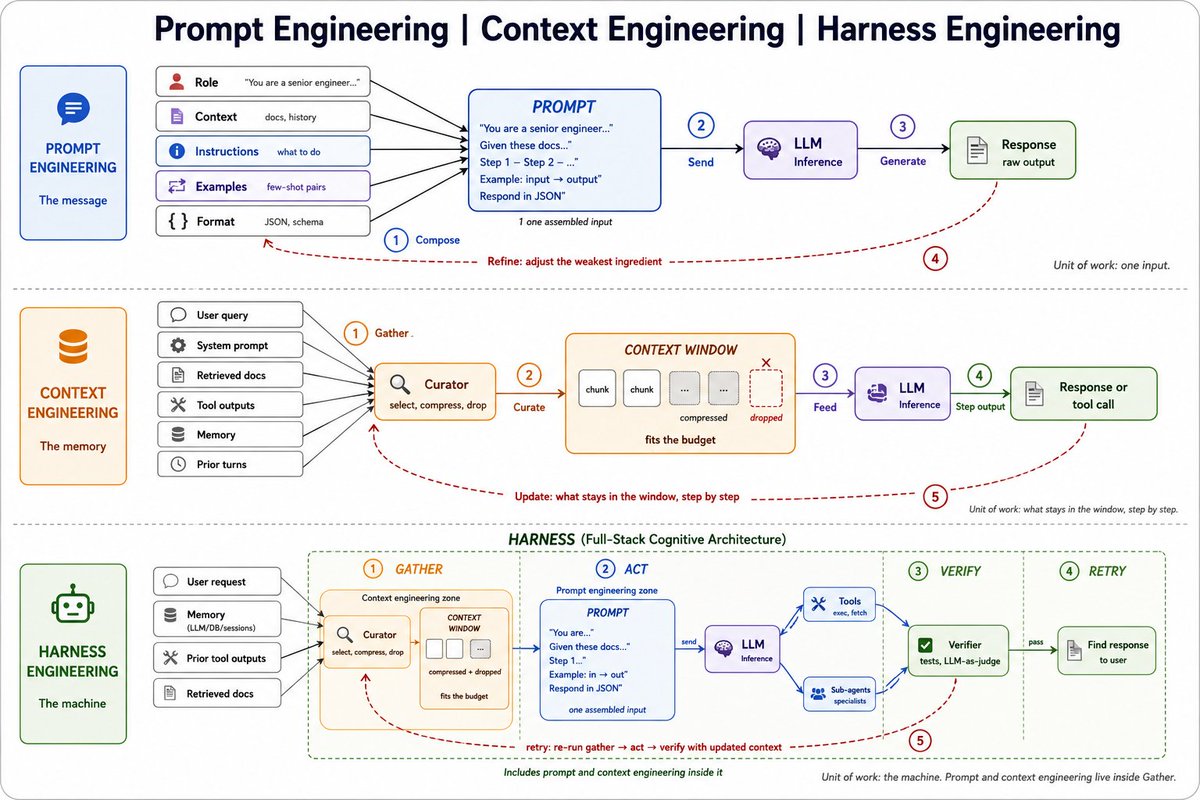
Instead of treating harness engineering as insider jargon, posters turned it into diagrams, loop taxonomies, public courses, and concrete repo patterns. The common move was to shift durable knowledge out of one-off prompts and into files, stop conditions, and reusable scaffolding.
@David_TornAI mapped (71 likes, 24 replies, 768 views) the stack from prompt engineering to context engineering to harness engineering, then described the harness as a machine that gathers, acts, verifies, and retries. The attached diagram mattered because it made the boundary visible: prompt engineering tunes one assembled input, context engineering manages what fits inside the window, and harness engineering wraps the whole loop with tools, memory, and verification.
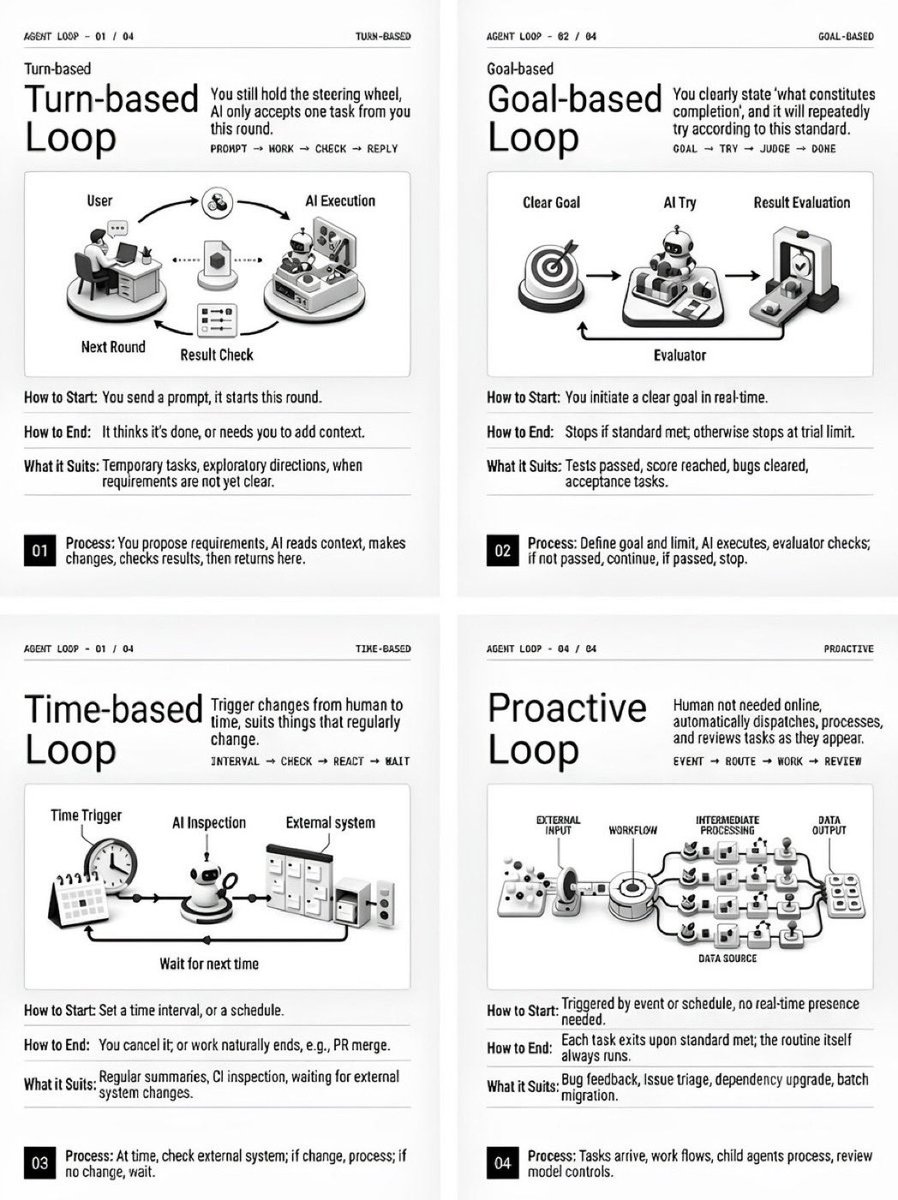
@mikenevermiss summarized (32 likes, 15 replies, 1,482 views, 25 bookmarks) an official Claude Code guide to four loop types: turn-based, goal-based, time-based, and proactive. The image is the useful evidence here because it spells out when each loop starts, how it stops, and what kind of work it suits, which turns "loop engineering" from a slogan into a workflow menu.
@Divyyanshishrma surfaced (72 likes, 6 replies, 1,549 views) Learn Harness Engineering, and the public course site plus screenshot show lectures, projects, and a resource library built around making Codex and Claude Code reliable through environment design, state management, verification, and control systems.

@mattpocockuk shared (83 likes, 11 replies, 8,306 views, 64 bookmarks) a skill for deep modules in TypeScript codebases: packages under src/packages, import fences through index.ts, isolated tests, no circular dependencies, and an AGENTS.md context pointer. That is a good example of the day's broader pattern: people are turning agent-friendly structure into repeatable skills instead of re-explaining it every session.
A smaller but concrete example came from @LearnWithBrij outlining (6 likes, 101 views) a Claude Code project tree with CLAUDE.md, hooks, skills, docs, and local rules near risky modules.

Discussion insight: The shared assumption was that prompting is temporary but structure is persistent. Skills, hooks, local rules, module fences, and explicit evaluators are becoming part of the repo, not just part of the conversation.
Comparison to prior day: July 9 treated skills as reusable infrastructure. July 10 made the surrounding pedagogy, loop design, and repository layout just as important as the skill files themselves.
1.3 Control surfaces around agents kept shipping as products 🡕
The strongest builder energy was less about one more autonomous demo and more about surfaces that let agents deploy, release, observe, or consume structured data safely. The recurring language was install blocks, trust gates, staged rollouts, dashboards, and API or MCP deployment.
@GithubProjects highlighted (34 likes, 1 reply, 5,609 views, 36 bookmarks) Langflow, and the 151,593-star repository describes a visual builder with an interactive playground, multi-agent orchestration, and built-in API and MCP server deployment. The distinctive angle is that every workflow can be turned into a tool for some other surface instead of remaining trapped in one chat product.
@gitlawb released (123 likes, 12 replies, 3,917 views) Zero v0.3.0, a terminal-native coding agent with voice dictation, OAuth profiles, workspace trust gates, and model memory. The pitch was explicit task ownership: "You say what. It plans, edits, runs, verifies," which fits the day's broader interest in governed execution rather than raw autonomy.
@istdrc open-sourced (9 likes, 3 replies, 1,042 views, 9 bookmarks) Hands, and the public README says it runs the release loop end to end with draft-first releases, staged rollouts, share pages, and in-app feedback or crash tickets on Cloudflare Workers, D1, and R2. That is a stronger signal than a generic agent launch because it is aimed at a concrete operational boundary: shipping client apps.
@nyk_builderz pointed to (9 likes, 120 views, 8 bookmarks) Mission Control, a 5,704-star self-hosted orchestration dashboard for tasks, agent fleets, spend, governance, and quality gates with SQLite-first deployment. The day did not offer massive engagement on the tweet, but the repo details make it a meaningful builder signal.
@CoinMarketCap launched (45 likes, 31 replies, 42,160 views) Agent Hub, and the public product page plus attached images carry the real substance: one-stop crypto coverage across CEX, derivatives, on-chain, news, social, KOL, and wallets; pre-computed signals; compact Markdown or YAML outputs; and copy-paste MCP install blocks for Claude Code, Cursor, VS Code, OpenClaw, Codex, and Gemini CLI.


Discussion insight: The shared product language was about governed paths to action. Builders were selling install blocks, trust gates, staged exposure, and operator dashboards more than abstract autonomy.
Comparison to prior day: July 9 already elevated operator workspaces. July 10 added more concrete release, install, and governance surfaces that agents can plug into immediately.
1.4 Auditable and domain-specific evaluation moved closer to production 🡕
The verification conversation moved from generic "use evals" advice into concrete domains and contract layers. Benchmarks looked more like production acceptance tests: domain tasks, explicit answer contracts, and published pass or fail distributions.
@kenbwork introduced (28 likes, 3 replies, 3,736 views, 16 bookmarks) BioSecBench-Surveillance, a benchmark with 100 evaluations across seven task categories, six sample types, and both short- and long-read sequencing. The attached chart matters because it makes the ceiling visible: top endpoint pass rates around 50 percent, most frontier configurations clustered below that, anomaly detection down at 20 percent, and long-read datasets harder than short-read.

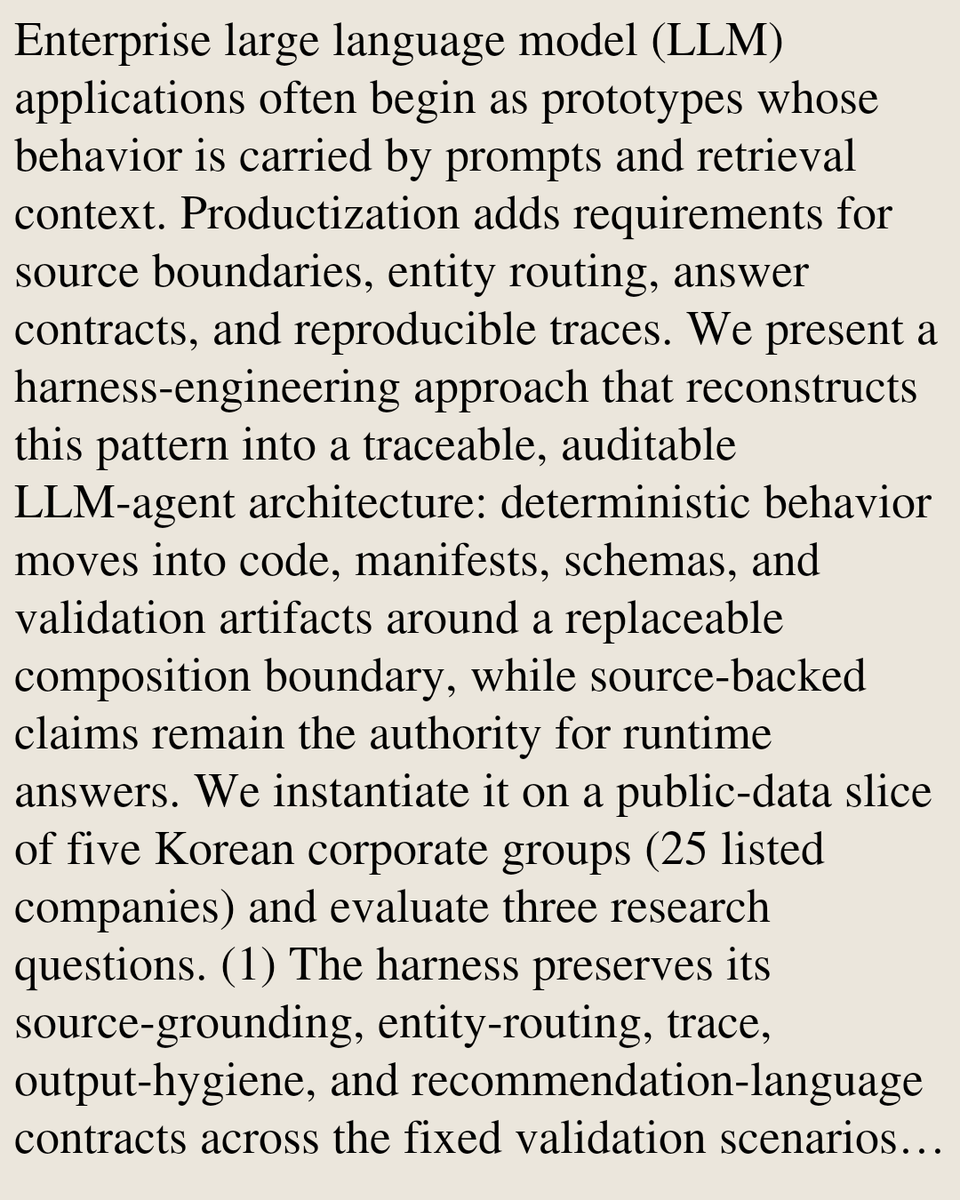
@SciFi shared (1 like, 110 views, 3 bookmarks) the paper From Prompts to Contracts and its companion repository. The abstract is unusually concrete: it argues for source boundaries, entity routing, answer contracts, and reproducible traces, then reports 270 composition-boundary runs across three hosted models and an ablation where code-owned enforcement preserved 120/120 utility while an external guardrail dropped utility to 88/120.
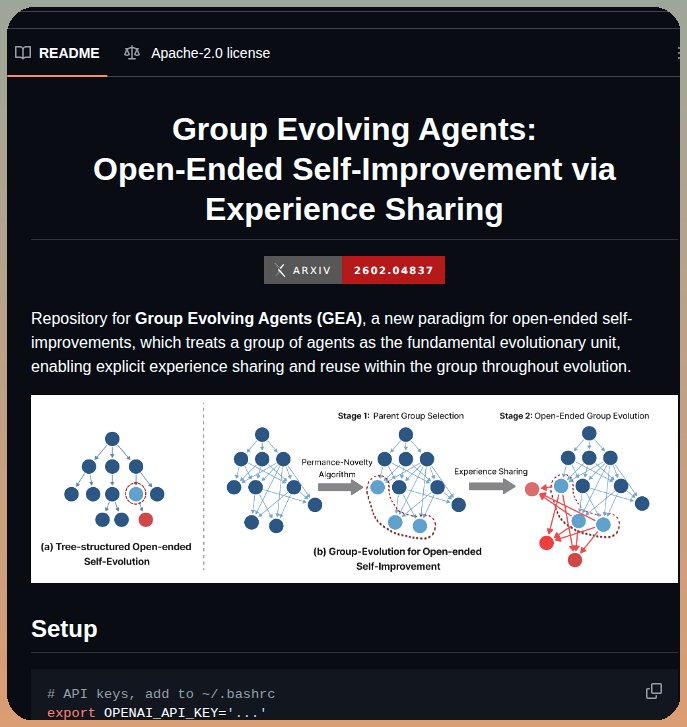
@tom_doerr shared (8 likes, 1 reply, 2,609 views, 13 bookmarks) the UCSB-AI/GEA repository, which frames self-improving agents as group evolution with explicit experience sharing instead of one agent editing itself in isolation. That is a smaller signal than the Codex conversation, but it fits the day's broader interest in auditable structures around learning loops.
@goose_oss amplified (5 likes, 1 reply, 504 views) an AAIF article where a 4B local Gemma model successfully drove a local MCP server on a laptop while a 7B Hermes function-calling model failed in the same setup. The important lesson was not the model ranking by itself, but that tool-calling behavior and local runtime fit can matter more than raw parameter count.
Discussion insight: The common pattern was to push reliability into artifacts that can be inspected: pass-rate tables, answer contracts, source manifests, and tool-call evidence.
Comparison to prior day: July 9 centered on external verifiers and rewrite loops. July 10 pushed those ideas into genomic surveillance, enterprise answer contracts, and local MCP tool-calling experiments.
2. What Frustrates People
Users still have to be their own model and reasoning router
High severity. @thsottiaux admitted (1,672 likes, 356 replies, 32,372 views, 112 bookmarks) that OpenAI made the highest-compute settings too easy to trigger and obscured the impact on usage limits, while @btibor91 captured (153 likes, 12 replies, 12,881 views, 89 bookmarks) an AMA where there is still no true Auto model and users are expected to pick among Sol, Terra, Luna, and different reasoning levels by task. @danshipper showed (737 likes, 46 replies, 121,730 views, 464 bookmarks) why that matters: Sol is good enough for many loops, but Fable still wins the hardest coding work by a wide margin on his benchmark. People are coping with subagent patterns, lower-reasoning wrappers for MCP-heavy flows, and a lot of manual experimentation. This is worth building for because the same routing pain appears in the vendor apology, the public AMA, and independent practitioner testing.
Harness portability and switching costs remain brittle
High severity. @nikesharora argued (132 likes, 29 replies, 11,058 views, 164 bookmarks) that harnesses, evals, procedural memory, and provider-specific cache pricing are the real lock-in layer, not the model weights. @dr_cintas showed (337 likes, 30 replies, 30,943 views, 495 bookmarks) one workaround: split planning and review onto Claude Fable 5 while pushing implementation volume to Grok 4.5. @KBlueleaf claimed (8 likes, 1 reply, 531 views) his own framework consumed roughly one half to one third of Codex's weekly limit at similar token totals, which is another sign that substrate overhead matters. Teams are coping with custom routing, per-model skills, and manual re-verification. This is worth building for because switching cost is showing up as a harness problem before it shows up as a model-quality problem.
Judgment-heavy domain work still breaks agents
High severity. @kenbwork reported (28 likes, 3 replies, 3,736 views, 16 bookmarks) that BioSecBench-Surveillance pass rates ranged from about 14 percent to 50 percent across model-harness pairs, with anomaly detection around 20 percent and long-read datasets at 26 percent versus 41 percent for short-read. The failure mode was not tool discovery alone; it was scientific judgment about thresholds, references, normalization, and interpretation. @goose_oss amplified (5 likes, 1 reply, 504 views) a local test where a 7B function-calling model still failed to execute an MCP workflow that a 4B model completed. People are coping with narrower scopes, stronger verifiers, and tool-first architectures. This is worth building for because the gap between “can call tools” and “can make the right judgment” remains large.
Repo-native structure is still mostly manual work
Medium severity, rising. @mattpocockuk shared (83 likes, 11 replies, 8,306 views, 64 bookmarks) a deep-modules skill just to enforce clean seams in TypeScript repos, @Divyyanshishrma pointed (72 likes, 6 replies, 1,549 views) to a full public course on harness engineering, and @LearnWithBrij argued (6 likes, 101 views) that coding-agent repos need CLAUDE.md, skills, hooks, docs, and local rules near risky modules. The coping strategy today is to manually build project memory and guardrails around the model. This is worth building for because the demand is real, but the setup still looks like bespoke repo carpentry.
3. What People Wish Existed
Auto-routing and usage-aware defaults
This need was explicit. @btibor91 summarized (153 likes, 12 replies, 12,881 views, 89 bookmarks) a Codex AMA where there is still no Auto model, @thsottiaux said (1,672 likes, 356 replies, 32,372 views, 112 bookmarks) defaults had pushed people toward unnecessarily expensive settings, and @nikesharora argued (132 likes, 29 replies, 11,058 views, 164 bookmarks) that routing has to be learned against actual traffic and verification cost. What people seem to want is a policy layer that decides model tier, reasoning depth, and stop conditions without making every operator become an expert router. Opportunity rating: [+++] direct.
Repo-native scaffolding for coding agents
The repeated wish was not for a cleverer prompt. It was for a repeatable project shape. @mattpocockuk proposed (83 likes, 11 replies, 8,306 views, 64 bookmarks) a reusable deep-modules skill, @LearnWithBrij outlined (6 likes, 101 views) a repo layout with CLAUDE.md, hooks, skills, docs, and local rules, and @Divyyanshishrma pointed (72 likes, 6 replies, 1,549 views) to a whole course for building those harnesses well. The practical need is a starter system for memory, hooks, boundaries, and reusable workflows that teams can adopt without inventing it from scratch. Opportunity rating: [++] direct.
Contract-driven audit layers for enterprise and regulated workflows
This need showed up in both research and production language. @SciFi shared (1 like, 110 views, 3 bookmarks) a paper arguing for source boundaries, entity routing, answer contracts, and reproducible traces, @kenbwork published (28 likes, 3 replies, 3,736 views, 16 bookmarks) domain-specific pass-rate evidence in genomic surveillance, and gokulrajaram/ProductSpec adds Decision Trace on top of a product-intent control file. What people seem to want is not just “better evals,” but code-owned contracts that survive model swaps, domain complexity, and audits. Opportunity rating: [+++] direct.
Agent-native release, data, and money backplanes
Several posts were really asking for dependable rails around agent action. @istdrc open-sourced (9 likes, 3 replies, 1,042 views, 9 bookmarks) Hands for release operations, @CoinMarketCap launched (45 likes, 31 replies, 42,160 views) an MCP-ready market-data hub, and @jerallaire framed (504 likes, 69 replies, 27,403 views) Circle's OCC approval as infrastructure for AI agents paying each other. The wish is for release, data, and payment rails that agents can use without bespoke glue and without losing operator control. Opportunity rating: [++] direct.
Local-first MCP stacks that privilege tool reliability over model size
The clearest signal came from one practitioner's result rather than a huge viral thread. @goose_oss shared (5 likes, 1 reply, 504 views) an article where a 4B local model succeeded at a local MCP task that a 7B function-calling model failed, while ai4s-research/open-science positions Open Science Desktop as a local-first, model-agnostic research workbench. The practical need is a local stack where tool calling, provenance, and privacy matter more than chasing the biggest model that fits on the device. Opportunity rating: [+] emerging.
4. Tools and Methods in Use
| Tool | Category | Sentiment | Strengths | Limitations |
|---|---|---|---|---|
| GPT-5.6 Sol + ChatGPT Codex | Model and agent workspace | (+/-) | Fast; cheaper than Fable; strong writing; useful for whole-loop knowledge work; improving UI work | Users still have to pick tiers and reasoning levels; limits and reset visibility caused confusion; harder coding tasks still trail Fable |
| Claude Fable 5 | Frontier model | (+/-) | Cleaner code at the top end; strong planner/reviewer role; good fit for hybrid workflows | More expensive; harder to use well; often paired with cheaper implementers |
| Grok 4.5 via Fable Advisor | Hybrid coding workflow | (+) | Good volume implementer under Fable review; open files for routing tweaks; parallel spec execution | Requires plugin plus CLI setup; cross-vendor handoffs can still be brittle |
| Learn Harness Engineering | Curriculum and reference | (+) | Public lectures, projects, and resource library around reliable Codex and Claude Code harnesses | More reference material than turnkey product; early jargon still needs translation for newcomers |
| ProductSpec | Intent-spec standard | (+) | Preserves problem, scope, acceptance criteria, and Decision Trace across agent handoffs; validator and GitHub Action exist | Early-adopter stage; teams must change spec habits to get value |
| Langflow | Workflow builder | (+) | Visual authoring; interactive playground; deploy flows as APIs or MCP servers; supports multi-agent orchestration | Larger platform surface than a lightweight library; not every team wants a builder UI |
| Mission Control | Orchestration dashboard | (+) | Self-hosted tasks, spend, governance, quality gates, and skill management with SQLite-first deployment | Alpha software; adds another control plane to run and secure |
| Hands | Release platform | (+) | Draft-first releases, staged rollouts, share pages, and feedback or crash loops for shipped apps | Narrower scope than a general agent platform; focused on client-app release operations |
| KohakuTerrarium | Agent framework | (+) | Reusable substrate with tools, sub-agents, persistent sessions, TUI, and web UI | Another framework to learn; best fit when teams need a new agent shape, not when an existing product already works |
| Goose local inference + MCP | Local stack | (+/-) | Keeps the model, tools, and MCP server on one laptop; strong privacy posture; good for tool-first workflows | Tool-calling quality is model-sensitive; larger models do not automatically perform better |
| CoinMarketCap Agent Hub | Data and signal hub | (+/-) | Unified crypto coverage; pre-computed signals; compact agent-ready outputs; MCP-ready install path | Crypto-specific; usefulness depends on the operator's need for market data and vendor dependency |
Overall, the satisfaction spectrum was widest around model-plus-harness combinations, not individual tools. GPT-5.6 Sol drew praise for speed and price, but Fable still held the prestige role for the hardest coding work, which is why hybrid planner-executor setups kept appearing. The same pattern showed up in the local stack discussion: a smaller local model beat a larger one when the tool-calling fit was better.
The most common workaround was to move logic out of the prompt and into structure. Skills, hooks, local rules, Decision Traces, API or MCP deployment, and staged rollout controls all serve the same purpose: make the system less dependent on one perfect completion. Migration pressure is therefore flowing less from one model vendor to another and more from ad hoc chat workflows toward products that expose routing, verification, governance, and reusable context as first-class features.
5. What People Are Building
| Project | Who built it | What it does | Problem it solves | Stack | Stage | Links |
|---|---|---|---|---|---|---|
| Zero v0.3.0 | @gitlawb | Terminal-native autonomous coding agent that plans, edits, runs, and verifies tasks | Gives solo developers a task-owning agent surface with trust gates instead of another chat box | Grok 4.5; voice dictation; OAuth profiles; workspace trust gates; model memory | Beta | tweet |
| Langflow | langflow-ai | Visual builder for AI workflows that can deploy as APIs or MCP servers | Turns agent workflows into reusable services and tools for other clients | Python; visual builder; interactive playground; API deployment; MCP server deployment | Shipped | tweet, repo |
| ProductSpec | gokulrajaram | Open standard for software intent before implementation, with Decision Trace and agent skills | Preserves intent through human and agent handoffs so specs do not disappear into chats or tickets | Markdown; validator; GitHub Action; installable agent skills | Beta | tweet, repo |
| Hands | botiverse | Agent-native release platform for client apps | Closes the loop from draft build to rollout to feedback/crash triage | Cloudflare Workers; D1; R2; Android/iOS/HarmonyOS/Electron SDKs | Beta | tweet, repo, site |
| Mission Control | builderz-labs | Self-hosted orchestration dashboard for agent fleets | Centralizes tasks, spend, governance, quality gates, and observability | Next.js; SQLite; WebSocket/SSE; skill registries | Alpha | tweet, repo |
| KohakuTerrarium | Kohaku-Lab | General-purpose framework and app for building and composing agents | Stops teams from rebuilding the same controller, tools, sub-agents, and session substrate for each new agent | Python; tools; sub-agents; persistent sessions; TUI; web UI | Beta | tweet, repo |
| Open Science Desktop | ai4s-research | Local-first AI research workbench that runs exploration, experiments, and write-up in one auditable flow | Gives research agents provenance, reproducibility, and local control instead of loose chat output | Tauri; React; MCP; agent skills; OpenCode runtime | Beta | tweet, repo |
| CoinMarketCap Agent Hub | @CoinMarketCap | Crypto data and signal hub for agents with MCP-ready onboarding | Removes bespoke data plumbing so agents can consume structured market signals quickly | Real-time APIs; event triggers; 200+ live skills; Markdown/YAML outputs; MCP-ready install blocks | Shipped | tweet, page |
| BioSecBench-Surveillance | @kenbwork | Verifiable benchmark for genomic-surveillance agents | Measures whether agents can make workflow-critical scientific decisions, not just call tools | 100 evals; sequencing-data tasks; 16 model-harness configurations | Alpha | tweet |
The dominant build pattern was a control layer around existing models. Langflow turns workflows into deployable APIs and MCP tools, Mission Control adds dashboards and quality gates, Hands adds rollout and post-release loops, and ProductSpec adds an intent contract upstream of code. The common point is not “more autonomy.” It is more durable structure around autonomy.
A second pattern was reusable substrate instead of one-off agents. Zero packages a task-owning terminal agent, while KohakuTerrarium packages the underlying machinery for creatures, sub-agents, and sessions. Open Science Desktop applies the same idea in research by tying runs, artifacts, notebooks, and provenance together locally.
Data and evaluation rails were the third pattern. CoinMarketCap Agent Hub sells agent-ready market data with copy-paste MCP onboarding, while BioSecBench-Surveillance turns a real scientific workflow into a benchmark that exposes where current agents still fail.
6. New and Notable
BioSecBench-Surveillance made the ceiling for scientific agents visible
What made this notable was not just another benchmark claim, but the shape of the failure. @kenbwork published (28 likes, 3 replies, 3,736 views, 16 bookmarks) a surveillance benchmark where current model-harness pairs topped out around 50 percent endpoint pass rate and struggled especially on anomaly detection and long-read data. That gives the agent conversation a domain-specific stress test instead of one more general coding score.
The "prompts to contracts" paper turned auditability into a concrete architecture
@SciFi surfaced (1 like, 110 views, 3 bookmarks) From Prompts to Contracts, which is notable because it makes the harness claim measurable: source boundaries, entity routing, answer contracts, reproducible traces, 270 composition-boundary runs, and an explicit harness-versus-external-guardrail utility comparison. It is one of the clearest public attempts in this dataset to move auditability out of aspiration and into named artifacts and acceptance tests.
Local-first research and MCP workbenches produced concrete public evidence
The local-first strand of the ecosystem looked stronger than usual. The Open Science Desktop README says it ranks #1 on ResearchClawBench while packaging exploration, experiments, provenance, and writing into one desktop loop, and @goose_oss amplified (5 likes, 1 reply, 504 views) a test where a smaller local model outperformed a larger one on a real MCP task. The notable signal is that local-first builders are now publishing benchmark positions and concrete tool-calling results, not just privacy rhetoric.
7. Where the Opportunities Are
[+++] Auto-routing and usage-governance layers — @thsottiaux, @btibor91, @danshipper, and @nikesharora all point to the same missing layer: decide model tier, reasoning depth, and stop conditions automatically, while exposing spend clearly enough that users trust the defaults. This is strong because the pain showed up in vendor communication, practitioner benchmarks, and user replies on the same day.
[+++] Contract-based audit and evaluation harnesses — @kenbwork, @SciFi, and ProductSpec all treat reliability as something that has to be encoded in contracts, validation artifacts, or durable traces. This is strong because the need spans both regulated enterprise answers and judgment-heavy scientific workflows.
[++] Repo scaffolding and persistent project memory — @mattpocockuk, @LearnWithBrij, and @Divyyanshishrma show a practical demand for starter systems that package skills, hooks, local rules, module boundaries, and project memory into something teams can adopt quickly. This is moderate because many variants will compete, but the need is already explicit.
[++] Agent operating backplanes for releases, data, and payments — Hands, CoinMarketCap Agent Hub, and @jerallaire all expose the same gap between reasoning and action. This is moderate because demand is concrete, but each rail brings compliance, vendor, and trust constraints that narrow the field.
[+] Local-first tool-calling stacks — @goose_oss, KohakuTerrarium, and Open Science Desktop suggest an emerging opportunity for systems where provenance, privacy, and tool reliability matter more than raw model size. This is emerging because the public evidence is promising but still early and niche.
8. Takeaways
- The launch-day UX problem is now routing, not raw intelligence. OpenAI's own follow-up admitted that defaults and usage visibility pushed people into expensive settings, while the public AMA still required users to choose model tier and reasoning level by task. (source)
- Harness engineering is becoming a formal discipline with diagrams, loops, and coursework. The day's strongest educational artifacts were not generic prompt tips but explicit gather-act-verify-retry diagrams, loop taxonomies, and a public harness curriculum. (source)
- The products getting attention are control surfaces around agents, not just agents themselves. Langflow, Hands, Mission Control, Zero, and CoinMarketCap Agent Hub all sell governed execution, deployment, or data access more than abstract autonomy. (source)
- Domain-specific evaluation still exposes a large judgment gap. In BioSecBench-Surveillance, frontier agent stacks were often below 50 percent endpoint pass rate and struggled hardest on open-ended scientific calls. (source)
- Auditable contracts and local-first stacks are the two clearest answers to trust. One thread pushed answer contracts, traces, and model-swap validation into code-owned artifacts, while another showed a full local MCP loop succeeding with a smaller model because the tool-calling fit was better. (source)