Twitter AI Agent - 2026-07-13
1. What People Are Talking About
1.1 Harness engineering became measurable, not just fashionable 🡕
July 13's strongest cluster treated agent quality as an orchestration problem, not a model-selection problem. Four high-signal items pushed the same idea from different angles: public benchmark numbers, explicit execution graphs, production harnesses, and operator hygiene. The common claim was that agents get cheaper and more reliable when context, routing, retries, and evaluation become first-class system behavior.
@IntuitMachine reported (87 likes, 3 replies, 6,127 views, 127 bookmarks) that swapping only the orchestration layer across six foundation models and 22 enterprise tasks cut per-model cost 33–61%, lowered median latency 44%, and reduced tokens per task 38%, with the linked Harness Effect paper arguing that "token maxing" is mostly a harness problem rather than a model problem.
@IntuitMachine argued (81 likes, 5 replies, 4,773 views, 102 bookmarks) that Atomic Task Graph fixes the same failure mode by moving agent state from a linear text trail into an explicit DAG. His thread claims the graph structure let Llama-3.1-8B-Instruct beat GPT-4+ReAct on ALFWorld and WebShop, while parallel branches and minimal repair cut wasted re-planning.
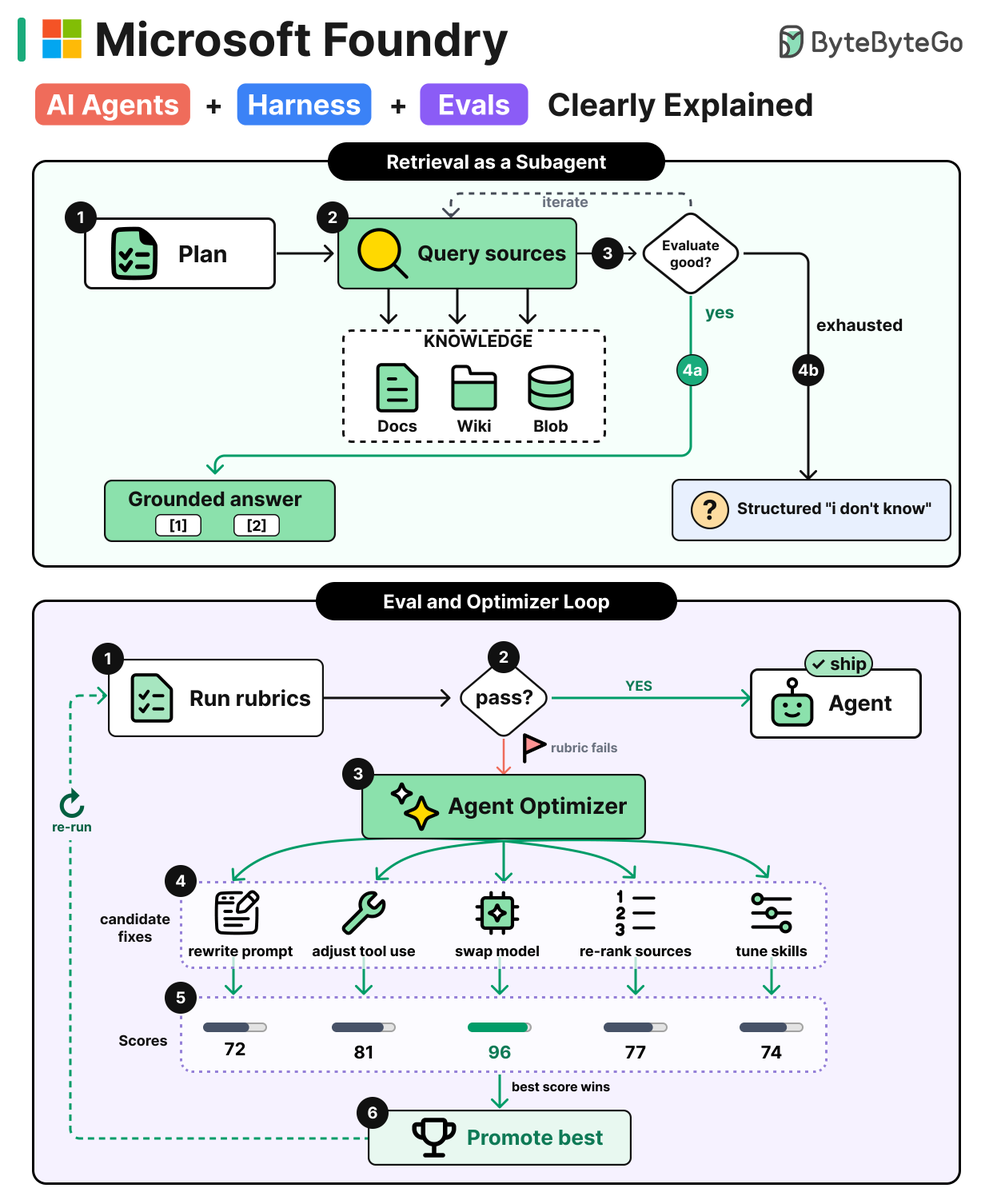
@alexxubyte summarized (39 likes, 5 replies, 5,341 views, 25 bookmarks) Microsoft Foundry's production version of the same idea: retrieval runs as a sub-agent that can iterate until it returns grounded citations or a structured "I don't know", and a rubric-driven optimizer loop rewrites prompts, tool use, model choice, source ranking, or skills until the best candidate wins.
@yanndubs warned (68 likes, 8 replies, 4,637 views, 21 bookmarks) that newer models make harness debt more visible: 5.6 follows buried bad instructions in old skills "carefully", while multi-agent modes can improve evals and latency at materially higher cost.
Discussion insight: @GergelyOrosz asked (105 likes, 43 replies, 19,251 views, 89 bookmarks) what "loop engineering" actually means in practice, and the best replies reduced it to specific jobs: nightly tech-debt runs, event-triggered incident triage, and agents that open PRs before a human joins the incident. The appetite was for concrete operating loops, not a new slogan.
Comparison to prior day: July 12 focused on harness hygiene—skill pruning, planning gates, and role-specific model lanes. July 13 added measured token economics, explicit graph execution, and vendor examples that expose those controls as product features.
1.2 Verifiers, evals, and guardrails became a standalone layer 🡕
A second cluster treated verification as its own stack. Instead of asking whether agents can act, posters asked how to prove that the action was good, grounded, and safe. Four items supplied the strongest evidence: one real-trace eval experiment, one research recap, one enterprise optimizer loop, and one new guardrail framework.
@doesdatmaksense tested (38 likes, 4 replies, 2,410 views, 43 bookmarks) automated eval agents on 100 real apartment-leasing traces, and the linked write-up says the best system recovered 87 percent of human-labeled failures but still missed interactions that looked correct while failing on business quality. Replies sharpened the point: internal tool calls and handoff rules still need human judgment, not just output scoring.
@quietnning reported (65 likes, 3 replies, 5,463 views, 57 bookmarks) from ICML Seoul that 88 of 168 oral papers touched RL or environments, with reward verification, dynamic games, and monitorability emerging as central agent problems. His takeaway was that reward hacking and oversight are no longer treated as accidental bugs; they are measurable research objects.
@TheInclusionAI open-sourced (3 likes, 2 replies, 164 views) SingGuard-NSFA, a runtime guardrail for prompt injection, goal hijacking, tool misuse, and permission abuse. The public repo describes 185 risk variants across seven domains, multilingual benchmarks spanning 133 languages, and low-latency classification heads for online interception.

Discussion insight: The strongest nuance today was not anti-eval; it was anti-automation without a taxonomy. The auto-evals experiment found obvious failures well enough, but the remaining misses were exactly the ones operators care about most: business rules, UX quality, and whether a tool call that "worked" still produced the wrong outcome.
Comparison to prior day: July 12 emphasized completion checks, specs, and package provenance. July 13 pushed deeper into runtime verification: real production traces, reward-verification research, and open-source guardrails that sit beside the agent instead of inside the prompt.
1.3 Marketplaces widened from agent hype to live distribution and payment surfaces 🡕
The most commercial theme was not a new chatbot. It was agent distribution: live catalogs, one-command wallets, per-call priced services, and published agent cards. The posts were still promo-heavy, but the evidence base was more concrete than the prior day because it included usage metrics, visible listings, and explicit settlement mechanisms.
@virtuals_io recapped (411 likes, 105 replies, 38 quotes, 73,585 views) Robinhood Chain's launch with Virtuals as its agent layer, claiming $30M in agent-driven DEX volume over the last seven days and naming shipped trading, privacy, prediction, RWA, and x402-linked services. Replies immediately added skepticism that early volume proves durable consumer-finance traction, which makes the post useful as both a signal and a caution.

@NavenNetwork introduced (70 likes, 15 replies, 4,417 views) Naven Marketplace as a catalog of paid, verifiable agent services, and the live marketplace plus attached screenshot show CoinGecko, CoinMarketCap, and Nansen endpoints priced at $0.01 per call over x402. The distinctive angle was not just discovery. It was independently priced, cryptographically verifiable invocations.

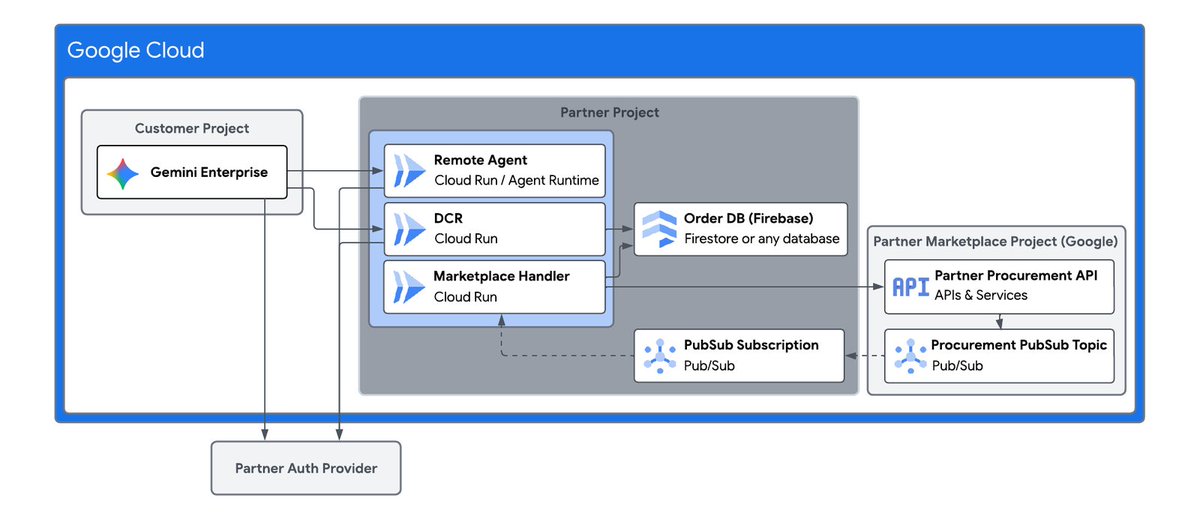
@PayGo402 announced (265 likes, 24 replies, 31,700 views) its partnership with AgentKey, framing the missing layer as one flow that lets agents discover trusted tools over MCP and pay for them without a human handoff. @okx pushed (60 likes, 18 replies, 36,110 views) the same direction from the wallet side: install Onchain OS in one command, get a TEE-backed agentic wallet, and use the broader OKX AI marketplace for tasks, escrow, and agent hiring. At the enterprise end, @GoogleCloudTech promoted (44 likes, 5 replies, 5,977 views, 23 bookmarks) A2A Agent Cards and publication into Google Cloud Marketplace and Gemini Enterprise.
Discussion insight: The replies kept pulling the conversation toward trust and approval. One reply to Google Cloud said discoverability gets an agent installed but "evidence gets it approved"; OKX replies asked for signing policy rather than just key isolation; PayGo replies said the hard part is not finding tools but knowing which ones are safe when money or customer data are involved.
Comparison to prior day: July 12 had verified revenue APIs and pay-per-call service markets as a direction. July 13 made those surfaces more legible with live catalogs, wallet install flows, escrow/task pages, and the first visible complaints about procurement and signing policy.
1.4 Specialist skill packs and memory vaults kept replacing monolithic agents 🡕
The most practical build pattern of the day was narrower surfaces with shared context. Instead of asking one general agent to do everything, builders kept packaging one research skill, one marketing foundation, one approval loop, or one knowledge vault that other actions can read from.
@mardehaym shared (34 likes, 7 replies, 2,007 views) /last30days, an open-source skill that searches X, Reddit, YouTube, TikTok, Instagram, Hacker News, Polymarket, GitHub, and more from one command, then merges the results into one brief. The public repo describes the same pattern as "searching people, not editors" with source-specific scoring rather than plain SEO ranking.

@0x_sakata packaged (49 likes, 24 replies, 631 views) 50+ marketing skills around a single product-marketing foundation doc, and the marketingskills repo explains that every CRO, copywriting, SEO, analytics, and GTM skill reads that shared file first. The high-value reply was skeptical in a useful way: a wide skill set still is not full autopilot if the workflow stops at drafts instead of live execution.
@IBuzovskyi built (34 likes, 2 replies, 3,491 views, 63 bookmarks) a Hermes flow that scans X comments, drafts replies in his voice, and routes approval or regenerate buttons through Telegram, with an optional night mode that auto-replies until morning. The best reply reframed the value: Hermes is safer when cron outputs land locally first and a human approves in the morning, because automatic posting can trip bot-pattern detection.
@KanikaBK described (13 likes, 4 replies, 1,248 views) a Fable 5 + Obsidian setup that replaced five disconnected research and ops tools with one vault for raw notes, active work, assets, and an INDEX file that recurring loops can read. The attached card is dense, but the thesis is simple: context quality compounds when the agent can keep rewriting the same knowledge base instead of starting from scattered tabs.
Discussion insight: Across research, marketing, and social workflows, the common move was to centralize shared context before automating actions. The debate was not "should agents do this?" It was "what single memory or foundation file should every specialist step read first?"
Comparison to prior day: July 12 concentrated on pruning bloated global skill folders. July 13 showed what builders want instead: one research skill with merged sources, one product-marketing foundation, one approval-gated social loop, and one vault that compounds context over time.
2. What Frustrates People
Token maxing and stale instructions
High severity. @IntuitMachine argued (87 likes, 3 replies, 6,127 views, 127 bookmarks) that agent bills rise because teams keep buying capability with longer histories, wider tool payloads, and replayed context, while his ATG thread followed up (81 likes, 5 replies, 4,773 views, 102 bookmarks) by saying the same failure shows up as plan structure and execution state being trapped in text. @yanndubs added (68 likes, 8 replies, 4,637 views, 21 bookmarks) that 5.6 follows buried bad instructions in old skills "carefully," and replies asked for tooling that can audit stale skills and inaccessible memories before a run. People are coping with prompt caching, compaction, graph execution, and manual skill cleanup. This is worth building for because the fix is still operator craft, not a default safeguard.
Verifiers still miss the failures that matter most
High severity. @doesdatmaksense tested (38 likes, 4 replies, 2,410 views, 43 bookmarks) eval agents on 100 real traces, and the linked article says even the best system recovered 87 percent of human-labeled failures while still missing business-quality problems that looked superficially correct. @quietnning reported (65 likes, 3 replies, 5,463 views, 57 bookmarks) that reward verification and monitorability are now central research topics, which is another way of saying existing checks are not enough. Teams cope with rubrics, human review, and runtime guardrails such as SingGuard-NSFA. This is worth building for because the missing verifier is often product-specific, not model-generic.
Autonomous payments and tool use still outrun policy controls
Medium-High severity. @virtuals_io claimed (411 likes, 105 replies, 38 quotes, 73,585 views) $30M of agent-driven DEX volume on Robinhood Chain, @PayGo402 connected (265 likes, 24 replies, 31,700 views) MCP tool discovery to machine-native payments, and @okx offered (60 likes, 18 replies, 36,110 views) one-command TEE-backed agent wallets. The replies show the real frustration: people want to know how agent-to-agent trades are governed, which tools are safe to trust, and what a wallet is actually allowed to sign. Current coping mechanisms are manual approval, escrow, and “verifiable” service claims. This is worth building for because the missing layer is policy visibility, not another rail.
Context is still trapped across too many tools
Medium severity. @KanikaBK said (13 likes, 4 replies, 1,248 views) that five separate research and ops subscriptions created disconnected outputs and no shared memory, which is why she moved to a single Obsidian vault. @0x_sakata said (49 likes, 24 replies, 631 views) every downstream marketing skill works blind unless a product-marketing foundation is filled out first, while @mardehaym marketed (34 likes, 7 replies, 2,007 views) /last30days as one merged brief instead of scattered X, Reddit, YouTube, and GitHub tabs. People cope with vaults, foundation docs, and source-merging skills. This is worth building for because the community keeps inventing its own memory substrate instead of trusting the default chat history.
3. What People Wish Existed
Concrete loop playbooks instead of slogans
The ask was unusually explicit today. @GergelyOrosz said (105 likes, 43 replies, 19,251 views, 89 bookmarks) that he keeps hearing "loop engineering" without enough specifics, and the best replies answered with practical patterns: nightly tech-debt runs, event-triggered agents for incidents, and agent-created PRs before a human wakes up. This is a practical need, not an emotional one. Partial answers exist in public harness guides and product examples such as Microsoft Foundry, but the community still wants reusable loop templates tied to real jobs instead of another label. Opportunity rating: [++] direct.
Trust packages for agent procurement, publishing, and wallets
This need showed up across enterprise and onchain posts. @GoogleCloudTech says (44 likes, 5 replies, 5,977 views, 23 bookmarks) builders should create an A2A Agent Card and publish into Marketplace and Gemini Enterprise, but a reply says buyers still need data-access details, approval points, eval results, support ownership, and a revocation path. @okx says (60 likes, 18 replies, 36,110 views) the wallet key sits in a TEE, yet replies still ask what it is allowed to sign, while @PayGo402 shows (265 likes, 24 replies, 31,700 views) that people still ask how anyone can know which paid tools are safe around money or customer data. This is an urgent practical need. Opportunity rating: [+++] direct.
Shared context layers that every specialist skill can read
@KanikaBK wants (13 likes, 4 replies, 1,248 views) one Obsidian vault instead of five disconnected subscriptions, @0x_sakata says (49 likes, 24 replies, 631 views) every marketing skill must read the product-marketing foundation first, and @mardehaym frames (34 likes, 7 replies, 2,007 views) /last30days as a way to merge scattered sources into one research object. This is a practical need with high urgency because the workaround today is hand-built vaults, markdown foundations, and custom research skills. Existing tools address fragments of the problem, but not the shared memory substrate itself. Opportunity rating: [+++] direct.
Business-aware evals and runtime guardrails
The missing verifier is now clear. The auto-evals experiment shows that systems can recover many obvious failures, but not necessarily the business misses that humans care about. SingGuard-NSFA shows a second gap: teams need runtime defenses against prompt injection, tool abuse, and permission abuse once agents start acting. This is a practical need with immediate operational value, and current solutions still look partial and domain-specific. Opportunity rating: [+++] direct.
4. Tools and Methods in Use
| Tool | Category | Sentiment | Strengths | Limitations |
|---|---|---|---|---|
| Harness Effect / Writer Agent Harness | Orchestration method | (+) | Prompt caching, history compaction, and failure-spend governance cut cost and latency across multiple models | Quality gains vary by model strength; sub-agent delegation can become a capability tax |
| Atomic Task Graph | Planning/execution framework | (+) | Explicit DAG state, parallel branches, reusable intermediate results, minimal repair | Requires a graph runtime and benchmarks are still research-led |
| Microsoft Foundry | Enterprise agent platform | (+) | Retrieval-as-subagent, rubric loop, optimizer loop, grounded fallback behavior | Gateway and rate-limit ceilings still matter at scale |
| Google Cloud Marketplace + Gemini Enterprise | Distribution platform | (+/-) | A2A Agent Card, marketplace reach, procurement plumbing | Buyers still need trust package details beyond installability |
| /last30days | Research skill | (+) | Cross-source search, engagement scoring, transcript quotes, merged briefs | Broader source set still needs setup and auth for full power |
| marketingskills | Skill bundle | (+/-) | Shared product-marketing foundation and cross-referenced specialist workflows | Wide coverage does not guarantee end-to-end execution in live systems |
| Hermes Agent + Telegram approval loop | Social workflow harness | (+/-) | Cron scans, approval/regenerate buttons, optional night mode | Safer with local review; automatic posting can trigger bot-detection risk |
| Fable 5 + Obsidian | Knowledge and memory system | (+) | Linked vault, reusable notes, recurring loops that compound context | Needs disciplined vault structure and ongoing maintenance |
| Naven Marketplace + x402 | Agent commerce layer | (+) | Live per-call catalog, verifiable endpoints, priced external capabilities | Early catalog and provider-trust questions remain |
| OKX AI / Onchain OS | Wallet and marketplace | (+/-) | One-command wallet setup, task marketplace, escrow, TEE-held keys | Signing policy is less clear than key custody |
| SingGuard-NSFA | Guardrail and runtime safety | (+) | 185-risk taxonomy, multilingual benchmark, low-latency classifiers | Early adoption signal and mostly single-turn risk framing |
Overall satisfaction was highest when a tool removed a concrete tax instead of promising generic autonomy. Harness Effect and ATG attacked wasted tokens and brittle context; Foundry and SingGuard made verification explicit; /last30days, marketingskills, and Fable+Obsidian centralized context before acting; and Naven plus OKX turned external capabilities into priced surfaces while immediately surfacing trust questions. The migration pattern was not simply model-vendor switching. It was movement from vague chat loops toward smaller surfaces, stronger verifiers, visible cost meters, and clearer approval and policy boundaries. @mark_k noted (41 likes, 16 replies, 2,189 views) the same shift in Grok Build release notes: even agent UIs are now exposing skill and MCP token costs plus per-subagent model selection because operators want the harness to show its work.
5. What People Are Building
| Project | Who built it | What it does | Problem it solves | Stack | Stage | Links |
|---|---|---|---|---|---|---|
| /last30days | Matt Van Horn via @mardehaym | Searches social, community, market, and repo sources in parallel and returns one cited brief | Scattered multi-tab research across X, Reddit, YouTube, HN, Polymarket, and GitHub | Agent Skills spec, Python, multi-source connectors | Shipped | tweet, repo |
| Marketing Skills | Corey Haines via @0x_sakata | Gives agents 50+ GTM, CRO, SEO, copy, analytics, and launch skills anchored by one foundation doc | Generic agents lack shared product and audience context for marketing work | Markdown skills, Agent Skills spec, plugin marketplace | Shipped | tweet, repo |
| Hermes X reply loop | @IBuzovskyi | Scans comments, drafts replies, routes approval or regenerate buttons through Telegram, and can run a night mode | Repetitive social response work and after-hours engagement | Hermes Agent, cron, Telegram, xurl, SOUL.md, Grok 4.5 | Alpha | tweet |
| Naven Marketplace | @NavenNetwork | Marketplace of paid, verifiable data and intelligence services for autonomous agents | Agents need trusted external capabilities without bespoke integrations | x402, per-call endpoints, stablecoin settlement | Beta | tweet, site |
| OKX AI / Onchain OS | OKX | Agent marketplace plus TEE-backed wallet, escrow, and task surfaces | Lets agents find work, hire services, and settle onchain | Onchain OS skills, TEE wallet, X Layer, marketplace | Beta | tweet, site |
| SingGuard-NSFA | InclusionAI | Runtime guardrail framework for agent-specific threats | Prompt injection, goal hijacking, tool misuse, permission abuse | Multilingual benchmark, lightweight classifiers, classification heads | Beta | tweet, repo |
| hermes-voicebox | Jamie Pine | Swaps Hermes voice I/O onto a local Voicebox plus Whisper stack | Keeps voice cloning and transcription off cloud defaults | Python plugin, Voicebox, Whisper, Hermes Agent | Shipped | tweet, repo, site |
/last30days and Marketing Skills share the day's dominant build pattern: put a durable context layer in front of specialist operations. One merges many external sources into a single research object; the other makes every downstream marketing skill read the same product brief before it acts.
Hermes X reply loops and hermes-voicebox are narrower but more operational. The comment workflow keeps social posting inside an approval gate, while the voice plugin changes the audio plumbing without pretending to add new agent reasoning.
Naven and OKX show the repeated commercial pattern: marketplace, wallet, settlement, and priced capabilities. SingGuard-NSFA is the counter-build from the same day: instead of adding more autonomy, it adds a runtime veto layer to keep agent actions inside a defined safety envelope.
6. New and Notable
The Harness Effect put numbers under the harness argument
@IntuitMachine surfaced (87 likes, 3 replies, 6,127 views, 127 bookmarks) a six-model, 22-task comparison where changing only the orchestration layer reduced cost, latency, and token use materially. That matters because the public debate about harness engineering often stays anecdotal; the linked paper turned it into a measurable economics claim.
Google Cloud framed agent publishing as infrastructure plus procurement
@GoogleCloudTech showed (44 likes, 5 replies, 5,977 views, 23 bookmarks) that getting an agent into Gemini Enterprise and Google Cloud Marketplace is not just a marketing step. The architecture image and guide route through an A2A Agent Card, Remote Agent runtime, DCR, auth provider, and procurement handlers, which makes distribution look more like SaaS onboarding than prompt sharing.
SingGuard-NSFA made runtime safety more concrete
@TheInclusionAI released (3 likes, 2 replies, 164 views) SingGuard-NSFA with a public taxonomy for agent-specific risks, multilingual benchmarks, and low-latency classifier heads. That is notable because it treats prompt injection, tool misuse, and permission abuse as runtime categories to intercept, not just prompt-writing mistakes to avoid.
Naven's live x402 catalog made agent commerce tangible
@NavenNetwork launched (70 likes, 15 replies, 4,417 views) a marketplace where paid agent services are visible as individual listings with per-call pricing. The concrete shift is from talking about machine-native payments in protocols and whitepapers to exposing an actual catalog of data providers and endpoints.
7. Where the Opportunities Are
[+++] Verifier-first harness layers — Evidence spans multiple parts of the dataset: @IntuitMachine quantified (87 likes, 3 replies, 6,127 views, 127 bookmarks) orchestration gains, @alexxubyte showed (39 likes, 5 replies, 5,341 views, 25 bookmarks) a rubric-driven optimizer loop at Foundry scale, the auto-evals experiment exposed where current systems still miss business-quality failures, and SingGuard-NSFA packages runtime safety as a separate layer. This is strong because the pain, research, and active building all line up.
[+++] Shared context substrates for specialist skills — @KanikaBK described (13 likes, 4 replies, 1,248 views) one vault replacing five disconnected tools, @0x_sakata showed (49 likes, 24 replies, 631 views) every marketing skill reading the same foundation doc, and @mardehaym framed (34 likes, 7 replies, 2,007 views) /last30days as one merged research object. This is strong because the workarounds are already obvious—vaults, foundation files, merged briefs—but none is yet a default layer.
[++] Policy and trust controls for agent wallets and tool procurement — @PayGo402 connected (265 likes, 24 replies, 31,700 views) tool discovery to payment, @NavenNetwork launched (70 likes, 15 replies, 4,417 views) a priced service catalog, @okx offered (60 likes, 18 replies, 36,110 views) one-command agent wallets, and @GoogleCloudTech pushed (44 likes, 5 replies, 5,977 views, 23 bookmarks) A2A publication into enterprise marketplaces. This is moderate because the need is obvious, but the exact control model will differ across enterprise software, agent marketplaces, and onchain wallets.
[++] Publish-once agent distribution tooling — Google Cloud, Naven, OKX, and Virtuals all expose different catalogs or marketplaces, each with its own identity, listing, and settlement assumptions. This is moderate because agent distribution is real now, but the surfaces are fragmented and still require custom packaging per ecosystem.
8. Takeaways
- Harness quality produced the clearest measurable gains of the day. @IntuitMachine showed (87 likes, 3 replies, 6,127 views, 127 bookmarks) that orchestration changes alone cut cost, latency, and tokens, while @alexxubyte described (39 likes, 5 replies, 5,341 views, 25 bookmarks) a Foundry case study that applies the same idea at enterprise scale.
- Verification is now a separate product layer. @doesdatmaksense tested (38 likes, 4 replies, 2,410 views, 43 bookmarks) real-trace auto-evals, @quietnning reported (65 likes, 3 replies, 5,463 views, 57 bookmarks) that reward verification dominated ICML agent research, and @TheInclusionAI released (3 likes, 2 replies, 164 views) runtime guardrails.
- Agent commerce moved from concept to visible surfaces, but trust still lags. @virtuals_io claimed (411 likes, 105 replies, 38 quotes, 73,585 views) $30M in weekly agent-driven DEX volume, @NavenNetwork launched (70 likes, 15 replies, 4,417 views) a priced service catalog, and @okx offered (60 likes, 18 replies, 36,110 views) one-command agent wallets while replies kept asking for signing policy and approval logic.
- The practical build pattern was narrower agents with stronger shared context. @mardehaym packaged (34 likes, 7 replies, 2,007 views) a merged cross-source research skill, while @0x_sakata showed (49 likes, 24 replies, 631 views) and @KanikaBK showed (13 likes, 4 replies, 1,248 views) that specialist workflows still start by fixing the shared context layer.
- The community still wants concrete loops more than new terminology. @GergelyOrosz asked (105 likes, 43 replies, 19,251 views, 89 bookmarks) what "loop engineering" actually means, and the most useful answers were specific—nightly jobs, event triggers, and incident triage—not abstract loop branding.