Twitter AI Agent - 2026-07-19
1. What People Are Talking About
1.1 Engineering moved from prompts toward harnesses, loops, and graphs (🡕)
The dominant technical frame was that a capable model needs an engineered operating environment: curated context, tools, verification, stopping rules, and, increasingly, coordination among specialized workers. This extends the prior day's focus on harnesses into a more explicit progression from a single call to an organization of agents.
@sairahul1 mapped (246 likes, 22 replies, 21,536 views, 372 bookmarks) five nested layers: prompt, context, harness, loop, and graph engineering. Its loop layer calls for independent checks, test-based completion, budget limits, and no-progress detection; its graph layer adds planners, researchers, builders, shared state, approval gates, and conditional routing.

@_lopopolo published (228 likes, 14 replies, 17,174 views, 402 bookmarks) twelve theses of harness engineering. The repository defines the harness as the environment around a fixed model and coding agent, carrying local requirements, context, tools, authority, proof, and lessons from prior work.
@VaibhavSisinty described (86 likes, 13 replies, 7,659 views, 91 bookmarks) the shift from repeated plan-act-observe loops to graphs that route state and work among agents. A reply supplied the practical caveat: shared state and evaluation remain the production risk, because parallel agents can amplify stale context or optimize the same metric together.
@PawelHuryn challenged (7 likes, 7 replies, 1,033 views) the “graph engineering” label, arguing that clear objectives, independent checks, strategic context, autonomy boundaries, state machines, evaluations, and guardrails matter more than a new name. The reply thread likewise characterized the labels as recurring names for established orchestration fundamentals.
Discussion insight: There was agreement on verification and state boundaries, but not on terminology. The strongest counterpoint was not that orchestration is unnecessary; it was that branded loop or graph vocabulary should not obscure independent evaluation, explicit stopping conditions, and ownership of shared state.
Comparison to prior day: The prior report emphasized harnesses as the explanation for reliability; this day supplied a five-layer map and a live disagreement over whether graph engineering is a distinct next layer or familiar orchestration with a new label.
1.2 Context quality, persistent memory, and evaluators became the reliability work (🡕)
Several retained items treated agent failure as an information-management problem rather than a model-selection problem. The evidence ranged from a context-quality paper and implementation rubric to practical proposals for persistent, local, and structured memory.
@omarsar0 highlighted (74 likes, 26 replies, 6,839 views, 106 bookmarks) the open-source ProofAgent Harness and its paper, which score context quality across role clarity, guardrail coverage, instruction consistency, tool-schema quality, grounding, injection hardening, and token efficiency. @alex_verem reported (26 likes, 5 replies, 3,135 views) that the associated study held the model fixed while changing context and found a 74% performance improvement.

@alex_prompter argued (13 likes, 3 replies, 4,814 views, 26 bookmarks) that repeated RAG retrieval rebuilds the same understanding each session, and proposed “wiki memory”: a structured Markdown knowledge base the agent maintains instead of repeatedly reasoning over raw documents. @itsharmanjot described (10 likes, 2 replies, 318 views) Hindsight as a local MCP memory server with retain, recall, and reflect operations, a knowledge graph, and living summaries.

@Aiswarya_Sankar said (16 likes, 4 replies, 751 views) that recurring PR-review patterns such as null guards, inverted logic, swallowed exceptions, and stale hooks should be fed back into the harness rather than discarded after each fix.
Discussion insight: The proposed remedies are structured and inspectable: evaluated context before a run, retained facts and summaries between runs, and implementation feedback returned to the next run. That is more specific than simply asking for a larger context window.
Comparison to prior day: July 18 concentrated on inspectable memory and context scoring; July 19 added a published scoring rubric, a reported fixed-model context result, local-memory implementation detail, and PR comments as a reusable source of operational knowledge.
1.3 Autonomy was being packaged as browser skills, content pipelines, and isolated runtimes (🡒)
Builders showed agents doing concrete work across browser automation, content production, finance, and runtime isolation. The common pattern was an explicit execution surface rather than an abstract “assistant.”
@ctatedev showed (105 likes, 6 replies, 8,935 views, 100 bookmarks) agent-browser recording browser network traffic with HAR start/stop commands and deriving a client through a skill. @Sonofpeace0001 reported (316 likes, 19 replies, 1,189 views) a scheduled Creao workflow that researches video hooks, writes a voice-matched script, generates voiceover and captions, renders, and uploads a YouTube Short without daily prompting.
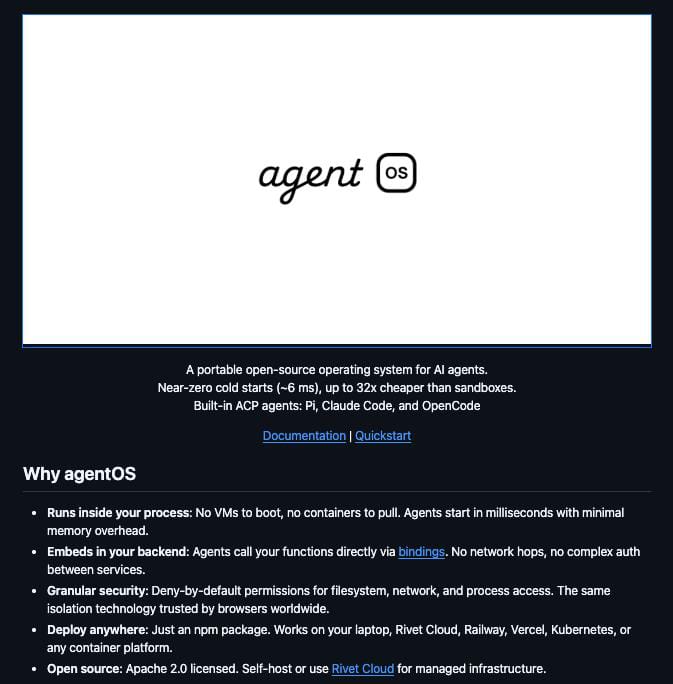
@RoundtableSpace introduced (43 likes, 12 replies, 40,528 views) AgentOS, claiming a per-agent virtual filesystem, process table, network stack, persistent filesystem, 6ms cold starts, and lower sandbox cost. A reply welcomed the isolation claim but asked how the system would coordinate the actual demands placed on agents.
2. What Frustrates People
Context that is noisy, transient, or impossible to evaluate
The clearest recurring frustration is not lack of model capability but context that is rebuilt, bloated, stale, or unevaluated. @alex_prompter said (13 likes, 3 replies, 4,814 views, 26 bookmarks) that conventional RAG makes agents reconstruct the same understanding each session, while @omarsar0 pointed to (74 likes, 26 replies, 6,839 views, 106 bookmarks) a context-quality evaluation approach because weak context leads to drift, hallucination, tool misuse, injection exposure, and wasted tokens. Severity: High. The visible coping methods are structured wiki memory, local persistent memory, curated files, and preflight scoring; this is worth building for directly because the pain appears in both implementation proposals and high-engagement discussion.
Cost and wasted work from indiscriminate model routing
@adxtyahq reported (63 likes, 14 replies, 3,928 views, 47 bookmarks) reducing a website-builder product's average LLM cost from roughly $3–4 to $1–1.50 per prompt after an initial redesign worsened cost to almost $5. The account attributed the eventual reduction to rebuilding the architecture, benchmarking changes, production testing, and avoiding routing every task to Opus or GPT-5.5. Severity: Medium. This is a practical optimization need, but the evidence is a single implementation report rather than a broad complaint cluster.
Autonomous tools still lack trustworthy execution boundaries
@karlmehta quoted (31 likes, 11 replies, 5,162 views) a warning about agent stacks without authentication, inventory, or confidence in downloaded models. A reply made the exposure concrete: MCP tools may inherit live logged-in cookies and act as the user without an intervening confirmation. @BrianRoemmele reported (30 likes, 15 replies, 3,981 views) a Hugging Face disclosure describing an autonomous system exploiting data-processing bugs and harvesting credentials; a reply argued that models must be able to operate where the evidence and credentials live during incident response. Severity: High. Proposed responses include inventory, authentication, narrow permissions, human approval, and isolated execution surfaces, making this a direct build opportunity rather than a documentation problem.
Vague tool failures make agents waste retries and tokens
@bsvdrip started building (7 likes, 4 replies, 261 views) an “Agentic Feedback Framework” in which API errors explain the failed condition, expected input, retry decision, and next action. The stated problem is that vague errors force an agent to guess, increasing token use and hallucinated recovery paths. Severity: Medium. The proposed intervention is unusually bounded: make API error responses as machine-actionable as successful responses.
3. What People Wish Existed
A measurable preflight for the full agent context
The strongest practical need is a way to know whether the instructions, tool schemas, retrieved material, memory, and guardrails are fit for a run before the agent fails. @alex_verem covered (26 likes, 5 replies, 3,135 views) ProofAgent’s proposed seven-criterion context score, while @omarsar0 shared (74 likes, 26 replies, 6,839 views, 106 bookmarks) its open-source harness. This is an urgent practical need with a partial answer already available. Opportunity: direct.
Memory that persists, remains local, and can be curated as knowledge
@alex_prompter wanted (13 likes, 3 replies, 4,814 views, 26 bookmarks) agents to maintain an evolving structured wiki rather than repeat retrieval from raw documents. @itsharmanjot offered (10 likes, 2 replies, 318 views) a local alternative built around retained facts, recall, reflection, knowledge graphs, and an MCP server. The need is practical rather than aspirational: persistent context that is inspectable, portable, and not dependent on a cloud API. Opportunity: competitive.
Execution surfaces with approval, scopes, and clear recovery paths
@mimu_ai1 described (25 likes, 13 replies, 14,174 views) an agent that provisions Stripe and QuickBooks access, a Postgres ledger, and a dashboard as code while enforcing a $100 monthly budget cap and payment approval. @bsvdrip proposed (7 likes, 4 replies, 261 views) actionable error contracts so an agent can recover without guessing. Together, they point to a need for agents that can touch real systems without silently exceeding authority or entering blind retry loops. Opportunity: direct.
4. Tools and Methods in Use
| Tool | Category | Sentiment | Strengths | Limitations |
|---|---|---|---|---|
| Harness engineering | Method / repository | (+) | Encodes local requirements, authority, proof, tools, and reusable learning around a fixed worker | Requires deliberate curation of organizational knowledge |
| ProofAgent Harness | Evaluation | (+) | Scores context across seven reliability-related criteria before behavior is judged | The feed does not show production adoption evidence |
| Hindsight | Memory / MCP | (+) | Local fact retention, recall, reflection, knowledge graph, and living summaries | Low-engagement single-account implementation report |
| agent-browser | Browser automation | (+) | HAR capture and derived client skill for browser work | A reply asked how it compares with other browser-use setups |
| AgentOS | Runtime isolation | (+/-) | Claimed granular per-agent execution boundaries and persistent filesystems | A reply questioned coordination beyond the runtime layer |
| Model routing and caching | Cost method | (+) | One report tied architecture and routing changes to substantial per-prompt cost reduction | Result is self-reported and implementation details are incomplete |
@_lopopolo linked (228 likes, 14 replies, 17,174 views, 402 bookmarks) harness engineering to repeatable organizational judgment, while @omarsar0 connected (74 likes, 26 replies, 6,839 views, 106 bookmarks) context quality to agent evaluation. The satisfaction spectrum is positive for explicit structure and measurable checks, but discussion repeatedly asks for clearer state ownership, comparisons among browser tools, and coordination above isolated runtimes. The only clear migration pattern is away from hand-written prompts and raw, repeated RAG toward loops, curated files, structured memory, and evaluated context.
5. What People Are Building
| Project | Who built it | What it does | Problem it solves | Stack | Stage | Links |
|---|---|---|---|---|---|---|
| Harness Engineering | @_lopopolo | A repository of theses, playbooks, and routing material for shaping the environment around coding agents | Makes local requirements, decisions, authority, and proof recoverable by agents | Repository documentation, AGENTS.md, context, tools |
Shipped | repo |
| ProofAgent Harness | @omarsar0 highlighting the project | Context-quality evaluation harness | Detects unreliable operating context before agent behavior fails | Multi-juror, consensus scoring; context criteria | Alpha | repo |
| Creao YouTube Shorts agent | @Sonofpeace0001 | Scheduled research-to-upload pipeline for Shorts | Removes repeated research, scripting, editing, and upload work | Creao agent, voiceover, captions, rendering, YouTube upload | Shipped | tweet |
| AgentOS | @RoundtableSpace highlighting the project | Lightweight isolated OS-like execution environment for coding agents | Reduces sandbox startup and persistence friction | Virtual filesystem, process table, network stack, VM isolation | Beta | tweet |
| Agentic Feedback Framework | @bsvdrip | API errors that explain expected input and next recovery action | Avoids blind retries and hallucinated recovery after tool failures | Machine-readable API feedback | Alpha | tweet |
| Wardn Hub | @abhi16_93 | Registry for skills audited against known attack surfaces | Prevents agents from blindly executing unsafe skill bundles | Skill registry and security audits | Alpha | tweet |
The most substantial build signal is the harness-engineering repository, which says it improves a fixed worker by making requirements, local decisions, authority, proof, and feedback available as context and tools. @_lopopolo released (228 likes, 14 replies, 17,174 views, 402 bookmarks) it as a distilled year of practice rather than a new model or framework.
The other projects package specific operational gaps: @Sonofpeace0001 automated (316 likes, 19 replies, 1,189 views) a scheduled publishing workflow; @RoundtableSpace presented (43 likes, 12 replies, 40,528 views) an isolation runtime; and @abhi16_93 built (4 likes, 5 replies, 141 views) a security-audited skill registry. The repeated build pattern is infrastructure around agent action: reliable context, controlled access, recoverable errors, and execution isolation.
6. New and Notable
A concrete context-quality measurement proposal
The ProofAgent paper and harness were the most specific reliability artifact in the feed: their stated seven criteria span role definition, guardrails, instruction consistency, tool schemas, grounding, injection hardening, and token efficiency. @alex_verem reported (26 likes, 5 replies, 3,135 views) a 74% fixed-model performance gain from changing context, while @omarsar0 linked (74 likes, 26 replies, 6,839 views, 106 bookmarks) the public evaluation harness.
Browser work becoming a reusable agent skill
@ctatedev announced (105 likes, 6 replies, 8,935 views, 100 bookmarks) an agent-browser skill that can derive a client from recorded network traffic. The post is notable because it turns exploratory browser interaction into an artifact an agent can reuse, rather than a one-off manual session.
The implementation feedback loop is broadening beyond prompts
@Aiswarya_Sankar identified (16 likes, 4 replies, 751 views) PR-review comments as a dataset agents should inherit, and @bsvdrip applied (7 likes, 4 replies, 261 views) the same idea to API errors. Both move feedback from a disposable human-facing message to a machine-usable improvement signal.
7. Where the Opportunities Are
[+++] Context observability and preflight evaluation — The feed joins a measurable context-quality harness with practical complaints about repeated RAG reconstruction and stale or unstructured state. @omarsar0 surfaced (74 likes, 26 replies, 6,839 views, 106 bookmarks) an open implementation, while @alex_prompter described (13 likes, 3 replies, 4,814 views, 26 bookmarks) the repeated-context failure mode. This is strong because it connects an explicit failure, a scoring method, and several implementation directions.
[+++] Safe execution control planes — Agent security discussion identified missing inventory and authentication, live-session credential exposure, bounded payment approvals, skill auditing, and runtime isolation. @karlmehta raised (31 likes, 11 replies, 5,162 views) the assurance gap, while @mimu_ai1 showed (25 likes, 13 replies, 14,174 views) budget caps and payment approval in an operational example. The space is competitive, but the evidence spans policy, runtime, and business workflow layers.
[++] Feedback contracts for tools and agents — PR-review patterns and explanatory API errors both make previous failures usable by the next execution. @Aiswarya_Sankar argued (16 likes, 4 replies, 751 views) for feeding review patterns into the harness; @bsvdrip specified (7 likes, 4 replies, 261 views) error responses that prescribe recovery. It is an emerging opportunity with a clear interface-level entry point.
[+] Reusable browser action discovery — HAR-derived clients and browser skills could reduce repeated manual integration work. @ctatedev demonstrated (105 likes, 6 replies, 8,935 views, 100 bookmarks) the workflow, but the reply asking for comparisons shows the tooling choice remains unsettled.
8. Takeaways
- The system around the model was the day’s main unit of analysis. The five-layer prompt-to-graph map and the harness-engineering repository both frame reliability as context, tools, authority, checks, and coordination rather than model selection alone. @sairahul1 mapped (246 likes, 22 replies, 21,536 views, 372 bookmarks) the layers, and @_lopopolo published (228 likes, 14 replies, 17,174 views, 402 bookmarks) a concrete harness playbook.
- Context is becoming an evaluable production input. @alex_verem reported (26 likes, 5 replies, 3,135 views) a fixed-model context result, and @omarsar0 highlighted (74 likes, 26 replies, 6,839 views, 106 bookmarks) a public harness that makes the proposed dimensions explicit.
- Persistent memory proposals favor structured, local, and reusable artifacts. @alex_prompter proposed (13 likes, 3 replies, 4,814 views, 26 bookmarks) a maintained Markdown wiki, while @itsharmanjot described (10 likes, 2 replies, 318 views) local graph-backed MCP memory.
- Autonomy is valuable only alongside bounded authority and recoverable failure. The feed paired a working scheduled content pipeline with budget and approval controls, a proposed error-feedback framework, and direct warnings about unauthenticated agent surfaces. @Sonofpeace0001 showed (316 likes, 19 replies, 1,189 views) full workflow automation; @karlmehta warned (31 likes, 11 replies, 5,162 views) about the security gap.