Twitter AI Agent - 2026-08-06
1. What People Are Talking About
1.1 Runtime control planes replaced prompt talk (🡕)
August 6's strongest technical discussion treated agent quality as a systems problem, not a prompt-writing problem. Posts kept splitting the work into loop control, state transitions, harness policy, and durable execution, with convergence and recovery discussed as first-class engineering concerns. Compared with August 5's packaging-heavy conversation, August 6 spent more time naming the runtime layers and the failure modes each one owns.
@fchollet argued (197 likes, 17 replies, 20,900 views, 80 bookmarks) that AI progress is following two tracks at once: more logic moves into neural models, while the strongest systems still wrap those models in neurosymbolic architectures such as coding-agent harnesses. In follow-up replies he made the operational claim explicit: the outer loop is still symbolic, tool use and code-writing remain part of inference, and "million-loc harnesses" are a core reason long-running reasoning works.
@unicodef1wn circulated (31 likes, 11 replies, 671 views, 24 bookmarks) a 3.5-hour Claude Code masterclass by Anthropic engineer Thariq Shihipar, with timestamps for sub-agents, sandboxing, tool choice, and harness design. The best reply was practical rather than celebratory: one builder said sub-agents plus sandboxing replaced five scanner scripts, but also said sandboxing still takes "an afternoon," which kept the thread anchored in setup cost.
@Nekt_0 reduced (41 likes, 10 replies, 669 views, 28 bookmarks) the loop to Goal -> Context -> Act -> Evaluate -> Memory -> Repeat, then separated loop engineering, graph engineering, and harness engineering into different responsibilities. The attached diagram mattered because it turned a floating vocabulary into a concrete control flow.
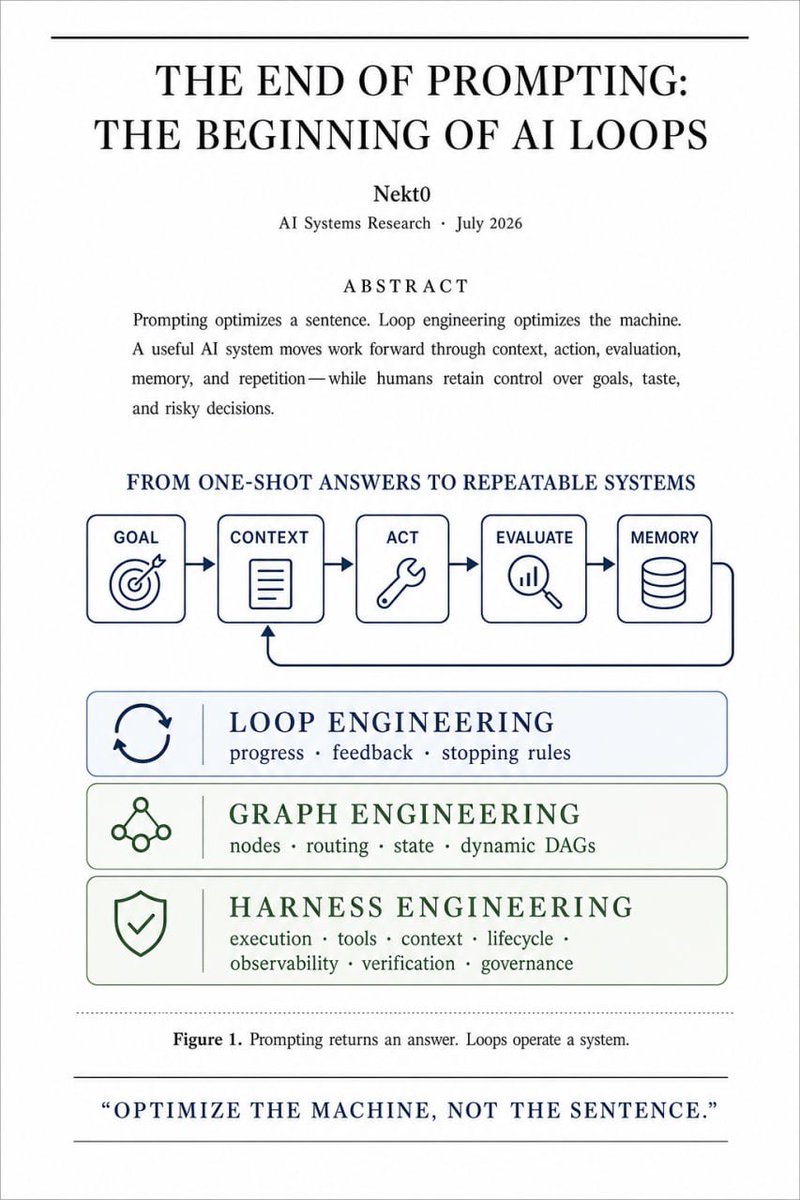
@elune0x extended (19 likes, 6 replies, 1,854 views, 16 bookmarks) the same split into explicit ownership boundaries: loop engineering owns time, graph engineering owns state, and harness engineering owns effect. @gakonst called durable execution "the most necessary primitive" (40 likes, 6 replies, 3,041 views, 20 bookmarks) because it lets developers declare start, resume, and completion semantics instead of writing bespoke orchestration loops.
@a16z shared (32 likes, 3 replies, 9,139 views, 17 bookmarks) Yoko Li's explanation for why coding loops were the first to work well: code sits high on both editability and verifiability, so agents can change one function, run it, read the failure, and try again. That framing tightened the day's implicit definition of a "good" agent task from "anything iterative" to "anything the system can edit and verify cheaply."

Discussion insight: Replies repeatedly moved from theory to operations. The most useful additions were about visible retries, checkpoints, and sandbox cost, which suggests the audience already accepts the vocabulary and is now asking how to run it without runaway loops or unsafe side effects.
Comparison to prior day: Compared with August 5's emphasis on shipping skills and harness products, August 6 concentrated more on the control planes that make those products reliable.
1.2 The agent-ready web became more concrete (🡕)
Cloudflare, Circle, and Agent Plugins all pushed the same direction: agents should discover services, call tools, and move through websites without pretending to be humans clicking HTML. The main shift was operational, not rhetorical: stateless MCP, keyless discovery endpoints, and portable plugin bundles all make the agent surface easier to host and reuse.
@_ashleypeacock summarized (112 likes, 14 replies, 7,057 views, 66 bookmarks) Cloudflare's Day 4 stack as Kitesurf, WebMCP, next-generation MCP, AI Search, and AEO. The underlying product posts say Kitesurf is a stateless browser built for Workers, WebMCP can expose site tools with one toggle, AI Search now offers public /search and /mcp endpoints, and the new MCP spec drops the sticky-session requirement.
@circle announced (186 likes, 25 replies, 15,460 views, 20 bookmarks) a keyless Discovery API for its Agent Marketplace. Circle's release notes add the useful specifics—14 query parameters, sanctions-screened and health-checked listings, and paid services via x402 and USDC—while the attached screenshot shows a public endpoint that can discover services across chains with no API key.

@jerallaire amplified (161 likes, 28 replies, 11,067 views, 10 bookmarks) the same launch but got the sharper follow-up in replies: discovery is only the first step, because agents still need identity, credentials, negotiation, memory, and execution.
@mattyp showed (61 likes, 4 replies, 4,760 views, 23 bookmarks) Agent Plugins running inside Cursor. The official site describes a portable bundle built from plugin.json, skills/, and mcp.json, while a reply argued progressive loading matters because it avoids dumping the entire plugin surface into context at once. @stbenjam pushed back (1 like, 3 replies, 4,810 views) that version 1.0 still lacks hooks, rules, signing, dependency management, and marketplace format, which is exactly the gap between "portable enough to demo" and "safe enough to standardize."
Discussion insight: Excitement around open interfaces was immediately paired with questions about identity, signing, and dependency semantics. The appetite for standards is real, but the acceptable minimum is already moving past "works on my client."
Comparison to prior day: August 5 was already interested in skills and distribution, but August 6 widened the surface from package installers to websites, service catalogs, and agent-native client interfaces.
1.3 Payment and ownership rails moved closer to the agent loop (🡕)
A separate cluster focused on how agents discover paid services, send money, and even expose tradeable strategies. The change from earlier "agent economy" talk was concreteness: today's evidence included install commands, marketplace screenshots, and public service directories.
@DD____ claimed (146 likes, 148 replies, 3,072 views) that Moss Agent Marketplace is live as an "on-chain capital market for AI agents." The screenshot is more informative than the copy alone: it shows 19 listed agents, $606 in total agent-managed assets, $522 in 24-hour volume, and 13 total mints, so this was not just a protocol whitepaper.

@naturalpay pitched (31 likes, 5 replies, 6,772 views, 7 bookmarks) Natural as the easiest way for an agent to send money. Natural's site exposes direct MCP and SDK install paths—claude mcp add, codex mcp add, and npm install @naturalpay/sdk—which makes the product look like an integration layer rather than a generic fintech narrative.
The Circle Discovery API discussion overlapped with this theme because it tied service lookup directly to x402 and USDC settlement. In other words, discovery and payment were being presented as one flow rather than as separate systems stitched together later.
Discussion insight: Replies were more about mechanics than ideology: pricing, supported chains, and what happens after discovery. That is a useful signal that payment rails are being judged on integration friction, not on whether agent commerce sounds exciting.
Comparison to prior day: August 5 also had payment and inference infrastructure, but August 6 added a public discovery surface and a live marketplace screenshot instead of only conceptual stack diagrams.
1.4 Builder upside met visible backlash and execution anxiety (🡕)
The day's most engaged post was not a launch. It was a warning from shadcn that AI has made cloning small open-source products nearly free, while safety-minded posts insisted that "can plan" is not the same as "should execute." Those threads show a social constraint and a control constraint arriving at the same time.
@shadcn warned (838 likes, 58 replies, 28,716 views, 213 bookmarks) that AI has made copying "effectively free," especially for small open-source launches whose code, roadmap, changelog, and launch copy can all become input prompts within hours. The post was not a license complaint; it was a creator-incentive complaint about what happens when the first small win no longer feels rewarded.
@nabu_lines argued (48 likes, 25 replies, 2,666 views, 5 bookmarks) that planning and tool use do not entitle an agent to execute, and that hardware should enforce the final boundary. The most useful reply immediately stress-tested the premise: if an attacker controls the plan step, the enforcement layer can still faithfully execute a bad intent, so isolation is not a full answer by itself.
Discussion insight: The strongest replies did not reject AI outright. They asked for attribution norms, tighter approvals, and clearer enforcement boundaries before more autonomy becomes the default.
Comparison to prior day: Compared with August 5's more launch-heavy tone, August 6 carried a stronger counterweight from creators and red-team-minded operators.
2. What Frustrates People
Creditless cloning and thin attribution
The clearest high-severity frustration was that AI has made copying small products cheap enough to break the usual reward loop for public builders. @shadcn described (838 likes, 58 replies, 28,716 views, 213 bookmarks) a world where a Friday launch can be cloned by Monday, with the creator paying the cost of research, design, and iteration while everyone else pays nearly nothing to reproduce it. Replies did not dispute that this is happening; one reply proposed simple attribution in docs for parity ports, while another asked whether builders will respond by launching less in public. Worth building for: High, because current coping mechanisms are mostly social norms rather than product defaults.
Long-running agents still fail at runtime boundaries
The runtime complaint was also high severity. @gakonst said durable execution is the primitive that lets developers stop hand-writing orchestration loops (40 likes, 6 replies, 3,041 views, 20 bookmarks), while @RichardsonDx used a calendar-meeting example to show why long-lived resume points are hard (1 like, 1 reply, 46 views, 1 bookmark). OpenClaw's Task Flow docs and @zawadzki_diana's Cadence keynote teaser point to the same pain: agents fail, but the work still has to recover. Builders cope today with workflow engines, visible checkpoints, and sandboxing, yet replies still described sandboxing setup as an afternoon's work. Worth building for: High.
Standards are arriving before trust, signing, and dependency management
Today's portability discussion was positive but visibly unfinished. @mattyp showed Agent Plugins working in Cursor (61 likes, 4 replies, 4,760 views, 23 bookmarks), but @stbenjam argued that the format still lacks hooks, rules, signing, dependency management, and marketplace semantics (1 like, 3 replies, 4,810 views). The Circle cluster added a second frustration: @jerallaire surfaced the need for identity, credentials, negotiation, memory, and execution after discovery already works (161 likes, 28 replies, 11,067 views, 10 bookmarks). The workaround today is to keep bundles small, load them progressively, and leave more trust decisions to centralized products. Worth building for: Medium to High.
3. What People Wish Existed
Durable runtimes that pause, resume, and recover
This was a practical need with explicit urgency. @gakonst called durable execution the key primitive, @RichardsonDx used a scheduled-meeting example to show why long-lived goals are hard, and @zawadzki_diana promoted a Cadence keynote explicitly framed around durable agent orchestration. Task Flow already offers one answer with persisted state and cancellation semantics, but the conversation suggests the market still wants a simpler default for pause, resume, approval, and recovery. Opportunity: direct.
Discovery that carries trust and payment context
Circle's keyless discovery endpoint made service lookup concrete, but @jerallaire immediately highlighted the missing layer: identity, credentials, negotiation, memory, and execution still sit after discovery. @naturalpay added the payment side with direct MCP and SDK install paths, while Cloudflare's open Agentic Internet framing extended the same need to readable, discoverable, callable, and payable sites. This is a practical need, and the posts treat it as immediate infrastructure rather than a far-future idea. Opportunity: direct.
Portable plugin bundles with real security and dependency semantics
Agent Plugins shipped a portable floor, which is why @mattyp could demo it inside Cursor. But @stbenjam responded with the missing pieces—hooks, rules, signing, richer versioning, and dependency management—which turns the wish into a very practical one. The urgency is medium rather than existential because teams can still ship with thinner bundles today, but the pressure for cross-client portability is clearly real. Opportunity: competitive.
Attribution and provenance defaults for AI-assisted ports
Shadcn's thread made this both practical and emotional. The direct reply-level ask was modest—small attribution messages, clearer credit, less frictionless laundering of origin—but the underlying need is broader: creators want proof that reuse preserved provenance instead of flattening authorship into the next prompt. Nothing in today's evidence showed a widely adopted answer, which is why the opportunity is real even if the adoption problem is partly social. Opportunity: direct.
4. Tools and Methods in Use
| Tool | Category | Sentiment | Strengths | Limitations |
|---|---|---|---|---|
| Claude Code | Coding agent | (+) | @unicodef1wn's post surfaced sub-agents, sandboxing, tool choice, HTML specs, and harness-building as reusable operator lessons | A reply said sandboxing still takes "an afternoon," so the gains still depend on careful setup |
| Loop / graph / harness engineering | Orchestration method | (+) | @Nekt_0, @elune0x, and @a16z gave explicit models for time, state, effect, and convergence | It is a design pattern, not a turnkey runtime; teams still have to implement the loops, checks, and gates |
| Kitesurf | Browser runtime | (+) | Cloudflare and @_ashleypeacock framed it as a lighter-than-Chromium browser built for agent tasks on Workers | Still a beta browser rather than a default surface across agent stacks |
| WebMCP / stateless MCP | Agent interface / protocol | (+/-) | One-toggle site tools and a stateless MCP core reduce sticky-session overhead and make sites more callable by agents | @stbenjam and related replies show the surrounding trust and dependency layers are still immature |
| Circle Discovery API | Discovery / commerce API | (+) | Keyless query surface with 14 filters and x402/USDC service discovery | @jerallaire replies said discovery still leaves identity, negotiation, and memory unresolved |
| Agent Plugins | Skill packaging standard | (+/-) | Portable bundles across Cursor and other clients with a clear plugin.json + skills/ + mcp.json structure |
Critics want hooks, rules, signing, dependency management, and marketplace semantics |
| Prime Agent | Coding harness | (+) | Persistent REPL, sub-agents, harness CRUD, and a strong public benchmark story | The operational complexity still lives in the harness itself, not in the model alone |
| OpenClaw Task Flow | Durable orchestration runtime | (+) | Explicit flow state, revisions, child tasks, and resumability | One strong implementation in a still-fragmented runtime market |
| Natural | Agent payments | (+/-) | Clear MCP and SDK install paths plus bundled ledgering, routing, compliance, risk, and disputes | Public operator evidence today came mostly from the builder's own framing |
| Moss Agent Marketplace | On-chain agent market | (+/-) | Verifiable on-chain track records and shareable agent ownership are live now | The live site exposed little detail, and replies were more promotional than operational |
Overall satisfaction was highest when a tool exposed an explicit operating surface: install commands, state records, public endpoints, progressive loading, or clear recovery semantics. The common workarounds were workflow engines above raw models, human approval boundaries, progressive bundle loading, and wallet-bounded payment layers. The competitive dynamic is now less about a single best model and more about who owns runtime recovery, discovery, provenance, and the post-build path to users.
5. What People Are Building
| Project | Who built it | What it does | Problem it solves | Stack | Stage | Links |
|---|---|---|---|---|---|---|
| Cloudflare agent-ready web stack | Cloudflare | Combines Kitesurf, WebMCP, AI Search, and stateless MCP so agents can browse, discover, and call sites more natively | Reduces human-UI scraping and sticky-session protocol overhead | Workers, WebAssembly, Dynamic Workers, Durable Objects, Browser Run, WebMCP, AI Search | Beta | Kitesurf, WebMCP, tweet |
| Circle Discovery API | Circle | Keyless discovery endpoint over the Agent Marketplace for x402 services | Helps agents find payable services across chains without custom discovery plumbing | Agent Marketplace, Discovery API, x402, USDC | Shipped | release notes, tweet |
| Agent Plugins | @mattyp | Portable plugin bundle that can ship skills and MCP servers across clients | Avoids rebuilding the same workflow package for every harness | plugin.json, skills/, mcp.json, Cursor |
Shipped | site, tweet |
| Prime Agent | Prime Intellect | Self-improving coding harness with persistent REPL, sub-agents, and editable skills and memory | Extends coding agents beyond one-shot inference and fixed scaffolding | Persistent IPython REPL, rlm sub-agents, prompts/skills/memory CRUD |
Shipped | blog, tweet |
| OpenClaw Task Flow | OpenClaw | Durable orchestration layer above background tasks | Keeps long-lived goals resumable, inspectable, and cancellable | Task Flow state, revisions, child tasks, JSON payloads | Beta | docs, tweet |
| Moss Agent Marketplace | Moss | On-chain capital market where users can mint shares in live trading agents | Gives agent builders verifiable performance and shareable ownership | FAT Protocol, smart contracts, on-chain execution | Shipped | site, tweet |
| Natural | Natural | Payments infrastructure for agent workflows | Bundles ledgering, routing, compliance, risk, disputes, and payout plumbing into one integration | MCP surfaces, JavaScript SDK, install script | Shipped | site, tweet |
| Continuous Skill Acquisition | @rvaniaaaa | Eight-agent pipeline that scouts repos, extracts reusable workflows, and publishes skills by pull request | Removes the manual last-mile work of turning new capabilities into installable skills | Scout, filter, reader, workflow extractor, skill evaluation, skill generation, review, publisher | Alpha | tweet |
Cloudflare, Circle, Natural, and Moss show the same build pattern from different angles. One makes websites callable, one makes services discoverable, one makes payment plumbing installable, and one makes agent performance tradeable. The shared problem is not whether an agent can produce an action, but whether another system can discover it, trust it, and settle with it.
Prime Agent and OpenClaw attacked the runtime problem from different sides. Prime Agent makes the harness itself editable during execution, while Task Flow makes long-lived work durable and inspectable outside the prompt. @zawadzki_diana reinforced (14 likes, 5 replies, 583 views, 2 bookmarks) the same runtime focus with a Cadence keynote teaser titled around durable agent orchestration and workflow recovery.
Agent Plugins and Continuous Skill Acquisition point to the next layer up: packaging itself is becoming automated. @rvaniaaaa described (11 likes, 1 reply, 117 views, 12 bookmarks) a pipeline that scouts GitHub, filters irrelevant repos before model use, extracts reusable workflows, scores them, and publishes installable skills by pull request. That is a distinct builder pattern from manually curating skills one by one.

6. New and Notable
Prime Agent made self-improving harness benchmarks hard to ignore
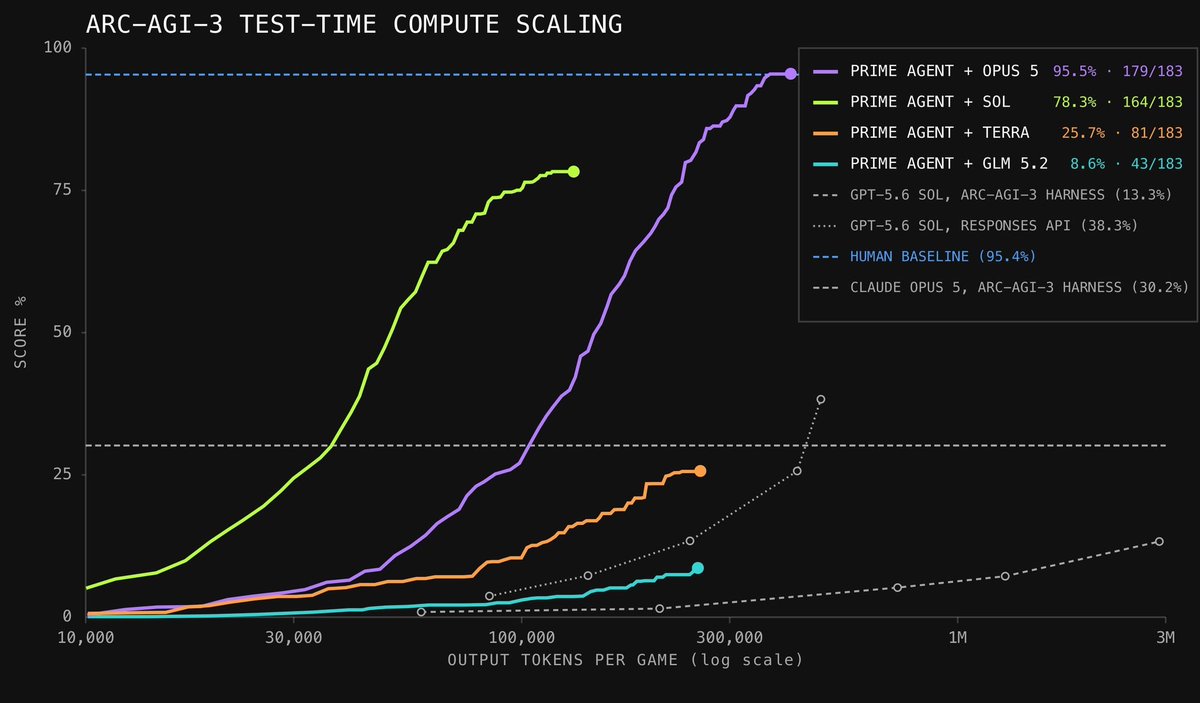
@daniel_mac8 broadcast (38 likes, 7 replies, 3,929 views, 15 bookmarks) Prime Agent's claim that a self-improving harness can raise Opus 5's ARC-AGI-3 score to 95.5%. The notable part is not just the number; it is that the accompanying Prime Agent post publicly explains persistent REPL state, programmatic sub-agents, and CRUD over prompts, skills, and memory.
Cloudflare turned the "agentic internet" from philosophy into product surfaces
@_ashleypeacock compressed (112 likes, 14 replies, 7,057 views, 66 bookmarks) Cloudflare's launch cluster into one thread, but the underlying posts are what make it notable: Kitesurf for browsing, WebMCP for callability, AI Search for discoverability, and the open Agentic Internet post for payments and identity. That is unusually complete coverage of the read, call, discover, and pay surfaces in one day.
Shadcn's cloning thread became the day's clearest cultural warning
@shadcn wrote (838 likes, 58 replies, 28,716 views, 213 bookmarks) the most discussed post in the dataset, and it was a warning rather than a launch. What made it notable was the scope of the complaint: not just code ports, but changelogs, launch copy, and product roadmaps becoming near-zero-cost prompts for fast imitators.
Continuous Skill Acquisition pushed agent learning beyond manual curation
@rvaniaaaa presented (11 likes, 1 reply, 117 views, 12 bookmarks) an architecture where agents monitor GitHub, filter repos before model use, extract reusable workflows, score them, and publish skills by pull request. That is notable because it shifts the bottleneck from model capability to knowledge acquisition and packaging discipline.
7. Where the Opportunities Are
[+++] Durable orchestration, recovery, and approval layers — The strongest cross-section signal combined @gakonst, @RichardsonDx, Task Flow, Cadence's workflow-recovery framing, the Claude Code sandboxing discussion, and the loop/graph/harness vocabulary from @Nekt_0 and @elune0x. The repeated opportunity is a runtime that can pause, resume, inspect, constrain, and recover agent work without custom orchestration glue.
[+++] Discovery-to-payment surfaces for agents — Circle, Natural, Cloudflare, and Moss all converged on the same missing layer: agents need to find services, call them, and settle with them through public, installable, low-friction rails. The evidence spans themes, tool rows, and build rows, which makes this more than a one-off marketing narrative.
[++] Attribution and provenance for AI-assisted reuse — Shadcn's complaint and the reply asking for lightweight credit in docs point to a real gap between legal reuse and socially legible reuse. The pain is strong and likely to spread beyond code, but the solution space is partly social, so this looks important rather than easy.
[++] Portable plugin governance and dependency security — Agent Plugins clearly met a real need, yet the first serious reaction was to ask for hooks, rules, signing, richer versioning, and marketplace semantics. That is a good sign for a competitive product layer that sits above the portability floor and below full platform lock-in.
[+] Autonomous skill acquisition and packaging — Continuous Skill Acquisition suggests one more step in the toolchain: agents that do not just use skills, but keep discovering and packaging new ones. The evidence is thinner than the runtime and commerce themes, but it is a credible emerging builder pattern.
8. Takeaways
- Agent engineering discourse moved decisively from prompts to control planes. Fchollet's neurosymbolic framing, Nekt_0's loop diagram, elune0x's time-state-effect split, and the Claude Code masterclass all treated runtime structure as the main lever. (source)
- Durable execution and recovery are no longer niche runtime concerns. Gakonst's thread, OpenClaw's Task Flow example, and Cadence's public keynote framing all pointed to the same gap: long-lived work needs explicit pause, resume, and failure semantics. (source)
- The agent-ready web is becoming a concrete product surface. Cloudflare's Kitesurf, WebMCP, and AI Search cluster, plus Circle's keyless Discovery API, showed real movement on the read, call, and discover layers rather than just another agent abstraction. (source)
- Portability won momentum, but trust and dependency management did not come with it. Agent Plugins made cross-client packaging feel real, yet the immediate pushback was for signing, hooks, rules, and richer versioning. (source)
- Creator incentives are now part of the agent conversation, not a side issue. Shadcn's cloning thread became the day's loudest signal that cheap copying can change how willing people are to build in public. (source)