Twitter AI Agent - 2026-08-07
1. What People Are Talking About
1.1 Runtime vocabulary turned into a public curriculum (🡕)
Compared with August 6's more theory-heavy control-plane talk, August 7 repackaged the same ideas as posters, course threads, and framework-choice crib sheets. The dominant question was no longer whether loops, graphs, and harnesses matter; it was how to draw the boundaries, when to choose each layer, and how to teach the stack to newcomers.
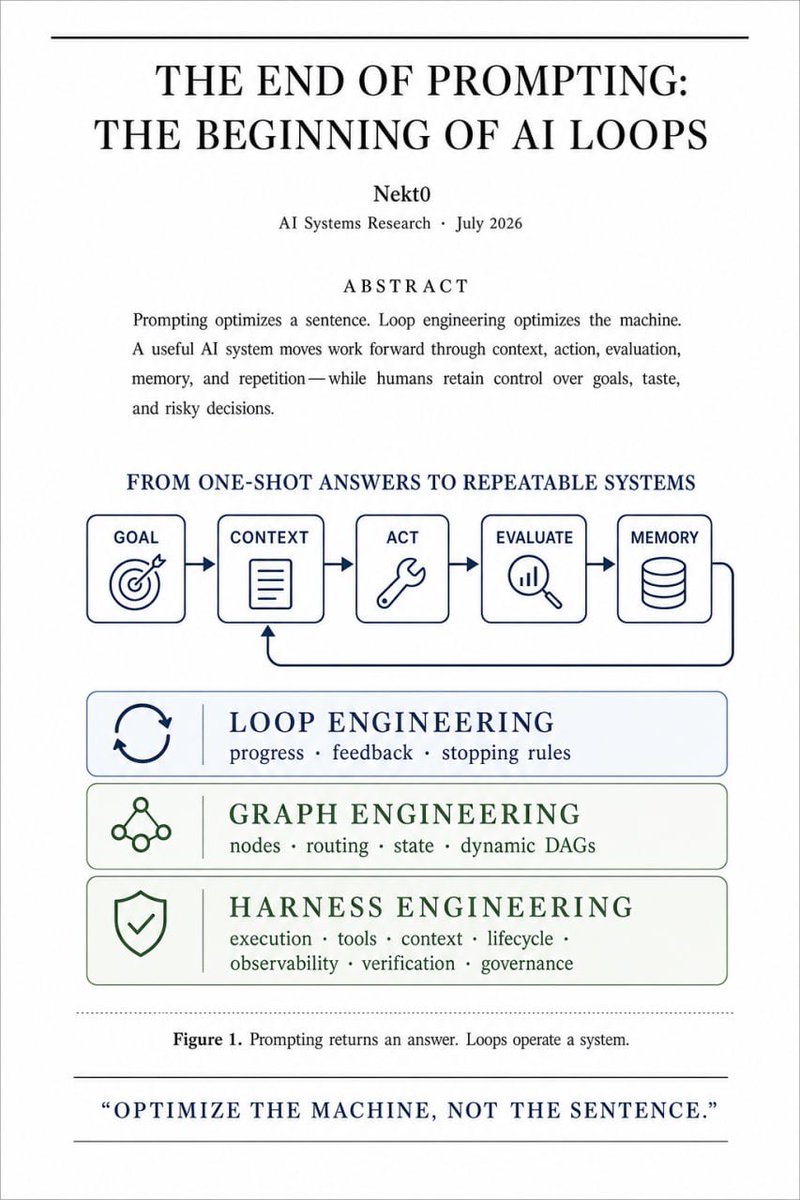
@Nekt_0 argued (44 likes, 11 replies, 890 views, 33 bookmarks) that one prompt gives one answer, but a loop gives a system. The attached poster mattered because it compressed the day's most repeated argument into one page: goal, context, action, evaluation, and memory sit on top of separate loop, graph, and harness responsibilities, ending with the line "optimize the machine, not the sentence."
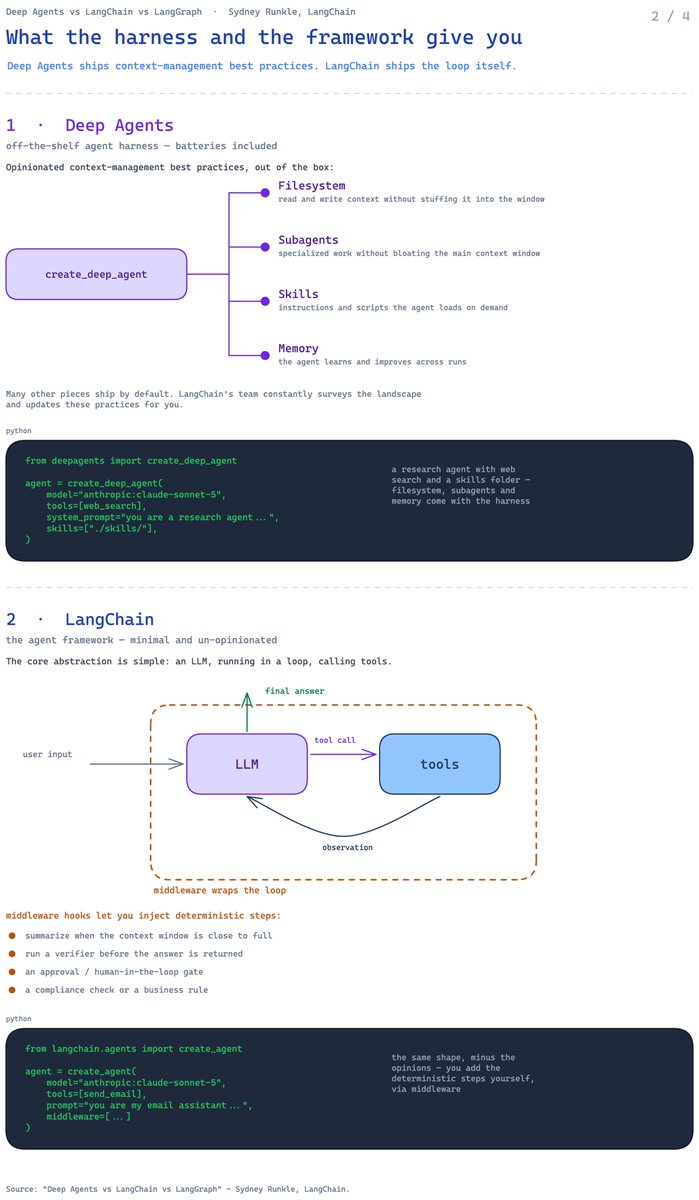
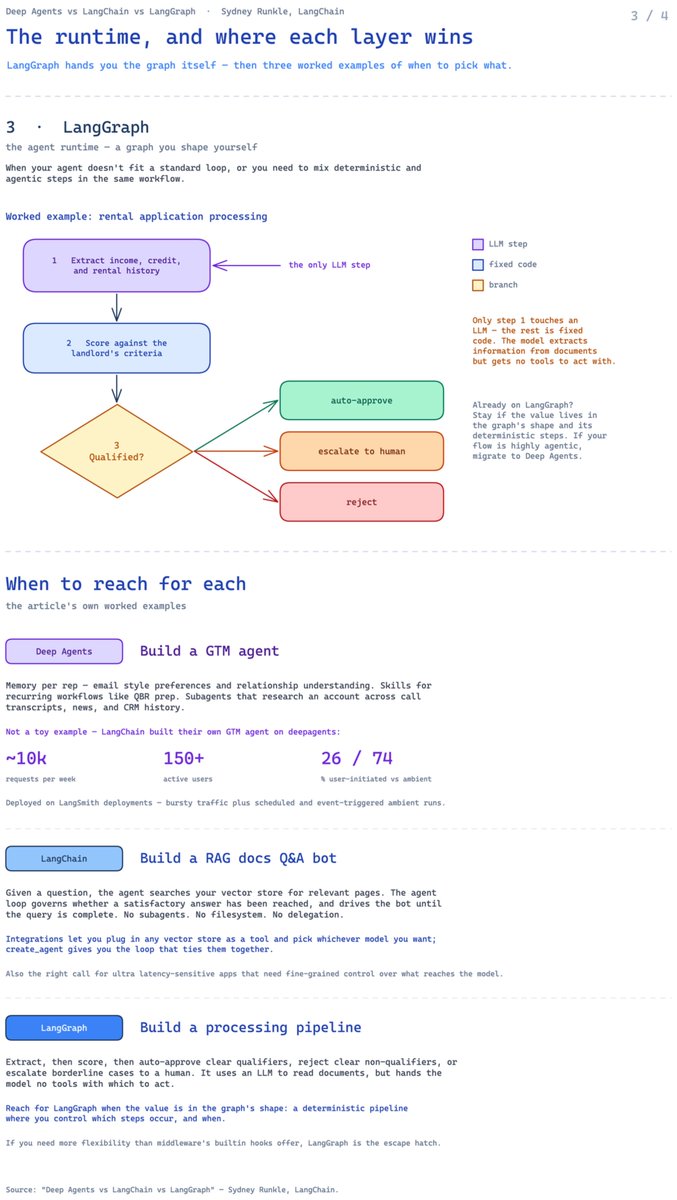
@rohit4verse reframed (21 likes, 9 replies, 2,490 views, 32 bookmarks) Sydney Runkle's LangChain material as a decision guide for runtime vs. framework vs. harness. The four-image sequence was unusually concrete: it mapped Deep Agents to the full harness layer, LangChain to the looping framework layer, and LangGraph to the runtime layer, then showed when determinism matters more than agency and how all three still compose inside one stack.


@elune0x pushed (29 likes, 6 replies, 2,179 views, 29 bookmarks) the split further, arguing that production agents need three different answers: should execution continue, where should it go next, and what may it change. The most useful reply came from another builder who separated those into loop logs, router logs, and permission-gate logs, which turned an abstract taxonomy into an operational debugging pattern.
@rvaniaaaa shared (14 likes, 1 reply, 209 views, 11 bookmarks) a one-page graph-engineering poster that translated the same vocabulary into workflow shapes: fan out, reduce, verify, synthesize, then stop after two dry rounds. It added concrete failure modes such as context collapse, false independence, and silent node failure.

@RoundtableSpace promoted (77 likes, 14 replies, 48,318 views, 49 bookmarks) a "Google dropped a 2 hour course" framing for graph, loop, and prompt engineering, and a reply immediately corrected the provenance, saying the curriculum was community-made rather than an official Google release. @unicodef1wn amplified (49 likes, 13 replies, 695 views, 38 bookmarks) another two-hour breakdown with chapters on persistent memory, reusable skills, token waste, and parallel agents, showing how fast the runtime vocabulary has become marketable courseware.
Discussion insight: The strongest replies were about misclassification and misuse, not disbelief. People corrected source attribution, warned against applying three layers to simple scripts, and asked for explicit logs per layer. That is a sign of a field arguing over operating boundaries rather than basic concepts.
Comparison to prior day: August 6 established loop, graph, and harness as the language of runtime reliability; August 7 turned that language into posters, course threads, and framework-selection heuristics.
1.2 Discovery, reputation, and payment were presented as one marketplace loop (🡕)
Marketplaces stopped sounding like vague agent-economy rhetoric and started showing concrete missing surfaces: keyless discovery, service ranking, agent identity, verifiable inference, and onchain hiring venues. The strongest posts did not just celebrate marketplaces; they stated exactly what has to be queryable or auditable before an agent can spend or act.
@jerallaire amplified (240 likes, 30 replies, 16,703 views, 25 bookmarks) Circle's new discovery layer for agentic services. Circle's release notes add the concrete mechanics: a public keyless Discovery API at GET https://api.circle.com/v2/x402/discovery/resources, 14 query parameters, and 900+ sanctions-screened, health-checked services. The replies were more valuable than the applause: one builder said discovery still leaves identity, negotiation, credentials, memory, and execution unsolved, while another said ranking and reputation matter because agents can discover bad services very efficiently too.
@CamKhosravi shared (5 likes, 1 reply, 43 views) a Circle earnings slide that quantified the same loop. It showed 99.3% of x402 agent-payment volume settling in USDC, 900+ paid services live, and a publish -> discover -> pay -> settle cycle where reputation feeds the next transaction.

@BNBCHAIN said (90 likes, 40 replies, 30,725 views) that 200,000+ AI agents already exist on BNB Smart Chain and asked builders to create the marketplace where people can find, compare, and hire them. The linked challenge brief is unusually explicit that discoverability itself is the bottleneck because users still dig through X threads and GitHub repos to decide what is live, useful, or trustworthy.
@NxtCypher boosted (119 likes, 90 replies, 16,556 views) CyAI as a decentralized market for verifiable inference, and the official Cysic AI docs frame it as the automation layer of ComputeFi. The attached table was the substantive part: centralized APIs offered one provider, fixed opaque pricing, single-datacenter supply, and unverifiable inference, while CyAI was pitched as cryptographic, distributed, free-market, and auditable.

Discussion insight: The valuable skepticism was not that marketplaces are fake. It was that discovery alone is insufficient. The missing pieces people kept naming were ranking, reputation, identity, credentials, and proof that the inference or service really did what it claimed.
Comparison to prior day: August 6 focused on public discovery endpoints and payment rails; August 7 merged those ideas into marketplace design, reputation loops, and explicit calls to build the venue itself.
1.3 Builders started designing operator surfaces for multi-agent work (🡕)
A separate cluster moved past abstract orchestration talk into where an operator actually sees, steers, and approves agent work. The common theme was not more autonomy by default, but better surfaces for mixing subagents, local files, research material, and human review.
@yoheinakajima showed (24 likes, 1 reply, 2,667 views, 30 bookmarks) a modular repo-centric agent operating system inspired by ActiveGraph. The public ActiveGraph repo describes an event-sourced reactive graph runtime where the log is the source of truth, runs are replayable and forkable, and behaviors react to a shared graph instead of passing opaque messages back and forth.
@warpdotdev demoed (59 likes, 5 replies, 3,841 views, 17 bookmarks) the new Warp Agent CLI UX for seeing subagents and configuring their model, harness, and environment. Warp's own harness docs say Warp Agent is the default Oz harness and the only harness that can spawn cross-harness subagents like Claude Code or Codex, which made the tweet more than a UI-polish post.
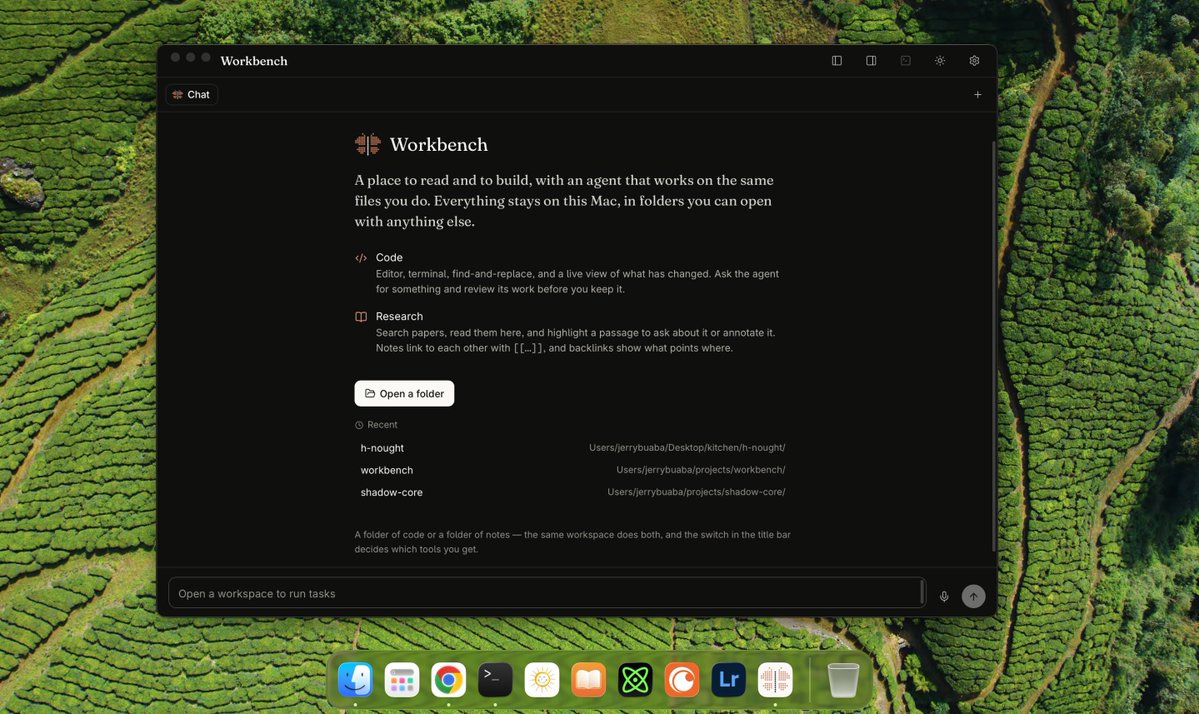
@buabaj_ shared (29 likes, 5 replies, 1,032 views, 12 bookmarks) a personal workbench that keeps code and research in one local surface, with Prime Agent as the harness under Codex and Claude Code models. The screenshots were unusually informative: one showed a home screen split between code and research, another showed a task-review sidebar beside a coding session, and a third showed PDF reading and annotation inside the same workspace. In replies, the builder said the project is open source but not yet packaged for distribution.


Discussion insight: Interest centered on visibility and control: how to see blocked subagents, keep runs local, merge code and research, and package these surfaces for other people. The operator UI is becoming part of the product, not just the shell around it.
Comparison to prior day: August 6 widened the agent-ready surface on the web; August 7 shifted inward to the operator console, the local workbench, and the repo itself.
1.4 Harness quality became something people could benchmark and train (🡕)
August 7 also had stronger evidence that the harness itself is now an experimental variable, not background glue. Two clusters mattered: open benchmarks that hold the model constant while comparing harnesses, and RL stacks that start treating multi-agent interaction as a trainable environment.
@RamaswmySridhar open-sourced (38 likes, 4 replies, 23,415 views, 17 bookmarks) data-eng-bench, and the repo is unusually specific: 103 containerized dbt tasks, hidden pytest verifiers, and both DuckDB and Snowflake backends. The attached chart carried the point visually: with the same model, different harnesses land at meaningfully different pass@1 and cost points.

@willccbb celebrated (76 likes, 9 replies, 3,707 views, 15 bookmarks) Prime Intellect's move from single-agent rollouts to multi-agent systems, quoting the announcement that PRIME-RL can now express arbitrary agent interactions and train them. Prime Intellect's post makes the shift concrete with first-class Agent and Env abstractions for agentic judging, self-play, and user simulation.
@taylorotwell said (66 likes, 7 replies, 4,313 views, 13 bookmarks) he paused agent-framework work long enough to open a Laravel Scout pull request for a Turbopuffer engine plus semantic and hybrid search support in a day. The public PR is concrete rather than rhetorical: it adds a Turbopuffer engine, weighted BM25 search, database semantic and hybrid search helpers, filters, pagination logic, and tests.
Discussion insight: The strongest signal here was methodological. People are increasingly comparing model+harness bundles, not just model names, and treating workflow topology, search, and verifiers as first-class levers.
Comparison to prior day: August 6 had benchmark and runtime claims around Prime Agent; August 7 added public benchmark kits, trainable multi-agent abstractions, and concrete shipping work tied to those ideas.
2. What Frustrates People
Discovery without trust context or ranking
The loudest marketplace complaint was not lack of agents; it was lack of legibility. @jerallaire relayed (240 likes, 30 replies, 16,703 views, 25 bookmarks) that discovery is only the first step, and replies immediately piled on with the missing pieces: identity, negotiation, credentials, memory, execution, and ranking. @BNBCHAIN made the same complaint in public product language (90 likes, 40 replies, 30,725 views), saying builders still need a venue where people can find, compare, and hire agents. One reply under the BNB thread joked that 200,000 agents exist and not one can file taxes yet, which is a blunt way of stating the usefulness gap. Worth building for: High.
Autonomy breaks when creation and judgment share the same loop
The clearest systems frustration was that good assistants become brittle when autonomy is bolted onto the same control loop. @panda_liyin argued (19 likes, 7 replies, 1,574 views, 10 bookmarks) that coding agents are already close to perfect for humans in the loop, which is exactly why autonomy needs its own agent. A reply sharpened the point further: the system that renders the frame should not also decide it is done. @RamaswmySridhar showed the same problem from the evaluation side (38 likes, 4 replies, 23,415 views, 17 bookmarks), where hidden verifiers and harness choice changed outcomes even when the model stayed constant. @Nekt_0 framed loop, graph, and harness responsibilities, and @elune0x extended that boundary language into routing and permission control. Worth building for: High.
Copywriting slop and model drift
Quality complaints were concrete rather than vague. @shannholmberg listed (18 likes, 11 replies, 2,071 views, 12 bookmarks) five ways to avoid copywriting slop: older models, dead prose, strict context budgets, voice-DNA skills, and a separate eval agent. The attached screenshot made the workflow explicit.
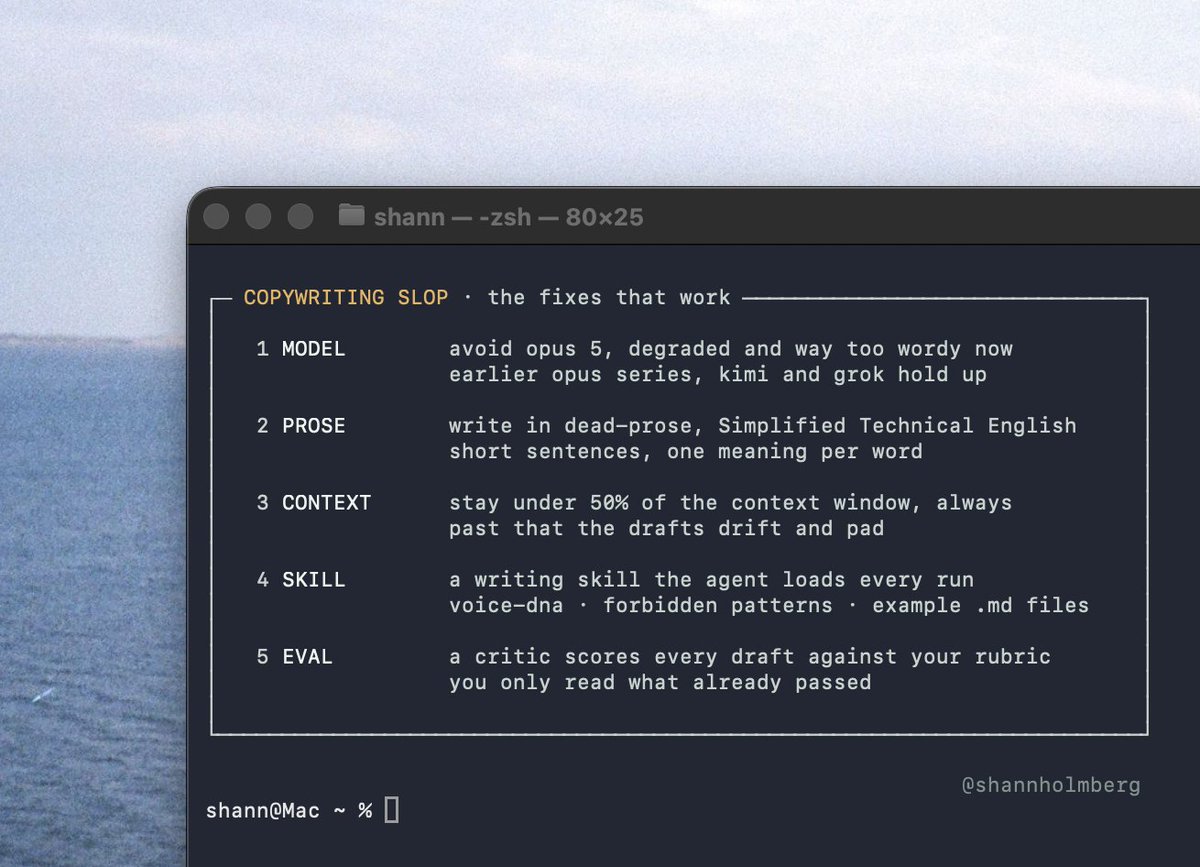
The strongest reply agreed that the separate evaluator is the highest-leverage fix because the same context that writes should not also judge the output. Today's workaround is manual harness tuning and model switching, not a stable default. Worth building for: Medium.
Keyboard-first control creates an attention bottleneck
Agent builders repeatedly described operator bandwidth as the new limit. @nickvasiles said (26 likes, 7 replies, 1,074 views, 8 bookmarks) that the next OpenClaw moment is voice because people running fleets are attention-constrained, not input-constrained. Replies said phone-first operators and small-business users would rather talk than type, but another reply exposed the gap immediately: people still want a true real-time voice mode, not just Telegram or WhatsApp voice wrappers. Worth building for: Medium.
3. What People Wish Existed
Marketplaces that combine discovery, ranking, identity, and payment
Circle, BNB Chain, and Cysic all described pieces of the same missing stack. Circle has keyless discovery and USDC/x402 settlement, BNB wants a place to compare and hire agents, and CyAI wants auditable inference. The direct ask in replies was clear: a marketplace where agents can be discovered, ranked, trusted, paid, and audited in one flow rather than across separate tools. This is a practical need, not an abstract one, because the threads repeatedly named the missing handoffs after discovery already works. Opportunity: direct.
Workbenches that unify code, research, and approval
Warp, ActiveGraph, and buabaj's Workbench each pointed to the same desire from different angles: operators want one place where subagents, repositories, research material, logs, and human approvals stay visible. Warp emphasized subagent trees and cross-harness coordination, ActiveGraph emphasized replayable state and fork-and-diff, and Workbench emphasized mixed code/research UX for people who do not want to live in a terminal. This looks practical rather than aspirational because the prototypes already exist, but remain fragmented and often unpolished. Opportunity: competitive.
Verification layers that judge independently of generators
Panda's autonomy split, shannholmberg's eval-agent advice, and data-eng-bench's hidden verifiers all say the same thing: teams want a clean layer that can approve, reject, retry, or escalate work independently of the model that drafted it. Today's stopgaps are extra agents, custom rules, and manual harness tuning. A reusable verification layer that can slot into coding, writing, and research workflows looks like direct demand. Opportunity: direct.
Voice-native orchestration for busy operators
Nick Vasilies's thread and replies describe a narrow but real ask: voice should be a first-class orchestration mode for people steering many tasks from a phone, on the move, or between jobs. The requirement is not just speech in and out; it is low-latency, stateful, multi-agent control without falling back to text-first UIs. The evidence is thinner than the marketplace and verification themes, but it is specific enough to matter. Opportunity: emerging.
4. Tools and Methods in Use
| Tool | Category | Sentiment | Strengths | Limitations |
|---|---|---|---|---|
| Loop / graph / harness engineering | Orchestration method | (+) | Clear separation of repetition, routing, permissions, and verification; strong visual decision aids from Nekt_0, rohit4verse, elune0x, and rvaniaaaa | Easy to overapply to simple tasks; provenance confusion around repackaged courseware |
| Circle Discovery API | Discovery / payment API | (+/-) | Keyless endpoint, 14 filters, 900+ services, sanctions-screened listings, USDC/x402 rails | Discovery still lacks built-in identity, ranking, negotiation, and memory |
| CyAI | Verifiable inference marketplace | (+/-) | Cryptographic auditability, distributed supply, market pricing, trusted-execution framing | Evidence is still mostly launch framing; little independent operator feedback surfaced in replies |
| ActiveGraph | Durable agent runtime | (+) | Event log as source of truth, replay, fork-and-diff, resumable runs | More architecture than ready-made end-user workbench |
| Warp Agent | Orchestration harness / UI | (+) | Cross-harness subagents, model routing, inspectable transcripts, Skills/Rules/Memory integration | Users still want clearer dependency and blocking views inside the orchestration tree |
| Prime Agent / PRIME-RL | Harness + RL stack | (+) | Persistent REPL, durable harness state, and first-class multi-agent training envs | Powerful but complex; still reads as research-heavy for mainstream teams |
| data-eng-bench | Benchmark / eval harness | (+) | 103 real dbt tasks with hidden verifiers make model+harness comparisons concrete | Narrow to data-engineering workflows |
| Laravel Scout + Turbopuffer | Search infrastructure | (+) | Public PR adds weighted BM25, semantic search, hybrid search, filters, and tests | Still an open PR rather than a shipped framework default |
Overall satisfaction was highest when a tool exposed explicit state or measurable interfaces: public endpoints, logs, verifiers, task-review panes, or replayable histories. Sentiment turned mixed whenever the post was more about the market story than about the operator surface. The common workarounds were separate autonomy agents, explicit approval gates, separate eval agents, older-model fallbacks for copy, and local workbenches that keep context visible. Migration patterns ran from prompt lists toward layered runtimes, from standalone agents toward operator consoles, and from model-only evaluation toward model+harness evaluation.
5. What People Are Building
| Project | Who built it | What it does | Problem it solves | Stack | Stage | Links |
|---|---|---|---|---|---|---|
| Circle Discovery API / Agent Marketplace | Circle | Public discovery layer over USDC/x402 services | Lets agents find payable services without custom discovery plumbing | Circle Agent Stack, Discovery API, x402, USDC | Shipped | release notes, tweet |
| CyAI | Cysic | Verifiable AI inference marketplace and automation layer for ComputeFi | Replaces opaque centralized inference with auditable, distributed execution | Cysic AI, ComputeFi, ZK-backed trust model, distributed nodes | Shipped | docs, tweet |
| ActiveGraph | @yoheinakajima | Repo-centric, event-sourced runtime for durable agents | Makes long-running agents replayable, forkable, and auditable | Python, append-only event log, packs, SQLite/Postgres stores | Beta | repo, tweet |
| Warp Agent | Warp | Harness and CLI for orchestrating subagents across models and harnesses | Gives operators visibility and control over multi-agent runs | Oz, model routing, Skills, Rules, Memory, MCP, cross-harness subagents | Shipped | docs, tweet |
| Workbench | @buabaj_ | Local code-and-research workspace with task review and PDF annotation around a coding harness | Helps non-terminal-native builders review agent work in one surface | Prime Agent, Codex, Claude Code, local notes, PDFs | Alpha | tweet |
| PRIME-RL multi-agent systems | Prime Intellect | Training and evaluation abstractions for agentic judging, self-play, and user simulation | Makes multi-agent interaction itself trainable and measurable | prime-rl, Agent/Env abstractions, verifiers | Beta | blog, tweet |
| data-eng-bench | Snowflake Labs | 103-task data-engineering benchmark for coding agents | Compares model+harness combinations on real dbt tasks with hidden verifiers | Harbor, Docker, dbt, DuckDB/Snowflake, pytest verifiers | Shipped | repo, tweet |
| Laravel Scout Turbopuffer engine | @taylorotwell | Adds a Turbopuffer engine plus semantic/hybrid search support to Scout | Improves search infrastructure inside a framework being built alongside agent work | Laravel Scout, Turbopuffer, BM25, vector search, hybrid search | Alpha | PR, tweet |
Circle, Cysic, and BNB's marketplace brief show the same build trigger from three directions: too many agents and services now exist without a trustworthy index. Circle is attacking discovery for paid services, Cysic is attacking verifiable inference, and BNB is openly asking the ecosystem to build the directory layer.
ActiveGraph, Warp, and Workbench show three different operator-surface strategies. ActiveGraph treats the log as the product and makes runs forkable; Warp turns orchestration and cross-harness delegation into a managed control plane; Workbench tries to make the same power approachable in a mixed code-and-research local UI.
data-eng-bench, PRIME-RL, and the Scout/Turbopuffer PR point to a second build pattern: agent infrastructure rather than end-user wrappers. One makes harness quality measurable, one makes multi-agent interaction trainable, and one tightens retrieval/search inside the frameworks people are building agents on top of.
6. New and Notable
data-eng-bench made harness comparison hard to wave away
@RamaswmySridhar made (38 likes, 4 replies, 23,415 views, 17 bookmarks) one of the day's most useful concrete claims: same model, different harness, meaningfully different cost-quality outcomes. The public data-eng-bench repo makes that claim reproducible with 103 real dbt tasks and hidden verifiers.
Circle quantified the marketplace loop
The low-engagement but high-information Cam Khosravi slide (5 likes, 1 reply, 43 views) was more valuable than a dozen generic marketplace posts. It gave hard numbers—99.3% of x402 agent-payment volume settling in USDC and 900+ paid services live—plus a publish/discover/pay/settle loop with reputation feeding the next transaction.
A personal workbench made post-terminal agent UX concrete
@buabaj_ showed (29 likes, 5 replies, 1,032 views, 12 bookmarks) a local workspace that keeps notes, PDFs, coding sessions, and task review in one place. The screenshots made a common but still under-demonstrated point visible: some builders want agent power without committing to a terminal-first interface.
PRIME-RL pushed multi-agent training from theory into public abstractions
@willccbb pointed (76 likes, 9 replies, 3,707 views, 15 bookmarks) to Prime Intellect's new multi-agent stack as the moment long-discussed theory became usable. The linked PRIME-RL post is notable because it does not just say "multi-agent"; it names the Agent and Env abstractions and walks through judging, self-play, and user simulation.
7. Where the Opportunities Are
[+++] Trust-aware agent marketplaces — Circle's keyless discovery API, the Circle marketplace metrics slide, BNB's request for a venue where people can find and hire agents, and Cysic's verifiable inference framing all point to the same gap. The strong version is not just a directory; it includes ranking, reputation, identity, payment, and auditability.
[+++] Independent verification and approval layers — panda_liyin's autonomy split, shannholmberg's separate eval agent, data-eng-bench's hidden verifiers, and the harness language from Nekt_0 and elune0x all say the same thing: generation and judgment need distinct control surfaces. This signal spans coding, writing, and long-running automation.
[++] Operator workbenches and orchestration UX — Warp, ActiveGraph, and Workbench each attack a different part of the same operator problem: subagent visibility, replayable state, mixed code/research context, and human approval. The market is real, but the interface patterns are still unsettled.
[++] Domain-specific model+harness benchmarking — data-eng-bench made one domain concrete, and the Laravel Scout/Turbopuffer work shows adjacent infra builders already tightening retrieval and evaluation around those workflows. There is room for more benchmarks where the harness, not just the model, is the variable under test.
[+] Voice-native fleet control — Nick Vasilies's thread and replies suggest a real but still emerging need for voice as an orchestration surface. The ask is specific—true real-time voice control for multi-agent work—not just bolted-on speech I/O.
8. Takeaways
- Agent-runtime discourse moved from theory to teachable doctrine. Posters, layer diagrams, and course threads turned loops, graphs, and harnesses into public curriculum rather than niche jargon. (source)
- The marketplace problem is now discovery plus trust plus payment, not discovery alone. Circle, BNB Chain, and Cysic all described parts of the same loop, and replies kept naming ranking, identity, and auditability as the next bottlenecks. (source)
- Builder energy is shifting toward operator surfaces. Warp's subagent tree, ActiveGraph's log-first runtime, and buabaj's local Workbench all show that how humans see and steer agents is becoming a product category of its own. (source)
- Harness quality is becoming measurable and trainable. data-eng-bench made model+harness comparisons reproducible, while PRIME-RL made multi-agent interaction itself a programmable training environment. (source)
- Higher autonomy is increasing demand for independent judgment layers, not reducing it. The strongest complaints were about separate eval agents, approval gates, and autonomy orchestrators that can say no or ask for a human before the same system grades itself. (source)