Twitter AI Agent - 2026-08-13
1. What People Are Talking About
1.1 Harness engineering turned into first-party product launches (🡕)
At least six high-signal items treated harness engineering as the product surface itself rather than as background glue. The conversation moved from yesterday’s abstractions about loops and verification into concrete runtimes, public repos, courseware, and architecture writeups: DeepSeek shipped a first-party harness, Arcee open-sourced a long-horizon alternative, and multiple practitioners framed agent quality as a systems problem around plugins, logs, workers, and externalized state.
@deepseek_ai announced (5,681 likes, 288 replies, 346,404 views, 1,695 bookmarks) DeepSeek Harness v0.1 as a developer-preview, MIT-licensed harness where models, tools, skills, sessions, sandboxes, filesystems, loops, orchestration, and UI are all plugins. The public repository repeats the same claim, says the project is powered by Cordis, and warns that compatibility-breaking changes are expected during preview.
@akshay_pachaar explained (222 likes, 10 replies, 21,386 views, 249 bookmarks) why that plugin boundary matters: context assembly can be changed without forking the framework, dependencies are declared instead of hand-sequenced, and the session log records system prompts, tool calls, subagent scheduling, and context injections. The most useful reply pushed on the tradeoff directly: pluginized behavior is more configurable than a fork, but harder to inspect in a static diff.

@khushiirl circulated (233 likes, 12 replies, 7,210 views, 295 bookmarks) Learn Harness Engineering, and the attached screenshot showed a lecture sequence on failure modes that readers already recognize from production agent work: repositories as systems of record, continuity loss on long-running tasks, agents declaring victory too early, and end-to-end testing. That mattered because the day’s biggest launches were being interpreted through a shared harness vocabulary instead of through prompt tips.

@arcee_ai launched (197 likes, 14 replies, 71,294 views, 120 bookmarks) nac, an Apache-2.0 harness for long-running tasks. The public README and technical writeup say nac separates temporary worker context from persistent state by having a central orchestrator dispatch fresh workers that return retained “episodes,” with MCP support and explicit thread-weaving between tasks.
Discussion insight: The debate was not whether agents need a harness anymore. It was about what the harness must expose: swappable components, model-visible logs, bounded workers, and state that survives the run without dragging the entire transcript forward.
Comparison to prior day: August 12 made harness engineering the dominant explanation layer for agent quality. August 13 advanced that theme by turning it into shipped first-party runtimes, public repos, and teachable curricula.
1.2 Skills became the main distribution layer for agent behavior (🡕)
A second cluster focused on packaging know-how into reusable skills, marketplaces, and slash-command surfaces. The shift was away from one-off prompting and toward workflows that can be authored once, published, imported, and carried between teams or tools.
@figma announced (61 likes, 9 replies, 7,470 views, 26 bookmarks) that users can create skills with the Figma agent, publish them to Community, save other people’s skills, and run them with the / command. Figma’s public skills post describes skills as reusable plain-English instructions and says they can work with connectors and, soon, Figma’s MCP server; the replies immediately asked for auto-invocation and support for loading skills from outside Figma.
@ArchiveExplorer claimed (33 likes, 3,155 views, 35 bookmarks) to have turned 27 official AI-lab docs into 22 installable skills so an agent can apply Anthropic, OpenAI, Google, and Microsoft guidance with one install. Even without expanded repo metadata in the tweet, the point that spread was methodological portability: context engineering, eval loops, harness patterns, MCP migration, and zero-trust rules packaged as runnable behavior instead of reading material.
@dannolan showed (91 likes, 13 replies, 9,509 views, 91 bookmarks) an agent using a marketplace through MCP to find products and report back whether they were good. The replies added the missing implementation nuance: browsing works without login, but messaging still needs a Facebook session, and verbosity remains something users tune in the prompt.
@heyemilyx argued (12 likes, 2,860 views, 12 bookmarks) that the real differentiator in desktop agents may be shared memory rather than any one model, because it lets users switch between GPT, Claude, or Kimi without restarting the workflow. That fits the broader packaging trend: the sticky layer is increasingly the reusable workflow and memory surface, not the underlying model.
Discussion insight: People are no longer just asking for better prompts inside one client. They want sharable skills, community discovery, MCP-mediated distribution, and memory layers that survive model swaps.
Comparison to prior day: August 12 already pointed to plugins and skills as packaging primitives. August 13 extended that pattern into creator tooling, community distribution, marketplace use, and cross-model memory claims.
1.3 Agents were framed as teammates with overseers, ledgers, and end-to-end chores (🡕)
A third theme pushed agents further away from “copilot” framing and closer to persistent workers with sponsors, approvals, routines, and public records. The strongest examples cared less about code generation than about judgment, delegation, and keeping work state coherent across many steps.
@kunchenguid reported (1,844 likes, 121 replies, 104,393 views, 213 bookmarks) that Grok 4.6 performed unusually well as the orchestrator in a real multi-agent workday: it merged when appropriate, escalated when needed, and stopped worker agents from over-engineering. But the same post became a pricing complaint, because one day of mostly single-threaded use exhausted a week of SuperGrok Heavy quota; Elon Musk’s reply, “Looking into it,” kept that pain point in view.
@iamlukethedev argued (130 likes, 14 replies, 4,971 views, 64 bookmarks) that Hermes should not be compared directly with Claude Code or Codex because it sits one layer up: triaging tickets, delegating work, handling review feedback, updating Jira, requesting approval, and routing results to chat apps. The post’s feature list made the claim specific by naming persistent memory, reusable skills, browser and computer use, background subagents, audit trails, secret vaults, and cost tracking.
@doodlestein introduced (89 likes, 18 replies, 4,164 views, 48 bookmarks) ASImposium, a public scientific ledger for agents and their human sponsors. The public site and repository say the system splits private workshop work from a public append-only ledger, keeps model execution off the server, and tries to stop “self-certification” by making public claims validator-gated.
@championswimmer described (197 likes, 10 replies, 11,837 views, 177 bookmarks) the organizational version of the same shift: teams are struggling to move from copilot-style coding to “jira-to-agent-to-automerge-PR” systems because many engineers still think in terms of single API calls instead of deterministic preprocessing, sandboxed VMs, and post-processing hooks.
Discussion insight: The desired end state is not “an AI that writes code.” It is an agent system that can hold responsibility in between human checkpoints, while humans retain the authority to approve, redirect, or revoke work.
Comparison to prior day: August 12 already treated coding agents as long-running operators. August 13 pushed that further into teammate metaphors, public research ledgers, and practical complaints about quotas, auth flows, and orchestration overhead.
2. What Frustrates People
Quotas, context limits, and manual steps that break otherwise-good orchestration
The most immediate frustration was that agents can now make good decisions, but the surrounding product still fails under real work. @kunchenguid reported (1,844 likes, 121 replies, 104,393 views, 213 bookmarks) that Grok 4.6 was excellent at orchestrator judgment yet still chewed through a week of top-tier quota in one workday, and a reply said the user had to supplement SuperGrok with Cursor for higher limits. @doodlestein followed up (25 likes, 5 replies, 1,422 views, 13 bookmarks) that starting a project still means browser-only chores such as Google Cloud auth, with replies saying computer use still needs human confirmation clicks. People are coping by mixing products, offloading setup into browser automation plans, and keeping humans around for the last mile. Worth building for: High.
Teams that still do not know where the harness should end and the model should begin
A second frustration was conceptual, but it showed up in very operational language. @championswimmer described (197 likes, 10 replies, 11,837 views, 177 bookmarks) engineers who still think the main tool is one LLM API call, even when the real workload needs preprocessing, post-processing, deterministic parsers, and a sandboxed VM. The same thread said many teams remain stuck in a CRUD-era backend mindset, while a reply warned that non-technical managers can now generate code faster than the people who must maintain it can review the blast radius. This is not a taste-level debate; it is an architecture and accountability mismatch. Worth building for: High.
“Human in the loop” claims that do not yet amount to real authority
The third frustration was that oversight language is ahead of control design. @omarsar0 highlighted (12 likes, 1 reply, 1,374 views, 21 bookmarks) Harness-IF, whose headline result is that many instruction-following wins disappear once coincidence is removed and execution evidence is used instead. A lower-signal but useful companion came from @Snowizzie, who argued (1 like, 216 views, 1 bookmark) that a human clicking “approve” is not the same as authority if the same software environment still holds the signing key.

People are coping by adding evidence gates, hardware-separated authority, and execution-based evaluation instead of trusting success narration or prompt placement alone. Worth building for: High.
3. What People Wish Existed
Model-agnostic memory that lets workflows survive model swaps
The clearest practical need was for a workflow layer that persists even when the chosen model changes. @heyemilyx argued (12 likes, 2,860 views, 12 bookmarks) that the real value is shared memory because it lets people switch between GPT, Claude, and Kimi without starting over, while @iamlukethedev positioned (130 likes, 14 replies, 4,971 views, 64 bookmarks) Hermes as exactly that higher layer of persistence, approvals, and coordination above individual coding agents. This is a direct need: users want continuity and routing to outlive any one model choice. Opportunity: direct.
Skill marketplaces that travel across tools and do more of the invocation for you
People also want skill systems that are easier to publish, discover, and trigger. @figma announced (61 likes, 9 replies, 7,470 views, 26 bookmarks) community-publishable skills with slash-command execution, and the replies immediately asked for auto-invocation and the ability to load skills from outside Figma. @ArchiveExplorer showed (33 likes, 3,155 views, 35 bookmarks) the portability end-state by packaging 27 lab manuals into 22 installable skills, while @dannolan showed (91 likes, 13 replies, 9,509 views, 91 bookmarks) how useful MCP-mediated discovery already feels in practice. This is practical but increasingly competitive: demand is obvious, but multiple skill surfaces are forming at once. Opportunity: competitive.
Better browser and auth automation around the parts coding agents still cannot finish cleanly
A narrower but urgent need was for robust handling of setup flows that still escape the terminal. @doodlestein said (25 likes, 5 replies, 1,422 views, 13 bookmarks) the most annoying part of starting a project was still manually navigating Google Cloud to configure authentication, and replies said even a computer-use plan still needed occasional “yes” clicks. The need is concrete, not aspirational: people want browser skills, auth-aware planners, and repeatable console automation that finishes the same setup chores every new project re-creates. Opportunity: direct.
Public ledgers for agent collaboration that preserve dead ends instead of burying them in local scrollback
@doodlestein proposed (89 likes, 18 replies, 4,164 views, 48 bookmarks) ASImposium as a forum for agents and human overseers, and the public site says the problem is that competent scientific work now dies inside local harness history where other agents cannot reuse it. This is more aspirational than the workflow and auth needs above, but it is clearly felt: users want a durable, public memory for multi-agent research that preserves both results and dead ends. Opportunity: aspirational.
4. Tools and Methods in Use
| Tool | Category | Sentiment | Strengths | Limitations |
|---|---|---|---|---|
| DeepSeek Harness | Agent harness / runtime | (+/-) | Everything-as-plugin architecture; developer-preview web UI; explicit community/plugin topic | Preview state and expected breaking changes; plugin/runtime interactions still raise debugging questions |
| nac | Long-running harness | (+) | Thread-and-episode design; fresh workers; retained episodes; MCP integration | Newer workflow with setup overhead; orchestrator waits at batch sync points |
| Learn Harness Engineering | Course / method | (+) | Turns failure modes, state, verification, and testing into a reusable curriculum | Education, not a runtime; still leaves implementation burden on the team |
| Grok 4.6 + MyFirstMate | Model + orchestrator workflow | (+/-) | Strong judgment on escalation, merging, and stopping over-engineering | Top-tier quota exhausted too quickly; subscription economics look weak for heavy use |
| Hermes | Orchestration layer | (+/-) | Persistent memory, reusable skills, subagents, approvals, browser/computer use, audit trails | Broader and heavier than a single coding task; users still joke about bill growth |
| Figma skills | Skill platform / design agent | (+/-) | Skills can be authored, published, saved, and run with /; connectors and MCP are part of the story |
Users still want auto-invocation and import paths from outside Figma |
| MCP marketplace workflow | Integration pattern | (+) | Lets agents search marketplaces and summarize findings in-line | Some downstream actions still require logged-in sessions; output can be too verbose without prompt tuning |
Overall, satisfaction clustered around systems that separate durable workflow state from transient model context. The happiest posts praised explicit orchestration, retained memory, and reusable skills; the main complaints were cost ceilings, preview rough edges, and the fact that browser/auth work still leaks out of otherwise-sophisticated harnesses. Migration pressure is visible in two directions at once: from prompt-centric work toward harnesses, and from single-model lock-in toward memory layers that can swap models underneath a stable workflow.
5. What People Are Building
| Project | Who built it | What it does | Problem it solves | Stack | Stage | Links |
|---|---|---|---|---|---|---|
| DeepSeek Harness | @deepseek_ai | First-party open-source agent harness with pluginized models, tools, sessions, loops, and UI | Teams want to swap control surfaces without forking the whole framework | Cordis, plugin architecture, Node.js web UI | Beta | repo, post |
| nac | @arcee_ai | Long-running harness that uses fresh workers and persistent episodes | Long tasks lose intent when raw transcript history becomes the only memory | Thread-and-episode orchestration, MCP, provider APIs | Beta | repo, blog, post |
| GooeyPi | @LLMJunky | GUI harness for Pi-family agents with browser, voice, git, terminal, and automation features | Local-model users want a richer harness without constant config switching or a pure TUI | Pi / OMP / Prime Agent ecosystem, local models, browser, voice, git, terminal | Beta | post |
| ASImposium | @doodlestein | Workshop-plus-ledger system for agents and sponsors doing collaborative scientific inquiry | Agent research disappears in local scrollback and cannot share dead ends or review state | Public ledger, sponsor-bound agents, Claude Code / Codex / Grok Build integrations | RFC | site, repo, post |
| AI-lab docs skill pack | @ArchiveExplorer | Turns official lab manuals into installable skills agents can use directly | Teams lose time re-reading best practices instead of encoding them into repeatable workflows | Markdown skills, lab documentation, installable agent workflows | Shipped | post |
DeepSeek Harness and nac were the day’s clearest build pattern: both externalize durable state and treat the main conversation context as something that should be bounded, inspectable, or disposable rather than sacred. DeepSeek’s emphasis was maximum swappability inside one plugin runtime, while nac’s emphasis was keeping the orchestrator separate from execution and retaining only compact episodes from workers.
GooeyPi and ASImposium point at a second pattern: builders are wrapping agent systems in more opinionated environments instead of leaving them as raw chats. GooeyPi packages local-agent workflows into a desktop-style GUI, while ASImposium proposes an agent-first public record for research collaboration. The trigger is the same in both cases: once agents do real work, teams want a surface for coordination, not just completion.
6. New and Notable
Harness-IF put numbers on how much “instruction following” is coincidence
@omarsar0 surfaced (12 likes, 1 reply, 1,374 views, 21 bookmarks) Harness-IF, a paper about evaluating instruction following across different prompt surfaces in coding agents. The claim that mattered for practitioners was not raw accuracy; it was that performance drops once the evaluation strips out instructions the model would have followed anyway, and that system prompts, project files, and user instructions all outrank tool or skill descriptions. That is directly relevant to every team writing AGENTS.md files, tool prompts, or skill packs.
The five-layer vocabulary of agent engineering got a crisp public diagram
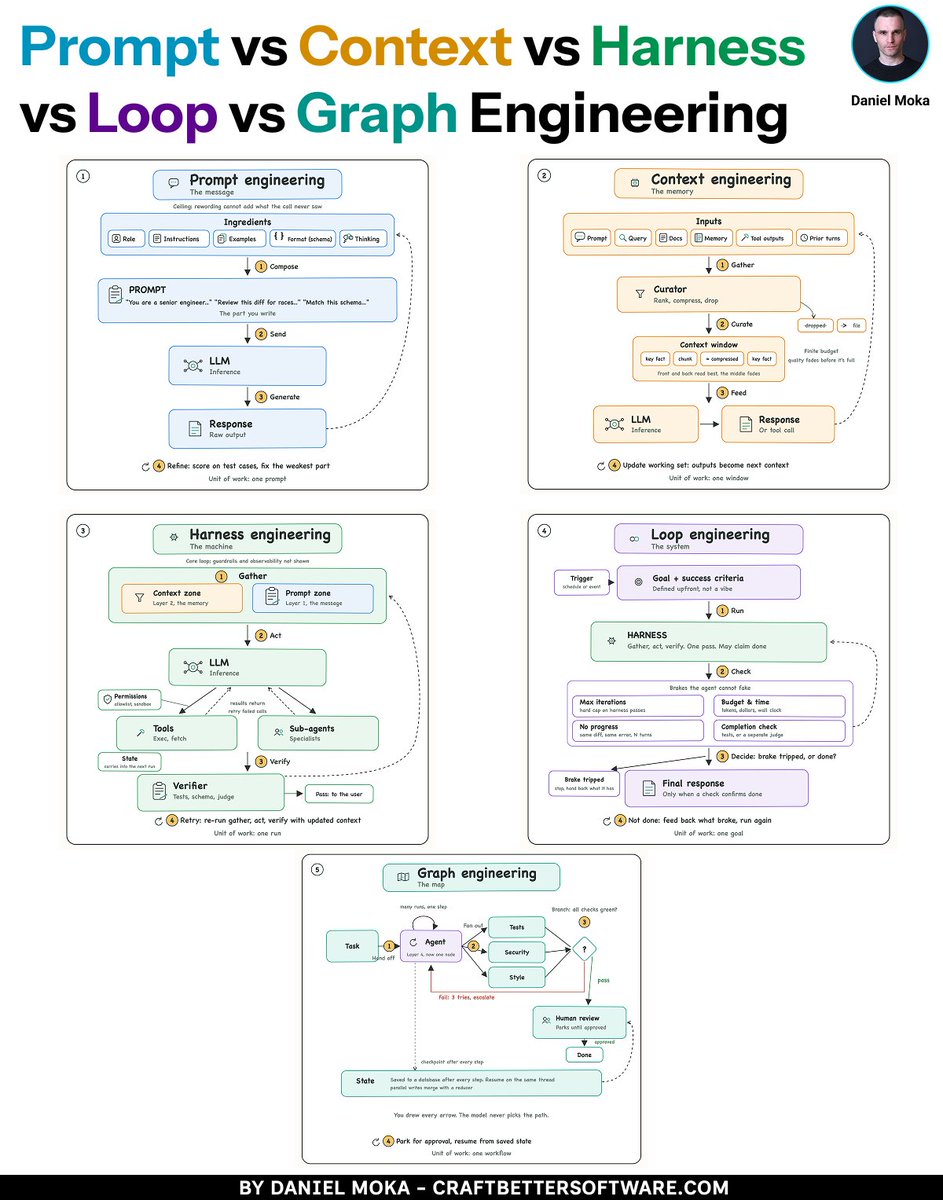
@dmokafa posted (2 likes, 236 views, 3 bookmarks) a compact taxonomy that separated prompt, context, harness, loop, and graph engineering into distinct layers. It was a low-engagement post, but the image was unusually useful because it gave concrete units of work for each layer: one prompt, one window, one run, one goal, and one whole workflow.
Oversight versus authority became a sharper security distinction
@Snowizzie argued (1 like, 216 views, 1 bookmark) that even a well-structured LangGraph flow is not a true security boundary if the same software system still holds the signing key. That distinction did not dominate the timeline numerically, but it sharpened the day’s broader move toward external authority, hardware separation, and evidence-gated approvals.
7. Where the Opportunities Are
[+++] Long-horizon control planes with explicit state, logs, and authority boundaries — DeepSeek Harness, nac, Championswimmer’s enterprise failure thread, and the oversight-versus-authority diagram all point to the same gap: teams need runtimes that separate transient worker context from durable task state, keep model-visible events inspectable, and let sensitive actions terminate in real approval boundaries rather than software theater.
[++] Portable skill packaging and marketplace distribution — Figma skills, ArchiveExplorer’s lab-doc skill pack, and Dannolan’s MCP marketplace demo all show demand for reusable agent behavior that can be authored once, discovered socially, and reused across tools. The opening is not only in publishing and sync, but in auto-invocation, compatibility, and evaluation of what a skill actually changes.
[+] Browser-native project setup and auth automation — Doodlestein’s complaint about Google Cloud setup and the replies about computer-use still needing “yes” clicks show that a lot of friction now sits outside the terminal. There is room for agents that can safely traverse admin consoles, auth flows, and other repetitive setup surfaces without turning every new project into another manual checklist.
8. Takeaways
- Harnesses are now competing as products, not just ideas. DeepSeek and Arcee both launched open-source runtimes for long-running agent work on the same day, but with different answers to the same problem of state, control, and context drift. (DeepSeek, nac)
- Skills are becoming the durable unit of agent capability. Figma moved skills into community publishing, ArchiveExplorer packaged lab manuals into installable workflows, and MCP marketplace use showed that agents are already shopping through tool surfaces instead of waiting for bespoke integrations. (Figma, ArchiveExplorer, dannolan)
- The hardest blocker is often not model quality but the missing system around it. Championswimmer’s thread on enterprise diffusion, Doodlestein’s complaint about console setup, and Harness-IF’s results all pointed to the same issue: teams still need better pipelines, evaluation, and setup tooling around the model. (championswimmer, doodlestein, omarsar0)
- Judgment is valuable, but it is not enough without cost and authority controls. Grok 4.6 earned praise for orchestrator judgment, yet quota exhaustion limited adoption, while lower-signal security discussion insisted that approval only counts when authority is actually separated from the software path. (kunchenguid, Snowizzie)