Twitter AI Agent - 2026-08-17
1. What People Are Talking About
1.1 The moat shifted from agent UI to owning the intelligence and execution surface (🡕)
At least three retained items argued that the next control point is no longer the chat box alone. The conversation moved toward who owns the persistent computer, the hosted repo, the PR loop, and the proprietary knowledge layer that sits behind an agent's output. Compared with August 15 and 16, the harness story widened from runtime design into full-stack platform ownership.
@sonyatweetybird argued (166 likes, 16 replies, 22,722 views, 266 bookmarks) that the AI application race is really a fight for the intelligence layer, and her replies made the claim more concrete by saying proprietary advantage can sit in context, prompting, and post-training, not only in workflow UI.
@leerob described (91 likes, 11 replies, 4,042 views, 35 bookmarks) Grok Bot as a product built around four decisions: text-first UI, a thin client with a thick server harness, an always-on computer instead of per-chat VMs, and browser use alongside code generation. The most useful replies were not about model quality; they were about product constraints such as X sync and paid-plan access.
@XFreeze reported (85 likes, 13 replies, 5,503 views, 11 bookmarks) that Cursor Origin now hosts code itself, with repos, PRs, GitHub sync, CI hooks, and deployment integrations sitting beside the agent. The official Origin page confirms that the code-hosting product is in early beta on paid plans.

Discussion insight: The sharpest reply on Origin was that platform risk did not disappear; it moved. One response said the real shift is that the company building the agent is starting to own the place where the agent works.
Comparison to prior day: August 15-16 treated the harness as the differentiator. August 17 pushed that logic further down-stack into owned compute, hosted repositories, and agent-native execution surfaces.
1.2 Graph engineering moved from slogan to schedulers, typed handoffs, and contradiction graphs (🡕)
The second cluster made graph engineering more operational. The strongest items were not generic “use graphs” posts; they were about DAG scheduling, exposed state transitions, typed handoffs between roles, and preserving conflicts instead of smoothing them away. This was a sharper, more formal version of the graph-first framing already visible on August 16.
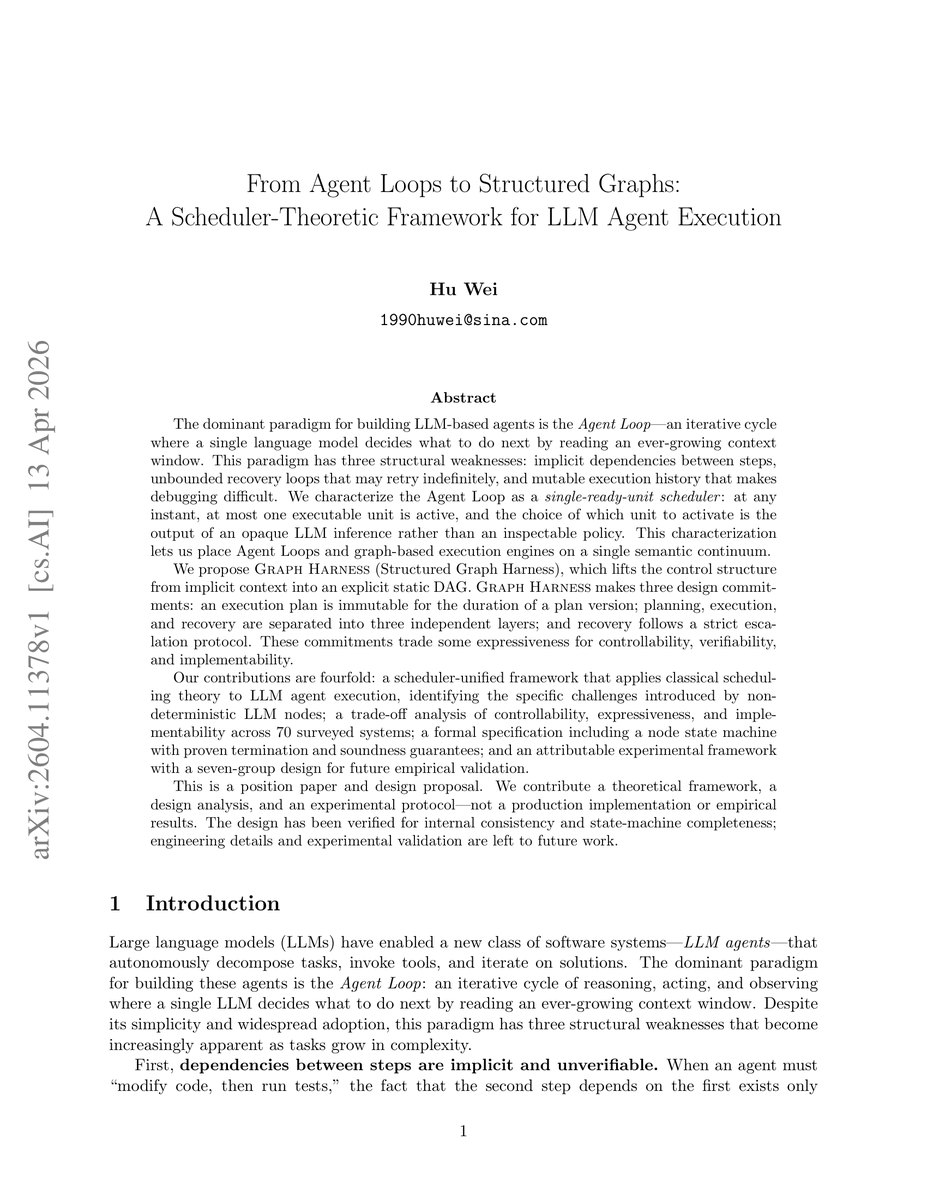
@beamnxw argued (49 likes, 10 replies, 1,903 views, 45 bookmarks) that scheduler theory exposes the weakness of ordinary agent loops, because explicit DAG execution can bound retries and make termination inspectable.
@ridark_eth warned (50 likes, 20 replies, 650 views, 28 bookmarks) that summarizers quietly fabricate consensus when sources disagree, and proposed contradiction edges, root-cause tags, and drop-a-source tests as the fix. The best reply summarized the sentiment cleanly: “If three sources disagree, I want the fight, not the average.”
@LimestoneHQ compiled (18 likes, 3 replies, 3,716 views, 16 bookmarks) a vocabulary sheet for edges, nodes, conditional routing, shared state, and loops, turning graph engineering into a practical operator language rather than a buzzword.

@eng_khairallah1 shared (13 likes, 6 replies, 1,376 views, 18 bookmarks) an Andrew Ng-derived multi-role graph, and the most useful reply said the graph framing works because architect, tech-lead, and developer handoffs have to declare what each step actually needs instead of hiding everything inside one prompt.
Discussion insight: The most valuable replies were about explicit interfaces. People were less interested in “100 agents” than in knowing which node owns what state, what the next step may read, and how contradictions stay visible.
Comparison to prior day: August 16 emphasized graph-first runtime diagrams and backend abstraction. August 17 added formal scheduling, typed handoffs, and disagreement-preserving outputs.
1.3 Skill sprawl and open-model harnesses turned governance into an economic issue (🡕)
A third theme combined ecosystem scale, security, and pricing pressure. The day’s strongest evidence said skills have already sprawled past informal sharing, while open-model coding harnesses are competing on token efficiency, zero-markup access, and secure deployment rather than on closed-model prestige alone.
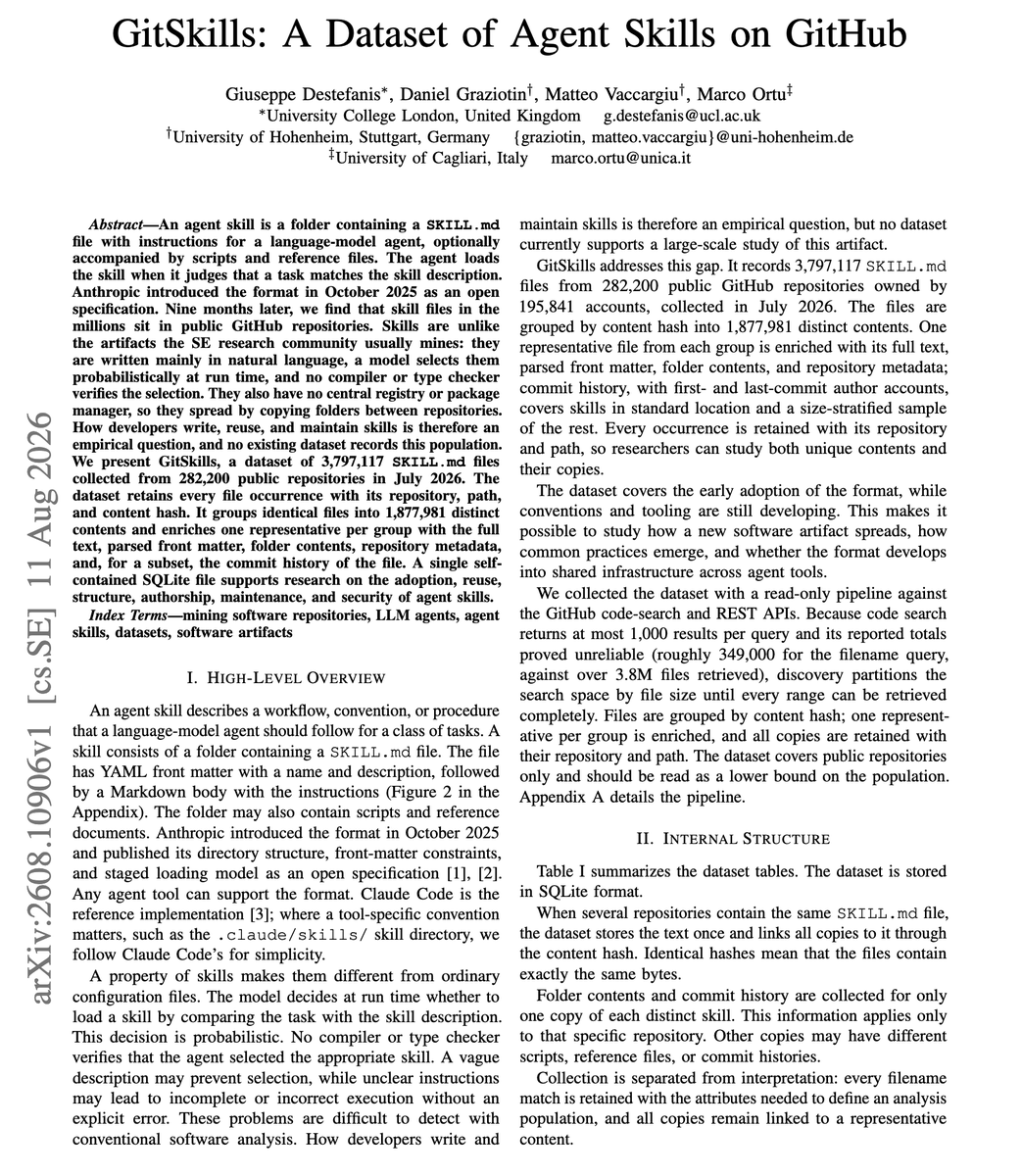
@dair_ai reported (25 likes, 4 replies, 5,283 views, 32 bookmarks) that public GitHub already contains roughly 3.8 million SKILL.md files across 282,200 repositories, with no registry or package manager. Replies immediately compared the situation to pre-registry npm.
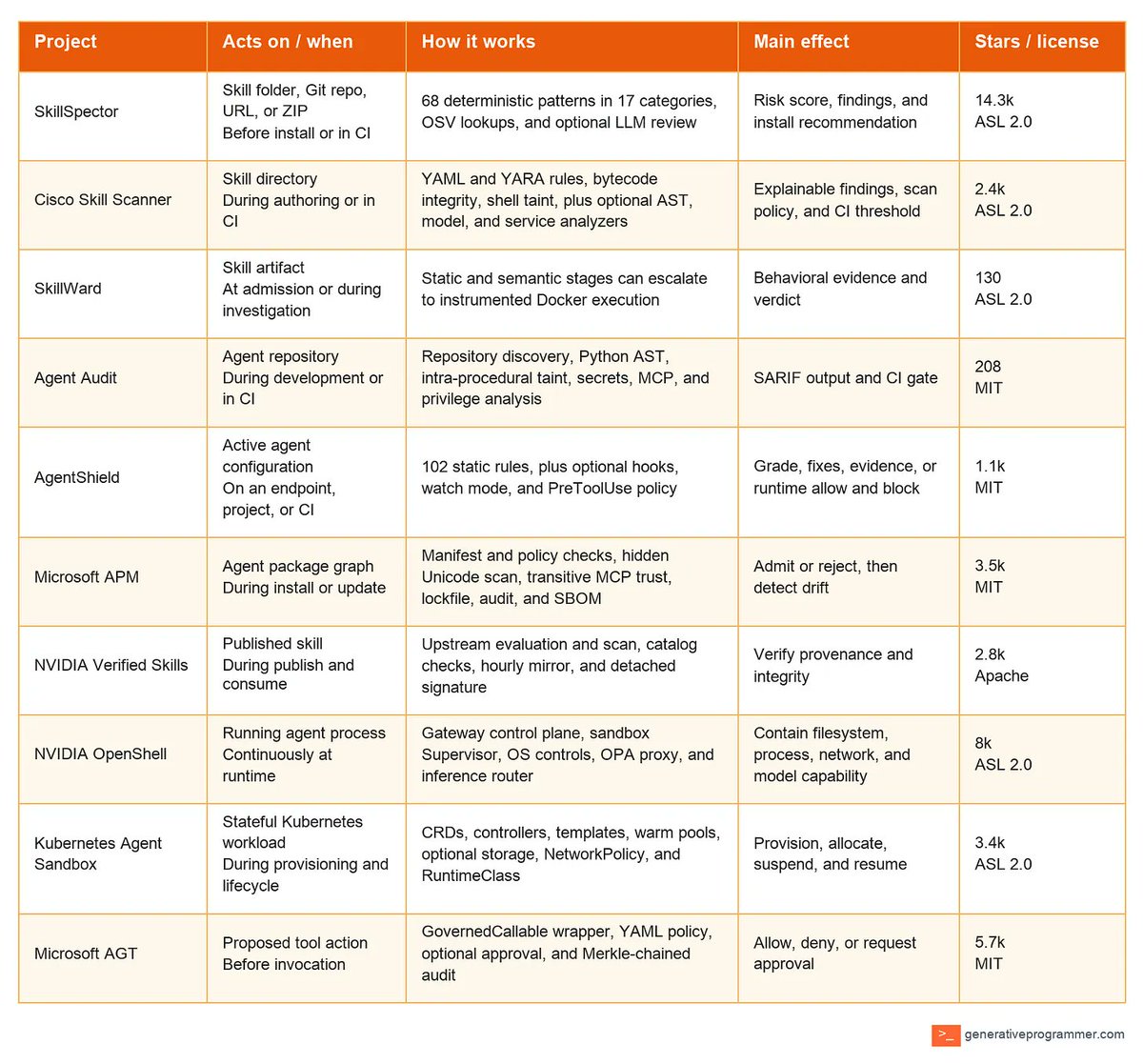
@bibryam compiled (26 likes, 1,717 views, 48 bookmarks) a table of ten open-source skill-security tools. The linked SkillSpector README says it checks 69 vulnerability patterns across 17 categories, while Cisco Skill Scanner explicitly says a clean scan does not prove a skill is safe.
@gideonxqt presented (29 likes, 8 replies, 527 views, 21 bookmarks) Kilo Code as an open-source coding agent with 500+ models, zero markup, and autonomous CI mode. The public Kilo site and repo reinforce the same cross-surface positioning across VS Code, JetBrains, CLI, and cloud agents.
@MrAhmadAwais argued (51 likes, 18 replies, 3,138 views, 6 bookmarks) that Command Code’s open-model harness work — taste learning, tool-call repairs, and cache efficiency — is what made cheaper models competitive. His companion benchmark poster claimed lower overhead and lower token use against other coding-agent setups.

@NorthflankWill summarized (19 likes, 1 reply, 1,359 views, 16 bookmarks) the enterprise version of the same problem: everyone is writing code with agents, that code is untrusted, and customers now want a secure way to deploy it inside their own VPC. Northflank’s public sandboxes page confirms BYOC deployment in customer VPCs, plus observability and CI/CD support.
Discussion insight: Replies tied the whole cluster together: zero-markup access matters because bundled agent pricing hides routing costs, but once teams install more skills and generated code reaches production, cost advantages are only acceptable if they come with scanners, isolation, and review gates.
Comparison to prior day: August 16 treated persistent files and skills as a security surface. August 17 added hard ecosystem counts, public scanner categories, and a visible pricing war around open-model harnesses.
2. What Frustrates People
Agents still smooth over disagreement and hide the reasoning trail
The sharpest frustration was not that agents are too dumb. It was that they often sound too clean. @ridark_eth warned (50 likes, 20 replies, 650 views, 28 bookmarks) that standard summarizers collapse incompatible source claims into a fabricated middle, which deletes the most useful information: why the sources disagree. @beamnxw argued (49 likes, 10 replies, 1,903 views, 45 bookmarks) that the same opacity exists in ordinary agent loops, where the next step is dynamically chosen inside a growing context window instead of by an inspectable schedule. @N01ennn framed (36 likes, 11 replies, 1,111 views, 29 bookmarks) the downstream consequence: most systems can tell you what happened next, but not why a regulated decision was made six months ago. Severity: High. Worth building for: High.
Skills, generated code, and agent memory all reach production before their trust layer does
A second frustration was that the ecosystem is scaling faster than its controls. @dair_ai reported (25 likes, 4 replies, 5,283 views, 32 bookmarks) millions of public SKILL.md files but no registry or package manager, and the replies immediately treated that as governance debt rather than growth. @bibryam compiled (26 likes, 1,717 views, 48 bookmarks) scanner projects precisely because skills are now installable software with prompt-injection, exfiltration, and privilege-escalation risk; the public SkillSpector and Cisco Skill Scanner READMEs both reinforce that automated scanning is best-effort, not proof of safety. @NorthflankWill summarized (19 likes, 1 reply, 1,359 views, 16 bookmarks) the enterprise version: everyone is writing untrusted code, and customers now want secure deployment inside their own VPC. Even low-volume practitioner guidance from @pvergadia argued (1 like, 223 views) that tenant isolation, IAM scope, encryption, and workload-shaped compute choices have to be made on day one rather than retrofitted later. Severity: High. Worth building for: High.
Agentic commerce still lacks a durable proof-of-intent package
The third frustration was that payment completion is easier to prove than user intent. @neviannn argued (39 likes, 3 replies, 1,886 views, 35 bookmarks) that the real gap in agentic payments is not technical execution but auditability: policy decisions, approvals, budget checks, signed execution, and immutable logs have to travel together as an evidence package. The strongest reply made the standard even clearer by calling that package the minimum viable authority record for moving beyond consumer experiments. The same concern reappeared in @N01ennn describing (36 likes, 11 replies, 1,111 views, 29 bookmarks) memory systems that can reconstruct which data, policies, and relationships led to a decision. People are not just asking whether an agent can act; they are asking whether the action can later survive dispute, audit, and compliance review. Severity: Medium to High. Worth building for: High.
3. What People Wish Existed
A real registry, package manager, and trust layer for agent skills
The clearest ecosystem-level gap was not another skill marketplace. It was the lack of basic packaging and trust infrastructure. @dair_ai reported (25 likes, 4 replies, 5,283 views, 32 bookmarks) that skills already number in the millions while still spreading by copied folders, and the replies explicitly compared the current moment to pre-registry npm. @bibryam compiled (26 likes, 1,717 views, 48 bookmarks) ten projects trying to bolt on scanning, admission control, sandboxing, and governance after the fact. This is a direct need because the ecosystem already exists; what is missing is the package, trust, and upgrade machinery around it. Opportunity: direct.
Agent-native workspaces that own compute, code, and review without hiding control boundaries
People also want persistent workspaces where the agent lives beside the code and keeps operating without forcing users to stitch five surfaces together. @leerob described (91 likes, 11 replies, 4,042 views, 35 bookmarks) always-on bot computers with browser access, while @XFreeze reported (85 likes, 13 replies, 5,503 views, 11 bookmarks) Cursor Origin as a host for repos, PRs, checks, and deploys. The catch is that the replies were already talking about new forms of lock-in and shifted platform risk, which makes this a competitive rather than greenfield need. Opportunity: competitive.
Memory that can prove why, not just remember what happened
The strongest wish around memory was for provenance, not bigger context windows. @N01ennn described (36 likes, 11 replies, 1,111 views, 29 bookmarks) a graph-native layer where every fact, decision, and policy hit remains queryable later, and the public Semantica repo makes the same promise with deterministic reasoning and PROV-O audit trails. @ridark_eth argued (50 likes, 20 replies, 650 views, 28 bookmarks) for contradiction-preserving summaries for the same reason: useful systems must keep the messy evidence, not just the final wording. This is a practical need for regulated or high-stakes use, and it is still early enough to feel direct. Opportunity: direct.
Open-model coding agents with transparent economics instead of bundled mystery pricing
A fourth need was transparent access to many models without hidden routing markup. @gideonxqt presented (29 likes, 8 replies, 527 views, 21 bookmarks) Kilo Code as a zero-markup, 500-plus-model coding agent, and @MrAhmadAwais argued (51 likes, 18 replies, 3,138 views, 6 bookmarks) that harness engineering is what lets cheaper open models compete with premium closed ones. The demand is practical, but the space is already competitive because multiple harnesses are now racing on price transparency, cache efficiency, and workflow quality. Opportunity: competitive.
4. Tools and Methods in Use
| Tool | Category | Sentiment | Strengths | Limitations |
|---|---|---|---|---|
| Grok Bot | Cloud agent computer | (+/-) | Text-first UI, thin client / thick server split, persistent computer, browser automation, repeatable task recording | Access gated to Cursor Ultra or SuperGrok Heavy; replies flagged X sync issues and product rough edges |
| Cursor Origin | Agent-native code hosting | (+/-) | Repos, PRs, GitHub sync, code browsing, CI/deploy hooks, official early beta for paid users | Early beta; platform risk shifts from GitHub dependency to Cursor-owned infrastructure |
| Kilo Code | Open-source coding agent | (+) | 500+ models, zero-markup pricing, VS Code/JetBrains/CLI coverage, autonomous CI mode, MCP marketplace | Broad model choice increases configuration complexity; autonomous mode still needs policy boundaries |
| Command Code | Open-model coding harness | (+/-) | Taste learning, tool-call repairs, transport-agnostic design, aggressive cache efficiency, low-cost model plans | Still vendor-owned; tweet itself says some models still fail due to API or config quirks |
| SkillSpector | Skill security scanner | (+) | 69 vulnerability patterns across 17 categories, repo/URL/zip scanning, risk scores, verified-skills pipeline | Two-stage scan is still best-effort; passing scan is not proof of safety |
| Cisco Skill Scanner | Skill security scanner | (+) | Static, behavioral, semantic, and SARIF-ready scanning; pre-commit and CI integration | README explicitly warns that “no findings” does not mean no risk |
| Semantica | Provenance / graph memory layer | (+) | Deterministic reasoning, W3C PROV-O provenance, audit trails, graph-native context, regulated-environment fit | Adds ontology / graph complexity; explains system inputs and decisions, not model internals |
| Oh My Hermes | Workflow operating layer | (+) | Skill integrations, model-aware routing, sub-agent orchestration, memory pruning, stronger TUI/operator UX | Beta-stage packaging on top of another harness; value depends on Hermes adoption |
| Northflank Sandboxes | Secure deployment / VPC runtime | (+) | Bring-your-own-cloud deployment, VPC control, multi-region APIs, observability, CI/CD, GPU support | Adds infra and governance work rather than removing it; aimed at teams already operating production environments |
Overall, the tool stack split into four visible layers: persistent execution surfaces (Grok Bot, Cursor Origin), open-model coding harnesses (Kilo Code, Command Code), trust and governance layers (SkillSpector, Cisco Skill Scanner, Northflank), and provenance-heavy memory layers (Semantica, Oh My Hermes in a lighter workflow form). Migration pressure ran in parallel: from GitHub-adjacent agents toward agent-native code hosts, from premium bundled model plans toward transparent open-model pricing, and from install-now skill usage toward scan-first or VPC-isolated deployment. The common workaround across the whole set was to make boundaries explicit - who owns the computer, who owns the repo, what gets scanned, and what evidence survives after the run.
5. What People Are Building
| Project | Who built it | What it does | Problem it solves | Stack | Stage | Links |
|---|---|---|---|---|---|---|
| Cursor Origin | Cursor team, surfaced by @XFreeze | Agent-native code hosting with repos, PRs, GitHub sync, checks, and deploy integrations | Removes the split between coding agent, repository host, and execution surface | Hosted code platform, PR workflows, CI/deploy integrations | Beta | post / site |
| Kilo Code | Kilo team via @gideonxqt | Open-source coding agent across VS Code, JetBrains, CLI, and cloud surfaces | Gives teams cheaper, broader model access without per-token markup | TypeScript, multi-model routing, IDE extensions, CLI, cloud agents | Shipped | post / repo |
| Command Code | Command Code team via @MrAhmadAwais | Coding-agent harness optimized for open models, cache use, and tool-call recovery | Makes weaker or cheaper models usable for real coding workflows | Open-model APIs, harness routing, cache optimization, tool repair loops | Shipped | post / site |
| Semantica | Semantica team via @N01ennn | Graph-native memory and provenance layer for agent systems | Lets teams reconstruct why an agent acted, not just what it stored | Knowledge graphs, SPARQL, SHACL, PROV-O, deterministic reasoning | Alpha | post / repo |
| GitSkills | DAIR.AI authors via @dair_ai | Dataset and paper mapping public SKILL.md usage across GitHub |
Quantifies skill sprawl and the lack of packaging / registry infrastructure | GitHub mining, dataset curation, paper analysis | RFC | post / paper |
| SkillSpector | NVIDIA researchers, surfaced by @bibryam | Vulnerability scanner for AI agent skills | Detects prompt-injection, exfiltration, and unsafe capability patterns before install | Python, rule engine, risk scoring, verified-skills pipeline | Alpha | post / repo |
| Oh My Hermes | @rlaope | Operator layer over Hermes with workflow routing, skill use, memory controls, and TUI improvements | Packages a raw agent harness into something easier to run and supervise | Hermes, TUI, routing logic, memory handling, skill integrations | Beta | post / repo |
| Northflank Sandboxes | Northflank team via @NorthflankWill | Isolated runtime for building and deploying AI-generated code in customer-controlled cloud environments | Gives enterprises a way to run untrusted agent output inside VPC and policy boundaries | BYOC, VPC isolation, CI/CD, observability, GPU workloads | Shipped | post / site |
Cursor Origin and Grok Bot pointed to the same build pattern: agent vendors are trying to own the whole execution surface, not just model access. Kilo Code and Command Code showed the counter-move from the open-model side, where the differentiator is cost discipline plus harness quality rather than premium branding. Semantica, GitSkills, SkillSpector, and Northflank were all downstream reactions to scale: once skills proliferate and generated code reaches production, teams start building provenance, scanning, and isolation layers around the agent itself. Oh My Hermes fit a smaller but recurring pattern as well - wrapping raw agent frameworks in operator tooling that makes routing, memory, and supervision usable day to day.
6. New and Notable
AWS-style evidence packages for agent payments
@neviannn highlighted (39 likes, 3 replies, 1,886 views, 35 bookmarks) an AWS governance blueprint for AI agent payments that centers on evidence packages rather than model capability. The useful novelty was the specificity: policy decision, approval, budget check, signed execution, and immutable log were presented together as the minimum record needed to defend a disputed action.

Oh My Hermes packaged raw harness power into an operator-facing beta
@rlaope announced (24 likes, 3 replies, 1,690 views, 21 bookmarks) Oh My Hermes as a beta layer over Hermes with workflow routing, model-optimized harnesses, sub-agent orchestration, memory pruning, and a stronger TUI. The public repo made it notable because it was not pitched as another model wrapper; it was pitched as packaging proven agent-engineering patterns into something operators can actually run.

Enterprise agentic SaaS guidance is already focusing on tenant isolation and IAM scope
@pvergadia argued (1 like, 223 views) that multi-tenant SaaS with agents fails first on isolation, workload shape, and security scope rather than on model choice. Even with low engagement, the attached slides were unusually concrete about tenant memory boundaries, IAM scoping, encryption posture, VPC isolation, and choosing between Lambda, ECS, and EKS for spiky agent workloads.

7. Where the Opportunities Are
[+++] Skill registry with built-in security admission control — Evidence came from the hard-count GitSkills paper, the lack-of-registry complaint in its replies, and the parallel rise of scanners such as SkillSpector and Cisco Skill Scanner. The opportunity is strong because the ecosystem is already large, the failure modes are already understood, and the current workflow is still copy folders first, scan later.
[+++] Provenance and evidence packages for agent decisions and payments — Semantica, the AWS-style payment blueprint, and contradiction-preserving summary demands all pointed at the same missing layer: systems that can later prove which evidence, policies, and approvals produced an action. This is strong because it showed up in both commerce and general memory infrastructure, not in a single niche.
[++] Enterprise-safe agent workspaces and deployment boundaries — Grok Bot, Cursor Origin, Northflank, and the AWS / SaaS governance posts all revolved around the same operational question: where does the agent run, where does its memory live, and who controls the cloud boundary? This is moderate because vendors are already moving aggressively, but the control and compliance problems are still visibly unsettled.
[+] Graph-native QA layers that preserve conflict instead of averaging it away — The graph-engineering cluster, especially scheduler theory and contradiction edges, suggested room for tooling that checks agent outputs for hidden consensus collapse, missing sources, or invalid handoffs. The signal is earlier than the governance themes, but it was reinforced by multiple technically specific posts rather than by hype alone.
8. Takeaways
- The control point is moving below the chat surface. Grok Bot and Cursor Origin both framed advantage around persistent computers, hosted repos, and owned execution surfaces rather than prompt UX alone. (source, source)
- Graph engineering got more operational today. The strongest posts focused on schedulers, typed handoffs, and contradiction-preserving summaries, not generic multi-agent enthusiasm. (source, source, source)
- Skills have already outgrown informal sharing. GitSkills quantified the scale, and the scanner ecosystem shows the security debt created by copy-first distribution. (source, source)
- Auditability is becoming a product requirement, not an enterprise afterthought. The day linked payment governance, provenance-heavy memory, tenant isolation, and VPC deployment into one trust stack. (source, source, source)
- Open-model coding agents are competing on harness quality and economics. Kilo Code and Command Code both argued that routing, cache efficiency, and repair logic can make cheaper models viable enough to change buyer behavior. (source, source)