Twitter AI Agent - 2026-08-18
1. What People Are Talking About
1.1 Context stopped being “chat history” and became a managed asset (🡕)
At least four retained items treated context as the real product surface. The conversation was less about getting a smarter answer from one prompt and more about where company memory lives, how it carries across models, and how much risk comes with centralizing it. Compared with August 17's emphasis on persistent computers and repo hosting, August 18 drilled deeper into the machinery of shared context itself.
@rauchg argued (1,070 likes, 52 replies, 79,797 views, 498 bookmarks) that the “software factory” should be a monorepo so design, marketing, sales, engineering, and support context all sit in one place for agents to build on. The thesis was not about code organization for humans alone; it was about making the full company operating context legible to agent systems. The sharpest reply immediately supplied the counterweight: the blast radius grows with the benefit when a confused or misprompted agent can see everything.
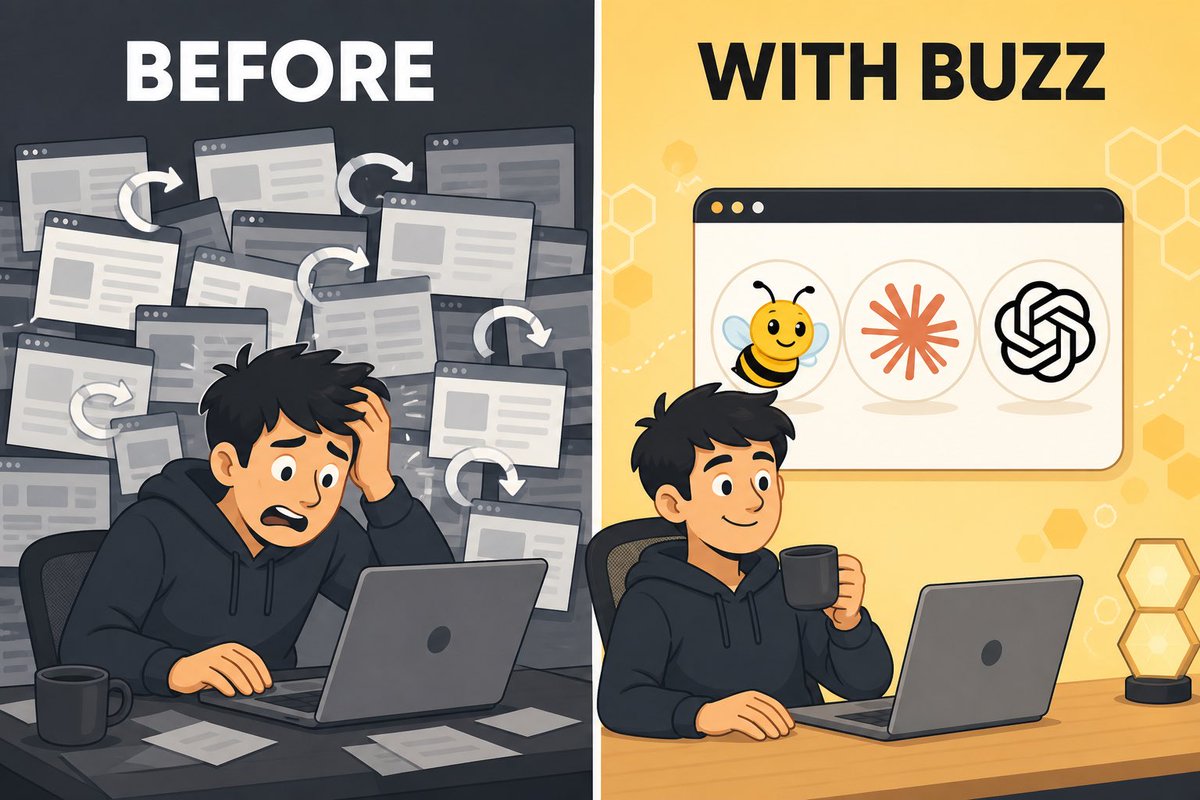
@MichaelLevin reported (42 likes, 6 replies, 17,377 views, 33 bookmarks) that Buzz solved one of his biggest frictions by letting multiple agents and subscriptions share one conversation, so a task could continue even when he switched the same agent from Claude to GPT midstream. His more important point was negative: long-running work still needed babysitting, with roughly a dozen recent status nudges because interrupted tasks did not reliably resume themselves. That moved the discussion from “shared chat” to durable task state, checkpoints, and visible agent status.
@tom_doerr shared (16 likes, 1 reply, 3,396 views, 22 bookmarks) Potpie as a “living context graph” for codebases, and the public repo/site make the claim concrete: it indexes code, source history, decisions, team knowledge, and workflows so agents can resolve tasks against project-specific context rather than a bare checkout. This mattered because it reframed context as a queryable graph product, not just a longer prompt or bigger memory file.

@milesdeutscher shared (81 likes, 23 replies, 15,276 views, 98 bookmarks) a migration prompt that tells Claude Code or Codex to package skills, memory files, recurring workflows, and business context into role-ready markdown for Grok Bot swarms. The most useful replies did not challenge the desire to move context; they asked whether the roles stay coherent once multiple agents share one profile document, and whether the economics change when the billing model flips.
Discussion insight: The replies kept distinguishing “having more context” from “knowing who can use it, when, and with what blast radius.” Shared conversation, monorepos, and role packs all looked useful, but the trust and synchronization problems became more explicit than the convenience story.
Comparison to prior day: August 17 said the control point was moving below the chat UI into owned computers and hosted repos. August 18 extended that argument into shared memory, context graphs, and reusable role/context packs that can outlive a single session or provider.
1.2 New agent products increasingly wrapped existing runtimes instead of replacing them (🡕)
The day’s clearest launches were not giant all-in-one reinventions. They were wrappers, sidecars, and minimal runtimes: a tiny embeddable harness, a desktop surface on top of Goose, a 24/7 assistant built on Claude Code, and a Google lifecycle tool meant to teach existing coding agents how to build and deploy agents. The build pattern was compositional rather than monolithic.
@vercel_dev introduced (347 likes, 21 replies, 37,679 views, 202 bookmarks) fx as a tiny open native coding-agent harness in Zig. The public repo adds the important specifics missing from the tweet’s launch framing: skills, MCP, ACP, experimental WebAssembly embedding, and a CLI that aims to feel more like a Unix shell than an IDE in the terminal. Replies made the architectural implication explicit: when the runtime is light enough for sandboxes and spawned sub-agents, model choice becomes a runtime dial instead of a product lock-in.
@TFTC21 reported (60 likes, 7 replies, 19,113 views, 43 bookmarks) that Block open sourced Berd, the desktop application its teams use to work with agents across projects, skills, tools, and models. Public docs show Berd talking to Goose through ACP, leaving the agent loop to Goose while the desktop app handles projects, sessions, providers, and context. That is a clean separation between runtime and work surface, not another hidden monolith.
@DanKornas shared (5 likes, 2 replies, 871 views, 9 bookmarks) Friday, a 24/7 assistant built on Claude Code CLI plus Telegram, a Flask memory server, SQLite, scheduled jobs, and MCP plugins. The repo is notable because it explicitly rejects extra framework layers: Claude Code is the runtime, and the builder adds memory, channels, and cron around it instead of inventing a separate orchestration engine.

@akshay_pachaar mapped (27 likes, 2 replies, 4,007 views, 38 bookmarks) Google’s Agents CLI plus Agent Runtime as a single natural-language path from setup to build, deploy, govern, evaluate, and publish. Google’s public docs largely match the post and add the enterprise pieces—Terraform, Cloud Build, IAM, VPC-SC, and a managed runtime—which reinforced the same pattern: use a thin lifecycle layer that makes an existing coding agent better at agent work.
Discussion insight: The strongest replies were about separation of concerns. People were not just celebrating more tools; they were noticing which layer owned the loop, which layer owned the UI, which layer owned deployment, and how much of that stack could remain model-agnostic.
Comparison to prior day: August 17’s harness conversation focused on open-model economics and platform ownership. August 18 pushed that further into concrete release patterns: lighter runtimes, explicit sidecars, and public wrapper layers around existing agent cores.
1.3 The bottleneck moved from agent capability to verification, governance, and cost control (🡕)
Several of the strongest posts argued that model quality is no longer the whole story. The harder problem is how agents get approved, monitored, resumed, and paid for once they leave the demo. The result was a much more operational conversation than the day before.
@businessbarista argued (20 likes, 10 replies, 3,612 views, 42 bookmarks) that enterprise vibecoding fails when companies choose either blanket enablement or blanket denial. His six-step “Citizen SDLC” replaced that false choice with discovery, request, triage, provisioning, build, and run/change stages, all designed to keep non-engineers productive without leaving IT to absorb unlimited security and review risk. The replies were simple but telling: sanctioned rails and named owners matter more than pretending shadow AI will not happen.
@michaelzixizhou announced (39 likes, 15 replies, 73,648 views) Codag as a compression and control layer for agent tools, and the YC page clarifies the point: compress tool results before the model reads them, report tool and MCP usage, and measure spend and savings at the tool path itself. The most useful reply translated the pitch into everyday pain: agents often waste most of their window on raw stdout and logs before reasoning ever starts.
@mardehaym argued (22 likes, 9 replies, 1,070 views, 12 bookmarks) that “adoption is easy, transformation is not,” and his attached slide sharpened the claim by naming the three recurring stall points: scattered context, unchanged processes, and output that nobody can verify quickly. His core comparison was blunt but persuasive: engineering transformed first because tests can say pass or fail in seconds; most other functions still lack that feedback loop.

Discussion insight: Across enterprise posts, the shared demand was not for more “AI seats.” It was for gates, checkpoints, searchable artifacts, and bounded ways to decide whether an agent run is working, waiting, blocked, or too expensive.
Comparison to prior day: August 17’s governance cluster emphasized skill scanners, VPC isolation, and deployment boundaries. August 18 widened the control question into request pipelines, verification loops, and per-tool cost visibility across the full agent workflow.
2. What Frustrates People
Durable delegation still needs babysitting, visibility, and bounded resume
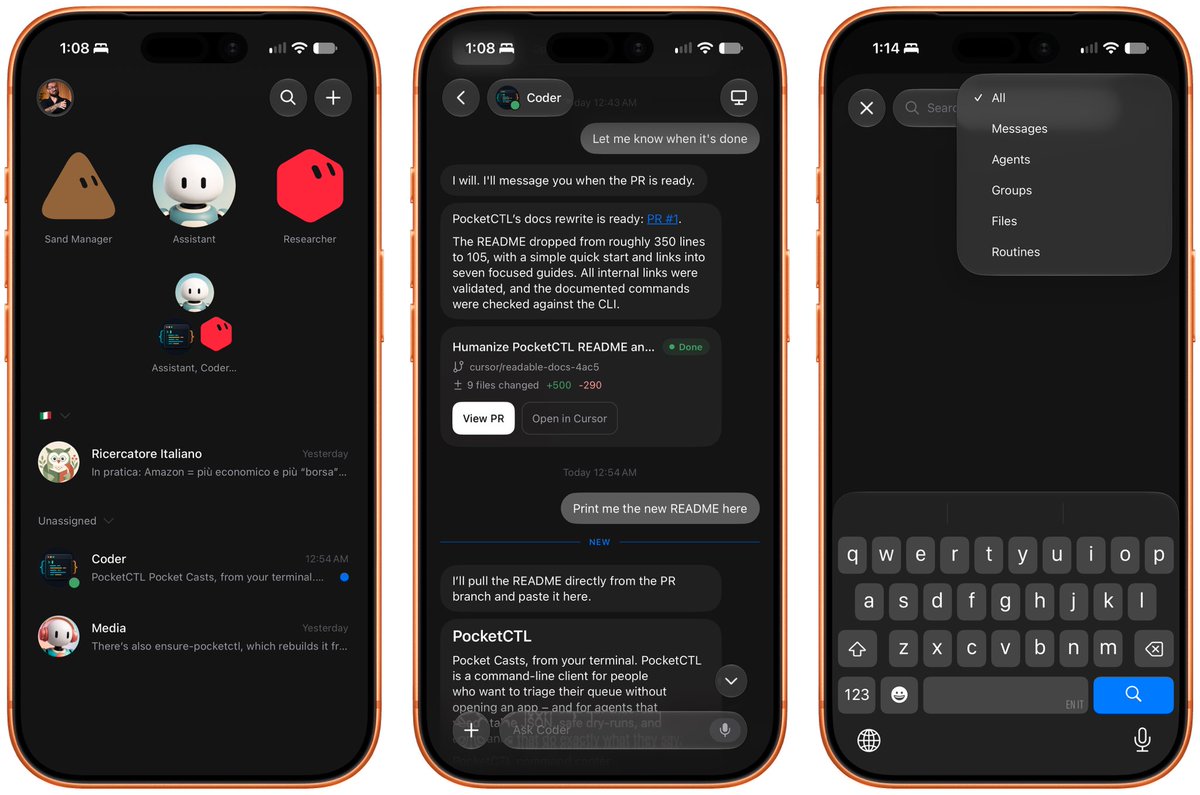
The recurring frustration was not that agents cannot do useful work. It was that people still do not trust them to keep going correctly once they step away. @MichaelLevin reported (42 likes, 6 replies, 17,377 views, 33 bookmarks) that Buzz solved shared context better than his earlier flows, but still left him sending roughly a dozen status nudges because interrupted work did not reliably resume. @milesdeutscher shared (81 likes, 23 replies, 15,276 views, 98 bookmarks) a Grok Bot migration prompt, and the replies immediately asked about context drift and how multiple agents behave when they all read the same profile document. @viticci reported (62 likes, 9 replies, 5,108 views, 30 bookmarks) that Grok Bot on iOS feels fresh and well executed, but hiding tool calls and offering no model picker made the process harder to trust; replies pushed the concern further by noting that separate bot instructions still sit on top of one persistent filesystem. People cope today by staying in a shared conversation, manually checking progress, and keeping a human approval loop in place. Severity: High. Worth building for: High.
Enterprise rollout breaks where context, ownership, and verification stay vague
A second frustration was that “installing AI” is not the same as changing how work happens. @businessbarista argued (20 likes, 10 replies, 3,612 views, 42 bookmarks) that blanket approval creates security debt while blanket denial just drives shadow AI, so every serious rollout needs explicit request, triage, provisioning, and ownership rails. @mardehaym argued (22 likes, 9 replies, 1,070 views, 12 bookmarks) that most rollouts stall because context stays scattered across tools, processes stay unchanged, and nobody can verify AI output quickly enough to remove manual review. Even the more optimistic infrastructure post from @akshay_pachaar mapped (27 likes, 2 replies, 4,007 views, 38 bookmarks) the same requirement into cloud lifecycle terms: govern, evaluate, publish, and observe are first-class stages, not cleanup steps. The coping strategy today is to force named owners, approval checkpoints, and test-like verification into the workflow before broader autonomy is allowed. Severity: High. Worth building for: High.
Raw tool output and scattered project memory waste tokens before reasoning even starts
The third frustration was quieter but highly specific: agents burn budget on junk context. @michaelzixizhou announced (39 likes, 15 replies, 73,648 views) Codag as a compression and control layer because searches, tests, builds, logs, and API responses often reach the model as repetitive raw output; one reply described sessions where roughly 80% of the window disappears into stdout and stderr before real reasoning begins. @tom_doerr shared (16 likes, 1 reply, 3,396 views, 22 bookmarks) Potpie precisely because a bare code checkout is not enough: agents need decisions, history, and workflow context, not just files. The best pushback under @rauchg arguing (1,070 likes, 52 replies, 79,797 views, 498 bookmarks) for the monorepo made the same point from another angle: centralizing context is easy compared with keeping it current and scoped correctly. The current workaround is to compress, index, or graph the context before the model sees it. Severity: Medium to High. Worth building for: High.
3. What People Wish Existed
A unified agent workspace that keeps context portable but boundaries visible
The clearest day-to-day wish was not for one more model. It was for one place to run many of them without losing control. @MichaelLevin reported (42 likes, 6 replies, 17,377 views, 33 bookmarks) that shared conversation context across models is already useful, but durable task state, checkpoints, and visible status are still missing. @viticci reported (62 likes, 9 replies, 5,108 views, 30 bookmarks) that Grok Bot needs a tool-call toggle and model picker even while its mobile UX feels novel. A low-engagement but unusually concrete prototype from @piotr_jura showed (3 likes, 22 views) exactly what power users seem to want: one native app across macOS and iPhone, multiple harnesses and worktrees, inspectable reviews, and explicit model choice. Existing products partially address this, but the control-boundary problem is still unresolved. Opportunity: competitive.

Enterprise-safe rails for citizen builders
People are not asking for less autonomy in the abstract. They are asking for safer paved roads. @businessbarista argued (20 likes, 10 replies, 3,612 views, 42 bookmarks) that enterprises need a full request-to-run pipeline for non-engineers rather than a yes/no policy. @mardehaym argued (22 likes, 9 replies, 1,070 views, 12 bookmarks) that the missing ingredient is verifiability, not seat count. @akshay_pachaar mapped (27 likes, 2 replies, 4,007 views, 38 bookmarks) a cloud-native version of the same need with govern, evaluate, publish, and observe as explicit stages. This is a practical need with immediate budget, compliance, and ownership consequences. Opportunity: direct.
Context-control infrastructure around tool outputs and artifacts
A third need was for infrastructure that decides what the model should actually read. @michaelzixizhou announced (39 likes, 15 replies, 73,648 views) Codag as a way to compress tool results before the model pays to process them, while also exposing usage and spend across tools and MCP servers. @tom_doerr shared (16 likes, 1 reply, 3,396 views, 22 bookmarks) Potpie as a living context graph precisely because raw files do not preserve decisions, history, and workflow structure. What people seem to want is not only “more memory,” but a control layer that filters, ranks, compresses, and explains what made it into context. Opportunity: direct.
Memory that remembers the right thing instead of just remembering more
The strongest memory wish was for durable systems that improve across sessions without turning into blind accumulation. @milesdeutscher shared (81 likes, 23 replies, 15,276 views, 98 bookmarks) a migration prompt that turns skills, preferences, and recurring workflows into portable role docs. @DanKornas shared (5 likes, 2 replies, 871 views, 9 bookmarks) Friday as a Claude Code-based assistant with a Flask + SQLite memory server, scheduled reflection, and MCP-linked external tools. The practical need is not infinite recall; it is selective recall that survives sessions, stays explainable, and feeds the next task without forcing the user to rebuild context from scratch. Opportunity: direct.
4. Tools and Methods in Use
| Tool | Category | Sentiment | Strengths | Limitations |
|---|---|---|---|---|
| bot / Grok Bot | Multi-agent cloud workspace | (+/-) | Agent-based organization, group chats, persistent Linux VM, strong mobile UX, cloud-agent handoff | Hidden tool calls, no model picker, shared-filesystem trust questions, unclear context boundaries |
| Buzz | Shared-context multi-model workspace | (+/-) | Keeps multiple subscriptions in one room, preserves context across model switches, supports adversarial review across agents | Long-running delegation still needs babysitting; status, resume, and failover are not durable enough yet |
| Berd | Desktop agent workspace | (+) | Persistent projects, context legibility, multi-model/harness workflow, approachable design, ACP link to Goose | Early-stage open-source app; depends on provider setup and Goose sidecar/runtime |
| fx | Lightweight harness / CLI | (+) | Native Zig binary, low-overhead runtime, provider agnosticism, embeddable ACP/WASM surfaces, shell-like UX | Experimental and intentionally minimal; narrower workflow surface than heavier agent environments |
| Potpie | Context graph / SDLC layer | (+) | Indexes code, history, decisions, and workflows; gives agents project-specific context; CLI-first and harness-aware | Adds setup, daemon, and graph-maintenance overhead; another layer teams must keep healthy |
| Codag | Tool-output compression / control layer | (+) | Shrinks tool results before model ingestion, measures tool and MCP usage, exposes spend/savings across providers | Launch-stage product; controls one failure layer, not planning or verification by itself |
| Agents CLI + Agent Runtime | Governed deployment lifecycle | (+/-) | Scaffolding, evals, deploy, publish, observability, managed runtime, IAM and VPC-aware security | Strongly Google Cloud-shaped; brings meaningful infrastructure and process overhead |
| Entire | Git-native session checkpointing | (+) | Stores prompts, transcripts, and files-touched metadata alongside commits, resumable checkpoints, clean main branch | Requires teams to adopt hooks and metadata discipline around agent sessions |
Overall, satisfaction rose when the tool made boundaries visible or context reusable, and dropped when it hid action traces or assumed a cloud/process model users had to reverse-engineer. The clearest workaround pattern was composition: Berd wraps Goose, Agents CLI teaches existing coding agents, Entire attaches itself to Git, and Friday wraps Claude Code with memory and cron rather than replacing the runtime. Migration pressure ran from scattered chats toward persistent workspaces, and from raw tool output toward compression, checkpoints, and context graphs. On the enterprise side, methods like Citizen SDLC and fast verification loops showed that tool choice alone is not enough without ownership and review rails.
5. What People Are Building
| Project | Who built it | What it does | Problem it solves | Stack | Stage | Links |
|---|---|---|---|---|---|---|
| fx | Vercel Labs via @vercel_dev | Tiny native coding-agent harness and CLI for direct use or embedding | Gives developers a lighter, model-agnostic runtime for sandboxes, benchmarks, and larger agent systems | Zig, AI Gateway, skills, MCP, ACP, WebAssembly | Alpha | post / repo / site |
| Berd | Block team via @TFTC21 and @morganmartn | Desktop workspace for working with agents across projects, skills, tools, and models | Reduces fragmented interfaces, provider setup, and context handling around existing runtimes | Tauri 2, React 19, Goose, ACP | Beta | post / repo / design |
| Potpie | Potpie team via @tom_doerr | Living context graph for codebases and SDLC workflows | Gives agents project-specific history, decisions, and workflow context instead of a bare checkout | Python CLI, daemon, graph explorer, GitHub and docs integrations, harness skills | Shipped | post / repo / site |
| Codag | Michael Palmer via @michaelzixizhou | Compression and control layer for agent tool output | Cuts context bloat and exposes tool/MCP usage, latency, and spend across agents | Tool wrappers, reducer pipeline, analytics, policy layer | Shipped | post / YC / site |
| Friday | missingus3r, surfaced by @DanKornas | 24/7 personal AI assistant built around Claude Code and Telegram | Adds persistent memory, scheduled jobs, and external tool access without inventing a custom runtime | Claude Code CLI, Telegram MCP, Flask, SQLite, Notion MCP, ElevenLabs, cron | Alpha | post / repo |
| Entire | Entire team, surfaced by @rseroter | Git-native session capture and checkpointing for AI coding sessions | Preserves prompts, transcripts, and touched files as team-visible metadata without polluting the main branch | Git hooks, checkpoint branch, CLI, worktree support | Shipped | post / repo / blog |
fx and Berd showed opposite but complementary strategies. fx strips the harness down until it is small enough to embed anywhere, while Berd adds a cleaner desktop surface around an external runtime so people can keep projects, providers, and context in one place. Friday pushed the same compositional pattern from the solo-builder side: keep Claude Code as the runtime, then add memory, channels, and scheduling around it.
That design emphasis was explicit in @morganmartn describing (70 likes, 6 replies, 33,807 views, 29 bookmarks) Berd as a workspace meant to feel approachable for non-engineers and worth opening every day, not just another technically capable wrapper.
Potpie, Codag, and Entire all fit a second build pattern: they are not trying to be the agent itself. They are products for the layers around it - context graphs, tool-output compression, and checkpointed session history. That is a strong sign that the surrounding infrastructure is becoming its own market, not just implementation detail.
A more promotional but still useful artifact came from @jack_9947 claiming (46 likes, 80 replies, 2,567 views, 51 bookmarks) that his team organized GTM work into a 92-agent marketplace spanning prospecting, pricing, RevOps reporting, partner motions, support handoffs, and executive reporting. Even if the post was clearly selling access, the poster itself was good evidence that teams are decomposing business functions into dozens of narrow agents rather than relying on one general assistant.

6. New and Notable
Entire made agentic thinking into a Git artifact
@rseroter shared (1 like, 1 reply, 168 views) Entire as a way to capture prompts, transcripts, and files touched on a separate entire/checkpoints/v1 branch. The public repo and blog make it notable because the tool does not try to replace Git or the coding agent; it turns session artifacts into a resumable, searchable history alongside normal code work.

One subscription, one CLI, one model became a serious builder pattern
@DanKornas shared (5 likes, 2 replies, 871 views, 9 bookmarks) Friday as a 24/7 assistant built entirely on Claude Code plus surrounding memory, cron, and MCP layers. What made it notable was not raw scale; it was the explicit refusal to add another framework when a builder could instead stretch one existing runtime into a durable personal system.
AI engagement modes reframed the question from model power to user behavior
@BrianRoemmele summarized (39 likes, 8 replies, 5,659 views, 25 bookmarks) a research framework arguing that long-run outcomes depend less on “using AI” and more on whether people verify, challenge, and set problems rather than passively accept output. That mattered today because many other tweets were really about building systems that force the user back into higher-agency modes instead of letting automation stay fluent but opaque.

7. Where the Opportunities Are
[+++] Context-control infrastructure for agent work — Potpie, Codag, Entire, and the Buzz complaints all pointed at the same gap: teams need a layer that decides what context enters the model, what gets checkpointed, what stays queryable, and what the tool path costs. This is strong because it appeared across open-source repos, commercial launches, and practitioner pain reports in the same day.
[+++] Enterprise rails for non-engineer software building — Citizen SDLC, the “adoption is easy, transformation is not” slide, and Google’s lifecycle stack all converged on a very practical need: request intake, ownership, provisioned environments, verification, and controlled change management for AI-built software. The opportunity is strong because the problem already has budget, risk owners, and repeated language from multiple posts.
[++] Inspectable multi-agent workspaces with explicit state boundaries — Grok Bot, Buzz, Berd, and piotr_jura’s prototype all suggested demand for one place to manage many agents, models, and projects without hiding tool calls, shared filesystems, or resume state. This is moderate because products are emerging quickly, but the trust and boundary questions are still visibly unresolved.
[+] Higher-agency personal assistant systems — Friday and the Brian Roemmele research frame suggested room for assistants that preserve continuity while keeping the user in verification, challenger, and problem-setting roles instead of passive prompt-and-ship habits. The signal is earlier than the enterprise/control themes, but it is reinforced by both a live build pattern and a clear theory of why the behavior matters.
8. Takeaways
- Context management was the day’s deepest control point. The strongest posts were about monorepos, shared conversations, portable role docs, and living context graphs rather than about one model beating another. (source, source, source)
- The most interesting new products wrapped or sharpened existing runtimes. fx, Berd, Friday, and Google’s lifecycle tooling all treated the runtime as a layer to embed, surround, or teach rather than something to rebuild from zero each time. (source, source, source, source)
- Durable autonomy is still the missing feature. Shared context is improving, but people still worry about context drift, hidden tool calls, ambiguous state sharing, and the need to babysit long-running work. (source, source, source)
- Enterprise AI rollouts now rise or fall on verification and ownership rails. The dominant operational language was discovery, triage, provisioning, governance, evaluation, and approval - not seat count or generalized enthusiasm. (source, source, source)
- A separate market is forming around the tool path itself. Compression, session checkpoints, and context graphs are becoming products because raw output, scattered artifacts, and invisible history are now meaningful bottlenecks. (source, source, source)