Twitter AI Agent - 2026-08-20
1. What People Are Talking About
1.1 Hosted personal-agent stacks were evaluated on ownership, convenience, and cost (🡕)
At least four retained items treated AI agents as a product category with explicit infrastructure tradeoffs rather than as a single-model experience. The discussion centered on who owns memory, where credentials live, how much ops work the user absorbs, and whether hosted convenience can coexist with self-owned state. Compared with August 19's software-factory framing, August 20 made the same argument legible as a buyer's matrix for power users and early consumer loops.
@illscience argued (139 likes, 21 replies, 8,901 views, 147 bookmarks) that Instinct, Grok Bots, and ChatGPT Work all inherit the same core pattern: persistent agents with cloud computers, browser access, cached credentials, recurring loops, and a top-level orchestrator. His most important distinction was not model quality but product posture: Instinct pushes hardest on consequential actions, Grok feels more like an enterprise platform for named agents, and ChatGPT Work looks more conservative around credentials and payments. The replies immediately exposed the risk side of that convenience, with one responder warning that cached credentials turn a stolen session into a standing one.
@milesdeutscher shared (44 likes, 17 replies, 11,619 views, 48 bookmarks) a concrete split-brain setup where Grok Bot handles deep app integration and Hermes handles sensitive, memory-critical, or cost-heavy background work. His attached graphic makes the architecture unusually specific: connect both through Buzz, let Grok own Salesforce, Slack, Gmail, Figma, and CRM work, and use Hermes as the cheaper always-on execution layer underneath. The replies expanded the same pattern beyond productivity into trading and emphasized isolation boundaries on the hosted side.

@RoundtableSpace shared (35 likes, 5 replies, 45,116 views) a comparison sheet for OpenClaw, Hermes, and Grok Bot that ranked them by license, hosting model, state ownership, approvals, model choice, memory, skills, scheduling, ops burden, and cost. The image mattered because it showed that the community is now evaluating agent products on the same axes it uses for infrastructure: self-hosting versus vendor cloud, file ownership versus vendor-held state, and convenience versus long-run control. Replies stayed on those exact questions, especially cost at scale and whether control over memory and permissions is worth the extra operational burden.

@XFreeze reported (91 likes, 18 replies, 6,385 views) that Grok Build v1.0.8 sped up concurrent subagents, improved MCP permission popups, added prompt stashing, and made workflow resume controls easier to use. That is a small but meaningful shift: managed agent products are now competing on workflow ergonomics and orchestration polish, not only on access to models.
Discussion insight: The replies kept returning to the same unresolved layer: not which model is smartest, but who owns state, who absorbs the convenience tax, and what boundaries exist once a hosted agent has both credentials and long-lived memory.
Comparison to prior day: August 19 focused on cloud-agent factories, isolated sandboxes, and reviewable PR output. August 20 translated that same debate into explicit hosted-versus-self-hosted product criteria for personal and prosumer agent stacks.
1.2 Harness engineering became packaged procedure instead of a back-room tuning art (🡕)
A second cluster said the harness is now the product surface. The difference from earlier in the week was how concrete the packaging became: named specialist bots, versioned skills APIs, skills-as-pages, meeting-ingest layers, and even research showing that harness code itself can be auto-optimized. The conversation stayed centered on context and procedures, but less as theory and more as shippable components.
@shannholmberg showed (106 likes, 15 replies, 6,679 views, 98 bookmarks) how Hermes Bot Mode can turn one app into a full marketing team, with each bot carrying its own model, skills, tools, memory, and role while reading from one shared “company brain.” The attached diagram is unusually useful because it makes the harness visible: research, SEO, content, PR, paid, CRO, and outbound bots all have separate responsibilities, while the shared context layer holds transcripts, past campaigns, strategy, offers, and brand voice. The replies fixated on the same operational detail that mattered most in the post itself: cheap models for throughput, stronger models for review, and reusable specialists that compound across campaigns.

@kmeanskaran argued (70 likes, 4 replies, 3,374 views, 87 bookmarks) that agent harness, LLMOps, loop engineering, and evals matter more than the model choice itself. That thesis was not isolated rhetoric: it matched the rest of the day almost perfectly, because nearly every strong item treated prompts, context engineering, memory, and review loops as first-class system design.
@beamnxw shared (74 likes, 18 replies, 2,341 views, 57 bookmarks) the paper Meta-Harness: End-to-End Optimization of Model Harnesses, and the attached first page plus project materials make the claim concrete: an outer-loop coding agent can search over harness code using source, scores, and execution traces, yielding a reported +7.7 point gain on online text classification while using 4x fewer context tokens and improving TerminalBench-2 harness performance. The replies added the main practical caution: once the harness is self-editing, rollback and undo become part of the product too.

@ClaudeDevs pointed to (39 likes, 1 reply, 10,512 views) Anthropic's Agent Skills documentation, which describes versioned, filesystem-based skills as reusable procedures and resources for managed agents. In parallel, @NotionHQ announced (42 likes, 2 replies, 3,678 views) team skills for Notion Agent, then clarified in a reply that the skill itself is just a Notion page containing process, examples, references, and preferred output format. @thesidsiva launched (40 likes, 14 replies, 1,270 views) MeetStream on Product Hunt with the bluntest context claim of the day: “the context that matters isn't in a CRM field. It's in the conversation,” so the product ships per-participant audio/video, live transcripts, in-call voice, MCP actions, and support for Zoom, Meet, and Teams.
Discussion insight: Across bots, docs, pages, and meeting pipes, the common move was to externalize context and procedure into reusable artifacts that can be loaded, versioned, and improved outside one long chat thread.
Comparison to prior day: August 19 emphasized layered runtimes and portable semantic state. August 20 turned that same idea into named product primitives—bot harnesses, skills pages, Skills API uploads, and live meeting-context feeds.
1.3 Autonomy only felt credible when authority was scoped and reviewable (🡕)
The third theme narrowed the governance conversation from broad trust language into concrete mechanisms. The strongest items were not just saying agents need to be “safe”; they were specifying what proof should exist, who approved the work, what authority was granted, what data could leave the boundary, and how to verify that an agent stayed inside its mandate. This extended the prior day's trust-and-permissions theme into more operational control surfaces.
@unicity_labs introduced (119 likes, 51 replies, 1,898 views) Unicity as a secure, efficient, and provable agent platform for regulated industries that keeps agents on the customer's network behind a single egress gate. The launch thread mattered more than the hero graphic: replies from the company specified in-path interception of regulated actions, data that never leaves the network, kernel-level circuit breakers for hallucination loops, tamper-evident audit, and AI Act deployer-ready monitoring. That is a concrete deployment pattern, not a vague compliance slogan.
@gakonst reported (28 likes, 4 replies, 3,921 views, 23 bookmarks) that his team built “proof of human” into PR reviews so agent deployment could scale without lowering the security bar. The best reply immediately supplied the missing nuance: proving that a human touched the review is still weaker than proving they exercised judgment. That exchange captured the current state of the market well—teams want human gates, but they also know checkbox review is not enough.
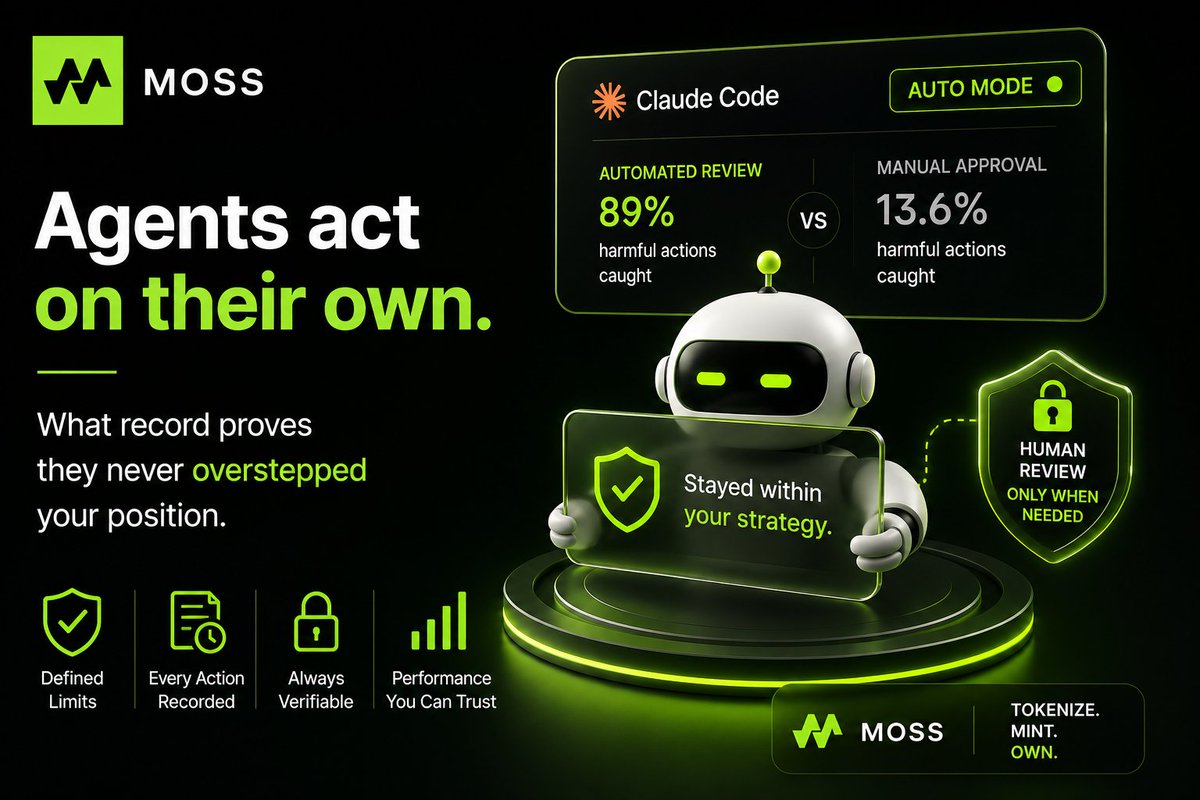
@Mmenyene_C argued (65 likes, 64 replies, 227 views) that autonomous agents need a record of strategy, permissions, decisions, actions, and blocked overrides, not only a profit curve or success metric. His attached image framed the demand in product terms with defined limits, recorded actions, verifiable behavior, and human review only when needed. Even though the example came from tokenized trading agents, the structure generalizes to any domain where an agent can act without asking every time.
@marfinxx highlighted (37 likes, 13 replies, 1,469 views, 43 bookmarks) DeepMind's Intelligent AI Delegation, which proposes contract-first delegation with explicit authority, responsibility, boundaries, and trust between delegators and delegates. The most useful evidence, however, came from the replies: when challenged on the 88.4% completion and 61.2% token-overhead figures in the thread, the author clarified that those numbers came from his own field tests rather than from the paper itself. That correction made the item's real value clearer—the paper is a governance framework, while practical validation is still being assembled in the field.
@circle claimed (262 likes, 33 replies, 10,732 views) that 99.3% of agentic payments run on USDC and that its marketplace already has 900+ paid services. The replies did not dispute the payment-rail message so much as push to the next question: who sets spend policy, how limits are enforced, and who holds liability when an agent overspends.
Discussion insight: Whether the context was regulated deployment, PR reviews, tokenized trading agents, or payments, the common ask was the same: make the mandate explicit, record the action path, and keep a human or policy gate for irreversible consequences.
Comparison to prior day: August 19 emphasized trust labels, memory-write policy, and programmable payment limits. August 20 pushed those concerns closer to execution with proof-of-human reviews, single-egress enforcement, action ledgers, and contract-style delegation.
2. What Frustrates People
Hosted convenience still comes with state, cost, and trust anxiety
The loudest frustration was that useful hosted agents still ask users to accept too much ambiguity around memory ownership, credential scope, and cost. @illscience argued (139 likes, 21 replies, 8,901 views, 147 bookmarks) that personal-agent products are finally capable enough to shop, browse, and run loops overnight, but he also described the core tension directly: one long-running relationship is convenient until context compaction, cached credentials, and consequential actions become scary. @milesdeutscher shared (44 likes, 17 replies, 11,619 views, 48 bookmarks) a Grok-plus-Hermes split precisely because he did not want one product to own both app-heavy workflows and sensitive, memory-critical tasks. The comparison sheet from @RoundtableSpace shared (35 likes, 5 replies, 45,116 views) made the same pain visible in checklist form: vendor-held state, model lock-in, ops burden, and cost. Even @XFreeze reported (91 likes, 18 replies, 6,385 views) Grok Build workflow improvements signaled the same underlying problem—permission UX and subagent management are still rough enough to be release-note features. Severity: High. Worth building for: High.
Teams still spend too much effort rebuilding context and procedures every run
A second frustration was that agents remain only as good as the context and workflows wrapped around them. @kmeanskaran argued (70 likes, 4 replies, 3,374 views, 87 bookmarks) that harness, LLMOps, loop engineering, and evals matter more than model choice, which is a blunt way of saying the real work still happens around the model. @shannholmberg showed (106 likes, 15 replies, 6,679 views, 98 bookmarks) that Hermes Bot Mode only becomes powerful once someone assembles the company brain, specialist roles, and review flow. @thesidsiva launched (40 likes, 14 replies, 1,270 views) MeetStream around the claim that the best context lives in meetings, not static CRM fields, while @NotionHQ announced (42 likes, 2 replies, 3,678 views) team skills because most agents still start from scratch. The research signal from @beamnxw (74 likes, 18 replies, 2,341 views, 57 bookmarks) reinforced the point: the harness alone can move results materially. Severity: High. Worth building for: High.
Autonomy without proofs still fails the trust test in high-consequence work
The third frustration was that autonomy looks impressive right up until somebody asks for receipts. @unicity_labs introduced (119 likes, 51 replies, 1,898 views) a single-egress, auditable deployment surface because regulated customers cannot tolerate loose data movement or unbounded tools. @gakonst reported (28 likes, 4 replies, 3,921 views, 23 bookmarks) proof-of-human PR reviews because scaling agent-written changes without lowering the security bar is still unsolved. @Mmenyene_C argued (65 likes, 64 replies, 227 views) that permission and decision logs matter more than a profit chart for autonomous trading agents, and @circle claimed (262 likes, 33 replies, 10,732 views) strong USDC adoption still drew replies about spend policy and liability rather than celebration alone. The correction under @marfinxx (37 likes, 13 replies, 1,469 views, 43 bookmarks) made the gap explicit: governance frameworks exist, but implementers still have to supply the real audit trail. Severity: High. Worth building for: High.
3. What People Wish Existed
A hybrid control plane that combines hosted app access with self-owned memory
The clearest practical wish was not for one more frontier model. It was for one surface that combines the app reach of hosted agents with the ownership and cost profile of self-hosted runtimes. @illscience argued (139 likes, 21 replies, 8,901 views, 147 bookmarks) that consumer and prosumer agents already have enough capability to run loops, but still differ sharply on how much authority they assume and how visible the machinery is. @milesdeutscher shared (44 likes, 17 replies, 11,619 views, 48 bookmarks) one current workaround—Grok Bot for app-heavy orchestration, Hermes for sensitive or cost-heavy work, and Buzz as the shared room. @RoundtableSpace shared (35 likes, 5 replies, 45,116 views) the same desire in matrix form by comparing OpenClaw, Hermes, and Grok Bot on ownership, ops burden, and cost. The need is immediate, but competition is already intense. Opportunity: competitive.
Skills and procedures that travel across agents without being rewritten
People also want reusable operating knowledge, not one-off prompt craft. @ClaudeDevs pointed to (39 likes, 1 reply, 10,512 views) Anthropic's Skills API for uploading and versioning team procedures once, while @NotionHQ announced (42 likes, 2 replies, 3,678 views) that its agent can turn shared Notion pages into skills. @shannholmberg showed (106 likes, 15 replies, 6,679 views, 98 bookmarks) the same pattern in Hermes Bot Mode, where each specialist carries its own harness while reading from one company brain. This is a direct need because teams are already building the artifacts manually; they want better packaging, versioning, and reuse. Opportunity: direct.
Verifiable autonomy with action ledgers and judgment-aware review gates
The most urgent governance wish was for agents that can act without becoming unaccountable. @Mmenyene_C argued (65 likes, 64 replies, 227 views) for a verifiable chain from strategy to permission to decision to action. @gakonst reported (28 likes, 4 replies, 3,921 views, 23 bookmarks) proof-of-human PR reviews, and the best reply immediately asked for proof of judgment, not just touch. @unicity_labs introduced (119 likes, 51 replies, 1,898 views) in-path controls and tamper-evident audit for regulated deployment, while @circle claimed (262 likes, 33 replies, 10,732 views) payment-rail adoption that prompted follow-up questions about spend policy and liability. This is a direct need with compliance, security, and trust consequences. Opportunity: direct.
Live conversation and voice context that agents can act on in real time
A fourth need was for agents to work from conversations as they happen, not after somebody summarizes them. @thesidsiva launched (40 likes, 14 replies, 1,270 views) MeetStream around real-time meeting capture, live transcripts, voice responses, and in-call MCP actions because “the context that matters isn't in a CRM field.” @illscience argued (139 likes, 21 replies, 8,901 views, 147 bookmarks) that full-duplex voice makes orchestration feel much more natural, and @Tannermullen reported (34 likes, 4 replies, 2,731 views, 13 bookmarks) a simple small-business win where a voice agent stopped missed calls and lost estimates. This is a direct operational need, though still early enough that implementations are pieced together from mixed stacks. Opportunity: direct.
4. Tools and Methods in Use
| Tool | Category | Sentiment | Strengths | Limitations |
|---|---|---|---|---|
| Grok Bot / Grok Build | Managed cloud agent workspace | (+/-) | Deep app sign-ins, hosted ops, routines, concurrent subagents, improving MCP permission UX | Vendor-held state, higher convenience tax, memory and credential-boundary concerns |
| Hermes Desktop / Bot Mode | Self-hosted multi-agent runtime | (+) | Named specialist bots, per-bot harnesses, owned memory, reusable roles | More setup and operator burden than hosted products |
| OpenClaw | Self-hosted open runtime | (+/-) | Maximum ownership, broad integrations, open-source surface | Manual install/config and ongoing ops work |
| Buzz | Shared agent workspace | (+) | One room for Grok and Hermes handoffs, shared channels, simpler oversight | Extra orchestration layer; handoffs still need custom design |
| Claude Managed Agents Skills API / Files API | Agent platform primitive | (+) | Versioned procedures, filesystem resources, reusable team knowledge | Platform-specific workflow surface |
| Notion Skills | Workflow packaging | (+) | Turns existing docs into shareable skills and playbooks | Depends on the quality and upkeep of source pages |
| MeetStream | Meeting-context infrastructure | (+) | Real-time transcripts, per-participant AV, in-call voice and MCP actions | Privacy, retention, and governance questions were not resolved in the thread |
| Unicity | Governed agent deployment | (+) | Single egress gate, in-path controls, tamper-evident audit, circuit breakers | Early-stage design-partner posture rather than broad GA deployment |
| Voight-Kampff / proof of human | Review control method | (+/-) | Adds a human gate to PR review as agent throughput rises | A human touch is weaker than demonstrable judgment |
| Meta-Harness | Automated harness optimization method | (+) | Measured accuracy gains, fewer context tokens, better coding-harness performance | Research-stage system; self-editing harnesses need rollback and guardrails |
| Intelligent AI Delegation | Delegation governance framework | (+) | Formalizes authority, responsibility, boundaries, and trust | Conceptual framework, not a shipped benchmarked product |
| USDC / Circle x402 marketplace | Agentic payments rail | (+/-) | Clear settlement story and claimed marketplace adoption | Spend policy, liability, and concentration remain open questions |
The overall satisfaction spectrum ran from “hosted and frictionless” to “owned and inspectable,” with very few people claiming those qualities are fully reconciled yet. The common workaround was stacking tools: Grok for app integration, Hermes for self-owned memory, Buzz for a shared room, Claude or Notion skills for repeatable procedure, and human gates or proof layers wherever mistakes would be costly. Migration is also visible in architecture: people are moving from one chat thread and one model toward specialist bots, reusable skills, explicit permissions, and context layers that live in docs, repos, and live conversations.
5. What People Are Building
| Project | Who built it | What it does | Problem it solves | Stack | Stage | Links |
|---|---|---|---|---|---|---|
| Hermes Bot Mode marketing team | @NousResearch / @shannholmberg | Turns Hermes Desktop into a specialist marketing team with named bots and a shared company brain | Lowers the skill floor for marketing engineering and makes specialist workflows reusable across campaigns | Hermes Desktop, per-bot models, skills, tools, memory, shared context | Shipped | tweet |
| Claude Managed Agents Skills API | Anthropic | Uploads, versions, and pins reusable team procedures for managed agents | Stops agents from starting from scratch on recurring work | Skills API, Files API, managed agents, filesystem resources | Shipped | docs, tweet |
| Notion Skills | @NotionHQ | Converts Notion pages into shared skills that agents can load automatically | Keeps team playbooks in one editable place instead of scattered prompts | Notion pages, Notion Agent, local-agent loading | Shipped | tweet |
| MeetStream | @thesidsiva | Gives agents live meeting context with transcripts, AV feeds, voice, and in-call actions | Captures the context that lives in conversations rather than static CRM fields | Zoom/Meet/Teams, per-participant audio/video, live transcripts, MCP actions | Shipped | tweet |
| Unicity | @unicity_labs | Runs agents on-network for regulated industries with controllable boundaries and audit | Safe deployment where data movement and unbounded tools are unacceptable | Single egress gate, in-path controls, circuit breakers, tamper-evident audit | Beta | tweet |
| Voight-Kampff | @gakonst | Adds a proof-of-human gate to PR review for agent-written changes | Scales agent deployment without quietly lowering the security bar | PR workflow gate, human review attestation | Shipped | tweet |
| PlugBO | @richardcsuwandi | A modular framework for agentic Bayesian optimization | Lets an agent adapt surrogate family, acquisition function, and search bounds instead of freezing them upfront | LLM agent plus modular BO framework | Alpha | repo, tweet |
| Codex-Co-Engineer v3.2.0 | @clyons | Multi-agent coordination tooling for Grok, Cursor local/cloud, and DSH | Makes large agent workspaces easier to inspect, paginate, and keep safe | Grok, Cursor Local/Cloud, DSH, bounded-evidence coordination | Shipped | release, tweet |
The most significant build pattern was externalization: Hermes, Claude Managed Agents, and Notion all package procedure and context into reusable artifacts instead of leaving them buried in a thread. MeetStream pushes the same logic one step further by treating live conversation itself as the source material, while Unicity and Voight-Kampff add the control rails required once those agents can act on real systems.
A second pattern was that even lower-volume open-source builders were converging on coordination and specialization rather than “one giant agent.” PlugBO moved the idea into Bayesian optimization, while Codex-Co-Engineer focused on how to manage many agent runs safely across multiple runtimes. The trigger is consistent across rows: once tasks become recurring, multi-step, or high-consequence, builders stop asking for a better prompt and start adding structure around the agent.
6. New and Notable
Agent harness work is turning into named org-chart roles
@frydwia reported (76 likes, 4 replies, 2,885 views, 29 bookmarks) that Viktor now distinguishes between Agent Harness Engineers, Agent Platform Engineers, and Product Engineers instead of old frontend/backend labels. Her follow-up reply made the split concrete: platform engineers own the tool gateway, sandboxes, data layer, isolation, reliability, and cost, while product engineers own the UX of AI employees. That is notable because it shows harness design is already becoming a staffing model, not just a temporary experiment.
Voice agents are landing in narrow business workflows before broader personal-agent promises
@Tannermullen reported (34 likes, 4 replies, 2,731 views, 13 bookmarks) a simple but credible deployment: a $2 million concrete business owner who kept missing calls and estimates now uses a voice agent to catch that overflow. The details are intentionally unglamorous, and that is what makes the signal strong; the wedge is not “general AGI for SMBs,” but one lost-revenue workflow where the operator immediately understands the payoff.
Payments rails may be standardizing faster than spending authority
@circle claimed (262 likes, 33 replies, 10,732 views) that 99.3% of agentic payments run on USDC and that its marketplace already supports 900+ paid services. The replies, however, barely lingered on the settlement rail and instead asked about spend policy, enforcement, liability, and concentration risk. That makes the signal more interesting than a simple adoption stat: the infrastructure stack may be converging on a rail before it has converged on who is allowed to use it.
7. Where the Opportunities Are
[+++] Hybrid agent control plane — Multiple sections pointed to the same gap: users want Grok-level app integration without giving up Hermes/OpenClaw-style ownership, lower cost, or inspectable state. The evidence came from @illscience, @milesdeutscher, and the comparison chart from @RoundtableSpace. This is strong because the workaround already exists—people are stacking products manually.
[+++] Verifiable autonomy rails — The clearest direct opportunity is the layer that records authority, enforces limits, proves review happened, and keeps a tamper-evident history when agents act. Evidence spans @unicity_labs, @gakonst, @Mmenyene_C, @marfinxx, and even the liability questions under @circle. This is strong because the pain is security, compliance, and money-adjacent rather than merely cosmetic.
[++] Team-procedure packaging and live context ingestion — Skills APIs, Notion pages, Hermes company brains, and meeting-ingest layers all attack the same problem: agents still waste too much time reacquiring context and rediscovering how a team works. Evidence came from @ClaudeDevs, @NotionHQ, @shannholmberg, and @thesidsiva. This is moderate because many entrants are shipping it, but the demand is clearly real.
[+] Narrow operational voice agents — The strongest everyday wedge in the data was not an abstract “AI coworker,” but concrete missed-call, scheduling, and live-conversation workflows. Evidence came from @Tannermullen and the voice-orchestration observations from @illscience. This is emerging because the need is obvious, but the implementations still look pieced together.
8. Takeaways
- The day's most visible product debate was hosted convenience versus owned state, not model IQ. That showed up in long-form personal-agent comparisons, hybrid Grok-plus-Hermes stacks, and explicit ownership/cost matrices. (source, source, source)
- Harness design is being turned into reusable product primitives. Specialist bot harnesses, versioned skills, skills-as-pages, meeting-context pipes, and even auto-optimized harness code all point in the same direction. (source, source, source, source)
- Trust is moving from abstract safety language to concrete receipts. The strongest governance items wanted proof of human review, explicit permission scope, in-path enforcement, action history, and contract-like delegation boundaries. (source, source, source, source)
- Context outside the repo is becoming first-class agent input. Meeting transcripts, live calls, company-brain docs, and conversational history were repeatedly treated as more valuable than yet another static knowledge base. (source, source, source)
- Agents are simultaneously creating new roles and new wedges. Viktor's role split suggests harness/platform work is becoming an org chart, while a simple voice-agent deployment for a concrete business shows where everyday economic value is already legible. (source, source)