Twitter AI Agent - 2026-08-24
1. What People Are Talking About
1.1 Voice agents gained benchmark and deployment proof points (🡕)
The clearest new surface was voice. Public evidence did not stop at “we built a demo”: it included an external benchmark, a production usage claim, an open-source framework update, and a plugin layer for extending voice agents. Three curated items plus linked public docs supported the theme, making it more concrete than August 23's mostly architecture-level discussion.
@SpaceXAI reported (921 likes, 60 replies, 471,969 views) that Grok Voice Think Fast 2.0 reached the top of Artificial Analysis's speech-to-speech index. The attached chart put it at 79.0, ahead of GPT-Realtime-2.1 High at 73.9 and Gemini 3.1 Flash Live at 71.5, while xAI's linked product note added 0.70s time-to-first-audio, $0.08/minute pricing, and migration into grok-voice-latest. A reply in the same thread said Starlink is already using Grok Voice to resolve more than 15,000 inbound support and sales calls per day and fulfill more than 3,000 orders per week, giving the benchmark a production usage story rather than a lab-only claim.

@DataChaz highlighted (14 likes, 3 replies, 2,216 views, 19 bookmarks) a major Pipecat update as evidence that the open-source voice stack is getting more operational. The tweet called out built-in WebRTC and WebSocket handling, pluggable STT/TTS/LLM components, multi-agent handoffs, client SDKs, and a CLI path from empty repo to runnable bot in under a minute. The public pipecat-ai/pipecat repo strengthens that story: it is a 14,658-star Python framework that explicitly positions itself around real-time voice, multimodal pipelines, and shared-bus multi-agent systems.
@DanKornas highlighted (1 like, 1 reply, 460 views) OpenHome Abilities as a plugin layer for voice agents. The tweet described four plugin types, trigger-word activation, terminal tooling, and a main.py-centered custom logic surface, while the public openhome-dev/abilities repo shows 100+ abilities, a marketplace, and a packaging model designed for workflows that a prompt alone cannot execute.
Discussion insight: The strongest pushback came inside SpaceXAI's own thread: one reply argued that the 79.0 score reflects a combined agent-performance metric rather than pure speech quality, while another singled out 0.70s latency and Tau Voice gains as the more useful signals. The broader conversation treated voice agents less like “chat with audio” and more like systems that now need benchmarks, transport layers, templates, and deployment surfaces.
Comparison to prior day: August 23 centered on protocols, graphs, and trust surfaces in general. August 24 added a distinctly voice-specific layer: benchmark tables, call-handling volume, voice-agent frameworks, and installable ability/plugin ecosystems.
1.2 Context engineering shifted from “more instructions” to slimmer, installable modules (🡕)
The second major cluster treated context as something to budget, modularize, and inspect. Instead of asking how to stuff more guidance into one window, builders kept showing smaller SKILL files, selective plugin installs, and explicit packaging rules for what should load at all. At least five curated items supported this theme, making it one of the day's strongest continuations from August 23.
@trevin reported (177 likes, 19 replies, 17,154 views, 162 bookmarks) that Compound Engineering rewrote nearly every skill so the always-loaded part became about 70% smaller. The distinctive angle was not “we compressed a prompt” but “we changed the loading model”: essentials first, detailed procedures only when needed. A reply added concrete downstream effects: smaller jobs can stay in chat, doc review only pulls deeper product/external lenses when warranted, and cross-model review got better about sandbox boundaries.
@Howaboua wrote (40 likes, 2 replies, 2,096 views, 41 bookmarks) that newer models already “know what a skill is,” so the optimization target has shifted toward short descriptions as triggers and carefully scoped deltas instead of bulky instruction dumps. The attached package page matters because it turns that claim into a concrete bundle: agent-session-diagnostics, agent-tool-design, extension-design, harness-checklist, instruction-calibration, and prompt-caching are all framed as narrowly-targeted installs rather than one giant context blob.

@DanKornas wrote (4 likes, 1 reply, 592 views) that Context Engineering Kit tries to make coding agents predictable by loading only the plugins a task needs. The public NeoLabHQ/context-engineering-kit repo describes the same design as “token-efficient,” “granular,” and “quality-focused,” with commands, skills, and sub-agents installed piecemeal rather than all at once.
@pauliusztin_ reported (4 likes, 3 replies, 156 views) a failure case from the other side: he hit Claude Code limits mid-feature because the window was already filling with huge AGENTS.md files, unused tools, 50+ rarely used skills, and duplicated documentation before the actual work began. That made context waste observable as a billing and productivity problem, not an abstract design concern.
Discussion insight: The surrounding governance talk kept sharpening the same point. @nykdotdev argued (53 likes, 6 replies, 4,500 views, 32 bookmarks) that a skill made of notes is still just a prompt unless it has schemas, versioning, refusal behavior, and a human owner. The common move across the cluster was to treat skills as selective, auditable packages rather than as ever-growing markdown folders.
Comparison to prior day: August 23 treated skills as a packaging and teaching layer. August 24 pushed one level deeper into operational context control: shrink what loads by default, install only what applies, and define what counts as a real reusable skill package.
1.3 Graphs, review loops, and approval gates became the boundary between demos and production (🡒)
The production conversation stayed strong, but it became more procedural. Instead of broad “agents need guardrails” language, posts described graph topology, review subagents, approval state machines, feedback loops, and missing memory layers in concrete engineering terms. This theme was supported by at least six curated items and remained tightly connected to August 23's trust discussion.
@hanakoxbt argued (122 likes, 8 replies, 15,895 views, 148 bookmarks) that “five agents is a count; a graph is a shape.” The thread did more than repeat the graph slogan: it specified that shared windows collapse diversity into echoes, that null branches can quietly poison a merge if they are not filtered, and that multi-agent runs can cost roughly 15 times the tokens of a single chat because every lane reloads its own core. That framed graph engineering as a control problem over slices of context and failure containment, not just parallelism.
@shivam74689 built (7 likes, 2 replies, 136 views) an unusually explicit self-improvement loop around evaluation, comparison, decision, approval, promotion, and monitoring. The diagrams made two details visible that the text alone might not: “eligibility” is not the same as “authorization,” and a missing approval should fail closed instead of being inferred from a better score.

@mardehaym wrote (55 likes, 17 replies, 10,558 views, 76 bookmarks) that most companies are stuck between agent POCs and production because four engineering pieces are missing: code graphs, knowledge bases, feedback loops, and approval gates. That gave the day a useful enterprise frame: the bottleneck is not only the model, but the surrounding environment that lets an agent see the codebase, recall prior failures, and stop before irreversible actions.
@HermesWatcher highlighted (37 likes, 2 replies, 1,102 views, 25 bookmarks) Hermes's new /review flow, where a separate background reviewer can inspect diffs, docs, research, and tests before sending findings back to the main agent. The distinctive angle was independence: one model can do the work while another model, or another provider, is explicitly asked to attack it.
Discussion insight: Two adjacent posts sharpened the failure modes. @kocer_eth wrote (30 likes, 9 replies, 1,089 views, 24 bookmarks) that “architecture routes work; it does not remember work,” separating harness topology from write/read/compress/isolate context operations. @omarsar0 argued (27 likes, 17 replies, 6,825 views) that benchmarking models inside proprietary harnesses is already muddy, which means evaluation standards will get harder, not easier, as harnesses become tunable artifacts.
Comparison to prior day: August 23 emphasized permission expiry, trust-gated skills, and critic roles. August 24 kept that trust focus but turned it into operational machinery: graph splitters, reviewer subagents, approval state machines, code graphs, feedback loops, and explicit memory layers.
1.4 Discovery, marketplaces, and monetization became agent product work (🡕)
The fourth cluster moved beyond “can you build an agent?” and into “can people find it, publish it, hire it, or pay it?” Public evidence in this theme skewed more promotional and programmatic than the harness cluster, but the repeated primitives were specific: search visibility, publish-and-earn marketplaces, agent identity, escrow, and official marketplace front doors.
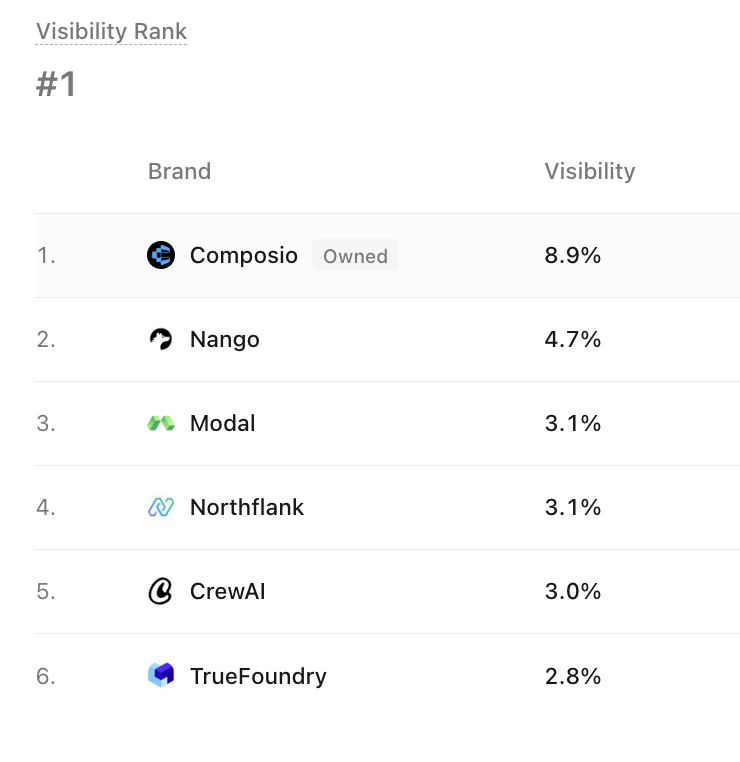
@mal_shaik reported (57 likes, 11 replies, 5,845 views, 121 bookmarks) that Composio became the top AI search result for agent integrations by building more than 1,000 toolkit pages, comparison pages for buying-intent searches, and tool-by-framework combinations. The attached ranking screenshot matters because it gives a concrete visibility snapshot rather than a hand-wavy growth claim: Composio was shown at 8.9%, ahead of Nango at 4.7% and Modal at 3.1%. The public ComposioHQ/composio repo adds more product depth here, describing 1,000+ pre-authenticated toolkits, per-user sessions, triggers, and a sandboxed workbench.
@Naila_Sync wrote (177 likes, 16 replies, 15,357 views) that the interesting part of AITOPIA is not merely building an agent, but turning a workflow into something other people can use and pay for. The quoted AITOPIA launch pitch promised no-code building, marketplace publishing, and 70% revenue share, while a reply in the thread linked that monetization angle to cloud-resident work that keeps running after the laptop is closed.
@Web3AlphaHunt wrote (68 likes, 46 replies, 392 views) that TermiX is building around the “find a job, prove identity, get hired, deliver, get paid” part of the agent economy. The useful detail was not the slogan but the checklist: onchain identity, job discovery, bidding, escrow, delivery verification, reputation, and settlement in USDC/USDT.
@BNBCHAIN announced (59 likes, 26 replies, 22,557 views) a marketplace-building track where the winning submission could become the official BNB Agent Studio front door. The linked program page made the requirements unusually concrete: four agent categories had to be surfaced with equal depth, the user flow had to support discovery and activation with minimal friction, and one partner track explicitly rewarded session-key limits, spend caps, expiry, and onchain revocation.
Discussion insight: The most substantive reply nuance came under the Composio post, where the author argued that integration pages are not enough if users ask AI systems problem-first questions such as how to authenticate an agent with OAuth or manage permissions across tools. That pushed the distribution conversation above raw toolkit count and toward problem-aware discoverability.
Comparison to prior day: August 23 focused on how skills, graphs, and trust layers are packaged. August 24 layered search, marketplaces, and payment rails on top, suggesting that distribution and monetization are moving into the core agent product conversation.
2. What Frustrates People
Context bloat still taxes coding agents before the real work starts
The most explicit frustration was that too much low-signal material gets loaded before the agent even touches the task. @trevin reported (177 likes, 19 replies, 17,154 views, 162 bookmarks) that Compound Engineering had to rewrite nearly every skill so the always-loaded portion shrank by about 70%, while @pauliusztin_ reported (4 likes, 3 replies, 156 views) that huge AGENTS.md files, unused tools, 50+ rarely used skills, and duplicated docs were consuming Claude Code context before the feature work even started. @Howaboua wrote (40 likes, 2 replies, 2,096 views, 41 bookmarks) that newer models want short triggers and deltas, not giant instruction dumps, and @DanKornas wrote (4 likes, 1 reply, 592 views) that selective plugin installs are the practical fix. The coping pattern was consistent: load essentials first, keep workflows small when the job is small, and install only the skills or plugins that a task actually needs. Severity: High. Worth building for: High.

A good harness still fails if it cannot remember, review, or stop safely
A second frustration was that agent systems can look well-orchestrated while still repeating mistakes or moving too fast. @kocer_eth wrote (30 likes, 9 replies, 1,089 views, 24 bookmarks) that “architecture routes work; it does not remember work,” separating the harness from the write/read/compress/isolate layer that keeps failures from recurring. @hanakoxbt argued (122 likes, 8 replies, 15,895 views, 148 bookmarks) that multi-agent systems silently converge, drop lanes, or burn 15x the tokens if context boundaries are wrong, while @mardehaym wrote (55 likes, 17 replies, 10,558 views, 76 bookmarks) that most failed deployments are missing code graphs, knowledge bases, feedback loops, or approval gates. The workaround pattern was to add independent review, persistent state, explicit approval transitions, and artifact lineage rather than trusting one long-running chat. Severity: High. Worth building for: High.

Evaluation is becoming mandatory, but the measuring surface is still unstable
Builders also sounded frustrated that “better” is still hard to define consistently. Under the Grok Voice benchmark thread, one reply noted that the headline score mixes agent performance and task success with speech quality, which changes what “number one” actually means. @omarsar0 argued (27 likes, 17 replies, 6,825 views) that measuring models inside proprietary harnesses is already broken, because harness choices advantage some models more than others, while @Al_Grigor wrote (37 likes, 4 replies, 1,512 views, 34 bookmarks) that evaluation was the top skill across 4,894 AI engineering job descriptions. The coping pattern was to lean on held-out sets, regression checks, minimal shared harnesses, and explicit judge/QA workflows, but the public evidence still shows no broadly accepted measurement surface. Severity: Medium. Worth building for: High.
3. What People Wish Existed
Selective context orchestration instead of one giant default payload
This was a practical need, and the public evidence described it in operational rather than aspirational terms. @trevin reported (177 likes, 19 replies, 17,154 views, 162 bookmarks) the work required to shrink always-loaded skills by about 70%, @DanKornas wrote (4 likes, 1 reply, 592 views) that Context Engineering Kit exists to load only the needed plugins, and @pauliusztin_ reported (4 likes, 3 replies, 156 views) that noisy windows make bigger plans feel like symptom treatment. The practical ask is not “give me more context,” but “give me the right context, late, and in pieces.” Opportunity: direct.
Approval-aware review and provenance layers that can prove what changed
The strongest need in the production cluster was not for more agent output, but for better evidence around when an output should be trusted. @shivam74689 built (7 likes, 2 replies, 136 views) a loop where improved prompts still cannot ship without explicit approval, @HermesWatcher highlighted (37 likes, 2 replies, 1,102 views, 25 bookmarks) a separate reviewer subagent that can attack completed work, and @monokern wrote (45 likes, 13 replies, 1,995 views) that every handoff in his Grok Bot interface now produces a versioned artifact with hash, parent history, and stale-audit blocking. That is a practical need with direct commercial value because today's failures are often about approval, recall, and traceability rather than raw generation quality. Opportunity: direct.

Cloud agents that can provision the machine the task needs
This need was framed as infrastructure, not theory. @dabit3 wrote (47 likes, 4 replies, 3,994 views, 21 bookmarks) that a new category of multi-VM cloud agents is emerging, where the right Linux, macOS, Windows, EC2, or sandbox environment becomes part of the prompt itself. A reply clarified that some of this already exists in Devin across Linux, Windows, macOS, EC2, Modal, and external servers, but the post's point was that these should become native platform capabilities rather than improvised add-ons. The need is practical and emerging because the requested abstraction is clear, but the public evidence is still more roadmap than mature standard. Opportunity: direct.
Discovery, publishing, and settlement layers for agent work
Several posts described a practical but increasingly crowded need: once an agent exists, builders still need ways to get it discovered, published, hired, and paid. @mal_shaik reported (57 likes, 11 replies, 5,845 views, 121 bookmarks) that search visibility now depends on problem-aware pages and comparison content, not only raw toolkit count. @Naila_Sync wrote (177 likes, 16 replies, 15,357 views) about no-code building plus 70% revenue share, @Web3AlphaHunt wrote (68 likes, 46 replies, 392 views) about identity, escrow, reputation, and settlement for agent labor, and @BNBCHAIN announced (59 likes, 26 replies, 22,557 views) an official marketplace front-door program. The need is clearly practical, but the current surface already looks competitive because multiple builders are converging on overlapping marketplace and monetization primitives. Opportunity: competitive.
4. Tools and Methods in Use
| Tool | Category | Sentiment | Strengths | Limitations |
|---|---|---|---|---|
| Grok Voice Think Fast 2.0 | Voice model / deployment | (+) | Top speech-to-speech index result, 0.70s time-to-first-audio, API and Agent Builder surface, public production call-handling claim | Benchmark mixes speech with broader agent task success; proprietary service |
| Pipecat | Voice agent framework | (+) | Voice-first Python stack with WebRTC/WebSockets, pluggable STT/TTS/LLMs, CLI, client SDKs, and multi-agent pipelines | Builders still need to design the surrounding product logic and operational controls |
| OpenHome Abilities | Voice-agent plugin layer | (+) | 100+ abilities, trigger words, main.py-centered custom logic, marketplace and starter templates |
Bound to the OpenHome platform and supported mostly by project documentation rather than broad public deployment evidence |
| Compound Engineering | Skill / workflow layer | (+) | Smaller always-loaded skills, reduced ceremony for small jobs, better cross-model review behavior | The reduction required repeated rewrites, evals, and regression cleanup |
| Context Engineering Kit | Context / skill marketplace | (+) | Selective plugin installs, token-efficient patterns, spec-driven and review-oriented plugins, minimal default footprint | Requires active curation of which plugins belong in a session; smaller ecosystem than the biggest agent platforms |
| Learn Harness Engineering | Course / templates | (+) | 14 lectures, 8 projects, frontier harness breakdowns, reusable templates, and a shell-based audit path | Educational surface rather than a live runtime |
| AutoDesign | Harness optimization method | (+) | Improved seven code-agent setups by 12.4% on average and showed especially large gains on weaker models | Research setting that presumes an existing eval loop and task benchmark |
/review in Hermes |
Review / audit workflow | (+) | Independent reviewer subagent, separate model/provider choice, checks across code, docs, research, and tests | Evidence comes from a product-update post rather than a public benchmark suite |
| Composio | Tool integration / discoverability | (+/-) | 1,000+ toolkits, per-user sessions, auth, triggers, sandboxed workbench, and strong search visibility | Replies say problem-aware AI queries are still under-served even when integration pages rank well |
| BNB Agent Studio marketplace | Agent marketplace / distribution | (+/-) | Official discovery-and-hiring brief with explicit judging rubric and session-key constraints in a partner track | Public evidence today is a program specification rather than observed usage data |
| Mandiant AVDH | Security harness | (+) | Claimed 100+ true-positive critical vulnerabilities in 2 days by combining multi-agent orchestration with analyst expertise | Public methodology is thin and presented in marketing form |
The satisfaction spectrum skewed positive for tools and methods that made context smaller, routing clearer, or review more explicit. People sounded happiest with selective plugin installs, reusable voice-agent frameworks, independent reviewers, and harness changes that improve weaker models without paying for a larger one. The common workaround pattern was to replace big default payloads with narrow packages, replace “trust me” with review or approval stages, and replace model-chasing with better scaffolding and evals.
The migration pattern was visible in multiple directions at once: from giant prompt folders to governed skill packages, from one-shot voice demos to frameworks plus ability/plugin layers, and from buying a bigger model to optimizing the harness around the one already deployed. The most obviously competitive surface was distribution: Composio, AITOPIA, TermiX, and BNB's marketplace brief all suggested that discoverability and monetization are becoming contested layers above the raw agent runtime.

5. What People Are Building
| Project | Who built it | What it does | Problem it solves | Stack | Stage | Links |
|---|---|---|---|---|---|---|
| Grok Voice Think Fast 2.0 / Agent Builder | xAI via @SpaceXAI | Ships a speech-to-speech model plus API and builder surface for production voice agents | Gives voice agents a deployable path for speech reasoning, tool use, and customer workflows | Proprietary voice model, API, Agent Builder, speech reasoning | Shipped | tweet news console |
| Pipecat | pipecat-ai | Open-source framework for real-time voice and multimodal conversational agents | Removes much of the transport, audio/video, and multi-agent orchestration work from custom voice stacks | Python, WebRTC/WebSockets, STT/TTS/LLMs, CLI, client SDKs | Shipped | tweet repo |
| OpenHome Abilities | openhome-dev | Collection of Python plugins that extend OpenHome voice agents with concrete workflows | Gives voice agents powers that a prompt alone cannot execute, from API calls to long-lived workflows | Python, main.py plugin units, trigger words, marketplace, templates |
Shipped | tweet repo |
| Learn Harness Engineering | walkinglabs | Project-based course, templates, skills, and audit surfaces for reliable coding-agent environments | Gives builders a reusable path for environment, state, verification, and control instead of ad hoc tutorials | TypeScript, shell audit, reusable templates, skills, documentation | Shipped | tweet repo |
| Context Engineering Kit | NeoLabHQ | Installable context-engineering plugins and skills for coding agents | Reduces token waste and makes agent behavior more predictable through selective installs | TypeScript, agentskills.io format, plugin marketplace, sub-agents | Shipped | tweet repo |
| Grok Bot Architecture | monokernn | Visible multi-agent operations interface with mission ledger, artifact rail, and approval airlock | Makes shared memory, review, provenance, and approval boundaries inspectable instead of hidden in chat logs | JavaScript, static UI, SHA-256 ledger, artifact lineage, approval controls | Alpha | tweet repo |
| Agentic Vulnerability Discovery Harness (AVDH) | @Mandiant | Internal multi-agent vulnerability discovery harness for code analysis during incident response | Scales exploit-path discovery when manual review cannot keep up with AI-assisted attackers | Multi-agent orchestration, analyst expertise, code analysis | Shipped | tweet |
The voice-agent stack showed up in three different layers on the same day. xAI pushed the model-and-service layer with benchmarked speech reasoning plus an API and builder surface, Pipecat covered the open-source orchestration layer with transport and multi-agent plumbing, and OpenHome Abilities covered the plugin layer with trigger-word workflows and a marketplace. The shape is notable because it shows builders decomposing voice agents into model, runtime, and extension surfaces instead of treating “voice” as one monolith.


Learn Harness Engineering and Context Engineering Kit pointed to a second repeated build pattern: public packaging of harness knowledge. One turned environment/state/verification/control into a course with templates and audits; the other turned context discipline into selectively installable plugins. In both cases, the product was not “another agent,” but a reusable way to make other agents behave more reliably.

Grok Bot Architecture and Mandiant's AVDH showed a third pattern: make review, provenance, and security coverage visible. The former exposes a live artifact rail, hashes, and approval airlock in a static interface concept; the latter claimed 100+ true-positive critical vulnerabilities in two days by combining agentic orchestration with frontline security expertise. Both projects framed the valuable part of the system as the control surface around the agent, not the model alone.
A parallel but thinner public build pattern focused on distribution rather than runtime internals. AITOPIA promised no-code building plus revenue share, TermiX described identity, escrow, and settlement for agent labor, and BNB Chain published an official discovery-and-hiring rubric for a future marketplace front door. The public evidence in that cluster was lighter on implementation detail, but the repeated problem statement was consistent: builders want agents to be discoverable, reusable products, not one-off workflows trapped in a single session.
6. New and Notable
Harness optimization became a public benchmark story, not just internal folklore
@rohanpaul_ai summarized (57 likes, 8 replies, 3,509 views, 40 bookmarks) AutoDesign as a system that recursively improves the harness around a code agent instead of upgrading the model by default. The attached poster and linked paper matter because they add specific public numbers: the arXiv abstract says AutoDesign reached 78.32 on PosterBench, improved seven code-agent setups by 12.4% on average, and executed a fully autonomous 253-tool-call, 11-edit loop in 40 minutes for under $3. That makes “fix the harness before buying a bigger model” a measured claim rather than an anecdote.

Enterprise security teams started talking publicly about agentic vulnerability harnesses
@Mandiant reported (9 likes, 1 reply, 889 views) that its Agentic Vulnerability Discovery Harness found more than 100 true-positive critical vulnerabilities in two days during a recent incident-response investigation. The attached cards are still marketing-shaped, but they make the operational claim legible: Mandiant framed the problem as manual source-code review losing a speed race against AI-assisted attackers, and the solution as multi-agent orchestration combined with human security expertise. That is one of the day's clearest enterprise signals that agentic systems are being positioned as force multipliers for expert review, not replacements for it.

Cloud-agent builders started treating the machine itself as part of the prompt
@dabit3 wrote (47 likes, 4 replies, 3,994 views, 21 bookmarks) that multi-VM cloud agents are becoming a new category: instead of fitting every task into one fixed environment, the platform should provision Linux, macOS, Windows, EC2, or sandboxed machines on demand. The replies made the current state of the market clearer: parts of this already exist in Devin, Modal, and external-server workflows, but the desired abstraction is higher-level and native. That makes this less a finished product category than a newly explicit infrastructure direction.
7. Where the Opportunities Are
[+++] Context-budget and skill lifecycle tooling — Evidence spanned Trevin's 70% smaller skill rewrites, Howaboua's compact skill bundles, Context Engineering Kit's selective plugin installs, Learn Harness Engineering's reusable audits and templates, and pauliusztin's report that unused defaults can burn the window before real work starts. The signal is strong because multiple builders described the same pain from different angles: too much context, too early, with too little governance.
[++] Review, approval, and provenance layers — Shivam's approval-state diagrams, Hermes's /review subagent, monokern's SHA-256 artifact rail, Mandiant's AVDH framing, and mardehaym's “Death Valley” post all pointed to the same gap: builders need systems that can question work, trace changes, and block unsafe promotion. The opportunity is moderate-to-strong because the pain is explicit and repeated, but the current public solutions are still fragmented across products, internal systems, and research-style prototypes.
[++] Voice-agent operability stacks — SpaceXAI's benchmark-plus-deployment story, Pipecat's real-time framework, and OpenHome Abilities' plugin marketplace together showed a layered voice ecosystem taking shape. The opportunity is moderate because the core surfaces are visible now — model, framework, plugin layer — but the market still appears split between proprietary service layers and open-source orchestration.
[+] Discovery, marketplaces, and payment rails for agent work — Composio's search-visibility playbook, AITOPIA's publish-and-earn pitch, TermiX's identity/escrow/reputation checklist, and BNB Chain's marketplace brief all suggest that “how an agent gets found and paid” is becoming its own product category. The signal is emerging because the requirements are getting specific, but today's evidence still leans more toward pitches and program pages than detailed adoption data.
[+] Multi-environment cloud agents — Dabit3's multi-VM cloud-agent argument and the follow-up references to Devin, Modal, and external servers showed a concrete demand for agents that can request the right machine for the job. The signal is emerging because the abstraction is clear, but the public examples are still closer to capability direction than settled product pattern.
8. Takeaways
- Voice agents moved from “interesting demo” toward layered, shippable infrastructure. The strongest evidence combined an external benchmark, production call volume, an open-source runtime, and a plugin marketplace rather than one isolated launch. (source)
- Context engineering is getting stricter about what earns a place in the window. Trevin's 70% smaller skills, Context Engineering Kit's selective installs, and pauliusztin's report of paying for wasted context all pointed toward the same norm: load less by default, and load it later. (source)
- Production credibility now depends on graph shape, review independence, and explicit approval state. Hanakoxbt's graph thread, Hermes's
/review, and Shivam's fail-closed approval barrier all described control surfaces around the agent rather than faith in the agent. (source) - Harness improvement is becoming measurable enough to compete with model upgrading. AutoDesign's public benchmark story gave a concrete example of better scaffolding materially lifting weaker models. (source)
- Discoverability and monetization are becoming first-class agent product problems. Composio's search playbook, AITOPIA's revenue-share marketplace, TermiX's identity-and-settlement checklist, and BNB Chain's marketplace brief all treated “found, hired, and paid” as part of the agent stack. (source)