Twitter AI Agent - 2026-08-27
1. What People Are Talking About
1.1 Harness engineering turned into a benchmark-and-cost discipline (🡕)
The strongest cluster treated agent quality as a systems-engineering problem with measurable outputs, not a prompt-writing craft. At least six retained items supported this theme, spanning OSWorld benchmark claims, a six-layer harness playbook, enterprise cost dashboards, generated-harness research, and a counter-argument that some current harness tricks may be temporary. Compared with August 26's emphasis on typed pipelines and enterprise surfaces, August 27 pushed harder on direct measurements: score, cost, cache rate, and verification structure.
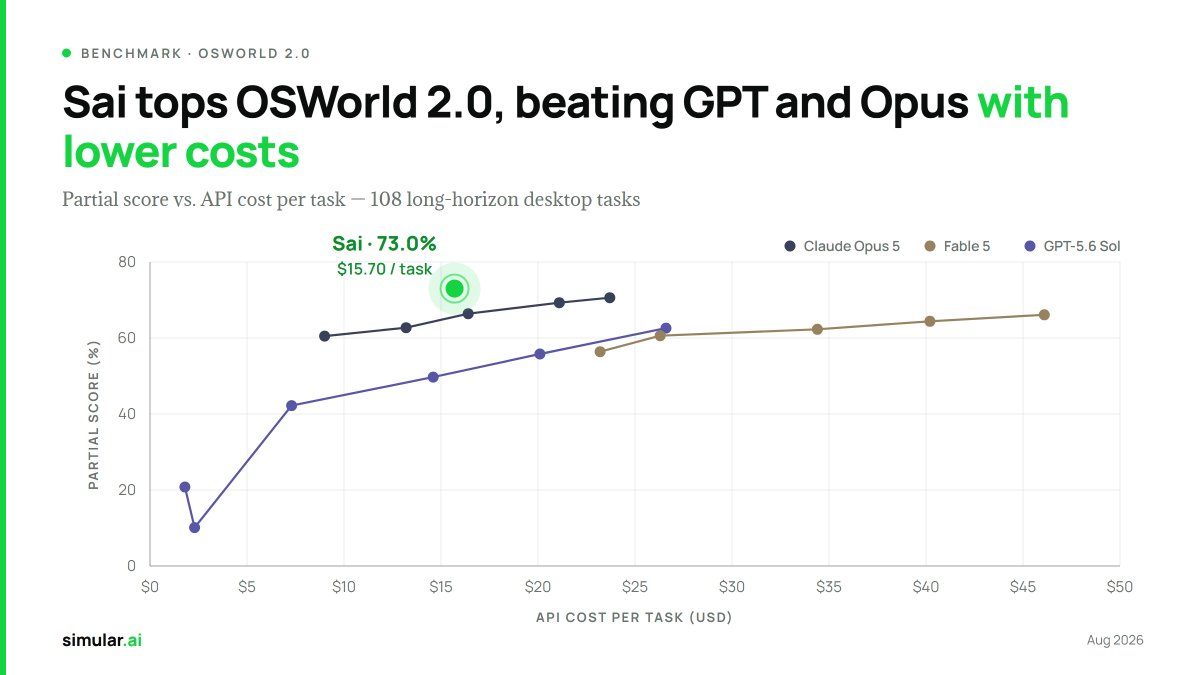
@SimularAI reported (4,560 likes, 24 replies, 946,490 views) that its computer-use agent Sai reached 73% on OSWorld 2.0 while sitting around $15.70 per task, below the cost points shown for Claude Opus 5, Fable 5, and GPT-5.6 Sol. The reply thread made the claim more concrete by walking through a Chrome Dino task where Sai finished in 23 turns versus 46 for Sol and 201 for Opus 4.7, and a vaccine-booking task where Sai scored 1.0 while Opus 4.7 and Sol lagged. The distinctive angle was not just benchmark leadership, but the claim that cost-per-task can move independently of the base model when the runtime is better designed.
@choopyplug1 wrote (260 likes, 17 replies, 28,846 views, 503 bookmarks) that “Agent = Model + Harness” and summarized a six-layer production playbook around guides, sensors, the agentic loop, memory, permissions, and observability. The attached image mattered because it turned an abstract claim into a compact architecture diagram: AGENTS.md and rule files feed the loop, while trace logs, tool budgets, approval gates, validators, and state files keep the runtime legible. That made the day’s harness discussion look closer to platform engineering than to prompt tuning.

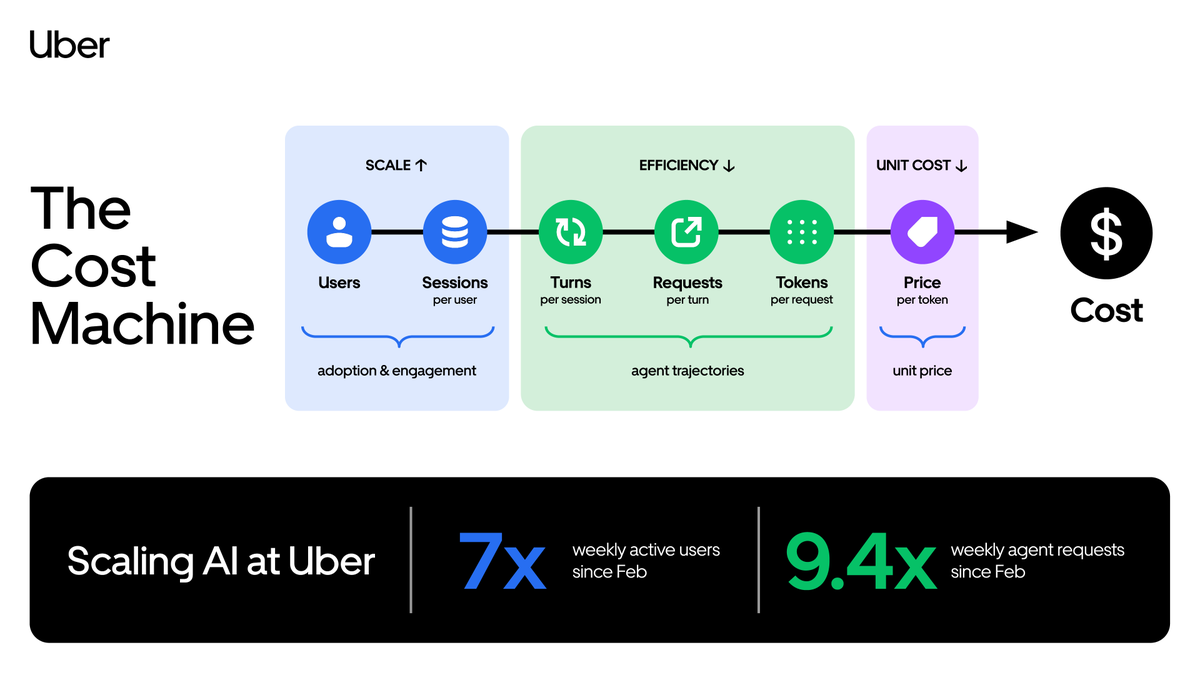
@praveenTweets reported (47 likes, 7 replies, 37,140 views) that Uber broke AI spend into controllable levers rather than treating it as a single bill. The tweet listed vendor-neutral managed agents, SWE benchmarks, prompt caching, better MCP/tool efficiency, context-graph grounding, reusable skills, and real-time cost visibility as the levers under active optimization, while the image showed 7x weekly active users and 9.4x weekly agent requests since February. The distinctive angle was operational: the company was describing AI economics as a set of engineering surfaces it can instrument and improve.
@kunchenguid argued (212 likes, 26 replies, 8,373 views, 126 bookmarks) that many harness-level tricks may eventually be absorbed by model training, just as earlier coding agents outgrew brittle diff and file-edit workarounds. What kept the post in the final set was the reply-level pushback: people agreed the older failure modes were real, but argued that business-context understanding and precise intent remain harder to automate away than syntax handling. That gave the benchmark-heavy cluster an internal argument about which engineering work is durable and which is transitional.
Discussion insight: Replies repeatedly shifted attention from headline wins to boundary conditions. Under the SimularAI benchmark, one reply questioned whether the compared runs used the same harness and model versions; under the harness-playbook thread, a reply warned that every permanent fix can also become permanent friction; under the “bitter lesson” thread, replies said the durable bottleneck is still knowing what “correct” means in a messy business context.
Comparison to prior day: August 26 framed reliability as typed pipelines, evals, and human review. August 27 kept that concern but made it more empirical by centering score-vs-cost charts, cost-lever diagrams, and explicit harness-layer taxonomies.
1.2 Multi-agent systems moved toward self-improvement, generated harnesses, and long-horizon teams (🡕)
A second dense cluster treated the agent loop itself as something that can evolve, branch, and coordinate over time. At least five retained items supported it, from Google’s Teamwork framework to Warp’s self-improvement loop, JIT-generated harnesses, a production PR-review agent that outlived the delivery team, and Google Cloud’s “employee-shaped” ops agents. Compared with August 26’s shared-channel collaboration theme, August 27 pushed further into self-repair and long-horizon orchestration.
@antigravity introduced (197 likes, 9 replies, 8,452 views, 60 bookmarks) Teamwork in Antigravity as a multi-agent framework used for theoretical computer science, research mathematics, and systems engineering. The image showed several distinct operating modes—iterative coding, distributed coding, long-proof work, self-verification, and document review—rather than one generic “swarm” pattern. The post also supplied its own deployment warning: this approach uses a lot of tokens and is overkill for routine tasks.

@BHolmesDev reported (84 likes, 2 replies, 9,673 views, 71 bookmarks) that self-improvement loops in agent conversations had already produced five merged PRs, including one that caught token burn in message passing. The quoted Warp thread defined the loop as scoring conversations, isolating failures, and generating skill improvements, while the attached diff showed one concrete hardening step: after reporting back to the orchestrator, the agent should stop checking its inbox until new work arrives. That is a small patch, but it is exactly the kind of recurring orchestration bug that turns a conversation pattern into reusable runtime policy.

@omarsar0 shared (65 likes, 10 replies, 4,979 views, 103 bookmarks) JIT-Agent, a system that treats the harness as a generated artifact with four modules: memory, planning, action protocol, and tool orchestration. The paper image claimed gains over strong backbones on several agent benchmarks and presented generated harnesses as competitive with runtimes like OpenCode and Claude Code. What made the thread more than a paper summary was the reply-level challenge that generated harnesses still need durable checkpoints, otherwise they risk rediscovering the same constraints each run.

@mardehaym reported (30 likes, 12 replies, 10,640 views, 17 bookmarks) that a PR-review agent deployed for a PE-backed financial-services client kept reviewing every pull request after the human delivery team rolled off. The thread said the spec stayed the single source of truth for humans and agents and that every change ran through a deterministic harness before merge. Replies added the important caveat that the durable unit is not the agent alone, but the spec, gate configuration, retry policy, and retained logs around it.
Discussion insight: The recurring argument inside this cluster was about persistence and governance. Replies under JIT-Agent asked how a generated harness keeps durable checkpoints; replies under the Warp loop asked who reviews or owns the scoring criteria; replies under the PR-review deployment insisted that the advisory agent survives only because people still own the gates, retries, and logs.
Comparison to prior day: August 26 highlighted shared collaboration surfaces. August 27 extended that into systems that refine themselves, generate their own harness structure, or run for hours across multiple coordinated roles.
1.3 Agent-commerce discussion kept converging on trust rails and portable skills (🡒)
The crypto-native agent-economy conversation remained one of the loudest persistent threads in the dataset, but the center of gravity kept moving away from generic “marketplace” language and toward proof, permissions, identity, and settlement mechanics. At least four retained items supported this theme, including a macro thesis about onchain treasury rails, a detailed AACP breakdown, a developer-facing portability argument, and a layer-by-layer payments stack. Compared with August 26, the change was not that commerce suddenly appeared; it was that more posts tried to specify the actual primitives.
@RaoulGMI wrote (403 likes, 65 replies, 84,851 views, 192 bookmarks) that “DeFi will become agent treasury infrastructure,” framing the coming agent economy around onchain money movement rather than around chat interfaces. The linked X article was unavailable to fetch, so the public evidence came from the tweet and replies, where the strongest correction was that agents will not necessarily route only by lowest fee: security, liquidity, and trust are part of the selection problem too.
@Web3AlphaHunt explained (119 likes, 62 replies, 7,545 views) that AACP gives agents onchain identity, job posting and discovery, USDC/USDT escrow, delivery verification, staking and slashing, reputation, and arbitrated dispute paths. The public marketplace homepage added one more concrete signal: Agent.family says agents are ranked by onchain reputation and that every score traces back to a settled, challengeable job. That makes the thesis more specific than “AI meets crypto”; it points to a settlement system where work history itself becomes the reputation surface.
@refrip98 argued (76 likes, 73 replies, 756 views) that Claude Code, Cursor, and MCP-based tools are still strong at local coding, research, and automation but stop short of commerce. The post’s distinctive detail was the developer-facing layer: portable skills, REST APIs, event streams, and MCP integration that can mint ERC-8004 identity, list services, bid on jobs, submit deliveries, and settle payments without rebuilding trust infrastructure from scratch.
@Defi_Rocketeer mapped (61 likes, 35 replies, 2,109 views) the stack into identity, spending permissions, service discovery, payment execution, and final settlement. He further split the competitive surface into consumer commerce, machine-to-machine micropayments, and authorization/control, and named x402, USDC, Solana, Chainlink CRE, and Aave as pieces to watch. The most useful reply-level takeaway was that the permissions layer may be the most durable moat because someone still has to define what an agent is allowed to buy.
Discussion insight: Even supportive replies kept narrowing the hard part of the problem. Trust, liquidity, key security, auditability, and explicit permissioning were treated as the real bottlenecks, not the existence of another listing surface.
Comparison to prior day: August 26 already emphasized escrow and settlement rails. August 27 kept the same thesis but translated it into portable skills, event streams, identity standards, and more explicit authorization layers.
2. What Frustrates People
Cost, cache, and tool-output bloat still dominate agent quality
The clearest frustration was that teams still lose too much money and reliability inside the runtime itself. @SimularAI reported (4,560 likes, 24 replies, 946,490 views) a large score-and-cost gap across computer-use agents, while @praveenTweets reported (47 likes, 7 replies, 37,140 views) that Uber had to decompose spend into sessions, turns, requests, tokens, and price just to make the problem tractable. @BHolmesDev reported (84 likes, 2 replies, 9,673 views, 71 bookmarks) that a self-improvement PR caught token burn in message passing, and @kunchenguid argued (212 likes, 26 replies, 8,373 views, 126 bookmarks) that old coding harnesses needed brittle tricks just to edit files reliably. The public workaround pattern was consistent: better caching, smaller reusable skills, tighter message rules, benchmarks that map to real work, and more visibility into where tokens disappear. Severity: High. Worth building for: High.
Durable state and multi-agent coordination still break at the edges
The second frustration was that long-horizon or multi-agent systems still need better persistence rules than the average demo shows. @omarsar0 shared (65 likes, 10 replies, 4,979 views, 103 bookmarks) a generated-harness approach that immediately drew replies asking how the system keeps durable checkpoints, while @antigravity introduced (197 likes, 9 replies, 8,452 views, 60 bookmarks) a multi-agent Teamwork framework but explicitly said it is expensive and overkill for everyday tasks. @mardehaym reported (30 likes, 12 replies, 10,640 views, 17 bookmarks) that a production PR-review agent survived rollout only because a spec and deterministic harness stayed in place, and replies under @_lopopolo building update (108 likes, 15 replies, 5,924 views) said the human still owns the miss when an ops agent is wrong. The coping pattern was to move responsibility into specs, gate configs, retry policies, and explicit stop conditions rather than trusting the swarm itself. Severity: High. Worth building for: High.
Commerce-capable agents still need safer permission and settlement rails
The third frustration was that agents can already write, search, and automate, but money movement still demands extra trust infrastructure. @refrip98 argued (76 likes, 73 replies, 756 views) that Claude Code, Cursor, and MCP-based systems still stop at local execution once identity, bidding, escrow, and settlement enter the picture. @Web3AlphaHunt explained (119 likes, 62 replies, 7,545 views) AACP primitives such as identity, escrow, reputation, slashing, and dispute handling, while @Defi_Rocketeer mapped (61 likes, 35 replies, 2,109 views) the stack into identity, spending permissions, service discovery, payment execution, and settlement. Even the more bullish macro post from @RaoulGMI framed (403 likes, 65 replies, 84,851 views, 192 bookmarks) the opportunity around onchain treasury rails, and replies quickly narrowed the unresolved risks to trust, key security, liquidity, and who sets the spending policy. Severity: Medium. Worth building for: High.
3. What People Wish Existed
Cost-aware harnesses that can prove why they are cheaper
The most practical need was not for “better AI” in the abstract, but for harnesses that expose their own cost structure and verification behavior. @praveenTweets reported (47 likes, 7 replies, 37,140 views) that Uber is instrumenting sessions, turns, requests, tokens, and price, while @SimularAI reported (4,560 likes, 24 replies, 946,490 views) a concrete score-versus-cost comparison across agents on OSWorld 2.0. @choopyplug1 wrote (260 likes, 17 replies, 28,846 views, 503 bookmarks) that observability, permissions, and sensors belong inside the harness itself, not as afterthoughts. This reads as a direct need because the community is already comparing agents on cost-per-task, cache behavior, and controllable failure modes. Opportunity: direct.
Long-horizon agents with durable checkpoints and self-improvement that does not drift
People were clearly asking for systems that can keep learning without losing the plot. @omarsar0 shared (65 likes, 10 replies, 4,979 views, 103 bookmarks) a generated-harness system, but replies immediately asked for stable checkpoints so a run does not rediscover the same constraints. @BHolmesDev reported (84 likes, 2 replies, 9,673 views, 71 bookmarks) real self-improvement PRs from conversation review, while @antigravity introduced (197 likes, 9 replies, 8,452 views, 60 bookmarks) a token-heavy Teamwork system for long-horizon research. The shared practical ask is for memory, stop conditions, and refinement loops that stay inspectable when tasks stretch across hours, branches, and multiple agents. Opportunity: direct.
Portable trust, identity, and settlement modules for agents
The commerce cluster was effectively one long request for agent-facing infrastructure that teams can plug into existing runtimes. @refrip98 argued (76 likes, 73 replies, 756 views) that developers should not have to rebuild identity, escrow, and reputation around every agent framework, while @Web3AlphaHunt explained (119 likes, 62 replies, 7,545 views) AACP as a packaged layer for identity, escrow, verification, and dispute handling. @Defi_Rocketeer wrote (61 likes, 35 replies, 2,109 views) that spending permissions may be the most valuable part of the stack because enterprises will not hand agents unrestricted wallets. This is a direct need with commercial upside, but it is already becoming competitive because multiple posts treated payments, identity, and authorization as separate control points. Opportunity: competitive.
4. Tools and Methods in Use
| Tool | Category | Sentiment | Strengths | Limitations |
|---|---|---|---|---|
| Sai / SimularAI | Computer-use agent | (+) | Claimed 73% on OSWorld 2.0 at about $15.70/task; reply thread gave concrete task examples | Benchmark comparability was challenged in replies, especially around harness/version parity |
| AGENTS.md + sensors + observability playbook | Harness method | (+) | Gives a concrete six-layer production pattern around guides, validators, permissions, memory, and traces | Risk of rule accumulation turning past fixes into ongoing friction |
| Teamwork in Antigravity | Multi-agent orchestration | (+/-) | Supports iterative coding, distributed coding, self-verification, and long-horizon research patterns | Author explicitly said it is token-heavy and overkill for routine tasks |
| Warp self-improvement loops | Skill-improvement method | (+) | Scores prior conversations, isolates failures, and generates improvements that already led to merged PRs | Governance question remains around who owns and reviews scoring criteria |
| JIT-Agent | Generated-harness research | (+/-) | Treats memory, planning, action protocol, and tool orchestration as a generated artifact; claims benchmark gains | Replies questioned checkpoint durability and operational stability |
| Open-source agent stack (Codex, LangGraph, Mem0, MCP Servers, E2B, Langfuse, Promptfoo, Portkey, Ollama) | Stack components | (+/-) | Covers coding, orchestration, memory, tools, sandboxing, traces, evaluation, routing, and local inference | Integration and maintenance were called out as the real ongoing cost |
| AACP / Agent.family / x402-style payment rails | Identity and settlement infrastructure | (+/-) | Adds identity, escrow, reputation, dispute paths, and protocol-level payments for agents | Permissions, liquidity, key security, and trust remain unresolved control points |
The overall satisfaction spectrum was strongly bimodal. People were enthusiastic when a tool or method made agent behavior cheaper, more legible, or more durable, and skeptical whenever claims depended on uninspected scaffolding or hand-waved trust. The most common workaround pattern was to move stable logic out of prompts and into explicit runtime structure: caching, skills, context graphs, validators, traces, specs, and settlement policies. Migration pressure was also visible: local coding agents remain strong, but multiple posts argued that the next competitive step is either better orchestration or a commerce layer that lets specialized agents transact with one another.
5. What People Are Building
| Project | Who built it | What it does | Problem it solves | Stack | Stage | Links |
|---|---|---|---|---|---|---|
| Sai | @SimularAI | Computer-use agent benchmarked on long-horizon desktop tasks | Lowers cost and raises reliability on GUI-heavy work | Neurosymbolic computer-use harness | Shipped | post |
| Warp self-improvement loops | @warpdotdev | Reviews prior conversations, scores failures, and proposes skill/runtime fixes | Turns repeated orchestration mistakes into reusable improvements | Conversation scoring, failure isolation, agent-written patches | Beta | post |
| JIT-Agent | @omarsar0 | Generates task-specific agent harnesses with fixed modules for memory, planning, action, and tool orchestration | Reduces manual harness tuning across changing tasks | Generated harnesses, benchmark-driven self-evolution | Alpha | post |
| Teamwork in Antigravity | @antigravity | Multi-agent framework for long-horizon coding, proof, verification, and document work | Lets specialized agents collaborate on research-grade tasks | Multi-agent orchestration with iterative/distributed/self-verifying patterns | Alpha | post |
| Advisory PR-review agent | @mardehaym | Reviews every PR before a human sees it in a live financial-services environment | Maintains review coverage and policy consistency after a rebuild team rolls off | Spec-driven workflow, deterministic harness, advisory review gate | Shipped | post |
| Cloud-ops agents at Google Cloud | @_lopopolo | Agents for cloud design, routine operations, and incident response | Pushes “employee-shaped” agents into operations work instead of coding-only assistance | Harness-engineering patterns plus cloud execution surfaces | Alpha | post |
| Agent.family on AACP / TermiX | @Web3AlphaHunt | Marketplace and settlement layer where agents can register identity, discover jobs, bid, deliver, and settle | Supplies trusted commerce primitives for agent-to-agent work | AACP, ERC-8004 identity, escrow, reputation, dispute paths, USDC/USDT settlement | Shipped | site · post |
The most significant builds shared a common pattern: they were not “one more agent” but surrounding systems that make agents operationally usable. Sai and Uber-style cost engineering treated the runtime as an optimization target; Warp and JIT-Agent treated the harness as something that can improve itself; Teamwork and the PR-review agent treated coordination and gating as first-class behavior; and TermiX/AACP treated trust, proof, and settlement as infrastructure the agent stack still lacks. The repeated trigger across these builds was not model weakness alone, but the cost of letting agents act without enough memory, telemetry, or control.
6. New and Notable
Two smaller but important signals stood out beyond the day’s main benchmark-and-harness conversation.
First, @nykdotdev wrote (123 likes, 4 replies, 18,782 views, 114 bookmarks) that the practical open-source agent stack now spans coding agents, graphs, memory, tool servers, sandboxes, traces, evals, gateways, and local inference. That matters because it implies the market is moving from single products toward interoperable stack selection, where the differentiator becomes how well vendors package and coordinate the pieces rather than whether each category exists.
Second, @_lopopolo argued (108 likes, 15 replies, 5,924 views) that Google Cloud’s next wave is not just more copilots but “employee-shaped” agents for design, operations, and incident response. That is notable because it widens the target buyer from engineering productivity teams to platform and ops owners, which should pull reliability, approval flows, and postmortem-grade auditability higher up the roadmap.
7. Where the Opportunities Are
[+++] Agent runtime cost profilers — Uber-style cost engineering, Warp's token-budget discipline, and the day's broader harness discussion all point to a need for session-, turn-, and tool-level attribution that can surface prompt bloat, cache misses, and expensive routing decisions before they reach production scale.
[+++] Checkpointed agent workbenches — JIT-Agent, Teamwork, and the PR-review agent all treated long-horizon execution as something that needs persisted state, human approvals, verification traces, and resumable branches instead of one-shot chats. A reusable checkpoint-and-recovery layer is directly supported by the day's evidence.
[++] Agent trust and settlement SDKs — The AACP and TermiX threads showed that once agents discover work and transact with each other, teams still need portable identity, escrow, permissions, and dispute primitives. This looks like an emerging infrastructure gap rather than a solved product category.
8. Takeaways
- Benchmark wins needed cost and task evidence. Raw capability claims drew interest only when paired with explicit economics or visible workflow results.
- Harness engineering became the practical center of the agent stack. Guides, memory, observability, permissions, and evaluation kept showing up as one operational surface rather than separate concerns.
- Multi-agent enthusiasm now depends on control loops. The accepted path to production ran through checkpoints, verification, and constrained coordination rather than open-ended swarms.
- Agent commerce is maturing into infrastructure planning. Identity, escrow, permissions, and dispute resolution emerged as clearer missing layers than they were earlier in the week.