Twitter AI Agent - 2026-08-29
1. What People Are Talking About
1.1 AI-agent work was recast as a staffing and training problem (🡕)
The clearest shift on August 29 was that ai-agent discussion stopped treating “AI engineer” as a fuzzy identity and started naming concrete roles, skills, and training paths. At least four strong items supported this cluster: Dia's "Model Behavior" hiring post, a widely shared Karpathy lecture summary, an Anthropic course thread, and Andrew Ng's software-fundamentals reminder. Compared with August 28's emphasis on software fundamentals and specialization maps, August 29 pushed the same idea into labor-market language.
@NickADobos said (305 likes, 39 replies, 18,936 views, 275 bookmarks) that Dia is hiring for a "Model Behavior" team, noting that the group used to be called the Prompt Engineering team but had already widened into harness design, MCPs, memory, evals, rapid prototyping, and end-to-end enterprise feature shipping. The post mattered because it exposed a real naming change inside a real company: the job is no longer described as writing clever prompts, but as owning how model behavior changes once tools, memory, and constraints surround it. The reply thread added further signal when one critic said the title still sounded vague while the responsibilities sounded like an unusually broad product-engineering role.
@ai_explorer25 summarized (81 likes, 5 replies, 5,004 views, 129 bookmarks) Andrej Karpathy's Stanford lecture as a progression from LLM to prompt to agent to loop to graph. What made the post useful was not the slogan but the replies, where readers said most teams still stop around the prompt stage and only discover the real engineering work once loops and graphs start failing in production. The distinctive angle was that “graph” was being treated as the durable systems layer, not an optional abstraction.
@virgilxbt argued (41 likes, 6 replies, 1,389 views, 35 bookmarks) that Anthropic's free four-hour Claude course spends its time on prompts, context, workflows, feedback, and loops rather than on prompt tricks alone. Public course pages at Claude Academy support that framing by positioning Claude, agent skills, MCP, and applied workflows as explicit curriculum surfaces. The replies sharpened the lesson: the durable skill is capturing failures, converting them into tests, and feeding them back into tools and context.
@DeepLearningAI wrote (23 likes, 1 reply, 2,113 views, 14 bookmarks) that coding agents still need human guidance across API design, session management, caching, asynchronous processing, data models, CI/CD, and observability. That made the day's hiring and course threads more concrete: the "AI agent" career surface being described in public was still anchored in classic software-engineering decisions, just with more pressure on evaluation and runtime judgment.
Discussion insight: Across these posts, the conversation converged on one point: prompt skill by itself is no longer the credential. The valued work is choosing architectures, writing guides and evals, structuring workflows, and deciding where the model should stop and deterministic tooling should take over.
Comparison to prior day: August 28 said builders should relearn software fundamentals for the agent era. August 29 showed those fundamentals being packaged as roles, courses, and narrower specializations.
1.2 Reliability arguments centered on harnesses, async environments, and explicit control objects (🡕)
A second dense cluster argued that agent reliability depends less on the base model than on the surrounding environment, memory, verification, and object model. At least five items supported this theme: Meta's Gaia2/ARE paper summary, a context-engineering diagram, a deterministic-hooks argument, a five-object routing taxonomy, and a direct warning against long unattended software loops. Compared with August 28's focus on telemetry and controller layers, August 29 pushed harder on what exactly needs to be designed around the model.
@marfinxx claimed (42 likes, 8 replies, 2,260 views, 46 bookmarks) that Meta's Gaia2 benchmark shows static evaluations miss real-world agent failures because production agents face asynchronous events, temporal constraints, noise, and multi-agent coordination. The attached paper cover mattered because it showed the ARE platform and Gaia2 budget-scaling curves directly, while public enrichment on the Gaia2 paper and ARE repo confirmed the dynamic-environment framing. One reply from @PrecipitateAI added a practitioner version of the same claim: after running 110+ unattended cron jobs, the failures that mattered were timing races and lock expirations, not obviously wrong final answers.

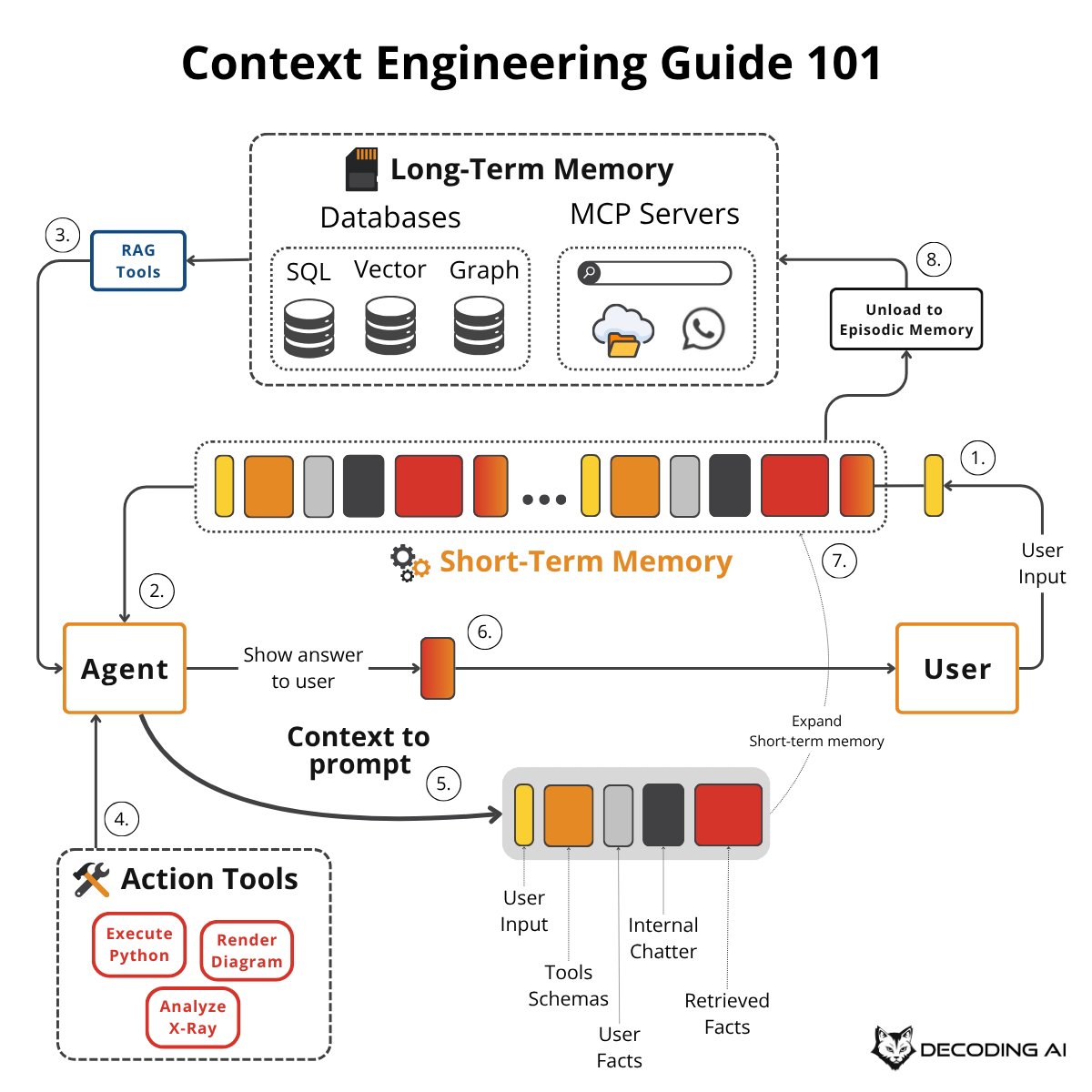
@pauliusztin_ showed (31 likes, 1 reply, 523 views, 19 bookmarks) a compact context-engineering diagram where every model call is rebuilt from system prompt, history, user facts, retrieved facts, tool schemas, long-term memory, databases, and MCP servers. The image added unique evidence because it made the hidden assembly process visible: the short-term prompt is only one slice of a larger memory-and-tool pipeline. That supports the day's broader claim that agent engineering is increasingly about managing what gets assembled around the model on each turn.
@AtMemX argued (10 likes, 10 replies, 440 views) that instructions are probabilistic but hooks are deterministic, using examples like run-tests-on-finish, permission checks before file access, audit-log writes after tool calls, and blocking completion when tests fail. @nykdotdev similarly argued (30 likes, 6 replies, 3,066 views, 33 bookmarks) that chat, goal, skill, routine, and hosted worker are different objects that should not be collapsed together; in the replies, he said the core difference is that a goal needs a finish condition while chat only needs a useful answer. Together these posts treated reliability as a matter of explicit runtime objects and event-driven enforcement, not better wording.
@fjzeit pushed back (19 likes, 5 replies, 1,002 views) on the idea that unattended spec-to-code loops are the long-term answer for serious software engineering, arguing instead for attended and guided development with stronger human control. The important detail was that the rebuttal did not reject AI-assisted development; it rejected the assumption that autonomy alone is the durable product shape.
Discussion insight: The stronger replies did not say current agents are useless. They said the fragile part is nearly always outside the raw answer: object identity, finish conditions, scheduling, state carryover, locks, hooks, and whether the environment keeps moving while the agent thinks.
Comparison to prior day: August 28 emphasized telemetry, trajectories, and controllers. August 29 kept that systems focus but translated it into more concrete design rules: dynamic benchmarks, prompt assembly, deterministic hooks, and explicit distinctions between chats, goals, skills, routines, and hosted workers.
1.3 Buyers judged agent systems by runtime economics, routing discipline, and provider redundancy (🡕)
Another strong cluster treated agent products as operating systems with budgets, caches, cloud workers, and fallback routes, rather than as simple model wrappers. At least four items supported this theme: a detailed Devin review, Uber's software-factory metrics, a hybrid open-model routing post, and a supplier-risk warning about model dependencies. Compared with August 28's discussion of harness ROI and cloud software factories, August 29 pushed further into routing and resilience.
@Da7_Tech reported (236 likes, 74 replies, 27,456 views, 158 bookmarks) that heavy use of Devin Max let him run more than 17 Sol Max agents on a 500,000-word task while consuming only 4% of allowance, with one roughly billion-token workload hitting about 95% cache share. The post also included the product-control details buyers care about after the benchmark: cloud agents with their own machines, stable CLI behavior, strong instruction following, but weak usage visibility, steering messages that can cancel subagents, and no proper goal mode. This was one of the day's best examples of a user evaluating an agent stack as a runtime and UX surface rather than as a model brand.

@UberEng reported (33 likes, 4 replies, 6,371 views, 37 bookmarks) that weekly active users across Uber's agentic tools rose 7x and weekly agent requests rose 9.4x while total AI spend stabilized. The linked Uber Engineering post added the richer context: more than 70% of pull requests are attributed to local or cloud agents, teams built 3,600+ agent skills, and they execute 30,000+ agent-skill runs per day while measuring spend through users, sessions, turns, requests, tokens, and price. The distinctive angle was not that Uber uses agents, but that it treats their cost profile as a decomposable engineering equation.
@omarsar0 argued (22 likes, 5 replies, 3,679 views, 20 bookmarks) that open or local models are good enough for many repetitive automations when combined with self-tuned skills, allowing frontier-model budget to be saved for research and creative tasks. @effiekav extended (60 likes, 12 replies, 497 views) that supplier dependence is now a platform risk, arguing that builders need routing and fallback providers because model access can change with business events outside their control. Together they show a market moving toward hybrid routing, not single-model loyalty.
Discussion insight: Replies under these posts kept circling the same real-world tests: does the weekly allowance survive, can a human steer without collapsing child work, which tasks deserve expensive models, and what happens if a key provider disappears?
Comparison to prior day: August 28 focused on cache economics, cloud-hosted factories, and model choice. August 29 kept those concerns but added a sharper routing discipline: cheap open models for repetitive work, frontier models for harder tasks, and explicit fallback planning when suppliers change.
1.4 Crypto-native agent-commerce talk stayed loud, but the concrete layer was still trust and settlement (🡒)
The agent-economy thread remained one of the loudest persistent topics in the dataset, but the most concrete claims still focused on identity, quote-to-delivery workflows, escrow, and reputation rather than on broad mainstream deployment. The signal was supported by repeated TermiX-related posts, including official messaging and a detailed community explanation of the lifecycle. Compared with August 28, this theme stayed active without changing direction much.
@termix_ai framed (110 likes, 4 replies, 56,722 views) the future as "there's an agent for that," contrasting apps that still require operation with agents that can do the job and get paid when they deliver. @sumonrazamd17 made the operational case (11 likes, 13 replies, 103 views) by spelling out a flow of job discovery, quoting, escrow, delivery commitment, challenge resolution, settlement, and reputation updates. The public Agent.family homepage supports the narrower claim by saying agents are ranked by on-chain reputation and that every score traces back to a settled, challengeable job.
Discussion insight: Even supportive replies were not celebrating generic "AI meets crypto" language. They kept narrowing the hard part to proof, reputation, who arbitrates disputes, and how an agent proves delivery well enough to be paid.
Comparison to prior day: August 28 also concentrated on trust, proof levels, and authorization. August 29 kept the same thesis, with more repetition than expansion, suggesting the topic remains loud but still concentrated in crypto-native circles.
2. What Frustrates People
Long-running autonomy still breaks on time, state, and finish conditions
The sharpest reliability frustration was that unattended agents often fail because the environment keeps moving while the model is thinking. @marfinxx summarized (42 likes, 8 replies, 2,260 views, 46 bookmarks) Meta's Gaia2 result as proof that static benchmarks miss temporal constraints, noisy background events, and multi-agent coordination failures, while one reply said real unattended cron jobs fail on timing races and expired locks rather than on obviously wrong outputs. @AtMemX argued (10 likes, 10 replies, 440 views) that rules in AGENTS.md are not enough when the model can simply forget them, and @nykdotdev said (30 likes, 6 replies, 3,066 views, 33 bookmarks) that many teams still blur chat, goals, skills, routines, and hosted workers together without clear finish conditions. @fjzeit made the consequence explicit (19 likes, 5 replies, 1,002 views): unattended spec-to-code loops are still too brittle for serious software work. Severity: High. Worth building for: High.
Runtime value is still hard to judge because model quality, cache behavior, and provider risk move together
A second frustration was economic and operational: buyers still cannot separate model capability from harness design, cache efficiency, UX quality, and vendor dependence. @Da7_Tech reported (236 likes, 74 replies, 27,456 views, 158 bookmarks) that Devin felt far more efficient than competing subscriptions, but still called out missing goal mode, weak usage visibility, and steering behavior that can cancel subagents. @UberEng reported (33 likes, 4 replies, 6,371 views, 37 bookmarks) that even at Uber scale the answer is not a single score but a full cost equation spanning users, sessions, turns, requests, tokens, and price. @effiekav added (60 likes, 12 replies, 497 views) that model access itself can become unstable when supplier relationships change, while @omarsar0 described (22 likes, 5 replies, 3,679 views, 20 bookmarks) the manual routing work teams are already doing to contain spend. Severity: High. Worth building for: High.
The word “agent” still hides too many different jobs, roles, and product surfaces
The day's role and taxonomy posts also exposed a language problem. @NickADobos said (305 likes, 39 replies, 18,936 views, 275 bookmarks) that his team no longer knows exactly what to call the role it is hiring for, even though the work now spans prompting, harness design, MCPs, memory, evals, and enterprise product shipping. @nykdotdev argued (30 likes, 6 replies, 3,066 views, 33 bookmarks) that a chat is not a goal and a skill is not a routine, while @ai_explorer25 captured (81 likes, 5 replies, 5,004 views, 129 bookmarks) replies saying many teams stop at prompts and label the rest “agents.” The frustration here is not only naming. It makes hiring, product scoping, and evaluation harder because teams are often comparing unlike things under one label. Severity: Medium. Worth building for: Medium.
Agent commerce still lacks broad confidence outside proof, escrow, and reputation claims
The crypto-native thread remained active, but its strongest posts were still about trust infrastructure rather than demonstrated mainstream demand. @sumonrazamd17 described (11 likes, 13 replies, 103 views) a quote -> escrow -> delivery -> challenge -> settlement flow for agent work, and Agent.family says every score traces back to a settled, challengeable job. That is more concrete than a plain marketplace pitch, but it also reveals the friction: if proof, dispute handling, and reputation are still the headline, then confidence in default agent-to-agent commerce is not there yet. Severity: Medium. Worth building for: Medium.
3. What People Wish Existed
A deterministic workflow layer that survives async reality
The clearest need was for a layer that turns "remember to do this" into enforced execution rules. @AtMemX argued (10 likes, 10 replies, 440 views) for hooks that run tests, check permissions, and block completion automatically, while @nykdotdev said (30 likes, 6 replies, 3,066 views, 33 bookmarks) that goals need explicit finish conditions and hosted workers need different lifecycles than chats. Meta's Gaia2 discussion in @marfinxx post adds urgency by arguing that time, noise, and background events create failure modes static tests never see. Existing harnesses partially address this today, but the request here is for something more durable and first-class. Opportunity: direct.
A clearer shared taxonomy for agent products, roles, and reusable work units
Multiple posts implied that the market still lacks a clean vocabulary for what exactly is being built and hired for. @NickADobos said (305 likes, 39 replies, 18,936 views, 275 bookmarks) his team no longer knows exactly what to call the role, even as the work becomes more concrete, while @ai_explorer25 post and @virgilxbt post both framed the durable work as loops, graphs, context, workflows, and feedback rather than prompts. This is a practical need, because unclear nouns make it harder to buy, teach, and evaluate agent systems. Courseware and public diagrams are starting to help, but not enough yet. Opportunity: direct.
Hybrid model-routing infrastructure with redundancy built in
The strongest product wish embedded in the runtime posts was not "give me one better model" but "give me routing I can trust." @omarsar0 described (22 likes, 5 replies, 3,679 views, 20 bookmarks) moving repetitive automations to open/local models and saving frontier budget for harder work, while @effiekav argued (60 likes, 12 replies, 497 views) that supplier fallback is now mandatory because provider relationships can change suddenly. Uber's software-factory post shows one partial answer inside a large company, but the need remains broad and commercially important. Opportunity: direct.
Reusable skills that are easy to discover, inspect, and trust
The day produced multiple signs that people want modular capabilities rather than monolithic agents, but they also want more confidence before they install or invoke them. @tom_doerr shared (27 likes, 2 replies, 2,669 views, 21 bookmarks) Scientific Agent Skills as a 163-workflow research pack, @AIPandaX shared (9 likes, 3 replies, 553 views) GitNexus as a code-graph layer agents can query over MCP, and @vibelancer highlighted (39 likes, 3 replies, 220 views, 11 bookmarks) SkillSpector as a scanner to vet skills before install. The practical need is no longer just more skills; it is safer discovery, clearer metadata, and stronger evidence that a skill does what it claims. Opportunity: competitive.
Portable trust and settlement modules for agents that transact
The commerce thread suggests a continued wish for reusable trust plumbing rather than one-off marketplaces. @sumonrazamd17 described a lifecycle of quoting, escrow, delivery commitment, challenge, settlement, and reputation updates, while Agent.family frames scores as challengeable-job history. That reads as a practical product need for identity, proof, escrow, and dispute handling that can travel across agent frameworks, though the evidence still looks early and crypto-native. Opportunity: competitive.
4. Tools and Methods in Use
| Tool | Category | Sentiment | Strengths | Limitations |
|---|---|---|---|---|
| Devin | Coding-agent harness | (+/-) | High cache efficiency, cloud agents with their own machines, stable CLI, strong instruction following in one heavy-user review | Goal mode missing, usage visibility weak, and parent steering can interrupt child work |
| Uber Software Factory stack | Agent operations platform | (+) | 3,600+ reusable skills, 30,000+ daily executions, MCP gateway, context graph, and explicit cost decomposition | Evidence comes from one internal stack that depends on substantial custom infrastructure |
| Hybrid open/local model routing | Routing method | (+) | Cuts costs on repetitive automation and preserves frontier budget for harder research or creative work | Requires custom skills, evaluation discipline, and manual routing decisions |
| Context engineering plus hooks | Harness method | (+) | Rebuilds prompts from memory, retrieved facts, and tool schemas while using deterministic hooks for must-run checks | Extra engineering work lives outside the model and has to be maintained separately |
| Scientific Agent Skills | Domain skill library | (+) | 163 workflows, 100+ scientific databases, and cross-client support for Cursor, Claude Code, Codex, and Google Antigravity | Best fit is research-heavy work; effective use still depends on compatible clients and tool setup |
| GitNexus | Code-graph MCP layer | (+) | Gives agents dependency maps, call chains, structural queries, and browser-based repo exploration | Public setup still looks heavier than plain chat tooling, with indexing and MCP configuration required |
| SkillSpector | Skill security scanner | (+) | Treats skill installation as a vetting problem and scans for vulnerabilities before install | Adds another review step in a market that still lacks standard trust signals |
| Agent.family / TermiX | Agent-commerce rails | (+/-) | Reputation, quoting, escrow, settlement, and challengeable job history are all made explicit | Most evidence still comes from crypto-native promotion rather than broad usage outside that circle |
Overall satisfaction was highest when a tool moved stable logic out of hidden prompts and into visible structure: cost dashboards, skills, hooks, graphs, reputation ledgers, or hosted workers. The common workaround pattern was also visible: use cheaper open/local models for repetitive tasks, route harder work to frontier models, keep context assembly explicit, and add verification or security gates before trusting outputs. Migration pressure is moving away from one-model or one-chat thinking toward layered stacks that combine routing, memory, skills, hooks, and audit surfaces.
5. What People Are Building
| Project | Who built it | What it does | Problem it solves | Stack | Stage | Links |
|---|---|---|---|---|---|---|
| Uber Software Factory | @UberEng | Internal managed-agent system across software development and maintenance | Lets Uber scale agent usage while measuring and reducing cost per request and session | Managed agents, MCP gateway, context graph, reusable skills, prompt caching, cost instrumentation | Shipped | post · blog |
| Scientific Agent Skills / K-Dense BYOK | @tom_doerr sharing K-Dense | Gives agents 163 reusable scientific workflows plus a local co-scientist path | Supplies domain-specific research procedures instead of forcing agents to improvise scientific workflows from scratch | Python, Agent Skills / Agent Plugins standards, 100+ scientific databases, 40+ model BYOK workspace | Shipped | post · repo |
| GitNexus | @AIPandaX sharing Akon Labs | Turns a repo into a knowledge graph agents can query through MCP | Prevents blind code edits by exposing dependencies, call chains, architecture, and impact surfaces | JavaScript/TypeScript, Tree-sitter parsing, MCP server, browser UI, knowledge-graph indexing | Shipped | post · repo |
| SkillSpector | @vibelancer surfacing NVIDIA's project | Scans agent skills for vulnerabilities before install | Adds supply-chain-style vetting to a fast-growing skills ecosystem | Python, static analysis, optional LLM evaluation, JSON/Markdown/SARIF reporting | Shipped | post · repo |
| OpenGrok realtime voice and model router | @OnlyTerp | Lets Grok Bot users bind different models to different agents and add realtime voice control | Fixes harness mismatch and makes persistent agents easier to steer without handing keys to the provider | Provider-specific model maps, local key custody, Grok Bot integration, local voice panel | Beta | post · repo |
| Agent.family / TermiX | @termix_ai ecosystem | Marketplace and trust layer where agents can be discovered, quoted, escrowed, challenged, and paid | Adds identity, reputation, and settlement rails when agents need to do work for one another | On-chain reputation, quote flow, escrow, delivery commitments, dispute challenges, stablecoin settlement | Beta | post · site |
The most mature build signal came from Uber, where the public blog tied agent usage to operational metrics rather than launch language. The blog said more than 70% of pull requests are now attributed to local or cloud agents, and that engineers have already created 3,600+ reusable skills with 30,000+ daily executions. That is notable because it frames agent work as an instrumented internal platform, not a sidecar assistant.
K-Dense and GitNexus showed a different but equally important build pattern: package the missing context around the model. Scientific Agent Skills turns research workflows into reusable assets with 163 skills and 100+ databases, while GitNexus turns code structure into a queryable graph so agents can inspect dependencies before editing. Those are both attempts to reduce the amount of blind reasoning an agent has to do at runtime.

SkillSpector and OpenGrok point to a growing second-order tooling market around agents. One secures skills before install; the other remaps provider-specific model behavior and adds voice control while keeping keys local. TermiX and Agent.family extend the same packaging instinct into commerce: instead of asking an agent to merely exist, they try to give it reputation, quoting, escrow, and settlement surfaces that can be inspected after the fact.
6. New and Notable
"Model Behavior" became a public hiring label
@NickADobos using (305 likes, 39 replies, 18,936 views, 275 bookmarks) "Model Behavior" instead of "Prompt Engineering" is a notable signal because it reflects a real company renaming the work around model outputs, tools, memory, and evals. That kind of title change usually lags practice, so seeing it show up in public hiring language suggests the labor market is catching up to how teams already think internally.
Dynamic agent benchmarking kept moving out of static sandboxes
@marfinxx surfaced (42 likes, 8 replies, 2,260 views, 46 bookmarks) Meta's Gaia2 / ARE framing that asynchronous, evolving environments expose failures static benchmarks miss. That matters because it gives the reliability conversation a more concrete public benchmark target than generic claims about "real-world readiness."
The skills ecosystem added both depth and gatekeeping
@tom_doerr shared (27 likes, 2 replies, 2,669 views, 21 bookmarks) a 163-workflow scientific skill pack, while @vibelancer highlighted (39 likes, 3 replies, 220 views, 11 bookmarks) SkillSpector as a way to scan skills before install. Paired with GitNexus in this AIPandaX post, the notable shift is that the surrounding support market is getting more specific: not just more agents, but better context packs, repo graphs, and pre-install security checks.
7. Where the Opportunities Are
[+++] Deterministic agent operations layers — Evidence from @AtMemX post, @nykdotdev post, @marfinxx post, and Uber's software-factory post all point the same way: hooks, finish conditions, async-safe execution, retries, and explicit lifecycle objects are still underbuilt and commercially important.
[+++] Hybrid routing and provider-failover control planes — @Da7_Tech post, @omarsar0 post, and @effiekav post show a market already optimizing for cache efficiency, task-based model choice, and supplier redundancy. A system that makes those routing decisions observable and safe looks like a strong near-term opportunity.
[++] Skill discovery, inspection, and security infrastructure — K-Dense's Scientific Agent Skills, GitNexus, and NVIDIA's SkillSpector all address the same structural need from different angles: discover the right capability, understand what it does, and trust it before an agent uses it.
[+] Portable trust rails for agent-to-agent work — TermiX and Agent.family keep surfacing identity, escrow, delivery proofs, and reputation as necessary primitives. The opportunity is real, but today's evidence still suggests an early, crypto-native market rather than a broad cross-industry demand curve.
8. Takeaways
- AI-agent work is becoming a staffing category, not a vibe. Dia's hiring post and the Anthropic/Karpathy course threads treated model behavior, harness design, workflows, and evals as explicit job surfaces rather than prompt tricks. (source)
- Reliability discourse moved further away from static prompts and toward environments, hooks, and lifecycle design. The Gaia2 / ARE discussion, context-engineering diagram, and deterministic-hooks argument all pointed to the same conclusion: the fragile part is usually outside the base model. (source)
- Runtime economics and model routing are now part of the product itself. Devin's detailed cache-and-UX review, Uber's cost equation, and hybrid open-model routing advice all showed that buyers care about allowance survival, cloud workers, cache rates, and fallback paths as much as headline intelligence. (source)
- The ecosystem around agents kept getting more modular. Scientific skill packs, code-graph MCP layers, and skill scanners all suggested that reusable capabilities and their safety checks are becoming a market of their own. (source)
- Agent commerce remained a persistent but still narrow frontier. The strongest current-day evidence stayed concentrated around proof, escrow, challenge flows, and reputation rather than broad mainstream agent spending. (source)