Twitter AI Agent - 2026-09-01
1. What People Are Talking About
1.1 Memory moved from a nice-to-have to the explicit bottleneck in long-running agent work (🡕)
September 1 pushed memory from a background capability into a named systems constraint. At least four strong items supported this theme, spanning robotics, product management, open-source agent frameworks, and local agent source control.
@belusochim argued (1,243 likes, 37 replies, 29,439 views, 66 bookmarks) that robotics is "blocked by a major bottleneck. MEMORY," saying long-horizon tasks fail when robots cannot retrieve the right context at the right time. The replies widened that claim beyond robotics: one responder said "memory is the bottleneck everywhere," while another said robots and chatbots fail "the same way" when they forget prior context.
@clairevo shared (37 likes, 8 replies, 6,518 views, 102 bookmarks) a Claude Cowork workflow where Daniel Blum uses Notion, voice memos, links, and a custom "workstation" plugin so the system compounds instead of restarting from a blank chat. The sharpest reply reduced the idea to an operational principle: "The chat is disposable, the file is the asset," which is the cleanest practitioner phrasing of the day's memory shift.
@sakatayasha summarized (25 likes, 7 replies, 970 views, 6 bookmarks) Hermes Agent v0.21.0 as adding persistent memory for cron jobs, bot-to-bot DMs, and steerable subagents, while @FReza1984 described (2 replies, 23 views) Atlas as source control for coding agents where prompts, tool calls, Markdown notes, and JSONL session logs survive across runs instead of vanishing with the terminal scroll. Atlas's public README confirms that shared memory is local by default and shared across Claude Code, Codex, and Atlas's own agent.
Discussion insight: The posts were not asking for "more context" in the abstract. They were converging on concrete storage choices: persistent files, thread history, shared memory indexes, cron memory, and provenance that survives handoffs between agents.
Comparison to prior day: August 31's strongest memory post was @omarsar0 on WikiSkill (100 likes, 17 replies, 8,442 views, 133 bookmarks), which framed persistent knowledge bases as a research-backed advantage. September 1 moved that idea into operator language and product surfaces: PM workstations, cron memory, local session stores, and a direct claim that memory is now the limiting factor in robotics itself.
1.2 Skills and harnesses are becoming installable assets, even as people argue over what a "harness" actually is (🡕)
The day produced both more reusable skill packaging and more open disagreement about language. At least six items supported the theme, split between installable skill ecosystems, practical harness advice, and pushback on the term itself.
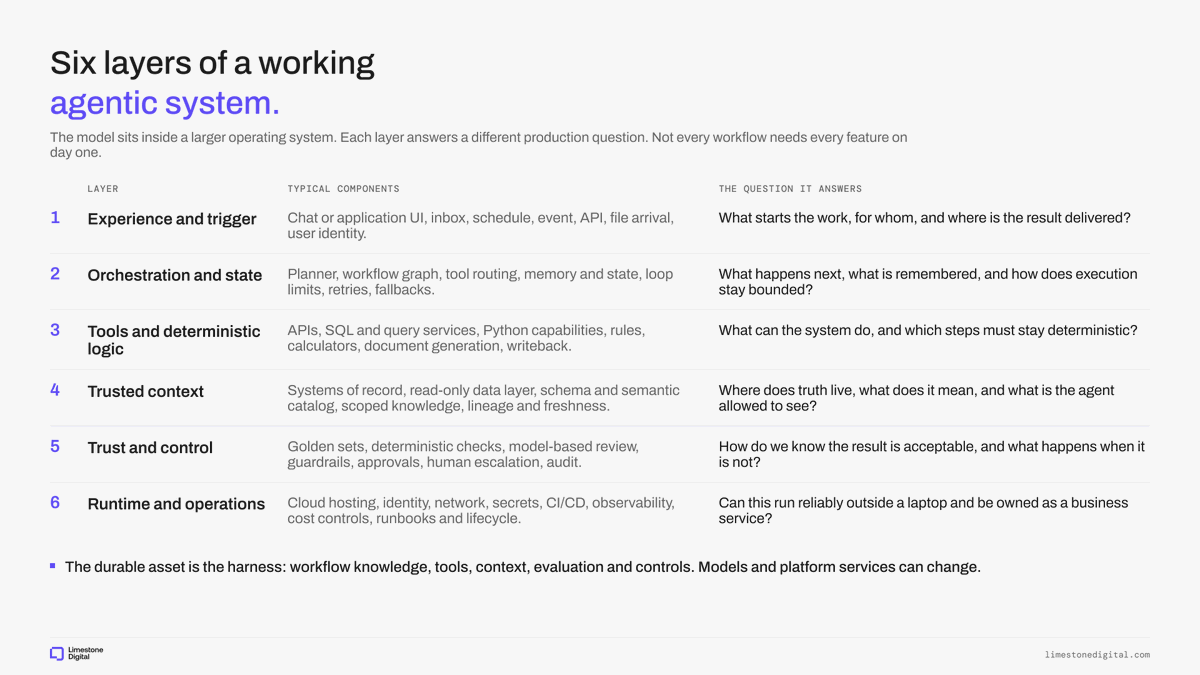
@mardehaym posted (59 likes, 12 replies, 10,203 views, 132 bookmarks) a six-layer working-agent stack that placed orchestration/state, deterministic tools, trusted context, trust/control, and runtime/operations around the model. The image matters because it makes the abstract harness idea legible as a production architecture rather than a slogan.
@omarsar0 recommended (88 likes, 20 replies, 9,048 views, 63 bookmarks) starting with "the tiniest possible harness" instead of frameworks, and replies added the most useful detail: begin with a task that has a clear pass/fail result, then learn tool calling, system prompts, and context compaction by debugging a small loop. That pragmatic tone sat next to visible semantic fatigue: @ThePrimeagen complained (169 likes, 19 replies, 15,844 views, 51 bookmarks) that people are now using "harness" for what he thought should be called orchestration, and replies agreed the term risks becoming too broad to be useful.
@kloss_xyz said (76 likes, 11 replies, 4,653 views, 113 bookmarks) he had Grok Bot study 300+ GitHub skill repos and then named 12 that shaped his own setup; in replies he said he uses about 20 skills a day and 60 a week, often combining multiple writing-cleanup skills into one. URL enrichment made that less hand-wavy: the public Humanizer repo describes a Markdown skill that rewrites AI-sounding prose using 35 patterns while preserving source facts.
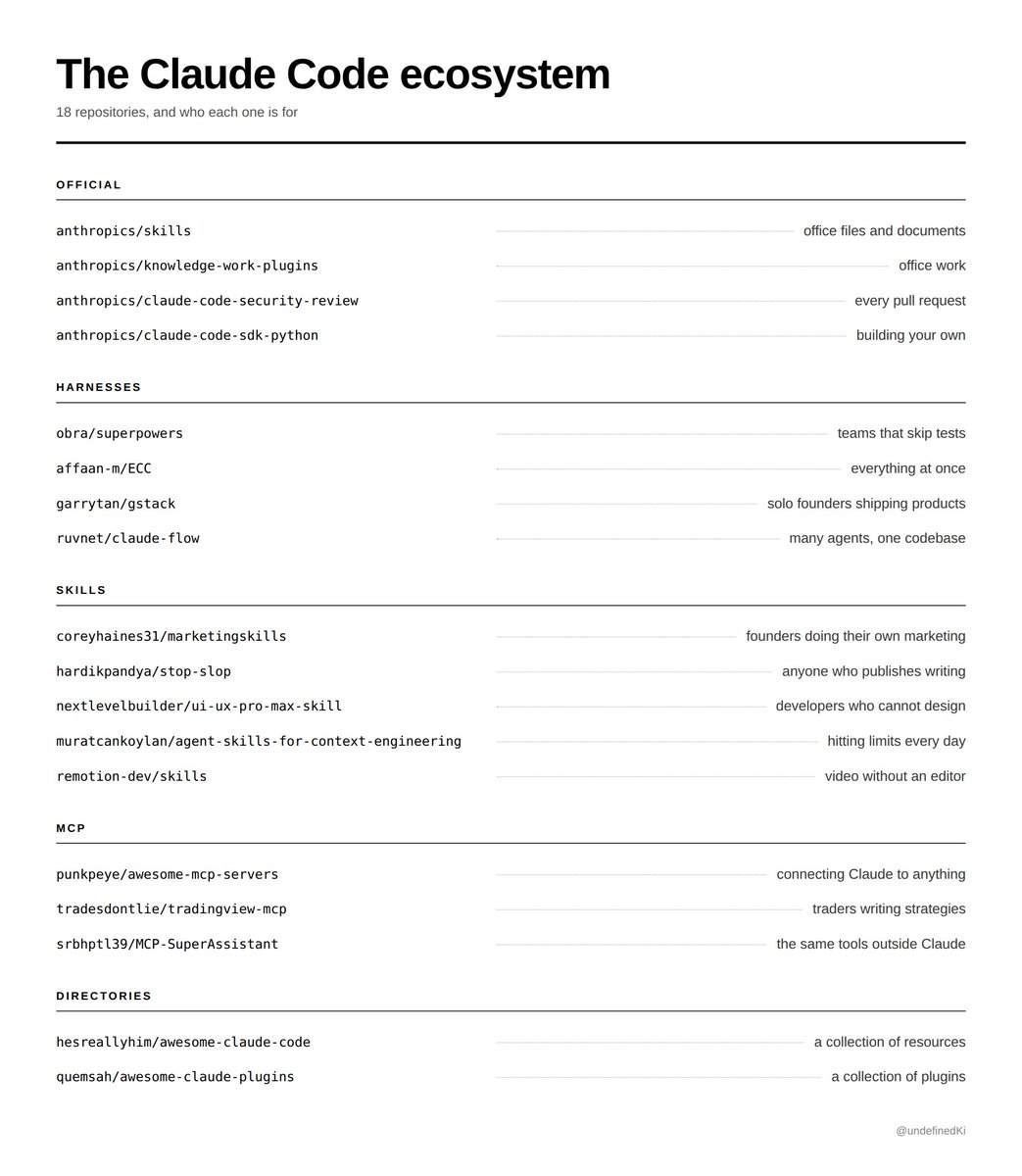
@undefinedKi mapped (52 likes, 19 replies, 5,606 views, 72 bookmarks) the "Claude Code ecosystem" into official repos, harnesses, skills, MCP servers, and list directories. The public anthropics/skills README confirms the repo is a real plugin marketplace and example-skill library, including source-available document skills and a direct install path for Claude Code.
@NikkiSiapno spelled out (16 likes, 3 replies, 1,531 views, 20 bookmarks) the emerging division of labor directly: "MCP gives agents reach. Skills give them know-how."

Discussion insight: The strongest replies in this cluster were not about whether skills work. They were about curation and trust: who audits them, how to avoid duplicate tools, and whether star counts or giant lists tell you anything about which skill should fire in production.
Comparison to prior day: August 31 emphasized organizational checklists and registries, from @businessbarista listing (180 likes, 26 replies, 19,092 views, 525 bookmarks) a "skills distribution system" as a feature of an AI-native company to @mattsgarman announcing (21 likes, 2 replies, 1,570 views, 5 bookmarks) AWS Agent Registry GA. September 1 kept the skills theme, but the evidence shifted toward hands-on remixing, repo maps, and open argument over terminology and governance.
1.3 New tools focused less on raw capability and more on bounded execution, reviewability, and editable outputs (🡕)
The most concrete builder posts of the day wrapped agents in tighter control planes. At least five retained items fit this pattern: a typed framework, an editable AI video editor, two AI-coding provenance tools, and a privacy-first onchain agent shell.
@danieljvdm introduced (136 likes, 7 replies, 11,583 views, 131 bookmarks) effect-agent as an Effect-native framework with schema-defined agents, typed failures, bounded tool use, subagents, persistence, and Cloudflare durability. Its public README adds the operational details the tweet only hints at: execution limits, bounded parallel tool batches, approvals, thread history/context management, and durable execution on Node.js with SQLite or Cloudflare Durable Objects.
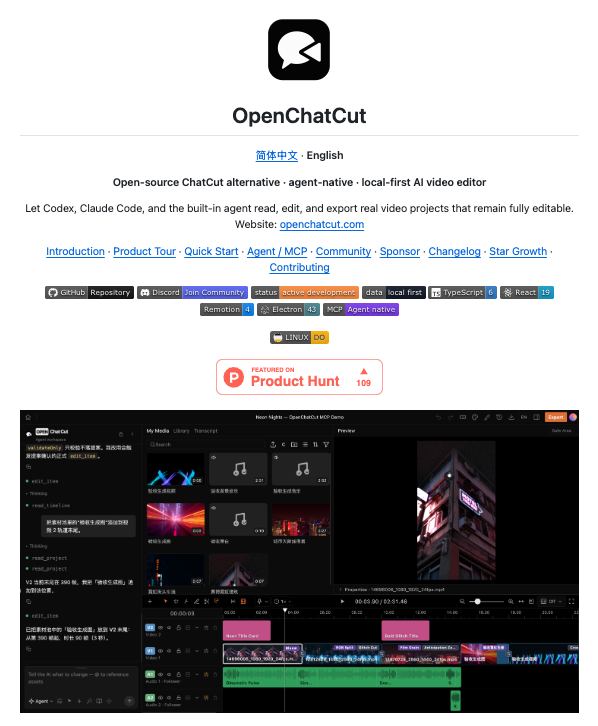
@aigleeson showed (14 likes, 4 replies, 340 views, 2 bookmarks) OpenChatCut turning Claude Code or Codex into an editor that proposes cuts, captions, transitions, and audio edits while leaving the multitrack timeline editable. OpenChatCut's public site describes it as a local-first, AGPL-licensed ChatCut alternative where external agents work through MCP on a real timeline, with transcript editing and editable exports instead of one-shot generated files.
@DanKornas presented (2 likes, 2 replies, 614 views) govctl as a governance-as-code CLI where RFCs, ADRs, work items, and verification guards live in the repo, and @FReza1984 described (2 replies, 23 views) Atlas as local source control for coding agents with checkpoints, searchable sessions, and shared memory across Claude Code and Codex. Their public govctl README and Atlas README confirm the underlying pattern: plain files, explicit artifacts, and auditable records around agent runs.

@jaouad2d claimed (33 likes, 40 replies, 174 views) ARC Terminal derives its wallet from an on-device passkey, keeps session material only in memory, and leaves public receipts for meaningful actions without exposing prompts. Public materials at arcterminal.ai support the broader framing of ARC Terminal as a privacy-first, browser-based onchain OS; the tweet is what adds the sharper claims around passkeys, ephemeral session state, and permissioned action.
Discussion insight: These were not just "better agents" posts. They were attempts to answer the same operational question from different angles: how do you keep the work bounded, reviewable, and recoverable after the model stops talking?
Comparison to prior day: August 31's tooling discussion centered on discovery and registry surfaces such as OpenClaw/ClawHub, Hermes Agent, and AWS Agent Registry. September 1 shifted toward execution contracts: durability, editable timelines, repo-native governance, local session provenance, and permissioned action records.
1.4 Agent commerce stayed protocol-heavy, but proof of delivery and dispute handling remained the real topic (🡒)
The loudest onchain cluster was still agent commerce, but the better items no longer treated it as just wallets plus AI. They spent their effort on delivery verification, dispute rules, escrow, and reputation.
@0xALTF4 argued (55 likes, 46 replies, 1,752 views) that payment rails are the easy part and that the real question is whether a system can decide if delivered work is actually correct. The attached diagram is the clearest single visual explanation in the day's dataset: client, provider, evaluator, and arbitrator roles sit above identity, escrow, staking, verification, and settlement layers.

@ZunnuMetaX framed (53 likes, 56 replies, 550 views, 4 bookmarks) AACP as the difference between a simple agent directory and a system where funds lock in escrow, deliveries get challenge windows, reputation updates on settlement, and verification strategy is fixed before work starts. In the thread, the author lays out five explicit states for a job, on-chain identity via a .agent handle, reputation-weighted staking, and a claimed ~2% protocol fee.

@Caccy_001 focused (63 likes, 73 replies, 798 views) on incentive design, saying reputation changes collateral requirements and that bad-faith acceptance criteria can also put the client's stake at risk. The interesting part was not the promotional volume numbers; it was the shift toward asking whether penalties, evaluators, and reputation are enough to make delivery quality legible between strangers.
Discussion insight: Even supportive replies kept landing on the same unresolved question: "how do we verify quality?" That makes this cluster more substantive than pure token promotion, but it also shows the category is still talking about mechanism design more than publicly completed, independently checked work.
Comparison to prior day: August 31 already had more credible official voices in this lane, especially @NEARProtocol promoting (83 likes, 1 reply, 13,497 views) Delphi Digital's agentic-commerce analysis and @BNBCHAIN offering (62 likes, 29 replies, 19,935 views) a $40,000+ marketplace hackathon. September 1 pushed deeper into workflow diagrams and incentive rules, but the public evidence still leaned more on proposed mechanics and in-progress tests than on finished, verified agent-to-agent deliveries.
2. What Frustrates People
Memory and context still fall apart on the tasks people most want agents to own
Severity: High. The clearest complaint of the day was not about model quality in isolation, but about systems losing the right context at the wrong moment. @belusochim said (1,243 likes, 37 replies, 29,439 views, 66 bookmarks) robots fail long-horizon tasks because they cannot get the right context at the right time, and replies extended that failure mode to chatbots and agents more broadly. @clairevo showed (37 likes, 8 replies, 6,518 views, 102 bookmarks) that practitioners are already coping by treating persistent files, voice memos, and company-specific context as the real asset, while a reply distilled the workaround into one sentence: "The chat is disposable, the file is the asset."
The coping strategy today was explicit externalization: shared memory, saved notes, thread history, cron memory, and operator-maintained context files. Worth building for: yes. The frustration is broad, concrete, and tied to long-horizon work that people already want to automate.
Teams can now install dozens of skills and plugins, but they still lack trustworthy curation and stable vocabulary
Severity: Medium to High. @kloss_xyz said (76 likes, 11 replies, 4,653 views, 113 bookmarks) he uses about 20 skills a day and 60 a week, while @undefinedKi mapped (52 likes, 19 replies, 5,606 views, 72 bookmarks) an 18-repo Claude Code ecosystem. But the replies under the ecosystem post kept returning to the same problem: "who audits them?", how to avoid installing overlapping tools, and whether giant lists or star counts actually identify the right skill.
At the same time, the underlying vocabulary is still unstable. @ThePrimeagen questioned (169 likes, 19 replies, 15,844 views, 51 bookmarks) whether people are calling orchestration a harness, and multiple replies agreed that the term is stretching too far to stay useful. Worth building for: yes, but this looks competitive. The gap is not another directory; it is trust signals, quality ranking, and clearer interfaces for when a skill, harness, plugin, or orchestration layer should be used.
"Done" still too often means the agent stopped typing, not that the work passed a check
Severity: High. @DanKornas said (2 likes, 2 replies, 614 views) the problem directly: AI coding gets messy when done only means the agent stopped typing. His govctl pitch answered that by forcing RFCs, ADRs, work items, and verification guards into the repository, while @FReza1984 described (2 replies, 23 views) Atlas as a system that keeps prompts, tool calls, file changes, and checkpoints queryable after the fact.
People are coping by adding extra layers around the model: approval gates, review agents, repo-native artifacts, and local provenance stores. Worth building for: yes. The demand is not for more code generation, but for better evidence that a generated change is reviewable, attributable, and actually complete.
Agent-to-agent commerce still lacks a convincing answer to "who decides the work was good enough?"
Severity: High. This was the central frustration inside the crypto-heavy cluster. @0xALTF4 wrote (55 likes, 46 replies, 1,752 views) that payment rails are easy and the hard part starts when one agent says the job is done and the other says it is useless. Replies did not rebut that; they reinforced it with questions about verification quality. @ZunnuMetaX added (53 likes, 56 replies, 550 views, 4 bookmarks) challenge windows, evaluator panels, and slashing rules, while @Caccy_001 focused (63 likes, 73 replies, 798 views) on reputation-weighted collateral and bad-faith penalties.
The workaround today is mechanism design: escrow, evaluators, arbitrators, reputation, and collateral. Worth building for: yes, but only if the product can show public, repeated examples of real deliveries being judged correctly. The frustration is not theoretical anymore, but the public evidence is still earlier than the promise.
3. What People Wish Existed
Persistent context that improves over time without becoming stale or opaque
The day produced multiple direct requests for systems that remember the right things and forget the wrong ones. @belusochim called out (1,243 likes, 37 replies, 29,439 views, 66 bookmarks) memory as the bottleneck in robotics, while @clairevo showed (37 likes, 8 replies, 6,518 views, 102 bookmarks) a PM workflow that keeps growing context instead of reopening blank chats. The practical need is not "more memory" in a generic sense; it is retained context with provenance, selective retrieval, and clear update rules. Opportunity: direct.
Skill ecosystems that tell operators what to trust, what to combine, and what not to install
People clearly want reusable skills, but the demand is shifting from raw quantity to curation. @kloss_xyz said (76 likes, 11 replies, 4,653 views, 113 bookmarks) he remixes many skills into a daily setup, and @undefinedKi mapped (52 likes, 19 replies, 5,606 views, 72 bookmarks) a sprawling Claude Code repo ecosystem. But replies immediately asked who audits these tools, how to avoid duplicates, and whether a list of 18 or 1,061 plugins helps anyone choose. Opportunity: direct, but competitive.
Provenance layers that make AI coding changes searchable, reviewable, and explainable after the fact
Two low-engagement but high-specificity projects made the same ask from different angles. @DanKornas pitched (2 likes, 2 replies, 614 views) a repo-native governance harness, while @FReza1984 pitched (2 replies, 23 views) source control for coding agents with prompts, tool calls, checkpoints, and shared memory. The need here is practical, not emotional: teams want a paper trail for AI-assisted work that survives rebases, agent switches, and review cycles. Opportunity: direct.
Delivery verification that works even when the buyer is not the domain expert
The strongest unmet need in the commerce cluster was a system that can judge output quality, not just release payment. @0xALTF4 said (55 likes, 46 replies, 1,752 views) the core issue is determining whether delivered work is actually valid, and @ZunnuMetaX expanded (53 likes, 56 replies, 550 views, 4 bookmarks) that into evaluator panels, locked verification strategies, and challenge windows. The need is highly practical and clearly unsolved in public today. Opportunity: direct.
4. Tools and Methods in Use
| Tool | Category | Sentiment | Strengths | Limitations |
|---|---|---|---|---|
| Claude Cowork | AI workspace | (+) | Compounding context over time; learns company jargon via Notion, voice memos, links, and custom plugins | Still leaves a meaningful PM judgment gap; depends on disciplined context maintenance |
| Anthropic Skills | Skill library / plugin marketplace | (+) | Dynamic skill loading; installable example and document skills; clear plugin workflow for Claude Code | Replies question auditability, overlap, and whether popularity helps selection |
| Humanizer | Writing skill | (+) | Rewrites AI-sounding prose with explicit pattern checks while preserving facts | Solves a narrow prose problem; still requires the user to supply source facts and voice samples when needed |
| MCP | Tool connection standard | (+) | Gives agents consistent reach into external tools and systems | Does not provide task know-how by itself; still needs skills or other operating logic |
| Effect Agent | Agent framework | (+) | Typed schemas, execution limits, bounded tool batches, approvals, history, subagents, and durable hosts | Public beta; durable storage/hosts/adapters are separate installs |
| Hermes Agent | Open-source agent framework | (+) | Bot Mode, bot-to-bot DMs, persistent cron memory, browser control, MCP dashboard | Evidence here is release-thread detail, not an independent benchmark |
| OpenChatCut | Agent-native video editor | (+) | Local-first editable timeline; transcript-driven editing; MP4 and FCPXML export; works with Claude/Codex via MCP | Connected AI services may add cost; early product surface rather than a mature editor category leader |
| govctl | Governance CLI | (+) | RFC/ADR/work-item flow, verification guards, repo-native TOML artifacts, brownfield adoption path | Heavier process than prompt-to-code workflows; social proof in this dataset is still thin |
| Atlas | Agent source control / memory layer | (+/-) | Cross-agent shared memory, session checkpoints, Markdown knowledge, JSONL/SQLite provenance, local-first design | README says macOS is the supported platform today; early-adopter project |
| ARC Terminal / ANIMA | Onchain AI OS | (+/-) | Passkey-derived local wallet, permissioned actions, public receipts, browser-based shell | Claims lean heavily on product/operator descriptions; evidence of broad organic use is still limited here |
| TermiX / AACP | Agent-commerce protocol | (+/-) | Identity, escrow, reputation, evaluator/arbitrator flow, and explicit dispute handling | Public debate still centers on quality verification, Sybil resistance, and whether the protocol proves real deliveries |
Overall, the strongest satisfaction clustered around tools that make agent state durable and inspectable: saved context, repo-native artifacts, editable timelines, and explicit execution limits. The most common workaround pattern was "externalize the state": move context into files, skills, histories, notes, receipts, or governed artifacts instead of trusting the transient chat alone. The clearest migration pattern was away from prompt-only usage and toward layered systems where MCP provides reach, skills provide know-how, and governance/provenance layers decide whether the result counts as done.
5. What People Are Building
| Project | Who built it | What it does | Problem it solves | Stack | Stage | Links |
|---|---|---|---|---|---|---|
| Effect Agent | @danieljvdm | Type-safe agent framework with bounded execution, approvals, subagents, history, and durable hosts | Makes agent loops explicit, typed, and recoverable instead of ad hoc prompt scripts | TypeScript, Effect, Effect AI, Node.js, SQLite, Cloudflare Durable Objects | Beta | tweet · site · repo |
| OpenChatCut | OpenChatCut | Local-first AI video editor where Claude, Codex, or the built-in agent edit a real multitrack timeline | Keeps AI-edited media inspectable, revisable, and exportable instead of ending in a locked generated file | MCP, local-first desktop/web app, transcript editing, MP4/FCPXML export | Beta | tweet · site · repo |
| govctl | govctl-org | Governance-as-code CLI for AI-assisted software delivery | Turns prompts and patches into RFCs, ADRs, work items, and guarded completion gates | Rust CLI, TOML artifacts, repo-native workflow | Beta | tweet · repo · site |
| Atlas | pacifio | Source control and shared memory layer for coding agents | Preserves prompts, tool calls, session logs, and commit provenance across agent switches and rebases | Rust/Tauri app, Markdown knowledge, JSONL logs, SQLite checkpoints | Beta | tweet · site · repo |
| ARC Terminal / ANIMA | ARC | Browser-based onchain agent shell with permissioned actions and public receipts | Lets agents act across browser, voice, and messaging while keeping credentials local and actions verifiable | Browser-based onchain OS, passkeys, local wallet control, permissioned agents | Beta | tweet · site |
| TermiX / AACP | TermiX | Marketplace and protocol for agent-to-agent work with escrow, reputation, and dispute handling | Tries to solve the post-payment question of whether delivered work was actually valid | Onchain identity, escrow, evaluator/arbitrator flow, reputation staking | Beta | tweet · site |
Effect Agent was the most detailed framework release in the dataset because its public README filled in the parts the tweet only named: execution limits, bounded parallel tool batches, approvals, thread history, and durable execution hosts. OpenChatCut stood out because it applies the same agent-control mindset to media work: the timeline remains editable, exports stay standard, and the AI does not become the only place where the project can live.
The govctl and Atlas posts pointed at the same builder pattern from different directions. One treats AI coding as a governed artifact workflow with RFCs and guards; the other treats every agent session as source material that should be checkpointed, linked to commits, and queryable later. ARC Terminal and TermiX apply that same instinct to onchain work: keep credentials local when possible, make actions inspectable, and put explicit rules around when money moves and when a task is considered complete.
6. New and Notable
Editable agent outputs became a product differentiator
OpenChatCut was notable because it made a strong claim that many AI creative tools still avoid: the generated result should stay editable in a normal project structure. @aigleeson described (14 likes, 4 replies, 340 views, 2 bookmarks) an editor where Claude Code or Codex can cut footage, add captions, and adjust audio while leaving the multitrack timeline intact, and the public site confirms transcript editing plus MP4/FCPXML export. That is a materially different product position from one-shot media generation.
Provenance for AI coding is turning into its own product category
govctl and Atlas did not have the biggest reach, but together they formed one of the clearest new signals in the dataset: builders are now shipping tools whose main job is not writing code, but making AI-written code reviewable after the fact. @DanKornas pitched (2 likes, 2 replies, 614 views) governed delivery through RFCs, ADRs, and guards, while @FReza1984 pitched (2 replies, 23 views) checkpointed agent source control. Their public repos and docs show this is more than a hot take.
Consumer-facing onchain agents are borrowing enterprise language: privacy, permissions, proofs
@jaouad2d framed (33 likes, 40 replies, 174 views) ARC Terminal around passkeys, ephemeral session state, and inspectable receipts rather than around raw agent cleverness. That matters because it imports enterprise-style control language into a consumer-facing onchain agent shell, and public product pages at arcterminal.ai back the broader positioning.
7. Where the Opportunities Are
[+++] Durable context with provenance and expiry — Evidence appeared in sections 1, 2, 4, and 5. People are already building around the gap with Claude Cowork context files, Hermes cron memory, Effect Agent history, and Atlas checkpoints, while the strongest complaint of the day was that long-horizon systems still lose the right context at the wrong time. The opportunity is strong because the need is immediate, cross-domain, and already tied to live workflows.
[+++] Governed AI coding control planes — govctl, Atlas, and Effect Agent all point to the same unmet need: teams want agent output that is bounded, reviewable, attributable, and recoverable. This is supported by sections 2, 4, 5, and 6, plus ThePrimeagen's and undefinedKi's replies showing that scale now creates governance and terminology problems, not just capability problems.
[++] Skill curation and automatic skill selection — The dataset showed clear appetite for reusable skills, but also immediate complaints about duplication, auditability, and giant unranked catalogs. That evidence came from kloss_xyz, undefinedKi, NikkiSiapno, and the prior-day shift from registries to practical remixing. This looks like a competitive but real opportunity.
[+] Verifiable agent-to-agent delivery — The TermiX/AACP cluster shows repeated focus on escrow, evaluators, challenge windows, and reputation rather than only on payments. The opportunity is real because the pain is explicit, but it remains emerging because the dataset still offered more diagrams and proposed mechanics than publicly demonstrated, independently verified completed jobs.
8. Takeaways
- Memory is now being treated as infrastructure, not polish. @belusochim called it the bottleneck in robotics (1,243 likes, 37 replies, 29,439 views, 66 bookmarks), and @clairevo showed a compounding context workflow for PM work (37 likes, 8 replies, 6,518 views, 102 bookmarks). (source)
- Skills have become a packaging layer for agent behavior, but trust and selection are the real unsolved parts. The day's strongest ecosystem posts came from @kloss_xyz remixing skills into a personal setup (76 likes, 11 replies, 4,653 views, 113 bookmarks) and @undefinedKi mapping an 18-repo Claude Code ecosystem (52 likes, 19 replies, 5,606 views, 72 bookmarks), while replies immediately asked who audits any of it. (source)
- The most concrete products of the day added controls around agents rather than simply making claims about smarter agents. Effect Agent's tweet (136 likes, 7 replies, 11,583 views, 131 bookmarks) and README, OpenChatCut's tweet (14 likes, 4 replies, 340 views, 2 bookmarks) and site, plus govctl and Atlas, all emphasized bounded execution, reviewability, and durable state. (source)
- The public language around agent systems is getting more specific and also more contested. @mardehaym translated harness talk into a six-layer architecture (59 likes, 12 replies, 10,203 views, 132 bookmarks), while @ThePrimeagen pushed back on what "harness" even means anymore (169 likes, 19 replies, 15,844 views, 51 bookmarks). (source)
- Agent commerce is no longer only about wallets and payments; it is about adjudication. @0xALTF4 made the strongest version of that case (55 likes, 46 replies, 1,752 views), and @ZunnuMetaX expanded it into challenge windows, evaluator panels, and fixed verification rules (53 likes, 56 replies, 550 views, 4 bookmarks). (source)