Twitter AI Agent - 2026-09-02
1. What People Are Talking About
1.1 Bot marketplaces and registries turned agent distribution into a product surface (🡕)
September 2 pushed agent distribution out of repo lists and into storefront language. At least three retained items supported this theme: an incoming Grok Bot marketplace, a sprawling registry map, and a clear managed-versus-self-hosted split between Grok Bot and Hermes.
@XFreeze reported (1,152 likes, 85 replies, 31,825 views, 372 bookmarks) that Grok Bot is getting a marketplace where users can browse hand-picked bots by category, inspect how each one works, and add them directly to a team. The quoted source tweet from @blankspeaker says the new Bots surface sits beside the existing plugin shop and was expected to launch within the week, which makes this more specific than a generic “marketplace soon” teaser.
@illyism argued (14 likes, 7 replies, 4,237 views, 76 bookmarks) that “traditional SEO is dead” because agents, plugins, skills, and MCPs now compete inside first-party stores and registries. The tweet’s URL list spans ChatGPT apps, GPTs, OpenAI plugins, Claude marketplaces, Cursor, Copilot plugins, hosted MCP directories, and community catalogs; a reply added the most concrete operator note in the thread: registries that can ping a live endpoint are the ones that actually send traffic.
@tonysimons_ framed (39 likes, 9 replies, 1,581 views) the Grok Bot versus Hermes choice as user segmentation rather than winner-take-all competition. In his summary, Grok Bot fits people who want cloud-hosted agents with minimal setup, while Hermes fits people who want custom models, recurring routines, memory, bot-to-bot handoffs, and control over where agents run; replies added smaller differentiators such as Hermes being desktop-first and not yet mobile.
Discussion insight: The interesting question was no longer whether people want reusable agents. It was who curates them, how live they are, and whether the product assumes a managed “AI team” buyer or a builder who wants to keep extending the system.
Comparison to prior day: On September 1, the closest parallel was still repo-level curation: @kloss_xyz said (76 likes, 11 replies, 4,653 views, 113 bookmarks) he had Grok Bot study 300+ GitHub skill repos and remix the best ones into his own setup. September 2 kept that installation theme, but moved the conversation up a layer into app stores, registries, and managed marketplaces.
1.2 Harness engineering moved from naming debate to concrete memory, project structure, and physical-world loops (🡕)
The strongest “harness” posts were more operational than rhetorical. At least four retained items described what the harness actually contains: layered memory, explicit extension points, stop conditions, and even voice-and-vision control loops for hardware.
@manthanguptaa shared (108 likes, 6 replies, 3,107 views, 132 bookmarks) a seven-part series on agentic memory, and the linked ChatGPT memory breakdown says the system feels persistent by combining session metadata, explicit long-term user facts, lightweight summaries of recent conversations, and the current chat window instead of generic vector retrieval. Replies pushed on exactly the edge cases practitioners care about: stale memories that keep resurfacing and whether Claude-style project memory scopes better across chats.
@tom_doerr pointed to (53 likes, 2 replies, 3,359 views, 79 bookmarks) a practical Claude Code guide centered on skills, hooks, subagents, workflows, and MCP. The repo itself describes those as five extension points that compose, and the screenshot matters because it shows the operational menu people are now standardizing around rather than just saying “use a harness.”

@ConsciousRide summarized (31 likes, 16 replies, 577 views) the production split as “Inference” versus “Harness,” listing tools, context, memory, state, permissions, verification, retries, and stop conditions on the harness side. Replies sharpened the point: one said inference has a vendor while “knowing when the task is done” gets whatever team member drew the short straw, and another said quantization savings can get paid back in retries when tool calls become less reliable.
@austingriffith showed (247 likes, 36 replies, 7,398 views, 44 bookmarks) the same idea crossing into the physical world: a voice-and-vision harness on Omarchy Linux that can inspect circuits, SSH into a controller, run code, send files to a 3D printer, and adjust a sensor while controlling a laser in real time. That made the day’s harness talk less about code assistants in the abstract and more about wrappers that can safely operate messy real systems.
Discussion insight: The reply layer repeatedly converged on three unsolved details: how to scope memory without carrying stale state forever, where one skill stops and another begins, and how to make an agent stop because a task is complete rather than because the model stopped talking.
Comparison to prior day: September 1 still spent energy on naming the layer: @mardehaym mapped (59 likes, 12 replies, 10,203 views, 132 bookmarks) a seven-layer production stack, while multiple quote-driven posts argued that harnesses had replaced prompt engineering. September 2 kept the same direction but added more specifics about memory design, project layout, and completion logic.
1.3 Vertical agents were evaluated against domain work, not just toy tasks (🡕)
The best builder posts came with benchmarks, domain constraints, or both. At least three retained items showed teams testing agents on legal review, antibody discovery, and safe local Firebase development instead of just posting one-shot demos.
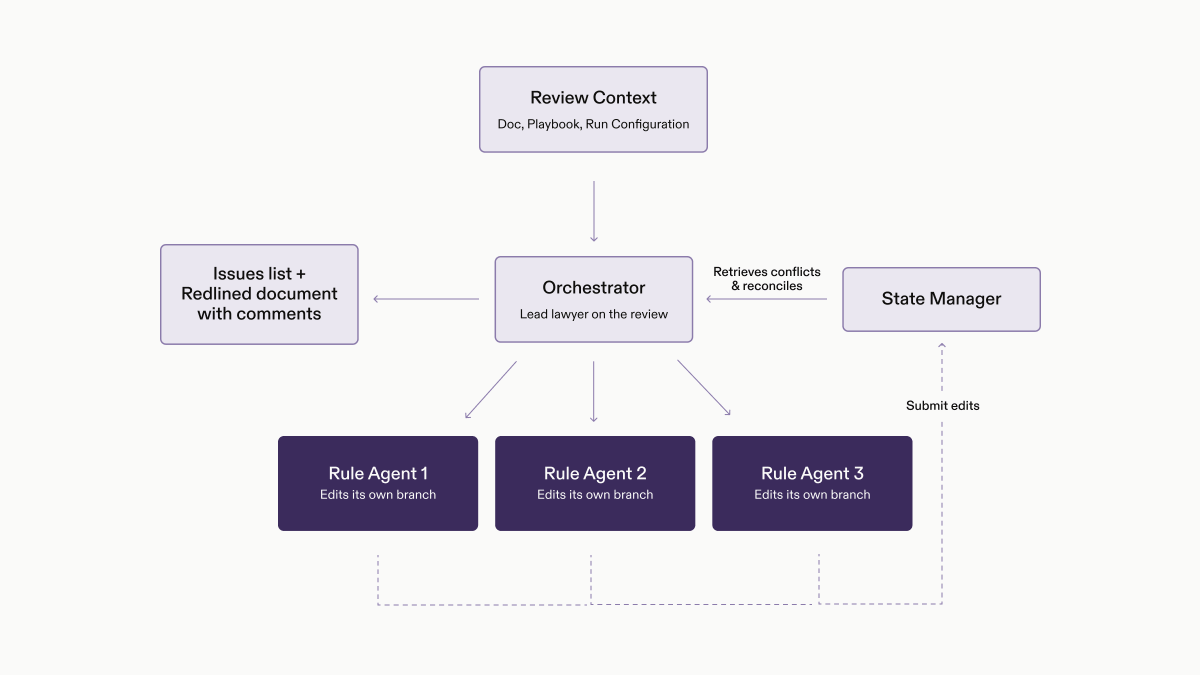
@harvey described (96 likes, 6 replies, 9,545 views, 117 bookmarks) a multi-agent contract-review system for in-house legal teams. The post says Harvey built a benchmark before picking an architecture, compared a rule-based workflow, a single agent, and an orchestrator with subagents, and found the multi-agent design performed best; the attached diagram shows why the tweet is substantive, with an orchestrator coordinating branch-editing rule agents and a state manager that reconciles conflicts.
@kenbwork introduced (52 likes, 6 replies, 4,189 views, 27 bookmarks) an antibody-discovery benchmark with 100 evaluations across target selection, assay design, binder discovery, pharmacology, antibody engineering, and preclinical de-risking. The tweet’s key result is that even across 20 model-harness configurations, the strongest setup passed only about half the attempts; the chart makes the claim legible by showing large swings by competency rather than one stable winner.

@_davideast launched (35 likes, 5 replies, 1,256 views, 14 bookmarks) Pyric, a disposable Firebase environment meant for coding agents. The site says the goal is to give agents a local sandbox with rich debug context instead of cloud-only state, and a reply adds the concrete differentiator versus Firebase emulators: Pyric generates indexes from code, lints rules, and covers cross-service rule behavior that the existing emulator path misses.
Discussion insight: The replies in this cluster were mostly about evaluation quality rather than excitement. Harvey’s readers focused on “benchmark before architecture,” while the antibody thread zeroed in on surprising model rankings and what missing failed-program data might hide.
Comparison to prior day: September 1 emphasized bounded execution and reviewability through more general-purpose frameworks such as @danieljvdm introducing (136 likes, 7 replies, 11,583 views, 131 bookmarks) effect-agent with typed failures, bounded tool use, and persistence. September 2 kept the reliability theme, but the evidence shifted into domain benchmarks and sandboxes tied to actual work.
1.4 Agentic commerce still revolved around verification, intent, and settlement (🡒)
The commerce cluster stayed active, but its substance was still trust infrastructure rather than delivered agent labor. Three retained items framed the problem as escrow, proof of intent, and multi-agent review before money moves.
@RMac_5 argued (115 likes, 84 replies, 4,510 views) that agent commerce needs a defined path from agreement to settlement, not just a way for agents to find each other. The attached graphic names TermiX as the settlement layer, AACP as the protocol, and agent.family as the marketplace, with escrow sitting between agreement and settlement.

@allpaypayz connected (19 likes, 1 reply, 357 views, 16 bookmarks) the same trust problem to card payments, saying “After KYC and KYB comes KYA.” The linked EMVCo release makes the jump notable: it introduces “Intent Services” as a shared layer for registering, retrieving, and managing consumer-authorized intent across recurring purchases, cumulative budgets, and post-transaction actions, and says future work may include Know Your Agent capabilities.
@Techie_Dammy pitched (82 likes, 53 replies, 636 views) “Token Verdict,” where multiple AIs research separately and cross-examine each other before an onchain trading verdict is written down. The replies were mostly supportive rather than skeptical, but the post still fit the day’s broader pattern: people keep inserting extra judges before they trust a single agent with money.
Discussion insight: This group kept returning to the same operational demand: valid credentials are not enough. Readers and builders both want persistent proof of what an agent was allowed to do, how completion gets challenged, and who signs off when the outcome is disputed.
Comparison to prior day: September 1 already had heavy discussion about escrow, evaluators, and dispute handling in AACP-style commerce. September 2 did not resolve that debate, but it did add payment-industry standards language from EMVCo on top of the crypto-native diagrams.
2. What Frustrates People
Memory that stays useful without turning into stale baggage
Severity: High. The memory conversation was no longer “agents should remember more,” but “agents should remember the right things, with clear scope and expiry.” @manthanguptaa showed (108 likes, 6 replies, 3,107 views, 132 bookmarks) that practitioners are still reverse-engineering memory layouts across ChatGPT, Claude, Hermes, OpenClaw, and voice agents, while replies asked for explicit handling of stale memories that keep resurfacing after correction. @ConsciousRide added (31 likes, 16 replies, 577 views) that the harness side of production AI still owns context, memory, retries, permissions, and knowing when the task is actually done.
People are coping with layered memory, project-scoped context, and manual harness rules, but the evidence still reads like active systems design rather than a solved product category. Worth building for: yes. The pain is direct and repeated across both coding and general-purpose agent workflows.
Catalog sprawl without enough trust signals or clean boundaries
Severity: Medium to High. @illyism mapped (14 likes, 7 replies, 4,237 views, 76 bookmarks) dozens of stores, registries, directories, and marketplaces for agents, plugins, and skills, which is useful evidence that the surface area is exploding. But the replies immediately narrowed the practical issue: the registries that actually route usage are the ones that can validate a live endpoint, while @tom_doerr linked (53 likes, 2 replies, 3,359 views, 79 bookmarks) to a guide whose first reply asked how to keep overlapping skills from stepping on each other.
The problem is not lack of listings. It is weak curation, limited health signals, and unclear boundaries between skills, bots, directories, and full harnesses. Worth building for: yes, but competitive. Any new solution has to do more than add another list.
Vertical agents still struggle to prove they deserve autonomy
Severity: High. @harvey said (96 likes, 6 replies, 9,545 views, 117 bookmarks) its older prompt-workflow approach was too brittle for complex contracts and that it had to benchmark multiple architectures before settling on an orchestrator with subagents. @kenbwork reported (52 likes, 6 replies, 4,189 views, 27 bookmarks) that even the best model-harness pair in antibody discovery passed only about half the benchmark attempts, and replies challenged surprising rankings and missing failure cases.
The current workaround is more evaluation, more decomposition, and more human review. Worth building for: yes. The frustration is concrete, expensive, and tied to high-value vertical work where even partial reliability gains matter.
Payments and agent commerce still need shared proof of intent and completion
Severity: High. @RMac_5 framed (115 likes, 84 replies, 4,510 views) agent commerce as a trust-and-settlement problem, not a discovery problem. @allpaypayz added (19 likes, 1 reply, 357 views, 16 bookmarks) that payment systems may need to identify the agent itself, while EMVCo’s September 1 release says agentic card payments may require a persistent shared state for consumer-authorized intent across recurring purchases and post-transaction actions. @Techie_Dammy responded (82 likes, 53 replies, 636 views) by proposing multi-agent consensus before an AI can move money.
The coping strategy today is escrow, extra evaluators, and proposed intent layers. Worth building for: yes, but still early. The public evidence is stronger on mechanism design than on repeated, verified real-world settlements.
3. What People Wish Existed
Memory that is scoped, inspectable, and easy to correct
What people seem to want is not infinite recall; it is memory they can reason about. @manthanguptaa outlined (108 likes, 6 replies, 3,107 views, 132 bookmarks) multiple memory architectures, while replies asked for explicit eviction behavior and project-scoped memory that does not keep resurfacing corrected facts. @ConsciousRide put (31 likes, 16 replies, 577 views) stop conditions, state, and verification in the same bucket, which suggests the practical need is a harness that can explain both what it remembers and why it decided a task was complete. Opportunity: direct.
Catalogs that validate live agents instead of just listing them
The discovery layer is visibly crowded, but operators still lack the equivalent of uptime checks, compatibility guarantees, and quality scoring. @illyism collected (14 likes, 7 replies, 4,237 views, 76 bookmarks) dozens of registries and marketplaces, and one reply said the directories that actually drive traffic are the ones that can ping a real endpoint. @tonysimons_ showed (39 likes, 9 replies, 1,581 views) that buyers also want help picking between a managed product and a build-it-yourself system. Opportunity: competitive.
Safer local sandboxes for coding agents to experiment without production fallout
This need was unusually concrete. @_davideast launched (35 likes, 5 replies, 1,256 views, 14 bookmarks) Pyric specifically because cloud-stateful Firebase workflows make debugging security rules hard for both humans and agents, and the site says the goal is to let agents build against a local sandbox with richer inspection tools. Harvey’s contract-review post points to the same desire from another angle: people want agents to parallelize real work, but only inside a system that leaves readable artifacts and merge points behind. Opportunity: direct.
Control planes that make autonomous agents auditable by default
The governance demand surfaced both in screenshots and in payments standards language. @kvbogdan shared (14 likes, 624 views, 19 bookmarks) a dashboard with approvals, incidents, rules, protected actions, and action history, while @allpaypayz connected (19 likes, 1 reply, 357 views, 16 bookmarks) agentic payments to persistent proof of intent and agent identity. The need here is practical, not aspirational: operators want review queues, policy interventions, and auditable state before they let agents touch money or production systems. Opportunity: direct.
4. Tools and Methods in Use
| Tool | Category | Sentiment | Strengths | Limitations |
|---|---|---|---|---|
| Grok Bot | Managed agent platform | (+/-) | Marketplace flow, categorized bots, easy add-to-team setup from @XFreeze | Limited control compared with self-hosted systems; marketplace was still described as upcoming |
| Hermes Bot Mode | Self-hosted agent runtime | (+/-) | Custom models, memory, recurring routines, bot-to-bot messaging in @tonysimons_ | Higher setup burden; replies called it desktop-first with no mobile app yet |
| Claude Code | Coding-agent harness | (+) | Skills, hooks, subagents, workflows, and MCP as composable extension points in the linked guide | Operators still struggle with skill overlap and boundary-setting in the thread around @tom_doerr |
| Opus 5 + Claude Code | Model + harness pair | (+/-) | Led the antibody benchmark at about 53% in @kenbwork | “Best” still meant only about half the attempts passed |
| Gemini 3.8 Flash | LLM / agent-builder model | (+) | Surfaced in Agent Studio for coding and multimodal agent tasks in @testingcatalog | Replies still asked for benchmarks before judging it |
| GPT Astra | Frontier model / orchestration | (+/-) | @testingcatalog and @Lentils80 both describe long-running orchestration strength and strong cyber evaluations | Access is tightly restricted because OpenAI labeled the model Critical for cybersecurity |
| Pyric | Local dev sandbox | (+) | Disposable local Firebase environment, rule linting, index generation, and richer debug context for agents in Pyric and @_davideast | Focused on Firebase workflows; still a new tool |
| Pipecat PhoneLLM Alpha 1 | Voice LLM | (+) | Open-weights 30B model for phone agents; low-latency, tool-calling voice workflows in the Pipecat README | Needs separate hosting and surrounding voice infrastructure |
| Deepgram Flux | Speech I/O | (+) | Handles both STT and TTS in the Pipecat phone stack | Adds an external service dependency and key management |
| Modal | Model hosting | (+/-) | Provides an OpenAI-compatible endpoint for PhoneLLM in the Pipecat setup guide | Provisioning can take around 20 minutes and requires proxy-token setup |
| AACP / TermiX | Settlement protocol | (+/-) | Agreement -> escrow -> settlement flow is explicit in @RMac_5 | Public evidence still centers on diagrams and proposals more than verified completed work |
Overall, the satisfaction curve ran from “easy but managed” to “powerful but operator-heavy.” Grok Bot was valued for fast setup, Hermes for control, Claude Code for structure, and Pyric for keeping agent experimentation local and inspectable. The common workaround pattern was to wrap models in more scaffolding: extra evaluators before payments, benchmarks before architecture choices, rule dashboards before automation, and local sandboxes before letting a coding agent touch live infrastructure.
5. What People Are Building
| Project | Who built it | What it does | Problem it solves | Stack | Stage | Links |
|---|---|---|---|---|---|---|
| Harvey contract-review system | @harvey | Multi-agent assistant for legal contract review and negotiation | Fixed prompt workflows were too brittle for non-standard contracts and playbook-heavy review | Orchestrator, rule-specific subagents, benchmark, multi-model routing, git-like document versioning | Beta | tweet |
| Pyric | @_davideast | Disposable local Firebase environment for coding agents | Cloud-stateful Firebase development leaves agents blind on rules errors and hard to reset | Local sandbox, rule linting, index generation, structured inspection tools | Shipped | tweet, site |
| ECC | affaan-m surfaced by @Nayak__Ai | Full engineering harness with many subagents, skills, commands, hooks, and memory | Turns a plain coding assistant into a coordinated engineering workflow with review and security passes | Shell, TypeScript, Python, plugin-managed hooks, AgentShield, GitHub plugin | Shipped | tweet, repo |
| Invarn agent governance dashboard | @kvbogdan | Approval, incident, rule, and action-history dashboard for autonomous agents | Teams need visible oversight and policy interventions before agents act freely | Web dashboard, approval queues, policy rules, protected-action review | Alpha | tweet |
| Pipecat PhoneLLM example | pipecat-ai surfaced by @kwindla | Reproducible low-latency voice-agent starter project | Voice teams need an end-to-end stack that is fast enough to feel conversational | PhoneLLM Alpha 1, Modal, Deepgram Flux, browser client, eval suite | Shipped | tweet, repo |
Harvey was the clearest example of an agent team built around a real domain constraint rather than a generic “copilot” pitch. The important detail was not just that an orchestrator beat a single agent, but that the team says it built a benchmark first, then chose the architecture, then added document version control so parallel edits could be merged back into one negotiated contract.
Pyric and ECC pointed at two different ways teams are hardening coding agents. Pyric narrows the scope and makes the environment locally disposable, while ECC broadens the scope and installs planning, review, security, and memory as reusable infrastructure around the model.


The Invarn screenshots mattered because they made “agent governance” concrete: approvals, incidents, blocked actions, and recent history all sat in one operator view instead of being hidden in logs. The Pipecat PhoneLLM example did the same for voice work by publishing a full stack with hosting, speech I/O, a client, and evals instead of a single model announcement.

6. New and Notable
Astra became a restricted frontier-agent story, not just another model launch
@testingcatalog summarized (173 likes, 13 replies, 10,778 views, 20 bookmarks) OpenAI’s “Path to Astra” announcement as the first time OpenAI has labeled a model Critical for cybersecurity, with Astra scoring 100% on ExploitBench and finding two zero-days in evaluation. Coverage from OpenAI and SecurityWeek says OpenAI is keeping advanced cyber capabilities limited to vetted testers and Daybreak Blue access rather than doing an unrestricted rollout, which makes this a notable agent story because “long-running orchestration” and “high-risk autonomy” were bundled together rather than marketed separately.
Gemini 3.8 Flash showed up directly inside an agent-building surface
@testingcatalog posted (81 likes, 2 replies, 5,368 views, 8 bookmarks) that Gemini 3.8 Flash was already available in Agent Studio on GCP for coding and multimodal agent tasks. The screenshot matters more than the caption because it shows the release landing inside an interface that also offers tool use, agents, app building, and a gallery, which is a stronger signal than a standalone model-card announcement.

EMVCo formalized “Intent Services” for card-based agentic payments
The clearest standards-level signal came from outside crypto Twitter. @allpaypayz highlighted (19 likes, 1 reply, 357 views, 16 bookmarks) EMVCo’s draft framework for agentic payments, and the release itself says recurring purchases, cumulative budgets, and post-transaction actions may require a shared intent state that persists across participants. It also explicitly names future Know Your Agent and Agentic Transaction Indicator capabilities, which turns a niche thread topic into something payment infrastructure groups are now naming in public.
7. Where the Opportunities Are
[+++] Harness infrastructure for memory, permissions, and completion — Multiple sections pointed to the same gap. @manthanguptaa (108 likes, 6 replies, 3,107 views, 132 bookmarks) showed active reverse-engineering of memory layers, @ConsciousRide (31 likes, 16 replies, 577 views) named stop conditions and verification as harness work, and @austingriffith (247 likes, 36 replies, 7,398 views, 44 bookmarks) showed those wrappers extending into hardware control. This is strong because the pain appears across coding, general productivity, and physical-world workflows.
[++] Safe evaluation and sandbox layers for high-value agent work — Harvey’s benchmark-first contract system, the antibody benchmark from @kenbwork (52 likes, 6 replies, 4,189 views, 27 bookmarks), and Pyric’s local Firebase sandbox all point to the same need: let agents act, but inside environments that can grade, inspect, and roll back what happened. This is moderate-to-strong because the willingness to pay should be high in legal, science, and production engineering settings.
[++] Distribution and governance surfaces for reusable agents — Grok Bot’s incoming marketplace, @illyism (14 likes, 7 replies, 4,237 views, 76 bookmarks) mapping the registry layer, and @kvbogdan (14 likes, 624 views, 19 bookmarks) showing a governance dashboard all suggest that “discover, install, monitor, and review” is becoming its own product surface. This is moderate because the market is already crowded, but trust, compatibility, and operator controls are still thin.
[+] Agentic payment identity and settlement — @RMac_5 (115 likes, 84 replies, 4,510 views), @Techie_Dammy (82 likes, 53 replies, 636 views), and EMVCo’s draft on Intent Services all agree that autonomous payment needs more than credentials. This is emerging because the design problem is clear, but public proof of repeatable real-world execution still looks early.
8. Takeaways
- Agent distribution is becoming a product category of its own. The clearest signal was Grok Bot’s incoming marketplace, backed by @XFreeze reporting (1,152 likes, 85 replies, 31,825 views, 372 bookmarks) that users will be able to browse categorized bots and add them to a team, while @illyism showed (14 likes, 7 replies, 4,237 views, 76 bookmarks) how many stores and registries already compete for that role.
- Harness talk got more concrete than it was the day before. Memory layers, project structure, permissions, retries, and stop conditions were all named explicitly by @manthanguptaa (108 likes, 6 replies, 3,107 views, 132 bookmarks), @tom_doerr (53 likes, 2 replies, 3,359 views, 79 bookmarks), and @ConsciousRide (31 likes, 16 replies, 577 views), instead of staying at the level of “prompt engineering is over.”
- The best vertical-agent evidence came from people willing to publish constraints and mediocre scores. Harvey benchmarked three contract-review architectures before choosing one, and @kenbwork reported (52 likes, 6 replies, 4,189 views, 27 bookmarks) that even the top antibody-discovery setup passed only about half the benchmark attempts.
- Coding-agent tooling is moving toward local, inspectable environments. @_davideast launched (35 likes, 5 replies, 1,256 views, 14 bookmarks) Pyric so agents can build against a disposable local Firebase rather than opaque cloud state, which matches the broader demand for stronger harness visibility. (site)
- Agentic commerce is still mostly about trust rails, but standards bodies are now entering the conversation. The RMac_5 settlement diagram, Token Verdict’s multi-agent jury, and EMVCo’s new Intent Services release all point to the same unresolved requirement: autonomous agents need auditable intent and challengeable completion before they can move money safely, a point @allpaypayz (19 likes, 1 reply, 357 views, 16 bookmarks) tied directly to Know Your Agent language.