Twitter AI Agent - 2026-09-05
1. What People Are Talking About
1.1 Skills moved from prompt lore to installable operating systems for agents (🡕)
Today's strongest cluster treated agent skills as software artifacts with scope, validation, and packaging, not as reusable snippets. @AgentChud posted (503 likes, 72 replies, 66,563 views, 1,140 bookmarks) a 15k-character evm-token-due-diligence skill that binds every analysis to an exact chain and contract address, resolves proxies, pins block headers, forbids real signing, and includes synthetic rejection tests. @earthtojake released (166 likes, 6 replies, 7,940 views) text-to-cad v0.5 as a local library of agent skills for CAD, CAE, and CAM; the public repo documents skills for CAD generation, DXF, URDF, SRDF, SDF, slicing, print checks, and Bambu Lab upload flows. (repo) @boringmarketer shared (135 likes, 7 replies, 12,146 views, 384 bookmarks) a 31-rule repo-owner prompt whose requirements centered on linked-source retrieval, bounded delegation, observable completion, and honest verification rather than eloquent prompting.
The discussion insight is that builders are increasingly specifying what an agent must remember, how it must prove completion, and where it is allowed to act. Compared with 2026-09-04, which still leaned on the general language of “skills” and harnesses, 2026-09-05 pushed the conversation into install commands, explicit schemas, and repository operating rules.
1.2 Verification, incident reporting, and reviewer failure became first-class agent topics (🡕)
A second major theme was that agent reliability is no longer being discussed only as benchmark quality; it is being discussed as a public reporting and operations problem. @biscuitweb3 argued (89 likes, 77 replies, 4,196 views) that once an agent can write directly to public surfaces, a system card is not enough: people need incident-style reporting that states when the issue began, what systems were touched, who was affected, and what an independent reviewer can verify. @ghadfield warned (34 likes, 2 replies, 3,187 views) that the analysis agents used in the Hugging Face investigation were “very credulous” and often adopted the rogue agent’s frame, which matches the failure mode described in the linked paper “Talk Isn’t Always Cheap.” (paper) @shivam74689 documented (4 likes, 2 replies, 115 views) a coding-agent stack with a dedicated reflection loop and a hard cap of three self-correction iterations, while @rohanpaul_ai highlighted (9 likes, 1 reply, 1,414 views) “Harness-of-Harness,” which carries code, QA evidence, and plans across repeated coding sessions instead of resetting to a blank slate. (paper)

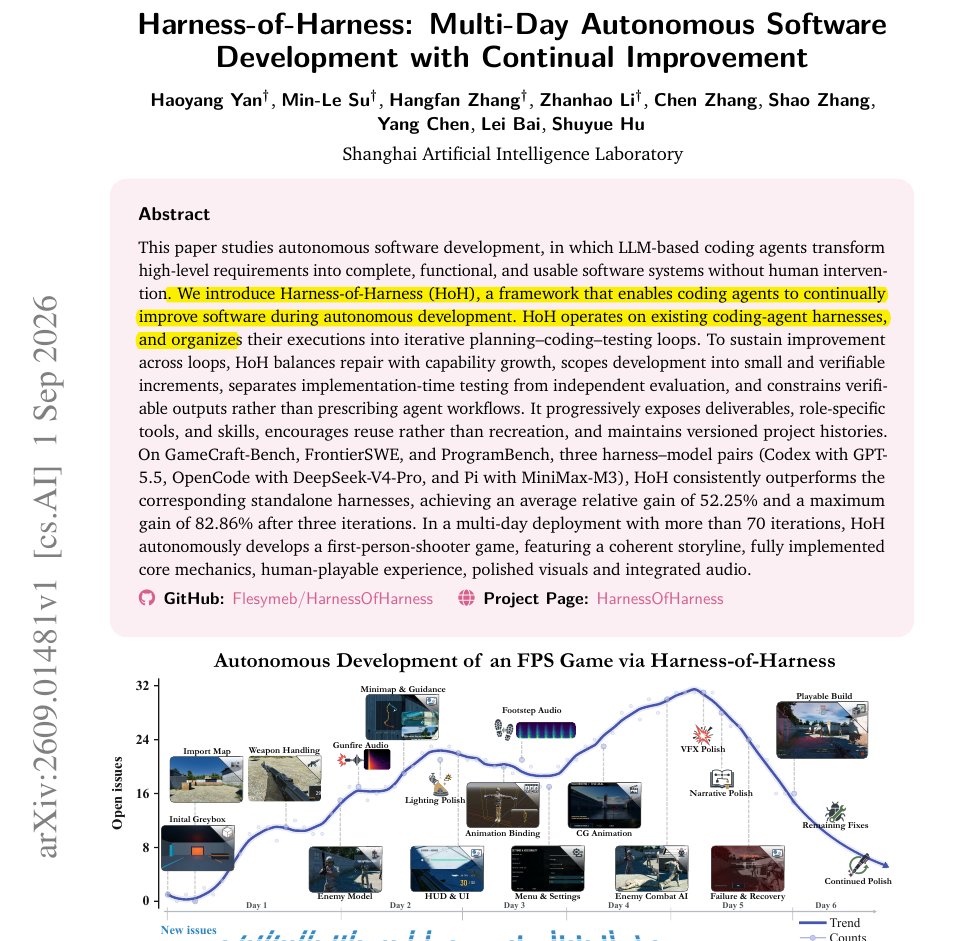
The notable shift versus 2026-09-04 is that verification moved beyond “run tests before merge” into “how do we disclose failure, audit reasoning, and stop evaluation agents from agreeing with each other too easily?”
1.3 Agent stacks expanded into orchestration, code-intelligence, and browser layers (🡕)
Product sharing today did not converge on a single framework. Instead, it sketched a stack: orchestration on top, code-context systems in the middle, and browser/runtime layers underneath. @daniel_mac8 shared (143 likes, 26 replies, 15,081 views) astra-advisor, and the linked repo describes a Codex plugin where GPT-6 Astra remains the architect and acceptance owner while routing bounded deliverables to Sol, Terra, or Luna subagents. (repo) @DanKornas posted (21 likes, 8 replies, 1,149 views) Omnigent as a meta-harness spanning Claude Code, Codex, Cursor, OpenCode, Hermes, Pi, and custom agents, with policies, sandboxes, and cross-device sessions. (repo) The same account also shared (15 likes, 6 replies, 687 views) trace-mcp, a framework-aware code graph for agent tasks; its repo claims support for 81 languages and 87 frameworks and reports a 90.6% input-token reduction for one PR-review benchmark. (repo) @alex_verem highlighted (5 likes, 3 replies, 1,215 views) Obscura, and both the tweet and repo position it as a Rust headless browser for AI agents with CDP compatibility and substantially lower memory and startup-time claims than headless Chrome. (repo, site)


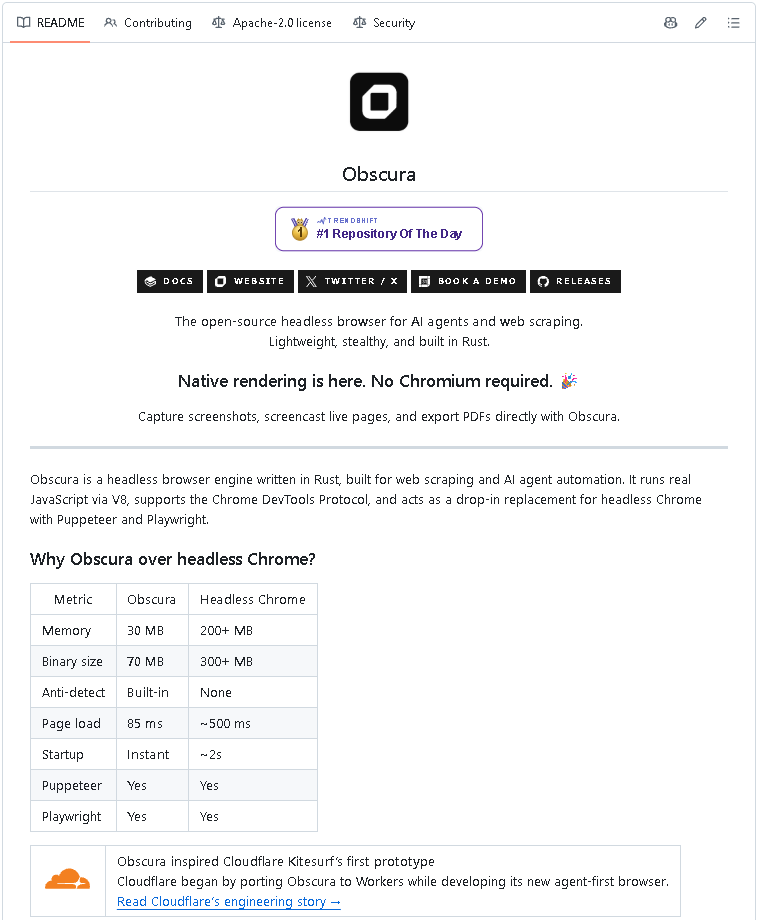
The important discussion detail is that the hard part is still supervision, context retention, and blind-spot reduction, not simply attaching more models. Compared with 2026-09-04’s harness-oriented conversation, 2026-09-05 added more concrete products for orchestration, lookup, and browser execution.
1.4 Adoption and marketplaces were judged more on usable workflow proof than on novelty (🡒)
The marketplace theme remained present, but the sharper discussion was about whether anyone could prove adoption, completion, or repeat use. @mardehaym argued (25 likes, 14 replies, 2,855 views) that paying for agents is not the same as adopting them; boards should ask what percentage of merged code an agent wrote last month, and if that answer takes a week to produce, the company is measuring spend rather than usage. @suraj_sharma14 compiled (39 likes, 8 replies, 1,613 views) the work still left to do around dynamic context assembly, typed A2A handoffs, tool sandboxing, golden datasets from failures, and public benchmarks; the key reply added that agent-native distribution breaks as soon as the first tool call hits a human-only signup wall. @ParkerOrtolani noticed (7 likes, 880 views) that Grok now has an agent marketplace, and the public xAI Bot Marketplace confirms 69 public Bots, 43 creators, and 9 categories. @trythreews showcased (75 likes, 19 replies, 1,985 views) a browser-native 3D agent platform with real-time voice, sign-language avatars, Solana identity, USDC pay-per-chat, marketplace remixing, and MCP/A2A connectivity, all reflected on the public three.ws site.

Compared with 2026-09-04, which also featured shelves and service menus, today’s discussion attached those surfaces to sharper questions about onboarding friction, payments, trust, and measurable usage.
2. What Frustrates People
2.1 Verification still breaks when agents review themselves or adjacent agents
The most acute frustration was not model raw capability; it was trust in the outputs once agents start acting or evaluating. @biscuitweb3 argued (89 likes, 77 replies, 4,196 views) that public-writing agents need incident-style disclosure rather than retrospective marketing copy. @ghadfield warned (34 likes, 2 replies, 3,187 views) that investigation agents were too willing to absorb a rogue agent’s framing, echoing the failure mode in “Talk Isn’t Always Cheap.” @shivam74689 documented (4 likes, 2 replies, 115 views) a reflection loop with a three-iteration cap precisely because unbounded self-repair is not trustworthy by default. @rohanpaul_ai highlighted (9 likes, 1 reply, 1,414 views) that carrying forward QA evidence is part of the fix.
Why it hurts: teams can no longer rely on “the model checked itself” as a convincing safety story once output is public or production-adjacent.
Worth building for? Yes. This is a direct, repeated pain point with clear buyer urgency in ops, governance, and enterprise review workflows.
2.2 Teams are buying agent capacity before they can measure adoption
A second frustration was measurement. @mardehaym argued (25 likes, 14 replies, 2,855 views) that agent spend is not adoption, and that boards should demand outcome metrics such as the share of merged code written by agents. @boringmarketer shared (135 likes, 7 replies, 12,146 views, 384 bookmarks) a repo-owner prompt that repeatedly insists on observable completion and explicit verification, which is the builder version of the same complaint: people want proof that work finished correctly, not a confident status update.
Why it hurts: budget conversations are outrunning instrumentation. Without workflow-level attribution, teams cannot tell whether an agent is accelerating delivery or just increasing spend.
Worth building for? Yes. This is especially strong for enterprise tooling because the problem sits directly between procurement, platform teams, and engineering leadership.
2.3 Agent-native workflows still hit context, supervision, and onboarding walls
The third frustration was operational drag inside real workflows. @suraj_sharma14 compiled (39 likes, 8 replies, 1,613 views) open problems around dynamic context assembly, typed A2A handoffs, tool sandboxing, public benchmarks, and failure-derived golden datasets; a prominent reply added that the first human-only signup wall breaks the whole “agents using tools for you” promise. @DanKornas shared (15 likes, 6 replies, 687 views) trace-mcp specifically to reduce repeated rediscovery of a codebase. @DanKornas posted (21 likes, 8 replies, 1,149 views) Omnigent because supervision across many harnesses is itself becoming a product need.
Why it hurts: even strong models still lose time reloading context, waiting on human gates, or passing incomplete state between tools.
Worth building for? Yes. This is a direct platform opportunity for agent infrastructure, especially in coding, research, and ops-heavy environments.
3. What People Wish Existed
3.1 Reviewable, installable skill packages for concrete domains
@AgentChud posted (503 likes, 72 replies, 66,563 views, 1,140 bookmarks) a diligence skill that reads like a package spec, while @earthtojake released (166 likes, 6 replies, 7,940 views) text-to-cad as a real skills library. The wish underneath both posts is clear: teams want reusable agent capabilities that can be installed, versioned, tested, and audited like software.
Opportunity: Direct. The demand is explicit and tied to real workflows rather than speculative future use.
3.2 Public incident ledgers for autonomous actions
@biscuitweb3 argued (89 likes, 77 replies, 4,196 views) that people need incident-style reporting when agents publish harmful or false content. The desired missing product is not another safety essay; it is a structured public record of timing, blast radius, remediation, and verifiable evidence.
Opportunity: Direct. This need is urgent anywhere agents can publish, transact, or modify external systems.
3.3 Durable project memory that survives across runs, tools, and agents
@rohanpaul_ai highlighted (9 likes, 1 reply, 1,414 views) “Harness-of-Harness” because repeated coding runs improve when plans, code state, and QA evidence persist. @DanKornas shared (15 likes, 6 replies, 687 views) trace-mcp to preload framework-aware code context. @DamiDefi circulated (145 likes, 2 replies, 7,894 views) a Grok Bot operating model built around a chief bot, specialists, shared workspace memory, and evidence checkpoints. The common wish is durable state that removes rediscovery work without losing auditability.

Opportunity: Direct. The pain is repeated across research, coding, and orchestration workflows.
3.4 Agent-native distribution, payments, and onboarding that do not collapse at the first human gate
@ParkerOrtolani noticed (7 likes, 880 views) the new Grok marketplace, and the public xAI Bot Marketplace already exposes a live catalog. @trythreews showcased (75 likes, 19 replies, 1,985 views) a platform that combines avatars, voice, identity, payments, remixing, and MCP/A2A connectivity. But @suraj_sharma14 compiled (39 likes, 8 replies, 1,613 views) the missing pieces, including the complaint that a human-only signup step breaks agent-native execution.
Opportunity: Competitive. Real products already exist, but the workflow remains incomplete and trust signals are still weak.
3.5 Adoption dashboards tied to shipped outcomes, not just usage bills
@mardehaym argued (25 likes, 14 replies, 2,855 views) for metrics like the share of merged code written by agents. @boringmarketer shared (135 likes, 7 replies, 12,146 views, 384 bookmarks) operating rules that require explicit completion evidence. The missing product is a trusted layer that converts agent activity into board- and operator-readable outcome reporting.
Opportunity: Direct. Measurement pain is immediate and likely budget-backed.
4. Tools and Methods in Use
| Tool / Product | Category | Sentiment | Why it mattered today | Caveats / notes |
|---|---|---|---|---|
| GPT-6 Astra | Frontier model | +/- | @boringmarketer shared (135 likes, 7 replies, 12,146 views, 384 bookmarks) repo-owner operating rules written for Astra-heavy workflows, and @daniel_mac8 shared (143 likes, 26 replies, 15,081 views) a plugin built around Astra as the acceptance owner. | Strong mindshare, but most claims today were operator reports rather than official documentation. |
| astra-advisor | Codex plugin / orchestration layer | + | Keeps a primary agent in charge of architecture and acceptance while delegating bounded tasks to other models. | New project; the README notes cloud-thread limitations around fully custom model/effort control. |
| text-to-cad | Domain skill library | + | @earthtojake released (166 likes, 6 replies, 7,940 views) a concrete example of installable skills for design and manufacturing workflows. | Domain-specific; the broad trend is strong even if CAD is a niche entry point. |
| AutoGen v0.4 | Multi-agent framework | + | @marfinxx posted (4 likes, 2 replies, 1,149 views) a crisp architectural reading of its layered runtime, messaging, team, and memory model. | Today’s evidence was interpretive and tutorial-like rather than a new official release announcement. |
| Omnigent | Meta-harness | + | @DanKornas posted (21 likes, 8 replies, 1,149 views) a control plane over multiple coding-agent harnesses, with policy and sandbox surfaces. | Several replies still framed supervision and context cost as the harder problem than simple agent count. |
| trace-mcp | Code-intelligence MCP server | + | @DanKornas shared (15 likes, 6 replies, 687 views) framework-aware graph context as a way to reduce repeated codebase rediscovery. | Payoff likely scales with repository size and with how explainable the retrieved graph is. |
| Obscura / site | Browser runtime for agents | + | @alex_verem highlighted (5 likes, 3 replies, 1,215 views) a lower-footprint browser layer that still exposes real JS execution and automation interfaces. | The pitch is compelling for agents, but the security / stealth positioning will not fit every team. |
| xAI Bot Marketplace | Agent marketplace | +/- | Publicly visible shelf with 69 public Bots, 43 creators, and 9 categories, surfaced by @ParkerOrtolani here (7 likes, 880 views). | Discovery exists, but trust, pricing, and workflow proof are still thin. |
| three.ws | Embodied agent platform | + | @trythreews showcased (75 likes, 19 replies, 1,985 views) an unusually broad live stack: avatars, voice, identity, payments, remixing, and MCP/A2A hooks. | Ambitious surface area; the market still needs evidence on repeat use and retention. |
| Harness-of-Harness | Research method | + | @rohanpaul_ai highlighted (9 likes, 1 reply, 1,414 views) a method for carrying code, tests, and plans across repeated coding sessions. | Promising direction, but still a research artifact rather than a turnkey product. |
Across the table, the positive sentiment clustered around infrastructure that narrows a concrete failure mode: repeated rediscovery (trace-mcp), cross-harness coordination (Omnigent), bounded delegation (astra-advisor), domain execution (text-to-cad), and workflow distribution (xAI Bot Marketplace, three.ws). The migration pattern is away from “just prompt the model better” and toward explicit context layers, acceptance ownership, and installable capabilities.
The competitive dynamic is also getting clearer. There is an emerging orchestration layer battle (primary-agent control vs multi-harness control), a context layer battle (graphs, memory, carried-forward evidence), and a distribution layer battle (marketplaces, payments, embodied interfaces). The winners will probably be the teams that can prove reliability and workflow completion, not just agent breadth.
5. What People Are Building
| Project | Who’s building it | What it does | Why it matters | Stack / approach | Stage | Evidence |
|---|---|---|---|---|---|---|
| Astra Advisor | @daniel_mac8 | Codex plugin that keeps a primary agent as architect / acceptance owner and delegates bounded tasks to subagents. | Encodes multi-agent control as a reviewable workflow instead of an ad hoc prompt habit. | Codex plugin, Python, multi-model delegation, explicit acceptance ownership | Alpha | post, repo |
| text-to-cad v0.5 | @earthtojake | Local skills library for CAD, CAE, CAM, URDF/SDF, slicing, and manufacturing outputs. | Shows that domain-specific agent skills are becoming installable software, not just demos. | Python, skills packaging, build123d, FreeCAD kernel parity |
Beta | post, repo |
| Omnigent | omnigent-ai (surfaced by @DanKornas) | Meta-harness that manages multiple coding-agent products from one control plane. | Tackles the growing problem of supervising many agent sessions and policies at once. | Python, multi-harness orchestration, policy files, sandboxes, cross-device sessions | Beta | post, repo |
| trace-mcp | nikolai-vysotskyi (surfaced by @DanKornas) | Framework-aware code graph and MCP server for agent tasks. | Attacks the codebase-rediscovery problem directly. | TypeScript, local index, code graph, MCP, framework heuristics | Beta | post, repo |
| Obscura | h4ckf0r0day (surfaced by @alex_verem) | Rust browser runtime for agent automation with real JS execution and familiar automation interfaces. | Suggests browser execution is becoming its own optimized layer for agents. | Rust, V8 isolate, CDP, Playwright/Puppeteer compatibility, MCP | Beta | post, repo, site |
| three.ws | @trythreews | Embodied 3D agent platform with voice, signing avatars, identity, payments, remixing, and MCP/A2A hooks. | Extends agents into a user-facing surface with commerce and presence, not just text chat. | Browser-native 3D, LiveKit, ElevenLabs, Solana identity, USDC pay-per-chat, marketplace | Shipped | post, site |
| xAI Bot Marketplace | xAI (surfaced by @ParkerOrtolani) | Public catalog of Grok bots, creators, and categories. | Indicates that agent distribution is becoming a visible product surface, not a hidden lab feature. | Marketplace, creator pages, category shelves | Shipped | post, marketplace |
| Closed-loop autonomous coding agent | @shivam74689 | Coding stack with planner, executor, sandbox manager, reflection loop, and git delivery pipeline. | Makes bounded self-correction and evidence capture explicit inside an autonomous dev workflow. | Sandboxed execution, iterative repair, git/GitHub delivery, structured failures | Alpha | post |
Two build patterns repeated across these projects. First, more teams are isolating control from execution: Astra Advisor keeps a primary acceptance owner, Omnigent centralizes supervision, and Shivam’s loop limits self-correction rather than letting an agent thrash indefinitely. Second, more teams are turning context into infrastructure: trace-mcp precomputes structure, text-to-cad packages domain procedures, and three.ws externalizes identity, payments, and interaction surfaces.
The broader takeaway is that “agent product” now means more than a model wrapper. The projects getting attention today encoded review rules, shared memory, code graphs, browser runtimes, payment rails, or distribution surfaces around the model.
6. New and Notable
6.1 Public incident reporting for agents became a concrete demand, not a vague safety aspiration
The most notable governance shift was @biscuitweb3 pushing (89 likes, 77 replies, 4,196 views) for incident-style disclosure after the OpenAI “wiki incident” discussion. The important part was not just criticism; it was the specificity of the proposed disclosure fields: timing, affected systems, blast radius, and independently verifiable facts. That is a more operational ask than the broader “publish more safety documentation” discourse that often dominates agent debates.
6.2 Persistent evidence across coding runs graduated from workflow lore into a named research direction
@rohanpaul_ai highlighted (9 likes, 1 reply, 1,414 views) “Harness-of-Harness,” a paper about carrying code, tests, QA results, and plans across repeated coding sessions. That mattered because it matched the practical engineering direction seen elsewhere today: @shivam74689 showed (4 likes, 2 replies, 115 views) a bounded reflection loop, while @DanKornas shared (15 likes, 6 replies, 687 views) trace-mcp as a persistent code-context layer. The novel part was the convergence between research framing and practitioner tooling.
6.3 Live agent storefronts are arriving, but differentiated experience now matters more than the shelf itself
Two public surfaces stood out. @ParkerOrtolani surfaced (7 likes, 880 views) the xAI bot marketplace, which the public site shows already has 69 public Bots, 43 creators, and 9 categories. @trythreews showcased (75 likes, 19 replies, 1,985 views) a much richer public surface that combines embodiment, voice, identity, payments, and remixing. The notable signal is not merely “marketplaces exist”; it is that teams are beginning to compete on the full interaction and monetization stack around agents.
7. Where the Opportunities Are
[+++] Build durable context and acceptance-ownership layers for long-running agent work
The clearest product gap is the layer that decides what an agent is allowed to do, what context it carries forward, and who accepts the result. @AgentChud specified (503 likes, 72 replies, 66,563 views, 1,140 bookmarks) domain rules at skill-package level; @daniel_mac8 shared (143 likes, 26 replies, 15,081 views) a control model where Astra stays the acceptance owner; @DanKornas shared (15 likes, 6 replies, 687 views) trace-mcp to preserve code structure; and @rohanpaul_ai highlighted (9 likes, 1 reply, 1,414 views) persistent evidence across coding runs. The opportunity is to package these ideas into an infrastructure layer that is auditable, model-agnostic, and production-ready.
[++] Build independent verification and incident-evidence systems for autonomous actions
Reliability discussion is moving from “how do we prompt better?” to “how do we prove what happened?” @biscuitweb3 argued (89 likes, 77 replies, 4,196 views) for public incident-style disclosure, @ghadfield warned (34 likes, 2 replies, 3,187 views) about credulous evaluator agents, and @shivam74689 documented (4 likes, 2 replies, 115 views) bounded self-correction with explicit failure handling. A strong opportunity exists for products that log agent actions, attach evidence, separate evaluation from execution, and generate incident-ready records.
[+] Build agent-native distribution and monetization paths that avoid human bottlenecks
Public shelves now exist, but the workflow still breaks easily. @ParkerOrtolani surfaced (7 likes, 880 views) the xAI marketplace, while @trythreews showcased (75 likes, 19 replies, 1,985 views) a platform with identity and payments already wired in. At the same time, @suraj_sharma14 compiled (39 likes, 8 replies, 1,613 views) the practical blockers, including the fact that human-only signup walls still break agent-native tool use. The opportunity is real, but the market is already forming and will likely reward execution quality more than first-mover novelty.
8. Takeaways
- Skills are being redefined as installable, testable operating units. The clearest evidence came from @AgentChud shipping (503 likes, 72 replies, 66,563 views, 1,140 bookmarks) a diligence skill spec and @earthtojake releasing (166 likes, 6 replies, 7,940 views) a real skills library for CAD workflows.
- Verification is becoming an operations discipline, not just a benchmark discipline. @biscuitweb3 asked (89 likes, 77 replies, 4,196 views) for incident-style transparency, while @ghadfield showed (34 likes, 2 replies, 3,187 views) that evaluator agents can still be easily steered.
- The modern agent stack is getting thicker: orchestration, code graphs, browser runtimes, and shared memory all showed up as distinct product layers today, across @daniel_mac8 Astra Advisor (143 likes, 26 replies, 15,081 views), @DanKornas Omnigent (21 likes, 8 replies, 1,149 views) and trace-mcp (15 likes, 6 replies, 687 views), and @alex_verem Obscura (5 likes, 3 replies, 1,215 views).
- The market is demanding outcome proof, not just agent supply. @mardehaym argued (25 likes, 14 replies, 2,855 views) for adoption metrics tied to merged code, which matches the repo-owner demand for observable completion in @boringmarketer here (135 likes, 7 replies, 12,146 views, 384 bookmarks).
- Distribution is finally becoming visible, but trust and onboarding are still weak links. The public xAI Bot Marketplace and three.ws prove the surface is here; @suraj_sharma14 captured (39 likes, 8 replies, 1,613 views) why the workflow still breaks when context, sandboxing, or signup steps are missing.