Twitter AI Agent - 2026-09-08
1. What People Are Talking About
1.1 Consumer-agent competition shifted from raw model quality to distribution, context, and relationship lock-in (🡕)
The strongest consumer thread was not about a new base model release. It was about what would make people stay once many agents feel comparably capable. @joshelman argued (665 likes, 71 replies, 61,704 views, 573 bookmarks) that consumer AI products without network effects, marketplaces, or platform lock-in remain easy to switch away from because they are still “single-player” surfaces tied mostly to model performance. The most useful replies added two concrete variants of that moat: accumulated personalization and relationship lock-in, with one respondent pointing to the backlash around losing a favored model personality.
@aaryankushwah launched (455 likes, 44 replies, 172,452 views, 535 bookmarks) Companion as an iMessage agent built around GPT-6 Astra, inherited ChatGPT context, marketplace plugins, and an isolated computer with MCPs and CLIs. The public Companion site says the agent gets a real computer, can browse the web, run terminal commands, handle files, use the 1,000+ apps already connected to a user's ChatGPT account, and even make payments through Link CLI. That positioning matched the reply-level complaint that Instinct still had stronger context reliability for some users, which means the competitive surface is increasingly a mix of latency, context inheritance, and integration depth rather than pure model IQ.
@signulll reported (492 likes, 21 replies, 30,098 views, 138 bookmarks) that Muse felt compelling because it combined imessage-style agent behavior with Meta's friend graph, connected services, and especially Facebook Marketplace as a distribution wedge. The attached product card makes the claim concrete: Muse is framed as an agent that can watch Marketplace continuously, negotiate against comparable listings, and arrange pickup while still checking with the user before committing.

@eshita added (7 likes, 1 reply, 943 views) that a personal agent needs relatable starter tasks and capabilities, not just a tool catalog. The attached Muse onboarding screen backs that up with example jobs across scheduling, moving, subscription cleanup, inbox planning, school logistics, pet care, and family coordination.

Discussion insight: the most substantive replies did not disagree that model quality matters; they argued that the harder moat is what the agent learns about you, who else is already there, and which transaction surface it can act on.
Comparison to prior day: 2026-09-07 already had a visible “who wins AI assistants?” thread plus an earlier Companion launch tweet, but 2026-09-08 sharpened the answer. The conversation moved from assistant rankings toward concrete distribution wedges such as iMessage context inheritance, social graphs, and Marketplace-native transactions.
1.2 Benchmarks, evals, and codebase memory got more concrete (🡕)
A second major theme was that harness talk kept turning into measurement talk. @ArtificialAnlys announced (1,528 likes, 130 replies, 278,437 views, 252 bookmarks) Intelligence Index v4.3, which upgrades Terminal-Bench from 2.1 to 4.0 and replaces a banking benchmark with AutomationBench-AA, a 657-task business-workflow benchmark built with Zapier's held-out test set. The thread makes the mechanics unusually explicit: the private-task weighting rose from 40% to 45%, Terminal-Bench 4.0 now covers 66 multi-step terminal tasks, and GPT-6 Astra and Claude Fable 5.1 both scored 53 on the top-line index while Astra led the cost frontier.

@hugobowne shared (134 likes, 11 replies, 6,531 views, 198 bookmarks) a guest post arguing that evals belong at the center of harness engineering. The attached diagram is useful because it breaks “good evals” into five checks: did the real-world outcome happen, did the agent actually call the tool it claimed to call, did it recover when the first retrieval path failed, did an old fix stay fixed, and are the criteria still measuring the right thing.

@suraj_sharma14 posted (89 likes, 4 replies, 4,182 views, 142 bookmarks) a builder's shopping list for AI engineering that centered on context assemblers, model routers, semantic caches, sandboxed executors, workflow engines, tracers, and eval harnesses. A reply tightened the point further: start with adversarial tasks and named failure modes, then block merges when those evals regress. @mardehaym argued (31 likes, 16 replies, 1,861 views) that a markdown knowledge graph built before the first code change saved roughly four months of rework on a logistics client by keeping the agent aligned with real module boundaries, data flows, and abandoned patterns.
Discussion insight: the strongest replies kept separating “the score told me it failed” from “the environment told me why it failed.” That is why the day featured both eval artifacts and codebase-context artifacts.
Comparison to prior day: 2026-09-07's top harness thread argued that harnesses are real research. On 2026-09-08, the discussion got less abstract: held-out workflow weights, 66-task terminal suites, merge-blocking evals, and brownfield knowledge graphs replaced generic harness advocacy.
1.3 The infrastructure layer thickened around orchestration, observability, and agent-readable context (🡕)
The builder conversation widened from “use a harness” to “which layer of the stack should be productized next?” @rauchg announced (401 likes, 49 replies, 31,712 views, 298 bookmarks) a new round of open-source grants that explicitly carved out “Agent skills & tools” as a funding theme, a sign that this layer is being treated as durable software rather than prompt hobbyism. On the execution side, @shiqway92 shared (40 likes, 7 replies, 915 views, 30 bookmarks) a three-repo stack around InsForge, Flue, and E2B, arguing that the differentiator is not smarter models but infrastructure that lets agents store state, run code, and test what they build. The public InsForge repo and site support the narrow, strong claim: agents can operate database, auth, storage, edge functions, compute, deployment, and model-gateway surfaces through MCP or CLI-plus-skills rather than stopping at code generation.
Research-oriented orchestration and observability artifacts also showed up in more concrete form than usual. @KyeGomezB introduced (17 likes, 13 replies, 2,471 views) GraphWorkflow as a compile-once execution engine for large multi-agent DAGs, and the attached slide claims 7x average speedup and up to 62.5x on larger graphs.

@marfinxx amplified (27 likes, 8 replies, 827 views, 17 bookmarks) Alibaba's UModel preprint, and the attached paper excerpt shows why it resonated: the paper reframes metrics, logs, and traces as structured objects tied together by an object-centric graph and a U-SPL query layer, instead of forcing agents to synthesize brittle multi-step PromQL/SQL chains by hand.

Discussion insight: whether the artifact was a benchmark, an agent stack, or a research preprint, the repeated move was the same: make context, orchestration state, and system evidence legible to agents before asking them to act.
Comparison to prior day: 2026-09-07 still centered much of the discussion on whether harnesses mattered and whether assistant UX was winning. On 2026-09-08, more of the evidence came from inspectable stack layers: backend control planes, orchestration engines, and observability models that expose machine-usable structure.
1.4 Agent commerce stayed loud, but the strongest public proof was around audit trails, escrow flow, and revocable access (🡒)
Agent-commerce volume remained high, but the most credible items were the ones that exposed mechanics instead of just saying “agents can transact.” @callmeperry3 argued (41 likes, 37 replies, 301 views) that once agents control economic value, intelligence matters less than whether custody, accounting, and performance can be independently verified. The attached Moss graphic condensed that thesis into a blunt slogan: if an agent acts, there should be a record.

@fepz_ documented (24 likes, 3 replies, 388 views) the Agent.family marketplace in a more operational way than most of the day's commerce posts. One screenshot shows searchable service categories plus budget, delivery, reputation, and verification filters.

A second screenshot shows an actual service page with $99 pricing, on-chain stablecoin escrow, a three-day review window, and a contested-order path instead of simple “trust me” fulfillment.

@Loreen2074591 added (12 likes, 8 replies, 134 views) that permissions themselves should be part of the marketplace contract, because an agent may need temporary access to private datasets, API keys, or smart-contract permissions to finish a task. That made the day’s commerce discussion less about catalog pages and more about access expiry, revocation, and the line between authority and custody.
Discussion insight: the most useful replies kept asking three audit questions: who holds the asset, who controls the accounting, and where the proof lives if something goes wrong.
Comparison to prior day: 2026-09-07 already had a strong “agents can transact” thread and debates about where those systems must stop. On 2026-09-08, the idea stayed loud, but the better evidence shifted toward searchable listings, escrow steps, review windows, and permission-scoping concerns.
2. What Frustrates People
2.1 Consumer agents are still too easy to switch unless they own context or distribution
The clearest consumer frustration was fragility of retention. @joshelman argued (665 likes, 71 replies, 61,704 views, 573 bookmarks) that most consumer agents are still “single-player” products whose value can be replaced the moment a faster or smarter competitor appears. The Companion thread added the operator version of that complaint: @aaryankushwah launched (455 likes, 44 replies, 172,452 views, 535 bookmarks) a faster iMessage agent, but one reply still preferred Instinct because it retained more context. @signulll reported (492 likes, 21 replies, 30,098 views, 138 bookmarks) that Muse looked stronger precisely because Meta can route it through friend graphs, email context, and Facebook Marketplace.
Why it hurts: users can like an agent yet still defect quickly if a rival is faster, better at inheriting existing context, or embedded in a stronger transaction surface.
Worth building for? Yes. The pain is direct and repeated, and the desired fix is concrete: deeper context portability, richer connected services, and built-in multi-user or marketplace surfaces.
2.2 Agent coding still fails without durable project memory, eval gates, and readable telemetry
Several of the day's strongest posts were variations on the same complaint: agents are still too likely to act before they understand the codebase or the environment. @mardehaym argued (31 likes, 16 replies, 1,861 views) that a markdown knowledge graph built up front saved roughly four months of downstream rework. @hugobowne shared (134 likes, 11 replies, 6,531 views, 198 bookmarks) an eval framework that explicitly checks whether the action happened instead of trusting a clean-looking reply. @suraj_sharma14 posted (89 likes, 4 replies, 4,182 views, 142 bookmarks) a builder list where context assemblers, sandboxed executors, tracers, and eval harnesses ranked above fashionable abstractions. Even the more productized evidence admitted the gap: @SignozHQ reported (2 likes, 3 replies, 58 views) that Appvia's workflow reaches “the actual solution” on 6 out of 10 alerts when telemetry is exposed through SigNoz MCP, which is promising but still leaves 4 out of 10 cases short of a code fix.
Why it hurts: teams keep paying the cost of rediscovery. Without project memory, regression gates, and inspectable traces, agents can produce work that looks plausible while missing local conventions, broken dependencies, or the real failing code path.
Worth building for? Yes. This was one of the most consistent builder signals of the day, spanning brownfield software delivery, observability, and harness design.
2.3 Trust boundaries are still weak when agents touch money, credentials, or people
The most serious frustration was around authority. @Agent0ai said (22 likes, 4 replies, 703 views) that its next iteration is moving agent-run code into disposable gVisor sandboxes, which only matters because execution risk is already real. @callmeperry3 argued (41 likes, 37 replies, 301 views) that economic agents need independent custody and accounting boundaries. @Loreen2074591 added (12 likes, 8 replies, 134 views) that marketplaces also need temporary, revocable access to private datasets, API keys, and smart-contract permissions. Outside commerce, the public Malwarebytes report, surfaced by @Malwarebytes here (23 likes, 5 replies, 1,714 views), showed conversational spam accounts handling hexadecimal instructions, personalized voice notes, and simple self-correction tests well enough to blur the human/bot line. The public Hacker News write-up, surfaced by @TheHackersNews here (14 likes, 1 reply, 5,730 views), described a six-hour credential campaign in which a coding chatbot plus markdown instructions handled scanning, troubleshooting, credential harvesting, and IP rotation.
Why it hurts: the failure mode is no longer just a wrong answer. It is unauthorized code execution, unclear asset custody, overbroad permissions, human-like fraud, or automated attack acceleration.
Worth building for? Yes. This is a direct security and governance gap with visible consumer, developer, and enterprise consequences. The Neo funding report adds a buyer signal: companies are already paying to log what agents do after they gain system access and to block actions outside preset limits.
3. What People Wish Existed
3.1 Personal agents that inherit your context and meet you inside existing consumer surfaces
Multiple posts implied the same missing product: an agent that does not ask users to start from zero in yet another chat box. @aaryankushwah launched (455 likes, 44 replies, 172,452 views, 535 bookmarks) Companion around inherited ChatGPT context, iMessage delivery, and direct access to browser, terminal, files, MCP, and connected apps. @signulll reported (492 likes, 21 replies, 30,098 views, 138 bookmarks) that Muse's edge is not just agent capability but distribution through Meta's friend graph and Facebook Marketplace. @joshelman framed (665 likes, 71 replies, 61,704 views, 573 bookmarks) the underlying need more bluntly: without network effects, marketplaces, or platforms, consumer agents are still easy to abandon.
Opportunity: Competitive. Real products are live, but the user need is still open because context portability, relationship continuity, and transaction-surface integration remain differentiators rather than solved defaults.
3.2 Context layers that make an agent's reading, reasoning, and failure modes inspectable
This was the most explicit wish of the day. @suraj_sharma14 listed (89 likes, 4 replies, 4,182 views, 142 bookmarks) “Build your own Context Assembler” first, ahead of flashier infrastructure. @mardehaym argued (31 likes, 16 replies, 1,861 views) that a folder of markdown files and a knowledge graph should exist before an agent edits brownfield code. @hugobowne shared (134 likes, 11 replies, 6,531 views, 198 bookmarks) an eval structure that checks whether the action actually happened. On the product side, Wallfacer, RepoPrompt CE, great_cto, and the SigNoz/Appvia workflow all converged on the same desire: make planning state, selected context, traces, diffs, and approvals visible before work is accepted.
Opportunity: Direct. The language was unusually concrete, the pain is repeated across threads, and several projects are already trying to meet it from different angles.
3.3 Permissioned execution and machine-verifiable settlement for agents acting on behalf of users
The commerce cluster kept circling a missing trust layer. @callmeperry3 argued (41 likes, 37 replies, 301 views) that intelligent agents are not enough if custody, accounting, and performance still rely on trust. @fepz_ showed (24 likes, 3 replies, 388 views) a marketplace with escrow, pricing, review windows, and dispute handling, while @Loreen2074591 added (12 likes, 8 replies, 134 views) that access to private datasets, API keys, and smart-contract permissions should be temporary and revocable. The Neo funding report surfaced by @murtuza_merc (87 likes, 21 replies, 3,949 views) reinforces the same need inside enterprises: someone has to log what the agent did and stop it from exceeding preset limits.
Opportunity: Direct. The desired product shape is specific: approval windows, revocable permissions, independent records, and enforcement boundaries between action and custody.
3.4 Local-model infrastructure that slots into the harness people already use
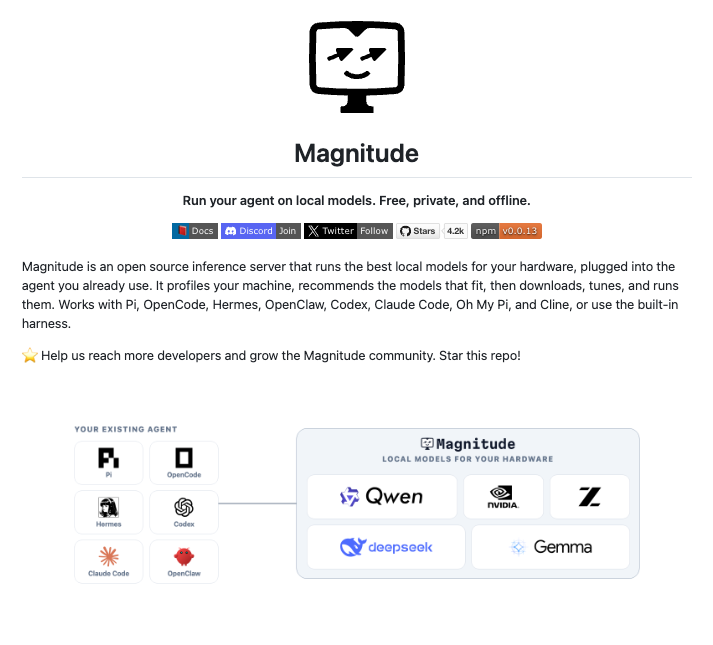
@ihteshamali highlighted (18 likes, 6 replies, 754 views) Magnitude because it promises something many builders want but still lack by default: keep the same agent workflow, but move inference onto local hardware when privacy, cost, or offline use matter more than frontier-cloud access. The public Magnitude repo is explicit about the desired experience: profile the machine, rank the best-fit local models, tune them, and plug them into Claude Code, Codex, Cline, and related harnesses without redesigning the whole workflow.
Opportunity: Direct. The need is practical and infrastructure-shaped, though today's public evidence still centered on Apple-silicon users rather than a broad cross-platform story.
4. Tools and Methods in Use
| Tool | Category | Sentiment | Strengths | Limitations |
|---|---|---|---|---|
| Companion | Consumer agent / iMessage surface | (+/-) | Real computer, browser, terminal, files, MCP, CLI access, and inherited ChatGPT-connected apps; strong context-portability pitch | Competitive edge still depends on users preferring its speed and setup over incumbents with deeper existing context |
| Muse | Consumer agent | (+) | Strong distribution story through Meta surfaces, friend graph, connected services, and Marketplace-native workflows | Public proof today came mainly from operator screenshots and product impressions rather than long operator retrospectives |
| Artificial Analysis Intelligence Index v4.3 / Terminal-Bench 4.0 / AutomationBench-AA | Evaluation suite | (+) | Harder terminal tasks, broader business-workflow coverage, held-out task set, and explicit cost-versus-intelligence comparisons | Still benchmark evidence rather than direct production success, and leaderboard shifts depend on harness choices |
| Wallfacer | Autonomous engineering platform | (+) | Connects chat, specs, tasks, code, worktrees, logs, and cost tracking in one local workflow | Public adoption signal was still modest compared with the size of its ambition |
| RepoPrompt CE | Context-engineering app | (+) | Assembles focused, reviewable context from files, CodeMaps, repo structure, and Git diffs; bundles MCP orchestration | Native macOS product, so the workflow is not yet framed as a universal cross-platform default |
| great_cto | Orchestration / approval layer | (+/-) | Three approval checkpoints, explicit skipped-step reporting, specialist-agent roster, and spend visibility | Depends on the host coding agent beneath it, and public quality claims today mostly came from its own benchmark narrative |
| Magnitude | Local inference server | (+) | Profiles Mac hardware, ranks local models, plugs into existing harnesses, and keeps prompts/files local | Apple-silicon focus narrows the immediate audience and hardware still caps model choice |
| InsForge | Agent-native backend platform | (+) | Gives agents database, auth, storage, functions, compute, deployment, and model gateway surfaces through MCP or CLI+skills | Larger platform scope means some claims extend beyond what one day's tweet-level usage can independently verify |
| SigNoz Cloud + MCP | Observability / MCP workflow | (+) | Turns traces, spans, and metrics into agent-readable context; concrete Appvia case reached a code fix on 6/10 alerts | Public evidence centered on one customer story, which is useful but narrower than a broad benchmark |
| UModel | Agent-ready observability model | (+/-) | Object-centric graph, U-SPL query layer, and a stated 8% root-cause-localization gain address telemetry fragmentation directly | Evidence came from a research preprint excerpt and thread summary, not a wide operator discussion |
| GraphWorkflow | Multi-agent orchestration engine | (+) | Compile-once execution design, 7x average speedup, and up to 62.5x on larger graphs make orchestration overhead visible as a bottleneck | Performance claims were tied to the authors' own benchmarks rather than independent replications |
| Agent.family / TermiX | Agent marketplace / settlement layer | (+/-) | Searchable categories, priceable services, on-chain escrow, review windows, and dispute paths make commerce mechanics tangible | Thread volume was high but often promotional; independent day-to-day operator evidence remained thinner than the UI evidence |
| Agent Zero gVisor sandboxes | Execution safety method | (+) | Moves heavyweight tools and agent-run code into disposable sandboxes instead of trusting host execution blindly | The public post was brief, so operational details and tradeoffs were still sparse |
Overall sentiment was strongest when a tool exposed more structure than a chat window: context selection, worktrees, checkpoints, traces, cost ledgers, or explicit permission boundaries. The workarounds people kept reaching for were markdown knowledge graphs, focused context assemblers, MCP telemetry bridges, and local-model adapters rather than bigger prompt packs.
The main migration pattern was away from undifferentiated assistant surfaces and toward layers that own a specific part of the workflow: consumer distribution (Companion, Muse), context packaging (RepoPrompt CE), autonomous planning and task boards (Wallfacer, great_cto), backend control (InsForge), observability context (SigNoz, UModel), and local inference (Magnitude). Competitive dynamics were clearest in two places: consumer agents, where context inheritance and marketplace access matter more than raw model novelty, and commerce infrastructure, where trust mechanics matter more than simply listing agents for sale.
5. What People Are Building
| Project | What it does | Evidence | Why it matters |
|---|---|---|---|
| Companion | iMessage-first personal agent with inherited ChatGPT context, browser, terminal, files, MCP, CLI, and payments | Launch tweet, site | Shows the consumer push toward agents that inherit existing context and can act across real tools instead of answering in a blank chat box |
| Muse | Personal agent packaged around daily life tasks and Marketplace transactions | Hands-on thread, onboarding thread | Demonstrates how distribution, friend graphs, and transaction surfaces can become a moat for consumer agents |
| Wallfacer | Local autonomous-engineering environment that separates chat, specs, tasks, code, worktrees, logs, and cost | Project thread | Treats coding agents as a workflow system with explicit state and review hooks, not as a single monolithic assistant |
| RepoPrompt CE | Native app for assembling focused project context, CodeMaps, Git diffs, and agent prompts | Project thread | Turns context engineering into a first-class product category for brownfield codebases |
| great_cto | Orchestrator that routes work to coding agents with checkpoints, approvals, and token-spend visibility | Project thread | Shows demand for a “manager layer” above existing code agents rather than yet another standalone model wrapper |
| Magnitude | Local LLM server that profiles hardware, recommends models, tunes them, and plugs into existing agent tools | Project thread | Captures the desire to keep agent workflows intact while shifting inference local for privacy and cost reasons |
| InsForge | Agent-native backend platform exposing databases, auth, storage, functions, compute, deployment, and model gateways | Project thread, site | Extends “AI coding agent” from code editing into backend operations and deployment control |
| SigNoz + Appvia MCP workflow | Telemetry-aware debugging flow that routes from traces and spans toward root cause and code changes | Case-study thread | Suggests observability can become agent context, not just a dashboard a human consults after failure |
| GraphWorkflow | Compile-once orchestration engine for large multi-agent DAGs | Project thread | Points to orchestration overhead itself becoming a product surface as multi-agent graphs scale |
| UModel | Object-centric observability data model and U-SPL query interface for AIOps agents | Project thread | Shows researchers trying to simplify how agents interrogate metrics, logs, and traces |
| Agent.family / TermiX | Agent marketplace with searchable services, pricing, escrow, review windows, and dispute handling | Marketplace thread, permissions thread | Makes the commerce stack around agents concrete: discovery, fulfillment, access control, and settlement |
| Agent Zero disposable sandboxes | Security-oriented execution boundary for agent-run code and tools | Sandbox thread | Reflects a rising assumption that capable agents need disposable runtimes by default |
A few project screenshots were especially informative because they exposed structure rather than marketing language:
Wallfacer separates chat, design artifacts, and execution state into reviewable panes instead of hiding everything inside one transcript.

RepoPrompt CE presents context assembly as a product in its own right, with space for repository structure, CodeMaps, diffs, and curated prompt packs.

great_cto visualizes the “manager layer” idea directly: there is an orchestrator on top, multiple specialist agents beneath, and approval points between them.

Magnitude is notable because the screenshot is not selling a new chat UI; it is selling model selection, benchmarking, and system fit for local inference.
SigNoz + Appvia provided one of the most concrete observability-to-action examples of the day. The first slide showed the flow from a monitored issue into trace investigation, while the second made the success metric explicit: 6 out of 10 alerts reached the actual code issue.


TermiX permissions was also informative because it framed access control itself as part of the agent-job lifecycle, not just a separate security checkbox.

6. New and Notable
- Companion launched a fully tooled personal-agent surface on iMessage. The product pitch combined inherited ChatGPT context, browser + terminal + file access, MCP/CLI support, and Link-powered payments in one consumer-facing wrapper (launch tweet, site).
- Artificial Analysis materially hardened its public agent benchmark mix. Intelligence Index v4.3 upgraded to Terminal-Bench 4.0 and added AutomationBench-AA with a private 657-task business-workflow set, increasing the weight of private tasks to 45% (thread).
- Meta-adjacent Muse discussion made Marketplace a distribution wedge for personal agents. The notable part was not just capability; it was the claim that a mainstream commerce surface can expose an agent to ordinary users while giving it a task loop it can actually close (hands-on thread, onboarding thread).
- Open-source grants explicitly added “Agent skills & tools” as a funding lane. @rauchg announced a fresh OSS grant batch with agents as a named category, which is notable because it treats tooling around agents as infrastructure worth seeding.
- The context-engineering product wave kept broadening. Wallfacer, RepoPrompt CE, great_cto, and Magnitude all pointed at different choke points—workflow state, context assembly, orchestration, and local inference—rather than trying to replace the whole agent stack.
- InsForge's agent-native backend stack kept pushing beyond code generation. The combination of InsForge, Flue, and E2B mattered because it framed backend operations, deployment, and testing as agent-operable surfaces rather than post-code manual work (thread).
- The most interesting observability items were agent-facing, not dashboard-facing. UModel proposed an object-centric observability model and U-SPL query layer, while SigNoz showed an MCP workflow where telemetry data can route toward the code issue itself (UModel thread, SigNoz thread).
- Neo's $100M financing was a governance signal, not just a funding headline. The public Fathom report described demand for systems that record agent actions after access is granted and halt behavior outside user-defined limits.
- Security posts were notable because they described operational misuse, not hypotheticals. The Malwarebytes and Hacker News items both described agents crossing the line from “better automation” into more convincing spam and longer-running intrusion workflows.
7. Opportunities
| Opportunity | Why now | Concrete wedge | Evidence |
|---|---|---|---|
| Context-portable personal agents | Consumer discussion has shifted from “which model?” to “which agent keeps my context and meets me where I already transact?” | Start with one high-frequency surface such as messaging, shopping, or scheduling; import existing context and connected-app state instead of re-onboarding users from scratch | Companion's inherited ChatGPT context and Muse's Marketplace-driven task loop were the clearest examples (Companion, Muse) |
| Brownfield context packs for code agents | Teams increasingly accept that generic agent prompts are not enough for legacy codebases | Build a repo-memory layer that maps architecture, data flow, invariants, dead ends, and safe edit zones, then feed only the relevant slice into the agent | The knowledge-graph thread plus RepoPrompt CE and Wallfacer all converged on this need (mardehaym, RepoPrompt CE, Wallfacer) |
| Agent permission contracts | Once agents touch assets or private systems, temporary access and revocation become product requirements, not security afterthoughts | Bundle scoped credentials, expiry, approval windows, action logging, and post-task revocation into a job contract the user can inspect | TermiX/Agent.family, Loreen's permissions thread, and Neo's governance pitch all point here (Agent.family, permissions, Neo) |
| Observability-to-remediation copilots | Telemetry is increasingly available to agents, but the gap between “I found the trace” and “I fixed the issue” is still large | Productize a workflow that traces from alert → span/log context → suspected root cause → safe code change or rollback recommendation | SigNoz/Appvia's 6/10 result and UModel's object-centric query model show the opportunity from both product and research angles (SigNoz, UModel) |
| Local-model adapters for existing agent workflows | Builders want privacy and lower cost without giving up their preferred harness | Offer hardware detection, model ranking, prompt/tool compatibility, and fallback routing into cloud models when local runs are insufficient | Magnitude paired this message with explicit integrations into existing agent tools (Magnitude) |
| Eval and regression gates for agent workflows | Benchmarks and harness engineering are moving from research signaling into day-to-day engineering practice | Ship easy-to-author adversarial tasks, trajectory graders, environment instrumentation, and CI merge blockers around agent tasks | Artificial Analysis, Hugobowne's eval framework, and Suraj's builder list all treated this as foundational infrastructure (Artificial Analysis, hugobowne, suraj_sharma14) |
The best near-term opportunities were not “another general AI agent.” They were missing layers around context portability, repo memory, permission boundaries, telemetry grounding, and eval discipline. In other words, the market signal favored picks-and-shovels plus a few distribution-advantaged consumer surfaces.
8. Takeaways
- Consumer-agent moats are being redefined around context, relationships, and transaction surfaces. The most credible consumer posts were not bragging about model IQ. They were arguing for inherited context, friend graphs, messaging surfaces, and Marketplace-native jobs.
- Agent engineering is becoming a systems discipline. Benchmarks, eval gates, context assemblers, traces, and brownfield knowledge graphs drew more serious attention than prompt tricks or general “AI automation” language.
- Context engineering is no longer a side practice. Wallfacer, RepoPrompt CE, great_cto, Magnitude, InsForge, SigNoz, UModel, and GraphWorkflow all attacked different parts of the same problem: making the environment legible enough for agents to act safely and usefully.
- The strongest commerce discussions were really governance discussions. Escrow, review windows, audit logs, independent records, scoped permissions, and revocation mattered more than marketplace branding alone.
- Security pressure is rising with capability. Disposable sandboxes, bot-detection concerns, and reports of autonomous credential operations all pointed to the same conclusion: agents are increasingly useful, but the operational blast radius is growing with them.
In short, 2026-09-08 felt like a day when the Twitter AI-agent conversation matured. The center of gravity moved away from “look what the model can do” and toward “what context does it inherit, what system can it inspect, what authority does it hold, and what proof exists after it acts?”