Twitter AI Agent - 2026-09-10
1. What People Are Talking About
1.1 Managed harnesses became a product surface (🡕)
The clearest shift was from discussing harness design to buying it as infrastructure. Two high-signal posts framed OpenAI's new Agents API as managed orchestration for long-running, tool-using work, with the sandbox still chosen by the developer.
@OpenAIDevs launched (1,089 likes, 66 replies, 128,262 views, 712 bookmarks) the Agents API in public beta, saying OpenAI operates the Codex harness, context management, and long-running sessions. Its launch thread added OpenAI-hosted sandboxes plus integrations for customer-selected CPU, GPU, storage, VPC, and third-party environments.
@Vtrivedy10 called (44 likes, 7 replies, 3,782 views, 49 bookmarks) this "Harness-as-a-Service": agent work exposed as an endpoint rather than assembled from raw chat APIs. The post's distinctive claim was that vertical products will discover useful behavior in task-specific harnesses, then fold that behavior back into model tuning.
Discussion insight: one reply to the launch asked whether a managed session that dies between side-effecting tool calls resumes from a checkpoint or replays the call. Replies to the HaaS framing added that buyers need a receipt showing which tools ran, what they changed, and what they refused; otherwise the endpoint hides the most important operating decisions.
Comparison to prior day: 2026-09-09 centered on versioned factory definitions, operator training, and reviewable control planes. The same concern moved into a vendor product on 2026-09-10: orchestration, sessions, and context are now explicitly sold as managed infrastructure.
1.2 DeepSeek moved the cost argument to input-heavy agent workloads (🡕)
DeepSeek-V4.1-Flash created the day's strongest model-specific cluster. Three posts focused not just on headline benchmarks but on the workload shape of agents: very large inputs, shorter outputs, repeated context reads, and parallel execution.
@kimmonismus summarized (238 likes, 20 replies, 15,338 views, 25 bookmarks) DeepSeek's own results as 74.2% on DeepSWE versus 73.0% for GPT-5.6 Sol, while stressing that these were vendor tests. The attached pricing card lists $0.60 per million output tokens off-peak and $1.20 at peak; the benchmark card reports an 890-byte global KV cache per token for V4.1-Flash.


@ZhihuFrontier explained (35 likes, 10 replies, 1,536 views, 13 bookmarks) the architecture as a Causal Encoder-Decoder with 8B active parameters during prefill, 16B during decode, a 196B Engram memory module, and shared sparse indexing. The thread tied those choices directly to agent workloads that read much more than they write.
@MatternJustus added (7 likes, 145 views) an important boundary condition from DeepSeek's test-time scaling chart: multi-agent configurations appear to help implementation-heavy tasks more than performance-engineering or autoresearch-like work.
Discussion insight: replies challenged the 361 versus 120 tokens-per-second comparison because repetitive inputs can flatter N-gram memory, and asked for results after hours of real agent work. Another reply noted that the paper's 437-fold KV-cache reduction is against DeepSeek-V1, not against the immediately preceding model.
Comparison to prior day: model choice was secondary to harness design on 2026-09-09. On 2026-09-10, it returned through a narrower question: which architecture and pricing model best fit long-context agent execution.
1.3 Runtime control advanced from logging to rollback and typed evidence (🡕)
At least four substantive items treated observability as an active control layer rather than a postmortem log. The repeated primitives were checkpoints, reversible execution, typed provenance, capture confidence, and rules that fire while an agent is still acting.
@marfinxx covered (11 likes, 5 replies, 823 views, 6 bookmarks) the SHEPHERD paper, whose images describe a Python substrate that exposes agent state as a reversible execution trace. The reported CooperBench result rose from a 28.8% baseline pass rate to 54.7% with runtime meta-agent supervision, while the interface lets a supervisor observe, revert, intercept, and fork.

@mirku21 highlighted (13 likes, 11 replies, 174 views, 8 bookmarks) a survey that separates execution provenance from evidence tracing. Its taxonomy records typed units and relations such as dependency, invalidation, contradiction, trigger, and update so operators can ask not only what tool ran, but which evidence justified the next decision.

@akshay_pachaar released (5 likes, 4 replies, 2,843 views, 10 bookmarks) Agent Beacon, a local-first telemetry layer that normalizes commands, tool calls, file changes, approvals, and session context across agent runtimes. Its public repository describes one OpenTelemetry-based event model, a local detection engine, and forwarding to customer-controlled observability systems.
Discussion insight: replies made two distinctions that flat logs miss. A tool call can succeed without being justified by valid evidence, and an agent can exit after asking a question while its prose still looks complete; completion status therefore needs an out-of-band record.
Comparison to prior day: 2026-09-09 asked for traces and proof. Today's research and open-source releases supplied more concrete data models and runtime actions for producing them.
1.4 Memory and skills became governed, reviewable assets (🡕)
The packaging theme continued, but today's strongest examples added governance. Four items moved beyond "store more context" toward versioned team lessons, typed contradictions, install receipts, and update rules for skills.
@itsharmanjot shared (15 likes, 4 replies, 625 views, 10 bookmarks) teamlore, which writes corrections into a repository-local .lore/ directory. The practical distinction is that lessons travel through ordinary pull-request review and Git blame, so one agent's bad lesson can be rejected before every teammate's agent inherits it.
@DanKornas described (1 like, 2 replies, 538 views, 1 bookmark) mcp-memory-service as a self-hosted MCP and REST memory backend with agent-scoped retrieval, typed relationships such as causes, fixes, and contradictions, local ONNX embeddings, and multiple storage options.
@DanKornas also surfaced (2 likes, 2 replies, 306 views) OpenAgentSkill, whose project page ranks reusable skills by task fit, maintenance, license, install safety, permissions, and outcomes before handing an agent a target-specific install receipt.

@dair_ai summarized (9 likes, 2,199 views, 15 bookmarks) SkillAdam's answer to unstable self-editing skills: preserve the history of prior corrections and vary the edit budget according to recent outcome volatility instead of rewriting a fixed amount every round.
Discussion insight: the common concern was no longer whether an agent can remember or install a skill. It was whether the memory can be reviewed, scoped, contradicted, and rolled back, and whether a skill's provenance is strong enough to execute.
Comparison to prior day: 2026-09-09 emphasized portable skill packs and host-portable state. On 2026-09-10, the conversation added quality gates for what enters that state and how it evolves.
2. What Frustrates People
2.1 One-shot agents still create work that cannot ship
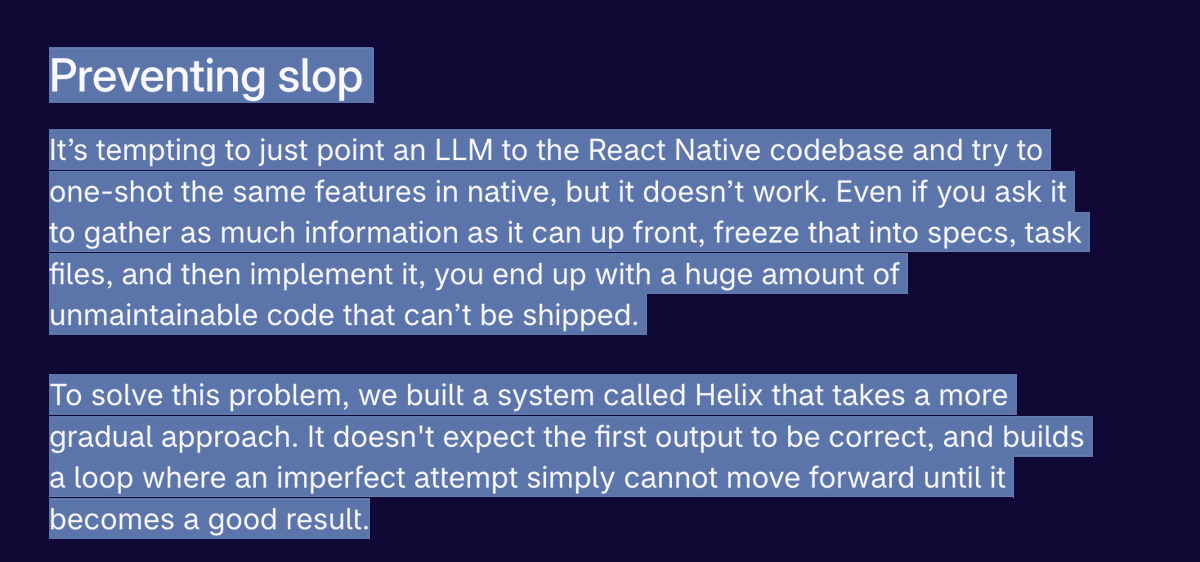
Severity: High. Two sources described the same failure at different scales: fluent output moves faster than verification. @hellonehha pointed (3 likes, 3 replies, 293 views, 2 bookmarks) to Shopify's native-app migration, where the engineering write-up says freezing a large specification and asking an agent to implement it in one shot produced "a huge amount of unmaintainable code that can't be shipped."
Shopify's workaround was Helix: split a screen into small checkpoints, then require tests, visual comparison, two adversarial code reviews, and human approval before the next checkpoint begins. Feedback is retained so later steps become more autonomous.
@techNmak argued (39 likes, 10 replies, 1,418 views, 41 bookmarks) that a reliable harness needs environment signals such as tests, type checks, screenshots, traces, and review, not just instructions. Replies described repeated prompting as an engineering smell and moved recurring mistakes into hooks, tool contracts, or regression tests.
Worth building for? Yes. The failure is severe because the output may look complete while remaining unmaintainable, and the coping pattern is explicit: smaller work units, deterministic gates, adversarial review, and durable feedback.
2.2 Team memory can preserve the wrong lesson
Severity: Medium. The memory problem appeared in three final-set items, but the frustration was not simple forgetting. @itsharmanjot described (15 likes, 4 replies, 625 views, 10 bookmarks) agents repeating a teammate's earlier mistake because correction history was not shared. @DanKornas described (1 like, 2 replies, 538 views, 1 bookmark) the corresponding retrieval problem: memories need scope and typed relationships so an old fact can be marked as contradicted rather than merely recalled.
The coping strategies split in two directions. Teamlore keeps small lessons in Git so humans can review and blame them, while mcp-memory-service uses a typed knowledge graph and agent-scoped retrieval. Both reject an undifferentiated vector store as sufficient team memory.
Worth building for? Yes, but the opportunity is competitive. The observable need is for review, ownership, contradiction, and deletion semantics around memory, not another unscoped storage layer.
2.3 Operators still cannot trust an action without its evidence
Severity: High for production and financial workflows. @akshay_pachaar said (5 likes, 4 replies, 2,843 views, 10 bookmarks) teams often reconstruct commands, file changes, and approvals from scattered logs after an incident. @mirku21 argued (13 likes, 11 replies, 174 views, 8 bookmarks) that final-answer accuracy does not reveal which retrieved source, memory item, or tool result justified an action.
The financial-agent prototype from @dreyethh made the risk concrete: the author separated (61 likes, 25 replies, 943 views, 8 bookmarks) permission to analyze a position from permission to move funds, and bound each proposal to a signed, expiring quote. Agent Beacon and the provenance survey supply the general workaround: normalized event records, typed evidence links, and capture confidence.
Worth building for? Yes. This was one of the day's strongest cross-cutting needs, appearing in research, security tooling, managed-agent discussion, and commerce prototypes.
3. What People Wish Existed
3.1 Managed agents with explicit recovery guarantees
The practical request beneath the Agents API launch was a contract for side effects: if a session fails between a payment, email, or file operation, does it resume, retry, or replay? @OpenAIDevs announced (1,089 likes, 66 replies, 128,262 views, 712 bookmarks) managed long-running sessions and sandbox choice, but a reply asked for checkpoint semantics before entrusting the runtime with irreversible actions. SHEPHERD partially addresses this at the research layer through reversible traces and forking, but it is not a service-level guarantee.
Need type: Practical and urgent for workflows with external side effects.
Opportunity: Competitive. Managed runtimes now exist; explicit recovery, idempotency, and replay receipts remain a product differentiator.
3.2 Organizational memory with ownership and conflict resolution
People want shared memory that does not flatten personal preference, team decisions, and company policy into one retrieval pool. @ashwingop warned (8 likes, 690 views, 14 bookmarks) that personal agents entering companies need organization-level state with fact-level access control and governance. Teamlore and mcp-memory-service partially address review and typed contradiction, but neither cited item demonstrated full hierarchy and policy resolution across an enterprise.
Need type: Practical. The urgency rises with the number of personal agents operating inside one organization.
Opportunity: Direct. The requested capabilities are concrete: scope, ownership, provenance, freshness, permissions, and a rule for resolving personal-versus-organizational conflicts.
3.3 Skill selection that is safer than copying an install command
The skill ecosystem is becoming large enough that discovery alone is insufficient. @DanKornas described (2 likes, 2 replies, 306 views) OpenAgentSkill as a resolver that considers license, maintenance, permissions, install safety, and outcomes, then produces a target-specific install receipt. @dair_ai added (9 likes, 2,199 views, 15 bookmarks) a second requirement: self-editing skills need stable update direction and variable edit budgets so a new feedback case does not undo an earlier correction.
Need type: Practical. OpenAgentSkill and SkillAdam are partial answers, but one governs selection while the other governs evolution.
Opportunity: Direct. A combined registry, permission review, execution sandbox, evidence trail, and versioned update history would address both halves of the request.
3.4 Agent services with inspectable terms before payment
Commerce posts repeatedly asked how a capable agent becomes a service a buyer can actually evaluate. @dreyethh built (61 likes, 25 replies, 943 views, 8 bookmarks) KNOT around identity passports, task-specific signed quotes, limits, price, and expiry. @Aeron_ai claimed (63 likes, 23 replies, 664 views, 9 bookmarks) its directory exposes accepted payment tokens for 1,902 endpoints before a buyer tries to use them.
Need type: Practical, though the emotional language centers on trust.
Opportunity: Competitive. Discovery, identity, escrow, and settlement products exist, but today's replies offered little independent evidence that the advertised agents consistently deliver the promised work.