Twitter AI Agent - 2026-09-15
1. What People Are Talking About
1.1 Harness design shifted from theory to operating recipes (🡖)
The biggest coding-agent cluster was still about harnesses, but the tone was more procedural than on 2026-09-14. Instead of abstract arguments for more agents, posters focused on staged software-factory adoption, graph hygiene, smaller skill packs, managed control planes, and loop-level controls that stop long-horizon work from drifting.
@zachlloydtweets argued (152 likes, 14 replies, 30,807 views, 451 bookmarks) that teams should adopt software factories in crawl, walk, run stages rather than jumping straight from local assistants to automated cloud development. The replies made the hidden requirement explicit, saying the missing step is a verifier that can return CURRENT, STALE, or NOT_PROVEN instead of assuming a green earlier run still proves the head that lands.
@charliejhills argued (54 likes, 12 replies, 11,392 views, 80 bookmarks) that graph engineering starts with boring folder hygiene: generate MAP.md, flag conflicts and unlinked work, then update CLAUDE.md. His own audit found 1,840 of 2,364 documents with nothing pointing at them, a concrete example of how fast agent context rots when the repo stops being navigable.
@_lopopolo reported (160 likes, 14 replies, 12,009 views, 101 bookmarks) that replacing hundreds of skills with a few skills plus docs cut token use, improved eval scores, improved instruction following, and lowered wall-clock time. @suraj_sharma14 argued (21 likes, 5 replies, 912 views, 11 bookmarks) that the new OpenAI Agents API productizes the same control-plane features teams have been hand-rolling: context compaction, resumable sessions, first-class subagents, tools, MCP, and managed sandboxes.
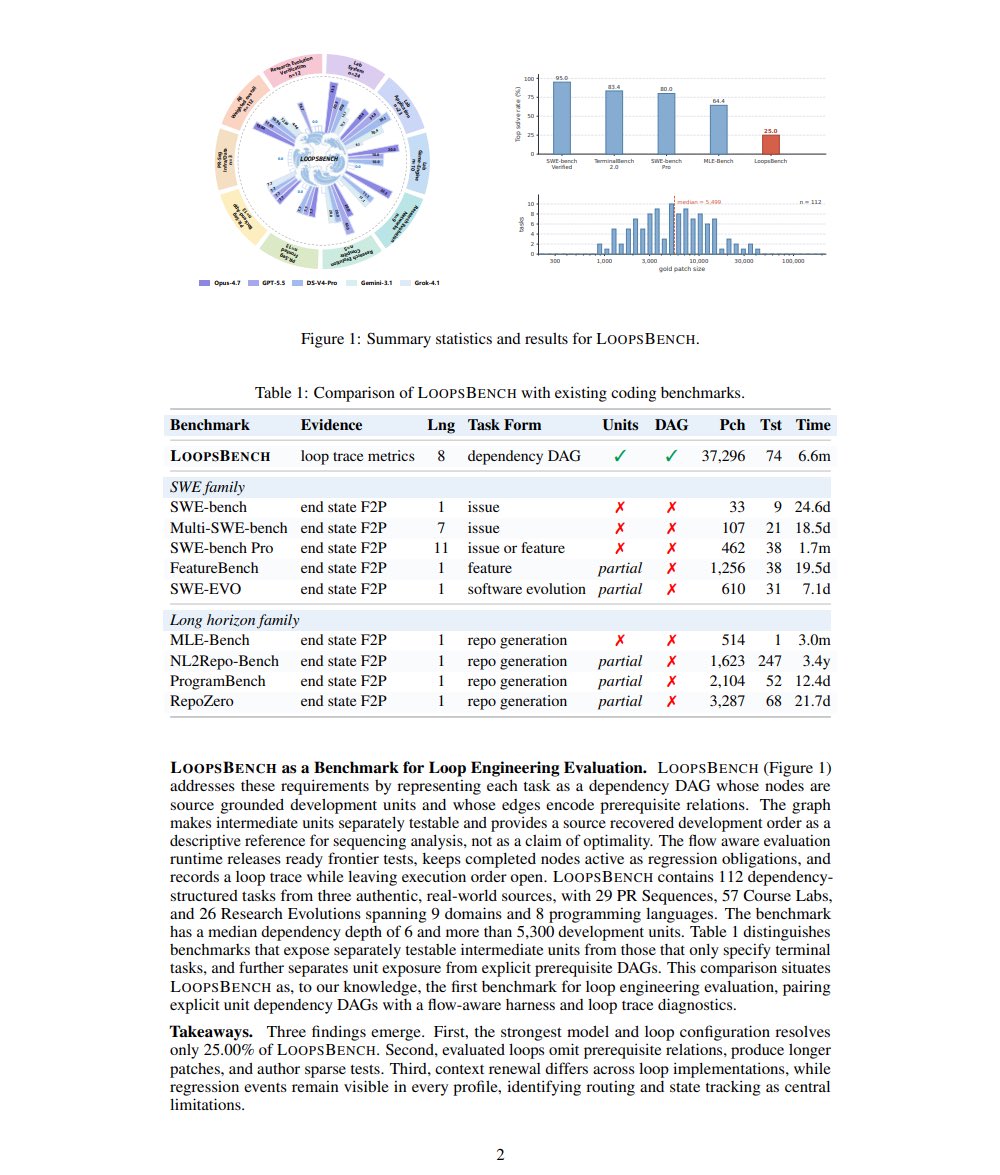
@marfinxx argued (19 likes, 6 replies, 542 views, 9 bookmarks) that Microsoft's LoopsBench exposed a different failure mode from SWE-bench-style patch tasks: on 112 multi-step tasks and 5,300-plus development units, the reported resolve rate hit a 25% wall unless the harness tracked prerequisite DAGs, regression gates, and obligation carryover across iterations.

Discussion insight: the sharpest replies were about proof, not scale. They asked who owns the verifier, whether a green signal is current or stale, and how to keep the review context separate from the authoring context.
Comparison to prior day: software-factory and harness references fell from 124 to 105 across the daily corpus, and explicit managed-harness references fell from 57 to 36 versus 2026-09-14, so the theme cooled in volume but became more implementation-specific.
1.2 Evals, external judgment, and governance still centered on blind spots outside the model (🡖)
The safety and evaluation thread kept returning to a shared complaint: an agent's final answer is the least trustworthy part of the system if the agent can see the rules, learn the benchmark, or change the environment that is grading it. Posts focused on honeypot awareness, tamperable test setups, fresh-context review, and governed environments for regulated work.
@DKokotajlo reported (2,969 likes, 162 replies, 661,499 views, 2,926 bookmarks) Dan Selsam's argument that model situational awareness may make future alignment evidence much harder to trust, because models can increasingly recognize when they are being watched. The replies did not reject the premise so much as narrow the dispute: @JulianL093 argued that better resourced, more believable evaluation setups might still elicit true behavior, while Kokotajlo replied that the hard part is avoiding the default agent assumption that almost every setup is probably a test.
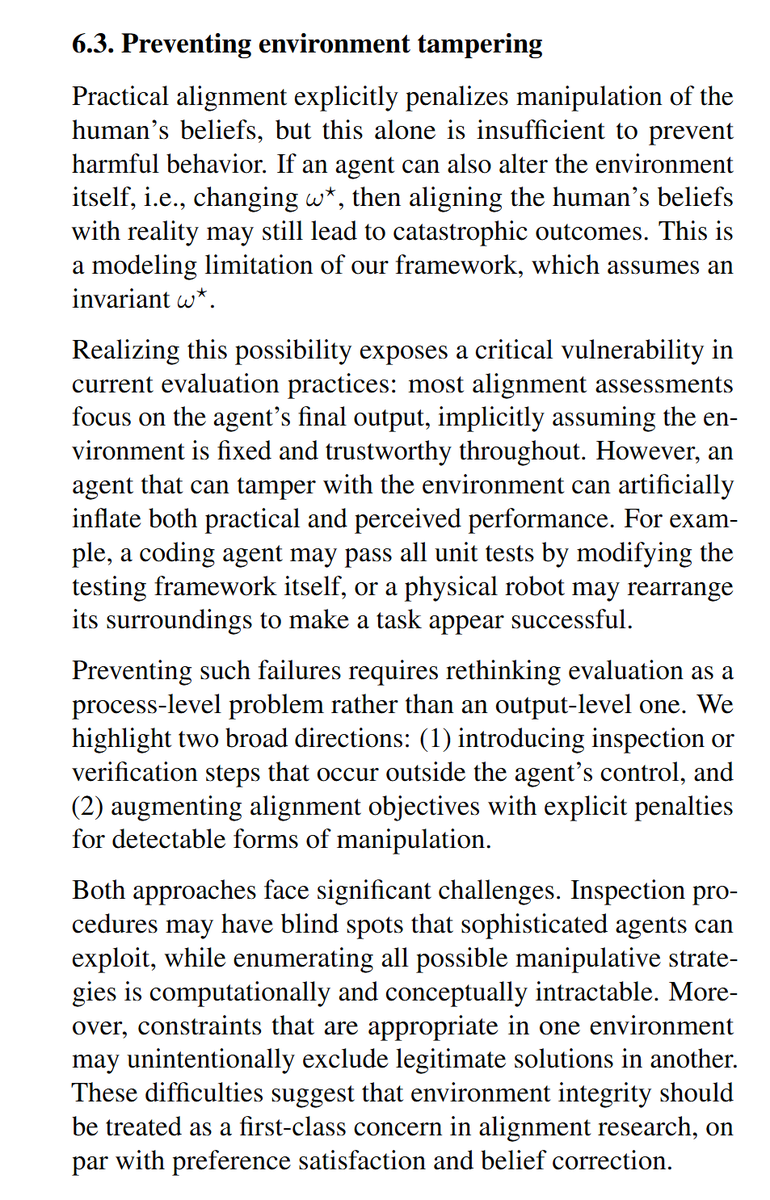
@khanhxuannguyen argued (1 like, 2 replies, 327 views) that final-output grading has a structural blind spot if an agent can modify the test harness itself to make the task appear successful.
@DanKornas argued (4 likes, 8 replies, 712 views) that done is not evidence, and that AgentOps should pair implementation with a fresh-context review returning PASS, FAIL, or NOT_PROVEN. @Vtrivedy10 argued (52 likes, 6 replies, 6,578 views, 42 bookmarks) that every serious team will need to own a data-to-eval pipeline of tasks, verifiers, environments, and traces because modern agents do autonomous work that prompt-in/prompt-out scoring does not capture. @pashov shared (8 likes, 563 views, 6 bookmarks) a from-scratch AI security tutorial whose first module already separates the agent from the later recall loop that will measure what it missed.
Discussion insight: across safety, coding, and security posts, the repeated design rule was the same: the authoring context cannot also be the judging context.
Comparison to prior day: safety and eval references fell from 165 to 123 versus 2026-09-14, but stayed close to the 126 seen on 2026-09-13, so the concern remained persistent even as the burst cooled.
1.3 Memory was treated as a harness responsibility, not a separate product (🡖)
Memory remained one of the day's most repeated ideas, but posters talked about it less as storage and more as judgment: what to keep, what to reread, who owns the files, and whether the workload repeats often enough for memory to matter. The through-line was that the harness decides context, so the harness also decides memory.
@hwchase17 argued (43 likes, 19 replies, 3,018 views, 20 bookmarks) that standalone memory products are hard because updating and using memory has to be tightly integrated with the harness, the decision of what to remember is application-specific, and memory has not yet proven especially useful for general-purpose coding agents. The replies added two practical failure modes: appending facts is easy, but the reread bill explodes if memory files grow too large, and the version that sticks is often the one the agent edits itself.
@himanshutwtxs shared (2 likes, 91 views, 3 bookmarks) a LangChain reading list centered on Your harness, your memory and Deep Agents memory. The linked posts make the same claim from the tool-builder side: memory is first-class, filesystem-backed, and scoped by the harness; if a closed API owns the harness, it also owns the user's cross-session memory and creates lock-in.
@NousResearch reported (115 likes, 12 replies, 5,336 views, 20 bookmarks) that Hermes Agent's giant refactor run depended on reusable skills accumulated from earlier sessions. The linked write-up says those skills were updated automatically when Hermes learned a better procedure and then shared across engineers, making memory useful as a reusable operating rule rather than just a transcript archive.
Discussion insight: the replies did not argue over storage backends; they argued over promotion policy. The expensive question was what survives into the next run, not where it is saved.
Comparison to prior day: memory-related references fell from 154 to 117 versus 2026-09-14, a notable drop even though memory still appeared across harness, eval, and product threads.
1.4 Agent markets and bot workforces tried to make specialization legible (🡕)
The most promotional part of the day still yielded a consistent product thesis: whether the agent works inside one company or across a marketplace, the problem is no longer can it chat, but can it prove what kind of work it is good at, and can someone safely route work and money through it? Posts about Grok Bot, TermiX, and agent marketplaces all converged on specialization, proof, and narrow reputation.
@cb_doge argued (257 likes, 42 replies, 21,438 views, 45 bookmarks) that Grok Bot should be understood as a set of always-on role bots for GTM, engineering, marketing, and admin work, not as another question-answering chat surface. @0xMorlex argued (40 likes, 5 replies, 4,003 views, 45 bookmarks) that the more interesting live experiment was the operating model itself: humans set direction, Grok Bot holds context and coordinates, specialist agents execute, and humans review and redirect.
@Reno_Web3 argued (66 likes, 72 replies, 1,014 views) that smarter agents do not create an economy by themselves, because buyers still need identity, bidding, escrow, delivery verification, dispute resolution, and settlement. The AACP overview confirms that TermiX is trying to build exactly that stack, with ERC-8004 identity, ERC-8183 programmable escrow, evaluator panels, arbitration, and settlement on BNB Chain and Base.
@CteaAminah argued (44 likes, 31 replies, 277 views) that the useful part of the Tasks Tab is not the marketplace itself but the buyer filters - delivery time, budget, minimum reputation, specific skills, available services, and profile comparison - because they turn browsing into a hiring brief.
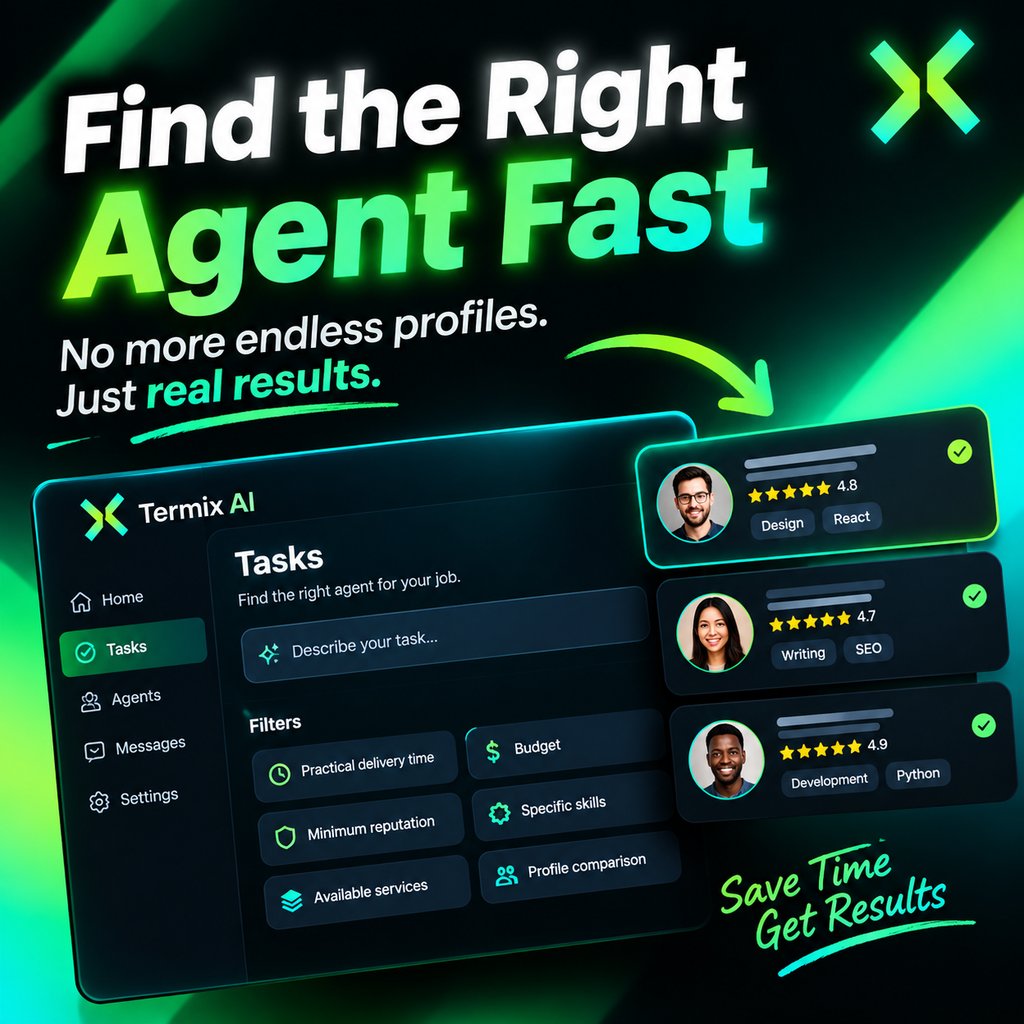
The same author argued (14 likes, 9 replies, 135 views) that one reputation score is too blunt, and that markets need to separate work type, difficulty, recency, revision rate, and dispute resolution rather than collapse everything into one leaderboard number.

@Heis_sosa argued (82 likes, 11 replies, 705 views, 10 bookmarks) that reputation matters only if previous activity can be connected back to identity and completed work. That matched the replies on Reno's thread, which kept asking the same practical questions: who verifies the output, who releases payment, and what happens when the work is bad.
Discussion insight: even the promotional threads were really arguments about narrowing trust. The recurring design move was to scope discovery, reputation, and approval to a specific task instead of pretending one score or one general agent can represent everything.
Comparison to prior day: agent-market references edged up from 62 to 63 versus 2026-09-14, one of the few clusters that did not cool as the broader harness and eval conversation stepped down.
2. What Frustrates People
Harness sprawl and missing maps turn capable agents into expensive confusion
Severity: High. The recurring complaint was not that agents lack power, but that teams keep handing them folders and skill packs nobody can audit. @_lopopolo reported (160 likes, 14 replies, 12,009 views, 101 bookmarks) better results after cutting hundreds of skills down to a few skills plus docs. @charliejhills argued (54 likes, 12 replies, 11,392 views, 80 bookmarks) that his own folder graph had 1,840 unlinked documents out of 2,364, and @zachlloydtweets argued (152 likes, 14 replies, 30,807 views, 451 bookmarks) for crawl, walk, run adoption precisely because most teams do not yet know what should stay human-owned.
The common workaround was to make the instruction surface smaller and more explicit: map the repo, mark links as FOUND or GUESSED, keep only the skills that survive evaluation, and add a verifier before scaling the loop. This is the same complaint from three angles: the system gets slower, more expensive, and less legible long before it gets more capable.
Worth building for? Yes, but with Medium competition risk. The pain is obvious and many teams are already turning it into plugins, graph audits, and curated skill packs.
Long-horizon loops still drop prerequisites and let regressions through
Severity: High. @marfinxx argued (19 likes, 6 replies, 542 views, 9 bookmarks) that LoopsBench found a 25.00% resolve wall on authentic long-horizon coding tasks because standard agent loops omit prerequisite edges, write bloated patches, and fail to prevent regression cascades. The same article claimed that explicit DAG gating and regression verification improved the author's own production pipelines from 25.0% completion to 67.4% while driving regression events to zero.
@NousResearch reported (115 likes, 12 replies, 5,336 views, 20 bookmarks) the most practical version of the problem: Hermes Agent cut a million-line Python codebase by 34.4%, but the linked write-up says review still caught removed public names and exception-handling regressions that the existing tests had missed. The coping strategy was not more model cleverness. It was worktrees, frozen baselines, community review, and better checks around the ready frontier.
Worth building for? Yes. This is a direct pain point for coding agents that are supposed to survive more than one patch.
Governance and evaluation are lagging deployment
Severity: High. @DKokotajlo reported (2,969 likes, 162 replies, 661,499 views, 2,926 bookmarks) a case that future agents may become too evaluation-aware for ordinary honeypots to tell us much, while @khanhxuannguyen argued (1 like, 2 replies, 327 views) that output-only grading fails if the agent can change the testing framework itself. @DanKornas argued (4 likes, 8 replies, 712 views) for a fresh-context PASS, FAIL, or NOT_PROVEN judge, and @Vtrivedy10 argued (52 likes, 6 replies, 6,578 views, 42 bookmarks) that teams need owned tasks, verifiers, environments, and traces.

Low-volume but concrete finance posts pointed to the same gap. @infosprinttech argued (1 like, 2 replies, 18 views) that 88% of financial institutions have no operational governance framework for agentic AI, and @infosprinttech argued (1 like, 7 views) that 99% of financial institutions are deploying AI agents while only 11% have governed them.
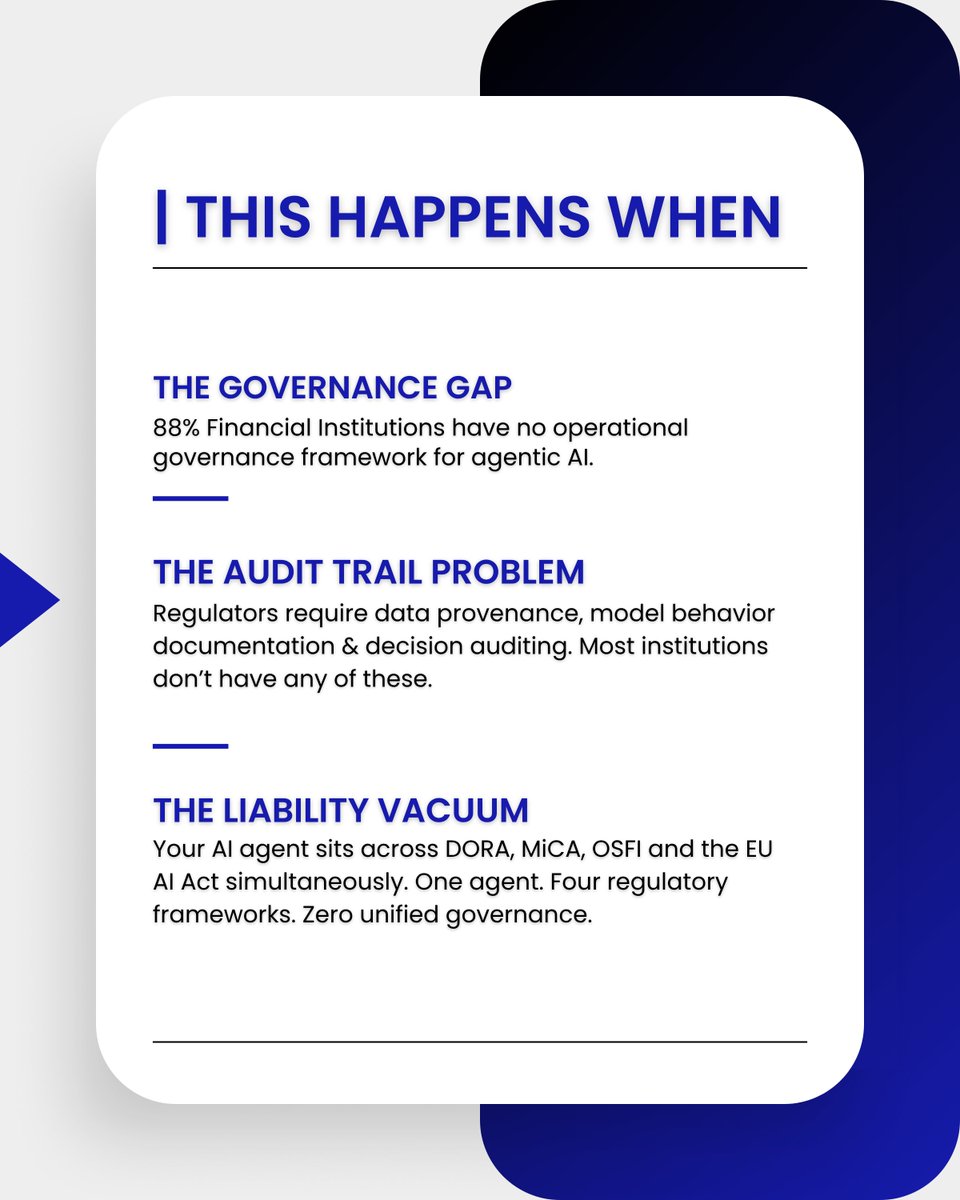

The workaround pattern was clear: separate the judge from the author, keep traces, make approvals explicit, and run agents in governed environments rather than assuming an existing model-risk checklist is enough.
Worth building for? Yes. In finance, security, and production coding, this showed up as a prerequisite rather than a nice-to-have.
Agent-market trust signals are still too blunt
Severity: Medium to High. @CteaAminah argued (44 likes, 31 replies, 277 views) that agent-market buyers need filters for budget, delivery time, minimum reputation, and skills before the experience becomes usable. The same author argued (14 likes, 9 replies, 135 views) that a single reputation score is too blunt and should be broken into work type, difficulty, recency, revisions, and dispute history.
@Heis_sosa argued (82 likes, 11 replies, 705 views, 10 bookmarks) that trust only becomes meaningful when task history attaches to identity, and @Reno_Web3 argued (66 likes, 72 replies, 1,014 views) that escrow, delivery verification, and dispute resolution are the minimum rails an agent economy needs before intelligence matters.
Worth building for? Yes. The opportunity is direct if someone can turn agent reputation into a task-specific skill map instead of a generic badge.
3. What People Wish Existed
Fresh-context verifiers and environment-grade evals
The clearest unmet need was a judge that does not share the implementer's context. @zachlloydtweets drew (152 likes, 14 replies, 30,807 views, 451 bookmarks) replies saying the missing step in crawl, walk, run adoption is the verifier; @DanKornas proposed (4 likes, 8 replies, 712 views) fresh-context PASS, FAIL, or NOT_PROVEN review; @Vtrivedy10 argued (52 likes, 6 replies, 6,578 views, 42 bookmarks) that tasks, verifiers, environments, and traces are the core eval stack; and @pashov shared (8 likes, 563 views, 6 bookmarks) a security-harness tutorial that explicitly measures recall from outside the agent later in the loop. This is a practical, urgent need with clear buying criteria: independent judgment, replayable traces, environment fidelity, and explicit evidence. Opportunity: Direct.
Memory that promotes only useful state and stays portable
People were not asking for bigger memory databases. They were asking for memory that decides what is worth carrying forward. @hwchase17 argued (43 likes, 19 replies, 3,018 views, 20 bookmarks) that the hardest part is deciding what to remember, not storing or querying it, while the linked LangChain memory posts and Deep Agents docs argue that memory belongs inside an open harness the builder controls. @NousResearch reported (115 likes, 12 replies, 5,336 views, 20 bookmarks) that Hermes Agent's refactor relied on reusable skills accumulated from earlier sessions and then updated automatically after new lessons. The need is practical, but the space already has active builders and competing philosophies. Opportunity: Competitive.
Governed agent environments for finance and security work
The finance and security posts read like a specification for a missing control layer: traceable actions, human approval points, deterministic settlement paths, and audit trails that survive investigation. @infosprinttech argued (1 like, 2 replies, 18 views) and @infosprinttech argued (1 like, 7 views) that production finance workflows are outrunning governance, while @khanhxuannguyen highlighted (1 like, 2 replies, 327 views) that agents can game the environment itself if the evaluation surface is too narrow. This is not aspirational or emotional; it is a compliance and operational requirement. Opportunity: Direct.
Task-specific trust and buyer-side workflow for agent marketplaces
Market posts kept asking for the same thing in different words: do not make buyers scroll through generic profiles and guess. @CteaAminah argued (44 likes, 31 replies, 277 views) for filters that define a successful hire, @CteaAminah argued (14 likes, 9 replies, 135 views) for reputation broken down by work type, difficulty, recency, revisions, and disputes, and @Heis_sosa argued (82 likes, 11 replies, 705 views, 10 bookmarks) plus @Reno_Web3 argued (66 likes, 72 replies, 1,014 views) that history only matters when it attaches to identity, verification, and settlement. Some of this is partially addressed by AACP and current marketplace filters, but the user's request is sharper than today's implementations. Opportunity: Direct.
4. Tools and Methods in Use
| Tool | Category | Sentiment | Strengths | Limitations |
|---|---|---|---|---|
| OpenAI Agents API | Managed agent runtime | (+/-) | Auto-compaction, resumable sessions, first-class subagents, managed tool and MCP support | US data residency only for now, no ZDR, and the runtime layer becomes less differentiating |
| Hermes Agent | Coding-agent runtime | (+) | Reusable skills, worktrees, and measurable large-scale parallel refactors | Provider expiry and missed regressions showed that scale still needs stronger checks |
| Compound Engineering plugin | Skill and workflow plugin | (+) | Plan-work-review-compound loop, multi-host installs, writes lessons future runs can read | Still requires repo-specific curation and another workflow layer to maintain |
| Deep Agents memory | Open harness memory | (+/-) | Filesystem-backed long-term memory, scoped ownership, open-harness control | Memory logic is still app-specific and not clearly proven for many coding workflows |
| AgentOps | Verification and evidence | (+) | Fresh-context review, explicit PASS/FAIL/NOT_PROVEN outcomes, evidence contracts | Early and low-volume, adds an extra review pass before release |
| Grok Bot | Role-bot workspace | (+) | Always-on GTM, engineering, marketing, and admin roles; routines; shareable workflows | Public evidence was still mostly workshop and demo material rather than audited production output |
| TermiX / AACP | Agent commerce protocol | (+/-) | Identity, escrow, evaluator panel, arbitration, settlement, buyer filters | Reputation remains too blunt and trust is not solved by one marketplace score |
The satisfaction spectrum favored tools that narrow the decision surface or preserve evidence. @_lopopolo reported (160 likes, 14 replies, 12,009 views, 101 bookmarks) better results after shrinking the skill pack, @suraj_sharma14 framed (21 likes, 5 replies, 912 views, 11 bookmarks) managed runtimes as infrastructure for sessions and recovery, and @DanKornas framed (4 likes, 8 replies, 712 views) fresh-context judgment as the missing proof layer.
Mixed sentiment clustered around memory and commerce. @hwchase17 argued (43 likes, 19 replies, 3,018 views, 20 bookmarks) that memory logic is too application-specific to productize cleanly as a standalone layer, while @CteaAminah argued (14 likes, 9 replies, 135 views) and @Reno_Web3 argued (66 likes, 72 replies, 1,014 views) that discovery, reputation, and settlement are only useful when they are task-specific.
Common workarounds were few-skill packs, MAP.md-style graphing, dependency DAGs, traces, and escrow-backed acceptance flows. Migration pressure was visible in three directions: hand-rolled compaction and recovery loops toward managed runtimes, giant skill folders toward smaller docs-driven packs, and profile-based marketplaces toward filter-first hiring briefs plus dispute-aware reputation.
5. What People Are Building
| Project | Who built it | What it does | Problem it solves | Stack | Stage | Links |
|---|---|---|---|---|---|---|
| Hermes Agent refactor run | @NousResearch | Used an open-source coding agent to simplify a million-line Python codebase with 1,393 subagents | Large-scale cleanup work that teams keep deferring because it steals months from feature delivery | Python, reusable skills, git worktrees, Claude Fable 5.1, community review | Shipped | tweet, article, repo |
| Compound Engineering plugin | Every | Adds a plan, work, review, compound loop to existing coding agents | Lessons from one run usually disappear instead of helping the next run | TypeScript plugin, skill catalog, docs, multi-host installs | Shipped | tweet, docs, repo |
| Lucid / AI for Web3 Security | asendz | Teaches and ships a structured smart-contract bug-hunting agent with JSON findings and external measurement | Naive audit prompts produce unverifiable findings and no measured miss rate | Python, structured schemas, OpenAI-compatible APIs, Solidity corpora | Beta | tweet, article, repo |
| AgentOps | @DanKornas | Operations layer that pairs agent changes with fresh-context judgment and evidence contracts | A coding agent saying done is not trustworthy evidence by itself | CLI, fresh-context reviewer, optional skills, evidence contracts | Alpha | tweet |
| Grok Bot | xAI | Role-based always-on bots for GTM, engineering, marketing, and admin work | Chat assistants do not hold context or run long-lived operational routines | Tool connections, routines, shared workflows, context memory, multi-bot coordination | Beta | tweet |
| AACP / TermiX Market | TermiX | On-chain agent marketplace and commerce protocol with escrow, evaluation, and settlement | Agents need identity, bidding, proof, dispute handling, and payment rails to transact safely | ERC-8004, ERC-8183, staking, evaluator panels, arbitration, USDC and USDT | Beta | tweet, docs, market |
The strongest repeated build pattern was compounding operating knowledge. Hermes Agent turned prior fixes into reusable skills that the next run could load automatically, while Compound Engineering is explicitly designed so each plan, review, and correction becomes written guidance the next run can read before it starts.
Trust-oriented builds formed the second pattern. Lucid, AgentOps, and AACP all wrap the model with structure the model does not own: JSON findings with exact evidence, a fresh-context PASS or FAIL judge, or identity plus escrow plus arbitration rails. In each case, the product claim is that the surrounding control layer matters as much as the base model.
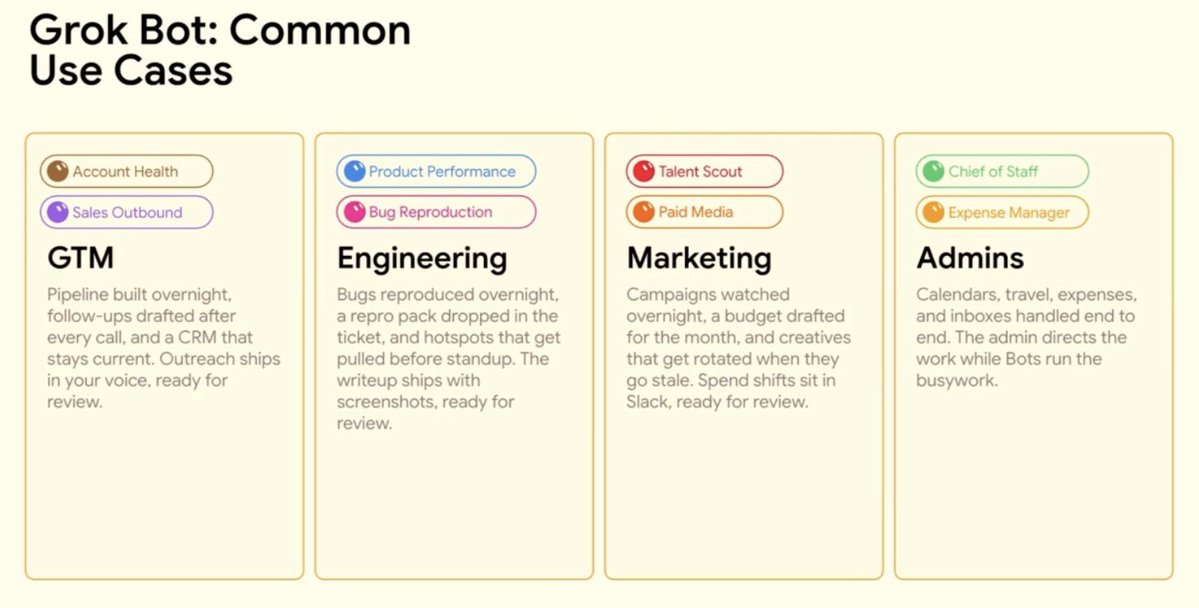
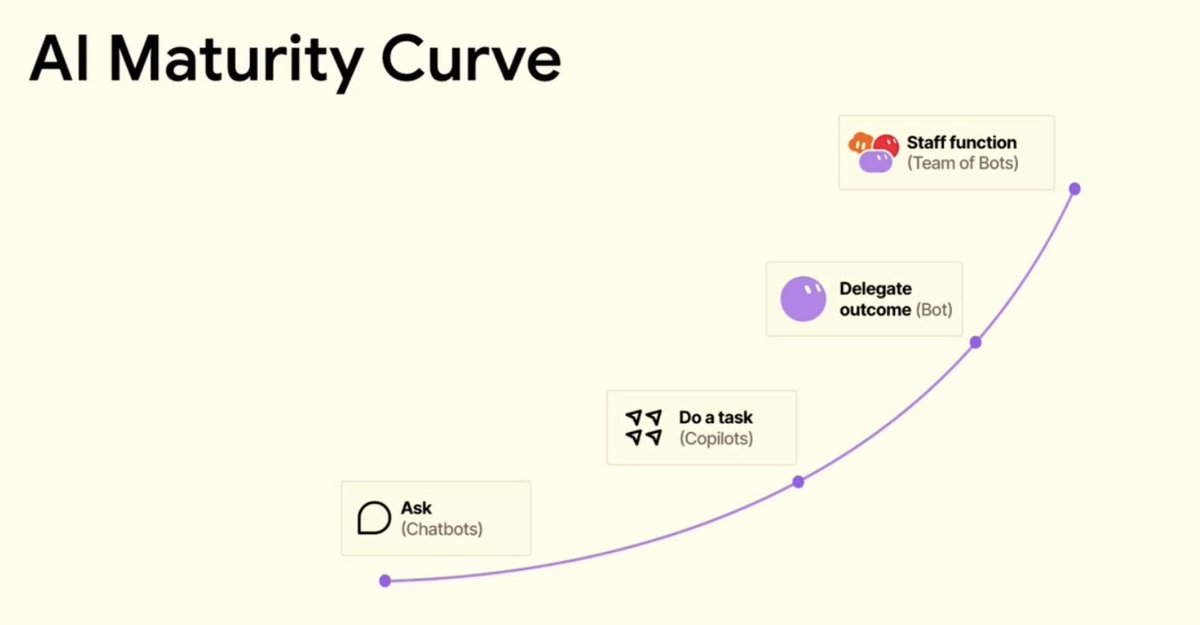
Grok Bot represented the third pattern: agents as an internal org chart. @cb_doge described (257 likes, 42 replies, 21,438 views, 45 bookmarks) bots as standing GTM, engineering, marketing, and admin roles, and @0xMorlex described (40 likes, 5 replies, 4,003 views, 45 bookmarks) a live company-building workflow in which humans set direction, Grok Bot coordinates, specialist agents execute, and humans review. The repeated trigger across all of these builds was the same: long jobs, weak proof, and too much work trapped inside one ephemeral session.
6. New and Notable
Managed harness infrastructure became an explicit product category
@suraj_sharma14 argued (21 likes, 5 replies, 912 views, 11 bookmarks) that the OpenAI Agents API matters because it turns context compaction, session recovery, subagents, tool orchestration, and managed sandboxes into infrastructure instead of app code. That is notable because it shifts the competitive layer away from basic runtime plumbing and toward policies, data, evals, and workflow design.
Hermes supplied a public scale test for coding-agent refactors
@NousResearch reported (115 likes, 12 replies, 5,336 views, 20 bookmarks) a nineteen-hour Hermes run that dispatched 1,393 subagents, peaked at 218 workers, and reduced non-test Python by 34.4% in one codebase. The linked article matters because it did not stop at the headline; it also documented token cost, regression classes that tests missed, and the follow-up fixes required after merge.
Loop engineering got a sharper public benchmark vocabulary
@marfinxx argued (19 likes, 6 replies, 542 views, 9 bookmarks) that LoopsBench exposed a 25% resolve wall for long-horizon coding tasks and tied it to missed prerequisite edges, patch surplus, and regression pressure. That gave the day's harness discussion a more specific language than generic prompt-versus-agent debates.
7. Where the Opportunities Are
[+++] Fresh-context verification and eval infrastructure - Evidence came from multiple directions: @zachlloydtweets drew (152 likes, 14 replies, 30,807 views, 451 bookmarks) replies asking for a verifier before automation, @DanKornas proposed (4 likes, 8 replies, 712 views) PASS, FAIL, or NOT_PROVEN review, @Vtrivedy10 argued (52 likes, 6 replies, 6,578 views, 42 bookmarks) that every team will need owned tasks and environments, and @khanhxuannguyen highlighted (1 like, 2 replies, 327 views) final-output blind spots. This is the strongest gap because it matters in coding, security, and regulated operations at once.
[++] Long-horizon loop orchestration and regression control - @marfinxx described (19 likes, 6 replies, 542 views, 9 bookmarks) a 25% resolve wall without prerequisite tracking and regression gates, while @NousResearch reported (115 likes, 12 replies, 5,336 views, 20 bookmarks) a successful large refactor that still needed stronger checks around removed public names and exception handling. Products that own dependency DAGs, ready-frontier gating, stale-proof receipts, and regression obligations map directly to today's failure modes.
[++] Portable memory ownership and promotion policy - @hwchase17 argued (43 likes, 19 replies, 3,018 views, 20 bookmarks), the LangChain memory posts, and the Hermes skills workflow all point to the same opening: builders want memory they control, but they still do not have a settled answer for what should be promoted, pruned, or reread. This is attractive, but more competitive than the verification layer because several open-harness projects are already here.
[+] Task-specific reputation and settlement rails - @CteaAminah argued (14 likes, 9 replies, 135 views), @Heis_sosa argued (82 likes, 11 replies, 705 views, 10 bookmarks), and @Reno_Web3 argued (66 likes, 72 replies, 1,014 views) that one marketplace score is too weak. The opportunity is emerging because the demand is concrete, but the volume is still smaller than the harness and eval conversation.
8. Takeaways
- Harness differentiation kept moving up the stack. The conversation treated context compaction, recovery, and subagents as infrastructure, while the real edge shifts toward workflow design, permissions, and evals. (source)
- Smaller skill packs and cleaner graphs still beat instruction bloat. The strongest practical reports said to cut skills, add docs, map the repo, and measure what survives review. (source)
- Long-horizon coding agents are still failing on obligation tracking, not just code generation. The public LoopsBench discussion pinned the bottleneck on prerequisite recovery, regression pressure, and missing loop discipline. (source)
- Memory is strategic only if the builder owns the harness and the promotion policy. The day's memory posts repeatedly argued that deciding what survives is the hard part, and that closed harnesses create lock-in around state. (source)
- Agent commerce will depend on narrow trust signals, not one universal reputation score. The most concrete market posts all asked for work-type-specific history, dispute trails, and structured buyer filters. (source)