Twitter AI Agent - 2026-09-17
1. What People Are Talking About
1.1 Harness engineering stayed practical and economics-driven (🡒)
The day's biggest cluster still treated the harness as the real product surface, but the framing got more operational and more economic. Instead of debating whether agents matter, posters focused on who gets paid for harness work, how teams prove output, and why domain-specific harnesses keep beating general-purpose agent shells once real data and real reviewers enter the loop.
@hijunedkhatri argued (208 likes, 19 replies, 21,186 views, 226 bookmarks) that engineers who master harness engineering, agentic systems, and inference are heading into a seller's market, while first-round screening shifts toward AI interviewers and take-homes shift toward paid work trials. The replies added useful friction instead of simple agreement: one engineer wrote that good harness work is "invisible when it's right and loud when it's wrong," while another said fresh graduates still struggle to get hired into these roles despite doing the work already.
@mardehaym argued (93 likes, 11 replies, 28,501 views, 161 bookmarks) that Deloitte's own internal chart effectively admitted the hourly consulting model is shrinking as AI-agent delivery grows. He contrasted five-person consulting teams with a smaller pod made of one senior engineer, agents across delivery, and a fractional architect, and tied that shift to enterprises that are deploying agents before they have redesigned jobs or governance around them.
@0xMovez shared (63 likes, 7 replies, 5,090 views, 104 bookmarks) a 20-point GrokBot checklist from Lauren Tan's founder session that reduced "harness engineering" to specific operating rules: start with a mission instead of roles, keep a chief-of-staff bot, require approvals for risky actions, use a fresh reviewer bot, verify actual behavior rather than a green test string, and count accepted work instead of raw PR volume.

@AIatDoorDash reported (35 likes, 9 replies, 2,013 views, 12 bookmarks) that DoorDash's internal data agent Vera outperformed frontier models dropped into general-purpose harnesses with simple data connectors. In reply, the team said Vera's pass rate rose from 43% to 90% while the evaluation set doubled twice, and the attached chart showed why the discussion kept moving away from model brand preference and toward harness design, reasoning effort, retrieval, and judged tool use.
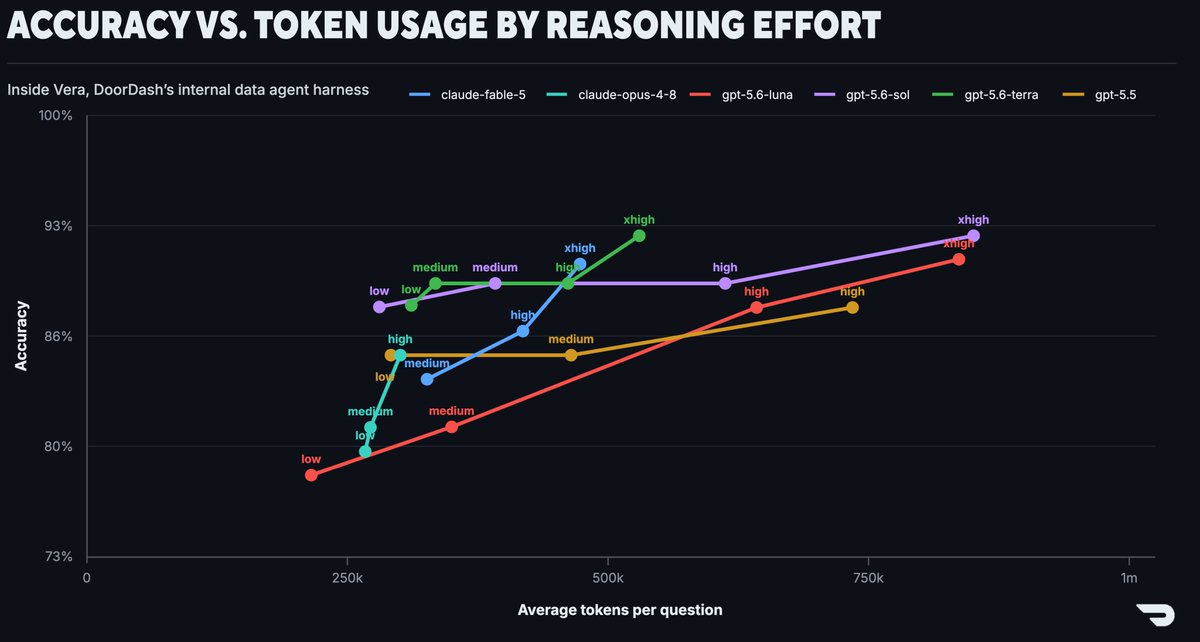
@Vtrivedy10 argued (44 likes, 4 replies, 2,936 views, 37 bookmarks) that model-harness-task fit matters more than model-harness fit, and that the harness is fundamentally a context router moving the right environmental state into a task-specific window. The replies sharpened the point: routing is only half the job, because completion quality also depends on what the harness does after a tool returns and whether failed checks become repair work or a stop signal.


Discussion insight: the most useful replies kept converging on the same design rule: the person or agent that authors work should not be the one that proves it. Fresh reviewers, traces, acceptance tests, and task-fit routing all mattered more than another model switch.
Comparison to prior day: harness conversation stayed roughly flat versus 2026-09-16, but today's evidence leaned harder on routing, evaluation, and labor pricing than on yesterday's team-rollout and subagent-topology stories.
1.2 Agent markets focused on verifiable micro-jobs, not agent counts (🡒)
Marketplace posts were still common, but the tone narrowed from directory growth to transaction mechanics. The strongest threads were not celebrating "the agent economy" in the abstract. They were asking whether an agent can be discovered for a specific task, hired with escrow, challenged if it fails, and trusted again on the next job.
@Chorux666 argued (108 likes, 131 replies, 396 views) that 440,000 registered ERC-8004 agents only matters because those identities sit inside a marketplace where another agent or person can actually find, hire, and pay them. @0LIVExl argued (58 likes, 59 replies, 236 views) that the more interesting number is not total volume but average ticket size: 409,000-plus jobs, $21.4 million moved, and roughly $52 per job, which implies an economy of repeatable micro-tasks rather than rare giant contracts.
@hollyyy argued (69 likes, 54 replies, 3,602 views) that TermiX's AACP layer matters because verification is committed before the job starts and can be deterministic, rubric-based, or hybrid depending on the task. @AzadWeb3 argued (51 likes, 54 replies, 420 views) that the more interesting marketplace future is agents hiring other specialized agents for research, on-chain data, automation, or code review, while replies under that thread said the hard part is handoff: pass only the needed context, then verify the result before the next step continues.
Discussion insight: the replies did not ask for more listed agents. They kept asking for better handoff, challenge windows, portable reputation, and proof that a completed job should count toward future trust.
Comparison to prior day: marketplace volume looked broadly steady versus 2026-09-16, but the content shifted from buyer-side scarcity and reputation theory toward micro-job economics, specialist delegation, and precommitted verification logic.
1.3 MCP moved from protocol talk into real work surfaces (🡕)
MCP discussion stepped up from abstract protocol enthusiasm into examples where the tool boundary, the evidence, and the business workflow were all explicit. The best posts treated MCP as a way to make agent work inspectable inside developer and procurement flows, not as another acronym to attach to a demo.
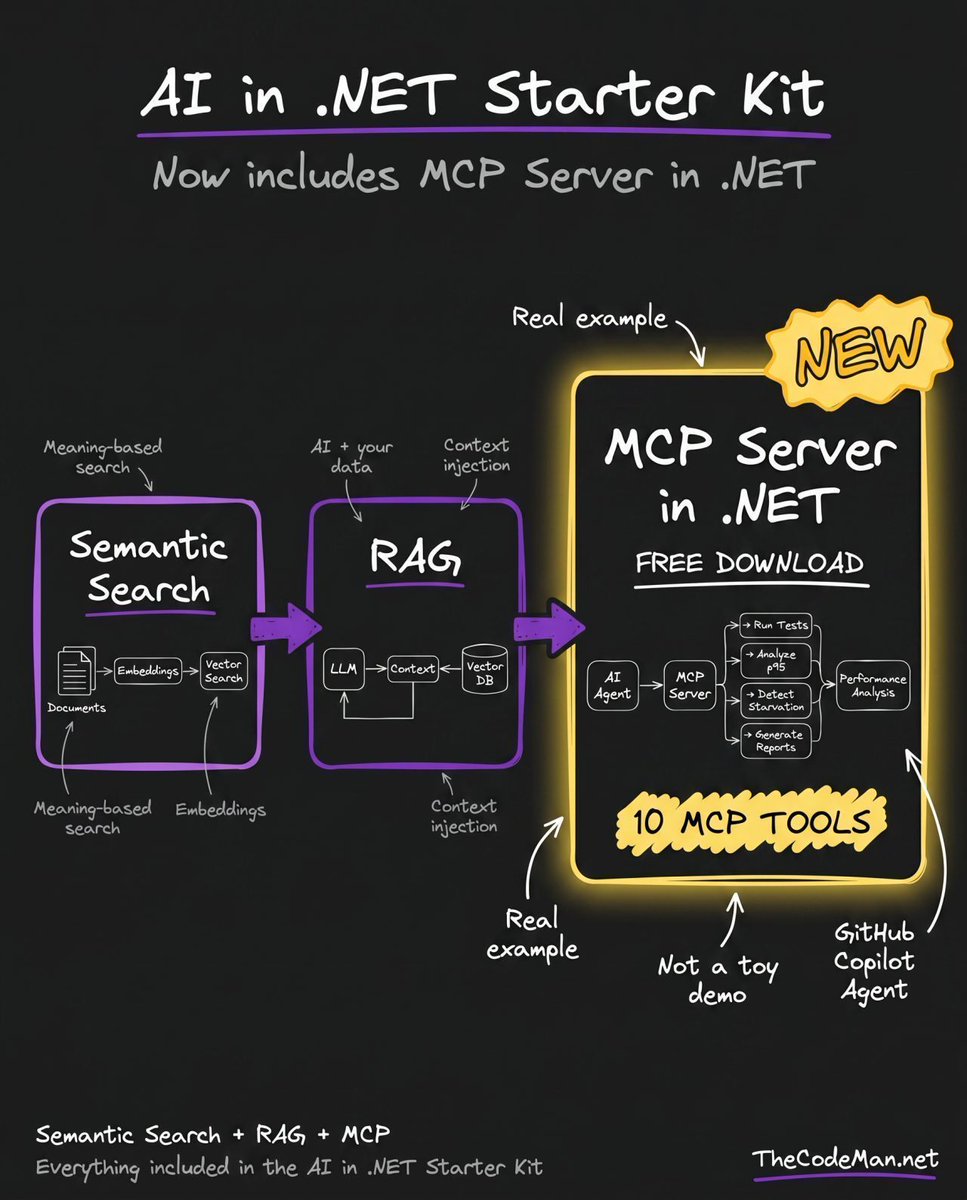
@TheCodeMan__ shared (48 likes, 9 replies, 1,048 views, 29 bookmarks) a realistic .NET MCP server for API performance analysis instead of a toy calculator. His example exposed 10 MCP tools that run load tests, compare endpoints, measure p50/p95/p99 latency, detect thread-pool starvation, and generate reports, and the replies pressed for the same thing serious teams want everywhere else: evidence, raw traces, auth, retries, and logs.
@slash1sol reported (49 likes, 13 replies, 880 views, 30 bookmarks) that Claude Code, Cursor, and Codex can now license datasets over MCP through Luel while a task is already running. The Luel blog made the claim concrete: agents can browse and license the same rights-cleared catalog over MCP, the contributor network spans more than 850,000 people across 96-plus countries, commercial speech data is integrity-checked before delivery, and every seller submission is reviewed by a person before listing.
@gabypadronp argued (30 likes, 20 replies, 170 views, 8 bookmarks) that the market is not short on skills, but on "a kitchen" where those skills can actually run: install-free runtime, sandbox, live MCP entry point, and inspectable trace. That matched the developer-side complaint in the .NET thread: the missing layer is executable infrastructure, not another pile of prompts.
Discussion insight: the sharpest pushback was not anti-MCP. It was anti-handwaving. Posters wanted every tool call to leave evidence behind and reminded each other that removing a procurement thread is not the same thing as removing governance.
Comparison to prior day: explicit MCP references increased versus 2026-09-16 and hit their highest level of the last eight days, with the center of gravity moving from protocol explanation to real developer and data-market workflows.
1.4 Specialized agent systems emphasized workflow metrics over generic chat (🡕)
The technical release thread was notable for how narrow and measurable it became. Instead of promising a better general assistant, posters highlighted systems built for one class of work: optimizing inference, making typed judgments inside code, or carrying multi-step co-work tasks at lower cost.
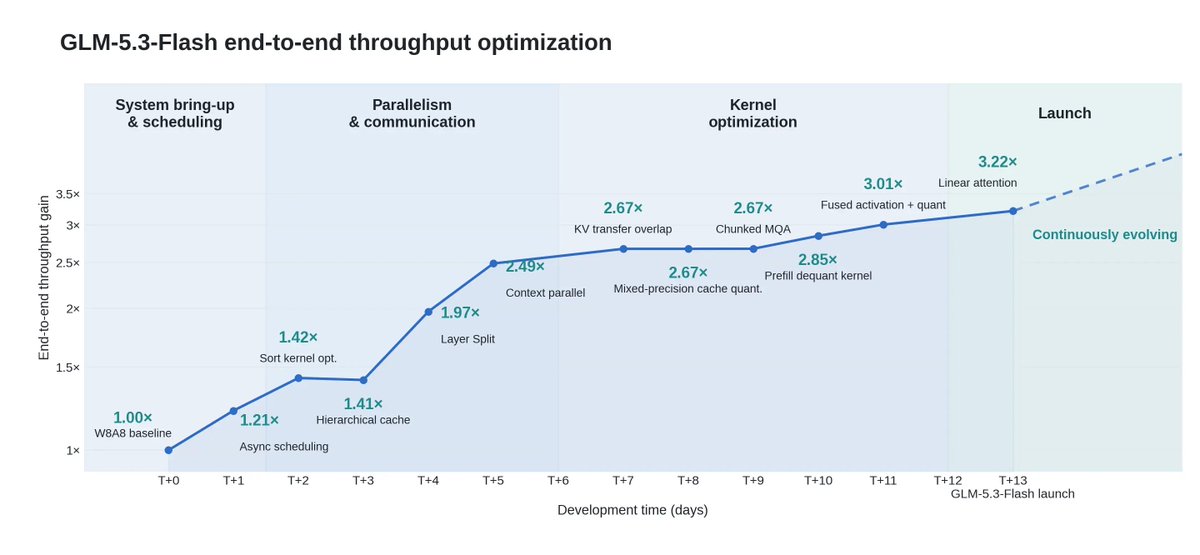
@ZixuanLi_ reported (359 likes, 38 replies, 23,182 views, 44 bookmarks) that a GLM-5.3-powered agent helped bring a production inference system online in less than two weeks while tripling throughput from the initial baseline. The quoted Z.ai post made the recommendation explicit: local correctness tests, execution traces, microbenchmarks, and end-to-end measurements were the feedback loop that let the agent test hypotheses instead of guessing.
@omarsar0 argued (34 likes, 12 replies, 2,985 views, 45 bookmarks) that Jev's highest-ROI uses right now are LLM-as-a-Judge, harness routing, and subagent creation, with dynamic harness generation as the next experiment. @Kostastsale argued (32 likes, 6 replies, 4,053 views, 33 bookmarks) that the same structured-decision model fits threat hunting, detection engineering, and incident response better than asking a chat model to "investigate this," though one reply pushed back that the product is still US-only SaaS and not specialized to every blue-team domain yet.

@ModelScope2022 reported (77 likes, 3 replies, 3,387 views, 37 bookmarks) that Occamy-1.0 is a 35B co-work agent with only 3B active parameters, ranks first in its evaluated 35B-A3B AutomationBench group, and ships with Apache 2.0 licensing plus multiple checkpoint formats. The paper page describes it as an open co-work agent for complex multi-step digital workflows that merges long-horizon and short-horizon experts before further optimization.


Discussion insight: the common preference was for typed outputs, measurable loops, and workflow-specific benchmarks. Posters were less impressed by "smarter" text than by systems that could route, judge, or optimize inside a bounded job.
Comparison to prior day: compared with 2026-09-16's replay-and-routing-heavy research emphasis, 2026-09-17 added more productized examples with explicit workflow metrics and narrower task claims.
2. What Frustrates People
Proof still breaks before generation does
Severity: High. The most practical threads kept returning to the same complaint: getting an agent to produce something is easier than proving the output should be trusted. @0xMovez shared (63 likes, 7 replies, 5,090 views, 104 bookmarks) rules like "done isn't proof," "the builder never approves its own work," and "verify locally before scaling in the cloud." @hollyyy argued (69 likes, 54 replies, 3,602 views) that AACP matters because verification is defined before the job starts, and @AIatDoorDash reported (35 likes, 9 replies, 2,013 views, 12 bookmarks) that Vera uses judged tool use and answer correctness rather than trusting the raw model.
The visible coping pattern was to insert fresh reviewers, screenshots, traces, acceptance rubrics, and deterministic checks between "agent says done" and "team believes it." The frustration is severe because almost every ambitious workflow in the corpus eventually hit this same trust boundary.
Worth building for? Yes. This is a direct production bottleneck, not a speculative annoyance.
General-purpose agents still lose to domain sprawl and runtime clutter
Severity: High. @AIatDoorDash reported (35 likes, 9 replies, 2,013 views, 12 bookmarks) that Codex and Claude Code inside general-purpose harnesses struggle against enterprise data sprawl, while Vera's domain-tuned prompting, retrieval, and skills performed better. @Vtrivedy10 argued (44 likes, 4 replies, 2,936 views, 37 bookmarks) that large memory files, broad tool surfaces, and unrelated skills make routing the right context harder. @gabypadronp argued (30 likes, 20 replies, 170 views, 8 bookmarks) that the ecosystem has plenty of skills but not enough trusted runtime "kitchens" where they can actually execute in sandboxes with traces. In the replies to @TheCodeMan__'s .NET example, people explicitly asked for auth, rate limits, retries, and logs because those are where toy demos stop helping real teams.
The workaround was to narrow the surface area: smaller harnesses, curated schemas, task-specific retrieval, install-free runtimes, and evidence-bearing tool outputs. The complaint is not that models are weak. It is that unmanaged surrounding context makes strong models act weak.
Worth building for? Yes. The need is concrete and showed up in developer, data, and skills-market threads.
Agent markets still lack easy trust transfer between jobs
Severity: High. The market threads were unusually explicit that raw registration counts and raw payment volume do not settle whether an agent is actually reliable. @Chorux666 argued (108 likes, 131 replies, 396 views) that there is a difference between an agent existing and being hireable. @0LIVExl argued (58 likes, 59 replies, 236 views) that the system now processes many small jobs, which makes repeatable verification more important than headline deal size. @AzadWeb3 argued (51 likes, 54 replies, 420 views) that delegation among specialized agents is the interesting future, while replies immediately moved to the hard part: how to pass context and judge completion across handoffs.
The workaround pattern was escrow, precommitted verification strategies, challenge windows, and narrow task descriptions. What remains frustrating is that the trust signal is still fragile: each new job can feel like starting over.
Worth building for? Yes. The demand is direct and the design space is still visibly incomplete.
Voice agents still fail on unstable transcripts and production variance
Severity: Medium. @heyrobinai argued (30 likes, 4 replies, 423 views, 21 bookmarks) that live voice agents usually break not because the LLM is "dumb," but because the transcript is still changing while the agent tries to think and act. The R2T2 site and GitHub repository reinforce why that complaint exists: the product claim is append-only streaming output that stops previously emitted words from being revised. @XFreeze reported (87 likes, 14 replies, 5,053 views, 9 bookmarks) that Grok Voice Think Fast 2.0 leads one task-success benchmark, but replies still warned that accents, interruptions, and latency budgets need to be rerun before anyone calls a voice stack production-ready.
The coping strategy was to stabilize the speech layer first, then let the agent act. That makes this frustration narrower than harness proof or market trust, but it is still severe enough to block real deployments.
Worth building for? Yes, with Medium competition risk. The pain is real, but the field is already crowded with model and ASR contenders.
3. What People Wish Existed
Harnesses that own context routing, evaluation, and current-state proof
The clearest unmet need was not another general assistant. It was a harness that can decide what context belongs in the window, remember state outside the model, and prove whether the result is still valid. @Vtrivedy10 argued (44 likes, 4 replies, 2,936 views, 37 bookmarks) that harness-task fit dominates model-harness fit and that the harness is fundamentally a context router. @AIatDoorDash reported (35 likes, 9 replies, 2,013 views, 12 bookmarks) a domain-specific harness whose judged evaluation loop and retrieval stack outperformed generic setups, while @0xMovez shared (63 likes, 7 replies, 5,090 views, 104 bookmarks) a field checklist built around fresh reviewers, approvals, and local proof. This is a practical need, and the urgency is high because posters repeatedly described proof as the real blocker between demo and deployment. Opportunity: Direct.
Agent-native execution surfaces for skills, tools, and data
People were not asking for more skills catalogs. They were asking for a place where skills, tools, and data can actually execute under inspection. @gabypadronp argued (30 likes, 20 replies, 170 views, 8 bookmarks) that the missing layer is a trusted runtime "kitchen" with sandboxing, live MCP access, and traces. @TheCodeMan__ shared (48 likes, 9 replies, 1,048 views, 29 bookmarks) a concrete MCP server that emits inspectable engineering outputs instead of chatty summaries. @slash1sol reported (49 likes, 13 replies, 880 views, 30 bookmarks) that Luel turned dataset procurement into an MCP-time action, and the Luel blog says that workflow still keeps rights review, integrity checks, and human listing review in the path. The need is practical and urgent, because the partial solutions already exist but are still fragmented across runtimes, catalogs, and governance layers. Opportunity: Direct.
Markets that can delegate work and carry proof forward
The agent-market threads wanted more than listings and wallets. They wanted task-specific trust that survives a completed job. @Chorux666 argued (108 likes, 131 replies, 396 views) that being registered is not the same thing as being hireable. @hollyyy argued (69 likes, 54 replies, 3,602 views) for verification logic that is committed before work begins. @0LIVExl argued (58 likes, 59 replies, 236 views) that the more representative market is thousands of roughly $52 jobs, and @AzadWeb3 argued (51 likes, 54 replies, 420 views) that useful agents should be able to hire specialists instead of pretending to do everything alone. This is a practical need with direct willingness-to-build energy already visible in the threads. Opportunity: Direct.
Stable speech layers for agents that need to act in real time
The voice posts were less about naturalness than about keeping input stable enough for action. @heyrobinai argued (30 likes, 4 replies, 423 views, 21 bookmarks) that a live voice agent feels broken when the transcript keeps moving underneath it. @XFreeze reported (87 likes, 14 replies, 5,053 views, 9 bookmarks) strong task-success numbers for Grok Voice, but the replies still called for production reruns across accents, interruptions, and latency budgets. The R2T2 project partially addresses the practical need with append-only streaming transcription, but the emotional layer is still present too: people want a voice agent that feels stable before it feels impressive. Opportunity: Competitive.
4. Tools and Methods in Use
| Tool | Category | Sentiment | Strengths | Limitations |
|---|---|---|---|---|
| DoorDash Vera harness | Data-agent harness | (+) | Domain-tuned retrieval, judged tool use, modeled data layer, strong pass-rate gains inside one environment | Higher reasoning effort raises token cost and latency; tuned to one enterprise data estate |
| Grok Bot operating pattern | Agent workspace / orchestration | (+/-) | Mission-first scoping, staged approvals, reviewer separation, reusable skills | Requires explicit proof and local validation; more bots add coordination risk |
| MCP | Protocol / tool integration | (+) | Makes tool calls, performance tests, and data licensing part of one workflow | Real deployments still need auth, retries, logs, and governance around every call |
| Luel Data marketplace | Dataset marketplace | (+/-) | Rights-cleared datasets over MCP, integrity checks, human review for seller listings | Faster procurement does not remove usage-rights review or governance requirements |
| TermiX / AACP | Agent marketplace and settlement | (+/-) | Hireable identities, escrow, challenge flow, verification strategies, micro-job economics | Registration counts do not prove quality; trust transfer across jobs is still immature |
| Jev | Structured-output decision model | (+) | Fast typed judgments for routing, scoring, and LLM-as-a-Judge flows | Less useful for open-ended synthesis; early feedback called out SaaS and domain-fit limits |
| GLM-5.3 feedback loop | Inference engineering method | (+) | Uses correctness tests, traces, microbenchmarks, and end-to-end measures to improve systems | Needs dense instrumentation and human-set boundaries to stay useful |
| Occamy-1.0 | Co-work model | (+) | Open weights, low active parameter count, strong workflow benchmarks, cost-performance emphasis | Some early replies questioned how it holds up once tool calls stack or terminal tasks get harder |
| R2T2 | Streaming ASR runtime | (+) | Append-only stable-prefix transcripts, low latency, built for downstream agent pipelines | Solves the speech layer only; task orchestration and evaluation still sit above it |
| Speech Agent Arena | Benchmark method | (+/-) | Measures whether voice agents understand requests, use tools, and finish tasks | A leaderboard is not enough to validate accents, interruptions, and production latency budgets |
Overall sentiment was most positive for narrower layers that constrain or expose agent behavior. @AIatDoorDash reported (35 likes, 9 replies, 2,013 views, 12 bookmarks) that frontier models get much closer once they share the same harness, while @Vtrivedy10 argued (44 likes, 4 replies, 2,936 views, 37 bookmarks) that harness-task fit matters more than model-harness fit. @ZixuanLi_ reported (359 likes, 38 replies, 23,182 views, 44 bookmarks) the same pattern at the systems layer: the gain came from measurement and feedback, not raw generation.
Mixed sentiment clustered around commerce and voice. @hollyyy argued (69 likes, 54 replies, 3,602 views) that markets need committed verification, while @AzadWeb3 argued (51 likes, 54 replies, 420 views) that agent-to-agent hiring only works if the handoff is good. @XFreeze reported (87 likes, 14 replies, 5,053 views, 9 bookmarks) a strong voice leaderboard result, but @heyrobinai argued (30 likes, 4 replies, 423 views, 21 bookmarks) that production pain still starts one layer lower, in the transcript itself.
Common workarounds were smaller harnesses, reviewer separation, traces, sandboxed execution, precommitted verification, and task-specific evaluation. The clearest migration pattern was away from general-purpose chat surfaces and toward inspectable layers: custom data harnesses, MCP-backed tool calls, typed routing models, agent-native procurement, and append-only speech pipelines. Competitive pressure looked strongest where the model itself is becoming less differentiated inside the same control plane.
5. What People Are Building
| Project | Who built it | What it does | Problem it solves | Stack | Stage | Links |
|---|---|---|---|---|---|---|
| Vera | @AIatDoorDash | Internal data agent that answers business questions across DoorDash's data estate | General-purpose coding agents struggle with enterprise data sprawl and ambiguous business context | Custom harness, retrieval, modeled data layer, domain skills, LLM judge | Shipped | tweet |
| GLM-5.3-Flash inference bring-up | @ZixuanLi_ quoting @Zai_org | Uses a GLM-powered agent to help optimize the infrastructure serving GLM-5.3-Flash | Manual inference-system bring-up and throughput tuning are slow and hard to verify | Agent loop, correctness tests, traces, microbenchmarks, kernel optimization | Shipped | tweet |
| TermiX / agent.family | @termix_ai via @Chorux666, @hollyyy, and @0LIVExl | Marketplace where agents hire agents, escrow funds, and settle verified jobs | Agent work needs durable identity, delivery proof, dispute handling, and repeatable micro-job settlement | ERC-8004 identity, AACP verification, escrow, reputation, on-chain settlement | Beta | market, tweet, tweet |
| Luel Data marketplace | @LuelCompany via @slash1sol | Lets agents browse and license rights-cleared datasets over MCP, or submit seller datasets for review | Dataset procurement and licensing often slow down model and agent development | MCP, browser auth, contributor network, integrity checks, human listing review | Beta | blog, tweet |
| AI in .NET Starter Kit / MCP Server in .NET | @TheCodeMan__ | Educational but realistic MCP server for API performance analysis | Most MCP examples do not show inspectable, engineering-grade tool workflows | .NET, ASP.NET Core, custom load-testing engine, Blazor dashboard, 10 MCP tools | Shipped | tweet |
| Jev | @typesafeai via @Kostastsale and @omarsar0 | Structured-decision model for routing, judging, scoring, and security classification | Free-form text models are awkward inside typed automation and blue-team workflows | Choice / Score / Noul primitives, structured probabilities, API delivery | Alpha | docs, tweet, tweet |
| Occamy-1.0 | @ModelScope2022 | Open co-work agent model for complex multi-step digital workflows | Long-horizon co-work tasks still cost too much relative to smaller benchmark gains | Qwen3.6-35B-A3B base, Marathon / Sprint experts, SAO, Dressage stack | Shipped | model, paper, tweet |
| R2T2 | R2T2 via @heyrobinai | Open-source append-only streaming ASR for real-time agent workflows | Voice agents break when transcripts revise themselves while the agent is acting | Stable-prefix decoding, 80 ms to 2 s chunking, vLLM backend, open weights | Shipped | site, repo, tweet |
The repeated build pattern was to wrap the model in a control layer the model does not own. Vera, GLM-5.3's inference loop, Jev, TermiX/AACP, and R2T2 all locate their value in retrieval, verification, routing, settlement, or transcript stability rather than in chat quality alone.
A second pattern was turning previously manual bottlenecks into agent-callable infrastructure. Luel made dataset licensing part of the same MCP workflow as the rest of the task, while TheCodeMan's .NET project made performance testing an inspectable tool surface instead of a loose instruction. TermiX tried the same move for market transactions, and AzadWeb3's thread suggests the next competitive layer is not just listing agents but helping them delegate across specialists safely.
The strongest overlap across builders was around proof. Vera and GLM publish measured workflow claims, Jev narrows output into typed decisions, R2T2 stabilizes the speech layer before action, and AACP commits verification before work begins. Multiple builders are clearly solving the same failure mode from different entry points.
6. New and Notable
Voice agents were judged on task completion and transcript stability, not just how natural they sound
@XFreeze reported (87 likes, 14 replies, 5,053 views, 9 bookmarks) that Grok Voice Think Fast 2.0 leads Artificial Analysis' Speech Agent Arena at 94.6% task success. That mattered because the framing was operational: did the hidden voice agent understand the request, choose the right tool, and finish the job. At the same time, @heyrobinai argued (30 likes, 4 replies, 423 views, 21 bookmarks) that even a smart model still feels broken when the transcript underneath it keeps changing, which makes the R2T2 project notable as a public attempt to stabilize that layer with append-only streaming output.

Dataset procurement became an in-task MCP action
@slash1sol reported (49 likes, 13 replies, 880 views, 30 bookmarks) that Claude Code, Cursor, and Codex can now license datasets over MCP in the middle of a task through Luel. The noteworthy part was not just "another marketplace." The Luel blog says the same workflow covers buying data and submitting data for review, while preserving rights checks, integrity checks, and human review for listings.
Public harness metrics became more specific than model-brand comparisons
Two of the day's strongest technical posts were unusually concrete about measured workflow gains. @AIatDoorDash reported (35 likes, 9 replies, 2,013 views, 12 bookmarks) that Vera's harness improvements drove pass-rate gains from 43% to 90% as the evaluation set doubled twice, while @ZixuanLi_ reported (359 likes, 38 replies, 23,182 views, 44 bookmarks) that a GLM-5.3-powered agent helped deliver a 3.22x throughput improvement on the system serving GLM-5.3-Flash. Those are notable because they move public agent discussion away from vague capability claims and toward measured harness outcomes.
7. Where the Opportunities Are
[+++] Verifier-first harnesses for domain workflows — Evidence came from multiple angles: @0xMovez made fresh review, local proof, and accepted-work metrics the center of a 20-step GrokBot playbook; @AIatDoorDash showed a domain-specific harness beating generic agents on real data work; and @Vtrivedy10 framed the harness as the task-fit router. This is strong because the complaints, workarounds, and measured wins all point to the same missing layer.
[+++] Agent-native execution surfaces for tools, data, and traces — @gabypadronp argued that the ecosystem lacks a trusted runtime kitchen; @TheCodeMan__ showed a realistic MCP server that produces inspectable engineering evidence; and @slash1sol plus the Luel blog showed procurement moving into the task itself. The opportunity is strong because current solutions exist, but they are still fragmented across skills, sandboxes, and governance.
[++] Verifiable micro-job markets and specialist delegation — @Chorux666 distinguished hireable agents from merely registered ones, @0LIVExl surfaced a market of roughly $52 tasks, @hollyyy emphasized precommitted verification, and @AzadWeb3 pushed the agent-as-buyer pattern. This is moderate rather than strongest because the need is obvious, but the current discussion is still concentrated around one ecosystem.
[++] Structured-decision layers for routing, judging, and security — @omarsar0 highlighted LLM-as-a-Judge, harness routing, and subagent creation as immediate Jev use cases, while @Kostastsale mapped the same primitive to threat hunting, false-positive analysis, and incident response. This is moderate because the workflow fit is clear, but the current public evidence still comes from early adopters and an early-stage product.
[+] Stable speech-to-action infrastructure — @heyrobinai said live voice agents break when the transcript keeps moving, @XFreeze showed growing appetite for task-success benchmarks, and R2T2 shows one public attempt to harden the speech layer itself. The opportunity is emerging because demand is visible, but competition among voice models, ASR stacks, and benchmarks is already intense.
8. Takeaways
- Harness work kept compounding into economic leverage. The strongest posts connected harness engineering to hiring scarcity, consulting-model compression, and smaller delivery pods rather than to prompt craft alone. (source, source)
- Verification remained the bottleneck between agent output and trusted work. Fresh reviewers, local checks, judged tool use, and precommitted verification strategies showed up across GrokBot, Vera, and TermiX threads. (source, source, source)
- MCP looked strongest when it touched a real workflow boundary. The most credible examples were API performance testing and rights-cleared dataset licensing, both of which turned a vague protocol story into inspectable work inside the task. (source, source)
- Specialized agent primitives gained attention by narrowing outputs, not broadening them. GLM-5.3's measured throughput loop, Jev's typed routing and judging, and Occamy-1.0's co-work benchmark story all pointed toward bounded workflow claims instead of generic assistant positioning. (source, source, source)
- Voice-agent credibility is shifting from naturalness to stable execution. One post highlighted a task-success leaderboard, while another said the real production failure is still-moving transcripts, making the speech layer itself part of the agent stack. (source, source)