Twitter AI Agent - 2026-09-19
1. What People Are Talking About
1.1 Jev expanded from routing theory into product surfaces, voice operators, and trading loops (🡕)
On 2026-09-18, Jev was mostly discussed as a cheaper typed-decision primitive. On 2026-09-19, the conversation widened into concrete surfaces: trading, voice control, spend gates, incident response, and orchestration. The top-ranked non-retweet item was @RohOnChain, who argued (534 likes, 48 replies, 61,174 views, 1,367 bookmarks) that Jev enables sub-100ms calibrated buy/sell decisions on every block. @gregisenberg then translated the same primitive into ten product ideas (298 likes, 58 replies, 24,434 views, 499 bookmarks), from agent spend firewalls and self-healing tool calls to dynamic permissions and confidence-based human queues.
@omarsar0 pushed the theme further (92 likes, 27 replies, 6,732 views, 84 bookmarks): Jev is not just a classifier, but a harness primitive for continuous evals, custom verifiers, dynamic UIs, orchestration, and context surfacing. @kwindla supplied the day’s most concrete operator benchmark by comparing Jev and GPT-5.6 Luna inside a Pipecat speech interface pipeline (65 likes, 13 replies, 2,905 views, 47 bookmarks), claiming better command accuracy and far lower latency for the typed-decision path.
Discussion insight: the Jev cluster no longer read like “new model hype.” It read like control-plane design: which decisions should stay cheap, typed, and inspectable, and which should escalate to a richer model or a human.
Comparison to prior day: on 2026-09-18, Jev won attention by replacing wasteful LLM calls. On 2026-09-19, it became more operational: builders started mapping it into trading loops, voice operators, branch pruning, spend control, and verification-heavy harnesses.
1.2 Agent systems themselves are turning into files, pipelines, and verifiers (🡕)
The day’s strongest infrastructure cluster was about making agent behavior governable below the prompt layer. @undefinedKi summarized Shopify’s internal stack (19 likes, 10 replies, 1,453 views, 25 bookmarks), and the linked Shopify engineering article confirmed a nine-stage Dispatch scan pipeline, parallel hunting followed by separate validation, and 300+ findings across 80+ applications. The attached diagram was one of the day’s clearest artifacts because it also connected Dispatch to River, a remediation loop that triages, fixes, watches, and hands work off to humans.

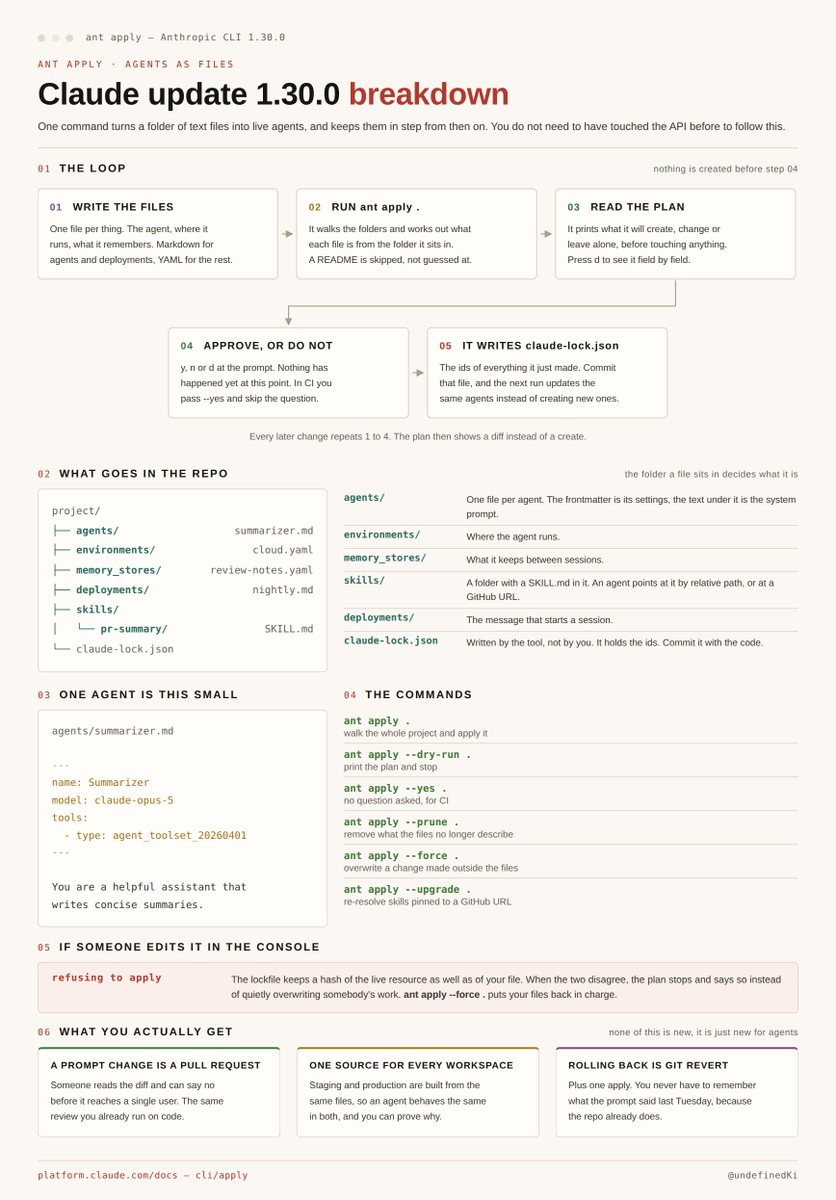
The same “make the runtime explicit” pattern showed up in Anthropic’s tooling. @undefinedKi argued (21 likes, 11 replies, 885 views, 20 bookmarks) that ant apply effectively turns agent components into editable repo files; Anthropic’s public release notes and ant apply docs back that up with file-defined agents, environments, memory stores, skills, deployments, plan review, and claude-lock.json for repeatable updates. A separate high-engagement research thread from @N01ennn argued (75 likes, 8 replies, 4,506 views, 91 bookmarks) that an agent saying “done” should never be enough: the graph should gate state transitions, the loop should own retries under hard budgets, and the harness should emit evidence for every path.
@jkelleyrtp supplied the systems side of the same story by describing Devin Cloud Mac (46 likes, 6 replies, 1,367 views, 20 bookmarks); Cognition’s public blog post confirmed that giving an agent a usable Mac required virtual-disk work, user-space networking boundaries, live control, and accessibility-tree-based UI verification.
Discussion insight: reliability discussion moved down a layer. The model still mattered, but the day’s highest-value posts were mostly about the runtime around the model: validation stages, lockfiles, graph transitions, retries, isolation, snapshots, and evidence.
Comparison to prior day: 2026-09-18 focused on portable skills and visible supervision surfaces. 2026-09-19 made the underlying execution substrate feel more real, because the strongest evidence came from official docs and engineering writeups rather than from only community diagrams.
1.3 The Claude Code ecosystem is starting to look like a package ecosystem (🡕)
The most obvious ecosystem signal was volume. In the review set, claude code appeared 46 times, coding agent 44 times, and GitHub was the second-most common linked domain after X. @charliejhills captured that sprawl with a 40-item Claude install list (49 likes, 19 replies, 8,721 views, 90 bookmarks) spanning workflows, skills, memory layers, tools, and prompt utilities. The image mattered because it grouped the stack by job rather than by popularity, which is much closer to how practitioners actually decide what to install.

But the more interesting posts were the ones that made that ecosystem executable. @brennanzambo shared a one-command Claude plugin marketplace entry for 100+ tools with per-call receipts (5 likes, 6 replies, 186 views), and the public marketplace manifest confirms the packaging and free-tier claim. @Mike_Andreuzza shared a VHS video skill (5 likes, 1 reply, 272 views, 4 bookmarks) whose README turns doc videos into rerunnable .tape artifacts instead of screen recordings.
Discussion insight: people are no longer just collecting prompts. They are assembling versioned stacks. The immediate reply pattern was governance: if skills, plugins, and agent helpers are becoming dependencies, teams want permission review, rollback, receipts, and some way to know what actually ran.
Comparison to prior day: on 2026-09-18, skills portability was the story. On 2026-09-19, curation and install surface became more prominent: not just “can this move between runtimes?” but “which 5-10 components deserve to be in the default stack?”
1.4 Agent commerce stayed visible, but the strongest proof point was still a tiny settled job (🡒)
Marketplace talk was still loud enough that termix ai appeared 40 times in the discovered phrase list and agent.family was one of the top linked domains. The most concrete retained example came from @EyoAugusti73181, who used a $1 holo-card commission as a test of agent-commerce rails (67 likes, 71 replies, 1,468 views). The tweet reduced the workflow to request → escrow → delivery → challenge → settlement, while the public agent.family site describes TermiX as a marketplace where agents hire agents with on-chain escrow, staked reputation, and dispute handling.
Discussion insight: the better commerce posts were still not proving macro demand. They were proving that the transaction loop can close at all, even on low-ticket creative work, and that may be the right near-term test.
Comparison to prior day: this theme held steady from 2026-09-18, but the framing got narrower. Instead of big agent-economy rhetoric, the clearest example was a tiny job whose value came from exercising the rails, not from the size of the payment.
2. What Frustrates People
Cheap control decisions are still routed through expensive, slow model paths
Severity: High. The strongest Jev posts were all complaints in disguise. @gregisenberg listed (298 likes, 58 replies, 24,434 views, 499 bookmarks) purchase approvals, retries, permission grants, branch pruning, and human queues as decision problems that should not need a full generative pass. @omarsar0 said (92 likes, 27 replies, 6,732 views, 84 bookmarks) he is seeing new harness capabilities precisely because Jev makes those control decisions cheaper and faster, while @kwindla supplied a concrete latency comparison inside a voice pipeline.
The workaround is obvious: split the stack into typed decision layers and broader reasoning layers. The frustration is severe because people are treating this as a production cost bug, not as a research preference.
Worth building for? Yes. This is repeated, practical pain with clear adoption behavior.
“Done” is still too easy for agents to say and too hard for humans to trust
Severity: High. The evidence-gating thread from @N01ennn framed the core problem directly (75 likes, 8 replies, 4,506 views, 91 bookmarks): a completion claim is not evidence. Shopify’s public scan architecture and Anthropic’s plan/apply flow point at the same problem from a different direction: separate validation, explicit plans, lockfiles, and human approval boundaries exist because free-form “it worked” is not good enough in production. Even @brennanzambo phrased his plugin marketplace pitch around receipts, not around raw tool breadth.
The workaround pattern is verifier layers, bounded retries, explicit state machines, and durable evidence artifacts. The frustration is high because the control gap appears every time agents move from demos into environments where mistakes matter.
Worth building for? Yes. This is one of the clearest needs in the corpus.
The agent-tool ecosystem is useful, but the governance tax is rising fast
Severity: High. @charliejhills offered a useful 40-item install list (49 likes, 19 replies, 8,721 views, 90 bookmarks), and the most useful reply immediately warned that every skill should be treated like untrusted code until its shell and network permissions are reviewed. @brennanzambo promised one-command tool access plus receipts, while @Mike_Andreuzza showed how one narrow skill can generate a deterministic docs artifact instead of another fuzzy chat output.
The workaround is more packaging, more provenance, and narrower utilities. The unresolved pain is composition: once teams have many skills, tools, and helpers, they need permission boundaries, observability, and rollback as much as they need more features.
Worth building for? Yes. The ecosystem is getting denser faster than it is getting safer.
Agent-commerce rails still need to prove demand and trust beyond the demo case
Severity: Medium to High. The low-ticket TermiX example from @EyoAugusti73181 made the settlement loop easy to understand (67 likes, 71 replies, 1,468 views), but it also highlighted the remaining gap: a $1 job can prove that rails exist without proving that durable demand, portable reputation, and dispute resolution hold up at scale.
The workaround is to start small: escrow, challenge windows, and accepted-delivery records even on tiny jobs. That is directionally right, but it still leaves the bigger market question unanswered.
Worth building for? Yes, but carefully. The infrastructure need is real; the near-term market size is less certain.
3. What People Wish Existed
Drop-in typed control planes for agent loops without replacing frontier models
People were not asking for another general chatbot. They were asking for a fast layer that can decide whether to retry, approve, deny, escalate, route, or prune before a larger model or a human gets involved. @gregisenberg made that explicit (298 likes, 58 replies, 24,434 views, 499 bookmarks), while @omarsar0 mapped the same need into evals, verifiers, orchestration, and dynamic context. Opportunity: Direct.
Verifier-first runtimes where a task cannot advance without proof
The most repeated wish beneath the day’s infrastructure talk was simple: make “done” impossible without evidence. @N01ennn argued for graph-gated transitions and bounded retries (75 likes, 8 replies, 4,506 views, 91 bookmarks), Shopify published separate validation stages in Dispatch, and Zambo positioned receipts as a default property of tool calls. Opportunity: Direct.
Git-native agent packaging that keeps local, CI, and production behavior aligned
Anthropic’s ant apply push made a larger wish visible: treat agents as repo resources, not as one-off UI state. The docs and release notes show the ingredients people want—plan review, file ownership, lockfiles, and reversible updates—but the opportunity is broader than one CLI. Teams want these semantics across environments. Opportunity: Direct.
Curated agent stacks with permission introspection, receipts, and fewer blind installs
Charlie Hills’ install list, Zambo’s one-command marketplace, and Mike Andreuzza’s narrow VHS skill all point toward the same wish: less random copying, more auditable installation. People want packages that explain what they do, what they can touch, and what proof they leave behind. Opportunity: Direct.
Trust rails for low-ticket agent work that can compound into real marketplaces
The agent.family example suggests a viable first wedge: tiny, scoped jobs whose delivery and settlement can be checked mechanically. What still feels missing is durable reputation portability and proof that request volume will grow with supply. Opportunity: Competitive.
4. Tools and Methods in Use
| Tool | Category | Sentiment | Strengths | Limitations |
|---|---|---|---|---|
| Jev / System One models | Typed decision model | (+) | Millisecond-scale routing, judging, scoring, gating, branch pruning, and confidence-based escalation | Best for bounded choices, not broad generation; replies flagged sensitivity to state framing |
| Shopify Dispatch / River | Agentic scan and remediation harness | (+) | Parallel hunting, separate validation, shared state, reusable artifacts, measured findings and merge outcomes | Narrow to specific security and dependency workflows; much of the detail is Shopify-specific |
ant apply |
Repo-native agent packaging | (+) | Agents, environments, memory, skills, and deployments as files; plan review; lockfile-backed updates | Tied to Anthropic’s CLI semantics and still needs human review on apply |
| Devin Cloud Mac | Computer-use runtime | (+) | Persistent Mac workspace, disk snapshots, networking boundary, live control, accessibility-tree verification | Heavy infrastructure cost and complexity below the model layer |
| Zambo Claude plugin marketplace | Tool marketplace / receipts layer | (+/-) | One-command install, 100+ tools, verifiable receipts, free tier, explicit manifest | Early and lightly validated in public; trust is concentrated in one provider |
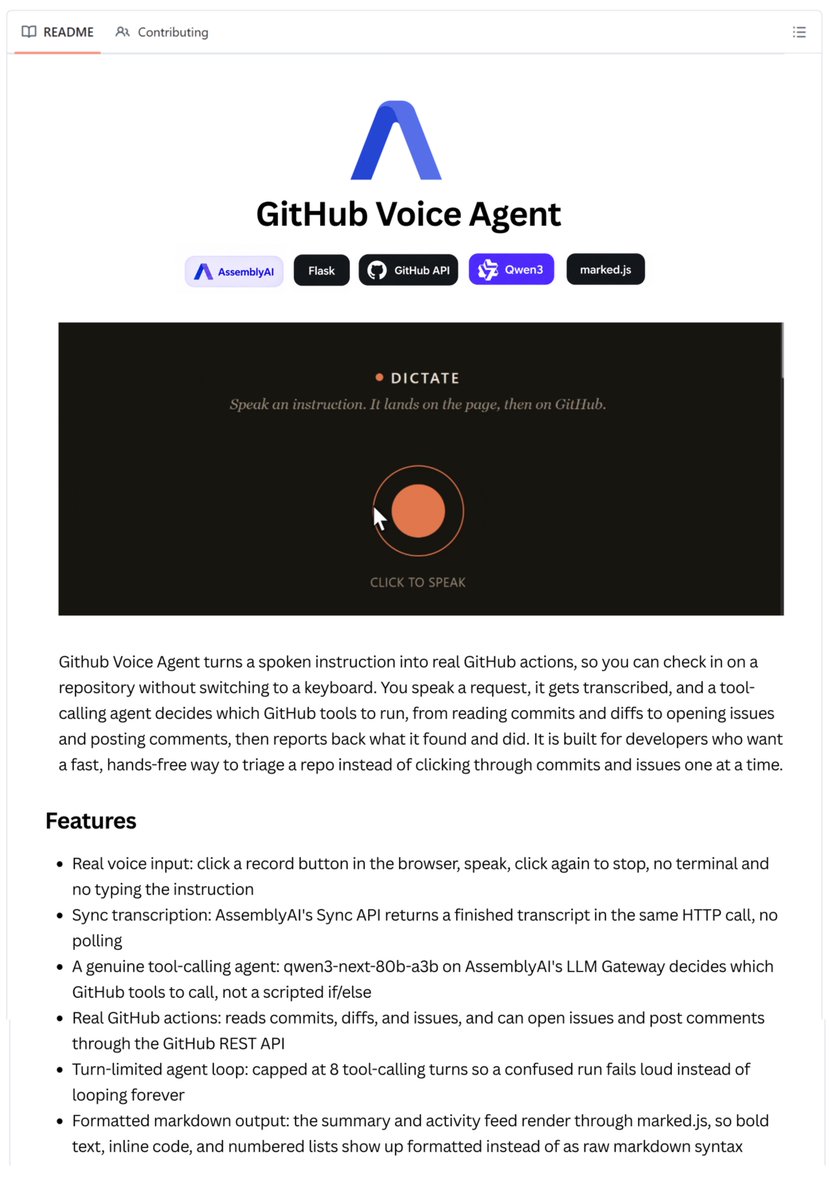
| Voice GitHub Agent | Voice front end to repo automation | (+) | Real GitHub actions, visible transcript and action feed, simple architecture, bounded loop | Single-repo scope, manual token setup, and an 8-turn cap |
| VHS demo videos skill | Deterministic docs artifact generator | (+) | Rerunnable .tape scripts, commands actually execute, broken flows fail loudly |
Narrow use case centered on terminal demos |
Overall sentiment was strongest for tools that narrow or externalize agent behavior: typed decisions instead of free-form guesses, plans and lockfiles instead of hidden UI state, receipts instead of trust-me tool calls, and reproducible tapes instead of recorded demos.
The migration pattern was away from “just prompt harder” and toward explicit control surfaces: files, manifests, receipts, shared state, validation stages, and bounded loops.
5. What People Are Building
| Project | Who built it | What it does | Problem it solves | Stack | Stage | Links |
|---|---|---|---|---|---|---|
| Shopify Dispatch / River | Shopify Engineering | Finds issues across a monorepo, validates them, and pushes remediations toward merge | Makes large-scale scanning and follow-up remediation tractable on a living codebase | Ruby client, sandboxed agents, partitioned scans, separate validation, shared state, human approval | Shipped internally / publicly documented | article, tweet |
ant apply |
Anthropic | Syncs repo-defined agents, environments, memory, skills, and deployments into live resources | Makes agent configuration reviewable, reproducible, and reversible | Markdown + YAML resources, plan/apply loop, claude-lock.json |
Shipped | docs, release notes, tweet |
| Devin Cloud Mac | Cognition | Gives Devin a persistent macOS workspace for building and verifying Apple apps | Extends cloud coding agents into Mac-native UI and simulator workflows | Apple Virtualization.framework on EC2 Mac, NBD snapshots, user-space networking, VNC, accessibility tree | Shipped | article, tweet |
| Zambo plugin marketplace | Zambo | Exposes 100+ execution tools to Claude Code with a single marketplace manifest and per-call receipts | Gives coding agents broader tool access with an auditable return artifact | Claude plugin marketplace manifest, receipts, hosted tool endpoints | Shipped | site, manifest, tweet |
| Voice GitHub Agent | @Sumanth_077 | Turns a spoken repo instruction into multi-step GitHub actions | Makes repo triage and issue creation hands-free while keeping actions visible | AssemblyAI Sync API, AssemblyAI LLM Gateway, qwen3-next-80b-a3b, Flask, GitHub REST API |
Prototype / open source | repo, tweet |
| VHS demo videos | Michael Andreuzza | Generates terminal docs videos from scripted .tape files |
Replaces brittle screen recordings with rerunnable, testable demos | VHS, Skills CLI, committed tape scripts | Shipped / open source | repo, tweet |
| agent.family / TermiX | TermiX | Marketplace where agents post, bid, deliver, and settle jobs | Tests whether agent work can carry escrow, challenge, and reputation rails | On-chain escrow, staked reputation, dispute handling, agent-to-agent marketplace | Live / early market | market, tweet |
The recurring build pattern was not “one big autonomous agent.” It was narrow, governable surfaces: a scan pipeline, a repo sync primitive, a Mac runtime, a receipted tool layer, a voice repo worker, a deterministic docs-video skill, and a marketplace with explicit settlement stages.
A more peripheral but still telling workflow came from @businessbarista, who outlined a full AI-assisted video pipeline (36 likes, 8 replies, 6,033 views, 84 bookmarks) spanning Ahrefs + Claude + Notion for ideation, Codex + Final Cut for the radio cut, Remotion for motion graphics, and Epidemic Sound via MCP for music. The point was not that agents replaced taste. It was that structured formats are giving agents more of the production line.
6. New and Notable
Shopify published one of the clearest public diagrams yet for agentic code scanning and remediation
The Shopify post mattered because it made the whole loop inspectable: partitioning, parallel hunting, separate validation, report authoring, PR creation, remediation, and shared state. The companion tweet from @undefinedKi surfaced the operational payoffs in a way that Twitter could actually absorb (19 likes, 10 replies, 1,453 views, 25 bookmarks).
Anthropic made “agents as files” concrete instead of aspirational
The ant apply discussion was notable because it turned a vague desire into a concrete repo contract: files define the resources, the CLI plans changes before creating them, and the lockfile keeps later updates honest. That is a much stronger story than “agents can have memory and tools,” because it tells teams how those pieces might be versioned.
Cognition explained the unglamorous systems work underneath computer-use agents
The Devin Cloud Mac writeup was notable because it did not hand-wave the environment away. It described the disk, the network boundary, live control, and the accessibility tree as first-class engineering problems. That is exactly the sort of detail missing from most “computer use” discourse.
Typed-decision discussion crossed into voice and trading, not just evals
The Kwindla benchmark and RohOnChain trading thread were notable because they extended the Jev conversation into interfaces and markets. Whether or not every claim holds up, the directional shift is clear: people are testing typed decisions where latency and bounded actions matter most.
7. Where the Opportunities Are
[+++] Typed decision control planes for agent workflows — The strongest evidence came from multiple angles at once: @gregisenberg listed concrete product wedges (298 likes, 58 replies, 24,434 views, 499 bookmarks), @omarsar0 mapped them into harness primitives (92 likes, 27 replies, 6,732 views, 84 bookmarks), @kwindla supplied a live operator benchmark (65 likes, 13 replies, 2,905 views, 47 bookmarks), and @RohOnChain pushed the idea into trading loops (534 likes, 48 replies, 61,174 views, 1,367 bookmarks). This is strong because the need, the pain, and the proposed insertion points all line up.
[+++] Evidence-gated runtimes and verifier layers — @N01ennn framed the conceptual need (75 likes, 8 replies, 4,506 views, 91 bookmarks), Shopify published a real validation-heavy production pipeline, Anthropic exposed reviewable plans and lockfiles, and Zambo wrapped tool calls in receipts. This is strong because it is the most repeated reliability theme across otherwise very different posts.
[+++] Repo-native agent packaging and environment parity — Anthropic’s file-defined resources and claude-lock.json, plus the broader Claude stack-curation wave around Charlie Hills’ list, point toward a real product category: agent config management that survives local development, CI, and production changes without becoming a mystery state machine. This is strong because the tooling direction is clear even if the ecosystem is still early.
[++] Curated install surfaces for agent skills, tools, and artifacts — @charliejhills showed how crowded the stack already is (49 likes, 19 replies, 8,721 views, 90 bookmarks), @brennanzambo offered receipted one-command tool installs (5 likes, 6 replies, 186 views), and @Mike_Andreuzza showed how narrow, deterministic skills can produce better outputs than giant generic stacks (5 likes, 1 reply, 272 views, 4 bookmarks). This is moderate to strong because demand is obvious, but trust and composition problems are still open.
[++] Trust rails for low-ticket agent work — The agent.family / TermiX example is compelling precisely because it is small. If micro-jobs cannot close cleanly, larger agent markets will not matter. This is moderate because the need is real, but public evidence is still concentrated in one ecosystem and still says more about infrastructure readiness than about sustained demand.
8. Takeaways
- Jev moved from abstract routing talk into concrete operating surfaces. On this day it showed up not just as a classifier, but as a spend gate, retry policy engine, voice operator, and trading-loop primitive. (source, 298 likes, 58 replies, 24,434 views; source, 92 likes, 27 replies, 6,732 views; source, 65 likes, 13 replies, 2,905 views)
- The most credible infrastructure posts were about the runtime around the model. Shopify, Anthropic, and Cognition all highlighted plans, validation stages, lockfiles, snapshots, and explicit boundaries rather than raw model intelligence. (source, 19 likes, 10 replies, 1,453 views; source, 21 likes, 11 replies, 885 views; source, 46 likes, 6 replies, 1,367 views)
- Verification language is becoming mainstream agent language. The high-engagement “done is not evidence” thread, Shopify’s validation stage, and Zambo’s receipt framing all pointed toward the same cultural shift: agents need proof surfaces, not just output surfaces. (source, 75 likes, 8 replies, 4,506 views; source, 19 likes, 10 replies, 1,453 views; source, 5 likes, 6 replies, 186 views)
- Claude Code’s surrounding ecosystem is starting to matter almost as much as Claude Code itself. The conversation was full of install lists, marketplaces, helper skills, receipts, and narrow utilities that turn agent behavior into something closer to software inventory. (source, 49 likes, 19 replies, 8,721 views; source, 5 likes, 6 replies, 186 views; source, 5 likes, 1 reply, 272 views)
- Agent commerce still looks more like infrastructure rehearsal than a mature market. The clearest example was a $1 settled creative job, which is useful because it tests escrow and acceptance, but it still leaves demand depth and portable reputation as open questions. (source, 67 likes, 71 replies, 1,468 views)