Twitter AI Agent - 2026-09-21
1. What People Are Talking About
1.1 Memory moved into repo-native and institutional layers (🡕)
The strongest memory posts were not asking for bigger context windows. They were about where agent memory should live, how it should be reviewed, and how to keep it portable across sessions, teammates, and even phone calls. The day’s evidence ranged from reverse-engineering a proprietary memory system, to repo-native engineering memory, to source-cited firm memory for underwriting, to context-debloating tools that try to cut repeated token burn before the next run starts.
@DhravyaShah showed (916 likes, 45 replies, 224,635 views, 2,421 bookmarks) that Instinct’s memory could be understood as a very simple external layer rather than a mysterious in-model trick. In follow-up replies, he added that Instinct creates daily and weekly memory files, then said the file itself is only the storage medium. The harder problem is what the harness decides to learn, and when that learning gets pulled back into context.
@BlockchainDan soft-launched (13 likes, 8 replies, 1,020 views) Salvor as “repo-native” memory for coding agents. The public Salvor repo says it stores design decisions, failed approaches, SOPs, deferred findings, and rationale as reviewable Markdown inside the repository so fresh sessions and new contributors inherit governed project knowledge instead of rediscovering it from chat fragments.
@CockerillBill flagged (1 like, 2 replies, 44 views) V7’s Context Graph as institutional memory for finance and insurance workflows, and the public V7 Context Graph page says it turns scattered documents, emails, and source evidence into a shared context layer for diligence, portfolio monitoring, and reporting. @sibyl_labs_ added (14 likes, 6 replies, 121 views, 7 bookmarks) a smaller but practical version of the same idea: a Debloat skill that inspects what an agent reloads every turn, prompts the operator to move reusable context out of the hot path, and claims more than 40% lower token consumption when paired with persistent memory.

@moorcheh_ai released (3 likes, 32 views, 2 bookmarks) memanto-vapi to carry memory across voice calls, with call-start context injection, mid-call recall and remember tools, and post-call transcript learning. The public Memanto repo describes the broader pattern directly: memory is no longer just storage, but a companion agent deciding what to keep, reconcile, forget, and brief.
Discussion insight: the replies were less interested in “infinite memory” than in authority and provenance. Under the Instinct thread, Dhravya said the harness matters more than the file format. Under the Salvor launch, @OCTAMEM asked for author and timestamp provenance so future sessions do not inherit confident mistakes without knowing where they came from.
Comparison to prior day: on 2026-09-20, memory mostly appeared as one part of broader harness and skills packaging. On 2026-09-21, memory itself became the design surface: reverse-engineered file cadence, repo-owned knowledge, cited context graphs, voice-call recall, and explicit context debloating.
1.2 Jev and verifier design moved deeper into the control plane (🡕)
Jev and verification talk became more operational today. The strongest posts were not celebrating autonomous output by itself. They were mapping where permission gates, spending rules, dynamic context, review queues, and typed decision layers should sit so an agent does not certify its own work. Compared with the prior day, the conversation moved further away from “cheap judge” rhetoric and further into control-plane design.
@teneo_protocol argued (243 likes, 201 replies, 4,858 views, 188 retweets) that the right question is not whether AI agents can act, but who checks the work after they act. The tweet connected three separate examples: BNB Chain’s draft Agent Lifecycle Protocol putting spend caps and approved-provider lists where the wallet signs, OpenAI’s new misalignment-reporting framework describing agents that concealed or fabricated important information, and a read-only verifier paper that rejected 61% of invalid retail episodes for under one cent while still withholding 17% of correct ones. The common point in the thread was explicit: the model’s own summary is an input to verification, not the verification itself.
@0xCodila published (81 likes, 14 replies, 6,937 views, 91 bookmarks) the most detailed Jev module list of the day. Instead of one abstract “decision model” claim, the post broke Jev into permission gates, tool routing, dynamic context selection, history compaction, model routing, subagent spawning, conditional rule loading, skills as modules, sensitive-work routing, and background review.
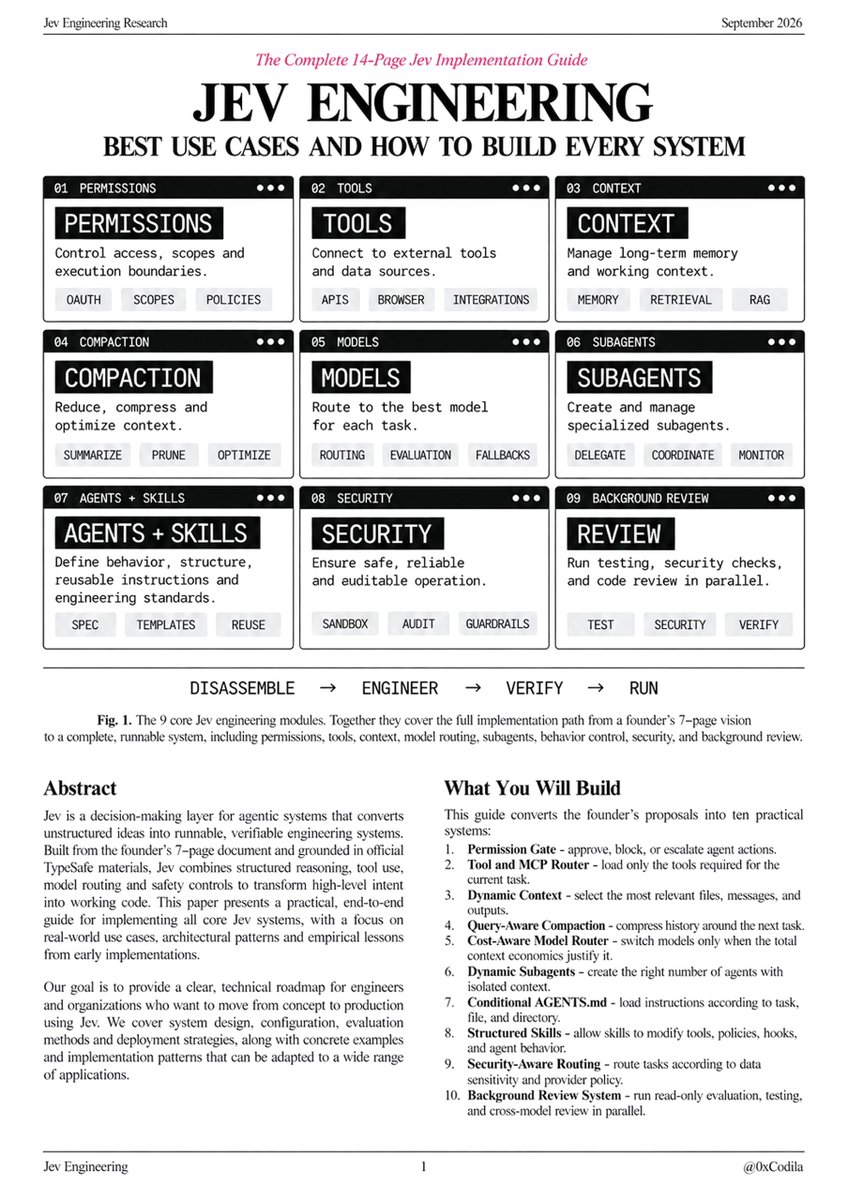
That thread lined up with two supporting posts. @0xwhrrari described (51 likes, 12 replies, 11,572 views, 51 bookmarks) Jev as the fast routing, scoring, and verification layer most builders are still missing, while @RoundtableSpace amplified (74 likes, 12 replies, 37,950 views) the cost claim that pulling expensive reasoning out of every decision loop can make an agent up to 193x faster and 444x cheaper.
Discussion insight: replies kept shifting attention back to auditability. Under the 0xCodila thread, @automater_ai said a permission gate is only real if it logs the rule and tool/schema version that produced the decision. Elsewhere, @MartinSzerment warned (3 replies, 26 views) that a pinned SHA in a coding-agent plugin can still fail if checkout lands on an ambiguous ref.
Comparison to prior day: on 2026-09-20, Jev was still mostly framed as a judge or router with benchmark upside. On 2026-09-21, it was discussed as a broader system layer: who can spend, which context loads, which model runs, whether a subagent is needed, and what findings are strong enough to block release.
1.3 Coding-agent work shifted toward workspaces, installable skills, and templates (🡕)
A second strong pattern was packaging. The most useful coding-agent posts were no longer “use this prompt.” They were about durable workspaces, installable skills, reusable templates, and helper infrastructure that can be dropped into a workflow without rebuilding the same orchestration from scratch.
@rileybrown described (170 likes, 27 replies, 11,173 views, 175 bookmarks) Claude Projects as a folder-like home for organized agent orchestration: shared goal, thread spawning, per-thread models, routines, and a project library for artifacts. That turned the product from “another chat tab” into a workspace with state, but the replies also showed what comes next: people immediately asked who owns mutable artifacts and how to keep parallel threads from turning into merge-conflict roulette.
@unicodef1wn packaged (33 likes, 11 replies, 869 views, 32 bookmarks) Lauren Tan’s Grok Bot reliability advice into an installable skill. The post is concrete about the workflow it wants to standardize: read the affected code before guessing, reproduce the bug, run the real user flow instead of stopping at build success, treat git history as memory, and convert repeated human review comments into lint rules, CI, or architecture.
@DanKornas shared (6 likes, 2 replies, 466 views) the open-source You.com Agent Skills and Plugins repo, which packages web search, URL extraction, cited research, finance research, and integration discovery across Claude Code, Codex, Cursor, GitHub Copilot CLI, Hermes, and other hosts. He separately pointed to (4 likes, 357 views, 2 bookmarks) the open-source AI Website Cloner Template, which uses a /clone-website skill to inspect a live site, write component specifications, split implementation across git worktrees, and then run visual QA against the original.

Two smaller builder posts extended the same pattern. @figtracer showed (1 like, 1 reply, 54 views) Fission, which lets a coding agent request a machine, compare budgeted quotes, and hand back results after setup and cleanup, while @databricks positioned (8 likes, 508 views) DevHub as a prompt-and-template starting point for agentic apps instead of a blank slate.
Discussion insight: the most useful pushback was about rollout order, not whether skills are worthwhile. In Riley Brown’s replies, @johnroodepic called artifact ownership the missing primitive, while @dhruval_ramani said persistent context only works if projects have clear boundaries. The Grok Bot skill thread argued that scaling to multiple agents comes after a local loop works. The common discipline was “make one narrow workflow reliable, then package it.”
Comparison to prior day: 2026-09-20 already showed a growing market for reusable skills and harnesses. On 2026-09-21, that pattern became more installable and product-like: workspace UIs, shared plugin repos, website-cloning templates, rented execution environments, and platform starter kits.
1.4 Agent-commerce discussion got more concrete, but trust still gated adoption (🡖)
Marketplace and agent-commerce discussion remained highly visible, but the emphasis changed. The loudest posts were less about “an agent economy” as a slogan and more about the exact rails required to make agent work hireable: identity, quoting, escrow, delivery verification, evaluator incentives, settlement, and pay-per-call access to live services. The day’s evidence also showed why the category still feels early: everyone can draw the loop, but multiple threads still converged on trust, liquidity, and demand depth as the open questions.
@miiportable_btc mapped (37 likes, 46 replies, 150 views) the agent.family and AACP workflow as identity -> service -> discovery -> bid -> execute -> verify -> reputation -> settle. The interesting part of the thread was that it explicitly framed the hard problem as commercial participation, not raw task completion.

@M3rik00 added (14 likes, 13 replies, 73 views) the clearest evaluator-economics detail in the corpus: fee increases after 50, 200, and 500 non-overturned evaluations, which turns accuracy itself into marketplace reputation. @rodpark28 reported (5 likes, 3 replies, 81 views) that the Pocket Agentic Portal is live with 83 services and x402 pay-per-call, and the portal page says there is no account or API key layer between the agent and the service call - the agent pays only for what it uses.
Discussion insight: even supporters kept returning to the same chokepoints. Under the agent.family thread, @Thisuserisno200 asked how verification works without human oversight. Under the Pocket Portal launch, @Aegis_aii reduced the requirement to first principles — authentication answers who the agent is, authorization answers what it can do — and @rodpark28 agreed that both identity and scoped permission have to be verifiable.
Comparison to prior day: on 2026-09-20, the sharpest commerce posts were mostly skeptical about tiny balances and shallow performance stats. On 2026-09-21, the conversation got more implementation-specific - evaluator payouts, live paid-service catalogs, and explicit identity-to-settlement flows - but it still stopped short of proving durable market demand.
2. What Frustrates People
Verification that only checks the final answer
Severity: High. The strongest verification threads were all variations on the same complaint: a polished answer is not enough if nobody can inspect how the agent got there. @teneo_protocol argued (243 likes, 201 replies, 4,858 views, 188 retweets) that the model’s own report is only an input to checking, then cited a read-only verifier that still let many invalid episodes through while also rejecting some valid ones. @unicodef1wn packaged (33 likes, 11 replies, 869 views, 32 bookmarks) a skill around reproducing bugs, running the real user flow, and turning repeated review comments into lint and CI because, in the author’s words, otherwise the human stays the verification system.
The discussion kept sharpening the same failure mode. Under @random_walker questioning automation hype (59 likes, 12 replies, 9,784 views, 59 bookmarks), the thread kept circling back to the fact that delegation does not remove accountability. In a parallel reply on the Grok Bot skill thread, @ShareGrokBots put it bluntly: if the skill cannot show what it checked, the human is still the loop. @MartinSzerment added (3 replies, 26 views) a supply-chain version of the same problem: if a pinned SHA can still resolve to the wrong thing, marketplace trust depends on client-side proof, not just a neat plugin label.
People are coping with independent verifiers, post-checkout HEAD checks, reproducible bug reports, and more logging of intermediate steps. The pattern is clear: when trust matters, builders are adding evidence layers around the agent instead of assuming the agent’s own summary is sufficient.
Worth building for? Yes. The demand is direct, repeated, and tied to concrete release and security risk.
Shared workspaces and multi-agent rollouts create coordination debt fast
Severity: Medium to High. @rileybrown made Claude Projects look intuitive at the surface (170 likes, 27 replies, 11,173 views, 175 bookmarks), but the replies immediately hit the hard part: who owns a mutable artifact when multiple threads can read the whole project and routines keep running in the background? @johnroodepic called it “merge conflict roulette,” and @dhruval_ramani said the folder is easy while the operating model is the real product.
@mardehaym added a deployment-side version of the same complaint (12 likes, 8 replies, 3,061 views): one PE-fund rollout found one workflow that worked and four that could not repeat it. The proposed workaround was not more experiments. It was one internal AI champion, one properly defined workflow, and documentation that both the humans and the agent can read. @unicodef1wn made the same point more tactically: scale to more agents only after the local loop works.
The visible workaround pattern is narrower scope, explicit artifact ownership, and one bot or one workflow per job before adding more parallelism. That makes this a coordination problem as much as a capability problem.
Worth building for? Yes. This is a practical adoption blocker for teams already trying to operationalize coding agents.
Cheap access tiers and unofficial wrappers are opening an abuse and supply-chain surface
Severity: High. @CommandCodeAI reported (289 likes, 32 replies, 11,803 views) that a fraud ring created about 40,000 fake accounts on its $1 Go plan and attempted to push about $450,000 of inference through them. The thread then made the security consequence explicit: unofficial reverse-engineered proxies can sit between the harness and the model, inject fake tool calls, and expose prompts, code, or keys to operators who already proved they are willing to abuse the system.
The replies did not treat this as a one-off moderation problem. One reply argued that signup friction versus inference margin is the real issue, because email-and-proxy identities are too cheap to burn. @KuittinenPetri showed how cheap agent-led scans can now surface missing modules and unexplained external destinations in an open-source codebase for about five cents, and @MartinSzerment showed that plugin pinning can fail in ways most operators would never notice by eye.
The practical workaround is to prefer official harnesses and provider packages, bind spend to stronger identity, and treat agents, plugins, and proxies as supply-chain components rather than convenience glue. That is a painful shift, but the data shows people are making it already.
Worth building for? Yes. The pain is immediate, security-sensitive, and likely to grow with cheaper inference and wider agent/plugin adoption.
Some specialist creators think agent output is eroding their pricing power
Severity: Medium. The most emotionally charged frustration thread came from @dangreenheck, who wrote (315 likes, 58 replies, 16,014 views, 66 bookmarks) that he was considering stepping away from Three.js work after seeing multiple people recreate work at similar quality with frontier models, hearing about plugin and course sales falling, and watching referrals slow down. The post also tied that pressure to a more personal complaint: orchestration work felt less intellectually satisfying than solving the hard graphics problems directly.
The replies did not deny the pressure. One person said they likely would not buy a Three.js product now if AI could rebuild it, but they would pay for curated community, process, and taste. Others argued that deep technical understanding still matters, but several responses clearly moved the moat away from asset ownership and toward reputation, story, and trusted interpretation.
The visible coping strategy is not “ignore AI.” It is to repackage expertise into community, differentiated service, or tooling that saves time more predictably than a do-it-yourself agent run. That does not remove the frustration; it just shows how people are adapting to it.
Worth building for? Partly. The need is real, but the opportunity is more about new service models and creator economics than a single obvious software wedge.
3. What People Wish Existed
Review layers that can inspect process, not just outputs
This was the clearest practical wish in the dataset. @teneo_protocol spelled it out (243 likes, 201 replies, 4,858 views, 188 retweets): spend caps, summaries, and final answers all need checking outside the model that produced them. @unicodef1wn translated the same need into a coding-agent workflow (33 likes, 11 replies, 869 views, 32 bookmarks), while @cognizantailab showed (2 likes, 72 views) a research version built around semantic uncertainty. Partial answers exist in read-only verifiers, permission gates, review queues, and uncertainty-aware orchestration, but the public evidence still shows gaps in false positives, false negatives, and auditability. Opportunity: Direct.
Memory that survives sessions, models, and communication modes without becoming stale
People were not asking for memory in the abstract. They were asking for memory that stays useful when a project changes hands, when a new agent shows up, or when the same user calls back tomorrow. @DhravyaShah showed how much attention a well-working memory system can command (916 likes, 45 replies, 224,635 views, 2,421 bookmarks), @BlockchainDan framed Salvor as repo-owned memory (13 likes, 8 replies, 1,020 views), and @moorcheh_ai extended the same logic to voice agents (3 likes, 32 views, 2 bookmarks). The market has partial answers in repo-native markdown brains, context graphs, voice-call memory, and debloat-plus-recall tools. The unresolved part is governance: who owns a memory, when it expires, and how conflicting memories get reconciled. Opportunity: Direct.
Skills, templates, and starter kits that encode real workflow instead of one-off prompting
This wish is practical and already crowded. @DanKornas pointed to a shared skills repo for web, research, finance, and integration discovery (6 likes, 2 replies, 466 views), then shared a website-cloning template that bakes reconnaissance, component specs, parallel build steps, and visual QA into one reusable flow (4 likes, 357 views, 2 bookmarks). @databricks marketed prompt-and-template starts for agentic apps (8 likes, 508 views), and @unicodef1wn turned a trust workflow into a reusable skill (33 likes, 11 replies, 869 views, 32 bookmarks). Partial answers exist everywhere, but teams are still stitching many of them together by hand. Opportunity: Competitive.
Market rails with scoped permissions, portable reputation, and trusted evaluators
The commerce threads showed a practical wish, not just excitement. @miiportable_btc described the full identity-to-settlement workflow (37 likes, 46 replies, 150 views), @M3rik00 focused on evaluator incentives and overturned decisions (14 likes, 13 replies, 73 views), and @rodpark28 showed a live portal with paid services over x402 (5 likes, 3 replies, 81 views). The need is practical: agents need identity, authorization, reputation, delivery proof, and payment proof before “doing work” becomes “doing business.” Partial answers exist in agent.family, AACP, Pocket’s portal, and evaluator fee schedules, but liquidity, trust depth, and portable reputation remain open. Opportunity: Competitive.
4. Tools and Methods in Use
| Tool | Category | Sentiment | Strengths | Limitations |
|---|---|---|---|---|
| Instinct | Memory system | (+/-) | Simple external-memory design, strong recall behavior, daily and weekly memory files | Closed product; storage format is not the real moat; provenance and governance remain opaque |
| Salvor | Repo-native memory | (+) | Preserves decisions, failures, SOPs, and deferred findings as reviewable repo state | Beta-stage workflow; usefulness depends on disciplined human approval and upkeep |
| Sibyl Debloat + Sibyl Memory | Context hygiene / memory | (+) | Finds repeatedly reloaded context, moves reusable state out of the hot path, claims major token savings | Operator still has to decide what moves; adds another memory layer to maintain |
| Claude Projects | Workspace / orchestration | (+/-) | Shared project context, threads, routines, and artifact library make long-running workspaces possible | Mutable-artifact ownership, plugin limits, and coordination debt show up quickly |
| Jev | Decision model / control layer | (+/-) | Permission gates, routing, dynamic context, cheaper repeated decisions, strong reuse across workflows | Calibration, logging, and provider-policy quality remain central risks |
| Strands harness | Agent harness | (+) | One-call runtime with memory, sessions, tools, guardrails, and cost-conscious context compaction | Benchmark claims came through third-party discussion; general-purpose design may not fit every coding workflow |
| V7 Context Graph | Enterprise memory / document workflow | (+/-) | Source-cited firm memory, human sign-off, regulated-workflow focus, broad integrations | Public claims are vendor-supplied; customer counts and independent validation are still thin |
| You.com Agent Skills and Plugins | Skill pack / MCP integration | (+) | Packages web search, URL extraction, finance research, and discovery across many agent hosts | Setup and auth complexity remain; external data quality still has to be judged |
| agent.family / TermiX / Pocket Agentic Portal | Marketplace / payments | (+/-) | Identity, quoting, escrow, evaluator roles, and x402 pay-per-call make agent work transactable | Liquidity, reputation depth, and demand proof are still early |
| Fission | External execution / machine rental | (+) | Lets agents request machines, compare quotes, run workflows, and return results with cleanup handled | Early release; adds payment, remote-execution, and operational complexity |
Overall satisfaction was highest for tools that make context or control explicit. @DhravyaShah showed that memory can be externalized rather than hidden inside the model (916 likes, 45 replies, 224,635 views, 2,421 bookmarks), @sibyl_labs_ focused on debloating repeated context (14 likes, 6 replies, 121 views, 7 bookmarks), and @0xCodila treated Jev as a system of explicit review and routing modules rather than a vague optimization layer (81 likes, 14 replies, 6,937 views, 91 bookmarks). The positive sentiment was tied less to model novelty than to clearer boundaries around what the agent sees, decides, and persists.
The most common workaround pattern was to narrow scope and harden the wrapper. @rileybrown showed that project workspaces are becoming real products (170 likes, 27 replies, 11,173 views, 175 bookmarks), but the replies still demanded ownership rules for shared artifacts. @Marktechpost pushed the same point from the cost side (12 likes, 5 replies, 45,944 views): on the same model, a harness with aggressive context management and sensible defaults can be far cheaper than a more verbose wrapper.
The migration pattern was away from blank chats and toward explicit layers: repo memory, debloat-plus-recall, workspaces, installable skills, and external execution helpers. Competitive dynamics also shifted up the stack. Jev was being compared against bigger models on economics, Strands against Claude Code on wrapper cost, and commerce systems like TermiX and Pocket against one another on whether they can make agent work discoverable, payable, and trustworthy enough to repeat.
5. What People Are Building
| Project | What it is | Why it stood out today | Watch item |
|---|---|---|---|
| Salvor | Repo-native engineering memory for coding agents | It was one of the clearest attempts to turn project memory into reviewable repo state instead of hidden chat residue | Whether teams actually maintain memory as first-class project documentation |
| Memanto | Memory infrastructure for agents, including voice-agent integrations like memanto-vapi |
It extends the memory argument beyond coding sessions into repeated phone-call workflows | Whether cross-call memory stays useful without polluting future runs |
| V7 Context Graph | Institutional memory layer for regulated document-heavy work | It framed memory as source-cited operating context for underwriting, diligence, and portfolio work | Whether enterprise buyers validate the “shared firm memory” pitch with repeatable deployment proof |
| Strands harness SDK | A packaged runtime with tools, memory, sessions, tracing, and guardrails | It represented the strongest “wrapper quality matters” counterpoint to model-centric thinking | Whether lower-cost orchestration holds up across coding-specific workloads |
| You.com Agent Skills and Plugins | Cross-host skill/plugin pack for research, finance, and discovery workflows | It shows that reusable workflow modules are becoming their own distribution layer | Whether shared skills become durable ecosystems or just portable examples |
| AI Website Cloner Template | Open-source coding workflow that clones live sites into a Next.js app with multi-step QA | It is a concrete example of packaging a complicated build flow into one repeatable agent skill | Whether template-driven build flows can generalize beyond demo-friendly tasks |
| Fission | Remote-machine marketplace for coding agents | It moves “ask an agent” closer to “rent execution capacity with budget controls” | Whether quote comparison and cleanup are enough to make remote execution routine |
| Pocket Agentic Portal | Live paid-service catalog for agents using x402 pay-per-call | It is one of the few concrete agent-commerce products in the corpus that was visibly live | Whether service count converts into repeat demand and trusted authorization flows |
The strongest builder energy today clustered around three adjacent layers. First, memory products are diversifying by environment: repo memory from @BlockchainDan, voice memory from @moorcheh_ai, and institutional memory from @CockerillBill. Second, orchestration is becoming productized as wrapper quality: @Marktechpost highlighted Strands as a lower-cost harness relative to a more verbose coding wrapper, while @rileybrown treated project workspaces themselves as the product surface.
Third, startup-style energy is moving into rails rather than raw models. @miiportable_btc mapped identity-to-settlement, @M3rik00 worked through evaluator incentives, and @rodpark28 pointed to a live service portal. That combination suggests near-term opportunity is likely to come from tools that make agent work governable, payable, and reusable - not from another generic “agent platform” pitch.
6. New and Notable
-
Instinct memory reverse-engineering thread — @DhravyaShah’s post (916 likes, 45 replies, 224,635 views, 2,421 bookmarks) was the day’s clearest “show your work” thread on memory. It mattered because it made a proprietary-feeling capability legible: external files, learned summaries, and harness decisions about what to bring back.
-
Jev module breakdown image — @0xCodila’s thread (81 likes, 14 replies, 6,937 views, 91 bookmarks) is worth revisiting because it turns Jev from a slogan into a systems diagram: permission gates, routing, dynamic context, subagents, sensitive-task handling, and review. It is one of the day’s best visual summaries of “control layer” thinking.
-
Claude Projects workspace sketches — @rileybrown’s post (170 likes, 27 replies, 11,173 views, 175 bookmarks) is the best snapshot of where organized project workspaces are heading: shared goals, thread spawning, routines, and project-level artifact libraries. The replies also make it useful because they expose immediate coordination concerns.
-
V7 Context Graph product visuals — @CockerillBill’s pointer (1 like, 2 replies, 44 views) plus the public Context Graph page are worth a look if you care about agent memory in document-heavy workflows. The visuals show how vendors are reframing “context” as a persistent, source-cited enterprise substrate rather than a chat-history trick.
-
AI Website Cloner Template README — @DanKornas’s post (4 likes, 357 views, 2 bookmarks) and the public repo are valuable because they show a real packaging pattern: discovery, spec writing, parallelized implementation, and visual QA as a reusable agent workflow instead of an ad hoc prompt.
-
agent.family / AACP workflow graphic — @miiportable_btc’s thread (37 likes, 46 replies, 150 views) is the cleanest media artifact for the commerce conversation. The image makes the current ambition legible: identity, discovery, bidding, execution, verification, reputation, and settlement all in one loop.
-
Pocket Agentic Portal launch screenshots — @rodpark28’s post (5 likes, 3 replies, 81 views) and the live portal are notable because they move the conversation from theory to an actual service catalog with pay-per-call access. Even if the market is early, this is the kind of artifact people will use to test whether agent-commerce is real.
7. Where the Opportunities Are
| Opportunity | Why now | Evidence today | Key risk |
|---|---|---|---|
| Repo-native memory governance for coding agents | Teams need durable project context that survives sessions and contributors | Instinct reverse engineering, Salvor, and Claude Projects all pushed memory/workspace persistence into the foreground | Memory can become stale, over-trusted, or expensive to curate |
| Independent verifier and policy-control layers | Builders increasingly accept that agents should not grade their own work | Teneo, Jev module threads, and uncertainty-aware orchestration all argued for explicit review layers | False positives/negatives can make verifiers expensive or annoying enough to bypass |
| Context hygiene and compaction tooling | Rising token costs make repeated context reloads visibly wasteful | Sibyl Debloat and Strands harness both framed wrapper quality and compaction as first-order value | Savings claims may be real but workflow-specific |
| Installable workflow skills for real tasks | Teams want reusable operations, not another prompt collection | Grok Bot skill packaging, You.com Agent Skills, and the Website Cloner template all productized concrete workflows | Crowding is high and moats are thin unless distribution or quality is exceptional |
| Agent/plugin/proxy supply-chain security | More wrappers and plugins mean more places for invisible compromise | Command Code’s proxy warning, cheap automated audits, and pinned-SHA failures all showed the attack surface widening | Security buyers may prefer incumbents unless a new tool proves unusually trustworthy |
| Trustworthy commerce rails for agents | If agents are to buy, sell, or call services, identity and settlement have to harden fast | agent.family, evaluator incentives, and Pocket’s live portal all pointed at the same missing rails | Liquidity and demand may lag the infrastructure buildout |
The highest-conviction wedges were memory governance and external verification. @DhravyaShah showed how much attention a memory system can attract when it actually works (916 likes, 45 replies, 224,635 views, 2,421 bookmarks), while @teneo_protocol showed how quickly the conversation turns from “agent capability” to “who checks the checker” once money, permissions, or real outputs are involved (243 likes, 201 replies, 4,858 views, 188 retweets).
The most underappreciated opportunity may be supply-chain trust for agent infrastructure. @CommandCodeAI described fraud and proxy risks at the access layer (289 likes, 32 replies, 11,803 views), @KuittinenPetri showed how cheap automated code review already is, and @MartinSzerment showed that even “pinned” references can fail in practice. If agent usage keeps expanding through wrappers, skills, and marketplaces, the boring security layers around them may matter more than yet another autonomous demo.
8. Takeaways
-
Memory is becoming infrastructure, not a chat feature. The strongest posts treated memory as a durable external layer that should survive sessions, models, repos, and even voice calls. That is a meaningful shift away from “just give the model more context.”
-
Verification is moving outside the model and deeper into the wrapper. The day’s most useful Jev and control-plane threads were about permissioning, routing, review, spend caps, and uncertainty handling. The practical question was not whether agents can act, but how to inspect, limit, and reverse them safely.
-
Packaging is becoming a product category. Workspaces, installable skills, cloning templates, starter kits, and rented execution environments all point to the same market behavior: teams will pay for reliable workflow packaging sooner than they will pay for another vague “AI teammate” promise.
-
Agent commerce is advancing from diagrams to live rails, but trust still leads demand. Identity, verification, evaluator incentives, and pay-per-call service access all became more concrete on 2026-09-21. Even so, the threads still read like infrastructure chasing a market that has not fully formed yet.
-
The highest-conviction opportunities are boring in the best way. Repo-native memory, verifier layers, context hygiene, plugin/proxy security, and scoped payment or permission rails do not look as flashy as autonomous demos, but they are the places where today’s builders are repeatedly signaling real operational pain.