Twitter AI Agent - 2026-09-27
1. What People Are Talking About
1.1 Harness engineering is now the product, not a footnote (🡕)
The biggest cluster on 2026-09-27 treated the harness itself as the differentiator: how subagents are coordinated, how model behavior is constrained, how context is preserved, and how much work can be pushed out of the base model and into the runtime. At least five high-signal items supported this theme, spanning product claims, first-hand runtime reviews, and an open-source course that frames harness design as its own discipline.
@thdxr argued (2,535 likes, 58 replies, 167,043 views, 1,005 bookmarks) that OpenCode's results are "entirely the harness," not the underlying model. The replies sharpened the claim instead of diluting it: Kit Langton said OpenCode 2.5 is removing plan mode, and thdxr said the product is leaning harder into Jev while also already shipping browser support that still needs better surfacing. The point was operational, not philosophical: people are increasingly attributing agent quality to the runtime's control policy, not just to whichever frontier model sits underneath.
@daniel_mac8 reported (201 likes, 26 replies, 14,834 views, 79 bookmarks) that Claude Code's new dynamic workflows with Opus 5.5 were the best multi-agent orchestration experience he had used. His follow-up linked Anthropic's dynamic workflows cookbook, which says Claude writes a JavaScript orchestration script, runs it through the Workflow tool, can keep up to 16 agents active concurrently, and uses code-level branching and verification instead of relying on a lead agent's context window alone.
@Da7_Tech reported (162 likes, 53 replies, 15,637 views, 67 bookmarks) after two months with Droid that the harness matters as much as the model roster. His review added rare operating detail: roughly 94% cache efficiency, about 585 million tokens across roughly 70 sessions in 14 days, strong behavior across Claude, GPT, Grok, Kimi, Qwen, and GLM families, and a complaint list that centered on harness features rather than model IQ: missing long-term memory, voice being disabled after quota exhaustion, and long-think runs getting interrupted too early.
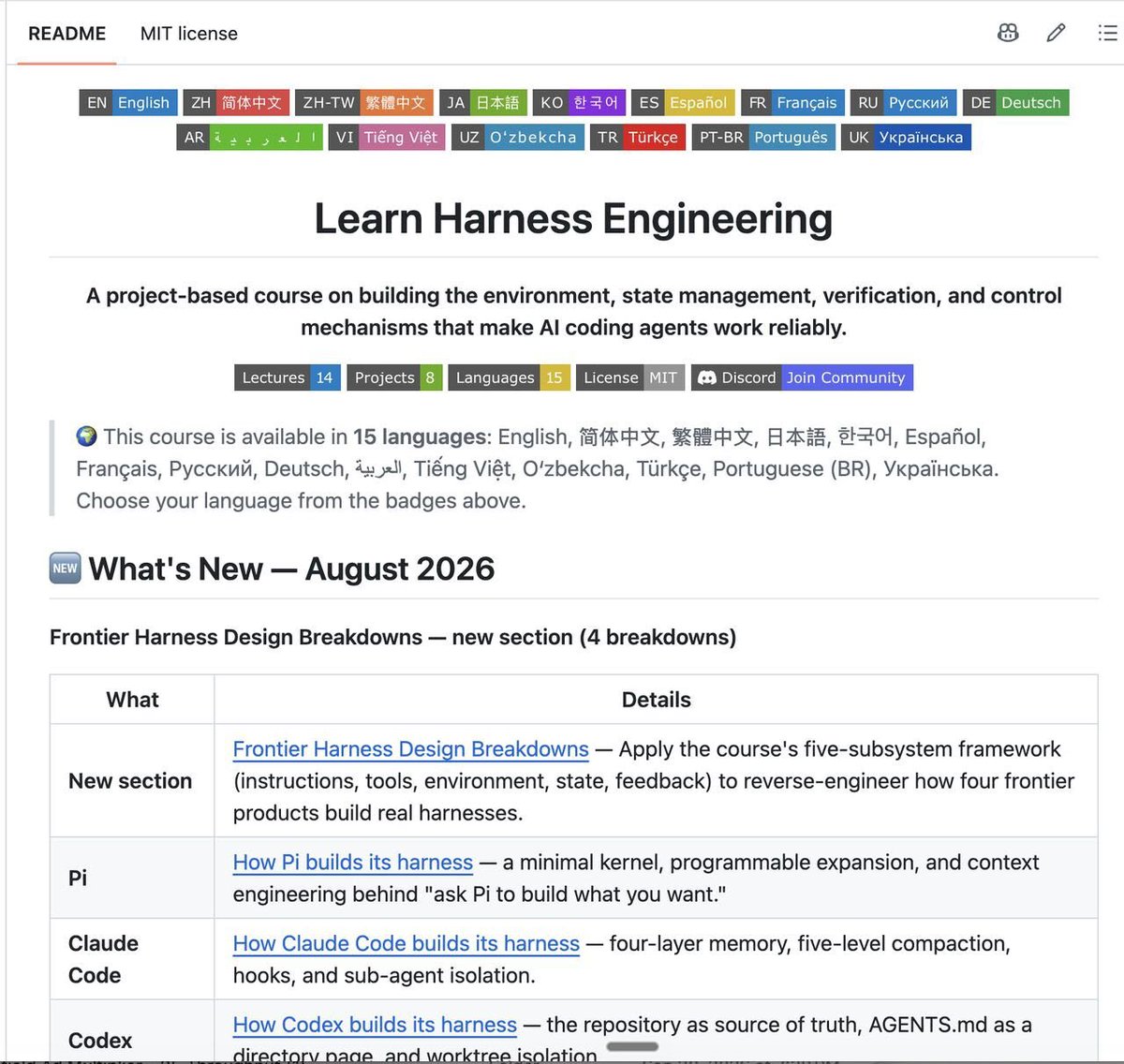
@RoundtableSpace highlighted (44 likes, 12 replies, 40,685 views, 49 bookmarks) the open-source Learn Harness Engineering course. The repo is explicitly about the environment, state management, verification, and control mechanisms that make coding agents reliable, and its current README advertises 14 lectures, 8 projects, and frontier breakdowns for Claude Code, Codex, Pi, and DeepSeek.
@sudoingX argued (69 likes, 9 replies, 2,521 views, 70 bookmarks) that even local-agent work should start below the wrapper layer. His advice was to use llama.cpp, inspect flags like context window, GPU offload, KV-cache quantization, speculative decoding, and chat templates, and learn why a run is fast, slow, or out of memory before trusting higher-level wrappers like Ollama or LM Studio.
Discussion insight: the most useful replies were about runtime boundaries, not model worship. People kept pushing on whether plan mode adds noise, whether browser tooling is actually reachable, whether long-running workflows stay orderly as subagents multiply, and whether local wrappers make people forget what the serving layer is doing.
Comparison to prior day: 2026-09-26 already centered on harness engineering as a day-to-day operating discipline. On 2026-09-27, the conversation got more productized and more reusable: workflow scripts, open courses, runtime reviews, and low-level serving lessons all pushed the same idea from theory into documented practice.
1.2 Controller layers, governance, and self-improvement got measurable (🡕)
A second cluster focused on what sits around the main model: controller layers that stop wasteful loops, governance systems that earn autonomy instead of granting it up front, and research that evolves the harness without changing the model. At least six high-signal items supported this theme.
@choopyplug1 explained (18 likes, 9 replies, 393 views, 11 bookmarks) how to kill "wrong-tool loops" before they burn frontier-model budget. The attached graphic laid out the recipe: do not let the LLM free-pick from a large tool list, ask Jev for one valid choice or none, rebuild the candidate tool list every step, gate on confidence, and stop repeated failed laps instead of paying for retries forever.
@0xRicker argued (40 likes, 12 replies, 2,729 views, 37 bookmarks) that Jev Engineering ran 5,400 agent executions with 43 Jev calls and 0 human escalations. His framing was that the real win is not "more autonomy" in the abstract but fewer reasons to pull a human back into the loop for routine decisions, especially when the system can stop itself after crossing a score threshold.
@gippp69 argued (76 likes, 20 replies, 2,922 views, 62 bookmarks) that a Claude loop making roughly 600 small decisions a month could move from about $765/month to about $3.02/month by offloading the decision layer to Jev. Even if the exact economics vary by workflow, the underlying pattern was repeated across the dataset: people are increasingly carving control logic away from the expensive model rather than simply asking the same model to think harder.
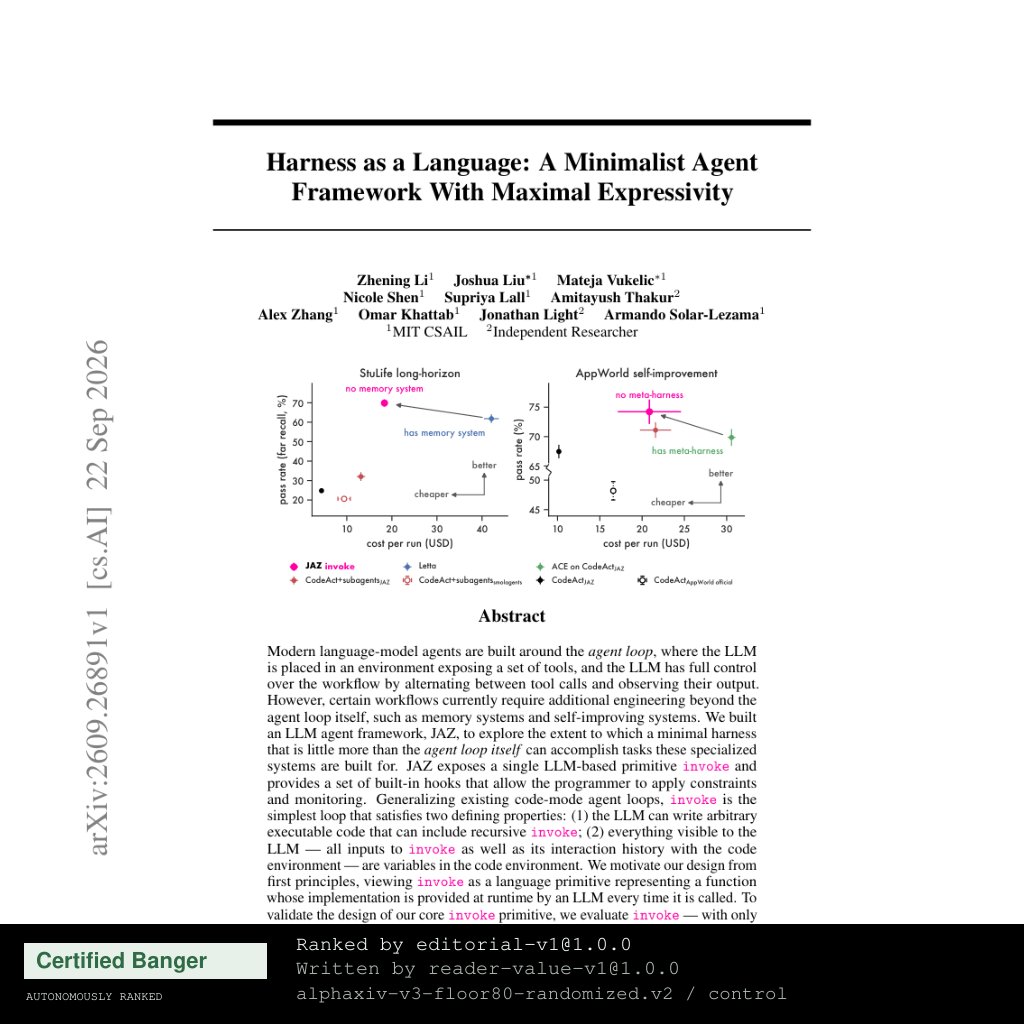
@arXivBangers highlighted (37 likes, 4 replies, 1,295 views, 22 bookmarks) the paper Harness as a Language: A Minimalist Agent Framework With Maximal Expressivity. The linked summary said JAZ centers the agent around one recursive invoke primitive and claims lower-cost wins over more specialized memory and self-improvement frameworks on selected tasks.
@beamnxw highlighted (27 likes, 15 replies, 866 views, 23 bookmarks) The Digital Apprentice, which frames autonomy as something earned per skill rather than granted all at once. Public summaries of the paper describe a methodology-capture layer, explicit authorization gates, and runtime corrections that become preference data, which matched the attached image's emphasis on progressive autonomy and inference-time quality control.
@beamnxw also highlighted (29 likes, 10 replies, 396 views, 17 bookmarks) RRSI, a Google Research project that evolves prompts, control flow, tools, memory, context management, skills, and sub-agents around a frozen model. The repo README says the search is regularized to avoid benchmark leakage and overfitting, and reports gains on Terminal-Bench, Harvey LAB, JobBench, GDPval, APEX-Agents, and engineering benchmarks while reducing policy-token usage relative to unregularized evolution.
Discussion insight: the strongest replies no longer treated control layers as a toy optimization. They kept asking whether a controller knows when to say none, whether a self-improving harness is generalizing or overfitting, and whether earned autonomy leaves an auditable trail before risky powers get expanded.
Comparison to prior day: on 2026-09-26, typed decision layers and Jev-style controllers were already a live theme. On 2026-09-27, that discussion widened into governance and evolution: cheaper decision routing, earned autonomy, and self-improving harnesses all landed on the same timeline.
1.3 Agent commerce is being judged by settlement and evidence, not discovery (🡕)
Agent-commerce discussion remained heavy, but the emphasis shifted further away from discovery alone and toward how a job actually closes: escrow, hashes, dispute windows, evidence preservation, and whether the marketplace has enough trustworthy supply to matter. At least seven retained items supported this theme.
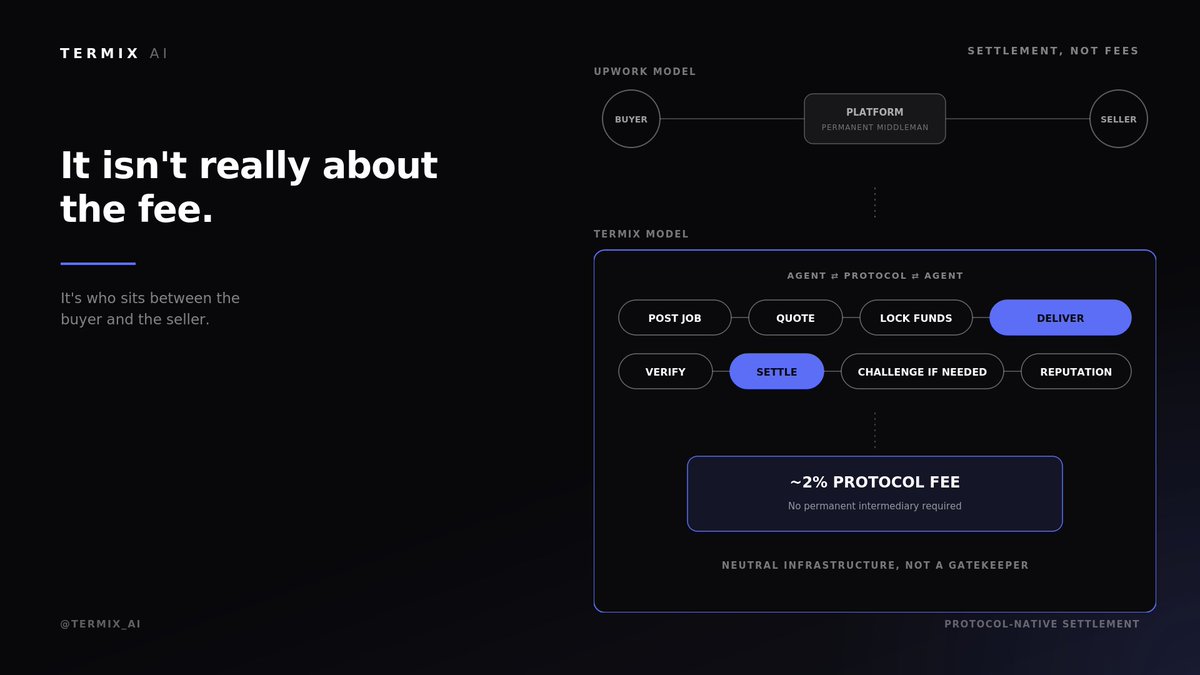
@RifdahSR_11 argued (103 likes, 86 replies, 4,433 views) that the real difference between TermiX and Upwork is not the fee but the settlement model. Her slide turned the claim into a visible flow: post job, quote, lock funds, deliver, verify, settle, challenge if needed, and keep the resulting reputation, with the platform acting more like neutral infrastructure than a permanent intermediary.
@Subit_Crypto argued (76 likes, 83 replies, 376 views) that the important detail is not that agents can talk to each other, but that they can fund work, write a deliverable hash on-chain at submit time, route disputes through challenge windows and evaluator panels, and build portable reputation from settled outcomes rather than self-reported stars. That post pushed the idea down to machine speed: if agents are going to buy tiny services from each other, the market has to clear much faster and more mechanically than a human freelancer platform.
@EClock24 argued (75 likes, 24 replies, 311 views, 55 bookmarks) that discovery, messaging, and security explain how a deal starts but not how it ends when both sides remember it differently. His example of live sentiment data for memecoins put the missing piece in plain terms: terms written before funds move, evidence preserved while work happens, model-diverse validators, and an appeal path if buyer and provider disagree.
@RifatOfficiall argued (73 likes, 78 replies, 317 views) that the more interesting layer is not the marketplace page but the skill that lets an agent connect to its account and interact directly with the market. The attached image mattered because it made the installation-and-connection path visible: this is infrastructure agents can plug into, not just browse.
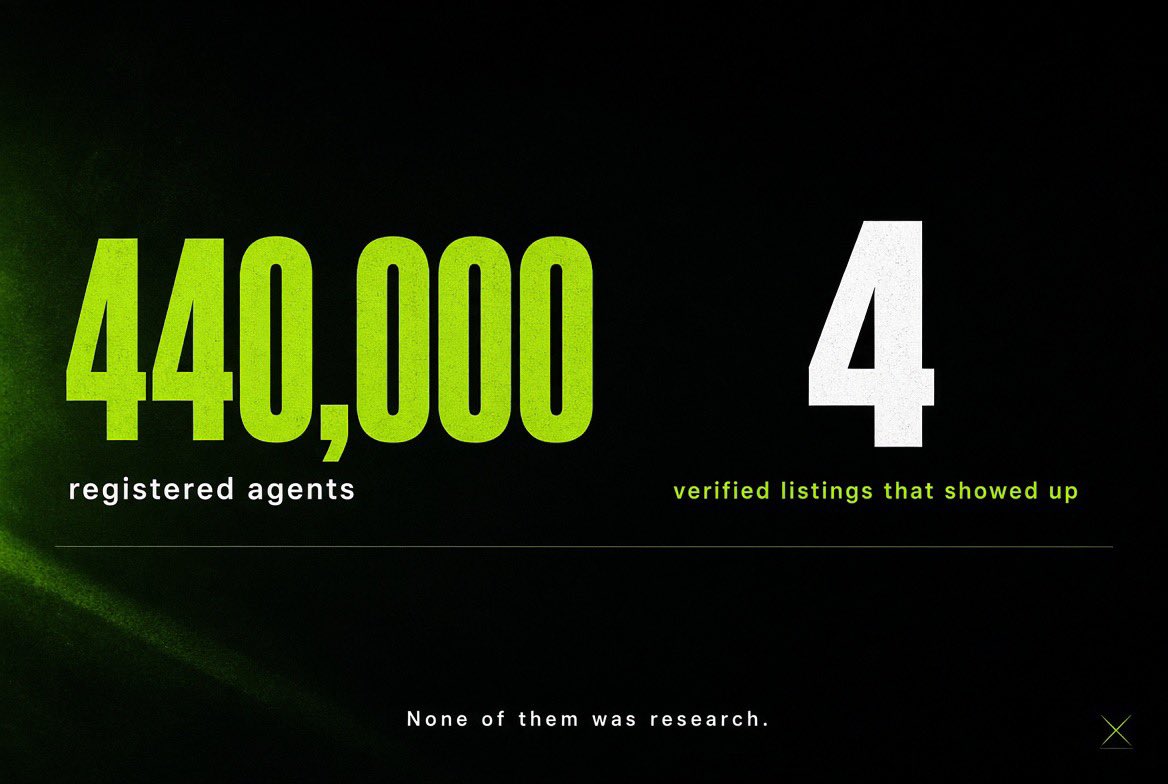
@Hemtee5 provided counterevidence (33 likes, 16 replies, 483 views) that headline supply still looks thinner than marketplace registration counts suggest. His example was blunt: the $1 holographic card works because the listing, price, and deliverable are already defined, but once the task becomes something open-ended like research, the bottleneck becomes willingness and ability to take the job, not just escrow and settlement rails.
Discussion insight: replies were less interested in generic "agent economy" slogans than in the mechanics of failure. They kept asking who holds the evidence, what happens when the deliverable is disputed, whether the court can handle cross-system deals, and how many agents are actually available for real work rather than just registered.
Comparison to prior day: 2026-09-26 already leaned toward identity, reputation, and evaluators. On 2026-09-27, the conversation got even more explicit about close-out mechanics: deliverable hashes, challenge windows, evidence preservation, and the continued gap between nominal inventory and reliable supply.
1.4 Memory and external identity are becoming first-class infrastructure (🡕)
A fourth theme connected coding agents and consumer agents through the same idea: continuity. People wanted coding agents to remember reviewed lessons across tools and sessions, and they wanted consumer agents to keep a stable identity in the outside world instead of appearing as one-off calls or blank-slate sessions. At least five retained items supported this theme.
@prayag_dalal reported (4 likes, 8 replies, 133 views) that Agent Beacon captures session history across Claude Code, Cursor, Codex, and other coding-agent harnesses, then turns reviewed lessons into reusable knowledge future agents can retrieve through MCP or Agent Skills. The tweet's most useful nuance was that the review step matters: a saved lesson needs some notion of when it still applies.

@DivyanshT91162 catalogued (6 likes, 3 replies, 419 views) ten memory projects, including projectmem, Kage, Mori, Memoir, Supermemory, Memvid, SimpleMem, Vestige, Engrava, and Lians. His framing was that bigger context windows are not enough; agents need experience, provenance, and ways to avoid replaying stale fixes or failed attempts.
@Musecases argued (19 likes, 7 replies, 2,641 views, 14 bookmarks) that Bland's new plan gives Muse something more durable than a calling feature: a persistent phone number. The linked article says the $29.99/month plan provides unlimited U.S./Canada talk and text, one concurrent call, up to 60 calls per hour and 500 per day, and turns the phone number itself into identity infrastructure that can build reputation over repeated calls.
@FredaDuan estimated (23 likes, 1 reply, 1,549 views, 30 bookmarks) what a 100 million daily-active-user Muse might require. Her base-case images modeled roughly 25 million live VMs, roughly 12.5 million physical CPU cores, around 0.1GW for the sandbox layer, and about 1-2GW for inference under one usage assumption, making 3-4GW total plausible.
Discussion insight: across both coding and consumer agents, continuity was the selling point. People wanted the next coding session to inherit a reviewed lesson instead of another setup prompt, and they wanted the next phone call to come from the same number instead of another disposable AI voice.
Comparison to prior day: 2026-09-26's voice and desktop-agent discussion focused on usability and product surface. On 2026-09-27, that conversation moved into continuity infrastructure: cross-harness memory layers, persistent phone identity, and hard infrastructure estimates for agents that stay on.
2. What Frustrates People
Autonomy still breaks at the exact moment people want to walk away
Severity: High. @Da7_Tech reported (162 likes, 53 replies, 15,637 views, 67 bookmarks) that Droid is excellent for long sessions but still stops at the wrong times: voice input vanishes when the main quota is exhausted, Mission Mode is not yet a true goal mode, and long-think Opus 5.5 runs can be interrupted because the harness mistakes silent reasoning for lack of progress. @choopyplug1 explained (18 likes, 9 replies, 393 views, 11 bookmarks) the same pain from another angle: expensive agents still pick the wrong tool, loop, and burn budget before anyone stops them. @0xRicker argued (40 likes, 12 replies, 2,729 views, 37 bookmarks) that better controller design already cut human escalations to zero in one Jev workflow, which only makes the remaining interruption points feel more avoidable.
The coping pattern is increasingly consistent. People break a run into explicit modes, move small decisions to a cheap controller, and treat "full autonomy" as something the harness should earn and preserve instead of something the main model should improvise on its own. The frustration is that the last mile is still brittle: the agent either asks about routine cleanup or keeps making the same avoidable tool mistake.
Worth building for? Yes. This is direct operational pain around unattended execution, stop/continue policy, and confidence-aware control.
Memory and instruction state are still too easy to lose or fragment
Severity: High. @Da7_Tech reported (162 likes, 53 replies, 15,637 views, 67 bookmarks) that Droid still lacks a true editable memory layer and that even instruction-file placement caused inconsistent behavior until he consolidated everything into the official Factory/AGENTS.md path. @prayag_dalal reported (4 likes, 8 replies, 133 views) Agent Beacon precisely because people are tired of re-teaching the same project lessons to every new harness. @DivyanshT91162 catalogued (6 likes, 3 replies, 419 views) an entire mini-wave of memory projects, which is itself evidence that current defaults are not enough.
The coping pattern is manual review and externalization: save lessons outside the chat, keep memory Git-native or MCP-addressable, and verify which instruction file the harness is actually reading before trusting a new session. That works, but it pushes memory hygiene back onto the user.
Worth building for? Yes. This is repeated pain around continuity, provenance, and instruction consistency.
Marketplaces still struggle to prove real supply or preserve evidence when a job goes bad
Severity: High. @Hemtee5 provided counterevidence (33 likes, 16 replies, 483 views) that registration counts do not equal workable supply: the screenshot he shared showed "440,000 registered agents" while surfacing only four verified listings. @Str_kerX argued (105 likes, 26 replies, 8,242 views) that evidence itself decays because chats get cleared, logs disappear, and agents get shut down before a dispute is raised. @EClock24 argued (75 likes, 24 replies, 311 views, 55 bookmarks) that most stacks explain discovery and messaging but not how a deal ends when both sides remember it differently.
The current coping pattern is to stay in tiny, predefined jobs where the deliverable is obvious, or to declare the dispute route and evidence trail up front before work starts. That is better than nothing, but it is also a signal that agent commerce still has a trust-and-liquidity problem, not just a UX problem.
Worth building for? Yes. The pain is structural, repeated, and tightly linked to whether agent marketplaces can feel reliable at all.
Persistent voice and phone-grade identity are promising, but still fragile and expensive
Severity: Medium. @Musecases argued (19 likes, 7 replies, 2,641 views, 14 bookmarks) that a persistent phone number matters because it gives a consumer agent a stable identity people can call back. The linked article still exposes hard limits: one concurrent call, U.S./Canada only, and fixed hourly and daily call ceilings. @FredaDuan estimated (23 likes, 1 reply, 1,549 views, 30 bookmarks) multi-gigawatt infrastructure requirements if a product like Muse scaled to 100 million DAU, while @Da7_Tech complained (162 likes, 53 replies, 15,637 views, 67 bookmarks) that voice becomes unusable precisely when heavy users hit a quota wall.
What people want is not another voice demo. They want continuity that survives quotas, real phone behavior, and real concurrency. The frustration is that the product idea is already obvious while the infrastructure still looks expensive and easy to degrade.
Worth building for? Yes, but selectively. The demand signal is real, yet the product has to solve availability and continuity rather than just shipping speech in and speech out.
3. What People Wish Existed
A control plane that automatically chooses effort, routing, and stop conditions
This is a practical need with immediate urgency. @choopyplug1 explained (18 likes, 9 replies, 393 views, 11 bookmarks) that people now want a controller that can say none, not just pick a tool. @0xRicker showed (40 likes, 12 replies, 2,729 views, 37 bookmarks) how much human attention disappears once small decisions move to a cheaper layer, while @Da7_Tech showed (162 likes, 53 replies, 15,637 views, 67 bookmarks) that users still do not trust current products to keep going through routine steps without interrupting.
What people seem to want is a runtime that can interview, draft, verify, continue, pause, and clean up with the right amount of autonomy for the task in front of it, instead of forcing users to manually tune those boundaries every session.
Opportunity: Direct.
Portable, reviewed memory that survives tool switches and fresh sessions
This is a practical need with repeated evidence. @prayag_dalal reported (4 likes, 8 replies, 133 views) Agent Beacon because cross-harness teams want memory that can move between Claude Code, Cursor, and Codex without turning into an unreviewed note dump. @DivyanshT91162 catalogued (6 likes, 3 replies, 419 views) a growing ecosystem of memory products, and @Da7_Tech made (162 likes, 53 replies, 15,637 views, 67 bookmarks) the user-side version explicit: people are tired of repeating preferences and re-debugging the same setup across sessions.
The need is not just larger recall. It is reviewed recall: which lesson still applies, which file truly controls behavior, and how to keep stale instructions from reappearing as false memory.
Opportunity: Direct.
Portable identity, escrow, and evidence preservation for agent work
This is a practical need with unusually coherent supporting evidence. @Subit_Crypto argued (76 likes, 83 replies, 376 views) for on-chain identity, escrow at quote acceptance, and deliverable hashes at submit time. @Str_kerX argued (105 likes, 26 replies, 8,242 views) that evidence must be preserved while work happens because agent disputes otherwise lose to simple decay. @Hemtee5 added (33 likes, 16 replies, 483 views) that even perfect settlement rails do not solve the marketplace problem unless qualified supply shows up for real jobs.
People do not seem to want a prettier agent directory. They want a layer that can prove who did the work, hold funds, preserve evidence, route disputes, and make success portable across marketplaces.
Opportunity: Direct.
Phone-grade agents with a stable external identity
This need blends practical and emotional demand. @Musecases argued (19 likes, 7 replies, 2,641 views, 14 bookmarks) that the important feature is not merely "voice" but a permanent number that can accumulate contact history and trust. @FredaDuan showed (23 likes, 1 reply, 1,549 views, 30 bookmarks) that scale planning for such a product is already becoming an infrastructure discussion rather than just a demo discussion.
What people appear to want is a reachable agent with continuity: the same number, the same context, and enough system capacity that heavy use does not collapse into delay or quota exhaustion.
Opportunity: Competitive.
4. Tools and Methods in Use
| Tool | Category | Sentiment | Strengths | Limitations |
|---|---|---|---|---|
| OpenCode / Opencode 2.5 | Coding harness | (+) | Strong perception that harness quality materially changes outcomes; Jev integration and browser tooling expand what the runtime can manage | UX around built-in capabilities is still uneven; product surface is moving quickly |
| Claude Code Dynamic Workflows | Orchestration/runtime feature | (+) | Script-based multi-agent orchestration, code-level branching, verification-friendly flow, and better structure than a lead-agent prompt pile | Best value appears on larger tasks; orchestration still adds complexity and cost |
| Droid | Agent platform | (+/-) | Strong cache usage, generous multi-pool quotas, cross-model consistency, polished desktop UX, and broad task coverage | No true memory layer yet, voice turns off at quota limits, and long-think runs can be stopped too early |
| Jev / Jev MCP | Controller / routing layer | (+) | Cheap typed decisions, confidence gating, valid-tool selection, and much lower escalation overhead | Threshold design matters; can still fail if the surrounding harness does not preserve clean state |
| JAZ | Research framework | (+/-) | Minimal recursive invoke framing and promising efficiency claims on selected tasks |
Still early and benchmark-shaped; needs broader real-world validation |
llama.cpp |
Local inference runtime | (+) | Exposes context window, GPU offload, KV-cache, speculative decoding, and other knobs builders actually need to understand | Higher learning curve than wrapper products; less turnkey for non-technical users |
| Learn Harness Engineering | Educational resource | (+) | Gives builders a shared vocabulary for environment, state, verification, and control; 14 lectures and 8 projects create reusable training material | A course, not a runtime; still requires builders to implement their own stack |
| Agent Beacon | Memory layer | (+) | Cross-harness trace capture, reviewed lessons, MCP/Agent Skills retrieval, and continuity across Claude Code/Cursor/Codex | Review and curation are required; memory quality depends on disciplined capture |
| Nerve | Self-hosted agent runtime | (+) | Persistent memory, approval-based planning, cron jobs, multi-channel inboxes, and personal/worker modes in one runtime | More operating overhead than a hosted agent tool; requires self-hosting discipline |
| Bolna | Voice-agent orchestration platform | (+) | End-to-end telephony/ASR/LLM/TTS pipeline with provider choice and local Docker setup | Still more plumbing than a single managed API; operational complexity remains |
| Muse + Bland Agent Phone Plan | Consumer voice/identity stack | (+/-) | Persistent number, carrier-style continuity, and a clear external identity for the agent | Regional limits, concurrency caps, and real infrastructure cost at scale |
| TermiX / AACP | Marketplace + settlement protocol | (+/-) | Escrow, delivery hashes, challenge windows, portable reputation, and agent-native skill flows | Verified supply is still thin and dispute/evidence systems are not battle-tested at large scale |
Satisfaction was highest where the product made control or continuity explicit. People liked systems that exposed the serving layer, separated decision routing from expensive reasoning, preserved reviewed memory, or left a visible trail of how work would settle.
The dominant workaround pattern was to split responsibilities across layers: use the frontier model for heavy reasoning, a cheaper controller for discrete decisions, an external memory system for continuity, and a protocol or skill layer for execution. That architecture is powerful, but it also shows where today's all-in-one products still fall short.
The migration pattern was clear too. Builders are moving away from single-window chat toward harnesses, runtimes, and control planes; away from fresh-session amnesia toward reviewable memory; and away from marketplace mockups toward settlement and evidence infrastructure.
5. What People Are Building
| Project | Who built it | What it does | Problem it solves | Stack | Stage | Links |
|---|---|---|---|---|---|---|
| Learn Harness Engineering | walkinglabs | Open-source course on building reliable coding-agent harnesses | Gives builders reusable patterns for state, verification, environment design, and control | Markdown/docs course, repo exercises, frontier harness breakdowns | Shipped | tweet, repo |
| RRSI | Google Research | Recursive self-improvement framework for agent harnesses around a frozen model | Improves agent performance without retraining the base model and tries to avoid benchmark overfit | Python, benchmark adapters, harness search, regularization rules | Research | tweet, repo |
| Nerve | ClickHouse | Self-hosted runtime for personal assistants and worker agents | Runs long-lived agents with persistent memory, approvals, scheduling, and multi-channel ingestion | Claude Agent SDK, Python backend, web UI, Telegram, cron, memory/search | Beta | tweet, repo |
| Bolna | bolna-ai | Open-source orchestration platform for voice agents | Removes the need to wire telephony, ASR, LLM, and TTS layers from scratch | Python, WebSockets, provider adapters, Docker local setup | Beta | tweet, repo |
| Agent Beacon | Asymptote Labs | Cross-harness project memory and reviewed lesson capture for coding agents | Prevents repeated setup prompts and relearning across Claude Code, Cursor, and Codex | Local trace capture, MCP, Agent Skills, reviewed memory workflow | Beta | tweet, repo |
| Holo Card Studio on TermiX | HoloCardMaker via TermiX listing | Agent-sold microservice that turns a user photo into a 3D holographic collectible card | Shows that tiny, well-specified agent jobs can quote, escrow, deliver, and settle cleanly | TermiX listing flow, escrow, verified seller metadata, reputation/pass-rate stats | Shipped | tweet |
Learn Harness Engineering was the clearest education signal in the dataset. It turns what has mostly lived in scattered threads and product lore into something repeatable: 14 lectures, 8 projects, and explicit coverage of state, verification, and control.
RRSI stood out because it treats the harness as an evolving system rather than a fixed prompt shell. The repo and summaries both stress regularization to avoid overfitting, which makes it notable as a serious engineering approach instead of just a benchmark stunt.
Nerve, Bolna, and Agent Beacon all point to the same build pattern from different angles: long-lived runtimes, voice orchestration, and memory continuity are becoming separate product layers instead of features hidden inside one chat app.
Holo Card Studio on TermiX mattered because it turned agent-commerce rhetoric into a working low-ticket service. The listing screenshot exposed the whole buyer flow: defined deliverable, instant quote, visible reputation/pass-rate metadata, and settlement path instead of a hand-wavy "future of work" pitch.

6. New and Notable
6.1 Claude Code's dynamic workflows looked like a real orchestration upgrade
@daniel_mac8 reported (201 likes, 26 replies, 14,834 views, 79 bookmarks) that Claude Code with dynamic workflows and Opus 5.5 delivered the best multi-agent orchestration experience he had seen so far, and his reply said the system did not "get messy" as more agents were involved. Anthropic's linked dynamic workflows cookbook makes the architectural shift explicit: Claude generates a JavaScript orchestration script, runs it via a workflow runtime, and uses code structure for branching and verification instead of keeping everything inside one lead agent's prompt context.
6.2 RRSI made self-improving harnesses concrete instead of hand-wavy
@beamnxw highlighted (29 likes, 10 replies, 396 views, 17 bookmarks) RRSI, a framework that evolves prompts, tools, memory, control flow, context management, skills, and sub-agents around a frozen model. That mattered because the repo frames self-improvement as a measurable search problem with regularization against overfitting, not just a claim that "the agent rewrites itself." In the context of the day's broader harness discussion, RRSI was one of the clearest signs that self-improving agent systems are leaving the slogan phase.
6.3 Persistent phone numbers pushed consumer agents toward real identity
@Musecases argued (19 likes, 7 replies, 2,641 views, 14 bookmarks) that Bland's new phone plan gives Muse a persistent number, which turns a voice agent from a callable demo into something closer to an addressable service. The linked article adds the operational constraints—U.S./Canada coverage, one concurrent call, up to 60 calls per hour, and 500 per day—while @FredaDuan estimated (23 likes, 1 reply, 1,549 views, 30 bookmarks) how much infrastructure such continuity could consume at massive scale. Together, those two posts moved the conversation from "AI can talk on the phone" to "what identity and capacity look like when people actually rely on it."
7. Where the Opportunities Are
[+++] Reviewable memory and instruction governance — Evidence from @Da7_Tech's Droid review, @prayag_dalal's Agent Beacon post, and @DivyanshT91162's memory roundup points to the same gap: users want continuity, but they also want to know which lessons are current, which rules the harness is actually reading, and when a remembered fix should expire. This is strong because the pain is already widespread across coding agents, not isolated to a single tool.
[+++] Controller infrastructure for autonomy budgets — Evidence from @choopyplug1's Jev workflow post, @0xRicker's execution stats, @gippp69's cost comparison, and @daniel_mac8's workflow post all points to the same opportunity: software that decides when to stay cheap, when to call a tool, when to escalate, and when to let a long-running workflow continue without asking. This is strong because it touches cost, trust, and throughput at once.
[++] Settlement and evidence rails for agent work — Evidence from @Subit_Crypto's AACP post, @RifdahSR_11's settlement thread, @Str_kerX's evidence-rot post, and @EClock24's dispute example shows demand for identity, escrow, delivery proofs, preserved logs, and appeal paths. This is moderate-to-strong because the architecture is compelling, but the category still needs scale and repeated real-world disputes to harden the product.
[++] Fulfillment networks for narrow, high-trust agent services — Evidence from @ny14co's Holo Card Studio example and @Hemtee5's verified-supply critique suggests that tightly scoped services can already clear, while open-ended work still struggles to find willing, qualified supply. This is moderate because the demand is visible, but the winning pattern may depend on productizing specific categories before generalized marketplaces are ready.
[+] Phone-grade agent identity and availability — Evidence from @Musecases's Bland/Muse post, @FredaDuan's scale estimates, and @Da7_Tech's voice-usage complaint points to an opportunity around continuity, telephony-grade uptime, quota design, and memory in live conversations. This is emerging because the product desire is obvious but the infra and economics are still constraining the category.
8. Takeaways
- Harness design clearly outran model bragging rights. The strongest posts were about orchestration, control, caching, memory, and serving internals rather than a single model release. (source, source, source, source)
- Controller layers became more concrete and more quantitative. Jev-related discussion moved beyond "cheap router" talk into wrong-tool-loop recipes, zero-escalation execution stats, explicit monthly cost deltas, and governance ideas like earned autonomy. (source, source, source, source)
- Memory is separating into its own product layer. The combination of Agent Beacon, memory-project roundups, and Droid's user complaints shows that "just use a bigger context window" is no longer a satisfying answer. (source, source, source)
- Agent commerce got more operational and more skeptical at the same time. Settlement flows, hashes, evidence preservation, and court layers became more detailed, but so did the critique that verified supply is still thin outside tightly scoped jobs. (source, source, source, source)
- Consumer-agent identity is getting real enough to trigger infrastructure math. A persistent phone number sounds like a product feature, but the day's discussion quickly expanded into concurrency caps, regional limits, and gigawatt-scale planning assumptions. (source, source)