Twitter AI Agent - 2026-10-05
1. What People Are Talking About
1.1 Harness engineering stopped sounding like lore and started looking like a repeatable operating discipline (🡕)
The strongest AI-agent cluster on 2026-10-05 was about making the harness itself explicit. The retained posts did not just say "use better prompts." They turned agent work into reading material, named flow steps, and component layers that can be reasoned about separately.
@KirkDBorne shared (503 likes, 1 reply, 30,082 views, 879 bookmarks) a 48-page "Understanding Harness Engineering" handbook that explicitly framed the stack as loops, tool interfaces, context, sandboxes, verification, and long-running work. That mattered because it treated harness design like an engineering surface with named parts instead of an accumulation of prompt tricks.

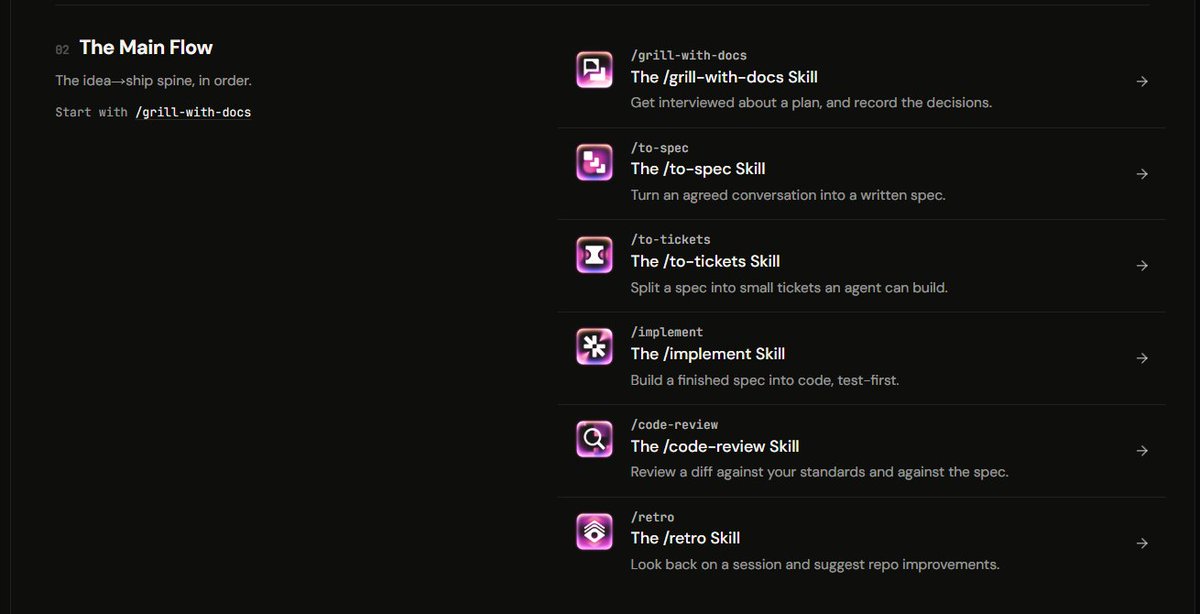
@mattpocockuk showed (276 likes, 33 replies, 14,143 views, 189 bookmarks) the same mindset at workflow level by inserting /retro into the default build flow. The point was not only to inspect failed runs. He explicitly said retro on a "successful" session still surfaces inefficiencies, and a reply clarified that the step can also prune accumulated AGENTS.md rules instead of only adding more.
@Lummox_eth made (14 likes, 5 replies, 223 views, 12 bookmarks) the same decomposition concrete by listing the seven layers GPT-6 Astra still needs around it: memory, changing-context handling, retrieval, tools, traces, and coordination. That item mattered because it framed GitHub repos such as mem0 and the MCP servers repository as parts of a "nervous system" rather than optional extras.
Discussion insight: The useful disagreement was not over whether retros matter. It was over how much process a good run can bear before the rules file turns into a dumping ground. Even that pushback reinforced the theme: people are now debating harness maintenance, not whether harnesses exist.
Comparison to prior day: Compared with 2026-10-04, which mostly standardized the anatomy of the harness, 2026-10-05 pushed toward concrete flows and installable layers that teams can copy into daily work.
1.2 Scaling agents now meant memory graphs plus manager loops, not one bigger worker (🡕)
The second cluster made a stronger operational claim: multi-agent scale only works when memory and supervision are first-class surfaces. The pattern showed up in Cognition's Dreaming announcement, in GrokBot "engineering lead" demos, and in concrete claims about dozens or hundreds of running coding agents.
@cognition introduced (314 likes, 25 replies, 14,180 views, 147 bookmarks) Dreaming as a cross-session memory graph plus an open-source "Agent Memory Repo" standard where memory records live in files and are versioned with Git. The strongest evidence was in the replies: the company said early experiments had already shown swarms of Devins coordinating through shared memory without being explicitly prompted to do so.
@0xRafy reported (51 likes, 2 replies, 5,685 views, 75 bookmarks) a GrokBot that breaks work into cloud agents, reviews progress, and keeps existing agents running, while @0xCodez amplified (55 likes, 4 replies, 4,026 views, 58 bookmarks) the same pattern with a 30-plus-agent /pstack loop and a claim of waking up to 20 landed changes. @beamnxw added (41 likes, 8 replies, 1,368 views, 33 bookmarks) the most practical operator detail: assign each manager bot an owned codebase area, demand screenshots and a working dev instance as proof, and keep an explicit board that requeues unfinished work every 30 minutes.
Discussion insight: The most credible part of the fleet stories was not the raw agent count. It was the insistence on owned areas, proof artifacts, and postmortem owners. Without those, the threads read like hype; with them, they sounded like an actual operating model.
Comparison to prior day: On 2026-10-04 the manager-over-workers pattern was becoming visible. On 2026-10-05 it became more concrete through Dreaming's shared memory, explicit ownership by codebase area, and claims about proof loops at much higher scale.
1.3 Agent commerce still cared more about proof, reputation, and challenge flow than about discovery (🡒)
The commerce-oriented posts were still builder-heavy, but they converged on one consistent idea: an agent economy only makes sense if review order, dispute rights, and work history are explicit. None of the retained items treated "marketplace" by itself as the important surface.
@Heis_sosa argued (166 likes, 47 replies, 1,932 views, 7 bookmarks) that person-to-agent, agent-to-service, and agent-to-agent interactions all need the same clearing path underneath, and said the useful metric is not awareness but agents that register, take work, and finish settlement. @strive750 made (134 likes, 137 replies, 816 views) the order of operations even clearer: deliverable first, human review second, payment approval third, and only then a permanent reputation update.
@0xndra highlighted (53 likes, 51 replies, 678 views) the part of TermiX that tries to turn that into a dispute system: if another agent says "prove it," the marketplace needs a challenge step, plus a way to verify work without rerunning the whole job or trusting one side blindly. That was the most important nuance because it exposed the missing surface underneath many agent-commerce pitches: the evaluator itself has to be contestable.
Discussion insight: The replies were more revealing than the slogans. One Heis_sosa reply bluntly said the real test is actual usage, not hype, while one reply to 0xndra immediately asked what happens if the verifier is compromised. That is the right kind of skepticism for this category.
Comparison to prior day: Compared with 2026-10-04, the commerce cluster was still early, but the design focus moved from abstract settlement rails toward a stricter sequence of review, approval, challenge, and reputation.
2. What Frustrates People
Agent stacks still sprawl across too many tabs and lose too much state
Severity: High. @Faazsh captured (24 likes, 16 replies, 517 views, 5 bookmarks) the complaint in one line: "Your agent stack is 14 tabs and zero memory." @cognition answered with a memory graph and versioned records, while @Lummox_eth answered with a repo stack for memory, retrieval, tools, traces, and coordination. The workaround is to assemble your own sidecars and standards, which is exactly why the pain still looks unsolved. Worth building: High.
Supervising lots of agents still requires explicit proof loops and ownership boundaries
Severity: High. @0xRafy wanted one bot to own the engineering loop, but the more operational posts immediately showed what that requires: @0xCodez talked about 30-plus agents, and @beamnxw specified area ownership, screenshots, transcripts, running instances, and periodic task-board review. The workaround is a manager layer plus a lot of evidence handling. Worth building: High.
Agent marketplaces still have a trust gap between narrative and demonstrated usage
Severity: Medium-High. @Heis_sosa framed settlement as the key metric, but the strongest reply under the post said the category still needs actual usage rather than hype. @0xndra showed why: even if a marketplace has a challenge step, people still want to know who verifies the verifier. The workaround is human review before payment plus explicit dispute rules. Worth building: Competitive.
3. What People Wish Existed
Acceptance layers that can challenge "done" before money or merge rights move
What people keep asking for is a portable "prove it" surface. @strive750 described a review-before-payment workflow, and @0xndra described a challenge step for disputed work. This is a practical need with immediate value because the alternative is trusting an agent's own declaration of completion. Opportunity: Direct.
Portable memory and handoff control planes
Dreaming, Agent Memory Repo, and the "14 tabs and zero memory" complaint all point to the same missing product: project state that survives across sessions without becoming a giant transcript dump. @cognition proposed a standard, while @Faazsh showed why teams are already shopping for bundles of runtime, memory, and management tools. Opportunity: Direct.
Installable manager stacks instead of one-off orchestration hacks
The GrokBot, OpenDots, Paperclip, and ClawLess posts all suggest users want a manager layer they can install, not just admire. @0xRafy sold the "engineering lead" role, while @zer0point_eth shared an open-source snapshot of Dots-style components and @Faazsh shared ready-to-clone management/runtime repos. The need is practical, but competition is rising quickly. Opportunity: Competitive.
4. Tools and Methods in Use
| Tool | Category | Sentiment | Strengths | Limitations |
|---|---|---|---|---|
| Understanding Harness Engineering handbook | Architecture guide | (+) | Gives a shared vocabulary for loops, context, sandboxes, verification, and long-running work | Educational artifact only; teams still have to turn it into runnable process |
/retro in the main flow |
Workflow skill | (+) | Forces post-run review and can surface both inefficiencies and stale rules | Adds process overhead and can bloat rule files if applied mechanically |
| Dreaming / Agent Memory Repo | Memory layer / standard | (+) | Cross-session memory graph plus versioned file-based memory records | Raises open questions about stale or hallucinated memory quality |
GrokBot / /pstack manager pattern |
Multi-agent orchestration method | (+/-) | Reduces chat babysitting and formalizes specialist managers | Depends on strong ownership boundaries, proof handling, and likely generous usage budgets |
| mem0-centered "system block" stack | Component stack | (+) | Makes memory, retrieval, tools, traces, and coordination explicit subsystems | Still requires users to assemble multiple repos into one working system |
| TermiX review and challenge flow | Settlement / evaluation method | (+/-) | Treats review-before-payment and post-delivery challenge as first-class steps | Public evidence is still promoter-heavy and evaluator trust is unresolved |
Overall satisfaction was highest when a method exposed one operational job clearly: review the run, store memory durably, route specialists, or challenge a result. The retained posts were much less enthusiastic about vague "agent platform" claims than about explicit surfaces with named responsibilities.
The visible workaround was layering. Teams are pairing a manager loop with memory, then adding repo-specific tools, then bolting on settlement or approval logic. That is a reliable signal that the missing product boundary is above the base model but below a full enterprise platform.
5. What People Are Building
| Project | Who built it | What it does | Problem it solves | Stack | Stage | Links |
|---|---|---|---|---|---|---|
| Agent Memory Repo / Dreaming | @cognition | Builds a memory graph across sessions and proposes a Git-versioned memory standard | Agents forget preferences, constraints, and prior decisions across runs | Memory graph, file-based records, Git versioning, cross-session cleanup | Alpha | post, site |
| Paperclip | paperclipai via @Faazsh | Agent-management app with goals, budgets, approvals, and org-chart style control | Operators need one place to supervise work instead of juggling tabs | TypeScript app, work-management surface, approvals, goals, budgets | Shipped | repo, post |
| ClawLess | open-gitagent via @Faazsh | Browser-based, serverless runtime for Claw AI agents | Lets teams run agent workloads in the browser without provisioning a server | TypeScript, WebContainers, browser runtime | Beta | repo, post |
| OpenDots | CopilotKit via @zer0point_eth | Open-source template for persistent agents that each get their own machine and approval surfaces | Gives users a Dots-like always-on coworker stack they can self-host and extend | TypeScript, AG-UI, OpenAI-compatible models, persistent agent workspace | Beta | repo, post |
| TermiX | TermiX team, discussed by @Heis_sosa, @strive750, and @0xndra | Puts proposal, review, payment approval, reputation, and challenge in one agent-work lifecycle | Agent marketplaces need proof and dispute logic, not just listings | Proposal flow, review-before-payment, reputation history, challenge step, TEE and zkVM claims | Beta | clearing-path post, reputation post, challenge post |
Paperclip, ClawLess, and OpenDots all reinforce the same builder instinct: make the missing surface installable. One manages agents at work, one gives agents a browser-native runtime, and one packages the "persistent coworkers" concept into an open template. That is a different kind of progress than another clever prompt file because it can actually be adopted and tested.
Dreaming and TermiX sit at opposite ends of the same trust problem. Dreaming tries to preserve internal state across sessions so the agent team behaves consistently. TermiX tries to preserve external trust across jobs so buyers can challenge results and attach history to what has already shipped. Together they make the day's core pattern very clear: the market is building memory and accountability rails around agents at the same time.
6. New and Notable
Dreaming introduced a memory graph plus a proposed file-based standard for agent memory
@cognition introduced (314 likes, 25 replies, 14,180 views, 147 bookmarks) both a product feature and an open-source standard idea in one post. That was notable because it treated long-term agent memory as a sharable primitive rather than a proprietary hidden layer.
/retro made harness maintenance part of the default flow instead of a cleanup chore
@mattpocockuk moved (276 likes, 33 replies, 14,143 views, 189 bookmarks) a retrospective step into the main path rather than leaving it as an occasional audit. That is notable because it makes harness quality an ongoing workflow concern instead of a one-off optimization project.
The highest-scale agent claims sounded believable only when paired with proof loops
@0xCodez claimed 30-plus agents, while @beamnxw described a 200-plus-agent setup. The notable part was not the raw number. It was the insistence on per-area ownership, screenshots, transcripts, dev-instance checks, and board-driven retries.
7. Where the Opportunities Are
[+++] Acceptance and proof layers for agent work - Evidence from /retro, TermiX's challenge step, review-before-payment flows, and proof-heavy fleet management all points to the same opportunity: people need a reusable way to say "show me the evidence" before they trust a result.
[+++] Portable memory and handoff control planes - Dreaming, Agent Memory Repo, the mem0-style system block, and the "14 tabs and zero memory" complaint all show that long-term state is still too fragile and too fragmented.
[++] Installable manager stacks for multi-agent work - GrokBot, OpenDots, Paperclip, and ClawLess show strong demand for one layer that supervises workers, owns budgets, and exposes approvals. The opportunity is real, but many open-source entrants are already racing toward it.
[+] Settlement and reputation rails for agent marketplaces - The need is visible in the way TermiX posts center on clearing, review, reputation, and challenge. The category is still early, so this remains more emerging than proven.
8. Takeaways
- Harness engineering is becoming a maintained operating discipline, not a one-time setup task. The handbook,
/retro, and system-block repo stacks all moved in that direction. (source) - Memory plus manager loops are now the default answer to agent scale. Dreaming, GrokBot, and the 30-plus and 200-plus agent examples all assumed a supervisor layer and durable state. (source)
- High agent counts only sound credible when proof artifacts and ownership boundaries are explicit. Screenshots, transcripts, dev instances, and requeue loops mattered more than the brag numbers themselves. (source)
- Agent commerce still revolves around trust order, not flashy discovery surfaces. Review-before-payment, challenge rights, and recorded work history dominated the useful posts. (source)
- The most durable builder pattern was "make the missing layer installable." Paperclip, ClawLess, OpenDots, and Dreaming all package one operational gap that teams can actually adopt. (source)