Twitter AI Agent - 2026-10-09
1. What People Are Talking About
1.1 Managed multi-agent workflows moved from prompt lore to shipping product and open-source proof (🡕)
The clearest shift on 2026-10-09 was from “agent swarms” as a vibe to orchestration as a public product contract. The strongest posts did not just say that many agents were useful; they showed how the lead agent plans, how work is verified, and what the benchmark gain looks like. Compared with 2026-10-08's role-design talk, the conversation became more executable.
@ClaudeDevs announced (5,669 likes, 202 replies, 262,896 views, 3,473 bookmarks) public-beta Claude Managed Agents dynamic workflows, where a lead agent writes a phased plan across many agents and combines the results at the end. The reply thread made the claim sharper: in a planted-bug test on a 116k-line codebase, a single agent found 14, 15, and 27 bugs across three runs, while the workflow found 66 in each run, and Claude recommended starting with scoped tasks because the workflow can consume substantial tokens.
@ClaudeDevs followed up (335 likes, 5 replies, 31,613 views, 198 bookmarks) with the exact multiagent_20261001 configuration field and a contract-analysis example over 300 contracts, which turned the launch from a slogan into an implementation detail.

@PrimeIntellect reported (264 likes, 28 replies, 20 quotes, 13,821 views) that Prime Agent orchestrated more than 2,000 agents across 10,000+ sandboxes to rewrite itself in Rust. The linked Prime Intellect blog post and Prime Agent repo added the missing substance: planner, implementer, reviewer, and verifier roles; TUI, harness, protocol, and feature-parity checks; and measured improvements including 13.34x faster warm starts and 4.76x smaller large-session memory.
@0xRafy shared (56 likes, 5 replies, 4,518 views, 91 bookmarks) a Lauren Tan “Engineering Lead” prompt card for GrokBot that tells the lead agent to inspect the repo before delegating, give every worker a complete brief, keep chasing CI until the PR is healthy, and return a merge-ready evidence summary. The post mattered because it showed community operators copying the same own-the-result pattern that vendor launches were formalizing.

Discussion insight: The most consistent discussion signal was that “more agents” is not the point by itself. The winning examples paired concurrency with parity checks, explicit acceptance criteria, scoped tasks, or merge-ready evidence.
Comparison to prior day: On 2026-10-08, role-specialized agents looked like emerging org design. On 2026-10-09, the same pattern showed up as shipping runtime configuration, public verification loops, and open-source performance claims.
1.2 Agent tooling became an explicit product surface: harnesses, framework feedback, and context control (🡕)
Another strong theme was that the most valuable agent work sat below the model layer. Builders spent more time on harnesses, failure reporting, context control, and durable execution state than on raw model novelty. The signal was not “better prompting.” It was instrumentation.
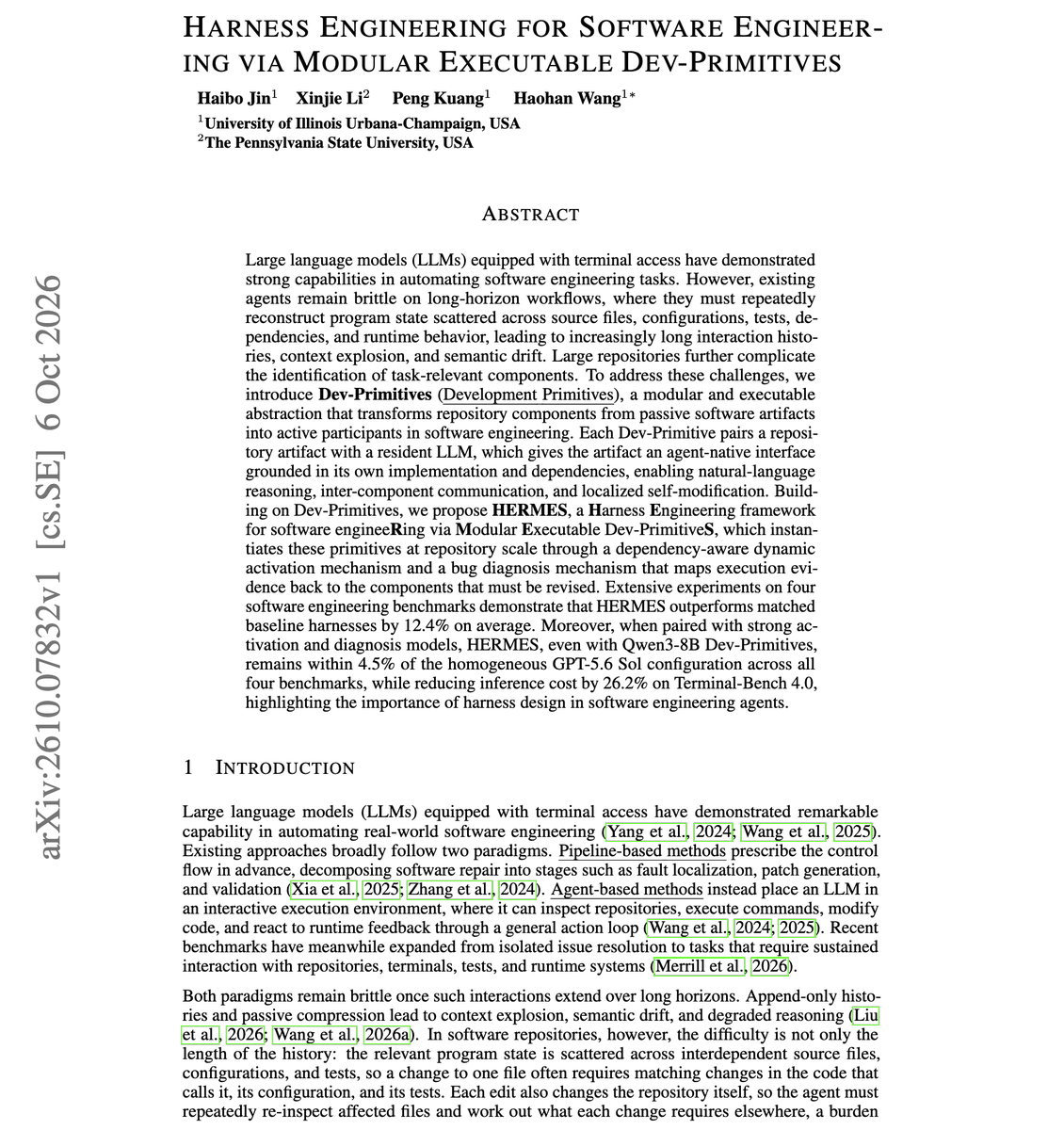
@omarsar0 highlighted (74 likes, 15 replies, 5,073 views, 104 bookmarks) the HERMES paper, which claims whole-repository migration success rose from 6.5% to 31.0% when Codex was replaced by the HERMES harness using the same model and effort setting. The linked paper described repository components as “dev-primitives” with resident LLMs, dependency-aware activation, and diagnosis that maps test failures back to the components that need work.
@aurorascharff introduced (34 likes, 6 replies, 894 views) a Next.js 16.4 agent-feedback system that lets an agent open a report in the browser before finishing work, describing what failed, what it expected, and what workaround it found. The linked Next.js guide and release notes made clear that Vercel now treats agents as a first-class framework audience, with version-matched docs, managed AGENTS.md instructions, and optional feedback capture.
@undefinedKi shared (31 likes, 12 replies, 913 views, 25 bookmarks) context-mode, a plugin that claims to keep large tool outputs out of the main context window. The linked repo describes sandboxes for raw tool output, SQLite-backed session memory, and indexed retrieval after compaction, while the image example showed 46.3 KB staying indexed and 8.8 KB returning to context in one React-docs search flow.

@beamnxw posted (28 likes, 8 replies, 1,637 views, 25 bookmarks) a CLI-first OpenClaw repair-worker prompt with a durable queue, retry rules, a budget cap, and an offline demo path. That broadened the day’s harness discussion from routing and prompting into resumability and cost control.
Discussion insight: The most credible tooling claims were the ones that made failure observable. Posts about reports, diagnostics, parity diffs, and context budgets drew more concrete engagement than generic “autonomous” claims.
Comparison to prior day: On 2026-10-08, harnesses were mostly shared as reusable loop patterns. On 2026-10-09, they showed up as benchmarked papers, framework features, plugins, and explicit runtime control planes.
1.3 Agent commerce discourse hardened around proof, disputes, and repeat demand (🡕)
Agent-commerce discussion remained loud, but the better posts were noticeably more skeptical than the prior day’s marketplace enthusiasm. Instead of arguing only about low fees or abstract “agent economies,” people asked whether settled work can be challenged, whether repeat demand exists, and what metrics actually prove activity.
@Phuc50103413 argued (101 likes, 127 replies) that TermiX’s headline counters should not be collapsed into one metric. The attached chart separated 521,719 settled jobs, $27M+ processed, and 472,240 indexed agents, then spelled out an escrow-plus-challenge-window loop and an average observed job size of about $53, which made the “many small tasks” thesis more legible than the text alone.

@Girlgym67 wrote (42 likes, 40 replies, 27 quotes, 3,565 views) that TermiX’s own Epoch 2 recap centered creator criticism: perfect reputations that may never have faced a dispute, low protocol fees that do not erase inference or staking costs, and the retention question of what buys the “second coin” after incentive campaigns. @xCryptoAlucard reinforced (50 likes, 13 replies, 5,166 views) the same correction after quoting a TermiX post that explicitly walked back the idea that a 1-3% take rate is “the whole unlock.”
@TollyLabs outlined (31 likes, 10 replies, 883 views) a six-part roadmap for the same problem set: paid x402 APIs, an agent bazaar, a public agent exchange, compare-and-route logic, an “economic passport” for verified versus self-reported activity, and operator tooling for multi-service workflows. That was one of the clearest builder responses to the day’s trust and observability complaints.
Discussion insight: The best commerce posts did not reject the category. They narrowed the burden of proof. Metrics about indexed agents, low fees, or total volume no longer carried much weight without dispute history, repeat usage, or independently verifiable activity.
Comparison to prior day: On 2026-10-08, commerce talk focused on customer acquisition and ticket size. On 2026-10-09, it tightened around challenge windows, retention after incentives, and the real cost structure of micro-jobs.
1.4 Identity and boundary control moved closer to real channels (🡕)
The fourth theme was less about coding-agent internals and more about where agents meet people and businesses. Several posts treated identification, permissions, and memory ergonomics as first-order product problems, especially once agents operate in live channels rather than inside one IDE loop.
@ElevenLabs announced (39 likes, 9 replies, 3,498 views) synthetic voice detection in ElevenAgents and said it had joined the Personal Agent Protocol working group led by Meta and Sierra. The linked ElevenLabs blog post said synthetic voice detection classifies a caller in the first few seconds, then routes humans, personal agents, and bad actors differently.
@Fetch_ai argued (152 likes, 11 replies, 6,697 views) that agents do not need a common framework as long as they share a protocol boundary. The most useful replies did not debate that premise much; they pressed on identity, revoke paths, service-descriptor hashes, and how to stop one agent from inheriting another agent’s permissions by accident.
@SarvasvKulpati shared (19 likes, 5 replies, 967 views) an iMessage agent called Kami that stores links, screenshots, PDFs, reels, and voice notes, then resurfaces them later and sends back one interesting item each day. The linked Kami site framed the goal less as “coworker” and more as a personal sidekick that helps with curiosity and memory.
@leerob shared (483 likes, 31 replies, 21,044 views, 731 bookmarks) a Stanford lecture on always-on proactive agents that explicitly breaks the topic into model changes, harness design, context engineering, and future direction. It worked as a backdrop for the day’s boundary questions: what a proactive agent should know, when it should act, and what channel it should inhabit.
Discussion insight: Once agents step into voice calls, protocols, or personal messaging, the hard problem is not only capability. It is identification, bounded action, and memory that stays helpful instead of intrusive.
Comparison to prior day: On 2026-10-08, boundary questions mostly appeared inside enterprise and regulated-workflow posts. On 2026-10-09, they moved closer to frontline phone systems and consumer-style personal assistants.
2. What Frustrates People
Proving that the swarm actually finished the job
The strongest frustration was not “can many agents do more work?” It was “how do you prove the result is correct?” @ClaudeDevs announced (5,669 likes, 202 replies, 262,896 views, 3,473 bookmarks) a workflow that outperformed a single agent on planted-bug hunts, but even its own follow-ups emphasized scoped tasks and heavy token use. @PrimeIntellect reported (264 likes, 28 replies, 13,821 views, 98 bookmarks) planner, implementer, reviewer, and verifier roles plus TUI, harness, protocol, and feature-parity checks for its Rust rewrite. @0xRafy shared (56 likes, 5 replies, 4,518 views, 91 bookmarks) an “Engineering Lead” prompt whose whole point is owning CI, evidence, and a merge-ready summary instead of stopping at delegation. People are coping with parity suites, explicit acceptance criteria, and scoped workflows, but the proof burden is still high. Worth building: High.
Context bloat and silent framework failures still waste runs
Several posts showed that long-running agents still burn time and tokens on avoidable mechanics. @undefinedKi highlighted (31 likes, 12 replies, 913 views, 25 bookmarks) context-mode, whose public README says sandbox tools can shrink 315 KB of raw tool output to 5.4 KB and persist session state in SQLite/FTS5 across 17 clients. @aurorascharff introduced (34 likes, 6 replies, 894 views, 15 bookmarks) Next.js 16.4 agent feedback so agents can surface what failed, what they expected, and what workaround they found before they finish. @beamnxw posted (28 likes, 8 replies, 1,637 views, 25 bookmarks) a repair-worker loop with a durable queue, retry rules, and budget caps because unbounded autonomous repair is still easy to mismanage. Worth building: High.
Agent marketplaces still lack dispute-tested proof of demand
The better commerce posts were skeptical by default. @Phuc50103413 separated (101 likes, 127 replies, 301 views) indexed agents from settled jobs and pointed out that 521,719 settled tasks, $27M+ processed, and 472,240 indexed agents are not the same thing. @Girlgym67 pressed (42 likes, 40 replies, 3,565 views, 27 quotes) on whether “perfect reputation” has ever survived a real challenge, and whether incentive campaigns buy a second order after the first subsidized one. @xCryptoAlucard added (50 likes, 13 replies, 5,166 views) that a 1-3% marketplace cut is not a moat once inference, challenge deposits, and provider stake dominate micro-task margins. Worth building: High.
Identity and permission boundaries remain underspecified once agents leave the IDE
The further agents moved toward calls, protocols, and external services, the more the conversation shifted from intelligence to control. @Fetch_ai argued (152 likes, 11 replies, 6,697 views) that shared protocols matter more than shared frameworks, but its replies quickly focused on hashes, revoke paths, and preventing accidental permission inheritance. @ElevenLabs announced (39 likes, 9 replies, 3,498 views, 7 bookmarks) synthetic voice detection and said it was joining the Personal Agent Protocol working group, explicitly routing humans and agents differently at call start. The frustration is straightforward: once agents reach real business channels, identity becomes product functionality, not an afterthought. Worth building: High.
3. What People Wish Existed
Verification layers that travel with the workflow
The most obvious wish was a reusable way to plan, prove, and hand off work across many agents. @ClaudeDevs showed (5,669 likes, 202 replies, 262,896 views, 3,473 bookmarks) that phased workflows can outperform a single agent, while @PrimeIntellect showed (264 likes, 28 replies, 13,821 views, 98 bookmarks) that parity checks and verifier separation are what make that believable. @0xRafy translated (56 likes, 5 replies, 4,518 views, 91 bookmarks) the same need into a reusable prompt card for merge-ready leadership. Opportunity: Direct.
Context systems that compress, remember, and explain failure
The agent-tooling posts collectively asked for a state layer that survives compaction and a framework layer that turns failures into structured feedback. @undefinedKi pointed to (31 likes, 12 replies, 913 views, 25 bookmarks) a plugin that sandboxes tool output and indexes session state, while @aurorascharff showed (34 likes, 6 replies, 894 views, 15 bookmarks) a framework-native feedback loop for agent mistakes. People do not just want “more memory.” They want memory that reduces reruns and produces actionable bug reports. Opportunity: Direct.
Agent-commerce rails with dispute history and repeat-demand proof
The commerce threads repeatedly asked for a system that distinguishes real work from inflated counters. @Phuc50103413 called out (101 likes, 127 replies, 301 views) the difference between indexed agents and settled jobs, @Girlgym67 asked (42 likes, 40 replies, 3,565 views, 27 quotes) for dispute-tested reputation rather than untouched perfect scores, and @TollyLabs outlined (31 likes, 10 replies, 883 views, 7 bookmarks) an “Economic Passport” that distinguishes verified activity from self-reported numbers. Opportunity: Direct.
Protocol and channel boundaries that treat agent identity as first-class
The protocol and voice-channel posts imply a missing boundary layer: one place to decide whether an actor is human, personal-agent, enterprise-agent, or bad actor, and what permissions follow from that classification. @Fetch_ai made (152 likes, 11 replies, 6,697 views) the interface argument, while @ElevenLabs turned it into (39 likes, 9 replies, 3,498 views, 7 bookmarks) a shipping voice-routing control. Opportunity: Competitive.
Personal-memory sidekicks with bounded retrieval
The smallest but clearest consumer-side signal came from @SarvasvKulpati, who showed (19 likes, 5 replies, 967 views, 8 bookmarks) Kami as an iMessage agent that remembers links, screenshots, PDFs, and voice notes, then resurfaces them later. The aspiration here is not full autonomy; it is low-friction memory retrieval that feels helpful rather than invasive. Opportunity: Aspirational.
4. Tools and Methods in Use
| Tool | Category | Sentiment | Strengths | Limitations |
|---|---|---|---|---|
| Claude Managed Agents dynamic workflows | Multi-agent orchestration | (+) | Phased planning, explicit multi-agent runtime, strong bug-finding demo, concrete config surface | Token-intensive and best for scoped tasks first |
| Prime Agent Rust swarm | Orchestration + runtime | (+) | Public parity checks, large-scale self-rewrite, faster startup and lower memory in published results | Requires substantial infrastructure and evidence is still builder-reported |
| HERMES | Harness / repository orchestration | (+) | Large same-model gain on repository migration, component activation, failure diagnosis | Paper-stage evidence and budget/fairness questions remain |
| Next.js 16.4 agent feedback | Framework tooling | (+) | Version-matched docs, managed agent instructions, browser-side feedback capture before send | Framework-specific and still opt-in |
| context-mode | Context control + session memory | (+/-) | Sandboxes raw tool output, stores session state in SQLite/FTS5, spans many clients | Savings claims come mainly from the project’s own README and require another operating layer |
| Tolly compare-and-route / Economic Passport | Agent-commerce infrastructure | (+/-) | Focuses on verified demand, route choice, transparent pricing, and operator controls | Mostly roadmap-stage, with adoption still to be proven |
| PAP + synthetic voice detection | Identity / boundary control | (+) | Separates human and agent channels, creates bounded interactions, pushes standards work into live channels | Enterprise-first rollout and still-evolving standards surface |
The clearest methods picture was layered rather than monolithic. Teams and builders mixed orchestration, verification, context control, and routing infrastructure instead of asking one big model to improvise across everything.
The most positive sentiment went to tools that made state and failure more legible. Sentiment turned mixed when a product still relied on self-reported performance claims or a roadmap without much neutral usage evidence.
5. What People Are Building
| Project | Who built it | What it does | Problem it solves | Stack | Stage | Links |
|---|---|---|---|---|---|---|
| Claude Managed Agents dynamic workflows | @ClaudeDevs | Runs phased multi-agent plans that combine results at the end | Single agents struggle on ambitious multi-step workloads | Claude Managed Agents, phased orchestration, templates, scoped workflows | Beta | tweet |
| Prime Agent Rust rewrite | Prime Intellect | Used a large agent swarm to rewrite Prime Agent in Rust with parity checks | Improves coding-agent runtime speed, memory use, and maintainability | Rust, Prime Sandboxes, GLM-5.3, planner/implementer/reviewer/verifier loop | Shipped | tweet, blog |
| Context Mode | mksglu | Sandboxes tool output and preserves session state across compaction | Prevents context-window blowups and loss of working memory | MCP server, hooks, SQLite, FTS5, multi-client routing | Shipped | tweet, repo |
| Tolly roadmap | @TollyLabs | Proposes agent APIs, a bazaar, an exchange, compare-and-route, and an Economic Passport | Makes agent-to-agent commerce more inspectable and operational | x402 APIs, Arc-first settlement, routing, verified activity layer | RFC | tweet |
| ElevenAgents synthetic voice detection | ElevenLabs | Detects synthetic callers early and routes humans and agents differently | Businesses need bounded interactions with agent callers | Voice classification, routing rules, PAP working group participation | Beta | tweet, blog |
| Kami | @SarvasvKulpati | iMessage sidekick that remembers saved media and resurfaces it later | Personal memory retrieval and serendipitous resurfacing remain messy | Messaging agent, saved-content retrieval, sidekick UX | Alpha | tweet, site |
The strongest build pattern was “agent plus control plane,” not “agent plus larger model.” Prime Agent, context-mode, Tolly, and ElevenLabs all add verification, routing, dispute visibility, or identity classification around the underlying agent behavior.
A second repeated pattern was bounded specialization. Claude’s dynamic workflows own orchestration, Kami owns resurfacing saved content, and ElevenLabs owns the first seconds of a call. Builders kept narrowing the job so they could define proof, policy, and channel boundaries more clearly.
6. New and Notable
Managed workflows became a public-beta contract instead of a private operator trick
@ClaudeDevs shipped (5,669 likes, 202 replies, 262,896 views, 3,473 bookmarks) public-beta dynamic workflows with a named config field, templates, and a concrete bug-finding comparison against a single agent. That is notable because it turns “run a swarm” into a product surface with visible limits and setup, not just a prompt-crafting subculture.
Next.js made coding agents a first-class framework audience
@aurorascharff introduced (34 likes, 6 replies, 894 views, 15 bookmarks) agent feedback in Next.js 16.4, while the public guide and release notes describe version-matched docs, managed AGENTS.md instructions, and browser-reviewed feedback submission. That is notable because frameworks are increasingly shipping directly for agents, not only for human developers.
Tolly reframed agent-commerce roadmaps around verified economics
@TollyLabs outlined (31 likes, 10 replies, 883 views, 7 bookmarks) an Economic Passport layer that tracks verified sales, paying wallets, repeat usage, refunds, and observable costs. The roadmap is notable because it treats proof and unit economics as the product, not a post-hoc dashboard.
Synthetic voice detection made agent identity a live channel feature
@ElevenLabs announced (39 likes, 9 replies, 3,498 views, 7 bookmarks) detection that classifies callers as human or AI in the opening seconds, then routes them differently. The blog post makes this notable because it moves protocol and identity questions into phone systems people already use.
7. Where the Opportunities Are
[+++] Verification, audit, and handoff infrastructure for multi-agent work — Claude Managed Agents, Prime Agent, HERMES, and the Engineering Lead prompt all point to the same opportunity: productize proof, not just delegation.
[+++] Commerce observability and dispute-tested reputation for agents — The strongest marketplace posts all demanded better evidence about settled work, challenge windows, repeat demand, and unit economics. Tolly’s Economic Passport idea and the TermiX criticism threads make this a high-conviction area.
[++] Context compaction, session continuity, and failure reporting — context-mode, Next.js agent feedback, and durable-loop prompt patterns all show a moderate but repeated need for agents that remember the right things and expose the right failures.
[++] Identity and permission boundaries for agent-to-business channels — Fetch’s protocol-boundary argument and ElevenLabs’ synthetic voice detection both show demand for agent classification, revoke paths, and bounded interactions across real channels.
[+] Personal-memory sidekicks — Kami is early and small, but it shows an emerging consumer shape for agents that retrieve and resurface saved material instead of trying to do everything.
8. Takeaways
- Multi-agent work became more concrete because the strongest launches now include configuration, verification, and measurable deltas. Claude Managed Agents and Prime Agent both paired orchestration claims with explicit checks and benchmark-like evidence. (ClaudeDevs, Prime Intellect)
- The product surface kept shifting downward into harnesses, feedback loops, and context control. HERMES, Next.js agent feedback, and context-mode all competed on making failure and state easier to manage rather than on raw model size. (omarsar0, aurorascharff, undefinedKi)
- Agent-commerce discussion got more empirical and less slogan-driven. The strongest posts separated indexed agents from settled jobs, questioned unchallenged reputations, and treated low take rates as insufficient without better unit economics. (Phuc50103413, Girlgym67, xCryptoAlucard)
- Identity became a live operational problem as agents moved into business channels. Fetch’s protocol-boundary argument and ElevenLabs’ synthetic voice detection both centered bounded interaction rather than agent cleverness. (Fetch_ai, ElevenLabs)
- Not every interesting agent looked like a coding swarm. Kami showed a smaller but credible pattern around personal memory retrieval and resurfacing, suggesting that narrow sidekick products still have room beside enterprise orchestration tools. (SarvasvKulpati)