Twitter AI Coding - 2026-04-14
1. What People Are Talking About
1.1 Claude Code Desktop Redesign and Routines Launch (🡕)
Anthropic shipped two major updates to Claude Code on the same day. The official @claudeai account announced a desktop redesign featuring parallel sessions running side by side, a new sidebar to manage them, an integrated terminal, file editing, HTML/PDF preview, and a drag-and-drop layout. @9to5mac covered the launch and revealed a second feature not in the tweet: Routines — scheduled automations that run on Anthropic's web infrastructure even when the user's Mac is offline. The 9to5Mac article details tier-based limits: Pro gets 5 routines per day, Max gets 15, and Team/Enterprise get 25. Routines ship with repo and connector access, eliminating the need for users to manage their own cron jobs and MCP server infrastructure.
@Yuchenj_UW framed the redesign as an IDE paradigm shift, quoting Andrej Karpathy: "We're going to need a bigger IDE. The basic unit is not a file, but an agent." The implication: "Cursor now has to fight to define that future of IDE too." @RoundtableSpace amplified the excitement with the day's highest view count (4,898 views, 13 bookmarks), drawing replies like @traleyweb3: "claude code just got a massive upgrade."
Discussion insight: The redesign drew broad amplification but no technical criticism. The Routines feature — server-side scheduled automations — is the more structurally significant update, yet received less social attention than the visual redesign.
Comparison to prior day: Yesterday's report tracked Copilot CLI going remote and mobile, and Codex transforming into a desktop Super App. Today, Claude Code responds by making its desktop app multi-session and adding server-side automations — matching the "device-independent" direction while adding a scheduling capability neither competitor has announced.
1.2 Claude Code Skills Ecosystem Expands (🡕)
Two posts showcased the growing ecosystem of installable skills that extend what Claude Code knows out of the box.
@shi3z published a Claude Code skill for SparkJS, the 3D Gaussian Splat rendering library built on Three.js. The post drew the day's highest score (95.8) with 22 likes, 12 bookmarks, and 3,240 views. The GitHub repo contains a SKILL.md and references directory covering the full SparkJS API: SparkRenderer, SplatMesh, PackedSplats, SDF-based splat editing, Level-of-Detail streaming, the Dyno shader graph system with 117+ stdlib functions, and platform-specific performance optimization. Install is a single git clone to ~/.claude/skills/.
Separately, @hasantoxr highlighted Taste Skill, an open-source collection of agent skills that give AI coding tools a "sense of design taste." The repo has 8.3k stars and 827 forks, with seven skill variants (taste-skill, redesign-skill, soft-skill, brutalist, minimalist, stitch, output-skill) and three adjustable dials controlling layout variance, motion intensity, and visual density. Unlike the SparkJS skill, Taste Skill works cross-tool: Cursor, Claude Code, Codex, Windsurf, Copilot, and Antigravity.
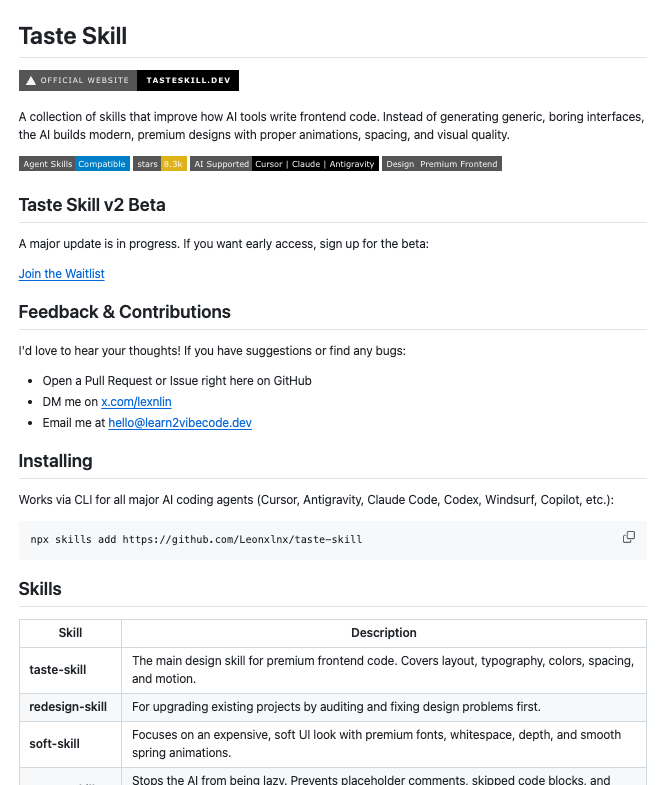
Discussion insight: The SparkJS skill demonstrates domain-specific knowledge injection (3D graphics APIs), while Taste Skill demonstrates cross-cutting quality injection (design patterns). Together they show two distinct skill patterns: deep vertical expertise vs. broad horizontal quality.
Comparison to prior day: Yesterday's report did not feature skills specifically. The skills ecosystem is growing alongside MCP as a second extensibility mechanism for AI coding agents.
1.3 Claude Opus 4.7 Launch Speculation (🡕)
@bridgemindai posted the day's most-liked thread (34 likes, 7 replies, 2 quotes) predicting an imminent Opus 4.7 release based on release cadence analysis: Opus 4.5 dropped November 24, Opus 4.6 dropped 73 days later on February 5, and April 14 is day 68 since Opus 4.6. The post claims the "Claude Code source code leak already confirmed Opus 4.7 and Sonnet 4.8 exist," that "Claude Mythos is live with enterprise partners," and that Anthropic is nerfing Opus 4.6 the same way they nerfed Opus 4.5 before replacing it.
Discussion insight: @PaulGugAI replied with a quality concern: "Hopefully Sonnet 4.7 will be like Opus 4.6 (from back in the good old days a week ago when it was still the best)" — suggesting perceived degradation of the current Opus 4.6 model. @bridgebench confirmed they will have benchmark results on launch day.
Comparison to prior day: Yesterday's report documented Claude Code token bloat and ghost token concerns. The perceived model nerfing described here could explain some of those quality regressions — a common user theory is that model quality degrades before a successor launches.
1.4 Claude Code Beyond Coding: Trading, Education, Investing (🡒)
Three posts demonstrated Claude Code applied outside traditional software development.
@shanesimpson513 outlined a roadmap for an agentic crypto trading system built with Claude Code and the @gmgnai API. His quoted thread details a 4-stage token filtering pipeline — discovery, tracking, deep dive, alert — that processed 3,200 trending tokens over 4 days with only 107 making the cut (3.3% pass rate). Every alerted token gets journaled with 30-second snapshots of price, market cap, liquidity, holders, bot rate, and smart money. The system powers both filter refinement and backtesting with realistic slippage.
@hot_town built a web dev tutor that lives inside Claude Code. The course site by Wasp offers a structured curriculum — users paste a prompt into Claude Code, which fetches course instructions and tutors them through building real web apps. Designed for non-technical teammates learning to "vibe code."
@kskgroup2017 (Keisuke Honda, former professional footballer and investor) shared a chat screenshot explaining his motivation for using Claude Code: "you can't sense the AI revolution without touching Claude Code raw" and "secondly, for my own time efficiency."

Discussion insight: These three posts share a pattern: Claude Code as a platform for non-coding workflows — crypto trading infrastructure, structured education, and investor research.
Comparison to prior day: Yesterday's report noted AI tool fluency expanding to non-developer roles. Today's data adds concrete examples: a trader, a tutor, and an investor all using Claude Code as their primary tool.
2. What Frustrates People
Claude Code Cost Opacity (Medium)
@GithubAwesome described the problem directly: "Someone was spending over $200 a day on Claude Code API credits with no idea where it was going." The solution — codeburn, a Terminal UI that reads local session transcripts and categorizes every token spent by task type (debugging, brainstorming, coding) — identifies "token overhead from bloated MCP servers" as a cost driver. The tool includes an interactive daily activity chart and a Mac menu bar widget. No LLM calls are required for the analysis.
This continues the token bloat frustration from yesterday's report, where Claude Code v2.1.100+ was confirmed to inject ~20k server-side tokens per request and system overhead consumed ~50k tokens before any user message. Today's evidence adds a new cost vector: bloated MCP servers contributing to token waste.
Claude Code Churn Signal (Low)
@inancgumus stated simply: "I've completely got rid of Claude Code." The post drew 374 views but zero likes and zero bookmarks — followers saw it but did not amplify. No explanation was given for the switch. As an isolated data point, this represents a churn signal without diagnostic value, but it sits against the backdrop of cost and quality concerns documented over multiple days.
3. What People Wish Existed
Granular Token Cost Attribution
The gap between "$200/day in Claude Code API credits" (@GithubAwesome) and any built-in cost visibility remains wide. Codeburn addresses this by reading local session transcripts, but the solution is external and after-the-fact. Users need real-time, per-task cost attribution built into the agent — knowing that a debugging session costs 3x a code generation session before it starts, not after the bill arrives. Yesterday's report flagged the same need; today's data confirms it with a specific dollar figure ($200/day).
Cross-Tool Skill Portability
Taste Skill's cross-tool compatibility (Cursor, Claude Code, Codex, Windsurf, Copilot, Antigravity) highlights what most skills lack: portability. The SparkJS skill only works with Claude Code. As the skills ecosystem grows, developers will want to install once and use everywhere — a skill registry and format that works across agents, similar to how MCP standardized tool connections. The npx skills add command used by Taste Skill hints at this direction.
4. Tools and Methods in Use
| Tool | Category | Sentiment | Strengths | Limitations |
|---|---|---|---|---|
| Claude Code | Coding agent / IDE | Positive | Desktop redesign with parallel sessions; Routines for scheduled automations; skills ecosystem (SparkJS, Taste Skill); non-coding use cases (trading, education) | $200/day cost opacity; MCP server token bloat; churn signal from at least one user |
| Taste Skill | Agent skill (design) | Positive | 8.3k stars; 7 design skill variants; cross-tool (Cursor, Claude Code, Codex, Windsurf, Copilot); adjustable dials for layout/motion/density | v2 still in beta; effect on code quality unverified |
| SparkJS Skill | Agent skill (3D) | Positive | Domain-specific API knowledge for 3D Gaussian Splatting; 117+ shader functions; installs via git clone | Claude Code only; no cross-tool support |
| ai-memory | MCP memory tool | Neutral | 97.8% Recall@5 on LongMemEval; SQLite FTS5 with zero cloud dependencies; 12+ AI platform support; TOON format 79% smaller than JSON | Zero social engagement (0 likes); new project |
| codeburn | Cost analysis TUI | Positive | Local session transcript analysis; per-task cost breakdown; Mac menu bar widget; no LLM calls required | External/after-the-fact; not built into Claude Code |
| Wasp Ship Your First App | Education platform | Positive | Free; structured curriculum inside Claude Code; designed for non-technical users | Phase 1 only; Modules 1-3 marked "Coming Soon" |
The dominant pattern today is Claude Code as a platform that other tools extend (skills) and analyze (codeburn), rather than a standalone product. ai-memory represents the MCP-based approach to cross-tool memory, claiming zero token cost until recall vs. vendor memory that loads into every message.
5. What People Are Building
| Project | Who built it | What it does | Problem it solves | Stack | Stage | Links |
|---|---|---|---|---|---|---|
| SparkJS Skill | @shi3z | Claude Code skill for 3D Gaussian Splat rendering API | Claude Code has no built-in knowledge of SparkJS; developers must paste docs manually | Claude Code, Three.js, SparkJS | Shipped (MIT) | GitHub, Post |
| Agentic Token Filter | @shanesimpson513 | 4-stage crypto token filtering pipeline with 30-second polling and journaling | Most trending tokens are unbuyable (bundled, botted, exit liquidity); filtering at speed is the moat | Claude Code, gmgn.ai API, custom dashboard | Running (4 days), open-source planned | Post |
| Ship Your First App | @hot_town / Wasp | Interactive web dev course that runs inside Claude Code as a tutor | Non-technical users lack a structured learning path for AI-assisted web development | Claude Code, Wasp, GitHub Pages | Shipped (Phase 1) | Course, Post |
| codeburn | Community (via @GithubAwesome) | Terminal UI for Claude Code cost analysis by task type | $200/day API spend with no visibility into where tokens go | Local session transcripts, TUI, Mac menu bar | Shipped | Post |
| ai-memory | @Alpha_One_AI | MCP-based persistent memory with on-demand recall across 12+ AI platforms | Vendor memory loads entire context into every message, wasting ~11M tokens/year | SQLite FTS5, BM25, TOON format, MCP stdio/HTTP | Shipped (benchmarked) | Site, Post |
| Invite Team Members Animation | @orevbajohn_ | Team invitation UI animation | Demo of Claude Code frontend output | Claude Code, React, Vercel | Shipped | Demo, Post |
6. New and Notable
Claude Code Routines: Server-Side Scheduled Automations
Anthropic launched Routines in research preview — scheduled automations that run on Claude Code's web infrastructure with access to repos and connectors. This moves Claude Code from a reactive tool (user prompts, agent responds) to a proactive one (agent runs on schedule without user presence). Tier limits: Pro 5/day, Max 15/day, Team/Enterprise 25/day. (9to5Mac, Post)
Claude Code Desktop Goes Multi-Session
The redesigned Claude Code desktop app supports multiple parallel sessions in a single window with a management sidebar. Adds integrated terminal, file editing, HTML/PDF preview, and a faster diff viewer in a drag-and-drop layout. This directly addresses the workflow where developers run parallel agent tasks on different parts of a codebase. (Post)
SparkJS Skill: First Domain-Specific Claude Code Skill for 3D Graphics
A MIT-licensed skill that gives Claude Code full knowledge of the SparkJS 3D Gaussian Splat rendering library — covering the renderer, splat mesh, SDF editing, LoD streaming, and 117+ shader stdlib functions. Installs via a single git clone. Demonstrates the pattern of packaging domain-specific API knowledge as a portable skill file. (GitHub, Post)
7. Where the Opportunities Are
[+++] Agent Skill Registries and Cross-Tool Portability — SparkJS Skill (Claude Code only) and Taste Skill (6+ tools) show two skill distribution models emerging simultaneously. Taste Skill's npx skills add and cross-tool support has 8.3k stars; SparkJS's Claude-only git clone approach has 22 likes and 12 bookmarks in hours. A unified skill registry — where skills are published once and installable across Claude Code, Cursor, Codex, Windsurf, and Copilot — would capture the same ecosystem value that MCP captures for tool connections. The demand exists; the standard does not.
[++] Real-Time Cost Attribution for AI Coding Agents — Yesterday's report documented ~50k tokens of system overhead before user messages. Today's data adds a $200/day cost figure and codeburn as a first external solution. The opportunity is in building cost attribution into the agent itself: per-task cost estimates before execution, budget alerts, and cost-per-outcome metrics. Every Claude Code API user is a potential customer for this capability.
[++] Scheduled Agent Automations Beyond Anthropic — Claude Code Routines is the first server-side scheduled automation for an AI coding agent. The feature is tier-limited (5-25 runs/day) and Anthropic-exclusive. An open-source equivalent — scheduled agent tasks that work with any LLM backend and run on the developer's own infrastructure — would serve the same demand that drove Multica to 4,000+ stars yesterday (self-hosted agent infrastructure).
[+] AI-Assisted Education Platforms — Ship Your First App demonstrates Claude Code as a structured tutoring platform for non-technical users. The curriculum pattern (fetch instructions, tutor through building, interactive exercises) generalizes beyond web development to any technical domain. The gap is that Phase 1 is the only content available — Modules 1-3 and Phases 2-3 are all "Coming Soon." First movers with complete curricula across multiple domains will own this category.
8. Takeaways
-
Claude Code shipped a desktop redesign and server-side Routines on the same day. Parallel sessions, integrated terminal, and drag-and-drop layout update the desktop experience. Routines — scheduled automations running on Anthropic's infrastructure — move Claude Code from reactive to proactive, with tier-based limits (5-25 runs/day). (9to5Mac)
-
The Claude Code skills ecosystem is materializing with two distinct patterns. SparkJS Skill (domain-specific API knowledge, Claude-only) and Taste Skill (cross-cutting design quality, 8.3k stars, 6+ tools) demonstrate vertical depth vs. horizontal breadth. Cross-tool portability is the differentiator. (SparkJS, Taste Skill)
-
Claude Opus 4.7 speculation is backed by release cadence analysis. Day 68 since Opus 4.6 puts the community inside the predicted launch window. A source code leak reportedly confirms Opus 4.7 and Sonnet 4.8 model names. Perceived nerfing of Opus 4.6 follows the same pattern as the Opus 4.5 deprecation cycle. (Post)
-
Claude Code cost opacity now has a dollar figure: $200/day with no visibility. Codeburn addresses this externally by reading session transcripts, but the need is for built-in, real-time cost attribution. Bloated MCP servers are newly identified as a cost driver alongside the token bloat documented yesterday. (Post)
-
Claude Code is expanding beyond coding into trading, education, and investor research. A 4-stage crypto token filter, an interactive web dev tutor, and a Japanese investor's endorsement all position Claude Code as a general-purpose agent platform rather than a coding tool. (Trading, Education, Investor)