Twitter AI Coding - 2026-04-15
1. What People Are Talking About
1.1 OpenAI Agents SDK Ships Production Primitives 🡕
OpenAI released a major update to the Agents SDK targeting durable, long-running agents in production. @snsf announced the launch (424 likes, 310 bookmarks, 30,339 views) detailing new primitives: file and computer use, skills, memory with compaction, and a separation of harness from compute. The harness is open-source, and compute execution can be delegated to sandbox partners including Blaxel, Cloudflare, Daytona, E2B, Modal, Runloop, and Vercel. The framing is explicit: "You can now build your own Codex-style agents."
@rohanvarma reported internal adoption at OpenAI itself (302 likes, 9,762 views): "Walking around OpenAI, there is one thing you will invariably overhear every 2-3 minutes: 'I'm asking Codex right now.'" @MatiBuildsWith replied: "Once people say 'I'm asking Codex' the way they say 'I'll Google it,' the interface war is basically over." A separate reply from @JDoeg53617 requested a new Codex model beyond 5.3, noting limits with the current model even when using continual learning skills and CLI hooks.
Discussion insight: The Agents SDK update reframes OpenAI's developer story from "use Codex" to "build your own Codex." The separation of harness and compute is architecturally significant — it means agent logic and execution environment are independently swappable. @stefanjrice identified observability as "the next big unlock": teams need to see why an agent took an action, not just whether it finished.
Comparison to prior day: Yesterday's report tracked Codex evolving into a desktop Super App. Today, OpenAI shifts upstream — open-sourcing the harness so developers can build production agent infrastructure themselves. This is a platform play, not a product update.
1.2 Rate Limits Become the Dominant Cross-Platform Pain Point 🡕
Rate limit frustrations spanned three platforms today with unusually high engagement.
@rsuyoy called out OpenAI for silently cutting Codex limits "by a huge amount" without public communication (161 likes, 39 replies, 17,833 views — the highest reply count in today's dataset). The author systematically ruled out alternative explanations: not fast mode, not high reasoning models, not excessive skill use, not a post-x2 adjustment. "The limits are now on par with Claude's code if not stricter." @Jacoob_shi replied: "silent limit drops are the worst. you just wake up one day, everything feels slower, and nobody said anything."
@TheRegister covered the broader Copilot backlash: "Customers revolt as GitHub Copilot 'fixes' rate limits." @mandraketech reported hitting rate limits on a Copilot Pro+ subscription for the first time despite averaging about 60 requests/day across 3-4 parallel sessions — "with no details on the exact nature, or timeline."
On the Anthropic side, @ChrisHayduk raised reliability concerns (46 likes, 11,588 views): "Having only two 9s of uptime for the Claude API and Claude Code (their main enterprise revenue drivers) is simply unacceptable. Especially when Codex and the OpenAI API have four 9s."
Discussion insight: The rate limit frustration is no longer tool-specific — it now spans OpenAI (Codex), GitHub (Copilot), and Anthropic (Claude Code uptime). The common thread is opacity: users cannot see their limits, cannot predict when they will hit them, and receive no formal communication when limits change.
Comparison to prior day: Yesterday's report documented Claude Code cost opacity ($200/day with no visibility) and token bloat. Today the frustration intensifies and broadens to include Codex and Copilot, with institutional media coverage from The Register.
1.3 VS Code and GitHub Copilot CLI Ship Agent Infrastructure 🡕
The official @code account announced a new VS Code release (348 likes, 68 bookmarks, 24,669 views) enhancing the agent experience with debug logs for past sessions, terminal interaction tools, and built-in GitHub Copilot. @m_emanaftab replied with the competitive framing: "every tool is shipping agent features now. VS Code, Claude Code, Codex, Cursor. The ones that win long term won't be the ones with the most features. They'll be the ones where the agent actually understands your project deeply enough that you trust it to work while you're away."
@cinnamon_msft promoted the Copilot CLI /remote command, enabling access to local dev environments from any device. @JamesMontemagno praised the Copilot CLI team's velocity: a PR was sent, docs updated, merged, queued, and deployed to production between noon and 1PM — before the responsible engineer returned from lunch.
@tristanbob surveyed Copilot users on which agent they use, linking to GitHub's third-party agents documentation. The options are the native VS Code agent, Anthropic Claude (Opus 4.5/4.6, Sonnet 4.5/4.6), or OpenAI Codex (GPT-5.2-Codex, GPT-5.3-Codex, GPT-5.4). Each agent session consumes one premium request plus GitHub Actions minutes.
Discussion insight: GitHub's agent platform now presents users with a three-way choice between native, Claude, and Codex agents — each with different model options and cost structures. The fragmentation is deliberate (competition drives quality) but adds decision overhead for users.
Comparison to prior day: Yesterday tracked Copilot CLI going remote and mobile. Today confirms that direction with the /remote command walkthrough and adds the VS Code agent infrastructure update — reinforcing Microsoft's two-track strategy (IDE + CLI).
1.4 OpenCode Remote Environments Approach Launch 🡕
@jlongster detailed the distributed systems work behind OpenCode's remote environments (76 likes, 29 bookmarks, 7,839 views). The architecture proxies writes through a control plane server to the remote environment while reads come from a local sync. This created eventual consistency: updates might not be reflected in subsequent reads. The fix is a "fence" mechanism — the remote env returns the latest sync status in a response header, and the control plane waits until its sync state matches before completing reads. A PR is linked and the feature is described as "very very close to releasing."
Follow-up comments reveal the roadmap: Cloudflare integration is coming ("@threepointone lots to talk about next week"), and the architecture will eventually support provider plugins so different sandbox providers can leverage their platforms natively. The system currently runs a full OpenCode server in remote environments, but splitting components for more flexible deployment is planned.
@LukeParkerDev published a 2-minute TUI plugin tutorial (49 likes, 23 bookmarks, 5,865 views) showing how to build custom panes inside OpenCode — demonstrating the extensibility of OpenCode's terminal interface.
@atbeme started building a wiki documenting the internals of OpenClaw, Hermes, OpenCode, and similar open agent harnesses, inspired by Karpathy's LLM personal wiki concept.
Discussion insight: OpenCode is developing the same remote execution capability that Codex already has, but with an open architecture and provider-plugin model. The fence mechanism solves a real distributed systems problem, and the PR-in-public approach lets the community inspect the implementation.
Comparison to prior day: New theme. OpenCode was not prominent in yesterday's report. The remote environments work positions OpenCode as the open-source alternative to Codex's cloud execution.
1.5 Claude Code Expands Into Multi-Agent and Enterprise Workflows 🡒
@TheTuringPost reported that OpenAI released a plugin letting users call Codex directly within Claude Code. The plugin turns Claude Code into a multi-agent setup with Codex as a specialized sub-agent for code reviews, debugging, async background jobs, and status tracking.
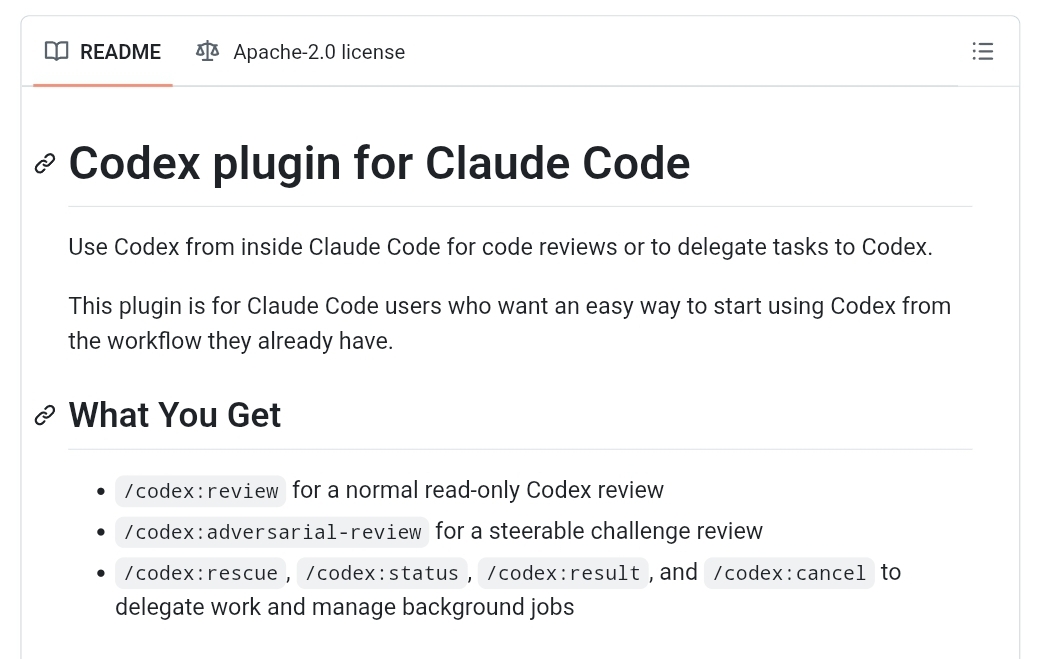
The plugin provides six slash commands: /codex:review for read-only reviews, /codex:adversarial-review for steerable challenge reviews, and /codex:rescue, /codex:status, /codex:result, /codex:cancel for delegating and managing background jobs. It is Apache-2.0 licensed.
@wmthomson22 described building a financial modeling system in Claude Code over roughly 40 hours across 75 companies. The methodology: treat Claude Code as "an analyst that knows nothing," then teach it iteratively — first to understand financial statements, then to identify revenue drivers from business models and operating segments, then to validate assumptions against 10-Qs, 10-Ks, and transcripts. The system is now deployable to analysts "without any knowledge whatsoever."
@JeremyNguyenPhD explored Claude Code Routines for daily briefings but raised privacy concerns: "I still haven't connected my main email account to any AI, just thinking about privacy etc."

Discussion insight: The Codex-inside-Claude-Code plugin is remarkable competitive behavior — OpenAI building into Anthropic's ecosystem rather than only competing against it. The financial modeling use case shows Claude Code being adopted for complex enterprise workflows that require weeks of iterative teaching, not single-prompt tasks.
Comparison to prior day: Yesterday's report launched Claude Code Routines and the desktop redesign. Today shows Day 2 adoption: users exploring routines (with privacy hesitation) and the financial modeling case extends the "Claude Code beyond coding" theme with the most detailed enterprise example yet.
2. What Frustrates People
Silent Rate Limit Reductions Across Platforms (High)
@rsuyoy documented that OpenAI cut Codex limits substantially without any public announcement. The post drew 39 replies — the most in today's dataset — with the author ruling out every common alternative explanation. @TheRegister covered the parallel Copilot revolt with institutional media reach (970 views on the tweet alone). @mandraketech hit Copilot Pro+ rate limits for the first time despite normal usage patterns, with no details on limits or timeline. The consistent frustration is opacity: limits change, no one is told, and the only way to discover the new limits is to hit them.
Anthropic API and Claude Code Reliability (Medium)
@ChrisHayduk quantified the gap: Anthropic's Claude API and Claude Code have "only two 9s of uptime" versus four 9s for Codex and the OpenAI API. The post frames Claude Code and the API as Anthropic's "main enterprise revenue drivers," making unreliability a direct business risk. This continues yesterday's reliability concerns and adds a specific competitive benchmark.
Google Antigravity and Gemini Instability (Medium)
Four separate posts express frustration with Google's AI coding tools. @tinyblue_dev cancelled Gemini Ultra calling Antigravity "nothing more than a fork of VS Code" and "half-finished software." @procesor_x reported persistent green quota issues across two accounts (Pro and Ultimate) with no Google response. @gujjutweeter reported that OpenCode usage within Antigravity triggered a policy violation with an appeal pending. @ultramathi complained of persistent "server at high usage" errors.
3. What People Wish Existed
Transparent, Published Rate Limit Policies
Every major platform drew rate limit complaints today. Users want published limits, change notifications, and real-time usage dashboards — not retroactive discovery through throttled requests. The current approach of silent limit adjustments erodes trust across Codex, Copilot, and Claude Code simultaneously.
Agent Observability and Audit Trails
@stefanjrice identified the gap in the top-scoring thread: "The next big unlock is better observability, so teams can see why an agent took an action, not just whether it finished." VS Code's new debug logs for past agent sessions address part of this, but the need extends to all agent platforms — especially for autonomous agents running in remote environments or as scheduled routines.
Model-Agnostic Agent Portability
@joe_lgtm noted that Codex CLI accepts OpenRouter, Databricks, and any OpenAI-compatible API via config change. @JulianGoldieSEO demonstrated using Qwen 3.6 with OpenCode. Users want to swap models freely without changing their agent tooling — a capability that open harnesses (OpenCode, Codex CLI) provide but vendor-locked tools do not.
4. Tools and Methods in Use
| Tool | Category | Sentiment | Strengths | Limitations |
|---|---|---|---|---|
| OpenAI Agents SDK | Agent framework | Positive | Open-source harness; durable execution; memory with compaction; 7 sandbox partners; build-your-own-Codex | New release; production track record unproven |
| VS Code + Copilot | IDE + agent | Positive | Debug logs for past sessions; terminal tools; built-in Copilot; /remote cross-device access | Three-way agent fragmentation (native, Claude, Codex); rate limit backlash |
| Copilot CLI | Terminal agent | Positive | /remote command for cross-device; rapid team velocity; free for students | Rate limits hit on Pro+ for first time; no published limit details |
| Claude Code | Coding agent / platform | Mixed | Routines for scheduled automation; financial modeling over 75 companies; Codex plugin for multi-agent | Two 9s uptime; rate limits on par with competitors; privacy concerns for Routines |
| OpenCode | Open-source terminal agent | Positive | Remote environments near launch; TUI plugin extensibility; model-agnostic (Qwen, OpenRouter) | Fence mechanism still in PR; provider plugins not yet available |
| Codex CLI | Terminal agent | Positive | Four 9s uptime; OpenRouter/Databricks compatible; internal adoption at OpenAI | Silent rate limit cuts; GPT-5.3 model aging; requires ChatGPT sub for some features |
| Antigravity (Google) | IDE | Negative | Integrated with Google ecosystem | "Fork of VS Code"; persistent server errors; policy violation risk; multiple cancellation reports |
| EDINET DB MCP | Financial data connector | Positive | 3,847 Japanese companies; 121 fields; 7 tool integrations via MCP; XBRL-parsed (no hallucinations) | Japan-focused; 100 free API requests/day |
5. What People Are Building
| Project | Builder | What it does | Stack | Stage | Links |
|---|---|---|---|---|---|
| Financial modeling system | @wmthomson22 | Iteratively trained system that analyzes financial statements, identifies revenue drivers, and builds models across 75 companies | Claude Code, 10-Q/10-K/transcript analysis | Deployed to analysts | Post |
| OpenCode remote environments | @jlongster | Remote agent execution with fence-based consistency, control plane proxy, provider plugin system | OpenCode, distributed sync | Pre-release (PR open) | Post |
| Codex plugin for Claude Code | OpenAI | Six slash commands to use Codex as sub-agent inside Claude Code for reviews, debugging, and background jobs | Claude Code, Codex API | Shipped (Apache-2.0) | Post |
| Agent harness wiki | @atbeme | Ground-up documentation of OpenClaw, Hermes, OpenCode internals for building custom harnesses | Wiki, source analysis | In progress | Post |
| Flipper Zero agent remote | @kasentuner | Physical remote control for terminal coding agents, accepted into Official Flipper App Catalog | Flipper Zero, Claude Code | Shipped (in catalog) | Post |
| Claude Code custom builds service | @Creatextravel | Custom application builds on Claude Code sold as a service with upsells | Claude Code, Stripe | Day 1 ($6,384 gross volume) | Post |
| EDINET DB MCP connector | @edinetdb_en | MCP server connecting 7 AI coding tools to structured Japanese financial data from 3,847 companies | REST API, MCP, XBRL, SQLite | Shipped | Post |
| X bookmarks triage skill | @arisehype | Triaged 3,333 bookmarks in one Claude Code session — 79% trash, kept 10 action items | Claude Code | Shipped (skill shared) | Post |
6. New and Notable
OpenAI Agents SDK: Build Your Own Codex
The most significant release of the day (2,111.2 score) separates the agent harness from compute execution. Developers can now combine durable execution, memory, file/computer use, and skills with any of seven sandbox providers — or bring their own. The harness is open-source. This reframes OpenAI's agent strategy from "use our product" to "build on our platform." (Post)
Codex Plugin for Claude Code: Cross-Platform Agent Integration
OpenAI released an Apache-2.0 plugin that embeds Codex inside Claude Code as a sub-agent. Six slash commands enable code reviews, adversarial reviews, and background job delegation with status tracking. This is a cooperative rather than purely competitive move — OpenAI building into Anthropic's ecosystem to capture usage regardless of which agent is the orchestrator. (Post)
OpenCode Remote Environments with Fence Consistency
OpenCode's remote environment implementation solves the distributed consistency problem with a fence mechanism — remote writes return sync status in response headers, and the control plane waits for sync convergence before completing reads. Provider plugins are planned (Cloudflare integration coming). The feature is "very very close to releasing." (Post)
Flipper Zero App for Controlling Coding Agents
@kasentuner built a physical remote for controlling terminal coding agents and got it accepted into the Official Flipper App Catalog. The device enables controlling Claude Code sessions from across the room, from the couch, or while pacing. A novel physical-digital interface for AI-assisted development. (Post)
EDINET DB: Financial Data MCP Across 7 Tools
A structured financial data service covering 3,847 Japanese listed companies connects to Claude Code, Cursor, Codex, Copilot, Cline, Antigravity, and ChatGPT via a single MCP server. Data is parsed deterministically from XBRL filings with no LLM involvement — "structurally no hallucinations." 121 financial fields across JP GAAP, IFRS, and US GAAP, updated daily. (Post, Site)
7. Where the Opportunities Are
[+++] Rate Limit Transparency and Usage Dashboards — Every major AI coding platform drew rate limit complaints today: Codex (silent cuts, 39 replies), Copilot (first-time Pro+ limits), Claude Code (two 9s uptime). The Register covered the Copilot backlash. No platform publishes clear limits, change notifications, or real-time usage dashboards. The first tool to offer transparent, predictable usage policies gains a trust advantage that cannot be matched by feature parity alone.
[+++] Open Agent Harness Ecosystem — OpenAI open-sourced the Agents SDK harness with 7 sandbox partners. OpenCode is building remote environments with provider plugins. @atbeme is documenting harness internals. The opportunity is in the ecosystem layer: standardized harness interfaces, provider marketplaces, and agent skill registries that work across OpenCode, Codex CLI, and any open harness. The "build your own Codex" message creates demand for components, hosting, and integration services.
[++] Agent Observability Platforms — The top-scoring thread's most insightful reply identified observability as "the next big unlock." VS Code added debug logs for past sessions, but the need extends to autonomous agents running remotely, in scheduled routines, and in multi-agent configurations (Codex-inside-Claude-Code). Tools that show why an agent took an action, cost-per-decision, and confidence-level traces will be essential as agents move from interactive to autonomous.
[++] Domain-Specific MCP Connectors — EDINET DB demonstrates MCP as a universal data protocol: one connector, 7 AI coding tools, 3,847 companies, zero hallucination risk. The pattern generalizes to any structured domain data — healthcare records, legal filings, logistics, compliance. Each vertical domain needs its own EDINET-style MCP connector with deterministic data extraction and cross-tool compatibility.
[+] Physical Interfaces for Agent Control — The Flipper Zero agent remote reached the Official App Catalog, validating demand for physical controls during AI coding sessions. As agent sessions become longer and more autonomous, the interaction model shifts from keyboard-intensive to monitoring-and-intervention. Dedicated hardware (remotes, status displays, notification devices) could serve this emerging workflow pattern.
8. Takeaways
-
OpenAI open-sourced the agent harness and separated it from compute execution. The Agents SDK update — today's highest-scoring item at 2,111.2 — provides durable execution, memory, file/computer use, and skills with 7 sandbox partners. The message is "build your own Codex," turning OpenAI's agent infrastructure into a platform rather than a closed product. (Post)
-
Rate limit frustrations hit critical mass across all three major platforms. Codex drew 39 replies over silent limit cuts, Copilot triggered a Register article on customer revolt, and Claude Code's two 9s uptime was flagged as an enterprise risk. The common failure is opacity — no platform publishes clear limits or change notifications. (Codex, Copilot, Claude)
-
OpenAI built a Codex plugin that runs inside Claude Code. Rather than only competing, OpenAI released an Apache-2.0 plugin with six slash commands for reviews, debugging, and background job delegation from within Claude Code. This cooperative-competitive move captures Codex usage regardless of which agent is the primary orchestrator. (Post)
-
OpenCode remote environments are near launch with a novel fence consistency mechanism. The architecture proxies writes through a control plane while reads come from local sync, with a fence mechanism ensuring sync convergence. Cloudflare integration is coming and a provider plugin system will let sandbox providers build native integrations. (Post)
-
Claude Code is being used to build enterprise financial modeling systems that take weeks to train. A 40-hour, 75-company financial modeling system — iteratively taught to understand financial statements, identify revenue drivers, and validate against SEC filings — demonstrates Claude Code as a platform for complex, non-coding enterprise workflows. This is the deepest enterprise use case documented in this series. (Post)