Twitter AI Coding - 2026-04-19
1. What People Are Talking About
1.1 Ollama Launches Copilot CLI Integration, Unlocking Free Local Agent Runs 🡕
The day's dominant story was @ollama announcing native support for GitHub's Copilot CLI (407 likes, 113 bookmarks, 36,321 views). The integration lets users run the Copilot CLI terminal agent entirely on local hardware via Ollama-hosted models: explore issues and PRs, scaffold work from tickets, navigate unfamiliar codebases. The command is ollama launch copilot. In the reply thread, Ollama credited @scaryrawr for the contribution and offered cache-hit troubleshooting to a user who found Pro plan usage too light.
@itsafiz published a step-by-step guide (22 likes, 24 bookmarks, 2,002 views) for running Copilot CLI with Ollama at zero cost, building a complete RAG pipeline using Haystack.

The screenshot shows Copilot CLI v1.0.32 running with a local Qwen model, exploring the directory, creating a requirements.txt, and scaffolding a PDFRAGPipeline class. @BradGroux amplified the announcement (31 likes, 10 bookmarks, 6,308 views), and @asamassekou10 noted that native Copilot CLI support for exploring issues and PRs locally is "a total game changer" while already running Gemma 4 for another project.
Comparison to prior day: Yesterday's Copilot CLI coverage focused on auto model selection going GA with a 10% premium discount. Today the story shifts to local execution via Ollama, which eliminates API costs entirely and positions Copilot CLI as the first major agent to offer a fully local option through official integration.
1.2 Codex Computer-Use Matures With Real-World Infrastructure Tasks 🡕
@_julianschiavo documented a weekend project (14 likes, 7 bookmarks, 1,458 views) using OpenAI Codex to configure a Raspberry Pi as a VPN exit node for international travel. The notable detail: Codex autonomously invoked the computer-use feature to click buttons in the Tailscale admin dashboard — without being asked.


The screenshots show CUA App Version 750 running GPT-5.4 at "Extra High" effort. Codex navigated to login.tailscale.com/admin/dns, clicked buttons autonomously, configured Pi-hole interfaces, and set up DNS routing. A follow-up reply confirmed Codex also diagnosed and fixed a broken PiHole setup and ran speed tests.
Separately, @Viewforge published head-to-head benchmarks (27 likes, 7 quotes, 1,322 views) pitting their Supers computer-use-kit against Codex at the same task (clipping a YouTube video and uploading it to TikTok with subtitles). Supers + GPT-5.4 completed in 16 minutes. Codex + GPT-5.4 failed after 21 minutes, getting the clip format wrong three times and requesting human intervention. A reply from @IDPHARMA5 noted: "long-running, real-world tasks are where most 'agents' break. Not toy demos." Two additional quote tweets from @gem_ilm (33 likes, 1,178 views) and @Something_USD1 (8,235 views) amplified the result.
Comparison to prior day: Yesterday a single endorsement called Codex computer-use "super token efficient." Today it advances to documented infrastructure automation (Raspberry Pi + Tailscale + PiHole) and competitive benchmarking, though the benchmarks also reveal failure modes on long-running tasks.
1.3 Google Ships Eight Products in One Week, Community Response is Mixed 🡕
@LyalinDotCom (Google) listed a barrage of releases (129 likes, 6,736 views) with pointed sarcasm — "Otherwise nothing much going on here recently" — in response to a claim that DeepMind was quiet until I/O. The list: Gemini 3.1 Flash TTS, Gemini Robotics-ER 1.6, Antigravity updates, Gemini CLI updates, Google AI Studio updates, Gemini macOS native app, Gemini 3.1 Flash Live (Thinking), and Gemma4.
Yet sentiment on Antigravity specifically remained negative. @StephenSawyerr wondered (511 views) if "anyone is still using Google Antigravity. Unusable model, outdated harness." @DynastyWillz reported (6 likes, 95 views) returning to Antigravity to fix a landing page section and failing: "After so many prompts the agent still mix the design up."
@JulianGoldieSEO continued flooding the feed with Antigravity education content: a 4-hour course (24 likes, 17 bookmarks, 1,071 views) and a 2-hour course (6 likes, 4 bookmarks, 527 views).
Comparison to prior day: Yesterday's Antigravity paradox — generating the most educational content while simultaneously driving power users to Windsurf — continues. Today Google's own employee touts the shipping velocity while community practitioners report persistent quality and stability issues.
1.4 Multi-Tool Stacking Solidifies as Standard Practice 🡒
The multi-tool workflow pattern, which emerged clearly yesterday, continued to solidify. @LyalinDotCom (Google) endorsed exploring all tools (17 likes, 1,243 views), quoting @AlexFinn's post calling out "crazy tribalism in AI" and advocating mixing Claude Code + Codex, Hermes + OpenClaw, Mac + Linux. Notable that a Google employee explicitly recommends using competitor products alongside Google's own.
@smartnakamoura reiterated (3 likes, 2 bookmarks): "Developers are now running all three together in the same workflow. Cursor for the interface, Claude Code for reasoning, Codex for code generation."
@BillydaAnalyst showed (1 bookmark, 60 views) a dual-tool setup with a side-by-side screenshot of Google Antigravity IDE and Claude Code terminal running together.

@drivelinekyle demonstrated a specific interleaving protocol (2 likes, 301 views): running Codex code reviews every other step in Claude Code to catch bugs and write proactive tests, using Opus 4.7 as the review model.

A reply from @devautomates noted: "small, constant reviews catch drift before it compounds."
Comparison to prior day: Yesterday the multi-tool pattern moved from aspirational to operational. Today it matures further with Google employees endorsing it, specific interleaving protocols emerging (code-review-fix-next), and visual evidence of dual-tool workflows.
1.5 Copilot CLI Opinion Shift: From Skeptic to Advocate 🡕
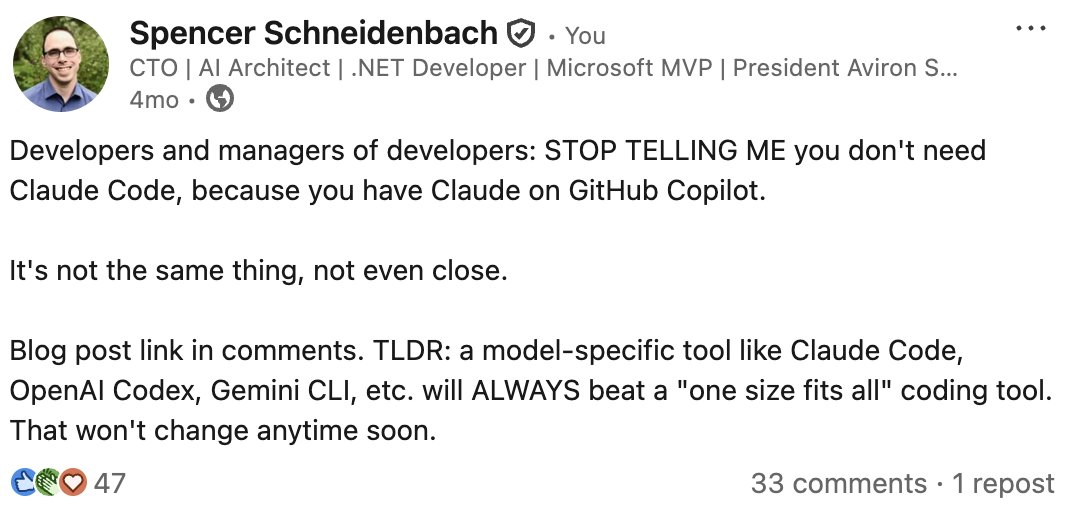
@schneidenbach (CTO, AI Architect, Microsoft MVP) posted (32 likes, 2,793 views) that he wrote a LinkedIn post "roughly 4 months ago" arguing model-specific tools like Claude Code would "ALWAYS beat a 'one size fits all' coding tool." He now says "things have changed. Copilot CLI is a great tool, and things like its code review feature highlight that multiple models attacking a problem leads to an outcome whose sum is greater than the individual parts. GitHub is swinging back."
@haridotworks shipped codexpilot (8 likes, 126 views), a fork of the Codex CLI that brings GPT models from a GitHub Copilot subscription into the Codex CLI. It supports switching between OpenAI and Copilot models mid-session, resuming sessions as a backup when rate limits hit, and works with Free, Student, Pro, and Pro+ Copilot plans.
Comparison to prior day: Yesterday's Copilot CLI coverage was about the auto model selection GA feature. Today the tool receives its first high-profile endorsement reversal from a credible skeptic, plus ecosystem tooling (codexpilot) that bridges it with Codex.
1.6 Vibe Coding Enters the Mainstream Consciousness 🡒
Vibe coding continued to permeate far beyond its developer origins. @beffjezos casually dropped it (79 likes, 2,547 views) into a lifestyle tweet: "Weekends are for lifting, quick hikes, and vibe coding all night." @masterofnone ran a vibe coding AI training (14 likes, 176 views) in Shah Alam, Malaysia, through the KrackedDevs community, explicitly targeting beginners.
@ridd_design captured the cultural penetration (12 likes, 498 views): "my sister just admitted that for the last year she thought vibe coding was taking a gummy before writing code."
But a counter-signal emerged. @DanTheronX warned (4 likes, 28 views): "The vibe coding hangover is real. Writing code is easy. Maintaining a massive, AI-generated codebase without a clear architecture is how senior engineers end up in development hell. The debt is compounding faster than the features."
@0xfeMMANUEL connected the dots (3 likes, 54 views) satirically: "Vercel got hacked, weird security issues everywhere, code quality is collapsing, and there's clearly some invisible force lowering engineering standards globally. Can't pinpoint its origin tho. Anyways, back to vibe-coding my novel tax app."
Comparison to prior day: Yesterday vibe coding was a workflow descriptor. Today it spans lifestyle culture (beffjezos), community education (Malaysia), folk humor (gummy misconception), and an emerging backlash term ("vibe coding hangover"). The term is now mainstream enough to generate its own criticism.
1.7 India Hackathon Ecosystem Accelerates 🡒
Two major hackathons ran simultaneously in India. @opencode announced judges (53 likes, 3,210 views) for India's first OpenCode Buildathon in Bangalore, with judges from Peak XV (investments), Mintlify (CoS), and Razorpay (Principal Engineer, two VPs of Engineering). @divyanshkul shared a hackathon project (4 likes, 67 views): Voyageur, an AI travel concierge that calls hotels and restaurants to get deals, shown live in free beta in Bengaluru.

Meanwhile, @KushalVijay_ reported (5 likes, 391 views) that a developer traveled from Jaipur to Delhi for the OpenAI Codex Hackathon. @TKarasani asked about (243 views) the $500 credits being offered to registered participants who couldn't attend.
Comparison to prior day: Yesterday documented the Codex Hackathon Bengaluru credits distribution and freeCodeCamp's Codex agentic development course. Today shows the events executing on the ground with corporate judges (Razorpay, Peak XV), live hackathon builds, and cross-city travel by participants.
2. What Frustrates People
Anthropic Support Cannot Resolve Its Own Confirmed Bugs — High
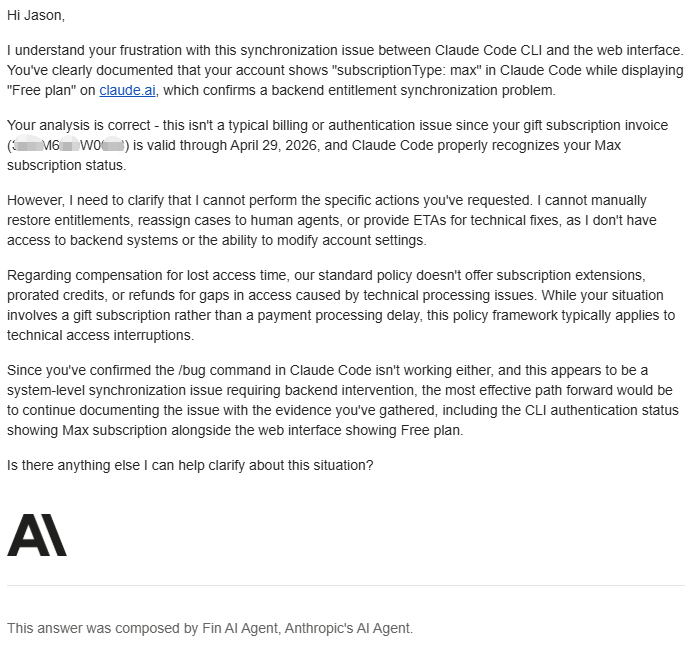
@Jasonzhouzld documented (8.4 score) a backend entitlement sync issue where Claude Code CLI shows a Max subscription while claude.ai shows Free. Anthropic's own support repeatedly confirmed the issue in writing, but the Fin AI Agent response explicitly stated: "I cannot manually restore entitlements, reassign cases to human agents, or provide ETAs for technical fixes" and "our standard policy doesn't offer subscription extensions, prorated credits, or refunds for gaps in access caused by technical processing issues."
@ask_alf cataloged (20 views) the scope: Claude Pro and Max subscribers are using subscriptions with OpenClaw, OpenCode, NanoClaw, custom agents, and the Agent SDK via OAuth — all without published terms.
Enterprise Account Bans With No Recourse — High
@johncrickett argued (13 likes, 1,035 views) that enterprises will pick GitHub Copilot specifically because they can talk to a person, quoting @patomolina who reported Anthropic took down an entire organization of 60+ accounts "without any explanations" and the only appeal path was a Google Form.
Google Antigravity Design Quality Failures — Medium
@DynastyWillz returned to Antigravity (6 likes, 95 views) to fix a landing page section: "After so many prompts the agent still mix the design up and have not gotten it right." @StephenSawyerr questioned (511 views) whether anyone is still using Antigravity, citing "unusable model" and "outdated harness."
AI-Generated Code Technical Debt — Medium
@DanTheronX named the pattern: "The vibe coding hangover is real." Maintaining AI-generated codebases without clear architecture leads to compounding debt. @0xfeMMANUEL linked security incidents and collapsing code quality to an "invisible force lowering engineering standards globally."
Provider Cost Asymmetry — Low
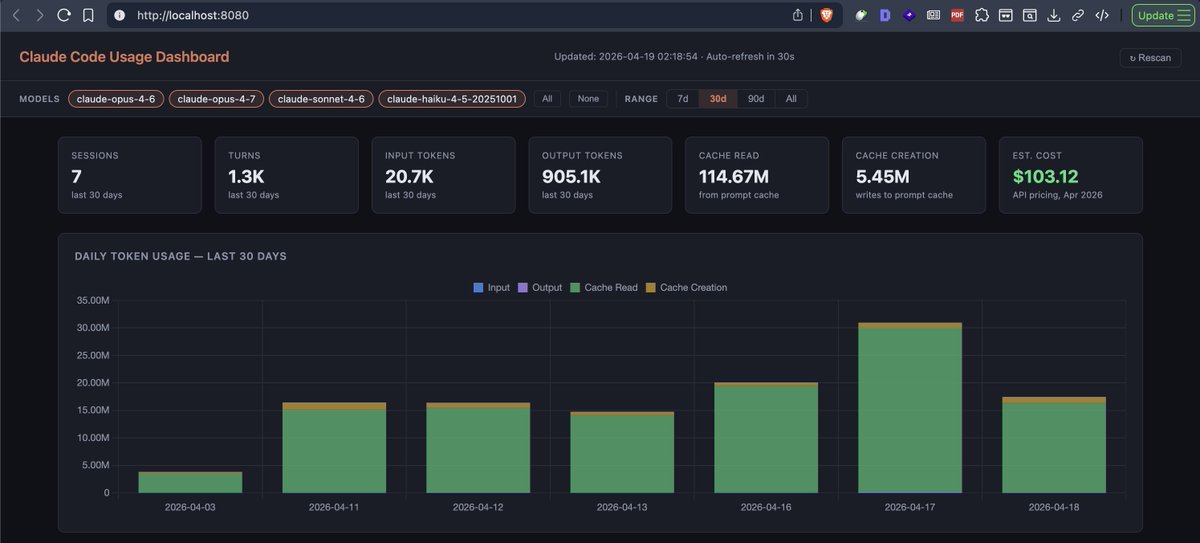
@GraemeVIP shared a Claude Code usage dashboard showing $103.12 in estimated API cost on a 20 GBP subscription over 30 days, with 114.67M cache read tokens. The implication: "Anthropic are losing money. OpenAI must be losing insane amounts with how generous Codex is."
3. What People Wish Existed
System-Wide Voice Input for AI Coding Tools
@kr0der reported (46 likes, 5,633 views) that a post from @RhysSullivan ("claude and codex not having standalone whispr apps is a decently big miss") kicked off a project at OpenAI to allow voice mode anywhere on the computer, not just the Codex app. @nishffx added a requirement: continuous listening mode, not push-to-talk. OpenAI may already be building this — a reply from @neocph noted they had already built it before the question was asked.
Design System Libraries for AI-Generated UI
@sharbel shared awesome-claude-design (19 likes, 11 bookmarks, 326 views): 68 ready-to-use design systems formatted for Claude Code's context window. The workflow: pick a system, drop DESIGN.md into the session, and Claude scaffolds a complete UI with README, CSS variables, Google Fonts substitutes, and preview cards in one shot.
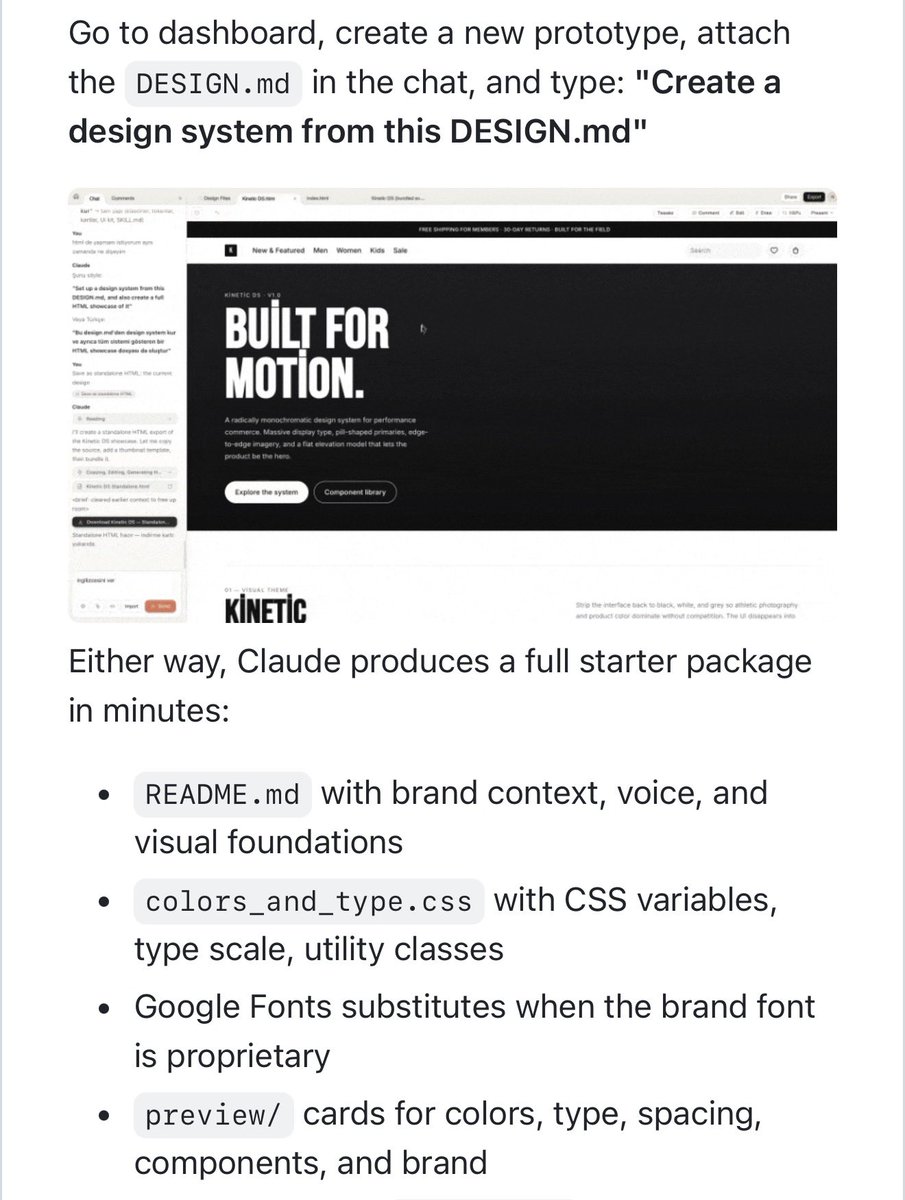
The 11 bookmarks relative to 326 views (3.4% bookmark rate) indicate strong reference demand. The tool addresses a specific, recurring complaint: "Every time you ask Claude to build a UI from scratch, you get a generic gray interface with default Tailwind classes."
Context Budget Visibility Inside Agent Sessions
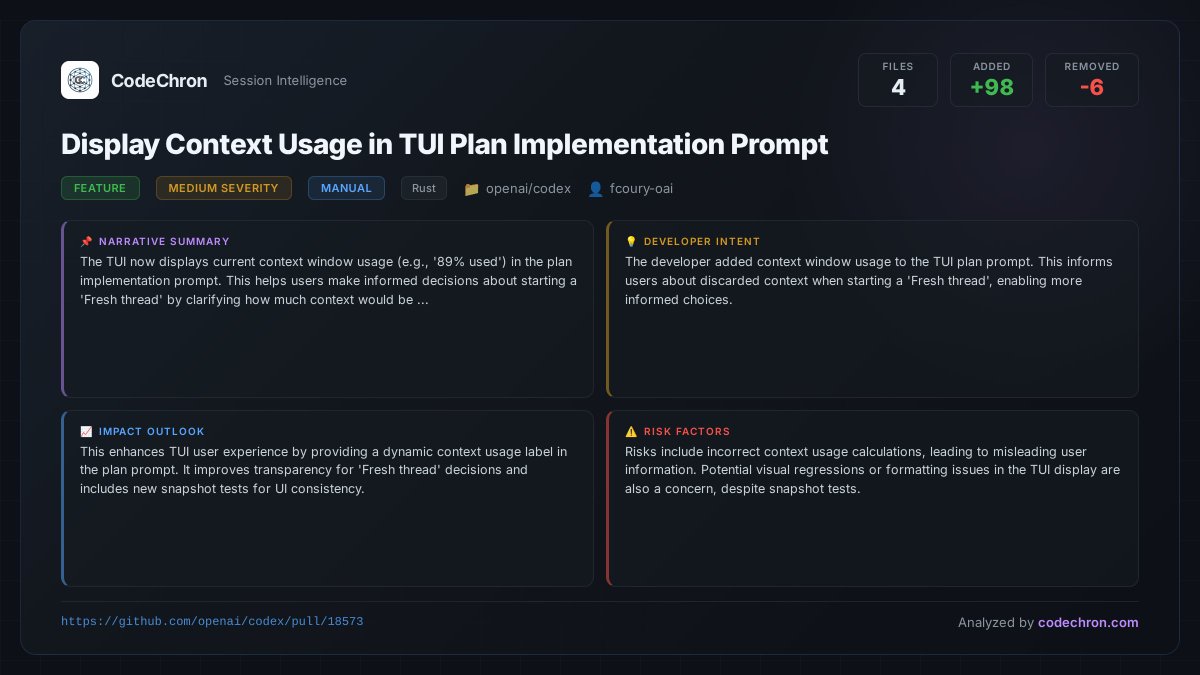
@ChronCode shared a merged PR to OpenAI's Codex repo (openai/codex#18573) that adds context usage display to the TUI plan implementation prompt (e.g., "89% used"). This directly addresses yesterday's identified need for token budget visibility.
Cross-Provider Rate Limit Arbitrage
@haridotworks shipped codexpilot (8 likes, 126 views): a Codex CLI fork that uses Copilot subscription models, supports switching between OpenAI and Copilot models mid-session, and acts as a backup when rate limits hit. @mattwiebe provided the demand signal: "I basically never run out of tokens in Codex on basic Pro plan. When I was using Claude Code on their Pro plan I ran out all the time."
Agent Protocol Standardization
@hiagentrq noted (48 views) that ACP (Agent Client Protocol), built by JetBrains and Zed, already has five major agents in its registry: Claude Code, Gemini CLI, Codex, GitHub Copilot CLI, and OpenCode. "Implement ACP once, works in every ACP-compatible editor." The breadth of adoption signals real momentum toward a universal agent interface standard.
4. Tools and Methods in Use
| Tool | Category | Sentiment | Strengths | Limitations |
|---|---|---|---|---|
| GitHub Copilot CLI | Terminal agent | (+) | Ollama integration for free local runs; multi-model code review; codexpilot bridge to Codex; skeptic-to-advocate endorsement | Inherits Copilot rate limits for cloud usage |
| OpenAI Codex | Agent platform | (+/-) | Computer-use maturing (Raspberry Pi + Tailscale); 90+ plugins; rate limit reset for anniversary; context usage display PR merged | Lost head-to-head computer-use benchmark to Viewforge; format errors on long tasks |
| Claude Code | Terminal agent | (+/-) | 68 design systems (awesome-claude-design); Minimalist Entrepreneur skills; token optimization ecosystem | Backend sync bugs; support cannot escalate to humans; subscription opacity persists |
| Google Antigravity | IDE | (+/-) | 8 product releases in one week; 6+ hours of course content | Persistent design mixing failures; "unusable model" complaints; user defection continues |
| OpenCode | Open-source terminal agent | (+) | Smooth Qwen 3.6 35B experience; Buildathon with Razorpay/Peak XV judges | Concurrency bug during prefill blocks other streams; harness sensitivity |
| Ollama | Local model server | (+) | Official Copilot CLI integration; enables zero-cost local agent runs | Cache-hit issues on some plans reported |
| Qwen 3.6 35B A3B | Local model | (+/-) | Flawless on M5 Max via mlx_lm at ~90tps; smooth in OpenCode | "Ultra sensitive to context pollution"; high variance across harnesses; "jaw-dropping to total disaster" |
| Supers (Viewforge) | Computer-use kit | (+) | Beat Codex in head-to-head benchmark; cross-platform (Mac/Win/Linux/Chrome/Android/iPhone) | $99/year; limited public validation beyond self-published benchmark |
| ACP | Agent protocol | (+) | 5 major agents in registry; JetBrains + Zed backing | Early standardization; adoption depth unknown |
The most significant shift from yesterday is the local execution story: Ollama + Copilot CLI integration means the first major terminal agent now has an official zero-cost local path. Combined with Qwen 3.6 performing well on Apple Silicon (ivanfioravanti, loktar00), the local-first option is now practical for a broader audience. The multi-tool pattern continues to evolve from "use both" to specific interleaving protocols (drivelinekyle's code-review-fix-next cycle).
5. What People Are Building
| Project | Builder | What it does | Problem it solves | Stack | Stage | Links |
|---|---|---|---|---|---|---|
| Ollama Copilot CLI | @ollama, @scaryrawr | Runs GitHub Copilot CLI on local Ollama models | API costs and cloud dependency for agent coding | Ollama, Copilot CLI, local models | Shipped | Post |
| codexpilot | @haridotworks | Codex CLI fork using Copilot subscription models | Rate limit walls; provider lock-in | npm, Codex CLI, Copilot OAuth | Shipped | Post |
| OpenFlip | @AshikkaG | Pocket AI agent for Sub-1GHz, BLE, WiFi, NFC, RFID, IR signals | Manual hardware security testing | OpenCode, AI agent, open module registry | Alpha (waitlist) | Post, Site |
| Supers computer-use-kit | @Viewforge | Cross-platform computer-use automation with benchmarks | Codex computer-use failure on complex tasks | GPT-5.4, Daytona sandboxes, Browserbase | Shipped ($99/year) | Post, Site |
| Voyageur | @divyanshkul | AI travel concierge that calls hotels/restaurants for deals | Manual travel booking across multiple sites | OpenCode Buildathon project | Free Beta (Bengaluru) | Post |
| awesome-claude-design | @sharbel (shared) | 68 pre-formatted design systems for Claude Code | Generic gray UI from default Tailwind in AI-generated code | DESIGN.md files, Claude Code context | Shipped | Post |
| Minimalist Entrepreneur Skills | @chenzeling4 (shared), Sahil Lavingia | 10 Claude Code slash commands for startup journey | Business strategy requires separate tools from coding | Claude Code plugin system | Shipped | Post |
| Codex TUI context display | fcoury-oai | Shows context usage percentage in plan implementation prompt | No visibility into token budget during sessions | Rust, openai/codex PR #18573 | Shipped (merged) | Post |
| WatchPickr | @itz_meenu14, @yash_yk45 | Unified movie discovery aggregating Netflix, IMDb, Rotten Tomatoes | Jumping between streaming platforms to pick movies | Codex (OpenAI), 35K movies | Alpha | Post, Site |
| Michelangelo: Vibe Coding | @giacomo_sardo_ | Native iOS vibe coding app | Mobile-first AI coding | iOS, App Store | Shipped (App Store #167 Developer Tools) | Post |
| codex-review skill | @drivelinekyle | Interleaved Codex review workflow inside Claude Code | Bugs accumulating between infrequent code reviews | Claude Code skills, Codex CLI, Opus 4.7 | Shipped (personal workflow) | Post |
The building pattern today centers on integration and bridging: Ollama bridging Copilot CLI to local models, codexpilot bridging Codex CLI to Copilot subscriptions, ACP bridging agents to editors, drivelinekyle bridging Claude Code to Codex reviews. The ecosystem is actively solving its own fragmentation problems through community tooling rather than waiting for vendors to consolidate.
6. New and Notable
Ollama Ships Official Copilot CLI Support
@ollama launched (407 likes, 36,321 views) ollama launch copilot, enabling GitHub's Copilot CLI to run entirely on local Ollama-hosted models. Users can explore issues and PRs, scaffold work from tickets, and navigate codebases without API costs. This is the first official integration between a major local model server and a major terminal coding agent.
OpenAI Codex Rate Limits Reset for One-Year Anniversary
@WesRoth reported (10 likes, 794 views) that OpenAI is resetting Codex rate limits across all plans, quoting @thsottiaux who announced the reset to celebrate the one-year anniversary. Codex users on all tiers receive refreshed limits.
OpenAI Building System-Wide Voice Mode
@kr0der disclosed (46 likes, 5,633 views) that @RhysSullivan's complaint about the lack of standalone speech-to-text apps kicked off a project at OpenAI to extend voice mode beyond the Codex app to work anywhere on the computer. If shipped, this would compete directly with Wispr Flow and similar standalone STT tools.
Codex Adds Context Usage Display to TUI
A merged PR to openai/codex (#18573) by fcoury-oai adds context window usage to the plan implementation prompt, showing users the percentage of context consumed (e.g., "89% used") before they decide whether to start a fresh thread. Four files changed, +98/-6 lines, implemented in Rust.
Week 16 Digest: Cloudflare Agent Cloud, Claude Opus 4.7, Claude Design
@btibor91 published the weekly digest (22 likes, 4,034 views) covering key releases not individually covered today: OpenAI's Cloudflare Agent Cloud partnership with frontier models, Agents SDK update with native sandbox execution, GPT-Rosalind life sciences model, Claude Code routines for scheduled/API/webhook-triggered automations, Claude Code desktop app redesigned for parallel agents, and Vas Narasimhan joining Anthropic's Board.
ACP Agent Protocol Reaches Five Major Agents
@hiagentrq noted that Agent Client Protocol (ACP), built by JetBrains and Zed, now has Claude Code, Gemini CLI, Codex, GitHub Copilot CLI, and OpenCode in its registry. A single ACP implementation works across all compatible editors, establishing a potential standard for agent-editor interoperability.
7. Where the Opportunities Are
[+++] Local-First Agent Infrastructure — Ollama's Copilot CLI integration (1,159 score, 36K views) proves that local model serving for terminal agents is viable and in high demand. Qwen 3.6 35B on M5 Max delivers ~90tps with flawless coding performance (@ivanfioravanti, post). The gap: no tool currently automates local model selection, fallback to cloud when local resources are insufficient, or cost comparison between local and cloud execution paths. The combination of provider rate limits, subscription opacity, and proven local model quality makes this a structural, growing demand.
[+++] Cross-Agent Review and Verification Workflows — @drivelinekyle demonstrated a code-review-fix-next interleaving protocol using Codex reviews inside Claude Code sessions (post). @Viewforge showed that even Codex fails on long-running computer-use tasks (post). An automated cross-agent verification layer — where one agent continuously reviews another's output during execution — would address both the quality gate need (yesterday's #4 opportunity) and the multi-tool orchestration need. The interleaving pattern exists manually; productizing it is the opportunity.
[++] AI Coding Subscription Intelligence — @GraemeVIP showed $103 in API-equivalent usage on a 20 GBP Claude subscription (post). @Jasonzhouzld documented Anthropic's support admitting a backend bug but unable to fix it (post). @johncrickett noted enterprises will choose Copilot for human support access (post). A subscription health monitor that tracks entitlement status across providers, alerts on sync issues, compares actual usage to subscription value, and recommends optimal provider allocation would serve both individual developers and enterprise buyers.
[++] Design System Integration for AI Coding — awesome-claude-design's 68 design systems for Claude Code (post) addresses the "generic gray UI" problem, but only for Claude. Extending design system context to work across Codex, Antigravity, Cursor, and other tools — and building a marketplace for community-contributed design systems — would capture the broader demand for non-generic AI-generated UI.
[+] Non-Coding Agent Skills Marketplace — The Minimalist Entrepreneur skills (post) demonstrate Claude Code's skill system used for business strategy, not code. @VaibhavSisinty listed Codex capabilities spanning file organization, CSV merging, report generation, web browsing, and app control. A curated marketplace for non-coding agent skills — targeting product managers, analysts, marketers, and founders — would expand the addressable market for coding agent platforms beyond developers.
8. Takeaways
-
Ollama's Copilot CLI integration is the day's defining event. At 1,159 score and 36,321 views, it is the highest-engagement post by 5x. Running
ollama launch copilotlets anyone operate GitHub's terminal agent on local models at zero API cost. This is the first official bridge between a major local model server and a major cloud-native coding agent. (@ollama, post) -
Codex computer-use is now documented in real infrastructure tasks — and in competitive failure. A user configured a Raspberry Pi as a VPN exit node with Codex autonomously navigating the Tailscale admin dashboard (@_julianschiavo, post). Separately, Viewforge's benchmark showed Codex + GPT-5.4 failing a YouTube-to-TikTok task that a third-party computer-use kit completed successfully (@Viewforge, post). Computer-use works for targeted tasks but breaks on long-running multi-step workflows.
-
Vendor trust erosion deepens with evidence of support system failure. Anthropic's AI support agent confirmed a backend subscription sync bug but explicitly stated it cannot fix it, escalate to humans, or offer compensation (@Jasonzhouzld, post). An enterprise with 60+ accounts was banned with a Google Form as the only appeal path (@johncrickett, post). Yesterday this theme was about opaque policies; today it is about non-functional support systems.
-
Multi-tool workflows now have specific interleaving protocols. Beyond general "use both" advice, practitioners are publishing concrete patterns: Codex reviews every other step in Claude Code to catch drift before it compounds (@drivelinekyle, post). Google's own employee endorses using Claude Code and Codex alongside Google tools (@LyalinDotCom, post). The multi-tool pattern is maturing from adoption to methodology.
-
The "vibe coding hangover" names an emerging backlash. While vibe coding spreads into lifestyle culture and beginner education, practitioners are naming the consequences: AI-generated codebases without clear architecture create compounding technical debt (@DanTheronX, post). Code quality collapse and security incidents are being connected, if satirically, to AI coding practices (@0xfeMMANUEL, post).
-
Local model quality is confirmed across multiple independent reports. Qwen 3.6 35B on M5 Max via mlx_lm delivers a "very pleasant coding experience" at ~90tps (@ivanfioravanti, post). The same model performs "amazingly" in OpenCode (@loktar00, post). But harness sensitivity remains a real problem: "jaw-dropping amazing to a total disaster and back, over and over" in Hermes (@paulmarin90). The model works; the integration surface is where quality varies.