Twitter AI Coding - 2026-04-23
1. What People Are Talking About
1.1 GPT-5.5 "Spud" Launches With Step-Change Coding Claims 🡕
The day's dominant story was the official release of GPT-5.5, codenamed "Spud." @danshipper published the most detailed practitioner review (249 likes, 20,105 views, 118 bookmarks) after three weeks of early testing at Every: "It scored 62/100 on our Senior Engineer benchmark. Opus 4.7 scored only a 33/100." The review noted GPT-5.5 is "the first model that can perform well on complex refactors requiring deleting and reimagining a substantial existing codebase" and "the first OpenAI model in about a year that got our writers to switch away from Claude." Testing consumed over 900 million tokens. However, danshipper noted GPT-5.5 "still loses to Opus 4.7 on plan quality" and on "front-end and full-stack product work."
@jetbrains confirmed (9 likes, 534 views): "In our first early tests it has been up to 3x faster." @DeryaTR_ shared (42 likes, 1,485 views) from the GPT Pro Community early testing group: "It's a major upgrade over GPT-5.4 & the frontend is just amazing now."
@soft_servo demonstrated (34 likes, 29 bookmarks) the first robotics use case: "Vibe coding a robot with GPT 5.5! This is a URDF of a 7dof robot arm with functional kinematics, a custom gui, and STEP parts/assembly, 100% generated in Codex. A similar result would have taken me weeks stitching half a dozen tools together."
Discussion insight: @navigateny asked whether danshipper was using GPT-5.5 over Opus 4.7. The review acknowledged Opus retains advantages in plan quality and full-stack design work, making this a "best at different things" split rather than a clear winner.
Comparison to prior day: On April 22, GPT-5.5 was a leak in the Codex model picker and a Polymarket prediction. Today it is a released product with practitioner benchmarks, IDE vendor confirmation, and domain-specific demos. The narrative shifts from speculation to evaluation.
1.2 Codex Model Metadata Confirms GPT-5.5 Hierarchy Shift 🡕
Hours before the official release, multiple users spotted changes to Codex model descriptions that confirmed GPT-5.5 was imminent. @chetaslua documented (184 likes, 11,557 views) a commit to codex-rs/models-manager/models.json showing GPT-5.4's description changed from "Latest frontier agentic coding model" to "Strong model for everyday coding" and its default_reasoning_level changed from "medium" to "xhigh." GPT-5.4-Mini was similarly downgraded from "Smaller frontier" to "Small, fast, and cost-efficient."

@HarshithLucky3 captured the same diff (43 likes, 4,217 views). @linie_oo added Polymarket context: the GPT-5.5 April 23 release prediction hit 89% with $254,358 in trading volume.

Chetaslua also noted a broader industry pattern: "OpenAI has Spud. Anthropic has Mythos. Both are reportedly smarter pretrained models that rely less on extended reasoning chains. Efficiency and speed is the new intelligence."
Discussion insight: A reply from @yyhh6tgg63536 pushed back on the Anthropic comparison: "Mythos may as well not exist. Why even give them credit for something they lack the compute for."
Comparison to prior day: On April 22, the model picker leak showed GPT-5.5 alongside codenames like "arcanine" and "glacier-alpha." Today the metadata changes provide a clearer signal: OpenAI is repositioning its entire model hierarchy around the new release.
1.3 GitHub Copilot Business Signups Paused, Compute Shortage Deepens 🡕
@GHchangelog officially announced (57 likes, 10,507 views, 16 bookmarks): "New self-serve signups for GitHub Copilot Business are paused for orgs on Free and Team plans." The changelog confirmed existing customers can still add seats.
@ecommerceshares framed it satirically (64 likes, 12,381 views): "$MSFT has blockaded the Strait of Tokenmuz. New paid GitHub Copilot customers are no longer accepted. Token shortages are the largest threat to the global economy."
@filip_a__ provided specific rate limits (4 likes, 2,258 views): "GitHub Copilot inside VS Code gives u 500 Sonnet requests per month which is roughly 16 per day for $10 a month. $40 a month plan gives u 1500 or around 50 requests per day."
Discussion insight: Replies reflected compute anxiety. @LeoMosqueraUN wrote: "If even Microsoft with some of the largest GPU clusters on Earth has to pause new Copilot sign-ups, the AI compute shortage is clearly severe." @sarahbeige countered: "we need more efficient models, not hungry ones."
Comparison to prior day: On April 22, the Copilot story was about token-based billing specifics ($19/mo for $30 credits). Today the supply-side constraint becomes official: GitHub cannot onboard new business customers. Combined with the billing changes, this confirms the subsidized era is ending.
1.4 OpenCode and Open-Source Models Gain as Claude Code Alternatives 🡕
A pattern of users migrating from Claude Code to OpenCode with open-source models emerged across multiple posts. @_toddanderson described a complete alternative workflow (3 likes, 144 views, 6 bookmarks): "I've been shipping about two enterprise features a day for two weeks now, untouched by AI outages." His stack: OpenCode TUI for plan-then-build, Hermes Agent for codebase overview, GLM 5.1 or Kimi K2.6 on open-source models, at "$5-$7 per day right now with pretty heavy usage. Compared to a $200/mth plan thats usable 80% of the time, this ROIs much better."
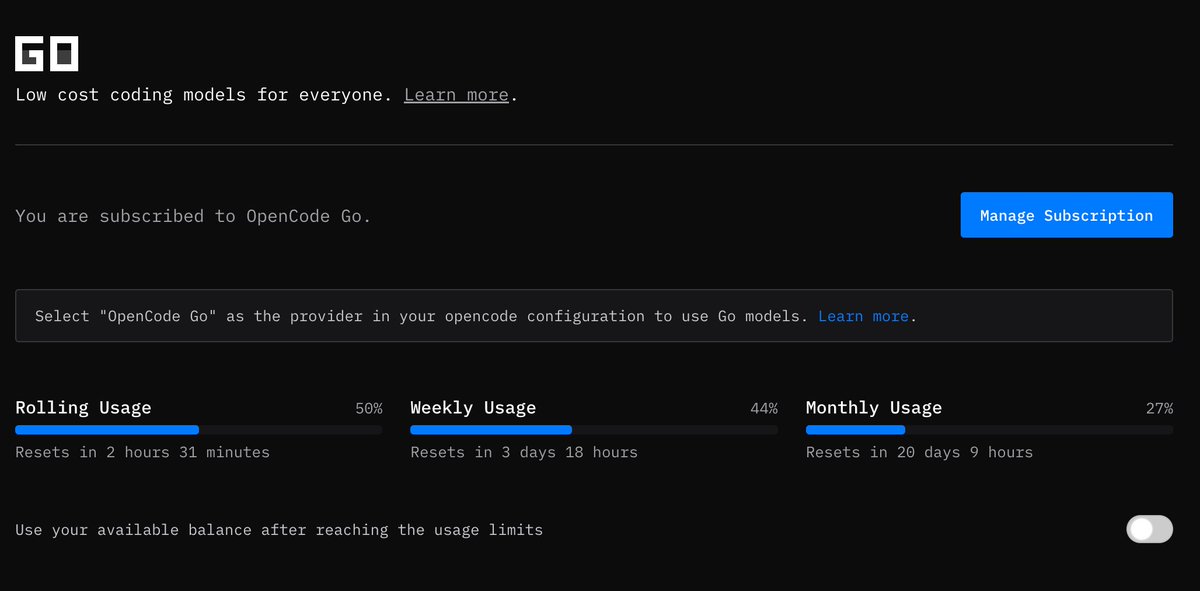
@DeepakNesss shared (2 likes, 116 views) an OpenCode Go usage dashboard: "I've been using OpenCode a lot over the last few days, and now I think I was wasting money on Claude Max earlier."
@0xEvinho announced (5 likes, 91 views): "finally canceled my Claude Max plan and went for Poe's subscription plan instead. Connected it to OpenCode and holy moly, there's a LOT of models to choose from -- Gemini 3.1, Gemma 4 31b, DeepSeek v3.2."
@riyazmd774 claimed (12 likes, 103 views, 13 bookmarks): "Kimi K2.6 is literally open source Opus4.7 but 7x cheaper." A reply from @E_s_h_a__ noted: "Lowkey scary how fast the gap is closing between these models."
Discussion insight: @justsisyphus quantified the cost case: "imagine you can develop a feature with gpt-5.5 and kimi k2.6 while debating each other just by $25 (opencode go + openai plus). You don't need claude code."
Comparison to prior day: On April 22, OpenCode was praised as "solid" at $10 with community enthusiasm. Today the migration narrative is more concrete: detailed daily costs, specific enterprise shipping rates, and cancelled Claude subscriptions.
1.5 GStack Turns Claude Code Into an AI Engineering Team 🡒
@ycombinator announced (39 likes, 1,576 views, 15 bookmarks) GStack, an open-source toolkit built by YC CEO Garry Tan: "GStack turns Claude Code into an AI engineering team -- with skills for office hours, design, code review, QA, and browser testing." The Office Hours skill is "modeled after real YC partner sessions that pressure-tests your idea before you write a line of code."
Discussion insight: @emonuxui observed: "Instead of one general agent, you get specialized roles that mirror how real teams operate." @katrin_fwa was skeptical: "This is just Claude with a fancier hat. Still won't ship faster than you."
Comparison to prior day: On April 22, the agent skills ecosystem was formalizing with Google Cloud and PixiJS publishing skills. Today, the YC CEO publishing a skills-based framework for Claude Code adds significant legitimacy to the pattern of skills-as-team-roles.
1.6 Google Antigravity: Security Threats Continue, Mindshare Flat 🡖
@ransomnews warned (3 likes, 179 views) of "zero-detection malware hidden in fake Google tool" -- trojanized Antigravity downloads that drop infostealers hijacking browser sessions and tokens.

@BenjaminDEKR continued the mindshare erosion thread (20 likes, 5,654 views): "Do you guys remember Google Antigravity." Replies ranged from @DumbEinstein ("it seems to lose any kind of advertising or promotion after a week or two") to @TravisMcDonald ("it's a vscode fork, but I still use it from time to time").
@nathanclark_ diagnosed the problem (24 likes, 1,792 views): "the Antigravity/Gemini CLI harness sucks so bad. It performs decently well in @droid... Google just needs to: 1. Align model, harness, UI in a cohesive manner 2. Squash the little dumb things the model does that erodes reliability."
Comparison to prior day: On April 22, Antigravity's story was a patched critical RCE flaw and trojanized downloads. Today the trojanized download story persists and the mindshare narrative ("do you guys remember") continues. The underlying issue remains: Google has capable models but poor harness integration.
1.7 GitHub Copilot Data Training Opt-Out Deadline Approaching 🡕
@jordanicruz shared (1 like, 22 views) a screenshot of a GitHub dashboard banner: "On April 24 we'll start using GitHub Copilot interaction data for AI model training unless you opt out."

This notice gives users until April 24 to review preferences in GitHub account settings. The original text is in Portuguese, indicating this notification is rolling out internationally.
Comparison to prior day: On April 22, the Copilot data story was about CLI telemetry tracking which AI agent drove each command. Today the scope expands to Copilot interaction data being used for model training, with an imminent opt-out deadline.
2. What Frustrates People
Codex Capacity Constraints During Peak Demand -- High
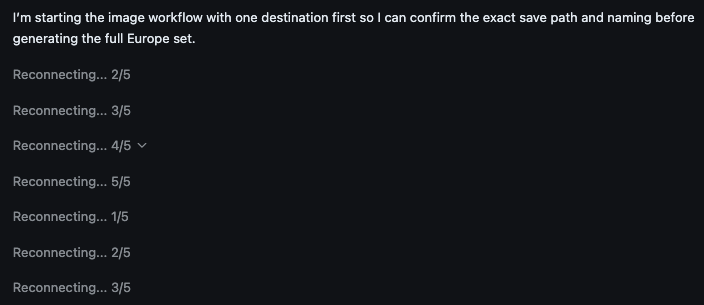
@CtrlAltDwayne documented (16 likes, 645 views) Codex connection issues: "Starting to notice an increase in Codex connection issues today. Makes me wonder if OpenAI are doing something on the compute side." The screenshot showed a loop of "Reconnecting... 2/5, 3/5" messages. @ZypherHQ proposed (29 likes, 4,057 views, 23 replies) a detailed solution: "During peak hours, enable a 'slow mode' that uses less inference." @MelansonIndus reported (0 likes, 144 views): "every ai model on github copilot are having issues."
GitHub Copilot Rate Limits Push Users Toward Higher Tiers -- Medium
@filip_a__ quantified (4 likes, 2,258 views) the pressure: "Github Copilot inside VS Code gives u 500 Sonnet requests per month which is roughly 16 per day for $10 a month. $40 a month plan gives u 1500 or around 50 requests per day. Usage limits for Claude Design are even worse." @HighKoalas acknowledged (8 likes, 1,344 views): "They nerfed it, but you still get a ton of sonnet access for $10 a month." @cmdcntr observed: "Everyone thinks GitHub Copilot is one clean subscription. It's becoming a billing hub for multiple AI providers."
Copilot Autocomplete Quality Stagnant -- Low
@WarrenInTheBuff asked (5 likes, 479 views): "Is it worth trying out github copilot again? Has it gotten any better?" Replies split sharply. @thepanta82 said: "It's slightly better than it was 3 years ago. Not good for agentic coding." @Shreyassanthu77 was blunt: "The API to access LLMs? Pretty decent. The autocomplete? Absolute trash." @devinbgoble offered a counter: "way less buggy than Claude code, and you get access to more models."
3. What People Wish Existed
Compute-Aware Scheduling for Agentic Workflows
@ZypherHQ described (29 likes, 4,057 views, 23 replies) a "slow mode" for Codex: reduced inference during peak hours (opt-in), with speed increases during quieter periods, plus a sleep-mode for overnight tasks. The 23 replies indicate this resonates. As token supply tightens across Copilot (signup pause) and Codex (reconnection loops), demand-side scheduling would help users optimize constrained compute budgets.
Stable, Outage-Immune Coding Agent Stack
@_toddanderson built a workaround (3 likes, 144 views, 6 bookmarks): OpenCode + Hermes Agent + open-source models at $5-7/day, specifically to avoid Claude Code outages. The demand is for resilient multi-provider setups that automatically failover between models and providers without workflow disruption. @MikeWithAHotDog expressed skepticism about vibe coding sustainability: "you spend 10x the time fixing the bugs and cleaning the workspace."
Cross-Harness Output Quality Comparison
@kylejeong demonstrated (15 likes, 584 views, 7 bookmarks) that the same model (Claude 4.6 Sonnet) produced significantly different outputs in Claude Code vs OpenCode: "cc ripped an ultra compact formatted HTML file, but opencode wrote a python script." This suggests a need for systematic harness comparison tooling that holds the model constant and evaluates output quality across different agents.
4. Tools and Methods in Use
| Tool | Category | Sentiment | Strengths | Limitations |
|---|---|---|---|---|
| OpenAI Codex + GPT-5.5 | Agent platform | (+) | 62/100 Senior Engineer benchmark (vs Opus 33/100); 3x faster per JetBrains; first model for complex refactors; Auto-review mode launched | Loses to Opus on plan quality and full-stack design; connection issues during launch day |
| GitHub Copilot | Cloud IDE agent | (+/-) | $10/mo still offers Sonnet access; Copilot Chat debugging improved; gh skill package manager shipped | Business signups paused; 500 Sonnet requests/mo on base tier; autocomplete quality stagnant; data training opt-out deadline April 24 |
| Claude Code | Terminal agent | (+/-) | 31 mentions in dataset; GStack adds team-role skills; kylejeong shows superior compact output | Usage limits and outages driving migration to OpenCode; ranked C-tier in community harness poll |
| OpenCode | Open-source terminal agent | (+) | $5-7/day for enterprise-grade output; diverse model roster (GLM 5.1, Kimi K2.6, MiMo V2); v1.14.21 adds LSP pull diagnostics for C#/Kotlin | Requires manual model configuration; Agent Vault integration still pending merge |
| Google Antigravity | IDE | (-) | Underlying Gemini models perform "decently well" per nathanclark_ | Trojanized downloads in the wild; harness/CLI UX criticized; continued mindshare erosion |
| Hermes Agent | Agent harness | (+) | Pairs with OpenCode for codebase-level analysis; works with open-source models via VPS | Requires separate setup; early-stage ecosystem |
| OpenCode Go | Model subscription | (+) | Low-cost access to Kimi K2.6, GLM-5.1, MiMo V2; rolling/weekly/monthly usage meters | Limited to OpenCode ecosystem; usage caps still apply |
5. What People Are Building
| Project | Who built it | What it does | Problem it solves | Stack | Stage | Links |
|---|---|---|---|---|---|---|
| GStack | @garrytan (YC CEO) | Turns Claude Code into AI engineering team with specialized skills | Single-agent lacks role specialization for office hours, design review, QA, browser testing | Claude Code, Agent Skills | Shipped (open-source) | Announcement |
| Agent Vault (OpenCode support) | @dangtony98 + chris-d-edwards | Credential proxy and security broker for AI agents | Agents handle credentials unsafely; no unified auth layer | Go, agent-vault CLI | PR merged (external contribution) | Post |
| Codex Auto-review | OpenAI | Enables longer autonomous Codex workflows with fewer manual approvals | Human approval bottleneck in agentic workflows | Codex | Shipped | Announcement |
| 7DOF Robot Arm | @soft_servo | URDF robot arm with kinematics, GUI, STEP parts, 100% generated in Codex | Manual robotics CAD/code integration takes weeks | Codex, GPT-5.5, URDF | Alpha (demo) | Post |
| Gameclaw | @learntouseai | Codex skill that turns sketches and sprites into playable browser game prototypes | Game prototyping requires manual Phaser/Matter setup | Codex, Phaser, Matter.js | Shipped | Post |
| OpenCode v1.14.21 | @OpenCodeLog | LSP pull diagnostics for C#/Kotlin, session compaction, Mistral Small reasoning | Missing language server support; token waste in sessions | OpenCode | Shipped | Changelog |
| gh skill | GitHub | Package manager for agent skills: search, install, pin, update | No standardized way to discover/manage agent skills | GitHub CLI v2.90.0 | Shipped | Post |
6. New and Notable
GPT-5.5 Represents a New Model Category: Fast, Friendly, and Agentic
GPT-5.5 is not just an incremental model upgrade. @danshipper reported it scored 62/100 on a Senior Engineer benchmark where Opus 4.7 scored 33/100, while also being "fast and friendly" enough to replace Claude for writing tasks. @chetaslua framed the broader shift: "Both are reportedly smarter pretrained models that rely less on extended reasoning chains. Efficiency and speed is the new intelligence." The combination of strong coding performance, general knowledge-work capability, and speed in a single model is new.
OpenCode x Tencent Hy3 Preview Free for 2 Weeks
@opencode announced (35 likes, 528 views) a partnership: "OpenCode x Tencent Hy3 Preview -- free for 2 weeks. Strongest in the Hy series: 256K context, reasoning, text only, 295B (A21B)." This is notable as a Chinese foundation model being offered free through a major open-source coding agent, expanding the accessible model ecosystem beyond US-based providers.
GitHub Copilot Chat Gets Structured Stack Trace Analysis
@GHchangelog shipped (11 likes, 1,285 views) improved debugging in Copilot Chat on the web. The feature now provides structured root-cause analysis: what failed and where, why it failed, most likely root cause with evidence from code references, a confidence level, and a suggested fix.
Harness Quality Matters More Than Model Choice
@kylejeong demonstrated (15 likes, 584 views) that Claude 4.6 Sonnet produced dramatically different outputs in Claude Code (ultra-compact HTML cheat sheet) versus OpenCode (Python script to format a summary). @FUCORY published a community harness ranking: S-Tier (Amp, Pi, Smithers), A-Tier (Conductor, OpenCode TUI, Warp), B-Tier (Codex, Antigravity), C-Tier (Claude Code, Gemini CLI, Cursor), D-Tier (Copilot, Windsurf). The pattern: harness implementation now differentiates more than the underlying model.
Model Routing Misinformation Corrected by Infrastructure Engineer
@thsottiaux pushed back (216 likes, 4,259 views) on claims that different clients get different model quality: "Not true. Please don't spread misinformation. The requests should all go to the same clusters irrespective of the client (pi, opencode, openclaw, w/e)." This was the second highest-engagement post of the day, indicating widespread concern about client-specific throttling.
7. Where the Opportunities Are
[+++] Multi-Provider Resilience Layer -- Codex had reconnection loops on launch day (@CtrlAltDwayne, screenshot). GitHub Copilot paused business signups (@GHchangelog, changelog). Claude Code outages drive users to OpenCode (@_toddanderson, workflow). A routing layer that automatically fails over between Codex, Claude Code, OpenCode Go, and open-source models -- maintaining session context across switches -- addresses the most acute infrastructure pain point as every major provider hits capacity constraints simultaneously.
[+++] Token Cost Optimization Across the Fragmented Stack -- GPT-5.5 is powerful but expensive. Open-source alternatives (Kimi K2.6, GLM 5.1) claim comparable quality at 7x lower cost (@riyazmd774, claim). @_toddanderson spends $5-7/day on OpenCode vs $200/mo on Claude. @filip_a__ calculated Copilot at ~16 Sonnet requests/day for $10. A tool that benchmarks actual task completion quality across providers at each price point, and routes tasks to the cheapest model that meets a quality threshold, serves a structural need as subsidies end.
[++] Agent Skills Ecosystem Infrastructure -- GStack (@garrytan) adds team-role skills for Claude Code. gh skill (GitHub CLI v2.90.0) adds a package manager for agent skills. This builds on April 22's Google Cloud and PixiJS skills launches. The skills format is gaining critical mass but still lacks discovery, version management, and cross-harness compatibility testing. A skills registry or marketplace would accelerate adoption.
[++] Agentic Workflow Scheduling and Throttling -- @ZypherHQ proposed (23 replies) peak/off-peak scheduling for Codex. Codex Auto-review enables longer autonomous runs. As agents operate for hours without supervision, tools for scheduling compute-intensive tasks during off-peak windows, batching non-urgent work, and managing concurrent agent sessions would help users maximize constrained token budgets.
[+] Agent Security and Credential Management -- Agent Vault merged OpenCode support, enabling credential brokering for AI agents. As users run agents against production systems with API keys and database access, the demand for secure credential isolation, audit logging, and permission scoping grows. This is early-stage infrastructure that becomes critical as autonomous workflows (Codex Auto-review) extend agent operating time.
8. Takeaways
-
GPT-5.5 "Spud" launched with the strongest practitioner benchmarks of any coding model to date. 62/100 on a Senior Engineer benchmark vs Opus 4.7 at 33/100, 3x faster per JetBrains, and the first model to handle complex multi-file refactors well. However, it still trails Opus on plan quality and full-stack design. (@danshipper, review; @jetbrains, speed claim)
-
Compute capacity constraints are now hitting every major AI coding provider simultaneously. GitHub paused Copilot Business signups. Codex showed reconnection loops on GPT-5.5 launch day. Claude Code outages continue to drive migration. The token shortage is no longer a single-provider problem. (@GHchangelog, announcement; @CtrlAltDwayne, screenshot)
-
Open-source models are producing enterprise-grade results at a fraction of frontier model costs. Multiple practitioners report shipping production features with Kimi K2.6, GLM 5.1, and MiMo V2 via OpenCode at $5-7/day vs $200/month for Claude Max. The cost gap is now 5-10x for comparable output. (@_toddanderson, workflow; @DeepakNesss, switch)
-
Harness quality now differentiates more than model choice. The same model produces dramatically different results across harnesses. A community tier list ranks OpenCode TUI and Conductor above Claude Code and Cursor. The implication: the agent framework matters as much as the underlying model. (@kylejeong, comparison; @FUCORY, rankings)
-
The agent skills ecosystem is consolidating around package management and team roles. GitHub shipped
gh skillas a cross-platform package manager. YC's Garry Tan open-sourced GStack with specialized team-role skills. The pattern is shifting from general-purpose agents to orchestrated teams of role-specific agents. (@jfversluis, gh skill; @ycombinator, GStack) -
GitHub Copilot's data training policy change creates an opt-out deadline. Starting April 24, GitHub will use Copilot interaction data for AI model training unless users explicitly opt out. Combined with the signup pause and billing changes, this accelerates the transition from subsidized tool to monetized platform. (@jordanicruz, screenshot)