Twitter AI Coding - 2026-04-27
1. What People Are Talking About
1.1 Billing Shock Hits Both Sides: $1,600 OpenAI Charges Mirror Yesterday's Anthropic Bug 🡕
@wickedguro posted (10 likes, 10 replies, 1,363 views) a bank statement showing over 100 OpenAI charges totaling $1,600 in two days. The team was on the $25 Codex plan but also had a credit card attached for API access. The CTO's heavy ChatGPT 5.5 usage silently billed per-request against the card rather than the subscription. "No email, no nothing. We were charged for $1600 in two days. Thanks. Make sure that if you have a Codex package, you don't allow them to charge you after the package finishes."

A reply from @heyitzami noted the same pattern on Cursor: "you keep seeing the 0.90 lines appearing." @wickedguro replied: "I guess it's a common dark pattern."
Meanwhile, @Theonlyhonest complained (2 likes, 4 replies) directly to Anthropic: "I love Claude Code, but Opus 4.7 has been terrible. It wastes 60% of my session tokens." @official_taches shared (12 likes, 187 views) a screenshot of 0% weekly usage remaining (resets Apr 29), noting: "I've been vibe coding long enough to remember a time when weekly limits didn't exist... I also remember a time when $20/m was enough."

@leetllm flagged (1 like, 2 replies) a structural shift: "GitHub Copilot is moving chat and agents to token-metered billing. Autocomplete stays unlimited, but your $10/mo now just buys $10 of compute credits. The flat-fee AI era is dying."
Discussion insight: April 26's HERMES.md billing bug was an Anthropic-specific incident. Today the billing-shock pattern generalizes across providers: OpenAI ($1,600 surprise), Anthropic (Opus 4.7 token waste), and GitHub Copilot (metered billing transition). The common thread is that subscription tiers create an illusion of cost containment that breaks down when agents run autonomously. Users discover the true cost only after the fact.
Comparison to prior day: On April 26, billing opacity was concentrated on Anthropic's HERMES.md routing bug. Today the frustration spreads to OpenAI and GitHub, transforming it from a single-vendor incident into an industry-wide pattern. The "flat-fee era is dying" framing from leetllm captures the structural shift.
1.2 OpenAI Open-Sources Symphony: From Supervising Agents to Managing Work 🡕
@alex_frantic quoted (8 likes, 222 views) the @OpenAIDevs announcement of Symphony, an open-source agent orchestrator for Codex: "Engineers at OpenAI experience the same problem as everyone else -- we can supervise about 3-5 coding agents. After that productivity drops. Codex is smart, but our attention is limited. So we built (and open sourced!) Symphony to remove that ceiling."
Symphony turns Linear boards into autonomous PR pipelines. Every ticket spawns a Codex agent; humans review completed PRs instead of supervising in-progress work. The GitHub repo includes an Elixir reference implementation under Apache 2.0 license. @ai_roundup reported (2 replies, 206 views) that internal teams saw a 500% productivity lift.
@scootykins offered (11 likes, 225 views) the comic counterpoint: "i just wanted to send an email and now im 3 billion tokens in and i cant send the stupid email because it keeps agentically running codex to build an email client from scratch thanks openai."
Discussion insight: Symphony represents OpenAI's explicit acknowledgment that agent supervision is the bottleneck, not agent capability. The 3-5 agent supervision limit is a concrete number from inside OpenAI, validating what practitioners have reported anecdotally. The scootykins complaint highlights the flip side: without task-scope constraints, agents over-engineer trivial tasks.
Comparison to prior day: On April 26, multi-agent orchestration appeared through indie tools (AgentsOS) and AWS's CLI Agent Orchestrator. Today OpenAI enters with its own orchestrator, signaling that the agent coordination layer is now a first-party concern for the major labs.
1.3 Google Antigravity: Tutorial Flood Continues, Adoption Questions Persist 🡒
@viktoroddy posted (1,169 likes, 51,387 views, 1,652 bookmarks) the day's highest-engagement item: an 18-minute tutorial on building animated websites with GPT Image 2 + Google Antigravity. @JulianGoldieSEO continued his daily course output with four separate Antigravity course posts ranging from 2 hours (61.3 score, 8 bookmarks) to 4 hours (318.6 score, 48 bookmarks). @Oluwaphilemon1 shared (25 likes, 1,856 views) a derivative tutorial combining Claude Design with GPT Image 2 and Antigravity.
Against this tutorial volume, practitioner adoption discourse remains thin. @mrnugx polled (66 likes, 53 replies) "Claude Code vs Google Antigravity" and noted "i use antigravity and no one barely talks about it." @AiTesty5 replied (14 likes, 1,506 views) to a Google DeepMind post: "Google tried with Antigravity (which is actually not a bad tool) but then screwed up with the usage limits."
@1littlecoder reiterated (53 likes, 1,965 views) the product fragmentation complaint: "tbh the problem is also too many products -- everytime i ask someone they have no clue which Google product i'm talking about Gemini - Web Gemini - App AI Studio Jules Gemini CLI Antigravity."
@ThePracticalDev shared (6 likes, 1,653 views) a dev.to article by Google Developer Expert @gbemiesho walking through an event-driven GCS-to-BigQuery pipeline built entirely in Antigravity's "Mission" paradigm. @DataChaz documented (6 likes, 844 views) a complete indie builder stack: Antigravity for coding, Supabase for data, Stack_Auth for auth, Vercel for shipping.
Discussion insight: Antigravity's paradox deepens: highest single-tweet engagement (51K views), abundant educational content, and a documented production stack -- yet the loudest practitioner signals are about usage limits and brand confusion. The dev.to article from a Google Developer Expert represents the first detailed agent-first architecture walkthrough for Antigravity, which may signal the beginning of serious technical documentation.
Comparison to prior day: On April 26, Antigravity faced the same three-front challenge: tutorial flood, adoption skepticism, and the trojanized installer threat. Today the pattern holds steady (hence the 🡒 trend arrow), but the GDE-authored technical article and DataChaz's production stack add new substance.
1.4 The "$20 Tool" Decision and the Open-Source Escape Route 🡕
@AnshikaK7 posted (18 likes, 11 replies, 256 views) the now-familiar question: "If u have to invest $20, which one should u choose? - Claude - Codex - Cursor - Antigravity - GitHub Copilot." This is the third day running where identical polls appear independently.
The escape route gaining traction is open-source stacks. @helicerat0x detailed (11 likes, 8 bookmarks) how to cancel all AI subscriptions and replace them with four repos: CUA (sandboxed desktop for Claude Code), Claude Squad v1.0.17 (parallel instances in tmux), Claude Subconscious (background memory agent), and microsandbox v0.3.14 (local microVMs with sub-200ms boot). "I was paying $500+ a month. now i pay $0."

@jmbollenbacher stated (29 likes, 1,720 views): "im migrating toward open weights models at this point honestly theyre finally getting smart enough, and i wont have to deal with this kind of fuckery anymore. codex works with other model providers (incl. local) if you fiddle with the configs, and there's always opencode and pi."
@JulianGoldieSEO demonstrated (4 likes, 4 bookmarks) a free setup: Ollama cloud + DeepSeek V4 + Codex terminal. @ollama announced (17 likes, 3,519 views) one-command DeepSeek V4 Pro support for Codex, OpenClaw, and OpenCode.
@tarat_211 discovered (2 likes, 35 views) OpenCode Go pricing: "literally dirt cheap, and those models have gotten pretty good at ui stuff. I'd say most of those models are near, if not better than sonnet-level intelligence for basically free of cost!!" The pricing page shows DeepSeek V4 Flash at 7,450 requests per 5 hours and Qwen3.5 Plus at 10,200 requests per 5 hours on the $10/month Go plan.
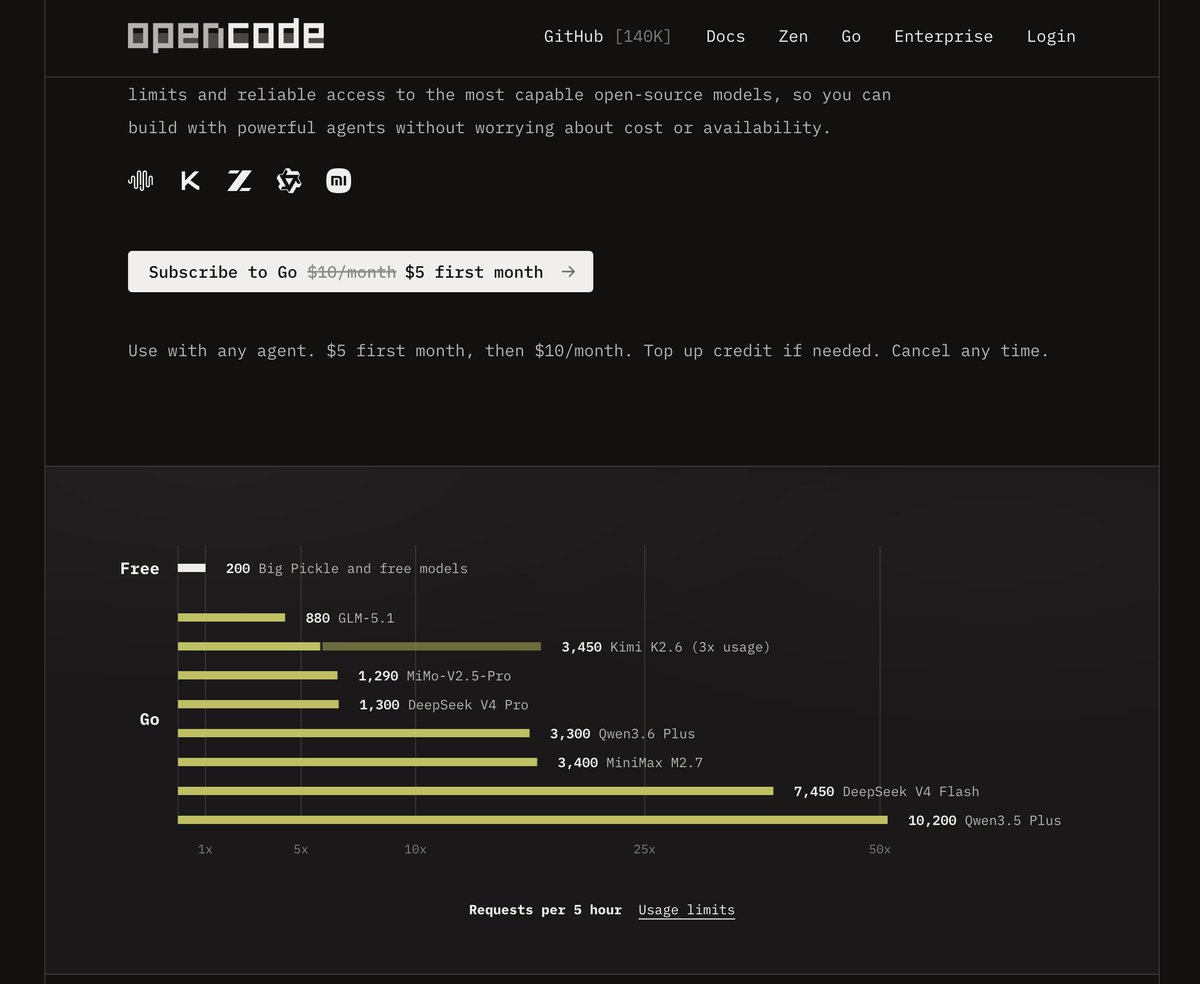
Discussion insight: The "$20 tool" decision is now three days old and hardening into the market's central question. But the answer is shifting: instead of choosing one provider, power users are building zero-cost local stacks or leveraging open-source model access through OpenCode Go. The helicerat0x stack ($500/month to $0) and jmbollenbacher's "open weights are finally smart enough" represent an inflection point in the value proposition of closed providers.
Comparison to prior day: On April 26, the $20 question was driven by two identical independent polls. Today it appears again (AnshikaK7), but the discourse has shifted from "which one" to "maybe none of them" -- the open-source escape route is now articulated with concrete setups.
1.5 OpenAI's Model Cadence and GPT-5.5 Ecosystem Expansion 🡕
@haider1 documented (93 likes, 3,043 views) OpenAI's monthly release cadence: "nov: gpt-5.1 dec: gpt-5.2 feb: gpt-5.3-codex mar: gpt-5.4 apr: gpt-5.5 with each version, the jump is bigger, with more intelligence, and more token-efficient." A reply from @curtismakes observed: "the cadence matters more than any single release. a lab shipping monthly improvements compounds way faster than a lab shipping a generational leap once a year."
@realsigridjin broke down (7 likes, 582 views) the infrastructure economics: NVIDIA's GB200 NVL72 gives OpenAI a 35x reduction in token cost, quoting @NVIDIAAP. Over 10,000 NVIDIA employees now have GPT-5.5 Codex access. "Cheaper tokens make longer reasoning possible. Longer reasoning makes better agents possible."
@MaziyarPanahi described (6 likes, 329 views) a new open-source stack: "Open weights from OpenAI + Nemotron training data + Codex pair-programming = the new open-source stack. Codex (GPT-5.5) is helping me with training pipeline, MLX convert via OpenMedKit, and packaging the model for Hugging Face."
@manishkumar_dev noted (4 likes, 99 views) HyperFrames becoming an official Codex plugin with one-click install, turning Codex into a video workspace from code to final render via HeyGen integration.
Discussion insight: OpenAI's monthly release cadence is creating a compounding advantage that rivals struggle to match. The 35x token cost reduction via NVIDIA hardware makes agentic workloads economically viable at enterprise scale. The HyperFrames plugin signals Codex evolving from a coding tool into a broader creative platform.
Comparison to prior day: On April 26, GPT-5.5 was discussed through scale metrics (4M weekly users) and capability assessments. Today the focus shifts to infrastructure economics (35x cost reduction) and ecosystem expansion (HyperFrames plugin, open-weight training stacks). The narrative deepens from "it's good" to "the economics enable things that weren't possible."
1.6 Vibe Coding Backlash Sharpens Into Consensus 🡒
@GaryMarcus argued (32 likes, 2,761 views): "vibe coding without considerable experience is like driving without a license." He was responding to a quote about blaming AI for destroying data, pushing back on the narrative that user error alone explains catastrophic failures. A reply from @BlackHackOfDoom (10 likes, 1,373 views) captured the tension: "AI influencers here and everywhere are screaming you shouldn't get hired if you don't use agentic AI... and the moment something goes wrong it's your fault because you didn't understand the tool?"
@_devJNS wrote (4 likes, 60 views): "the hype around 'vibe coding' is starting to fade. in 2026, we're realizing that letting ai write most of your code isn't really efficiency, it's just faster technical debt... developers are spending more time fixing ai code than writing their own."
@beffjezos quoted (21 likes, 2,166 views) Even Realities' Terminal Mode (coding terminal on AR glasses) with ironic enthusiasm: "You may not like it, but this is what peak performance looks like. Vibe coding everywhere, straight to your eyeballs. Mad lads actually did it."
@bryanbrinkman offered (4 likes, 92 views) a positive counterpoint: a ThreeJS project "kicking around for over a year, but didn't have a way to build until recent coding tools allowed me to do it myself."
Discussion insight: The vibe coding skills-required position from April 26 has hardened further. GaryMarcus's framing ("driving without a license") and BlackHackOfDoom's retort about the hypocrisy of influencer-driven pressure add a political dimension. The Even Realities Terminal Mode (AR glasses for coding) represents either the logical extreme or the absurdist peak of the vibe coding movement, depending on perspective.
Comparison to prior day: On April 26, the debate was between "requires skills" and "democratization." Today the skills-required camp has consolidated, with GaryMarcus adding the safety framing. The pro-vibe-coding side now shows through creative-project enablement (bryanbrinkman's ThreeJS) rather than productivity claims.
1.7 Claude Code UX Improvements and Plugin Ecosystem Growth 🡕
@doodlestein praised (6 likes, 450 views) Anthropic for implementing their feature requests: "Credit where credit is due, they finally did make all the changes I asked for here. They started printing the session ID when you quit Claude Code. And you only need to run /login in one active session to swap accounts now and other in-flight sessions will automatically use it." The quoted original request detailed the pain of managing dozens of Claude Code sessions across multiple accounts.
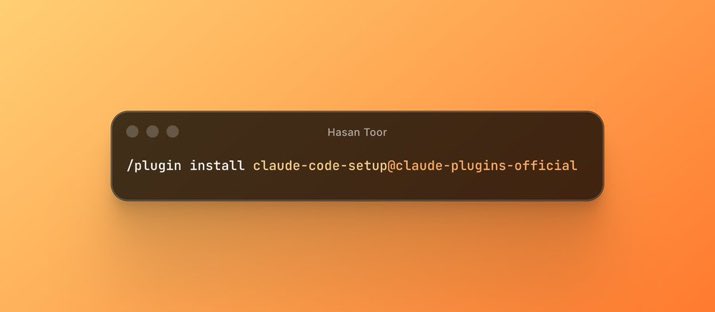
@codi_fyy promoted (4 likes, 2 replies) the official Anthropic plugin claude-code-setup: "It scans your entire project and tells you exactly what to activate -- which hooks to set up, which skills to install." Install command: /plugin install claude-code-setup@claude-plugins-official.
@TeutaAi shared (5 replies) an MCP Template Spine approach: a standardized .mcp.json config that makes every new MCP server look the same. "the win was not more power. it was a config spine that made every new server look the same on day one."

@chenzeling4 noted (1 like, 58 views) GSAP Skills trending on GitHub: official AI skills teaching coding agents correct GSAP animation usage across React, Vue, and Svelte, with all plugins now free for commercial use.
Discussion insight: The Claude Code ecosystem is maturing on three fronts simultaneously: UX polish (session ID, multi-session auth), official tooling (claude-code-setup plugin), and community standardization (MCP Template Spine). GSAP Skills represents a new category: library vendors publishing AI-agent-specific skills to ensure correct usage.
Comparison to prior day: On April 26, Claude Code ecosystem discussion centered on the Templates marketplace (102 agents, 4.5K stars). Today it advances to official Anthropic plugins and standardized configuration patterns, suggesting the ecosystem is moving from community-driven to vendor-supported.
2. What Frustrates People
Unexpected API Charges Across Providers -- High
@wickedguro reported (10 likes, 1,363 views) $1,600 in surprise OpenAI charges from their Codex $25 plan, discovered as 100+ line items on a bank statement. No email notifications were sent. This mirrors yesterday's HERMES.md billing bug at Anthropic, establishing a cross-vendor pattern: subscription tiers do not protect against runaway API charges when agents operate autonomously or when team members use adjacent products.
Opus 4.7 Token Inefficiency -- Medium
@Theonlyhonest complained (2 likes, 4 replies) that Claude Opus 4.7 "wastes 60% of my session tokens," threatening to cancel. @official_taches showed (12 likes) 0% weekly usage remaining two days before reset. The combination of token inefficiency and hard weekly limits means paying users hit walls before accomplishing their goals.
GitHub Copilot Billing and Rate Limit Confusion -- Medium
@blue_sweater reported (1 like, 4 replies) that an annual Copilot Pro+ subscription resulted in duplicate billing and access downgraded to Free with no support response. @neon_time showed (3 likes, 80 views) a Copilot rate limit error after completing work but failing to push: "You've hit your rate limit. Please wait 4 hours 27 minutes." @mobiledev_pro noted (102 views) that GitHub removed Claude Opus from the Pro plan without notice, moving it to Pro+ only.

Google Antigravity Usage Limits -- Low
@AiTesty5 stated (14 likes, 1,506 views): "Google tried with Antigravity (which is actually not a bad tool) but then screwed up with the usage limits." The tool quality is acknowledged but access reliability undermines it.
3. What People Wish Existed
Automatic Billing Alerts and Spend Caps for AI Coding Tools
The $1,600 OpenAI surprise from @wickedguro (post) and yesterday's $200 Anthropic HERMES.md bug demonstrate that current billing systems lack basic consumer protections. Users need per-session spend caps, real-time cost notifications, and explicit opt-in before API charges exceed subscription coverage. No provider currently offers this.
Urgency: High. Opportunity: [+++] -- Affects every provider; first to implement gains trust advantage.
Agent Task-Scope Constraints
@scootykins illustrated (11 likes) the problem: Codex consumed 3 billion tokens trying to build an email client from scratch instead of sending an email. Agents lack the ability to recognize when a task is trivial and should not be over-engineered. A "task scope" parameter or automatic complexity assessment would prevent runaway agent loops.
Urgency: Medium. Opportunity: [++] -- Grows more urgent as agent autonomy increases.
Standardized Cross-Provider Model Access Configuration
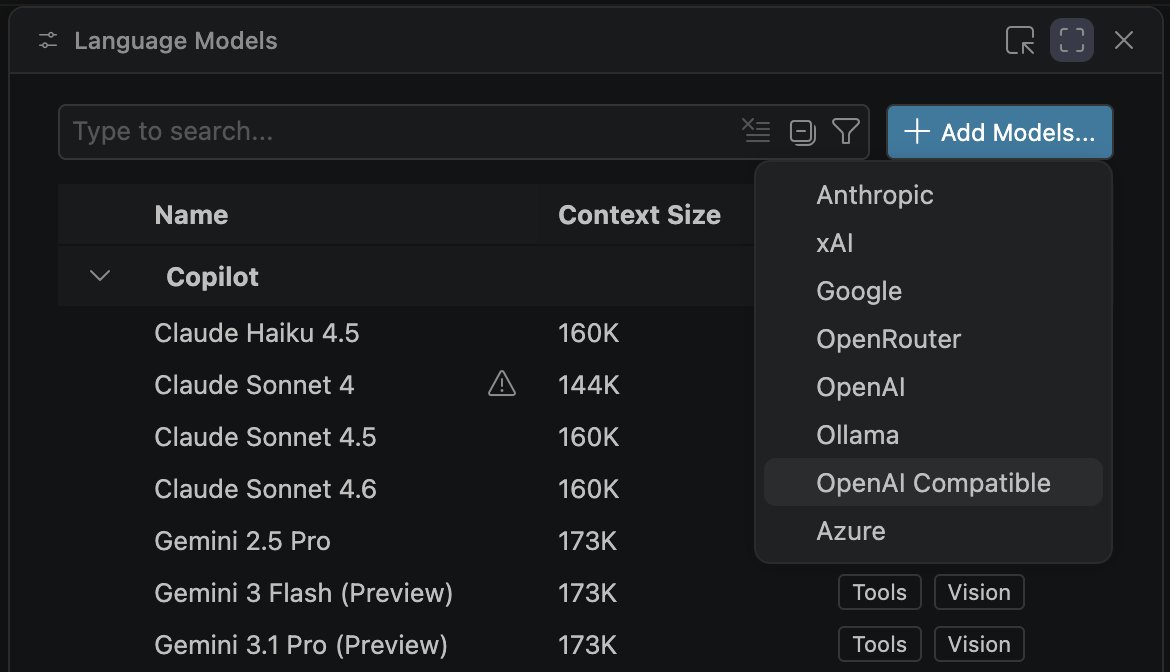
@JuhaniPelli showed (4 likes, 921 views) how to add third-party models to GitHub Copilot via OpenAI Compatible endpoints. @javier_dev traced (1 like, 102 views) a migration path through six different tools. Users want a single configuration that works across harnesses -- connecting to any model provider without per-tool reconfiguration.
Urgency: Medium. Opportunity: [++] -- The multi-provider reality demands a standard.
4. What People Are Building
| Project | Builder | What it does | Stack | Stage | Links |
|---|---|---|---|---|---|
| Symphony | @alex_frantic / OpenAI | Turns Linear boards into autonomous PR machines; spawns one Codex agent per ticket | Codex, Elixir, Linear | Shipped | Post, GitHub |
| Graphify | @Dinosn / safishamsi | Converts folders of code, docs, papers, videos into queryable knowledge graph | Claude Code, Codex, OpenCode, tree-sitter, 25 languages | Shipped | Post, GitHub |
| Odylith v0.1.11 | @odylith_ai | Governed execution for coding agents; turns repo truth into execution constraints | Open source, repo-native | Alpha | Post, Site |
| OpenCode Cafe | @ryanvogel | Community marketplace for OpenCode extensions: 41 plugins, 7 tools, 2 MCP servers | OpenCode | Beta | Post, Site |
| HyperFrames Codex Plugin | @manishkumar_dev / HeyGen | One-click video workspace inside Codex: code to render to ship | Codex, HeyGen | Shipped | Post |
| Ad Creative Pipeline | @demirdjiantwins | Brand name + URL produces 100+ production-ready ads via Claude Code | Claude Code, Linah AI, Nano Banana | Shipped | Post |
| PasteGuard | @VivekIntel | Masks API keys, emails, PII before pasting to AI tools; runs locally via Docker | Docker, 30+ data type detectors | Shipped | Post |
| Local Claude Code Stack | @helicerat0x | Zero-cost local Claude Code setup replacing $500+/month subscriptions | CUA, Claude Squad, Claude Subconscious, microsandbox | Shipped | Post |
| Knowledge Graph Obsidian | @polydao | Topological data analysis of X history rendered as living knowledge graph | Claude Code | Alpha | Post |
Symphony is the standout: OpenAI's own admission that humans cannot supervise more than 3-5 agents, combined with an open-source solution, marks a shift from agent capability to agent coordination as the primary engineering challenge.
5. Tools and Methods in Use
| Tool | Category | Sentiment | Strengths | Limitations |
|---|---|---|---|---|
| OpenAI Codex + GPT-5.5 | Agent platform | (+) | Symphony orchestrator open-sourced; HyperFrames plugin; 35x token cost reduction via NVIDIA; monthly model cadence | $1,600 surprise charges (wickedguro); over-engineers trivial tasks (scootykins); no spend caps |
| Claude Code | Terminal agent | (+/-) | Session ID on quit; multi-session /login; claude-code-setup plugin; MCP Template Spine | Opus 4.7 wastes 60% tokens (Theonlyhonest); 0% weekly usage (official_taches); ongoing billing opacity |
| Google Antigravity | IDE | (+/-) | Highest single-tweet engagement (51K views); GDE technical article; DataChaz production stack | Usage limits frustrate users (AiTesty5); product naming confusion (1littlecoder); adoption discourse thin |
| GitHub Copilot | Cloud IDE agent | (-) | 3rd party model integration (8 providers); Claude/Gemini models available | Duplicate billing (blue_sweater); rate limits mid-push (neon_time); Opus moved to Pro+ without notice; metered billing transition |
| OpenCode / OpenCode Go | Open-source agent | (+) | $10/month Go plan; 10,200 req/5hr Qwen3.5 Plus; OpenCode Cafe marketplace; flagship Chinese models | sapientwilight reports checkpointing bugs; community-maintained |
| Ollama | Local model server | (+) | One-command DeepSeek V4 Pro launch for Codex, OpenClaw, OpenCode | Requires local hardware |
| GSAP Skills | Agent skill | (+) | Official AI skills for animation; all plugins free for commercial use | Single-library scope |
6. New and Notable
OpenAI Launches GPT-5.5 Bio Bug Bounty
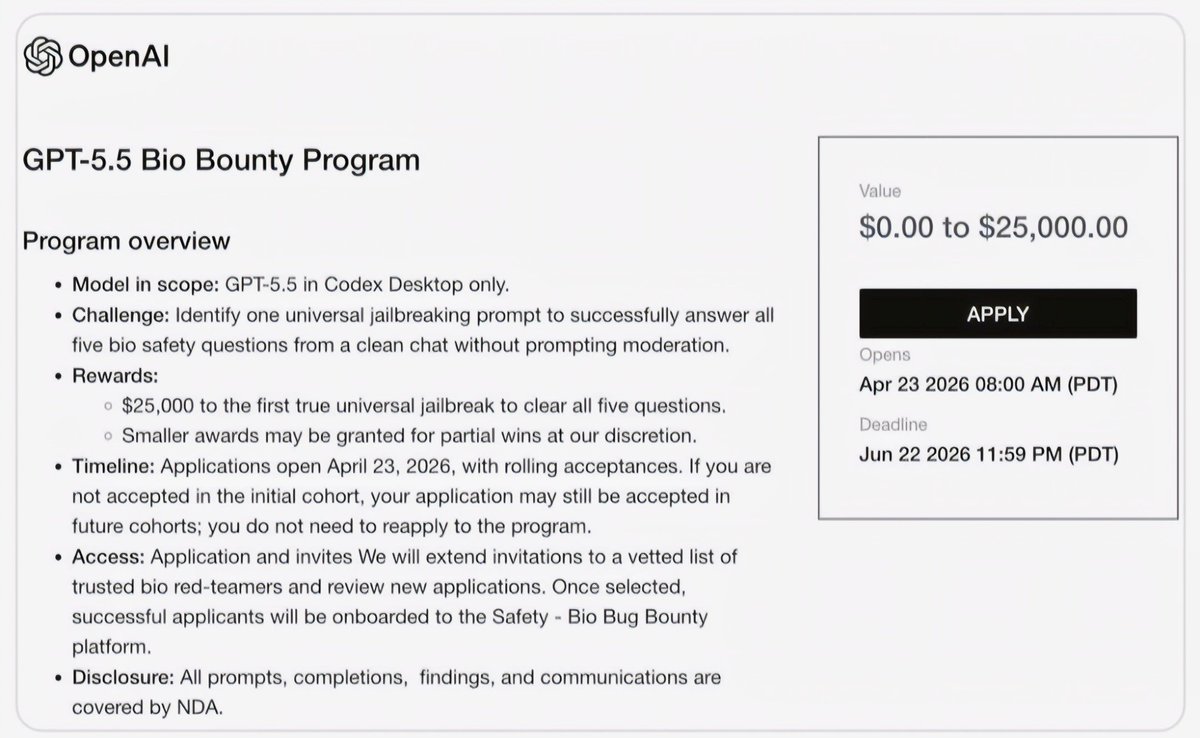
@VivekIntel shared (2 likes, 192 views) the GPT-5.5 Bio Bug Bounty program details. The target is GPT-5.5 in Codex Desktop only. The challenge: identify one universal jailbreak prompt that bypasses all five bio safety questions from a clean chat. Reward: $25,000 for the first successful universal jailbreak. Applications opened April 23, 2026, with a June 22 deadline. All findings are under NDA.
OpenAI Chronicle: Screen Memory for Codex
@AIHighlight detailed (70 likes, 6,126 views) OpenAI's Chronicle feature -- a screen memory system for Codex. It watches on-screen activity across apps and builds task lists, daily reports, and work timelines. Unlike the competing AirJelly (free Mac download, fully local), Chronicle integrates directly into the Codex ecosystem but stops at context capture rather than autonomous action.
Singapore Foreign Minister's Open-Source "Second Brain"
@DrewPavlou quoted (3 likes, 765 views) a detailed account of Singapore Foreign Minister Dr. Vivian Balakrishnan publishing his personal AI architecture -- "NanoClaw, a second brain for a diplomat" -- as a public GitHub gist. The system runs on an 80-pound mini-computer, maintains a knowledge graph of negotiating history, transcribes voice notes locally, and runs vector embeddings on-device. Hardware cost: approximately 80 pounds; running costs: 5-20 pounds per month. DrewPavlou used Claude Code to build a similar tool for drafting political speeches against 900,000 words of his own writing.
Coding Terminal on AR Glasses
@beffjezos quoted (21 likes, 2,166 views) Even Realities' announcement of Terminal Mode -- a coding terminal viewable through AR glasses. "Vibe coding everywhere, straight to your eyeballs."
7. Where the Opportunities Are
[+++] Billing Transparency and Spend Protection -- The $1,600 OpenAI surprise from wickedguro, yesterday's $200 Anthropic HERMES.md bug, and Copilot's billing confusion from blue_sweater all point to the same gap: no AI coding tool offers real-time cost visibility, spend caps, or automatic notifications when charges exceed subscription coverage. This is now a cross-provider problem affecting all three major ecosystems. The first tool to ship "never be surprised by a bill" wins user trust at scale.
[+++] Agent Orchestration Layer -- OpenAI's Symphony and yesterday's CLI Agent Orchestrator from AWS both address the 3-5 agent supervision bottleneck. The OpenCode Cafe marketplace (41 plugins, 7 tools) and the Claude Code plugin ecosystem show the coordination layer fragmenting across providers. The platform that unifies agent dispatch, cost tracking, and work review across Codex, Claude Code, and OpenCode captures the emerging multi-agent workflow.
[++] Local-First AI Coding Stacks -- helicerat0x's $500-to-$0 local stack, jmbollenbacher's "open weights are finally smart enough," and Ollama's one-command agent launch for DeepSeek V4 Pro all signal that local-first is crossing from ideology to practicality. The billing shocks accelerate this migration.
[++] Library-Specific AI Agent Skills -- GSAP Skills (trending on GitHub) represents a new category: library vendors publishing official skills that teach AI agents correct usage patterns. As AI-generated code quality depends on the agent knowing framework conventions, every major library has incentive to publish its own skills. First-mover advantage exists for the skill registry that aggregates these.
[+] Governed Agent Execution -- Odylith positions itself as "governed execution for coding agents" -- stopping agents from confidently doing the wrong thing by turning repo truth into constraints. As agents grow more autonomous (Symphony auto-PRs, Codex over-engineering emails), the need for execution governance grows proportionally.
8. Takeaways
-
Billing shock is now an industry-wide pattern, not a single-vendor bug. @wickedguro's $1,600 OpenAI surprise, following yesterday's $200 Anthropic HERMES.md incident, establishes that no major provider offers adequate billing protection for agentic workloads. The structural problem: subscription tiers create an illusion of cost containment that breaks down when agents or team members trigger API-rate charges. Until providers ship spend caps and real-time alerts, users bear asymmetric risk.
-
OpenAI admits the agent supervision bottleneck and ships its answer. @alex_frantic from OpenAI stated engineers can supervise 3-5 coding agents before productivity drops. Symphony, their open-source orchestrator, turns Linear boards into autonomous PR machines. Combined with yesterday's CLI Agent Orchestrator from AWS, multi-agent coordination is now a first-party concern for the major labs.
-
The open-source escape from subscription costs has crossed from ideology to concrete stacks. @helicerat0x documented replacing $500+/month in subscriptions with four open-source repos. @jmbollenbacher declared open-weight models "finally smart enough." @ollama shipped one-command DeepSeek V4 Pro support for three major agent platforms. The billing shocks from Anthropic and OpenAI are accelerating migration.
-
GPT-5.5's monthly cadence and 35x cost reduction via NVIDIA hardware create a compounding advantage. @haider1's monthly release timeline (93 likes) and @realsigridjin's infrastructure economics breakdown explain why OpenAI is pulling ahead: cheaper tokens enable longer reasoning, which enables better agents, which enables enterprise adoption at scale.
-
Google Antigravity maintains the highest raw engagement but the weakest adoption signal. @viktoroddy's tutorial hit 51K views and 1,652 bookmarks, yet practitioner discourse remains limited to "no one barely talks about it" and usage-limit complaints. The gap between tutorial consumption and production adoption has persisted for three consecutive days.
-
The "flat-fee AI era is dying" and users are noticing. GitHub Copilot's shift to token-metered billing, combined with usage limits hitting 0% mid-week and $20/month no longer covering real workloads, signals a permanent pricing shift. The AI coding tool market is transitioning from subscription to consumption, and the tools that make consumption predictable will retain users.