Twitter AI Coding - 2026-04-28
1. What People Are Talking About
1.1 The Free Token Era Ends: Usage-Based Billing Sweeps All Providers 🡕
@sdrzn posted (26 likes, 8 replies, 3,401 views) a side-by-side showing Anthropic removing Claude Code from Pro and GitHub Copilot switching to usage-based billing with a 6x multiplier for GPT and 27x for Opus: "the era of free tokens is ending." A reply from @ninedp asked whether this was a capacity issue; @sdrzn responded: "nope, i think its supply and demand. we're all officially dependent on tokens and they know it." @superscribeio raised a practical concern: "which gets ugly first once free tokens end, the model bill or explaining which agent run was actually billable to the client."
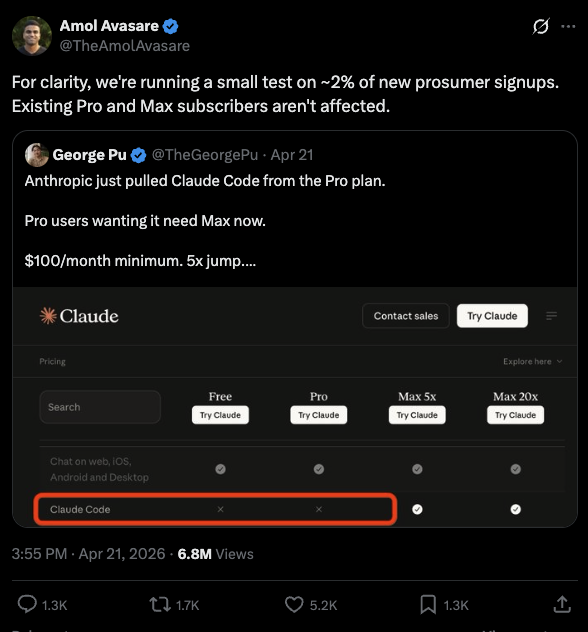
@SamanthaLaDuc quoted (13 likes, 1,413 views) Ed Zitron's analysis: "Microsoft is arguably the best-capitalized, most-profitable, and best-positioned company to continue subsidizing compute, and if it can't afford to do so further, nobody else can either." A reply from @friendsofwealth predicted: "sub fee will become annual not monthly. People will soon protest however on the ugly consumption of tokens."
@buildwithsid listed (10 likes, 221 views) GitHub Copilot's cascading changes: "removed claude models for students, added rate limits everywhere, made models wayy more expensive, then switched to usage based pricing -- like who tf will even use this now?"

@poezhao0605 observed (2 likes, 314 views): "Agent workloads broke the flat-rate subscription model. Every major AI coding platform hit the same wall this month." @OjasSharma276 added (11 likes): "people are basically going to burn through their tokens on the first day itself."
Discussion insight: The billing conversation has evolved from yesterday's single-vendor shock ($1,600 OpenAI surprise) into a structural thesis: flat-rate AI coding subscriptions are economically unsustainable. The sdrzn framing -- "supply and demand" rather than capacity constraints -- positions this as a deliberate pricing strategy, not a temporary limitation. The superscribeio reply surfaces a second-order problem: freelancers and agencies cannot pass through opaque per-token costs to clients.
Comparison to prior day: On April 27, billing shock centered on individual horror stories (wickedguro's $1,600 bill, Anthropic's HERMES.md bug). Today the discourse consolidates into an industry-wide structural narrative. The SamanthaLaDuc/Zitron thesis -- "if Microsoft can't subsidize, nobody can" -- marks the shift from anecdote to analysis.
1.2 OpenCode Emerges as the Multi-Model Escape Hatch 🡕
@enunomaduro posted (12 likes, 2,370 views): "going back to @opencode cli -- it was a mistake to couple myself with claude code cli since i can only use claude models there and now, since i'm not happy with claude code opus 4.7, my workflows are kind of stuck." In a follow-up (7 likes, 1,520 views), he asked the community what models they use with OpenCode. @taylorotwell replied: "GPT 5.5, Kimi 2.6." @wendell_adriel added: "I'm almost switching to GPT-5.5 as my main model, TBH. Not liking a lot how Opus is doing lately." @nazmulpcc detailed: "Kimi 2.6 and Deepseek v4 flash mainly. I find Kimi 2.6 to be more intelligent."
@StefanTMD quote-tweeted (18 likes, 511 views) Sam Altman's "codex with the $20 plan is a really good deal" with a pointed correction: "opencode with the $10 plan is a really good deal."
@manojlds shared (1 like, 58 views) a model rotation pattern: "I am not liking GPT-5.5. Back to 5.3-Codex and Opus-4.7 for me. Apart from Kimi K2.6 via OpenCode Go."
@neural_avb explained (2 likes, 304 views) the technical economics: OpenCode maintains input prefixes across tool calls so DeepSeek's server can look up KV cache instead of recomputing. "If opencode changed anything in the prompt, cache will break and we will have to pay more money."
Discussion insight: OpenCode's value proposition has shifted from "cheaper alternative" to "vendor independence." The enunomaduro thread is significant because it shows a developer with a large following (Laravel creator Taylor Otwell replies) publicly migrating away from Claude Code's model lock-in. The neural_avb explanation of KV cache economics reveals why OpenCode's architecture produces real cost savings beyond just cheaper model access.
Comparison to prior day: On April 27, the open-source escape route was discussed through helicerat0x's local stack and Ollama's DeepSeek V4 support. Today the narrative sharpens specifically around OpenCode as the practical alternative, with concrete model recommendations and infrastructure economics.
1.3 Codex Masterclass and the OpenAI Content Machine 🡕
@gregisenberg posted (254 likes, 22,541 views, 470 bookmarks) a 64-minute OpenAI Codex masterclass -- the day's highest-scoring item by far (score: 2,710.2). The curriculum covers running Claude Code inside Codex, creating reusable skills, connecting Notion with surgical permissions, using Remotion for video creation, and one-shotting mobile apps in Swift. A reply from @BrandGrowthOS captured the surprise: "wait, you can run claude inside codex now? that's wild. been stuck choosing between anthropic's reasoning and cursor's editor."
@WesRoth shared (15 likes, 2,360 views) details on OpenAI's Symphony orchestrator, which integrates with task trackers to automatically assign Codex agents to open tickets. @startupideaspod framed (1 like, 123 views) Codex as the "super app" of AI tools, arguing it combines vibe coding and knowledge work in one place while competitors silo them.
@tuncerdeniz replied (11 likes, 2,759 views) to Jim Cramer: "In the last 3 months our company is spending more on Codex than ever before. 10x more. They are on fire." @manosaie pushed back (7 likes, 632 views) against Anthropic dismissiveness: "Codex is a well made product that's only getting better, 5.5 is fast and smart."
Discussion insight: The gregisenberg masterclass represents the maturation of Codex's educational ecosystem -- a single 64-minute episode covering eight distinct capabilities signals the product has enough surface area to warrant comprehensive courses. The "Claude inside Codex" capability particularly resonated, suggesting users want Anthropic's models without Anthropic's pricing constraints.
Comparison to prior day: On April 27, Symphony's launch and GPT-5.5's monthly cadence dominated the OpenAI narrative. Today the focus shifts to education and adoption, with gregisenberg's masterclass outscoring everything else in the dataset by 5x.
1.4 Google Antigravity: Tutorial Volume Persists, Cracks Appear 🡒
@JulianGoldieSEO continued his daily output with four Antigravity course posts: a 4-hour course (74 likes, 2,315 views, 77 bookmarks), a repost (23 likes, 913 views), a 2-hour version (266 views), and a third variant (388 views). @Oluwaphilemon1 shared (27 likes, 1,982 views) a tutorial combining GPT Image 2 + Antigravity for animated websites.
@xdadevelopers published (15 likes, 2,195 views) a month-long comparison: "I tried VS Code, Google Antigravity, and Claude Code for a month and one clearly dominated."
Against this content volume, reliability concerns surfaced. @tombos21 reported (8 likes, 2,584 views): "There's something freaky going on with LLMs today. In the last 24 hours: Claude is completely down. Gemini API users were force-downgraded from Tier 3 to Tier 1. Google Antigravity crashing out. Microsoft services seeing widespread outages." @AiTesty5 reiterated (15 likes, 1,607 views): "Google tried with Antigravity (which is actually not a bad tool) but then screwed up with the usage limits."
@CisoRaging77913 raised (1 like, 23 views) a security concern: "hidden prompt in comments leads to agent reads, then local code execution. Data treated as orders. Agent with filesystem, build tools, no human check."
Discussion insight: Antigravity's pattern from the past three days holds: high tutorial volume, measurable engagement, but reliability complaints and security concerns undercut adoption narratives. The tombos21 multi-platform outage report contextualizes Antigravity's instability as part of a broader infrastructure stress event rather than an isolated issue.
Comparison to prior day: On April 27, Antigravity had the highest single-tweet engagement (51K views from viktoroddy) and a GDE-authored technical article. Today the tutorial machine continues (JulianGoldieSEO is relentless) but the outage reports and security concerns add new friction. The trend remains steady.
1.5 Vibe Coding: Addictive, Divisive, and Entering the Security Conversation 🡒
@CyrusAbrahimX posted (122 likes, 3,854 views): "If you do something today, try Claude. I find myself vibe coding hours every day." @shiri_shh offered (7 likes, 202 views) the counter-thesis: "Vibe coding gives you the feeling of progress without the pain of real work -- that's why it's addictive."
@MatthewBerman observed (9 likes, 528 views) negative sentiment building: "I took the 'joy of coding is dead' as negative sentiment towards AI coding... because it is. I've watched a bunch of your clips and many are pointing out the negative side of AI coding. The vibe is often negative."
@9to5mac published (8 likes, 2,955 views) an Apple @ Work podcast episode: "Securing mobile apps in the age of vibe coding." @AntiD2ta argued (2 replies): "You will find success in vibe coding an app that runs in production if you can be a PM, QA, and a senior software engineer all at once. The engineering principles and the product fundamentals remain the same."
@Ronycoder recommended (3 likes, 180 views) a 30-minute speech by the Head of Anthropic's Coding Agents research team, calling it more valuable than "100 paid courses" for understanding vibe coding.
Discussion insight: The shiri_shh framing -- "feeling of progress without the pain of real work" -- is the sharpest psychological critique of vibe coding to date. Combined with the 9to5mac security podcast and AntiD2ta's skills-required position, the discourse is maturing from "is vibe coding good or bad" toward "what guardrails does vibe coding need." The addictiveness angle is new and notable.
Comparison to prior day: On April 27, GaryMarcus framed vibe coding as "driving without a license" and the skills-required camp consolidated. Today the debate evolves: the addictiveness critique (shiri_shh) and enterprise security framing (9to5mac) add new dimensions beyond the competence question.
1.6 Claude Code Outages and Opus 4.7 Dissatisfaction 🡖
@jjackyliang asked (1 like, 3 replies, 301 views): "claude code down for anyone?" @liebertjohanm checked (2 replies, 140 views): "looks like claude code is working?" The outage was part of the broader LLM infrastructure stress event documented by @tombos21.
@nevada_app noted (7 likes, 61 views) a competitive shift: "Claude, which has been a formidable rival to OpenAI Codex, was clearly leading the coding sector just a month ago. However, lately there have been quite a few voices saying that Codex has pulled slightly ahead."
@shreyansj shared (3 replies, 76 views): "GPT 5.5 is definitely a great model but Codex just doesn't feel as good as Claude Code to me still. I think OpenAI just needs to work on the TUI a bit." @DanKulkov differentiated (1 like, 171 views) by task: "give codex a frontend task you get the biggest slop in the world. give opencode go a backend task it's degenerate. claude is great at everything from my experience."
Discussion insight: Anthropic faces a two-front challenge: reliability issues (outages) and quality perception (Opus 4.7 dissatisfaction driving migration to OpenCode/GPT-5.5). The DanKulkov comment reveals that Claude's strength is generalist capability across frontend and backend, while competitors are perceived as task-specific.
Comparison to prior day: On April 27, Opus 4.7 token waste and billing opacity were the main complaints. Today the outage compounds the dissatisfaction, and the competitive narrative explicitly names Codex as having "pulled slightly ahead."
2. What Frustrates People
Usage-Based Billing Transition -- High
@sdrzn documented (26 likes, 3,401 views) the convergence: Anthropic removed Claude Code from Pro, GitHub Copilot switched to usage-based billing with a 27x multiplier for Opus. @buildwithsid listed (10 likes) the cascading degradation of Copilot's value. @thegenioo complained (8 likes, 516 views): "Plus plan isn't a really good deal anymore. Limits get burnt like crazy." Users cope by migrating to OpenCode ($10/month) or cycling multiple Codex accounts.
Claude Code Vendor Lock-in -- Medium
@enunomaduro stated (12 likes, 2,370 views) that coupling to Claude Code CLI was "a mistake" because single-model access means workflows get stuck when model quality fluctuates. Multiple replies recommended GPT 5.5, Kimi 2.6, and DeepSeek V4 via OpenCode as alternatives. The coping mechanism is migrating to model-agnostic CLIs.
Multi-Platform Outages -- Medium
@tombos21 reported (8 likes, 2,584 views) simultaneous failures: Claude down, Gemini API force-downgraded, Antigravity crashing, Microsoft Copilot outages, and ChatGPT producing "corrupted nonsense" with extended thinking. @jjackyliang confirmed (301 views) the Claude outage. No provider offered proactive status communication.
GitHub Copilot Quality and Access Degradation -- Medium
@daradoescode posted (11 likes, 786 views) that Copilot's move to usage-based pricing is "complicated." @AllanatrixQ reported (9 likes, 432 views): "GitHub is falling apart every time I try to build my project. It crashes, it's down, or it's super slow. They replaced the standard repo view on mobile with Copilot (which sucks, BTW)."
3. What People Wish Existed
Model-Agnostic Agent CLI with Transparent Cost Tracking
The convergence of usage-based billing (@sdrzn, post) and vendor lock-in frustration (@enunomaduro, post) points to demand for a single CLI that routes to any model provider while surfacing real-time cost per task. OpenCode approaches this but lacks built-in spend tracking. The @superscribeio reply about client billing highlights the need for cost attribution at the task level, not just the session level.
Urgency: High. Opportunity: Direct -- multiple CLI agents exist but none combine multi-model access with per-task cost visibility.
Search Provider Integration for Agent CLIs
@jeremyphoward asked (43 likes, 29 replies, 7,505 views) what search providers work with openclaw/pi/opencode. Replies named Parallel, Exa, Brave, and SerpAPI, with no consensus. The 29 replies on a simple configuration question indicate that search integration remains fragmented and undocumented across agent CLIs.
Urgency: Medium. Opportunity: Direct -- a curated integration layer or benchmark for search providers in agent workflows.
Agent Task-Scope Awareness
@ProfAdebay showed (3 likes, 451 views) hitting limits across four Codex accounts. @sanchitmonga22 built (3 likes, 71 views) Codext to "run Codex in a loop" overnight -- a tool that maximizes token consumption. Users lack mechanisms to constrain agent scope or estimate task cost before execution.
Urgency: Medium. Opportunity: Competitive -- builds on yesterday's Symphony orchestrator; the missing piece is cost-awareness per agent task.
4. Tools and Methods in Use
| Tool | Category | Sentiment | Strengths | Limitations |
|---|---|---|---|---|
| OpenAI Codex + GPT-5.5 | Agent platform | (+) | 64-min masterclass ecosystem; Symphony orchestrator; Claude-inside-Codex capability; "super app" framing; 10x enterprise spend growth (tuncerdeniz) | Frontend "slop" (DanKulkov); token burn on Plus plan (thegenioo); TUI needs work (shreyansj) |
| Claude Code | Terminal agent | (+/-) | Best generalist across frontend/backend (DanKulkov); high adoption in polls (Adidotdev); CyrusAbrahimX endorsement (122 likes) | Opus 4.7 dissatisfaction driving migration; outages; single-model lock-in; removed from Copilot Pro |
| Google Antigravity | IDE | (+/-) | JulianGoldieSEO 4-hour courses; DataChaz production stack; xdadevelopers month-long comparison | Crashing during multi-platform outage (tombos21); usage limits (AiTesty5); hidden prompt security risk (CisoRaging77913) |
| OpenCode / OpenCode Go | Open-source CLI | (+) | $10/month; multi-model (GPT-5.5, Kimi 2.6, DeepSeek V4); KV cache economics; enunomaduro migration | Community-maintained; no built-in spend tracking |
| GitHub Copilot | Cloud IDE agent | (-) | Rubber Duck dual-model approach (vorty279); 74.7% SWE-Bench gap closure | 27x Opus multiplier; usage-based transition; crashes and slowness (AllanatrixQ); removed Claude for students |
| Lovable | No-code builder | (+) | Opus 4.7 optimized for minimal tokens; auto-bug-fixing (ZypherHQ) | Standard LLM design aesthetic |
| SuperWhisper | Voice interface | (+) | v2.13 integrates Claude Code and OpenCode agents natively | macOS only |
| Kimi K2.6 | Model | (+) | 3x limits; built-in database and auth (AdarshChetan); recommended by taylorotwell | Limited ecosystem tooling |
OpenCode is this day's breakout tool. The combination of usage-based billing across incumbents and OpenCode's $10 multi-model plan creates a clear migration path that multiple high-visibility developers are publicly endorsing.
5. What People Are Building
| Project | Who | What | Problem | Stack | Stage | Links |
|---|---|---|---|---|---|---|
| Codex Masterclass | @gregisenberg / @rileybrown | 64-minute comprehensive Codex training covering 8 capabilities | No structured Codex education | Codex, Claude Code, Remotion, Notion, Swift | Shipped | Post |
| Multi-model Agent System | @MystiqueMide | 20 sub-agents running across 4 models for Web3 tasks; agents delegate and argue | Single-model dependency | OpenCode, Claude, GPT, Google, Grok | Active | Post |
| DP Code v0.0.39 | @emanueledpt | Split-chat IDE with drag-across-projects, OpenCode todo integration, context tracking | Fragmented agent conversations | OpenCode integration | Shipped | Post |
| Vibetown App | @charis_ai | First app built with Codex using goodvibesclub builder kit; non-dev built in 2 hours | Non-developers cannot ship | Codex, OpenAI API | Personal | Post |
| OpenClaw 4.26 | @JulianGoldieSEO | Fixed local models; Ollama works properly; one-command Claude Code migration; voice agents in browser | Local model integration was unreliable | Ollama, local models | Shipped | Post |
| Codext | @sanchitmonga22 | Runs Codex in a loop overnight for maximum throughput | Manual Codex sessions are time-limited | Codex | Alpha | Post |
| Gesture-Controlled Mind Map | @anthonyt590361 | Hand-gesture-controlled 3D mind map; no mouse or keyboard | Traditional input limits spatial thinking | Google Antigravity, Claude | Prototype | Post |
The MystiqueMide multi-agent system is architecturally notable: 20 agents across 4 model providers that "delegate and argue with each other" represents the kind of multi-model orchestration that was theoretical just weeks ago. DP Code v0.0.39's OpenCode integration (todo events, context tracking, model picker) shows the third-party tooling ecosystem maturing around OpenCode specifically.
6. New and Notable
GPT-5.6 Spotted in Internal Codex Logs
@AILeaksAndNews reported (9 likes, 196 views) that GPT-5.6 appeared in internal Codex logs verifying which model was being used. If the monthly cadence documented on April 27 holds (5.1 in November through 5.5 in April), 5.6 would be the May release, maintaining OpenAI's compounding improvement pace.

GitHub Copilot's "Rubber Duck" Dual-Model Architecture
@vorty279 detailed (5 likes, 40 views) a new feature inside CLI Copilot: a second model (GPT-5.4 Claude Sonnet version) acts as a "Rubber Duck" that challenges the primary model's reasoning at the last moment. On SWE-Bench Pro, Sonnet + Rubber Duck "closes 74.7% of the gap with Opus" at a fraction of the cost. This dual-model approach directly counters the single-expensive-model paradigm.
AWS Brings OpenAI Codex to Amazon Bedrock
@CaseyVSilver reported (1 like, 5 replies, 71 views): "AWS just dropped OpenAI's Codex on Bedrock. Bedrock is no longer just an Anthropic play. Codex + latest OpenAI models + managed agents." This expands Codex's distribution into AWS-native enterprise workflows.
NVIDIA Free API Access to 50+ Models
@dr_cintas posted (5 likes, 347 views) that NVIDIA is offering free API access to over 50 AI models -- including MiniMax M2.7, DeepSeek v4, GLM 4.7, Kimi, and Nemotron -- with an OpenAI-compatible endpoint that works with Cursor, Zed, OpenCode, and Hermes. No credit card required.
Google Agent Factory Podcast and ADK
@Saboo_Shubham_ announced (7 likes, 292 views) Google's Agent Factory Podcast covering Agents CLI and ADK for building AI agents. The ADK works with Claude Code, Codex, Gemini CLI, and other coding agents -- positioning Google as an interoperability layer rather than a walled garden.
7. Where the Opportunities Are
[+++] Per-Task Cost Visibility and Spend Controls -- The convergence of usage-based billing across all major providers (@sdrzn, @SamanthaLaDuc, @buildwithsid) creates immediate demand for tools that estimate, track, and cap costs per agent task. @superscribeio surfaced the client-billing dimension: freelancers and agencies need cost attribution per project, not just per session. No current tool provides this. The market is moving from "how much did I spend" to "how much will this task cost before I run it."
[+++] Model-Agnostic Agent Platform -- @enunomaduro's public migration from Claude Code to OpenCode, @taylorotwell's GPT-5.5/Kimi endorsement, and the NVIDIA free API access announcement all point to multi-model as the winning architecture. The platform that best abstracts model selection -- routing tasks to optimal models based on cost, capability, and availability -- captures the users fleeing vendor lock-in.
[++] Dual-Model and Multi-Agent Architectures -- GitHub's Rubber Duck (74.7% Opus-quality at cheap-model cost) and @MystiqueMide's 20-agent system demonstrate that single-model usage is economically suboptimal. Tools that make multi-model orchestration accessible to non-expert users -- automatic model selection, adversarial checking, cost-optimal routing -- have growing demand.
[++] Agent Search Integration -- @jeremyphoward's 29-reply thread asking about search providers for agent CLIs reveals fragmented, undocumented integration. A curated search-provider layer with benchmarks, pricing comparison, and one-command setup for major agent CLIs would serve the rapidly growing OpenCode/pi/openclaw user base.
[+] Vibe Coding Security Tooling -- The @9to5mac podcast on "securing mobile apps in the age of vibe coding" and @CisoRaging77913's Antigravity prompt injection concern signal that enterprise security teams are beginning to take vibe-coded applications seriously as an attack surface. Security scanning tools purpose-built for AI-generated code have a growing addressable market.
8. Takeaways
-
Usage-based billing is now the industry default, not the exception. @sdrzn documented Anthropic, GitHub Copilot (27x Opus multiplier), and the expectation that OpenAI will follow post-IPO. @SamanthaLaDuc quoted the thesis that if Microsoft cannot afford to subsidize compute, no one can. The flat-fee era that April 27's report called "dying" is now being eulogized.
-
OpenCode is the primary beneficiary of vendor lock-in frustration. @enunomaduro publicly migrated from Claude Code citing single-model dependency. @taylorotwell and community replies converged on GPT-5.5 and Kimi 2.6 as the preferred models. @StefanTMD reframed Sam Altman's Codex pitch as "opencode with the $10 plan is a really good deal." The open-source escape route from April 27 now has a named destination.
-
OpenAI's Codex educational ecosystem has reached critical mass. @gregisenberg's 64-minute masterclass (254 likes, 22,541 views, 470 bookmarks) covered eight distinct capabilities including running Claude Code inside Codex. Enterprise adoption signals -- @tuncerdeniz reporting 10x spending growth -- confirm demand beyond the tutorial audience.
-
Multi-model architectures are replacing single-model dependency. GitHub's Rubber Duck closes 74.7% of the Opus gap at cheap-model cost. @MystiqueMide runs 20 agents across 4 providers. @DanKulkov differentiates by task type. The question is no longer "which model" but "which model for which task."
-
Google Antigravity maintains tutorial dominance but gains no new adoption signal. Four JulianGoldieSEO courses, an xdadevelopers month-long review, and DataChaz's production stack represent substantial content -- yet the loudest practitioner signals remain reliability complaints (@tombos21's multi-platform outage report) and usage limits (@AiTesty5). This pattern has held for four consecutive days.
-
Vibe coding criticism is evolving from competence debates to psychological and security concerns. @shiri_shh identified addictiveness as the mechanism: "the feeling of progress without the pain of real work." @9to5mac published on securing apps in the vibe coding era. The discourse has moved past whether vibe coding works to what it does to practitioners and codebases.