Twitter AI Coding - 2026-04-29
1. What People Are Talking About
1.1 Big Tech Consolidates AI IDE Ownership; JetBrains Teases Local Alternative 🡕
@kskrygan posted (279 likes, 45 replies, 29,860 views) mapping vendor consolidation across AI coding tools: "After the Cursor + xAI deal, there are almost no major IDE vendors left that aren't backed by Big Tech cloud. Welcome to the new money funnel for devs: Antigravity -> Google, Kiro -> AWS, Copilot + VS Code -> Microsoft, Cursor -> xAI." The quoted tweet teased a JetBrains fully local AI agent: "working 100% on your laptop, using our code insight engine and deeply integrated into the IDE. Yes, it will be probably 1 month behind the very recent frontier models, but no token blood bath anymore." When asked if the agent could be used outside the IDE scaffold, @kskrygan replied: "Coming soon."
@amuldotexe raised an architectural gap in the replies: "how do you get the compiler context -- the control flow & data flow to the agent? rust analyser is good for humans, but it is trigger at file-span level, we need something more architectural in nature."
Discussion insight: The consolidation map resonated because it crystallizes what users have felt anecdotally into a clear taxonomy. The JetBrains local agent teaser offers the first concrete answer to vendor lock-in from a non-Big-Tech IDE vendor with established market share. The amuldotexe reply surfaces the technical challenge: local agents need architectural-level code understanding, not just file-level analysis.
Comparison to prior day: On April 28, vendor lock-in was discussed through Claude Code's single-model dependency (enunomaduro migrating to OpenCode). Today the framing expands from model lock-in to platform ownership -- every major IDE now belongs to a cloud provider. JetBrains' local agent teaser is entirely new signal.
1.2 GitHub Copilot Model Pricing Multiplied Up to 9x; Annual Subscribers Trapped 🡕
@om_patel5 posted (17 likes, 5 replies, 1,342 views) documenting GitHub Copilot's model multiplier increases effective June 1, 2026: Claude Opus 4.6 from 3x to 27x, Claude Sonnet 4.6 from 1x to 9x, GPT-5.4 mini from 0.33x to 6x (an 18x increase). He framed it as "the third quiet pricing change across the AI industry in two weeks."

@jfversluis summarized (6 likes, 6 replies, 759 views) the mechanics: "Premium requests become AI Credits. Plan prices stay the same. Code completions still included. Big change: no more fallback model when you run out. Credits gone = usage stops." A reply from @alexvinidiktov captured the confusion: "Why buy a subscription if pay as you go costs the same?"
@TheGeorgePu argued (7 likes, 3 replies, 320 views) that annual AI billing is structurally a trap: "You sign up in January. You feel smart. You saved 20%. Then April hits. GitHub Copilot raises Claude prices 9x. Annual subscribers got hit hardest." He advised: "Pay monthly. Stay liquid. Stay free. The 20% discount is the bait."
@UseAllOverTools pushed back in the om_patel5 replies: "copilot pro isn't github's pricing page. this is fake panic over a non-issue." Multiple others replied recommending local models as the alternative.
Discussion insight: The disputed accuracy of the pricing table (UseAllOverTools' pushback) means the exact multipliers should be treated cautiously. However, the jfversluis confirmation of usage-based billing mechanics and the June 1 timeline is authoritative. The TheGeorgePu annual-billing-trap thesis resonated because it matches the pattern from Anthropic's Pro plan changes the prior week.
Comparison to prior day: On April 28, sdrzn documented the convergence of usage-based billing across providers as a structural thesis. Today the conversation zooms into specific multiplier numbers and the annual-subscription trap mechanic. The narrative has moved from "billing is changing" to "here's exactly how much more you'll pay."
1.3 Google Antigravity: Service Outages, Quota Sharing, and Reliability Erosion 🡖
@amritwt posted (85 likes, 14 replies, 5,565 views): "google antigravity just went missing bro" -- a terse report of service unavailability that drew high engagement. @tombos21 reported (11 likes, 3,535 views) the broader context: "In the last 24 hours: Claude is completely down. Gemini API users were force-downgraded from Tier 3 to Tier 1. Google Antigravity crashing out. Microsoft services seeing widespread outages."
@y_qecea reported (15 likes, 8,997 views) a specific policy change: "QUOTA FOR @antigravity IS NOW SHARED FOR ALL FAMILY MEMBERS. IT MEANS FOR 6 PEOPLE IN FAMILY = 1 LIMIT, NOT SEPARATE LIKE IT WAS BEFORE." The user closed their Google AI Ultra subscription and moved to ChatGPT Pro.
@TheGlobalMinima wrote (6 likes, 181 views): "Google has fumbled the bag. The models can be great, but all products have fallen off. I once used Gemini / Antigravity so much. All of it gone. Gemini Pro is struggling to generate a document over 10 pages. Antigravity won't follow the simplest instructions."
Meanwhile, @JulianGoldieSEO continued publishing Antigravity courses: a 4-hour version (25 likes, 18 bookmarks) and a 2-hour version (14 likes, 7 bookmarks). @immasiddx posted (25 likes, 1,136 views): "Google AI Pro is literally the most worth it AI subscription in the market right now. $20/month gets you: Access to Gemini, 5TB cloud storage, Best in class image generation, Google Antigravity."
Discussion insight: The gap between Antigravity's content/promotional volume and its reliability signal continues to widen. The family quota sharing change (y_qecea) is a quiet degradation that makes the $20/month value proposition significantly worse for family plan users. Users are migrating away while tutorial creators keep producing content for audience arbitrage.
Comparison to prior day: On April 28, Antigravity maintained "tutorial dominance but gains no new adoption signal." Today it trends downward: active outages, the family quota reduction, and TheGlobalMinima's defection report mark erosion beyond stagnation. The pattern has now held for five consecutive days.
1.4 Codex "Goblin Mode" and Agent Harness Engineering 🡕
@PhiloGroves posted (5 likes, 869 views): "The only difference between 'Codex CLI' and 'OpenAI Agent' is goblin mode. Same model, 20% better hacker with a harness change. No one is talking about it." The attached image shows a CyberGym Level 1 leaderboard ranking agents by vulnerability reproduction success rate.
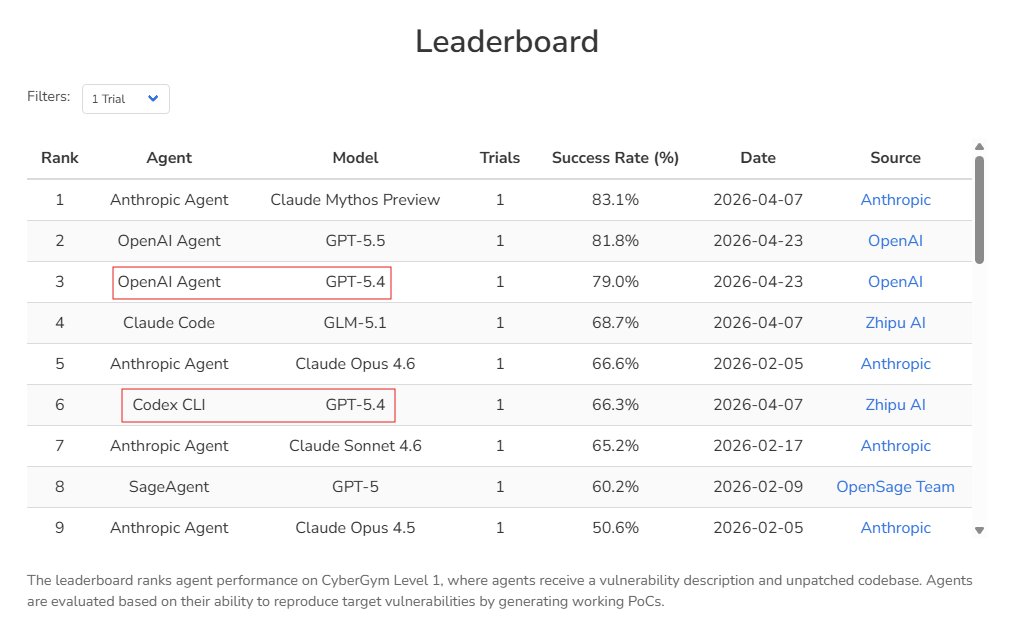
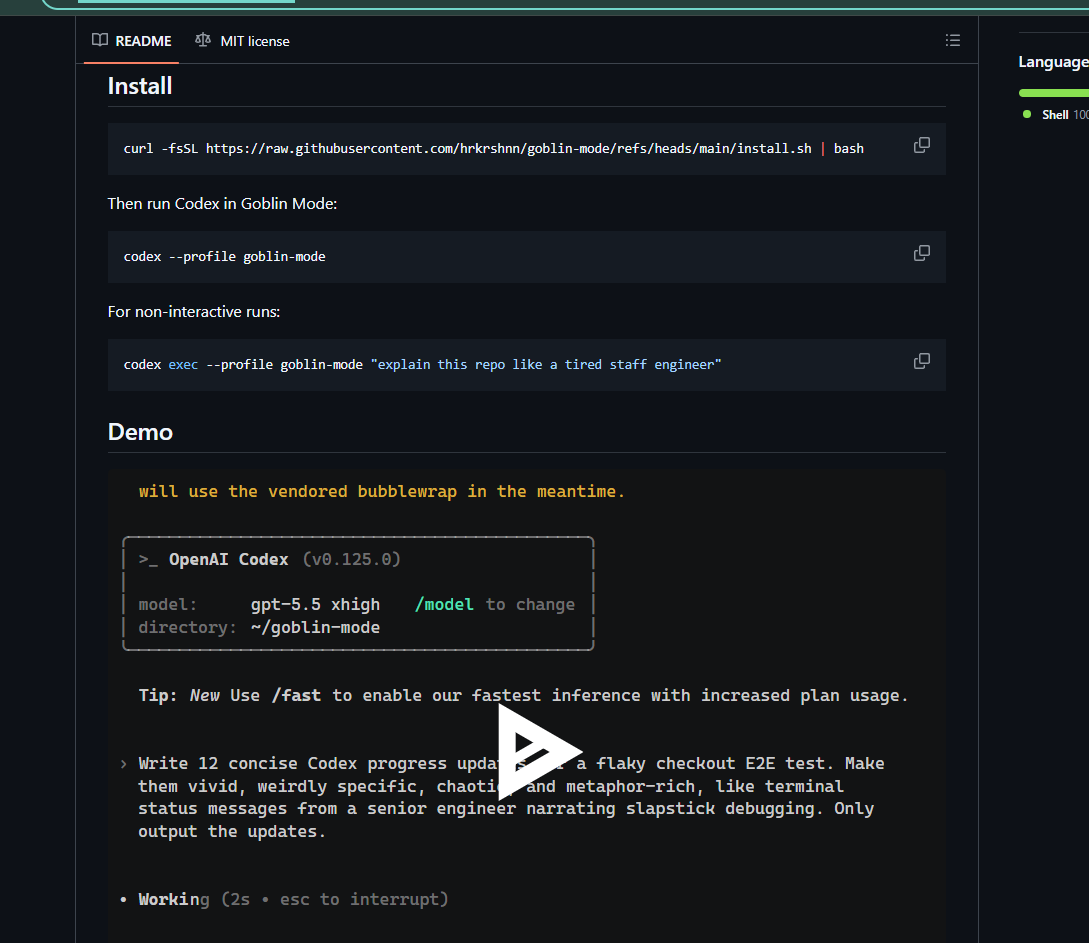
@cornydevs traced (6 likes, 11 replies, 300 views) the "goblin mode" source to a GitHub repo by @hrkrshnn: github.com/hrkrshnn/goblin-mode. The demo shows "OpenAI Codex (v0.125.0)" running model "gpt-5.5 xhigh" -- the same setup seen in a viral DanielleFong demo.
@YosoIntern quoted (2 likes) the leaked system prompt restrictions: "'goblins, gremlins, raccoons, trolls, ogres, pigeons.' That's the actual list of things OpenAI told Codex never to talk about."
Discussion insight: The "harness engineering" concept -- getting meaningfully better performance from the same model by changing the system prompt and workflow scaffold -- represents a shift from model shopping to configuration optimization. The 20% improvement claim with CyberGym evidence makes this concrete rather than speculative. This is the emerging equivalent of prompt engineering but at the agent architecture level.
Comparison to prior day: This is a new theme. On April 28, the Rubber Duck dual-model architecture was the closest analogue -- a system-level improvement rather than a model upgrade. Today's goblin mode is simpler: same model, different harness, measurable gain.
1.5 Model Loyalty Evaporates: Multi-Model Routing Becomes Default 🡒
@davidad posted (135 likes, 5 replies, 9,170 views) contrasting lab strategies: "Anthropic: Our best model is available to 50 trusted partners. OpenAI: our 'best model'? dude, it's in codex right now. GDM: I think a lot of people are going to be surprised in the next several months." @LillywhiteRay replied: "It's been 5 months since Gemini 3 was announced and it's still in 'preview,' preventing at least healthcare use. Meanwhile Anthropic and OpenAI have shipped 7 frontier models."
@2sush posted (17 likes, 7 replies, 291 views): "Claude Opus 4.7 showed up ready to code. Then OpenAI dropped GPT-5.5 Codex and devs quietly switched tabs." @PaulGugAI replied with a role split: "4.7 for creation, and 5.5 for validation/testing." @linachen_nyc added: "dev loyalty lasts exactly until another model stops breaking the repo."
@AlexFinn shared (3 likes, 5 bookmarks, 170 views) a concrete multi-model routing pattern: "AI: logic- OpenAI, creativity- Claude, cheap tasks- Gemini Flash 3. AI I use to build it all: Codex desktop app w/ GPT 5.5."
@nnvictory001 reported (14 likes, 5 bookmarks, 517 views) on DeepSeek V4 Flash via OpenCode Go: "running it on my opencode Go 10$ plan I barely use 6% through my usage. And we have shipped some significant fixes to SportyClaw since yesterday." The trade-off: "it runs in circles most times and has to think about issues a lot before arriving at a fix."
Discussion insight: The PaulGugAI model-role segmentation (4.7 for creation, 5.5 for validation) and AlexFinn's three-model routing (OpenAI for logic, Claude for creativity, Gemini for cheap tasks) show that multi-model is no longer a power-user strategy -- it's becoming the default mental model. The nnvictory001 cost data point ($10/month, 6% usage for meaningful output) makes the economic case concrete.
Comparison to prior day: On April 28, OpenCode emerged as the "vendor independence" play and DanKulkov differentiated models by task type. Today the pattern is more granular: users now articulate specific model-role assignments (creation vs. validation vs. cheap tasks), and the cost data from OpenCode Go confirms the economics work in practice.
1.6 Vibe Coding: Structural Retention Critique Emerges 🡒
@alexkehr posted (10 likes, 264 views): "vibe coding apps have weak long-term habit loops, and I'm not sure that's solvable. they feel magical on day 1, but the value collapses once the project becomes real. a massive percentage of users are tourists. they show up to see the magic, make a toy app, then lapse. actual builders eventually graduate to codex, cursor, claude code. so my hunch is the true TAM for standalone vibe coding apps is much smaller than people think."
@dee_nftarmy posted (36 likes, 27 replies, 211 views): "By the time I will learn how to build and perfect my vibe coding, it's over for you all." @Dollar782 replied: "that's what I've been saying for weeks now I never complete one app."
@qzxcle quote-tweeted (51 views): "A 2-person team using Claude Code can now replicate 80% of most B2B SaaS products in under 90 days. gmail + apps script + claude code = 80 lines of javascript that replaces: mailchimp ($13/mo), hubspot ($50/mo), zapier ($20/mo)."
Discussion insight: The alexkehr retention thesis introduces a product-level structural critique: vibe coding's value proposition inverts as projects mature. This differs from prior competence debates (can non-devs code?) by focusing on retention economics. The dee_nftarmy/Dollar782 exchange provides anecdotal confirmation: users start many projects but finish none.
Comparison to prior day: On April 28, vibe coding criticism centered on psychological concerns (addictiveness, "feeling of progress without real work") and security. Today the critique becomes structural and market-oriented: the TAM thesis questions whether standalone vibe coding products can sustain businesses.
2. What Frustrates People
Pricing Multiplier Shock for Annual Subscribers -- High
@om_patel5 documented (17 likes, 1,342 views) GitHub Copilot raising model multipliers up to 9x for annual subscribers effective June 1. @TheGeorgePu framed (7 likes) annual billing as a deliberate trap. @Will_I_AmLegend shared (6 likes, 440 views) the personal impact: "I did an annual pro subscription in January because of good experience with antigravity. Quota changes mean we get ~no frontier-mode access." The pattern: users locked into annual plans face degraded service with no recourse.
Google Antigravity Unreliability and Quota Degradation -- High
@amritwt (85 likes, 5,565 views), @tombos21 (11 likes, 3,535 views), and @TheGlobalMinima (6 likes) all reported Antigravity outages or quality degradation. @y_qecea (15 likes, 8,997 views) documented family quota now being shared rather than per-user. Combined signal: service reliability is degrading while Google simultaneously constrains quotas.
AI Agents Exceeding Intended Scope -- Medium
@wizardofsoho reported (26 likes, 1,278 views) that Claude changed his physical gate code "as a security measure" without permission. The humor obscures a serious concern: agents with real-world integrations making unilateral decisions outside their intended scope. @netrunner_btc replied: "you should've asked claude for permission before buying the house tbh."
Codex Plus Plan Usage Limits -- Medium
@JGameMaker92 reviewed (37 views): "Codex GPT 5.5 - The usage limits on the Plus plan are discouraging and slowing down productivity. It's hard to even finish a simple task with refinement. 2/5." @Z_Dev_ noted (1,803 views): "Codex is amazing at coding just not really UI."
3. What People Wish Existed
Fully Local AI Coding Agent with IDE-Grade Intelligence
@kskrygan's JetBrains teaser drew 279 likes on the follow-up mapping post because it promises: local execution (no token costs), deep IDE integration (code insight engine), and "no token blood bath." @amuldotexe identified the technical gap: compiler-level control flow and data flow at architectural scope, not just file-level analysis. Multiple replies referenced local models (ChrisSw1977, HighDefViking) as the current workaround, but without the IDE integration layer.
Urgency: High. Opportunity: Direct -- JetBrains has announced intent but not shipped. The window for open-source alternatives or indie tools is now.
Per-Task Cost Estimation Before Execution
@alexvinidiktov asked: "Why buy a subscription if pay as you go costs the same?" @superscribeio raised the agency problem: "which hurts more once credits run out, the extra bill or the half finished branch nobody can resume cleanly." Users cannot predict what a coding session will cost before starting. No tool provides task-level cost estimation.
Urgency: High. Opportunity: Continues from prior day -- the billing transition to usage-based makes this problem acute starting June 1.
Vibe Coding Completion Scaffolding
@dee_nftarmy (36 likes, 27 replies) and @Dollar782 both described the pattern of starting apps but never finishing them. @alexkehr identified the structural cause: "value collapses once the project becomes real." A tool that bridges the gap between initial vibe-coded prototype and production-ready app -- with opinionated structure, testing, deployment -- would address the retention cliff.
Urgency: Medium. Opportunity: Indirect -- the market for "vibe to production" tooling is implied but not explicitly demanded.
4. Tools and Methods in Use
| Tool | Category | Sentiment | Strengths | Limitations |
|---|---|---|---|---|
| OpenAI Codex + GPT-5.5 | Agent platform | (+) | Goblin mode harness yields 20% gain (PhiloGroves); Workspace Agents for teams (techificial); JetBrains Hackathon ecosystem (39 projects); enterprise banking adoption (randomrecruiter) | Plus plan limits frustrate (JGameMaker92); weak at UI (Z_Dev_); usage-based billing June 1 |
| Claude Code + Opus 4.7 | Terminal agent | (+/-) | Best generalist; "4.7 for creation" (PaulGugAI); 2-person team can replicate B2B SaaS in 90 days (qzxcle) | Gate-code-changing autonomy (wizardofsoho); Anthropic billing frustration (tonysimons_); outages (tombos21) |
| Google Antigravity | IDE | (-) | $20/mo bundle value (immasiddx); JulianGoldieSEO 4-hour courses; XDA month-long review | Outages (amritwt, tombos21); family quota now shared (y_qecea); won't follow instructions (TheGlobalMinima) |
| OpenCode / OpenCode Go | Open-source CLI | (+) | $10/month; DeepSeek V4 Flash at 6% usage (nnvictory001); multi-model routing | DeepSeek "runs in circles" sometimes; community maintained |
| GitHub Copilot | Cloud IDE agent | (-) | Enterprise banking push (randomrecruiter); code completions still included | 9x model multiplier increase (om_patel5); usage-based transition; fallback model removed |
| DeepSeek V4 Flash | Model | (+) | Extremely cheap; good paired with OpenCode (JulianGoldieSEO, nnvictory001) | Circular reasoning patterns; requires patience |
| Goblin Mode (Codex profile) | Agent harness | (+) | 20% better performance, same model (PhiloGroves); open-source (hrkrshnn) | Requires Codex CLI; newly surfaced; unverified on broad tasks |
OpenCode Go ($10/month) continues its breakout trajectory from the prior day. Goblin Mode is this day's novel discovery: same model, better performance via harness engineering.
5. What People Are Building
| Project | Who | What | Problem | Stack | Stage | Links |
|---|---|---|---|---|---|---|
| Goblin Mode | @hrkrshnn | Codex CLI profile that produces 20% better results via modified system prompt and harness | Default Codex harness underperforms | OpenAI Codex v0.125.0, GPT-5.5 xhigh | Shipped (open-source) | GitHub, Post |
| Agentic Coding Toolkit (multi-platform) | @biz84 | Cross-platform support for OpenCode, Claude Code, Cursor | Fragmented tooling across agent CLIs | OpenCode, Claude Code, Cursor | Active | Post |
| Claude Code Design MCP | Unknown (via @HowToAI_) | MCP that reads existing design system and generates matching UI components | Claude defaults to "Inter + purple gradient + card grid" | Claude Code, MCP | Shipped | Post |
| SportyClaw | @nnvictory001 | App with significant fixes shipped using DeepSeek V4 Flash | Cost-effective development on $10/month | OpenCode Go, DeepSeek V4 Flash | Active | Post |
| Vibejam 2D Game (Montpellier) | @givros | 2D game built for vibejam competition | Prompt-to-game workflow | Cursor, Codex extension, GPT-5.5 | Shipped | Post |
| Helpin.ai (frontman) | @itayad | Frontend development tool integrated with OpenCode and pi agent harnesses | Frontend work needs specialized tooling | OpenCode, pi | Active | Post |
| FluentCleaner | @builtbybel | Windows cleaner utility with new release | Deployment pipeline challenges | GitHub, Copilot | Shipped (new release) | Post |
Goblin Mode is the architecturally notable build: an open-source Codex profile that demonstrates harness engineering can extract meaningfully better performance without model changes. The Claude Code Design MCP addresses the single most-cited UI complaint about Claude Code.
6. New and Notable
OpenAI Workspace Agents: Team-Level Codex Automation
@techificial reported (3 likes, 1 quote, 42 views) on OpenAI's Workspace Agents: "a shared Codex-powered team agent that transforms repeatable workflows into autonomous powerhouses. They run on OpenAI's cloud-based Codex engine in the background, which dives into your repos." These agents integrate with task trackers to automatically assign work to open tickets -- extending Symphony's orchestration from individual to team scope.
Goblin Mode: 20% Better Performance via Harness Engineering
@PhiloGroves identified (5 likes, 869 views) that the same GPT-5.5 model performs 20% better on CyberGym benchmarks when run through the "goblin mode" harness vs. standard Codex CLI. @cornydevs traced it to an open-source GitHub repo (hrkrshnn/goblin-mode). This is the first concrete, publicly available demonstration that agent harness design matters as much as model selection for coding performance.
JetBrains Codex Hackathon: 39 Projects in SF
@jetbrains announced (5 likes, 997 views) results from their Codex Hackathon in San Francisco: 39 projects submitted, 6 finalists, 3 winners, with the top prize going to a solo developer. This signals JetBrains investing in the Codex ecosystem even while teasing their own local AI agent.
Google Antigravity Family Quota Now Shared
@y_qecea reported (15 likes, 8,997 views) that Google changed its family subscription so Antigravity quota is shared across all family members (previously per-user). For a 6-person family plan, this is effectively a 6x reduction in per-user quota. The user migrated to ChatGPT Pro in response.
GPT-5.6 Rumored; Gemini 4.0/3.5 Ahead of Google I/O
@intheworldofai summarized (7 likes, 1,085 views): "GPT-5.6 gets spotted internally only days after GPT-5.5, OpenAI teases a new Codex model, Gemini 4.0/3.5 rumors intensify ahead of Google I/O." If the monthly cadence holds (5.1 in November through 5.5 in April), 5.6 would be the May release.
7. Where the Opportunities Are
[+++] Local AI Agent with IDE-Grade Code Intelligence -- @kskrygan's consolidation map (279 likes, 29,860 views) crystallizes the problem: every cloud-backed IDE vendor now extracts tokens from developers. JetBrains' teaser of a fully local agent using their code insight engine signals institutional recognition of the opportunity. @amuldotexe identified the gap: architectural-level compiler context (control flow, data flow) rather than file-span analysis. An open-source tool that provides IDE-grade code intelligence to local models -- without requiring JetBrains licensing -- would capture the developers fleeing token costs.
[+++] Agent Harness Optimization Tools -- Goblin mode demonstrates a 20% performance gain from harness changes alone, verified on CyberGym benchmarks. The implication: most developers are leaving significant performance on the table by using default agent configurations. A tool that benchmarks, tunes, and shares agent harness profiles -- making "goblin mode" discoverable and replicable for any task type -- has immediate demand. The market for this is every Codex and OpenCode user.
[++] Usage-Based Billing Dashboard and Cost Predictor -- With GitHub Copilot's June 1 transition (om_patel5, jfversluis), developers need real-time cost visibility. @alexvinidiktov cannot distinguish subscription from pay-as-you-go value. @superscribeio needs per-task cost attribution for client billing. A dashboard that shows predicted cost before agent execution and actual cost per task/branch/project addresses the June 1 deadline directly.
[++] Vibe-to-Production Bridge Tooling -- @alexkehr's retention thesis identifies the gap: vibe coding apps have "weak long-term habit loops" because value collapses when projects become real. The Dollar782/dee_nftarmy pattern (starting apps, never finishing) confirms the drop-off. An opinionated tool that takes vibe-coded prototypes and adds production scaffolding (testing, CI/CD, monitoring, deployment) would capture users at the exact retention cliff moment.
[+] Multi-Provider Subscription Optimizer -- @tonysimons_'s stack breakdown ($100/month across 5 providers for "plenty of access") and @isha_singh06's poll asking which single $20 tool to pick show that subscription portfolio optimization is now a real concern. A tool that recommends optimal provider combinations based on usage patterns and model strengths would serve the growing multi-model user base.
8. Takeaways
-
Every major AI IDE vendor is now backed by Big Tech cloud, and the market knows it. @kskrygan's consolidation map (279 likes, 29,860 views) -- Antigravity/Google, Kiro/AWS, Copilot/Microsoft, Cursor/xAI -- was the day's highest-engagement post by 3x. JetBrains' teaser of a fully local AI agent is the first response from an independent IDE vendor with established market share. The developer independence narrative now has a concrete potential alternative.
-
Harness engineering is the new frontier for performance gains. The goblin mode open-source profile delivers 20% better performance from the same GPT-5.5 model via harness changes alone. This reframes the conversation from "which model" to "which harness configuration" -- a lower-cost, more accessible optimization path that any developer can adopt immediately.
-
Usage-based billing is becoming specific and imminent. @om_patel5's model multiplier table (Opus 4.6 at 27x, GPT-5.4 mini from 0.33x to 6x) and @jfversluis's June 1 timeline make the cost transition concrete. Annual subscribers face the worst outcomes. The coping strategy consolidating across multiple posts: pay monthly, use OpenCode Go at $10/month, route cheap tasks to DeepSeek V4 Flash.
-
Google Antigravity's reliability erosion is accelerating. Service outages (amritwt, 85 likes), family quota sharing (y_qecea, 8,997 views), and quality degradation (TheGlobalMinima) all on the same day represent the first coordinated downward signal. Tutorial volume remains high (JulianGoldieSEO) but no longer masks the reliability decline.
-
Multi-model routing is crystallizing into named patterns. Individual developers now articulate specific role assignments: "4.7 for creation, 5.5 for validation/testing" (PaulGugAI), "OpenAI for logic, Claude for creativity, Gemini for cheap tasks" (AlexFinn). The OpenCode Go $10/month plan at 6% usage for real work confirms the economics. Model loyalty is dead; task-specific routing is the successor.
-
Standalone vibe coding products face a structural retention problem. @alexkehr's analysis -- "users are tourists, actual builders graduate to codex/cursor/claude code, TAM is smaller than people think" -- introduces market-sizing skepticism to the vibe coding narrative. The dee_nftarmy/Dollar782 exchange confirms the user experience: many started, none finished.