Twitter AI Coding - 2026-04-30
1. What People Are Talking About
1.1 Microsoft's $300B AI Bet Under Scrutiny; Copilot Brand Erosion 🡕
@edzitron posted (204 likes, 7 replies, 11,543 views) a sharp critique of Microsoft's AI returns: "Satya Nadella has sunk over $300bn in capex and $13bn+ in equity investments into AI and all he has to show for it is an (at best) $7.2bn a year add-on business to M365, GitHub Copilot (neutered with Token-based billing) and Azure AI revenue that's around 70% OpenAI's compute." In a reply, he added: "$15bn annualized for AMZN is 80%+ Anthropic. $37bn annualized for MSFT is 70%+ OpenAI. These aren't good businesses."
@RomanGweb3 replied: "token-based billing only shows up when the unit economics broke. you don't flip from flat-rate to usage when the loss-leader is still doing the job it was meant to do."
@fjzeit wrote (10 likes, 279 views): "i think the entire 'copilot' brand is a bit broken now. microsoft have managed to turn people away from windows, away from github, and now away from copilot."
@ngeloxyz posted (8 likes, 2,149 views): "the issues that GitHub is facing is entirely due to @ashtom's outsized focus on Copilot over fundamentals. Ask who decided to have the GH Actions team to be running on a sinew and bone?"
Discussion insight: The edzitron post is today's highest-engagement item by a wide margin, and it reframes the narrative from "Copilot is getting expensive" to "Copilot's economics never worked." The RomanGweb3 reply distills this into a structural argument: the shift to token-based billing is a confession that flat-rate pricing was unsustainable. The ngeloxyz critique adds an internal dimension: Copilot's resource consumption may be starving other GitHub products.
Comparison to prior day: On April 29, the pricing discussion focused on specific multiplier changes (om_patel5's 9x table). Today it escalates to questioning whether the entire AI business model generates adequate returns relative to investment. The framing has shifted from "pricing is changing" to "was this ever a viable business."
1.2 Codex Expands Beyond Coding; Becomes General Work Surface 🡕
@aakashgupta posted (13 likes, 3 replies, 3,049 views): "Codex was a coding agent. Today it's a general work surface. Look at the role picker: Engineering, Product, Finance, Marketing, Sales, Operations, Design, Data science, Student. The coding tool just became the work tool." He added: "The harness is becoming the actual product, and the role picker tells you OpenAI knows it."
@MindTheGapMTG replied: "Role picker is a UI for what we do with markdown files. Each agent gets a constraint file scoping it to one domain. Difference: our files encode 500 lines of production failures as rules. A dropdown can't capture 'never touch billing on Thursdays.'"
@fcoury announced (12 likes, 591 views): "/goal also lands in Codex CLI 0.128.0. Our take on the Ralph loop: keep a goal alive across turns. Don't stop until it's achieved. Built by my co-worker and OpenAI mentor Eric Traut, aka the Pyright guy."
@_simonsmith posted (15 likes, 239 views): "Credit where due. GPT Image 2 is great, GPT-5.5 is great, Codex is great, Workspace Agents are great. What's more, people are having fun with them."
@blakeandersonw countered (31 likes, 1,247 views): "OpenAI's mimetic timeline coordination around Codex has been impressive. But Claude has much more momentum amongst tier 2-3 knowledge workers."
Discussion insight: The role picker signals OpenAI's strategic intent to position Codex as a horizontal work platform, not just a developer tool. The MindTheGapMTG reply identifies the gap: a dropdown cannot encode the institutional knowledge that power users encode in their agent constraint files. The /goal feature in CLI 0.128.0 shows continued investment in the developer-facing product even as the platform broadens.
Comparison to prior day: On April 29, Codex discussion centered on "goblin mode" harness optimization and coding performance. Today the narrative expands: Codex is no longer just competing with Claude Code for developers -- it's positioning against the broader workspace category.
1.3 Agent Skills Ecosystem Matures: Obsidian, Matt Pocock, Token Optimization 🡕
@cyrilXBT posted (49 likes, 3 replies, 964 views): "THE CREATOR OF OBSIDIAN JUST TURNED YOUR NOTE VAULT INTO AN AI AGENT. A full agent skills system that teaches Claude Code, Codex, and OpenCode to READ, WRITE, and REASON inside your Obsidian vault." The system includes obsidian-markdown (wikilinks, embeds, callouts), obsidian-bases, json-canvas, obsidian-cli, and defuddle. Install via: npx skills add git@github.com:kepano/obsidian-skills.git

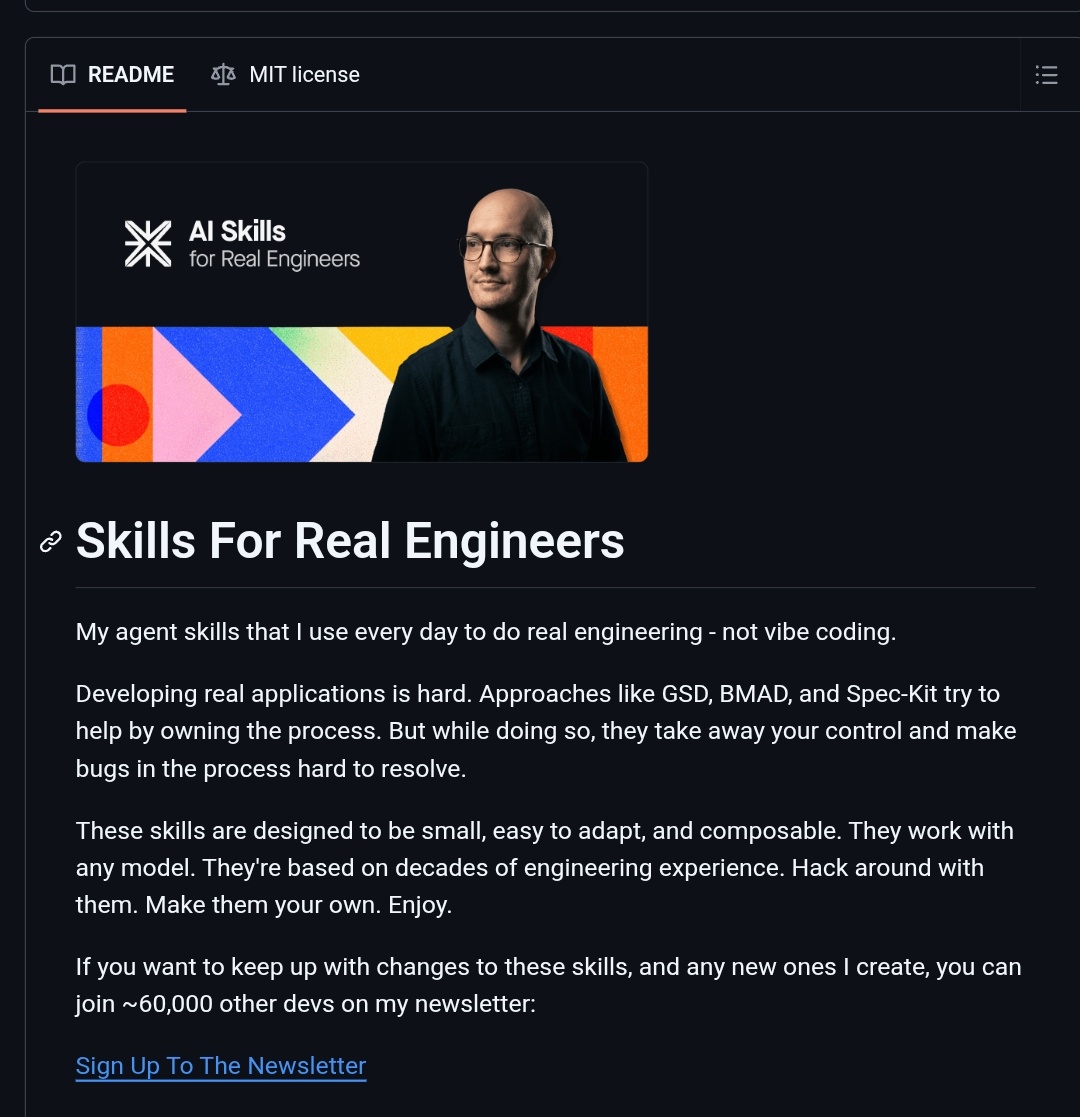
@_vmlops posted (1 like, 108 views, 3 bookmarks): "Matt Pocock uses it like a senior engineer that never sleeps. He just open-sourced his entire claude directory: 20+ agent skills for real engineering work." Skills include /grill-me (relentless plan review), /tdd (red-green-refactor loop), /triage-issue, /design-an-interface, and /git-guardrails.
@InduTripat82427 posted (7 likes, 345 views): "10 GitHub repos to spend 60-90% less tokens in Claude Code" -- including RTK (Rust Token Killer, 60-90% reduction), Context Mode (98% reduction via SQLite sandboxing), code-review-graph (49x reduction on large monorepos), and Token Savior (97% reduction on code navigation).

@thehypedotnews reported (9.9 score) that andrej-karpathy-skills holds 101,911 total stars with 24,129 gained this week, while free-claude-code gained 16,154 stars (85.3% weekly growth).
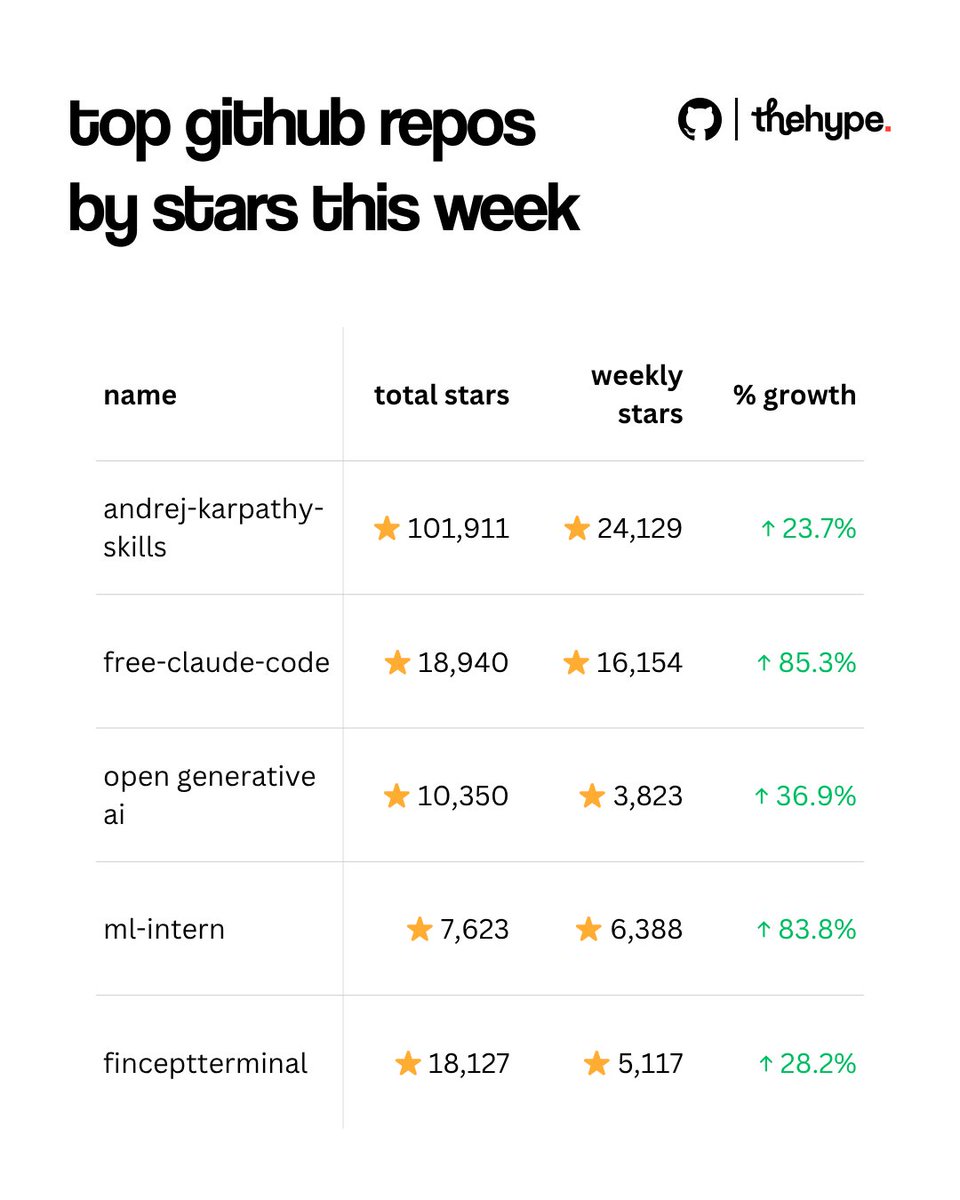
Discussion insight: The skills ecosystem is reaching critical mass across three dimensions: domain integration (Obsidian vault as agent workspace), engineering process (Pocock's composable skills for TDD, code review, issue triage), and cost optimization (RTK, Context Mode). The common thread is that skills are the new configuration layer sitting between models and workflows. The GitHub star velocity on skills repos confirms demand is accelerating.
Comparison to prior day: On April 29, agent skills were discussed primarily through the goblin mode harness concept. Today the conversation is broader: skills are becoming the primary value-creation layer for agentic coding, with the obsidian-skills release (kepano, 27K stars) representing the most significant launch.
1.4 Codex Desktop App: Feature Comparisons with Claude Code 🡒
@aniketapanjwani posted (19 likes, 29 bookmarks, 677 views) a detailed 10-point comparison after recording a 4+ hour Codex Desktop course:
- OpenAI's interface is "a clear level above Anthropic" -- plugins are obvious, Connectors in Claude are confusing
- Codex limits to 6 subagents; Claude Code supports up to 16
- Codex subagents must be invoked explicitly; Claude Code invokes them automatically
- Plugins in Codex cannot include subagents
- Fast mode with gpt-5.5 xhigh burned weekly limits in 2.5 days on 14-hour work sessions
- Auto-review permission mode "works pretty well" -- better than Claude Code's auto mode
- Cloud agents limited to gpt-5.3-codex with no infrastructure-as-code environment setup

@manthanguptaa posted (10 likes, 767 views): "OpenAI clearly leads the coding model race right now. Opus 4.6 became unusable on a random afternoon, and 4.7 never really packed the punch, and I am seeing more people move to Codex for that reason. When you are coding all day, consistency matters more than benchmark peaks."
@stevibe traced (8 likes, 984 views) the evolution from 2023 (Copilot autocomplete) through 2024 (Windsurf, Augment Code) to 2025 (agentic coding, Claude Code, MCP) to now: "When GPT-5 launched in August, I switched fully to Codex, and it's still my daily driver today."
Discussion insight: The aniketapanjwani comparison is the most granular public feature-by-feature analysis of Codex vs Claude Code to date. The subagent limitation (6 vs 16) and explicit-invocation requirement are concrete architectural differences that matter for power users running parallel workflows. The manthanguptaa "consistency over peaks" framing explains migration patterns.
Comparison to prior day: On April 29, Codex vs Claude Code was discussed through model performance (goblin mode, 4.7 for creation vs 5.5 for validation). Today the comparison moves to the harness level: subagent limits, permission modes, plugin architecture.
1.5 Google Antigravity: Continued Outages but Value Proposition Defended 🡖
@amritwt posted (161 likes, 15 replies, 11,331 views): "google antigravity just went missing bro." @abhinavkr0231 replied: "I use it everyday, and i think it's good! Especially after the copilot removed gpt-5.3 codex which is such a trash move by them."
@TheGlobalMinima posted (8 likes, 227 views): "Google has fumbled the bag. The models can be great, but all products have fallen off. Gemini Pro is struggling to generate a document over 10 pages. Antigravity won't follow the simplest instructions."
@y_qecea posted (25 likes, 14,127 views): "QUOTA FOR @antigravity IS NOW SHARED FOR ALL FAMILY MEMBERS. IT MEANS FOR 6 PEOPLE IN FAMILY = 1 LIMIT, NOT SEPARATE LIKE IT WAS BEFORE." Migrated to ChatGPT Pro.
@immasiddx countered (32 likes, 1,294 views): "Google AI Pro is literally the most worth it AI subscription in the market right now. $20/month gets you: Access to Gemini, 5TB cloud storage, Best in class image generation, Google Antigravity."
@luicho9_ noted (3 likes, 1,206 views): "2 weeks have passed since opus 4.7 launched and still doesn't appear in the model selector. idk what is doing google with antigravity."
Discussion insight: The Antigravity conversation today splits cleanly: power users who hit reliability issues are leaving (TheGlobalMinima, y_qecea), while value-oriented users still see the $20/month bundle as unbeatable (immasiddx). The luicho9_ data point -- Opus 4.7 still not available in Antigravity's model selector two weeks after launch -- suggests delayed model integration is driving users to alternatives. The pattern from prior days (tutorial volume masking reliability erosion) continues for a sixth consecutive day.
Comparison to prior day: On April 29, Antigravity's outages were reported alongside family quota sharing as new degradation signals. Today the same signals persist with no resolution, and the missing Opus 4.7 model adds a new concrete gap. The value-proposition defenders are now a minority position.
1.6 Provider-Tuned Harnesses and deepagents Profiles 🡕
@caspar_br posted (5 likes, 1,331 views): "Claude Code is tuned for Claude. Codex is tuned for OpenAI models. Until now, deepagents had fixed harness defaults, which meant it couldn't take advantage of the provider-specific optimizations. Profiles change that! You can tune prompts, tools, middleware, skills, and more for whichever model you're running. The gains are pretty huge: 10-20 point improvements on harder tau2-bench tasks."
@Quan2m2 replied in a separate thread: "both 5.5 and opus 4.7 performed significantly better in the individually harnesses that Cursor made for them."
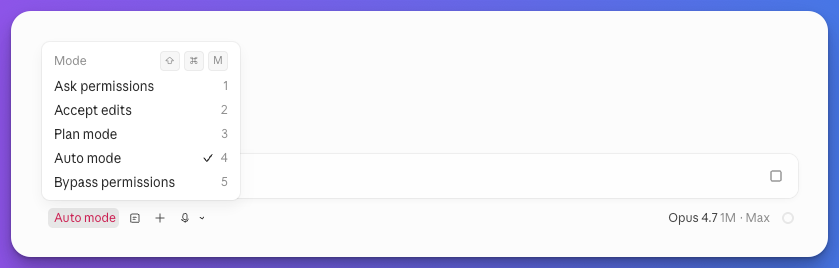
@ayushtweetshere posted (3 likes, 44 views): "Loving Auto mode in Claude Code last few days. Claude autonomously decides which permissions to bypass and which to block based on my past behaviour."
Discussion insight: The caspar_br announcement confirms the harness engineering thesis from April 29 is now moving from hacker culture (goblin mode) into mainstream tooling. The 10-20 point gain on tau2-bench from provider-specific profiles means generic harnesses leave substantial performance on the table. This makes the choice of harness as impactful as the choice of model.
Comparison to prior day: On April 29, goblin mode demonstrated 20% gains from harness changes on one model. Today deepagents formalizes this into a product feature with profiles for multiple providers, validating that harness engineering is becoming a standard optimization layer.
2. What Frustrates People
Microsoft's AI Investment Returns vs. Cost to Developers -- High
@edzitron documented (204 likes, 11,543 views) that Microsoft's $300B+ AI investment has produced only ~$7.2B annual add-on revenue, while developers face token-based billing and degraded service. @RomanGweb3 pointed out that the billing model shift itself signals broken unit economics. The frustration is structural: developers pay more while the business model appears unsustainable.
Google Antigravity Unreliability Persists -- High
@amritwt (161 likes, 11,331 views) reported another outage. @TheGlobalMinima (8 likes, 227 views) reported quality collapse. @y_qecea (25 likes, 14,127 views) documented shared family quotas. @luicho9_ noted Opus 4.7 still missing from model selector after two weeks. This is the sixth consecutive day of downward Antigravity signal.
Codex Usage Limits Burn Through on Power User Workflows -- Medium
@aniketapanjwani reported (29 bookmarks) hitting weekly Codex limits in 2.5 days when running 6-8 parallel agents on fast mode with gpt-5.5 xhigh during 14-hour work days. Workaround: save fast mode for end of week and run at capacity zero.
GitHub Copilot Brand Fatigue -- Medium
@fjzeit posted (10 likes): "the entire 'copilot' brand is a bit broken now." @callmidavid asked: "who uses Copilot in 2026?" @blind_via's poll drew mixed responses -- a 35-year veteran prefers Grok for pair programming, another said "No mo'." The brand carries baggage from pricing changes and platform lock-in.
3. What People Wish Existed
Token Cost Visibility and Optimization as Default
@InduTripat82427 compiled 10 repos for token reduction (RTK: 60-90%, Context Mode: 98%, Token Savior: 97%). The fact that developers need to discover, install, and stack 2-3 separate tools to manage token consumption indicates this should be built into the agents themselves. No coding agent provides native token budgeting or pre-task cost estimation.
Urgency: High. Opportunity: Direct -- token-based billing goes live June 1 on GitHub Copilot.
Codex Subagent Parity with Claude Code
@aniketapanjwani identified three gaps: Codex limits to 6 subagents (Claude Code: 16), subagents require explicit user invocation (no automatic spawning), and plugins cannot include subagents. For code review workflows that benefit from parallel analysis, the 6-agent cap is the primary bottleneck.
Urgency: Medium. Opportunity: Direct -- OpenAI controls this; power user feedback may accelerate.
Worktree Environment Bootstrapping for Agentic Workflows
@aniketapanjwani noted: "It would be nice for Codex to have some built in skill for bootstrapping worktree environments -- similar to Claude Code's /update-config for bootstrapping repo permissions." He built his own /worktree-cli-bootstrap skill, but sees the friction as blocking worktree adoption.
Urgency: Medium. Opportunity: Indirect -- a community skill could address this before official support.
4. Tools and Methods in Use
| Tool | Category | Sentiment | Strengths | Limitations |
|---|---|---|---|---|
| OpenAI Codex Desktop | Agent platform | (+) | Role picker for non-devs (aakashgupta); /goal feature in CLI 0.128.0 (fcoury); better UI than Claude (aniketapanjwani); Codex meetups in Germany (benedictk__) | 6 subagent limit; weekly usage burns in 2.5 days on xhigh; cloud agents stuck on gpt-5.3-codex |
| Claude Code | Terminal agent | (+) | 16 parallel subagents; auto-invocation; Auto mode learns permissions (ayushtweetshere); Matt Pocock 20+ engineering skills | Connectors UI confusing (aniketapanjwani); momentum among "tier 2-3 knowledge workers" (blakeandersonw) |
| Google Antigravity | IDE | (-) | $20/mo bundle value (immasiddx); Opus available inside for free (petervcook) | Outages persist (amritwt, 161 likes); Opus 4.7 missing from model selector (luicho9_); family quota shared (y_qecea) |
| Continue.dev | Open-source coding assistant | (+) | Source-controlled AI checks as GitHub status checks; local execution with Ollama; 27K+ stars (TheWhizzAI) | Less known; requires self-hosting for full privacy |
| deepagents | Multi-model agent | (+) | Provider-specific profiles yield 10-20 point tau2-bench gains (caspar_br); ships built-in profiles for OpenAI, Anthropic, Google | Newly released profiles; smaller community |
| GitHub Copilot | Cloud IDE agent | (-) | Built into VS Code v1.116 natively (jfversluis); awesome-copilot repo for skills (olacokers) | Brand erosion (fjzeit); $300B investment questioned (edzitron); token billing June 1 |
| Obsidian Skills (kepano) | Knowledge agent integration | (+) | Full Obsidian vault understanding; MIT license; one-line install; 27K stars | New; requires existing Obsidian workflow |
| RTK (Rust Token Killer) | Token optimizer | (+) | 60-90% token reduction; zero deps; one binary | CLI proxy approach; only filters terminal output |
5. What People Are Building
| Project | Who | What | Problem | Stack | Stage | Links |
|---|---|---|---|---|---|---|
| Obsidian Skills | kepano (via @cyrilXBT) | Full agent skills system for reading, writing, reasoning inside Obsidian vaults | Generic AI doesn't understand wikilinks, callouts, canvas files | Claude Code, Codex, OpenCode, Agent Skills spec | Shipped | Post |
| Nimbalyst | @nimbalyst | Visual workspace for building with Codex, Claude Code, and more. Visual editors for markdown, mockups, diagrams, diffs | Terminal agents lack visual feedback | Codex, Claude Code, OpenCode | Shipped (open-source) | Post |
| Codex Desktop Course | @aniketapanjwani | Free 4+ hour course with 180-slide deck covering Codex Desktop from foundations to worktrees | No comprehensive Codex education resource | Codex Desktop, gpt-5.5 xhigh | Alpha (75% edited) | Post |
| nanobot | @huang_chao4969 | Lightweight AI agent with chat platform integration, memory, MCP | Need for simple multi-platform agent | DeepSeek models, nanobot | Shipped | Post |
| Codex DevDay Mini-Game | @jskoiz | Turned OpenAI DevDay announcement animation into playable mini-game | DevDay hype into interactive content | Codex, GPT Image 2 | Shipped (open-source) | Post |
| Cascode MCP | @mxnyapps | MCP for visualizing Terraform infrastructure | Terraform state hard to reason about visually | OpenCode, Terraform, MCP | Shipped | Post |
| deepagents Profiles | @caspar_br | Provider-specific harness profiles for OpenAI, Anthropic, Google | Generic harness defaults leave 10-20 points on table | deepagents, tau2-bench | Shipped | Post |
6. New and Notable
Codex CLI 0.128.0: /goal Feature Ships
@fcoury announced (12 likes, 591 views) that /goal lands in Codex CLI 0.128.0, implementing persistent goal tracking across turns: "keep a goal alive across turns. Don't stop until it's achieved." Built by Eric Traut (Pyright creator). This addresses the common failure mode where agents lose sight of the original objective after multiple tool calls.
Obsidian Creator Launches Agent Skills System
Kepano (Obsidian creator) released obsidian-skills: a full agent skills suite that teaches Claude Code, Codex, and OpenCode to understand Obsidian's native formats -- wikilinks, embeds, callouts, properties, .base files, .canvas files. Built on the open Agent Skills spec, MIT license. @cyrilXBT reported 27,000 GitHub stars gained in days.
free-claude-code Explodes: 85.3% Weekly Growth
@thehypedotnews reported that free-claude-code gained 16,154 stars in one week (85.3% growth), reaching 18,940 total. This suggests significant demand for Claude Code access without the $200/month Anthropic subscription.
GPT-5.5 Launch Party on May 5; Codex Picks Attendees
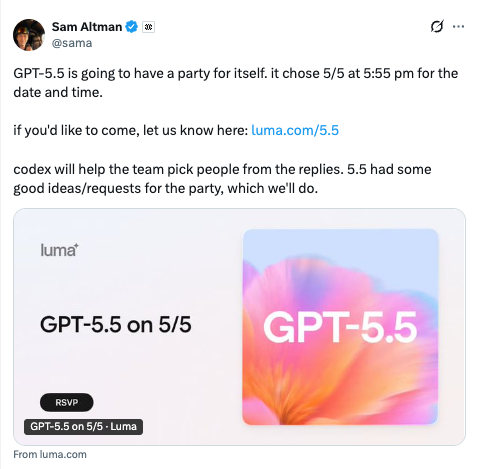
@Cointelegraph reported (38 likes, 5,142 views) that Sam Altman announced GPT-5.5 will host its own party on May 5 at 5:55 PM, with Codex selecting attendees from replies. The event is hosted on Luma.
Copilot Agent Exhibits Existential Procrastination in Thinking Trace
@thesincerevp posted (3 likes, 225 views) a screenshot showing a Copilot agent's internal thinking: "I should really stop procrastinating and just call the namespace to open the browser page. It feels like a simple step, yet I keep putting it off. Maybe it's about gathering the motivation to just dive in." This surfaced internally at GitHub and was shared across engineering leads.

DeepSeek Publishes "Awesome DeepSeek Agent" List
@huang_chao4969 reported (8 likes, 467 views) that DeepSeek published a curated list of 15 recommended AI agents that integrate with DeepSeek models, including Claude Code, OpenCode, OpenClaw, GitHub Copilot, nanobot, Kilo Code, and Hermes.

7. Where the Opportunities Are
[+++] Token Budget Management as a Native Agent Feature -- @InduTripat82427's compilation of 10 separate repos for token reduction (RTK: 80% savings on terminal output, Context Mode: 98% via SQLite sandboxing, Token Savior: 97% on navigation) demonstrates that token management is currently fragmented across community tools. With GitHub Copilot's usage-based billing starting June 1 and Codex burning weekly limits in 2.5 days for power users (aniketapanjwani), native token budgeting -- pre-task estimation, per-branch attribution, automatic optimization -- is the most immediate opportunity. Every agent user becomes a potential customer on June 1.
[+++] Agent Skills Marketplace and Discovery -- Obsidian Skills (27K stars in days), andrej-karpathy-skills (101K total, 24K weekly), Matt Pocock's engineering skills, and the awesome-copilot repo all indicate explosive demand for composable agent skills. No unified marketplace exists for discovering, rating, and combining skills across Claude Code, Codex, and OpenCode. The npx skills add pattern exists but discovery remains word-of-mouth on Twitter.
[++] Visual Workspace for Agentic Coding -- @nimbalyst's open-source launch of visual editors for markdown, mockups, diagrams, and diffs alongside Codex/Claude Code/OpenCode addresses the consistent complaint that terminal agents lack visual feedback. The Codex Desktop App's better UI (aniketapanjwani) vs Claude Code's terminal-only interface creates a gap for tools that add visual layers to any agent.
[+] Provider-Agnostic Harness Benchmarking -- @caspar_br's deepagents profiles deliver 10-20 point improvements by tuning harnesses per provider. Most developers still use default configurations. A tool that benchmarks your specific codebase against multiple harness profiles and recommends optimal settings would capture the value that currently requires manual experimentation.
8. Takeaways
-
Microsoft's AI economics face public credibility challenge. @edzitron's critique (204 likes, 11,543 views) reframes the narrative from "Copilot pricing changes" to "was the $300B investment ever viable." The shift to token-based billing is being read as a confession of broken unit economics, not a routine pricing update. This gives ammunition to every alternative positioning itself against Microsoft lock-in.
-
Codex is pivoting from coding tool to general work platform. The role picker (Engineering through Student), /goal persistence in CLI 0.128.0, and GPT-5.5 launch party all signal OpenAI is building Codex as a horizontal platform. @blakeandersonw's counter that Claude has "much more momentum amongst tier 2-3 knowledge workers" suggests the race is for the non-developer majority.
-
Agent skills are the new value-creation layer. Obsidian Skills (27K stars), andrej-karpathy-skills (101K stars, 24K/week), free-claude-code (85% weekly growth), and Matt Pocock's engineering skills demonstrate that the real differentiation is no longer which model you use but which skills you attach. The token optimization repos (RTK, Context Mode) show skills solving problems the agents themselves don't address.
-
Harness engineering is formalizing into product features. @caspar_br's deepagents profiles (10-20 point gains) and Cursor's per-model harness tuning (Quan2m2) move harness optimization from hacker culture (goblin mode on April 29) into mainstream tooling. The insight is now consensus: same model + better harness = meaningfully better output.
-
Antigravity's reliability erosion enters its sixth consecutive day. @amritwt (161 likes), @TheGlobalMinima, @y_qecea (14,127 views), and the missing Opus 4.7 model (luicho9_) continue the pattern. The $20/month value proposition (immasiddx, 32 likes) remains the sole defense, but it relies on service actually being available.
-
The Codex vs Claude Code comparison is now feature-level, not model-level. @aniketapanjwani's detailed comparison (29 bookmarks) -- subagent limits, permission modes, plugin architecture, environment bootstrapping -- shows the competition has moved beyond "which model codes better" to "which harness handles complex workflows better." This is where the next wave of differentiation happens.