Twitter AI Coding - 2026-05-14
1. What People Are Talking About
1.1 GitHub is trying to answer a credibility gap with new agent surfaces 🡕
The strongest thread on May 14 is that GitHub remains central to AI coding discussion, but mostly in a defensive posture. The viral frame is that GitHub should be winning this category and is not; the counter-frame is that GitHub is still shipping new agent surfaces in the terminal and around the GitHub graph. The result is a split feed: backlash about missed advantage, alongside real interest in Copilot CLI and the new Copilot App technical preview.
@thekitze argued (3,238 likes, 80 replies, 61,831 views, 117 bookmarks) that GitHub had the earliest and strongest structural advantage in AI coding and still let newer agent products define the category narrative. The replies extended that critique from vibes into product differentiation: one user asked what makes Copilot meaningfully different if users can pick other models anyway, while another compared it to an aging social platform rather than a category leader.
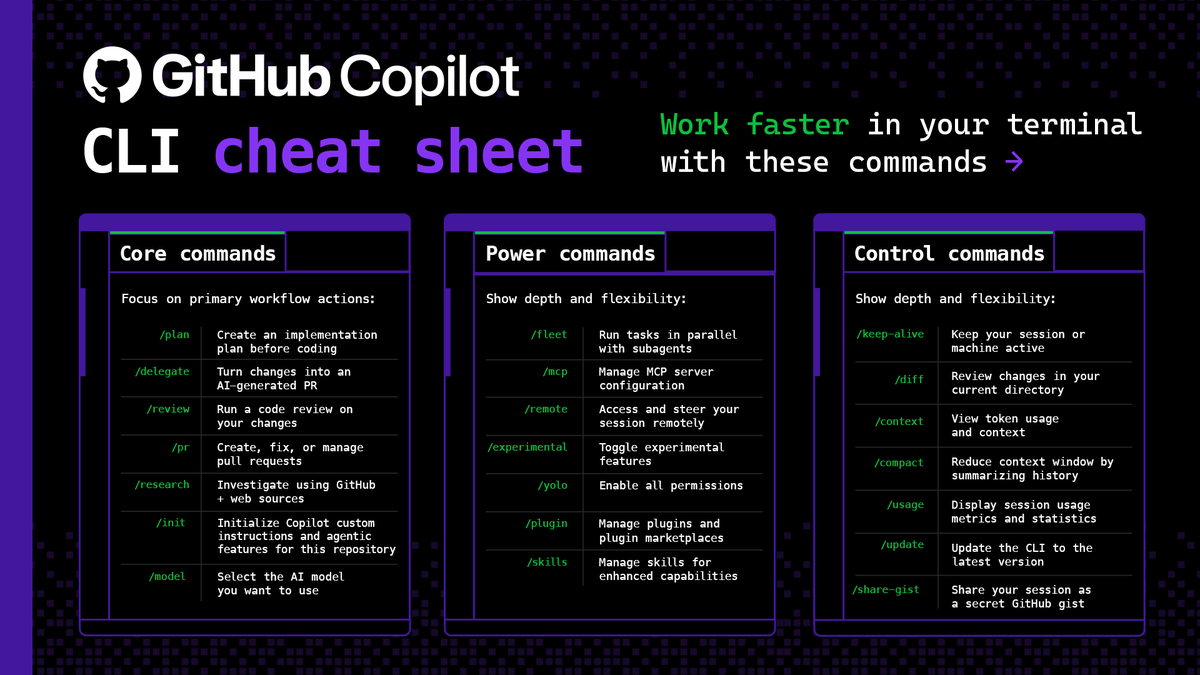
@msdev posted (130 likes, 5 replies, 6,713 views, 102 bookmarks) a GitHub Copilot CLI cheat sheet that lists planning, delegation, review, MCP, plugin, skills, diff, context, and session-management commands. The image matters because it shows GitHub pushing a richer workflow surface than generic prompting.
@burkeholland announced (55 likes, 7 replies, 3,308 views, 24 bookmarks) a technical preview of the GitHub Copilot App as a new agentic development tool that brings agents and GitHub into one pane of glass. @davidfowl reinforced (50 likes, 7 replies, 6,333 views, 15 bookmarks) the same product direction, quoting an "agent-native development environment deeply integrated with the GitHub graph" and answering a follow-up by saying "The GitHub integration is deeper." Replies also surfaced product-boundary friction: users asked how this differs from the VS Code Agents app, flagged waitlist and feedback issues, and asked about missing WSL support.
Discussion insight: The market is not treating GitHub's problem as model quality alone. The replies keep coming back to identity: what Copilot is for, where it is better than rival tools, and whether deeper GitHub integration is enough to restore an edge.
Comparison to prior day: May 13 centered on billing shock and churn declarations. May 14 keeps Copilot under pressure, but the focus shifts from pricing arithmetic to whether GitHub can reframe the product around CLI workflows and a new GitHub-native agent surface.
1.2 Antigravity is stuck between shutdown rumors and compelling demos 🡕
Google Antigravity generated the biggest volume of attention again, but the signal is contradictory. Users openly speculate that the product is being starved, yet other posts still treat it as one of the most ambitious agent-first IDEs in the market. The tension is not "does it work?" so much as "is anyone steering it?"
@hiarun02 asked (1,994 likes, 285 replies, 414,707 views, 247 bookmarks) whether Google is shutting Antigravity down. The attached image shows the product still exposing a live model picker with Gemini 3.1 Pro and Flash, Claude Sonnet 4.6, Claude Opus 4.6, and GPT-OSS 120B, so the evidence is not outage but silence.

@HarshithLucky3 reported (184 likes, 16 replies, 9,251 views, 9 bookmarks) that Antigravity still had no Opus 4.7 and no visible updates since April 16. The changelog screenshot is specific: version 1.23.2, dated Apr 16, 2026, only lists bug fixes for MCP server loading and workspace-specific settings.

The interesting counter-signal came from @0xMovez, who highlighted (230 likes, 18 replies, 26,531 views, 314 bookmarks) a 25-minute Antigravity demo that shows an agent-first IDE planning, coding, browsing, validating, and self-educating. Meanwhile @CryptoPrifti summarized (120 likes, 113 replies, 592 views) current tool perception in one line: Claude Code is top-tier but hits limits, Codex is almost as strong with higher limits, and Antigravity offers far higher limits with a less impressive model. That is the market's most direct tradeoff statement.
Discussion insight: Replies to the shutdown thread split three ways: users who already moved to Cursor or Claude Code, users who still value Antigravity because of free or high-allowance access, and users who think Google I/O might still revive the product. The common complaint is lack of communication, not lack of ambition.
Comparison to prior day: May 13 raised the existential question of whether Antigravity had a future. May 14 sharpens the contradiction: the product still looks technically serious in demos, but the stale changelog makes that seriousness hard to trust.
1.3 Coding agents are spreading across mobile, plugins, and side-by-side stacks 🡕
The third theme is that tool competition is no longer limited to "which IDE wins." Distribution is moving across surfaces and into rival products: mobile Codex, Codex inside Claude Code, and comparison threads where builders choose tools based on limits, workflow fit, and availability rather than loyalty to a single vendor.
@Polymarket reported (221 likes, 43 replies, 23,903 views, 19 bookmarks) that Codex is now in the ChatGPT mobile app. The immediate replies were revealing: one asked how many real use cases exist outside simple scripts, while another argued that mobile Codex removes the excuse to wait until returning to a desk. Even the skepticism confirms the shift in surface area.
@goyalshaliniuk posted (20 likes, 8 replies, 122 views, 7 bookmarks) that OpenAI dropped a plugin that lets users run Codex directly inside Claude Code for code reviews, adversarial reviews, and background tasks. The replies framed the value as staying in an existing workflow rather than switching environments.
@pmitu asked (63 likes, 83 replies, 3,518 views, 11 bookmarks) what builders use now, listing Antigravity, GitHub Copilot, Claude Code, ChatGPT, Windsurf, Lovable, Gemini, Cursor, Codex, Replit, Bolt, and v0. The point is not which one won the thread; it is that the market now expects a stack, not a single permanent choice. @VraserX claimed (61 likes, 16 replies, 2,165 views, 4 bookmarks) that Codex entering the enterprise triggered 2,000 companies reaching out in three hours, but replies immediately pushed back that enterprise adoption still has to pass procurement and security review.
Discussion insight: The interoperability item matters because it changes the competitive frame. If users can bring Codex into Claude Code and steer Codex from mobile, vendors have to compete on workflow fit and trust, not just model branding.
Comparison to prior day: May 13 treated competition mainly through Copilot churn and Microsoft strategy. May 14 makes distribution itself the story: mobile access, plugins into rival tools, and explicit side-by-side comparison based on limits and ergonomics.
2. What Frustrates People
Roadmaps are opaque enough to create shutdown rumors
The clearest frustration is not even a bug; it is uncertainty. @hiarun02 (1,994 likes, 285 replies, 414,707 views, 247 bookmarks) got massive engagement simply by asking whether Antigravity was being shut down, and @HarshithLucky3 (184 likes, 16 replies, 9,251 views, 9 bookmarks) backed that worry with a screenshot showing the latest visible changelog entry was still Apr 16. Users are coping by migrating to other tools, waiting for Google I/O, or treating rumor threads as de facto product updates. Severity: High. Worth building for: yes.
Limits and pricing still shape tool choice as much as quality
The tool-ranking post from @CryptoPrifti (120 likes, 113 replies, 592 views) makes the tradeoff explicit: Claude Code is best but exhausts limits, Codex is close with higher limits, and Antigravity offers far more allowance at lower perceived intelligence. The same pattern shows up in replies to @msdev, where a user says Copilot CLI's usage limit is "a joke." The workaround is not loyalty but portfolio behavior: people keep multiple tools around and choose by today's budget or allowance. Severity: High. Worth building for: yes.
Product sprawl is creating comparison fatigue
Replies to @burkeholland asked how the new Copilot App differs from the VS Code Agents app and where each is supposed to shine. The builder poll from @pmitu includes a dozen active options, while the Codex mobile and Codex-inside-Claude-Code posts extend the choice set even further. Users are not asking for more tools in the abstract; they are asking for clearer boundaries, synced workflows, and fewer redundant surfaces. Severity: Medium-High. Worth building for: yes.
3. What People Wish Existed
Stable, communicative AI IDE roadmaps
The Antigravity threads show that users do not just want a strong product; they want to know whether it is alive, what is shipping next, and when to expect updates. This is a practical need with no strong evidence of satisfaction on May 14. Opportunity: direct.
Cross-surface coding agents with shared state
Codex moving into the ChatGPT mobile app and into Claude Code via plugin points to the same unmet need: people want to start, review, steer, and resume work across phone, CLI, and desktop without restarting context. Partial answers exist, but the market still treats them as experiments. Opportunity: direct.
Heavy-use plans that map to real agent workflows
The ranking threads and usage-limit complaints show that people still choose tools partly by what they can afford to keep running, not only by what they prefer. The practical wish is for plans that support repeated long-running agent work without forcing a multi-tool juggling act. Opportunity: competitive.
Clearer product boundaries across overlapping agent apps
The Copilot App replies show a softer but still real need: users want to understand why a new agent surface exists, when to use it, and how it differs from adjacent products. This is partly informational and partly UX: the pain is wasted evaluation time and duplicated setup. Opportunity: emerging.
4. Tools and Methods in Use
| Tool | Category | Sentiment | Strengths | Limitations |
|---|---|---|---|---|
| GitHub Copilot CLI | CLI coding assistant | (+/-) | Rich terminal workflow surface for planning, delegation, MCP, plugins, skills, diffing, and context inspection | Discoverability still poor enough that cheat sheets are high-signal; replies mention usage-limit pain |
| GitHub Copilot App | Agent-native GitHub workspace | (+/-) | Deeper GitHub integration and a new surface for "meta-work" around coding | Users are unclear how it differs from adjacent apps; waitlist, feedback, and WSL concerns appear immediately |
| Google Antigravity | Agent-first IDE | (+/-) | High allowances, live multi-model picker, and demos showing plan/code/browse/validate loops | Stale changelog, unclear roadmap, and repeated complaints about model quality |
| Codex | Coding agent | (+) | Expanding distribution across enterprise, mobile, and plugins; seen as near-top-tier in quality by comparison threads | Mobile use cases are still questioned and enterprise momentum claims remain contested |
| Claude Code | CLI coding agent | (+) | Treated as the quality benchmark in side-by-side ranking posts | Limits are repeatedly cited as the main downside |
Overall satisfaction is fragmenting by workflow rather than consolidating around one winner. Claude Code still functions as the quality reference point, Codex is gaining through distribution and allowances, Antigravity keeps attention because of generous access and product ambition, and GitHub is trying to reset the story with new surfaces. The most obvious workaround is portfolio usage: builders keep several tools active and switch by budget, task, or environment.
5. What People Are Building
| Project | Who built it | What it does | Problem it solves | Stack | Stage | Links |
|---|---|---|---|---|---|---|
| GitHub Copilot App | @burkeholland / GitHub | Agentic development tool that brings agents and GitHub into one pane of glass | Gives GitHub users a deeper workspace for code plus surrounding coordination work | GitHub-integrated agent environment | Beta | tweet |
| Agent-native GitHub environment | @_Evan_Boyle via @davidfowl | Agent-native development environment deeply integrated with the GitHub graph | Reduces switching between coding and GitHub-side meta-work | GitHub graph integration | Beta | tweet |
| Codex in ChatGPT mobile app | OpenAI, reported by @Polymarket | Lets users start work, review outputs, and steer coding tasks from mobile | Extends coding-agent workflows beyond the desk | ChatGPT mobile app + Codex | Beta | tweet |
| Codex plugin for Claude Code | OpenAI, reported by @goyalshaliniuk | Runs Codex inside Claude Code for reviews and background tasks | Avoids context-switching between coding tools | Claude Code plugin | Shipped | tweet |
| Google Antigravity | Google, highlighted by @0xMovez | Agent-first IDE that can plan, code, browse, validate, and continue work | Offers a higher-autonomy coding flow than traditional editor copilots | Multi-model IDE | Beta | tweet |
The repeated build pattern is convergence on agent workspaces rather than single-pane autocomplete. GitHub is building around the repository graph, OpenAI is pushing Codex into mobile and rival environments, and Google is still drawing attention with a more autonomous IDE concept even while its roadmap looks stalled. The market is rewarding reach and workflow continuity as much as raw model performance.
6. New and Notable
GitHub tries to reset the frame with a dedicated Copilot app
The technical preview of GitHub Copilot App matters because it is a product-level answer to the "GitHub should be winning this" criticism. The tweet from @burkeholland and the quoted description amplified by @davidfowl both define the product as an agent-native environment tied directly to GitHub rather than just a chat pane inside an editor.
Codex distribution is accelerating beyond the desktop
Codex appearing in the ChatGPT mobile app and as a plugin inside Claude Code shows OpenAI competing through surface area. The notable part is not only the features themselves, but the willingness to meet users inside other environments. (mobile, plugin)
Antigravity's stale changelog became the screenshot of the day
The changelog image attached to @HarshithLucky3 turned a vague sense of neglect into concrete evidence: no visible update since Apr 16 and only small bug-fix notes. That screenshot did more to shape product perception than any feature post on the day.
7. Where the Opportunities Are
[+++] Cross-surface coding workspaces — Evidence spans Codex mobile, Codex inside Claude Code, Copilot App, and Antigravity demos. The strongest opportunity is a workflow that keeps context, approvals, and history intact across phone, terminal, and desktop.
[++] Trustworthy release and pricing communication — The Antigravity rumor cycle and recurring limit complaints show a gap for products that make roadmap, allowance, and product boundaries explicit before users have to infer them from screenshots and rumor threads.
[+] Interoperability-first agent tooling — The Codex plugin story and multi-tool comparison threads show that builders increasingly prefer tools that cooperate with the rest of their stack instead of demanding exclusive adoption.
8. Takeaways
- GitHub is still a central AI coding brand, but the conversation has shifted from feature depth to category legitimacy. The biggest GitHub-adjacent post on the day was a critique that GitHub should have won this market already, while the official-ish counter-signal was a new Copilot App technical preview. (source, source)
- Antigravity has become a communication problem as much as a product problem. One screenshot shows a live multi-model picker, another shows no visible update since Apr 16, and the feed filled in the silence with shutdown rumors. (source, source)
- Distribution is now a competitive weapon for coding agents. Codex spread into ChatGPT mobile and into Claude Code through a plugin on the same day that builders openly compared tools by allowance and workflow fit. (source, source, source)
- Users are managing a portfolio of tools instead of committing to a single winner. The builder poll and ranking threads show that quality, limits, price, and environment all matter enough that teams keep multiple agents in play. (source, source)