Twitter AI Coding - 2026-05-17
1. What People Are Talking About
1.1 GitHub Copilot's billing transition is landing as sticker shock 🡒
The dominant thread of the day was GitHub Copilot's June 1 move to usage-based billing (AICs — AI Credits). The top item in the feed by a large margin came from @edzitron, who posted (827 likes, 53 retweets, 121 bookmarks, 60,564 views) a screenshot of a Reddit post from r/GithubCopilot showing the billing calculator: a user who had been paying $451 under the current PRU-based plan would owe $11,432.22 under the equivalent usage-based model. The Reddit post title — "I'm cooked dawg aint no way" — became the shorthand for the moment.

A second billing screenshot in the review set — from @therealshodan, posted (660 views) — showed a different account: $123.67 total under usage-based pricing (12,867 AICs at $0.01 each), with $128.67 in consumed AICs, a $15 included-AIC credit, $113.67 in additional usage, and a $10 license fee. Together these two screenshots cover both the extreme ($11k) and the more typical power-user case ($123).

Alongside the billing data, @koltregaskes reported (17 likes, 7 replies, 660 views) a separate quota confusion issue: Codex told him he was "out of messages" while his dashboard still showed 37% weekly usage remaining, and his reset date shifted silently from May 18 to May 23. The attached screenshot showed the popup clearly marking usage as 0% while the side panel disagreed.

@alex_prompter placed (16 likes, 5 replies, 2,318 views) the billing issue inside a broader product narrative: GitHub Copilot launched in 2021 as the only player, with access to all public code, but by 2026 Claude Code had reached 46% "most loved" among developers, Cursor 19%, and GitHub Copilot only 9%. He cited the March 2026 event in which Copilot injected promotional tips into 1.5 million pull requests and the subsequent pause on new sign-ups as the points where trust collapsed. @thekitze, whose post he quoted, framed it as "the most unfair advantage in AI history" fumbled.
A counter-signal came from @pamelafox, who wrote (11 likes, 624 views) about a new GitHub Copilot desktop app — a UI wrapper over the CLI that lets users create agent sessions across multiple repos. She said she liked it for chores agents can predictably do. The screenshot showed an active session completing a pull request to switch a dependency (replacing httpx with httpx2), with a PR summary auto-generated on the right side.

Discussion insight: The billing story on May 17 was not about uncertainty — users now had concrete numbers. The dominant response was exit evaluation and workaround hunting, not negotiation with GitHub.
Comparison to prior day: On May 16 the billing story was still anchored by the same @edzitron tweet (then at 188 likes), but by May 17 it had grown to 827 likes. The Codex quota-confusion issue is a new thread specific to May 17.
1.2 Hermes v0.14.0 turns OAuth subscriptions into API endpoints 🡕
@Teknium announced (410 likes, 37 retweets, 68 bookmarks, 35,908 views) that Hermes Agent v0.14.0 — "The Foundation Release" — was out, with xAI SuperGrok OAuth access, an OpenAI-compatible local proxy, LINE gateway support, native Windows beta, and performance improvements. @HermesAgentTips added (24 likes, 3 replies, 1,519 views) a feature-by-feature breakdown.
The release notes (confirmed via GitHub) describe 808 commits and 633 merged PRs since v0.13.0. The most consequential new capability is the OpenAI-compatible local proxy: hermes proxy spins up a localhost endpoint that speaks the OpenAI API but routes through whichever OAuth provider you are signed into — Claude Pro, ChatGPT Pro, or SuperGrok. This means any tool that expects an OpenAI-compatible endpoint — Codex CLI, Aider, Cline, Continue — can use a paid consumer subscription as its backend without an API key. Other highlights: grok-4.3 bumped to a 1M token context window via SuperGrok; browser CDP calls 180x faster; cold start 19 seconds shorter; Microsoft Teams fully wired end-to-end; LSP semantic diagnostics on every write; 22 messaging platforms total.
Discussion insight: A reply from @ARomeoSierra flagged concern about scope creep in the core. Teknium confirmed that Claude Pro access is not yet supported because Anthropic does not allow it. The proxy therefore currently works only for ChatGPT Pro and SuperGrok.
Comparison to prior day: Hermes was not a top theme on May 16. The v0.14.0 release is a new entrant.
1.3 OpenCode's open-ecosystem narrative is gaining institutional surface area 🡕
Three separate threads on May 17 reinforced OpenCode's position as the alternative to Claude Code. @thdxr wrote (153 likes, 27 replies, 24 bookmarks, 10,433 views) that his team creates all internal apps "100% vibecoded" and that OpenCode + Vercel is the preferred deployment path because OpenCode can handle the entire workflow. He said the one missing piece is an IaC file the agent can generate for infrastructure — the "maximally lazy" goal where only one CLI is ever needed. In replies he added that a native database (preferably SQLite, not a marketplace dependency) would complete the picture.
@iam_elias1 published (24 likes, 20 retweets, 449 views) a detailed head-to-head comparison. The OpenCode TUI screenshot showed a live session running a button color change across a monorepo for 39,413 tokens at 20% ($0.29) on claude-opus-4-5, with real-time grep, glob, and read calls visible. The text claims 150,000 GitHub stars, 850+ contributors, 6.5 million monthly active developers, and a unique LSP diagnostics loop that feeds compiler errors back to the model after every edit.

@verycracked declared (12 likes, 2 retweets, 298 views) that "opencode is the standard of how UI should look inside the terminal and it's not even close."
Discussion insight: A reply to @iam_elias1 from @Nolann_dev offered the clearest counterpoint: on sessions with 4,000+ tokens, Claude Code's auto-compaction maintained context where OpenCode dropped two files, requiring six re-prompts to recover state. The reply concluded that "free isn't the same when you re-prompt 6 times."
Comparison to prior day: On May 16 OpenCode appeared primarily in cost-saving context. On May 17 it was discussed as a platform for deployment workflows (Vercel IaC), not just a cheaper Claude Code substitute.
1.4 Antigravity is in a pre-Google I/O holding pattern 🡒
Google Antigravity appeared in multiple threads on May 17, ranging from new feature discoveries to maintenance concerns, with expectations deferred to Google I/O.
@LexnLin posted (129 likes, 12 replies, 7,698 views) a screenshot showing Antigravity with Plan mode still available alongside Gemini 3.1 Pro (High) model selection and a Local environment dropdown — and asked whether cloud agents were coming at I/O. A reply from @SubleBoom immediately noted that Plan mode had disappeared for them long ago even after updating.

@SaiNemani1 predicted (84 likes, 2,919 views) that Antigravity updates would be announced at Google I/O, drawing high community agreement for a short tweet. @droid254 discovered (23 likes, 9 bookmarks, 2,181 views) that Antigravity can take over the browser for testing features — a capability new to many, though a reply noted it works only in Chrome.
@ossynoya argued (36 likes, 14 replies, 2,565 views) that the IDE had become "terrible to use" even for pro users, citing rate limit errors and traffic errors. One reply reported switching back to VS Code because Gemini models don't work during daytime and the Claude model "chooses when it wants to work."
A strong counter-signal came from the Google AI Ultra pricing screenshots shared by @almmaasoglu posting (13 likes, 708 views). The pricing page shows Google AI Ultra at €274.99/month (30 TB storage, Gemini 3 Pro) and the feature list explicitly includes Google Antigravity with "Highest rate limits to agent model in Google Antigravity, our agentic development platform" — the clearest same-day evidence that Antigravity is not being discontinued.
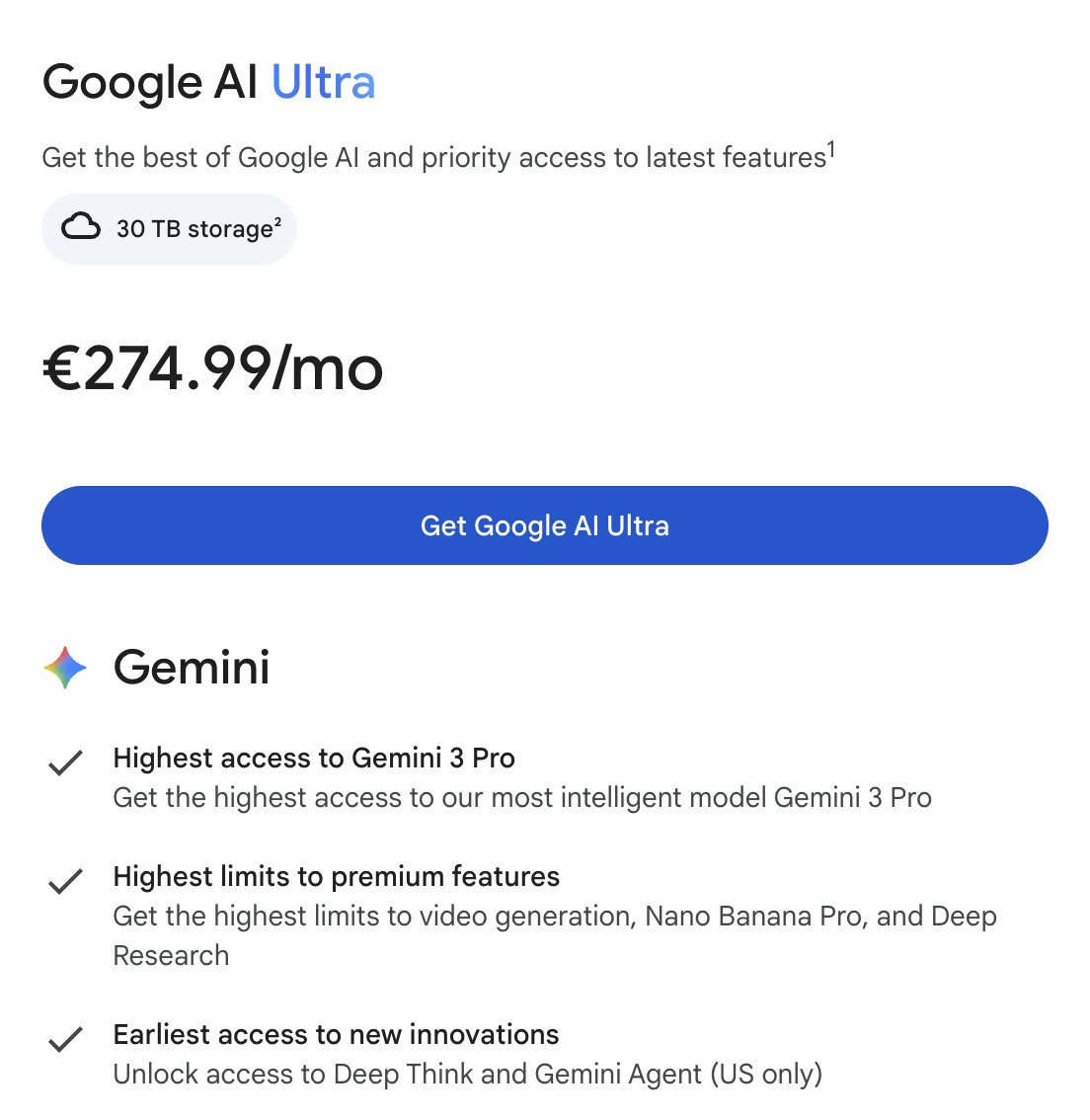

Discussion insight: The I/O deferral pattern is stable: users are not switching away in large numbers, but they are not trusting new investment until Google confirms the roadmap. The rate-limit complaints are operational rather than existential.
Comparison to prior day: May 16's Antigravity story had more concrete negative evidence (v1.23.2 from April 16 still current, context loss, forgotten checkpoints). May 17 added the Google AI Ultra bundle confirmation as a positive signal and the I/O expectation as the community's settlement point.
1.5 Developer tool stack migration crystallized in a 2025 vs 2026 comparison 🡕
@AntonMartyniuk published (42 likes, 6 retweets, 41 bookmarks, 1,461 views) a "2025 vs 2026" tool comparison that laid out a clean migration map: GitHub Copilot to Claude Code, Visual Studio to Cursor, VS Code to Rider, Keyboard to Wispr Flow, Stack Overflow to OpenAI Codex, "works on my machine" to Docker Desktop, Fireflies to Granola, Confluence docs to Claude Skills, Google Scholar to NotebookLM, Draw.io to Eraser.io.

The 41 bookmarks with only 1,461 views indicate a high save-to-view ratio — developers are collecting this as a reference. A reply noted that running agents locally changes the design approach by removing budget constraints, though @AntonMartyniuk replied that local model quality remains well behind cloud models.
Comparison to prior day: No comparable summary appeared on May 16. This is May 17-specific content that consolidates trends observed across the week.
2. What Frustrates People
GitHub Copilot billing opacity reaches breaking point
The sharpest frustration of the day is that Copilot users are learning their actual token costs through a calculator preview, not through advance communication. @edzitron showed (827 likes, 60,564 views) the viral $451-to-$11,432 example, and @therealshodan posted (660 views) a more typical heavy-user case at $123.67. A reply from @JoshCaughtFire said his own $39/month plan had consumed $72 worth of token dollars in April, adding "good while it lasted." The pattern is consistent: users built workflows around a heavily subsidized model without knowing the real token economics. The June 1 transition date makes this acute. Severity: High. The need is not just cheaper tokens — it is usage observability before the bill arrives and workflow guardrails that prevent runaway consumption.
Codex quota and reset mechanics are unreliable
@koltregaskes reported (17 likes, 7 replies, 660 views) that Codex's usage counter dropped to 0% and blocked new messages while the weekly quota panel still showed 37% remaining. The reset date also changed without notice from May 18 to May 23. He described getting "compacted" messages he could not stop. This is a reliability and trust issue distinct from the billing cost issue: users cannot plan workload around limits they cannot predict. Severity: Medium to High, because it breaks the core workflow of pacing agent work against quota cycles. @BradGroux showed (972 views) the other side of this — when a reset does land, he immediately queues a 3+ hour full-codebase audit, treating the reset as a scarce resource to exploit fully.
Antigravity rate limits and model unavailability erode daily use
@ossynoya said (36 likes, 2,565 views) Antigravity has become "terrible to use" for pro users. Replies cited limits and traffic errors, Gemini models unavailable during daytime hours, and Claude model availability inconsistency. One user switched back to VS Code entirely. The inconsistency is compounded by feature availability differences: @LexnLin showed (129 likes) Plan mode still working while @SubleBoom said it had disappeared for them. Severity: High for users who adopted it as a primary IDE. The coping pattern is returning to VS Code for reliability while waiting on Google I/O announcements.
Skill atrophy anxiety is surfacing as humor
@pdrmnvd posted (8 likes, 113 views) that Claude "stopped and asked me to write the code myself and he laughed when he realized I couldn't do it anymore." The joke frames a real concern: developers who have spent months relying on agents for all coding are unsure how much manual skill they have retained. This was reinforced by @Hesamation pointing (11 likes, 370 views) to a YouTube video titled "The bar is incredibly low and always getting lower — we should've gatekept programming" (117K views, 5.4K likes) in which the presenter argues that vibe coding lowered quality standards and the industry normalized it. Severity: Low for individual workflows, but Medium as a signal that the practitioner community is grappling with skill dependency.
3. What People Wish Existed
IaC generation that agents can deploy without leaving the coding tool
@thdxr wrote (153 likes, 10,433 views) that the missing piece in an OpenCode + Vercel "maximally lazy" workflow is an IaC file the agent can create itself, so deployment requires only one CLI and zero manual infrastructure steps. He also said a native database (SQLite, not a marketplace integration) would complete the picture. The need is practical and clearly bounded: the agent should own the full loop from code to deployed infrastructure without handing off to a human for config. Opportunity rating: direct. The audience is developers deploying internal tooling and small production apps. Vercel already has the distribution side; the gap is on the IaC generation and the embedded data layer.
Billing observability before the invoice
No tweet phrased this as a wish explicitly, but the pattern across the billing items is consistent: users want to know their token spend in real time, not via a retroactive calculator. The need for a spend dashboard, budget alerts, and model-mix guidance before bills land is inferred from the shock response to the Copilot billing preview. Opportunity rating: direct and competitive (Copilot itself needs to add this, but third-party spend-monitoring tools could fill the gap now).
Cross-agent skill portability without manual reformatting
@DanKornas announced (784 views, 20 bookmarks) SkillKit as the answer, but the high bookmark/view ratio says the problem is widely felt. The wish is to write a skill once and have it work across Claude Code, Cursor, Codex, Copilot, Windsurf, and OpenCode without manually translating formats. Opportunity rating: competitive — SkillKit and several similar tools launched this week.
Reliable Antigravity with consistent model access
@ossynoya, @SubleBoom, and @EmeraldOnyeka5 all described returning to simpler tools because Antigravity's model access was too unpredictable. The wish is an Antigravity that works when you open it, with the same features available to all users on the same plan. Opportunity rating: aspirational (this is Google's product to fix).
4. Tools and Methods in Use
| Tool | Category | Sentiment | Strengths | Limitations |
|---|---|---|---|---|
| Claude Code | AI coding agent (CLI) | (+/-) | Tight agentic loop, SWE-bench performance, 4% of public GitHub commits, auto-compaction maintains context | $200/month ceiling, Anthropic-only models, no LSP feedback loop, closed source |
| OpenCode | AI coding agent (CLI) | (+) | 75+ model providers, free tool (pay model API directly), MIT licensed, LSP diagnostics loop, desktop app, 150K stars | Context drop on 4k+ token sessions vs Claude Code auto-compaction |
| Hermes Agent | Multi-modal agent framework | (+) | OAuth subscription bridging (hermes proxy), 22 messaging platforms, grok-4.3 1M context, LSP diagnostics, native Windows beta | Scope creep concern from community; Claude Pro not yet supported in proxy |
| GitHub Copilot | AI coding assistant (IDE) | (-) | Wide IDE coverage, session management in new desktop app | Token billing shock ($451 plan → $11,432 usage-based), trust erosion from PR ad injection, quota confusion |
| Antigravity | AI coding IDE (Google) | (+/-) | Browser automation (Chrome), Plan mode (for some users), bundled in Google AI Ultra | Rate limit errors, model unavailability during daytime, inconsistent feature access across users, no visible update since Apr 16 |
| Codex | AI coding agent (CLI, OpenAI) | (+/-) | Open-sourced, long autonomous sessions, multi-agent orchestration (ULTRAWORK MODE), used as its own reference for harnesses | Quota counter unreliability, reset date confusion, "out of messages" despite remaining balance |
| Cursor | AI IDE | (+) | AI-native IDE workflow, tab-complete, inline edits, mentioned as 2026 standard by multiple users | Less mentioned than Claude Code or OpenCode in this feed |
| SkillKit | Skill package manager | (+) | 46-agent support, 400K+ skills, format translation, stack-aware recommendations, Apache 2.0, Product Hunt #3 | Early-stage; 1.1K stars, 2.6K/month downloads |
| Vercel | Deployment platform | (+) | Used alongside OpenCode for zero-friction internal app deployment | Lacks native SQLite/database; marketplace dependency required |
| Repowise | Codebase intelligence (MCP) | (+) | 4-layer codebase graph (AST + git hotspots + docs + ADRs), 5 MCP calls replace 30 grep+read calls, dead code detection | AGPL-3.0; early; first-time index for 3,000-file project takes ~25 minutes |
The overall sentiment spectrum runs from enthusiastic OpenCode adoption among cost-sensitive developers to frustrated Copilot users examining exit options. The migration pattern most visible today is Claude Code → OpenCode for price-sensitive teams, Antigravity → VS Code (temporary regression) for reliability-sensitive users, and GitHub Copilot → anything else among developers who saw the billing preview. The subscription-bridging approach (Hermes proxy, opencode-grok-plugin) is a community workaround for the API key requirement that is gaining adoption. Tools with the highest bookmark/view ratios on May 17 are SkillKit (20 bookmarks, 784 views = 2.6%) and the softaworks/agent-toolkit post (3 bookmarks, 395 views = 0.76%), indicating practitioners are saving skill tooling for later use.
5. What People Are Building
| Project | Who built it | What it does | Problem it solves | Stack | Stage | Links |
|---|---|---|---|---|---|---|
| SkillKit | @DanKornas | Package manager for AI agent skills across 46 agents | Skill fragmentation — rewriting skills per tool | TypeScript, npm | Shipped (v1.24.0) | GitHub / npm |
| opencode-power-pack | @waybarrios via @Dinosn | 11 Claude Code skills ported to OpenCode (code-review, security-review, feature-dev, frontend-design + 7 more) | Claude Code users migrating to OpenCode losing their skill libraries | OpenCode plugin | Shipped | GitHub |
| agent-toolkit (softaworks) | @leonardocouy via @tom_doerr | Curated opinionated skills for Claude Code: codex skill, gemini skill, agents, slash commands | Knowing what to install and configure in Claude Code | Claude Code plugin marketplace | Shipped | GitHub |
| AionUi | @aaliya_va | Desktop app unifying Claude Code, Codex, Gemini CLI under one interface with MCP sync and Team Mode | Juggling separate terminals and configs per agent | macOS/Windows/Linux, WebUI, Telegram, WeChat remote control | Alpha | GitHub |
| Skilled | @Everlier | TUI dashboard for agent skill usage: filter by project/agent, sort by usage, activity map | No visibility into which skills are being called and how often | Supports Claude Code, Codex, Droid, OpenCode, Grok Build | Alpha | post |
| opencode-grok-plugin | @iz_23520 via @q_yeon_gyu_kim | Plugin routing X/Grok OAuth subscriptions as OpenCode API calls | Not wanting to pay separate API fees when already subscribed to Grok | OpenCode plugin | Alpha (unofficial) | GitHub |
| Geek AI | @smolgeeek | Claude-powered crypto intelligence agent with live market feed, on-chain analysis, chart analysis, wallet-native login | Crypto navigation without multiple specialized tools | Claude API, Arc testnet (ERC-8004 identity) | Shipped (pro plan) | geekAI |
SkillKit solves the most widely felt pain point in this feed. As agent fragmentation grows (46 supported agents), the cost of maintaining skills per tool scales linearly. SkillKit installs via npm i -g skillkit, translates skills between formats (SKILL.md, .mdc, Markdown), and exposes skill search through a REST server and MCP wiring. Its Product Hunt #3 ranking on May 17 aligns with the release of v1.24.0. The 400K+ indexed skills and 1.1K GitHub stars indicate this is past proof-of-concept.

Skilled provides the observability layer that SkillKit and agent-toolkit don't: a usage telemetry TUI showing which skills are actually being called. The dashboard screenshot shows 1,152 total skill calls across 75 skills and 25 projects. The top skills by frequency are verification-before (217), bugbash (97), brainstorming (92), agent-integration-testing (68), agent-browser (64), and test-driven-development (57) — a clear picture of how practitioners actually sequence agent work.

The opencode-power-pack and opencode-grok-plugin are part of a pattern visible across multiple days: as OpenCode gains users migrating from Claude Code, community contributors are immediately building skill-porting and subscription-bridging tools to close the feature gap.
6. New and Notable
Hermes proxy bridges paid subscriptions to the OpenAI API surface
The most technically significant new capability announced on May 17 is Hermes Agent's local proxy mode. Running hermes proxy creates an OpenAI-compatible endpoint backed by a consumer OAuth subscription. Any tool expecting an OpenAI-compatible API — Codex CLI, Aider, Cline, Continue — can use a Claude Pro or ChatGPT Pro subscription as its model backend without a separate API key or API billing. This directly undercuts one of the main barriers to using community coding tools: the need for a paid API account on top of an existing chat subscription. The v0.14.0 release notes confirm this was the centerpiece of the "Foundation Release" alongside native Windows beta and the grok-4.3 1M-context SuperGrok integration.
Codex ULTRAWORK MODE enables named parallel sub-agent orchestration
@q_yeon_gyu_kim shared (16 likes, 898 views) a Codex terminal screenshot showing a session in "ULTRAWORK MODE" that had spawned four named sub-agents — Hubble [explorer], Poincare [explorer], Franklin [librarian], Confucius [librarian] — each running gpt-5.4-mini low, with MCP servers starting in parallel. The session was evaluating a project called "omo" in Codex. This is not a feature announcement, but a practitioner demonstration of Codex being used as a multi-agent orchestration platform.

GitHub Copilot Desktop App launches in preview
@pamelafox described (11 likes, 624 views) a GitHub Copilot Desktop App in preview — a UI wrapper over the Copilot CLI that manages agent sessions across multiple repositories. The screenshot shows a session completing a real pull request (dependency swap, auto-generated PR summary with validation notes). Availability is tied to Copilot plan. This is GitHub's desktop-agent response to the CLI ecosystem, arriving the same week the billing preview is generating the most backlash.
Google AI Ultra explicitly bundles Antigravity at €274.99/month
The Google AI Ultra pricing page (captured by @almmaasoglu) lists Antigravity under the heading "Highest rate limits to agent model in Google Antigravity, our agentic development platform." This is the most explicit public statement of Antigravity's status as a live, actively positioned product. The bundle also includes Gemini 3 Pro, Nano Banana Pro, Deep Research, Deep Think, Gemini Agent (US only), Gemini CLI, Code Assist, Jules, and 30 TB of storage.
7. Where the Opportunities Are
[+++] Real-time AI spend observability for coding workflows — The billing shock across GitHub Copilot (May 16–17 viral thread, 60,564 views, 827 likes) and Codex quota confusion (koltregaskes, reset date changed without notice) both trace to the same root: developers have no live visibility into what they are spending until the invoice or the block. A tool that tracks token spend per model per session, provides budget alerts, and models cost under different billing structures would address a pain point now affecting every heavy user of Copilot, Codex, and Claude Code. The near-term opportunity is a lightweight dashboard or CLI plugin; the medium-term opportunity is vendor-neutral spend management. Evidence from Sections 1, 2, and 3.
[+++] Cross-agent skill packaging and distribution — SkillKit (46 agents, 400K+ indexed skills, Product Hunt #3), opencode-power-pack (Claude Code skills ported to OpenCode), agent-toolkit (curated Claude Code skills), and Skilled (usage telemetry TUI) all launched or gained visibility on May 17. Each addresses a facet of the same problem: as developers use 3-5 agents simultaneously, skill configuration becomes a maintenance burden. The opportunity for a comprehensive registry — skills discoverable, translatable, and updatable across all major agents — is well-established. Evidence from Sections 1.5, 5.
[++] IaC generation inside agentic coding workflows — @thdxr's Vercel + OpenCode thread (153 likes, 10,433 views, 27 replies) articulated the gap precisely: the agent can write and deploy code, but infrastructure setup still requires manual steps. An agent that can generate Terraform, Pulumi, or Vercel config files from a description of the project's needs, then apply them autonomously, would close the "maximally lazy" workflow. The use case is strongest for internal tools and small production apps. Evidence from Sections 1.3 and 3.
[++] Subscription bridging as a developer tool primitive — The Hermes v0.14.0 proxy, the opencode-grok-plugin, and the Codex-inside-Claude-Code pattern (DivyanshT91162, 950 views) all demonstrate appetite for using one paid subscription as a backend for multiple tools. The pain is paying twice — once for a consumer subscription and once for API access to the same model. The opportunity is a general-purpose subscription bridge that supports more providers (including Claude Pro, which Anthropic currently blocks). Evidence from Sections 1.2 and 5.
[+] Agent skill usage analytics — Skilled's TUI showing 1,152 calls across 75 skills reveals that developers are already accumulating measurable skill usage data. The top skills (verification-before 217 calls, bugbash 97, agent-browser 64) suggest that practitioners want structured workflows, not just ad hoc prompting. An analytics product that aggregates skill usage across teams, surfaces patterns, and recommends skill libraries would serve both individual developers and engineering orgs. Evidence from Section 5.
8. Takeaways
-
GitHub Copilot's billing transition is the most consequential AI coding story of the week. The $451-to-$11,432 screenshot accumulated 827 likes and 60,564 views on a single viral quote-tweet by @edzitron. Developer exit evaluation is now active, not theoretical. (source)
-
Hermes v0.14.0's
hermes proxycommand directly addresses the API-key barrier. By routing Claude Pro, ChatGPT Pro, and SuperGrok subscriptions through an OpenAI-compatible endpoint, Hermes enables Codex CLI, Aider, and Cline users to avoid separate API billing. This is the first community tool to make subscription bridging a first-class feature with 808 commits behind it. (source) -
OpenCode is accumulating ecosystem tooling faster than Claude Code. On a single day: opencode-power-pack ported 11 Claude Code skills, an unofficial Grok OAuth plugin launched, and @thdxr described OpenCode + Vercel as his team's production internal app stack. The migration is not just about price — it is now about ecosystem depth. (source)
-
Antigravity's fate is formally deferred to Google I/O by community consensus. @SaiNemani1's short "Antigravity updates might be announced at Google I/O" (84 likes, 2,919 views) represents the community's settled posture. The Google AI Ultra €274.99/month pricing page confirms Antigravity is bundled and actively marketed, but inconsistent feature availability (Plan mode missing for some users, rate limits during daytime) keeps skepticism alive. (source)
-
The agent skill ecosystem is reaching observable maturity. SkillKit at Product Hunt #3, Skilled showing 1,152 real usage calls across 25 projects, and agent-toolkit's curated library together indicate that the "skills-as-packages" abstraction is consolidating. The question shifts from whether skills are useful to which packaging format wins. (source)