Twitter AI Coding - 2026-05-19
1. What People Are Talking About
1.1 GitHub Copilot is turning from assistant into orchestrator 🡕
The clearest shift in today's feed was not just that Copilot can code, but that it is gaining more places to run, more ways to hand work off, and more ways to be supervised. Compared with May 18's launch-heavy conversation about remote control and hooks, May 19 added cloud-hosted CI repair, desktop session spawning, mobile-facing model rollout, and fresh user discussion about the Copilot app's ergonomics.
@code announced (140 likes, 2 replies, 18,463 views) that remote control for GitHub Copilot CLI and @code sessions is now generally available, framing Copilot as something you monitor and approve from anywhere rather than a tool tied to one terminal window. That broader runtime story got more concrete when @GHchangelog said (11 likes, 1,069 views) Copilot Business and Enterprise users can now ask the cloud agent to fix failing GitHub Actions jobs in one click; the linked changelog says Copilot investigates in its own cloud development environment, pushes a fix to the branch, and tags the user for review.
@jfversluis showed (4 likes, 3 replies, 272 views) the Copilot app spawning a second session from inside the first one, seeding it with context for a different repo and letting it begin code search independently. That is a stronger claim than generic “multi-agent” marketing because the screenshots show the spawned session creating a worktree and searching MAUI toolbar badge code. @lexrus added (9 likes, 3 replies, 1,386 views) a product-design angle by posting the new Copilot app UI and then saying in replies that it feels laggier than Codex, especially when rendering markdown, which turned the desktop app from abstract launch talk into comparative UX feedback.


Discussion insight: Even the supportive discussion is now about orchestration quality, not autocomplete novelty: the cloud-agent story stresses background execution and reviewable output, while the app screenshots prompted direct comparisons against Codex on responsiveness.
Comparison to prior day: On May 18, Copilot's strongest evidence was remote control, hooks, and Spaces/API surface area. On May 19, the conversation moved further into operational handoffs: spawned sessions, cloud-hosted CI repair, and a desktop app people were already benchmarking against rival agent runtimes.
1.2 Security and governance moved to the center of agent discussions 🡕
Another strong theme was that agent adoption is now being discussed in enterprise-control terms: where the code runs, how it reaches private systems, and how credentials are handed to it without leaking into prompts or context windows. This was one of the most evidence-dense parts of the feed because it combined product announcements, architecture diagrams, and external reporting.
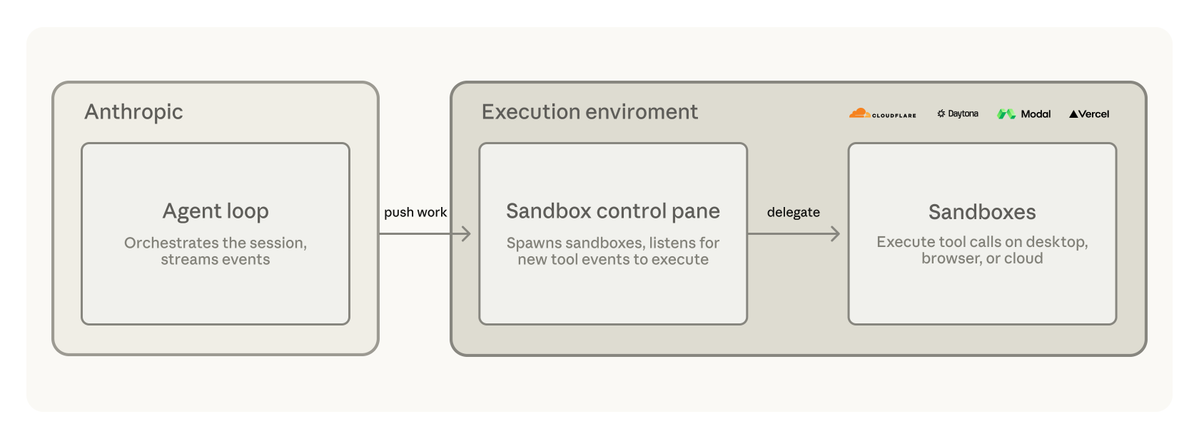
@testingcatalog summarized (38 likes, 3 replies, 2,004 views) Anthropic's self-hosted sandboxes and MCP tunnels for Claude Managed Agents, and the attached diagram clarified the architecture: an Anthropic-managed agent loop pushes work to a sandbox control plane, which then delegates execution into desktop, browser, or cloud sandboxes. Replies sharpened the point by calling private MCP access and self-hosted execution a trust barrier remover for enterprises that cannot pipe sensitive code through third-party infrastructure.
@ithilgore pointed (6 likes, 985 views) to Forbes coverage of OpenAI and 1Password's Codex security work. The article adds the missing substance: 1Password's Environments MCP Server gives Codex just-in-time access to credentials without putting secrets into prompts, code, or model context, and OpenAI's agent security lead explicitly argues for audit trails, continuous authorization, and credential mediation as sub-agents become more common. Together, these items show the market moving from “can the agent do it?” to “under whose controls, with which credentials, and with what audit record?”
Discussion insight: The discussion did not revolve around abstract AI safety. It stayed concrete: private-network MCP access, self-hosted sandboxes, just-in-time credentials, and observability for sub-agent actions.
Comparison to prior day: On May 18, governance showed up mostly as remote-control trust and admin-visibility anxiety around Copilot. On May 19, the conversation matured into perimeter architecture and credential mediation, with both Anthropic and OpenAI-linked evidence on the table.
1.3 Cost control and routing are becoming first-class workflow concerns 🡕
Pricing and token discipline stayed central, but the tone shifted from complaint to operational workaround. The feed had multiple examples of people changing harnesses, routers, and model mixes to make coding agents economically tolerable.
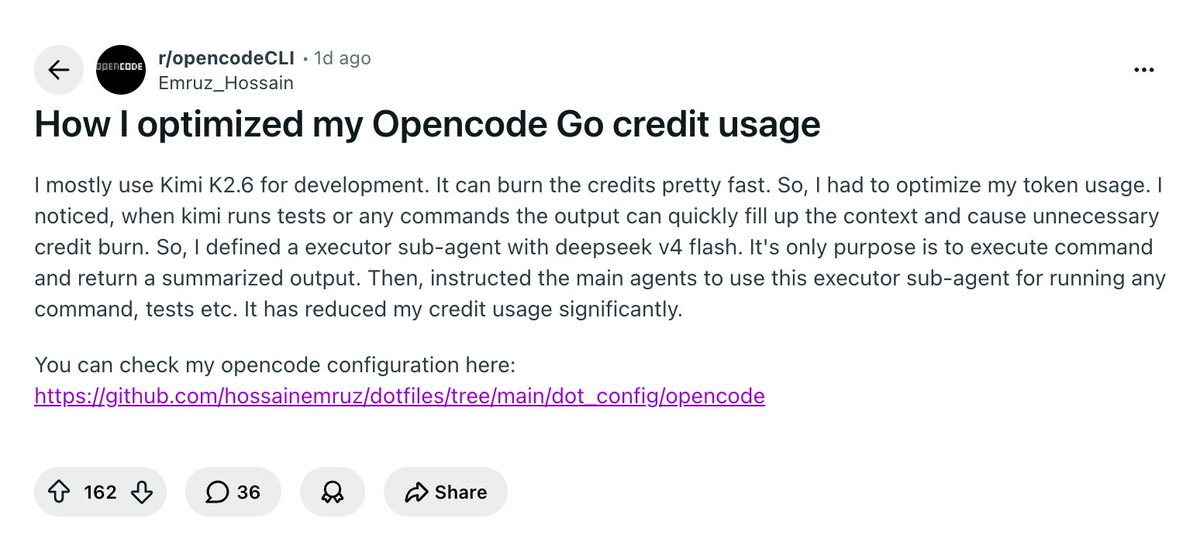
@DeepakNesss shared (4 likes, 2 replies, 80 views) a specific OpenCode optimization pattern: Kimi K2.6 as the main orchestrator, with cheaper DeepSeek v4 Flash sub-agents executing commands and tests so output does not burn expensive context. The screenshot matters because it explains the mechanism in detail instead of just claiming lower spend.
@FellMentKE highlighted (3 likes, 2 replies, 3,132 views) UncommonRoute, and the linked repo says the local router solved 75 of 100 held-out SWE-bench Verified tasks versus 74 for Opus-only at 53 percent lower API cost, while exposing a dashboard for per-request routing decisions across Claude Code, Codex, Cursor, and the OpenAI SDK. On the platform side, @Sarthak4Alpha warned (16 likes, 12 replies, 213 views) that GitHub Copilot's June 1 token-based billing will hit heavy agentic workflows harder than simple completions and will pull code reviews into GitHub Actions metering as well.
Discussion insight: The feed now treats routing as a normal engineering lever. People are not just picking a favorite model; they are introducing sub-agents, local routers, and task-based escalation rules to control burn.
Comparison to prior day: On May 18, the pricing theme still leaned toward quota shock and free-tier breakage. On May 19, the stronger signal was adaptation: route cheaper, meter commands differently, and audit the true cost of multi-step agent workflows.
1.4 Google's coding-model momentum showed up more in Copilot than in Antigravity 🡒
Google-related attention remained high, but the strongest evidence did not come from Antigravity itself. Instead, the most concrete Google-model story in today's dataset was GitHub distributing Gemini 3.5 Flash inside Copilot while standalone Antigravity still drew skepticism and waiting-room behavior.
@github announced (52 likes, 4 replies, 6,710 views) that Gemini 3.5 Flash is generally available and rolling out in GitHub Copilot, and @GHchangelog added (50 likes, 5 replies, 3,123 views) that it is reaching Copilot Pro, Pro+, Business, and Enterprise users across major IDEs and GitHub Mobile. The linked changelog says GitHub sees near-Pro coding quality at Flash-tier speed and cost, with strong tool use and high cache efficiency, but also notes a tentative 14x premium request multiplier and policy gating for business plans.
That distribution story sat beside weaker standalone product confidence. @Surendar__05 said (24 likes, 28 replies, 650 views) that nobody they spoke to actually uses Antigravity or Gemini models for coding, and the attached image was only a branded title card, not product evidence. @EdenKollcinaku posted (292 likes, 8 replies, 16,930 views) a countdown-to-I/O image that again showed anticipation more than product proof.
Discussion insight: The Google coding story remains bifurcated: excitement and speculation around I/O-branded surfaces, but clearer day-to-day adoption evidence when Gemini is distributed through somebody else's coding product.
Comparison to prior day: On May 18, Antigravity speculation was driven by leak culture and routing screenshots. On May 19, the public, structured launch signal came from GitHub shipping Gemini 3.5 Flash in Copilot, while Antigravity itself still lacked comparable user conviction.
2. What Frustrates People
Metered agent workflows are exposing real cost anxiety
@Sarthak4Alpha warned (16 likes, 12 replies, 213 views) that GitHub Copilot's token-based billing will make heavy agentic workflows more expensive and even pull code reviews into GitHub Actions minutes. The frustration is not that AI coding costs money; it is that richer autonomous workflows are now being metered more explicitly, which makes people feel they may not understand their real monthly exposure until the bill lands. Severity: High.
The workaround pattern was visible elsewhere in the feed. @DeepakNesss used (4 likes, 2 replies, 80 views) cheaper executor sub-agents for command-heavy work, while the UncommonRoute repo linked by @FellMentKE explicitly sells per-request model routing as a way to halve API bills without sacrificing benchmarked performance. Worth building for: Yes. The pain is specific, recurrent, and already producing improvised routing layers.
Copilot's new desktop surface still looks rough against Codex-style competitors
@lexrus posted (9 likes, 3 replies, 1,386 views) the new GitHub Copilot app and then said in replies that it feels laggier than Codex, especially on markdown-heavy views. That is a practical complaint rather than a culture-war jab: users are already benchmarking these products on render speed, session clarity, and how easy it is to follow the agent's work. Severity: Medium.
The frustration is not that Copilot lacks features; section 1 shows the opposite. The problem is that once users can compare spawned sessions, plan mode, and remote control across tools, polish gaps become more obvious. Worth building for: Yes, but as workflow observability and interface quality, not another bare model wrapper.
Google still has not convinced practitioners that Antigravity is a daily coding tool
@Surendar__05 asked (24 likes, 28 replies, 650 views) why Gemini remains bad at coding if Google has spent decades crawling code, and said nobody they talk to actually uses Antigravity. That was a stronger practical complaint than the day's countdown and branding posts, which mostly showed expectation rather than successful use. Severity: Medium.
The coping pattern is to use Google models indirectly when another product ships them with better workflow glue. That is exactly what today's GitHub Gemini 3.5 Flash rollout suggests. Worth building for: Possibly, but the opportunity sits more in product packaging and workflow integration than in raw model availability.
3. What People Wish Existed
Auditable, secure agent runtimes inside the enterprise perimeter
The clearest practical need in today's feed was for agents that can reach private systems without forcing teams to give up security controls. @testingcatalog reported (38 likes, 3 replies, 2,004 views) self-hosted sandboxes and MCP tunnels for Claude Managed Agents, while the Forbes article linked by @ithilgore argues for just-in-time credential access, continuous authorization, and auditable sub-agent behavior in Codex. Opportunity rating: direct.
Smarter cost-routing and budget control across agent stacks
@DeepakNesss documented a sub-agent pattern to keep OpenCode credits low, and the UncommonRoute repo linked from @FellMentKE formalizes the same instinct with local routing, dashboards, and spend-aware model selection. The need is practical and urgent because metered agent usage is no longer hypothetical. Opportunity rating: direct.
Better away-from-desk supervision for long-running agents
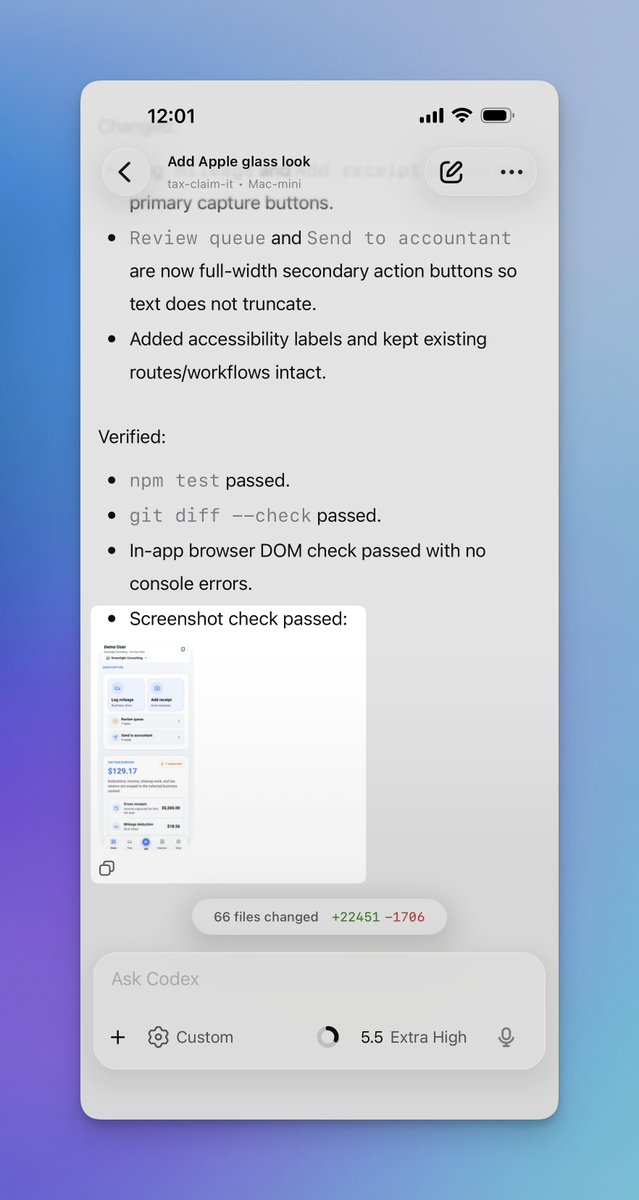
@code announced remote control for Copilot CLI and app sessions, and @DevAdventur3s showed (4 likes, 1 reply, 167 views) Codex in the ChatGPT app receiving screenshots and presenting verification checks on mobile. People clearly want agents to keep working while they step away, but with enough visibility to approve, inspect, and steer from the phone. Opportunity rating: direct.
Clearer agent observability from the buyer's side
@anandPa94 introduced (4 likes, 2 replies, 49 views) Scope as a platform that shows how Claude Code, Codex, and Cursor interact with a product, where they get stuck, and when they choose a competitor. That pitch worked because it answered a concrete new buyer question: not “which model is best?” but “how do agents actually experience my product?” Opportunity rating: competitive.
4. Tools and Methods in Use
| Tool | Category | Sentiment | Strengths | Limitations |
|---|---|---|---|---|
| GitHub Copilot / Copilot app / cloud agent | AI coding assistant + hosted agent | (+/-) | Remote control, spawned sessions, one-click CI fixes, broad distribution across GitHub surfaces | Desktop app polish is still being compared unfavorably with Codex; richer workflows now surface billing concerns |
| Gemini 3.5 Flash in Copilot | Model distribution inside coding tool | (+) | GitHub claims near-Pro coding quality at Flash-tier speed/cost, strong tool use, fast responses, high cache efficiency | Tentative 14x premium multiplier; enterprise access can require policy enablement |
| Claude Managed Agents with self-hosted sandboxes + MCP tunnels | Enterprise agent runtime | (+) | Private-network access, self-hosted execution, clearer security posture for sensitive codebases | Public evidence today was architecture-level, not hands-on throughput or DX proof |
| Codex mobile in ChatGPT | Mobile agent supervision | (+) | Shows verification steps, screenshot evidence, and remote task review away from the desk | Evidence today was still low-volume and mobile-first, not deep workstation replacement |
| OpenCode | Terminal coding agent | (+/-) | Users praised cleaner UX and headless operation; supports multi-provider setups and harness experimentation | Cost still matters enough that users are inventing sub-agent execution schemes and migrating harnesses |
| UncommonRoute | Model router / proxy | (+) | Local per-request routing, dashboard, benchmarked cost savings, drop-in support for Claude Code/Codex/Cursor/OpenAI SDK | Early-stage infrastructure layer that adds another component to operate |
| 1Password Environments MCP Server for Codex | Agent credential/security layer | (+) | Just-in-time credential access without exposing secrets in prompts or model context | Adds identity and access-management complexity that teams still need to design carefully |
The overall satisfaction spectrum was wide but pragmatic. People were willing to mix and match models, routers, mobile supervision, and hosted agents as long as each layer solved a concrete workflow problem. The biggest migration pattern was not “everyone leaves tool X for tool Y”; it was introducing routing and harness layers so the same models could be used more cheaply or more safely. Competitive dynamics are also shifting: Google's strongest coding-model evidence today appeared through Copilot distribution, while OpenCode and Codex continued to win mindshare on UX and runtime control.
5. What People Are Building
| Project | Who built it | What it does | Problem it solves | Stack | Stage | Links |
|---|---|---|---|---|---|---|
| UncommonRoute | @FellMentKE / CommonstackAI | Routes each coding-agent request to the cheapest suitable model and exposes routing decisions in a dashboard | Frontier-model quality is expensive when every request is sent to the strongest model | Python, local router, dashboard, Claude Code/Codex/Cursor/OpenAI SDK integrations | Beta | GitHub / tweet |
| skillgrade v0.1.5 | @mgechev | Evaluates agent skills and now adds OpenCode support plus configurable grader providers | Teams need a repeatable way to test whether skills are actually discovered and used correctly | Node.js, Docker, eval.yaml, OpenCode support | Shipped | GitHub / tweet |
| Wearable remote control for Codex agents | @DsouzaJovian | Prototype hardware for controlling Codex agents remotely at a hackathon | Agent sessions are useful away from the desk only if users can steer them from other devices | Custom hardware, Codex, hackathon prototype | Alpha | tweet |
| Scope | @anandPa94 | Observability platform for how Claude Code, Codex, Cursor, and similar agents traverse a product | Product teams do not know where agents get stuck or why agents choose competitors | Agent workflow replay, trace analysis, product instrumentation | Beta | tweet |
UncommonRoute was the strongest builder signal because the repo answered the obvious follow-up questions: benchmark results, supported clients, health checks, and a dashboard for inspecting every route. That is a sign the router category is maturing from a vague “use cheaper models” tip into a productized operations layer.
skillgrade pointed to a different pattern: builders are starting to create infrastructure around skills themselves, not just around models. @mgechev published (7 likes, 499 views) version 0.1.5 with OpenCode support and configurable grader providers, suggesting that evaluation harnesses are becoming part of the coding-agent toolchain.
@DsouzaJovian showed (12 likes, 2 replies, 309 views) a wearable remote-control prototype for Codex agents, while @anandPa94 framed Scope as the buyer-side observability layer for agent-driven product usage. Those two builds sit on opposite sides of the same shift: one tries to make agents easier to supervise, the other tries to make their behavior legible to product teams.
Repeated builder pattern: people are no longer mostly building “yet another coding chat.” They are building routing layers, evaluators, observability layers, and remote-control surfaces around the agents that already exist.
6. New and Notable
Gemini 3.5 Flash reached GitHub Copilot
@github announced (52 likes, 4 replies, 6,710 views) the rollout, and @GHchangelog documented (50 likes, 5 replies, 3,123 views) the actual availability across Copilot Pro, Pro+, Business, Enterprise, major IDEs, and GitHub Mobile. This mattered more than a routine model-picker update because it gave Google's newest Flash-tier coding model immediate distribution inside a workflow product developers already use.
Copilot cloud agent can now fix failing Actions jobs from the logs page
@GHchangelog announced (11 likes, 1,069 views) that Business and Enterprise users can ask Copilot to repair failing GitHub Actions jobs in one click. The linked changelog says Copilot investigates in a separate cloud environment, pushes a fix to the branch, and tags the user for review, making this one of the cleanest examples today of AI coding work moving out of the local IDE and into background infrastructure.
7. Where the Opportunities Are
[+++] Agent governance and security mediation — Anthropic's self-hosted sandboxes and MCP tunnels plus the OpenAI/1Password Codex work both point to the same unsolved layer: private-network access, credential mediation, audit trails, and continuous authorization for sub-agents. This opportunity is strong because it is already being defined in concrete operational terms, not abstract safety language.
[+++] Cost-routing and spend visibility for agentic workflows — DeepakNess's OpenCode sub-agent pattern, UncommonRoute's benchmarked local router, and Copilot's token-billing anxiety all say the same thing: teams need help deciding when to pay for frontier reasoning and when not to. The strongest product wedge is not a cheaper model, but a control plane for routing, budgeting, and explaining spend.
[++] Agent observability for product and workflow owners — Scope's pitch and the broader feed both suggest that companies increasingly need to know how agents traverse onboarding, docs, auth, and feature flows. The opportunity is moderate because observability is already competitive, but the underlying need is becoming much more visible.
[+] Remote-supervision surfaces for always-on agents — Copilot remote control, Codex mobile screenshots, and hackathon wearable controls all show appetite for supervising long-running agents from other devices. The signal is emerging because usage is real, but the market shape is still forming.
8. Takeaways
- GitHub Copilot's story moved from feature launch to workflow orchestration. Remote control, cloud-hosted CI repair, and spawned sessions in the Copilot app made the product feel more like a runtime manager than a chat sidebar. (source)
- Enterprise agent adoption is now being argued through perimeter and credential design. Anthropic's sandbox/tunnel architecture and the OpenAI-1Password Codex story both centered on secure execution and mediated access, not raw model capability. (source)
- Cost control is becoming a product category around coding agents. The day produced both a practitioner recipe for cheap executor sub-agents and a repo that benchmarked local model routing against an Opus-only baseline. (source)
- Google's coding-model momentum was clearer through Copilot than through Antigravity itself. The most concrete Google-model signal was GitHub shipping Gemini 3.5 Flash into Copilot, while Antigravity discussion still leaned on anticipation and skepticism. (source)
- Builders are increasingly wrapping agents with control layers instead of replacing them. Today's notable projects focused on routing, evaluation, observability, and remote supervision rather than a brand-new coding assistant. (source)