Twitter AI Coding - 2026-05-21
1. What People Are Talking About
1.1 OpenAI turned Codex usage into first-party documentation and product updates 🡕
The biggest shift in today's feed was that Codex discussion moved from outside commentary to OpenAI-authored guidance and shipped product surfaces. The dataset combined OpenAI's own usage report, Appshots and goal-mode rollout notes, iOS supervision updates, and user reports of browser-based self-testing. Together these posts made Codex look less like a promising tool and more like a structured operating environment.
@AIHighlight reported (112 likes, 3 replies, 8,783 views) that OpenAI had published a "How OpenAI uses Codex" report. The attached screenshot shows Codex used daily across Security, Product Engineering, Frontend, API, Infrastructure, and Performance Engineering, and the thread replies add two concrete behaviors: engineers use it to read unfamiliar code quickly and to refactor across many files.

@testingcatalog noted (104 likes, 5 replies, 7,489 views) that Codex on macOS now supports Appshots. The attached settings screen makes the mechanism explicit: pressing both Command keys sends the frontmost window to Codex with both screenshot and text. The Codex changelog adds that goal mode is now generally available across the app, IDE extension, and CLI, with plugin sharing and remote locked-computer use in the same release.

@9to5mac reported (131 likes, 3 replies, 13,170 views) that Codex in the ChatGPT iOS app added turn-completion notifications and more commands, and the linked article adds the Sign in with Apple fix, /fork, better diff and reconnection UI, and /side on the way. @freddier said (129 likes, 9 replies, 5,516 views) that Codex can already click through the app it built, check behavior, find bugs, and fix them if asked directly, which turns browser use into a concrete QA loop rather than a demo feature.
Discussion insight: Replies around Appshots and browser testing converged on one point: the bottleneck is no longer raw code generation so much as getting the right context and the right verification target into the tool.
Comparison to prior day: May 20 centered on security incidents and vendor comparison. May 21 shifted toward first-party Codex documentation, release notes, and product surfaces.
1.2 Teams are turning agent know-how into reusable workflows, training, and interfaces 🡕
A second theme was operational packaging. Instead of asking whether AI coding works at all, posts showed people wrapping it into workshops, cheat sheets, workflow UIs, and internal build habits that can be repeated by others. The strongest evidence came from research training, Copilot's new Workflows surface, and community documentation around Copilot CLI.
@nasqret reported (76 likes, 1 reply, 2,781 views) that after a 300-person ChatGPT training round, 60 researchers were in a longer Codex course, and after 12 hours they had already built apps for topological insulators, gene expression, and hidden symmetries. The workshop photos matter because they show a real science visualization app running on a participant laptop, not just classroom promotion.

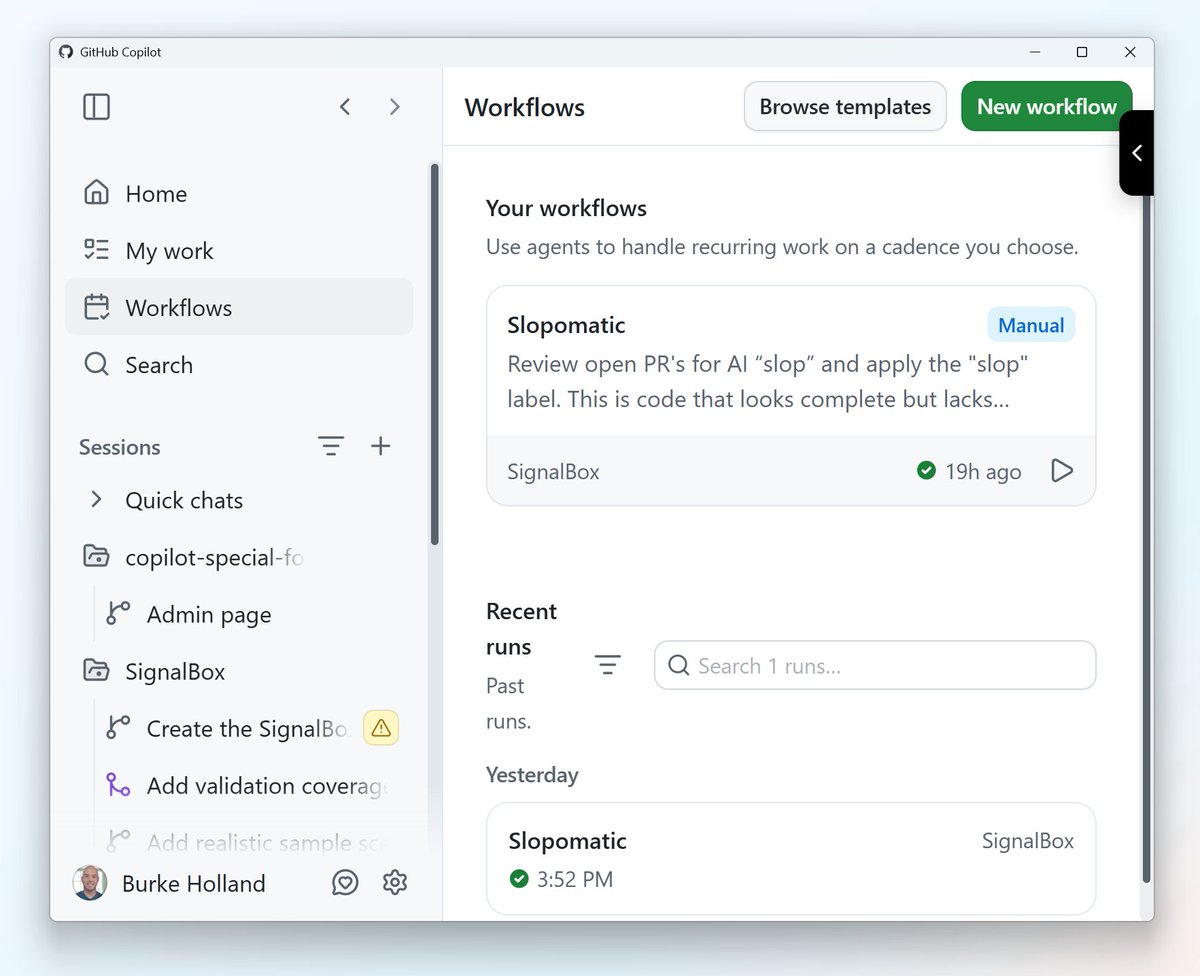
@burkeholland said (56 likes, 6 replies, 4,456 views) he was enjoying the new Workflows feature in the GitHub Copilot App, and the screenshot shows recurring agent jobs plus recent runs in a desktop UI. The replies add the main caveat: enterprise enablement is still rough, with one user unable to get it working on enterprise and another hitting Windows VM file-lock errors.
@DanWahlin highlighted (32 likes, 1,470 views) a GitHub Copilot CLI cheat sheet site created by Prasad Honrao; the linked site and repo show searchable command categories, examples, and demos rather than a static list. @_lopopolo added (77 likes, 9 replies, 3,690 views) a product-building example from inside OpenAI, saying that ChatGPT Record was built by a five-person team using o1-preview, o3, and early Codex in Swift and SwiftUI, with replies crediting modular ownership and aggressive Swift 6 linting.
Discussion insight: The useful material today was repeatable process - live workshops, workflow UIs, command references, and modular build discipline - not generic prompting advice.
Comparison to prior day: May 20 already showed skills and training growing, but May 21 added more end-user surfaces and live examples of people using those methods to ship or teach.
1.3 Interoperability and workflow-control layers became a real build pattern 🡕
Another clear theme was that builders are not waiting for one perfect assistant. They are wiring coding agents together, adding PR tooling around them, and publishing reusable prompt and search layers. The conversation around model rivalry was less prominent than the evidence that people are building bridges and control planes on top of existing tools.
@rushu888 shared (33 likes, 6 replies, 81 views) that OpenAI had dropped a plugin that lets people run Codex inside Claude Code. The linked openai/codex-plugin-cc repo makes the bridge concrete with /codex:review, /codex:adversarial-review, /codex:rescue, /codex:status, and /codex:result.
@pamelafox said (14 likes, 2 replies, 523 views) that the GitHub MCP server now has a dedicated tool for replying to inline PR comments, and the screenshot shows the approval flow for that exact tool call. The linked review-pr-comments skill and github/github-mcp-server#1856 turn that primitive into a real review workflow.

@masihmoloodian introduced (2 likes, 2 replies, 35 views) Sema as local semantic search for Claude Code and Codex, and the repo frames the problem as 10,000-25,000 tokens wasted on cold-start repository navigation. @petabridge added (3 likes, 1 reply, 447 views) that Netclaw v0.20.0 can now use GitHub Copilot as an inference provider, while @tom_doerr shared (7 likes, 570 views) a 1,042-star prompt-pack repo for delegation, memory, and multi-agent coordination.
Discussion insight: The build pattern is not "replace Codex, Claude Code, or Copilot." It is "make them easier to compose, search, review, and supervise."
Comparison to prior day: May 20 already had skill packs and wrappers, but May 21 added more concrete shipped bridges, repo links, and PR-oriented tooling.
1.4 Pricing, quotas, and rollout friction kept pushing people toward switching and skepticism 🡕
The last major theme was budget and rollout friction. Google spent much of the day reacting to Antigravity quota complaints, while OpenAI-linked posts framed free credits and switch incentives as a competitive wedge. That made pricing feel less like background noise and more like a direct lever in tool adoption.
@Iguanasan said (1 like, 1 reply, 43 views) one prompt in an existing project burned through 100% of a basic Google account's quota and nearly a week's worth of AI Pro tokens in about 24 hours, and the screenshot literally shows a "Model quota reached" banner with a future refresh time.

@ai_for_success reported (54 likes, 6 replies, 2,275 views) that Google had tripled Gemini model rate limits across all paid Antigravity tiers and reset everyone's weekly quota, quoting Logan Kilpatrick directly. That made the vendor response a story in itself, not just the complaints.
@aaronrubin said (19 likes, 1 reply, 1,646 views) that OpenAI had given his company 60 days of Codex credits worth about $100,000, and @trikcode posted (6 likes, 6 replies, 93 views) a screenshot quoting Sam Altman offering companies two months of free Codex usage to try switching.

@RussellQuantum argued (12 likes, 4 replies, 689 views) that Antigravity 2.0's CLI, SDK, and managed execution were building a walled garden, and @ZackKorman showed (14 likes, 4 replies, 432 views) that even product discovery was messy, with Google search surfacing a lookalike Antigravity IDE site above an ad-heavy fake landing page.
Discussion insight: The strongest pricing posts were not abstract complaints about expensive models. They were screenshots of quotas, direct switch offers, and rollout issues that changed what tool people could use today.
Comparison to prior day: May 20's cost theme was mostly about routing and local models. May 21 shifted toward quotas, plan design, and vendor-funded switching.
2. What Frustrates People
Quotas and billing models still break normal usage
@Iguanasan said (1 like, 1 reply, 43 views) that one prompt exhausted a baseline Antigravity quota and nearly a week's worth of AI Pro tokens in about 24 hours, and the screenshot makes the complaint concrete with a visible "Model quota reached" banner. @ai_for_success reported (54 likes, 6 replies, 2,275 views) that Google reacted by tripling Gemini rate limits and resetting the week's quota, which implies the original limits were painful enough to need an immediate correction. Severity: High.
@limatech_ar argued (1 like, 22 views) that Antigravity 2.0 forces users onto expensive Gemini options and attached a chart claiming a steep cost gap between Gemini 3.5 Flash and Gemini 3 Flash. OpenAI-linked posts then used free credits as competitive ammunition: @aaronrubin said (19 likes, 1 reply, 1,646 views) his company got about $100,000 in Codex credits, while @trikcode posted (6 likes, 6 replies, 93 views) Sam Altman's two-month switch offer. Worth building for: Yes. The feed is showing a direct need for spend visibility, plan design that matches real usage, and easier multi-provider fallback.
Cross-app context is still too manual
@petertr99 said (1 like, 2 replies, 11 views) that describing a UI bug to an AI in words is the slowest part of vibe coding, which is a small post but an unusually crisp description of the problem. The rest of the dataset points in the same direction: @testingcatalog highlighted (104 likes, 5 replies, 7,489 views) Appshots so Codex can ingest the frontmost app's screenshot and text, and @freddier said (129 likes, 9 replies, 5,516 views) Codex can click through an app and fix behavior issues only if the user explicitly asks for that loop. Severity: Medium.
The common coping pattern is to add more context capture and more explicit verification instructions. That helps, but it also confirms the missing layer: better ways to transfer UI state, screenshots, and off-screen text into the agent without a manual narration step. Worth building for: Yes.
Enterprise rollout edges are still messy
@GHchangelog announced (20 likes, 1 reply, 1,932 views) that Copilot usage-metrics downloads now use GitHub-owned domains, and the linked changelog turns that into concrete operational work for customers: new firewall and proxy allowlists, plus blob-storage fallback planning. Under @burkeholland saying (56 likes, 6 replies, 4,456 views) he was enjoying the new Copilot App workflows feature, one user said the feature was not working on enterprise and another reported repeated ACL file-lock errors in a Windows VM. Severity: High.
Google's rollout pain looked different but rhymed. @Andreyscott247 said (1 like, 1 reply, 47 views) that Antigravity stayed stuck even after two reinstalls, and @ZackKorman showed (14 likes, 4 replies, 432 views) a fake Antigravity IDE site ranking near the official result. Worth building for: Yes. The opportunity is not another chat window; it is smoother auth, cleaner distribution, and better enterprise-grade failure handling.
Lock-in anxiety rises once agents move into managed execution
@RussellQuantum argued (12 likes, 4 replies, 689 views) that Antigravity 2.0's CLI, SDK, managed execution, and enterprise tiers amount to a walled garden, and the reply thread makes the fear explicit: whoever owns the execution layer also sees the runs, tool calls, and outputs. @ibuildthecloud said (3 likes, 1 reply, 1,273 views) that the piece he wanted was VS Code integration, but guessed it was all tied to GitHub Copilot. Severity: Medium.
People are coping by building bridges instead of waiting for official neutrality: Codex inside Claude Code, Copilot inside Netclaw, and local semantic search that works across assistants. Worth building for: Yes. Interoperability and migration paths are becoming product requirements, not nice-to-haves.
3. What People Wish Existed
Cross-platform context capture and remote follow-up
The most explicit need in today's feed was for coding agents that can see the right app state without a long manual explanation and then keep the user updated away from the desk. @testingcatalog showed (104 likes, 5 replies, 7,489 views) that OpenAI is tackling this on Mac with Appshots, while the linked Codex changelog adds remote locked-computer use and @9to5mac reported (131 likes, 3 replies, 13,170 views) iPhone and iPad notifications for turn completion. The gap is that the feature set is still fragmented by surface: one reply to testingcatalog was simply "Windows," and a reply under @ai_for_success reporting (54 likes, 6 replies, 2,275 views) asked for a mobile app to run remote sessions. Opportunity rating: direct.
IDE-agnostic interoperability instead of vendor lock-in
@ibuildthecloud said (3 likes, 1 reply, 1,273 views) "I wish I could figure out how to integrate into vscode," then guessed the experience was tied to GitHub Copilot. The rest of the feed shows people building around that constraint: @rushu888 shared (33 likes, 6 replies, 81 views) Codex inside Claude Code, @petabridge used (3 likes, 1 reply, 447 views) Copilot as an inference provider inside Netclaw, and @masihmoloodian built (2 likes, 2 replies, 35 views) Sema to work across Claude Code and Codex. Opportunity rating: direct.
Predictable access without quota shock or switching subsidies
The day also showed a practical need for pricing that feels usable without emergency vendor intervention. @Iguanasan hit (1 like, 1 reply, 43 views) a quota wall after a single prompt, @ai_for_success reported (54 likes, 6 replies, 2,275 views) that Google had to triple Antigravity limits, and OpenAI-linked posts from @aaronrubin saying (19 likes, 1 reply, 1,646 views) his company got large Codex credits and @trikcode posting (6 likes, 6 replies, 93 views) a switching offer framed free Codex access as an incentive. The practical wish is not just "cheaper models." It is a pricing model that does not force people into quota triage or time-limited migration deals. Opportunity rating: direct.
Reusable workflow memory that teams can load instead of retyping
This need was less explicit in wording but consistent in behavior. @DanWahlin highlighted (32 likes, 1,470 views) a searchable Copilot CLI cheat sheet, @tom_doerr shared (7 likes, 570 views) a public prompt-pack repo for delegation and memory, @burkeholland showed (56 likes, 6 replies, 4,456 views) workflow templates inside the Copilot App, and @nasqret described (76 likes, 1 reply, 2,781 views) teaching researchers a repeatable Codex workflow using Obsidian and Jupyter Book. The implied request is simple: teams want durable operating context that survives beyond one person's prompts. Opportunity rating: competitive.
4. Tools and Methods in Use
| Tool | Category | Sentiment | Strengths | Limitations |
|---|---|---|---|---|
| OpenAI Codex | Coding agent | (+) | First-party adoption across OpenAI teams, Appshots for context capture, goal mode, iOS notifications, browser testing loops | Expensive enough to trigger credits and switching offers; advanced behaviors still need explicit instructions |
| GitHub Copilot App | Agent app / workflow UI | (+/-) | Workflows UI for recurring jobs, strong GitHub integration, visible run history | Enterprise enablement and Windows VM issues still appear in replies |
| GitHub Copilot CLI | CLI agent | (+) | Growing documentation ecosystem, searchable cheat-sheet support, GitHub-owned metrics-report domains | Enterprise customers still have allowlist and proxy work to do |
| Claude Code | Terminal agent | (+/-) | Remains the reference environment for prompt packs, semantic search layers, and interop bridges | Users still build around missing IDE integration and add plugins to reach other runtimes |
| Google Antigravity | Agent workspace | (+/-) | Still attracts experimentation around Gemini 3.5 Flash and managed agent execution | Quota exhaustion, auth problems, scam-site confusion, and lock-in complaints are frequent |
| Sema | Semantic search / MCP | (+) | Local indexing, fewer tokens, faster repository navigation across Claude Code and Codex | Experimental and requires up-front indexing/setup |
| Codex plugin for Claude Code | Interoperability plugin | (+) | Brings Codex review and rescue commands into an existing Claude Code workflow | Requires Codex auth plus another plugin layer to manage |
| GitHub MCP Server | PR workflow tooling | (+) | New inline-comment reply tool makes PR-review agents more complete | Approval and permission layers still add operational complexity |
| Prompt packs and repo memory | Workflow method | (+) | Reusable instructions, delegation patterns, and onboarding context | Quality depends on maintenance and is still fragmented across repos and docs |
The satisfaction spectrum stayed pragmatic rather than tribal. @AIHighlight reported (112 likes, 3 replies, 8,783 views) that Codex is now used daily across multiple OpenAI engineering teams, @testingcatalog showed (104 likes, 5 replies, 7,489 views) a concrete context-capture upgrade, and @9to5mac reported (131 likes, 3 replies, 13,170 views) better mobile supervision. Copilot's tone was more mixed: @burkeholland showed (56 likes, 6 replies, 4,456 views) a real workflows UI, while @GHchangelog announced (20 likes, 1 reply, 1,932 views) a metrics-report URL change that helps stability but still creates enterprise ops work.
The common workaround pattern was to add another layer instead of replacing the base tool. @rushu888 shared (33 likes, 6 replies, 81 views) Codex inside Claude Code, @petabridge added (3 likes, 1 reply, 447 views) Copilot as an inference provider inside Netclaw, @masihmoloodian introduced (2 likes, 2 replies, 35 views) local semantic search for both Claude Code and Codex, and @nexxeln said (13 likes, 3 replies, 499 views) OpenCode compaction was good enough to keep one thread alive across about 15 PRs. The emerging competitive dynamic is not one tool replacing another; it is which runtime can become the easiest hub for context, extensions, and supervision.
5. What People Are Building
| Project | Who built it | What it does | Problem it solves | Stack | Stage | Links |
|---|---|---|---|---|---|---|
| Sema | @masihmoloodian | Local semantic code index and MCP server for Claude Code and Codex | Large codebases waste tokens and time on cold-start file navigation | Python, tree-sitter, SBERT, ChromaDB, MCP | Alpha | GitHub |
| Codex plugin for Claude Code | OpenAI | Runs Codex review and rescue commands inside Claude Code | Lets Claude Code users delegate to Codex without changing shells | JavaScript, Claude Code plugin, Codex app server | Shipped | GitHub |
| Review PR Comments skill | @pamelafox | Reviews PR comments, helps decide accept or reject, and replies inline | Reduces manual PR-feedback triage and follow-up work | GitHub MCP Server, skill repo, PR-comment reply tool | Shipped | GitHub / MCP PR |
| GitHub Copilot CLI Cheatsheet | Prasad Honrao | Searchable Copilot CLI reference with examples and demos | Makes a growing CLI surface easier to learn and reuse | React, Vite, TypeScript, static site | Shipped | site / GitHub |
| claude-code-prompts | RepoWise | Public prompt templates for system prompts, tool prompts, delegation, and memory | Gives teams reusable agent behavior instead of ad hoc prompting | Prompt pack, Markdown docs, multi-agent patterns | Shipped | GitHub |
| Tencent ncnn optimization patch | @nihui / Tencent contributors | Massive merged optimization patch for MIPS and LoongArch transformer ops | Speeds transformer inference on edge and mobile hardware | C++, MIPS, LoongArch, bf16/int8, AI-assisted coding | Shipped | commit |
@masihmoloodian introduced (2 likes, 2 replies, 35 views) Sema as a local search layer for Claude Code and Codex, and the repo is unusually explicit about the pain point: assistants burn 10,000-25,000 tokens just navigating a large repository before they can help. That makes Sema a good example of a builder project aimed at cold-start efficiency rather than another agent shell.
@rushu888 shared (33 likes, 6 replies, 81 views) the Codex plugin for Claude Code, and the linked repo shows real workflow depth: review, adversarial review, rescue, status, and result commands from inside an existing Claude Code session. @pamelafox showed (14 likes, 2 replies, 523 views) the same pattern on the GitHub side, where a new MCP primitive becomes a full PR-comment triage workflow once it is wrapped with the right skill.
@DanWahlin highlighted (32 likes, 1,470 views) the Copilot CLI cheatsheet site, while @tom_doerr shared (7 likes, 570 views) a prompt-pack repo with 1,042 GitHub stars. Those are lighter-weight projects than an agent runtime, but they matter because they package how to work with these tools, not just what tool to buy.
@nihui reported (32 likes, 5 replies, 8,714 views) that a 165,628-line optimization patch had merged into Tencent's ncnn with a claimed 10x transformer speedup, explicitly crediting Claude, GPT, Copilot, and Codex. That is the clearest evidence in today's feed that AI-coding tools are being used on serious low-level performance work, not only on wrappers and workflow glue.
Repeated builder pattern: most of today's projects sit around the agent rather than replacing it. They add search, delegation, review, workflow memory, or specialized performance work on top of Codex, Claude Code, and Copilot.
6. New and Notable
OpenAI published a first-party Codex operating guide
@AIHighlight reported (112 likes, 3 replies, 8,783 views) that OpenAI had published "How OpenAI uses Codex," and the screenshot plus thread replies turn that into unusually concrete evidence: internal teams named, daily usage stated, and specific tasks like reading unfamiliar code and refactoring across many files called out. That is notable because it converts anecdotal product excitement into official operating guidance.
Appshots made context capture a flagship Codex feature
@testingcatalog showed (104 likes, 5 replies, 7,489 views) the Appshots settings screen, and the linked Codex changelog groups it with goal mode GA, remote locked-computer use, plugin sharing, and browser improvements. Combined with @9to5mac reporting (131 likes, 3 replies, 13,170 views) iOS notifications and /fork, this made May 21 one of the clearest "surface area expansion" days for Codex in the recent feed.
GitHub's coding-agent layer became more operational
@burkeholland showed (56 likes, 6 replies, 4,456 views) the new Copilot App Workflows UI, @GHchangelog announced (20 likes, 1 reply, 1,932 views) more stable GitHub-owned metrics-report URLs, and @pamelafox showed (14 likes, 2 replies, 523 views) a new MCP tool for replying to inline PR comments. None of these posts were flashy, but together they show GitHub investing in the day-two operating surface around agents.
Cross-agent interoperability stopped being a thought experiment
@rushu888 shared (33 likes, 6 replies, 81 views) Codex inside Claude Code, @petabridge added (3 likes, 1 reply, 447 views) Copilot as an inference provider in Netclaw, and @masihmoloodian introduced (2 likes, 2 replies, 35 views) a local search layer that works across Claude Code and Codex. The notable part is not any single feature; it is that interoperability is now being shipped in repos and release notes rather than argued about abstractly.
7. Where the Opportunities Are
[+++] Context capture and UI-state verification - Appshots, browser-based self-testing, and the "describing a UI bug is the slowest part" complaint all point to the same opening: agents need a better way to ingest visual state, off-screen text, and expected behavior, then verify what changed. This is strong because both product updates and user frustration are pushing in the same direction, as @testingcatalog showed (104 likes, 5 replies, 7,489 views).
[+++] Spend, quota, and routing control - Antigravity quota exhaustion, emergency rate-limit increases, switch incentives from OpenAI, and Sema's token-efficiency pitch all say the economics of AI coding are now part of product design. The strongest product opportunity is not merely cheaper access; it is policy-aware routing, usage visibility, and graceful fallback when plans or quotas run out, as @Iguanasan showed (1 like, 1 reply, 43 views).
[++] Interoperability and migration layers - Codex inside Claude Code, Copilot as an inference provider, Sema across assistants, and direct user wishes for VS Code integration all show that many teams do not want to commit to one vendor surface. There is room for products that make switching, mixing, and supervising multiple runtimes feel normal, as @ibuildthecloud said (3 likes, 1 reply, 1,273 views).
[++] Enterprise-safe rollout and review automation - The GitHub-owned metrics domains, Copilot workflow UI, new inline PR-comment reply tool, and repeated enterprise edge-case complaints point to an opportunity in the operational layer: allowlists, approvals, PR review loops, and platform-specific failure handling. This is moderate because the pain is real, but it is concentrated in teams with existing agent adoption, as @pamelafox showed (14 likes, 2 replies, 523 views).
[+] Team workflow memory packs - Research workshops, searchable CLI references, and public prompt packs all show demand for reusable operating context that can be loaded instead of re-explained. The signal is emerging because people are clearly building these assets, but the market is still fragmented across repos, docs, and internal habits, as @nasqret described (76 likes, 1 reply, 2,781 views).
8. Takeaways
- Codex had its strongest first-party day in this dataset window. OpenAI's own usage report, Appshots rollout, and iOS improvements made Codex look like a maturing platform rather than just a popular terminal tool, as @AIHighlight reported (112 likes, 3 replies, 8,783 views).
- The bottleneck is shifting from code generation to context and verification. Appshots, browser-based self-testing, and complaints about manually describing UI bugs all point to the same missing layer, as @freddier said (129 likes, 9 replies, 5,516 views).
- Repeatable workflows are becoming a larger part of adoption. The feed rewarded workshops, workflow UIs, cheat sheets, and modular build discipline more than generic prompt tips, as @nasqret reported (76 likes, 1 reply, 2,781 views).
- Builders are increasingly wrapping agents instead of replacing them. The strongest project signals were search layers, prompt packs, review skills, and cross-runtime bridges around Codex, Claude Code, and Copilot, as @rushu888 shared (33 likes, 6 replies, 81 views).
- Quota pain and switching incentives are now shaping competition directly. Emergency limit increases on the Google side and free Codex credits on the OpenAI side made pricing a visible adoption lever rather than a background consideration, as @Iguanasan showed (1 like, 1 reply, 43 views).